Bio-Based Warp Sizers Market Size, Share, Growth and Forecast (2026 - 2036)

The Bio-Based Warp Sizers Market is segmented by Chemistry, by Yarn Type, by Performance Need, by End User, by Product Form and Region. Forecast for 2026 to 2036.

What is the bio-based warp sizers market forecast to be worth by 2036?

USD 295 million in 2026 to USD 690 million by 2036, at 8.9% CAGR.

  • The bio-based warp sizers market crossed a valuation of USD 260 million in 2025.
  • Demand is estimated to reach USD 295 million in 2026 and is projected to reach USD 690 million by 2036.
  • The market is forecast to record 8.9% CAGR from 2026 to 2036 due to modified starch use in export weaving mills.
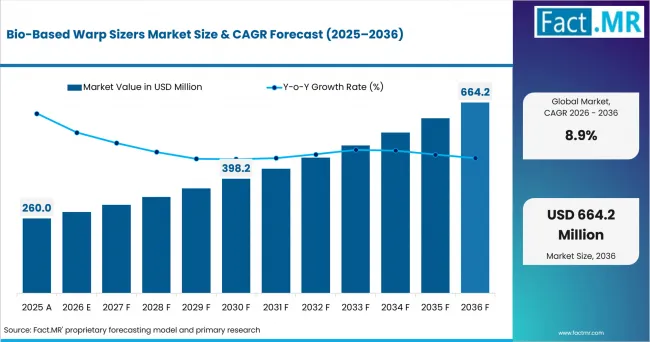
Bio Based Warp Sizers Market Market Value Analysis

What are the defining numbers behind bio-based warp sizers growth?

USD 395 million absolute opportunity by 2036, led by India and Vietnam.

  • Demand Drivers in the Market
    • Textile mills are expected to increase bio-based sizing trials due to lower desizing load and buyer pressure on wastewater records.
    • Denim producers are anticipated to use more modified starch blends owing to high warp stress and repeated fabric washing.
    • Technical textile makers are projected to specify stable sizing films due to higher loom speeds and tighter defect tolerance.
    • Chemical formulators are expected to blend starch and cellulose derivatives to reduce PVA reliance in export-oriented mills.
  • Key Segments Analyzed
    • By Chemistry: Modified starch is projected to hold 46.0% share in 2026 due to price fit and easier desizing.
    • By Yarn Type: Cotton yarn is expected to account for 34.0% share in 2026 owing to broad woven fabric use.
    • By Performance Need: Loom efficiency is forecast to capture 31.0% share in 2026 driven by fewer warp breaks.
    • By End User: Textile mills are estimated to hold 48.0% share in 2026 supported by direct sizing room use.
    • By Product Form: Dry powder blends are projected to account for 52.0% share in 2026 due to storage and dosing ease.
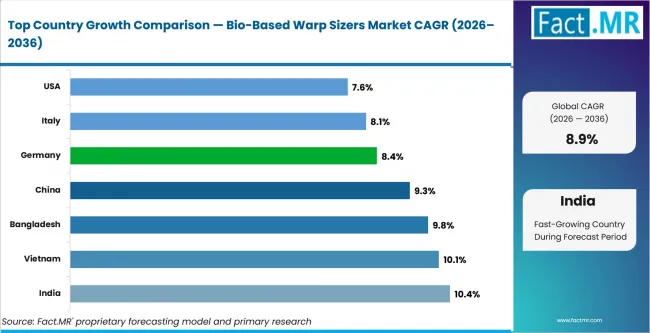
    • By Geography: India is projected to record 10.4% CAGR through 2036 due to integrated textile investment.
  • Analyst Opinion at Fact.MR
    • Shambhu Nath Jha, Principal Analyst at Fact.MR states, “Warp sizing buyers are making a practical trade-off. Mills are not buying bio-based chemistry only for a label claim. They are asking whether the size reduces yarn breaks and whether the same system comes off cleanly in desizing. That is why modified starch and cellulose blends matter. They fit existing cooking rooms and help reduce PVA use without forcing a full process change. Suppliers with application labs and mill trial teams are better placed than suppliers selling only dry material.”
  • Strategic Implications
    • Sizing suppliers need mill trial support before they can replace synthetic-heavy recipes in high-speed weaving.
    • Weaving mills need formulation records that connect yarn strength and desizing behavior in one file.
    • Starch producers can enter higher-margin textile channels when they support viscosity control and batch handling.
    • Brand-linked apparel supply chains are expected to favor suppliers that document lower PVA reliance.

Textile Exchange reported in September 2025 that global fiber output reached 132 million tonnes in 2024. That fiber base keeps mills focused on sizing blends that work on cotton and mixed yarn without raising desizing cost.

India is projected to record 10.4% CAGR through 2036 due to integrated textile parks and export mill additions. Vietnam is expected to expand at 10.1% CAGR through 2036 due to export weaving and buyer diversification. Bangladesh is forecast to grow at 9.8% CAGR through 2036 due to high apparel output and wastewater checks. China is expected to advance at 9.3% CAGR through 2036 due to large textile capacity and cost-led substitution.

How does the bio-based warp sizers market break down by segment?

Modified starch holds 46.0%; cotton yarn holds 34.0%; dry powder blends hold 52.0%.

Which chemistry dominates?

Modified starch is projected to hold 46.0% share in 2026.
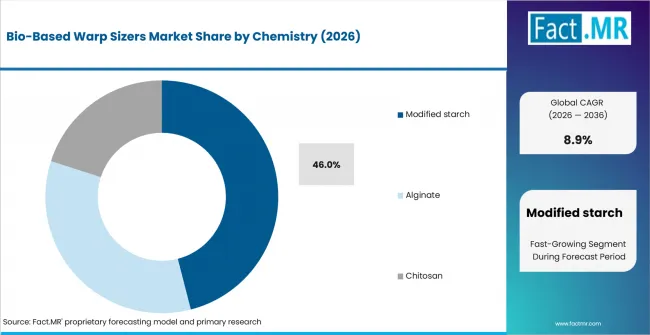
Bio Based Warp Sizers Market Analysis By Chemistry

Modified starch is expected to hold 46.0% share in 2026 due to its fit with existing sizing kitchens. Mills can cook starch-based blends without replacing core dosing equipment. Cotton and polyester remain large fiber bases in weaving supply chains. That substrate mix keeps modified starch relevant where buyers need adhesion and easier wash-off behavior.

Which yarn type leads?

Cotton yarn is expected to account for 34.0% share in 2026.
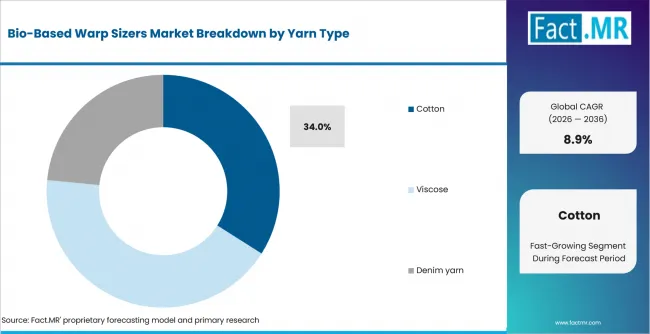
Bio Based Warp Sizers Market Analysis By Yarn Type

Cotton yarn is forecast to lead early use owing to its long history with starch-based sizing. Cotton weaving mills already understand starch viscosity and pick-up control. The segment is projected to hold 34.0% share in 2026 while viscose and blends add follow-on demand. Suppliers gain faster approval when they support cotton recipes before moving into mixed yarns.

Which performance need leads?

Loom efficiency is projected to capture 31.0% share in 2026.
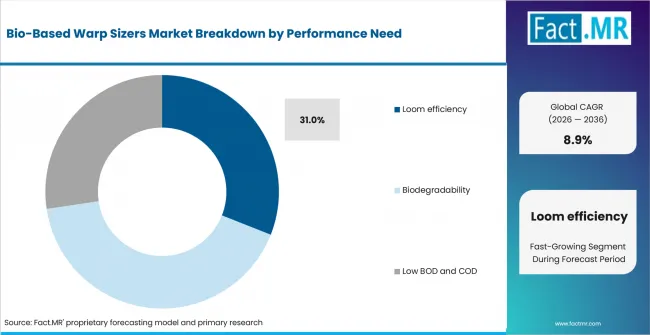
Bio Based Warp Sizers Market Analysis By Performance Need

Loom efficiency is expected to lead performance-based demand because mills measure yarn breaks every shift. A bio-based size that cuts breakage is easier to approve than one sold only on material origin. Mills still benchmark wash-off against polyvinyl alcohol when they test new recipes. This makes application testing a core selling tool.

Which end user dominates?

Textile mills are estimated to hold 48.0% share in 2026.
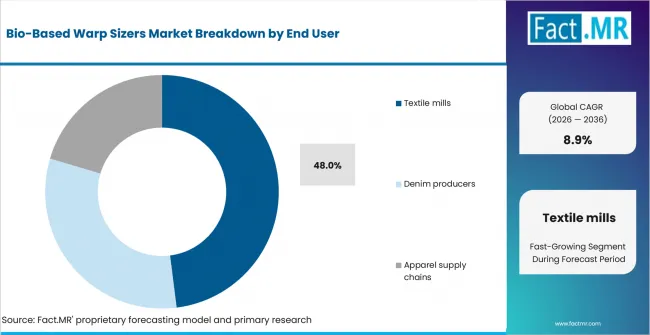
Bio Based Warp Sizers Market Analysis By End User

Textile mills are estimated to account for 48.0% share in 2026 because the sizing bath is controlled inside the mill. Formulators and distributors influence selection but mill technicians decide whether a blend runs cleanly. Export mills also need documentation that links recipe choice with wastewater handling. This keeps direct technical service important in supplier selection.

Which product form leads?

Dry powder blends are projected to account for 52.0% share in 2026.
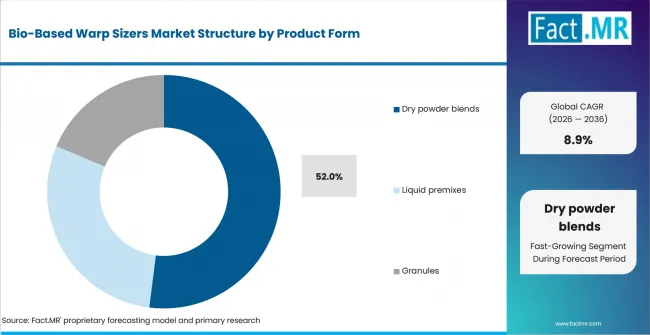
Bio Based Warp Sizers Market Analysis By Product Form

Dry powder blends are projected to account for 52.0% share in 2026 due to easier storage and lower transport burden. Mills can dose powder into existing size cooking systems and adjust viscosity by recipe. Liquid premixes remain useful where mills need faster preparation. Dry blends stay ahead where buyers want flexible formulations and longer shelf life.

What is accelerating bio-based warp sizers demand, and what is holding it back?

Wastewater pressure, export mill scale and PVA substitution drive it; viscosity control and buyer approval cycles restrain it.
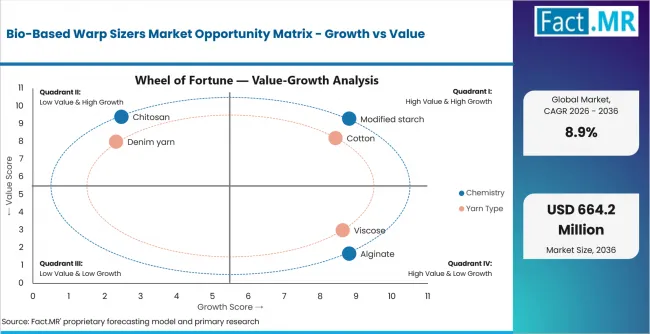
Bio Based Warp Sizers Market Opportunity Matrix Growth Vs Value

The main driver is mill-level pressure to reduce PVA reliance without adding weaving defects. Suppliers that serve the broader warp sizing agents value chain are expected to benefit when mills ask for lower desizing load. Textile sizing is still judged by loom breaks and fabric quality. This keeps bio-based suppliers focused on practical substitution rather than material claims.

Another driver is the size of apparel and home textile fiber consumption. The wider textile chemicals supply base gives mills more choices for binders and auxiliaries. Related supplier overlap between pretreatment and warp preparation helps mills test bio-based systems with known vendors.

The main restraint is recipe control under different yarn counts and loom speeds. Starch viscosity can shift during storage and cooking if the mill lacks trained operators. This raises the risk of uneven pick-up and fabric defects. Suppliers need trial data and on-site support before buyers approve a switch.

Where do the biggest bio-based warp sizers opportunities sit?

Modified starch blends, cellulose derivatives, export denim mills and low-PVA systems.

  • Modified Starch Blends: Producers can target cotton and denim mills that need lower PVA use without changing cooking equipment.
  • Cellulose Derivatives: Formulators can use film-forming polymers where mills need smooth yarn and controlled wash-off behavior.
  • Export Denim Mills: Buyers can pair low-residue sizing with textile enzymes when desizing records are reviewed after repeated washing.
  • Low-PVA Systems: Mills can connect material substitution with bioplastics discussions when brands review renewable input use.

Which countries are scaling bio-based warp sizers fastest?

India 10.4%, Vietnam 10.1%, Bangladesh 9.8%, China 9.3%, Germany 8.4%, Italy 8.1%, United States 7.6%.

Based on regional analysis, the bio-based warp sizers market is segmented into North America, Europe, East Asia, South Asia, Latin America and Middle East and Africa. South Asia grows faster than the global average due to cost pressure and wastewater scrutiny.

Apparel suppliers that already review bio-based polyester sourcing are expected to ask similar questions about warp preparation chemistry. This creates a bridge between fiber selection and sizing recipe approval.

Top Country Growth Comparison Bio Based Warp Sizers Market Cagr (2026 2036)

Country CAGR
India 10.4%
Vietnam 10.1%
Bangladesh 9.8%
China 9.3%
Germany 8.4%
Italy 8.1%
United States 7.6%

Bio Based Warp Sizers Market Cagr Analysis By Country

What is powering India’s lead?

10.4% CAGR, supported by integrated textile parks and export mill additions.

India is projected to record 10.4% CAGR through 2036 due to integrated textile parks and woven export capacity. The Press Information Bureau reported in December 2025 that seven PM MITRA parks were approved with an outlay of Rs. 4,445 crore. That program strengthens the case for new weaving and processing clusters. Suppliers that combine starch chemistry with mill service are expected to gain faster approvals.

Why is Vietnam an important sizing market?

10.1% CAGR, driven by apparel export scale and buyer diversification.

Vietnamese mills are expected to expand bio-based sizing trials as apparel export programs move toward traceable inputs. The Viet Nam Ministry of Industry and Trade reported in July 2025 that textile and garment exports reached USD 21.66 billion in the first half of 2025. Vietnam is expected to expand at 10.1% CAGR through 2036 due to export orders and mill modernization. Formulators should focus on quick recipe trials for polyester blends and cotton-rich fabrics.

How does Bangladesh support bio-based sizing demand?

9.8% CAGR, led by RMG output and tighter wastewater review.

Bangladesh remains a large woven and knit apparel base where mills focus on recipe cost and buyer compliance. The Bangladesh Garment Manufacturers and Exporters Association reported USD 35.31 billion in ready-made garment exports for fiscal year 2025 to 2026 through June. Bangladesh is forecast to grow at 9.8% CAGR through 2036 due to high mill throughput and wastewater checks. Suppliers need distributor depth because smaller mills often buy through local chemical channels.

What keeps China in a large position?

9.3% CAGR, backed by textile capacity and substitution pressure.

China has large textile capacity and broad chemical supply depth. The National Bureau of Statistics of China reported a 77.2% textile industry capacity utilization rate in the third quarter of 2025. China is expected to advance at 9.3% CAGR through 2036 due to scale and cost-led recipe shifts. Local suppliers are expected to compete on consistency and price while global suppliers compete on testing support.

Why does Germany remain a relevant buyer base?

8.4% CAGR, supported by technical textiles and EU product rules.

Germany’s demand is tied more to technical textiles than high-volume apparel production. Germany is projected to rise at 8.4% CAGR through 2036 due to compliance-led buyer checks. Suppliers gain here when they document recipe performance and restricted-substance alignment.

How is Italy positioned in the market?

8.1% CAGR, driven by premium woven textiles and EU sourcing rules.

Italy is expected to use bio-based warp sizers in higher-value woven fabrics and branded supply chains. The Centre for the Promotion of Imports from Developing Countries reported in March 2026 that Italy exported EUR 25.4 billion of apparel in 2024. Italy is forecast at 8.1% CAGR through 2036 due to premium fabric output and EU product expectations. Supplier wins are likely to come from tailored blends rather than standard commodity starch.

What supports the United States outlook?

7.6% CAGR, led by technical textiles and domestic mill shipments.
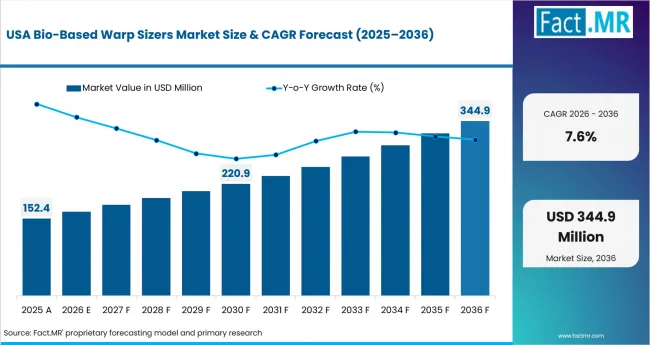
Bio Based Warp Sizers Market Country Value Analysis

The United States is a smaller but quality-focused market for bio-based warp sizing. The National Council of Textile Organizations reported that U.S. textile and apparel shipments totaled USD 60.9 billion in 2025. The United States is expected to post 7.6% CAGR through 2036 due to technical textile demand and military textile supply needs. Suppliers need proof of consistency and reliable domestic distribution before mills switch recipes.

Who leads the bio-based warp sizers landscape?

Archroma and Seydel lead direct sizing portfolios while starch and cellulose suppliers support formulation depth.
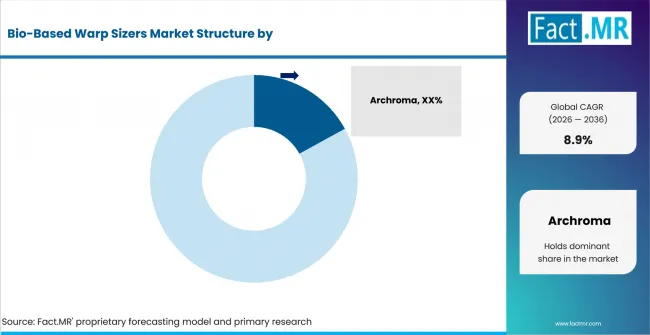
Bio Based Warp Sizers Market Analysis By Company

Bio-based warp sizers are bought by mills that need a working recipe rather than a standalone raw material. Archroma offers ARKOFIL sizing agents and TREFIX sizing additives for yarn protection and smoother weaving. Mills still compare each bio-based recipe against PVA during wash-off and film strength checks.

Seydel supplies dry warp size blends for shirts, denim, sheeting and towels. Avebe and Ingredion are relevant through starch capabilities while Ashland and Nouryon support cellulose chemistry.

Competitive advantage is expected to depend on recipe service and desizing evidence. Cellulose suppliers connected to cellulose nanofibrils can support film strength discussions in textile binder programs. That evidence matters when mills compare film strength against desizing effort. Cationic starch formulators also monitor CHPTAC chemistry when mills ask for stronger adhesion on blended yarn.

Which companies are the key players?

Archroma, BASF, Kemira, Avebe, Ingredion, Solenis, Ashland, Seydel and Nouryon.

  • Archroma
  • Avebe U.A.
  • Ingredion Incorporated
  • Ashland Inc.
  • The Seydel Companies Inc.
  • Nouryon Chemicals Holding B.V.

Bibliography

  • Textile Exchange. (2025, September 18). Materials Market Report 2025. Textile Exchange.
  • Press Information Bureau, Government of India. (2025, December 24). Year End Review 2025 of Ministry of Textiles. Ministry of Textiles.
  • Viet Nam Ministry of Industry and Trade. (2025, July 23). Opportunities and challenges for domestic textile, garment, footwear and bag enterprises under U.S. countervailing tariffs. Viet Nam Ministry of Industry and Trade.
  • Bangladesh Garment Manufacturers and Exporters Association. (2026, June 16). Export performance. BGMEA.
  • National Bureau of Statistics of China. (2025, October 21). Industrial capacity utilization rate in the third quarter of 2025. National Bureau of Statistics of China.
  • Centre for the Promotion of Imports from Developing Countries. (2026, March 11). What is the demand for apparel on the European market? CBI.
  • National Council of Textile Organizations. (2026, April). U.S. textile industry. National Council of Textile Organizations.
  • Archroma. (2026, June). ARKOFIL and TREFIX sizing products. Archroma.
  • The Seydel Companies Inc. (2026, June). Warp sizing products. The Seydel Companies Inc.

This Report Addresses

  • Strategic intelligence on bio-based warp sizers across chemistry, yarn type and performance need.
  • Segment analysis covering modified starch, cotton yarn, loom efficiency and dry powder blends.
  • Regional outlook covering India, Vietnam, Bangladesh, China, Germany, Italy and the United States.
  • Competitive analysis of Archroma, Kemira, Avebe, Ingredion, Solenis, Ashland, Seydel and Nouryon.
  • Application assessment covering textile mills, denim producers and technical textile makers.
  • Source review using institutional textile statistics, official trade data and company product pages.

What does the bio-based warp sizers market cover?

Plant-derived and bio-polymer sizing systems used to strengthen warp yarn before weaving.

The bio-based warp sizers market covers modified starch, cellulose derivatives and other renewable polymer blends used before weaving. It differs from general textile chemicals because the use point is warp preparation and desizing behavior. It excludes synthetic PVA-only products when no bio-based component is used.

What is included in the scope?

Modified starch sizing, cellulose blends and low-PVA sizing systems.

The scope includes starch-based sizing agents and bio-polymer auxiliaries used on cotton and blended yarn. It includes low BOD and low COD sizing systems when the formulation uses a bio-based binder. It also includes dry powder blends and liquid premixes supplied to weaving mills.

What is excluded from the scope?

PVA-only systems, generic finishing chemicals and weaving lubricants sold outside warp sizing.

The scope excludes pure synthetic PVA sizing systems without a renewable component. It excludes fabric finishing auxiliaries that are not used in warp preparation. It also excludes enzymes, dyes and detergents unless they are sold as part of a sizing and desizing program.

How was the analysis built?

120+ sources, 35+ company portfolios, 28 countries, 22 supplier checks.

  • Primary Research: Primary inputs came from textile chemical distributors and weaving mill sourcing teams. Inputs were checked against supplier product pages and export mill activity.
  • Desk Research: Desk research reviewed textile fiber output and country export data. It also covered company pages for sizing agents, starch derivatives and bio-based polymer activity.
  • Market-Sizing and Forecasting: Forecasting used a top-down share of warp sizing agents and textile chemical consumption. It was cross-checked against fiber output and export-oriented weaving volume.
  • Data Validation and Update Cycle: Forecasts are validated through producer checks and wrap-grade paper demand review. Brand owner shifts toward recyclable packaging and bio-based additive trials help confirm market direction.

What is the report’s scope and coverage?
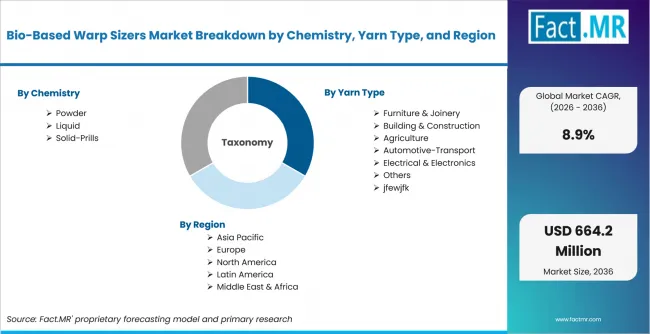
Bio Based Warp Sizers Market Breakdown By Chemistry, Yarn Type, And Region

Attribute Details
Quantitative Units USD Million in 2026 to USD Million by 2036 at CAGR
Market Definition Plant-derived and bio-polymer sizing systems applied to warp yarn before weaving
Chemistry Modified starch, Cellulose derivatives, Alginate, Chitosan, Bio-acrylic hybrids, Biodegradable wax blends
Yarn Type Cotton, Viscose, Polyester blends, Denim yarn, Technical textile yarn, Recycled fiber yarns
Performance Need Loom efficiency, Biodegradability, Low BOD and COD, Easy desizing, Reduced PVA reliance, Strength improvement
End User Textile mills, Denim producers, Technical textile makers, Apparel supply chains, Chemical formulators
Product Form Dry powder blends, Liquid premixes, Granules, One-shot blends, Waxed blends
Regions Covered North America, Europe, East Asia, South Asia, Latin America, Middle East and Africa
Countries Covered India, Vietnam, Bangladesh, China, Germany, Italy and United States
Key Companies Profiled Archroma, Avebe U.A., Ingredion, Solenis, Ashland, Seydel and Nouryon
Forecast Period 2026 to 2036
Approach Hybrid top-down and bottom-up approach using textile output, export weaving signals, sizing chemistry portfolios and supplier validation

How is the market segmented?

  • By Chemistry:

    • Modified starch
    • Cellulose derivatives
    • Alginate
    • Chitosan
    • Bio-acrylic hybrids
    • Biodegradable wax blends
  • By Yarn Type:

    • Cotton
    • Viscose
    • Polyester blends
    • Denim yarn
    • Technical textile yarn
    • Recycled fiber yarns
  • By Performance Need:

    • Loom efficiency
    • Biodegradability
    • Low BOD and COD
    • Easy desizing
    • Reduced PVA reliance
    • Strength improvement
  • By End User:

    • Textile mills
    • Denim producers
    • Technical textile makers
    • Apparel supply chains
    • Chemical formulators
  • By Product Form:

    • Dry powder blends
    • Liquid premixes
    • Granules
    • One-shot blends
    • Waxed blends
  • By Region:

    • North America
      • United States
      • Canada
      • Mexico
    • Latin America
      • Brazil
      • Argentina
      • Rest of Latin America
    • Europe
      • Germany
      • Italy
      • United Kingdom
      • France
      • Spain
      • Rest of Europe
    • East Asia
      • China
      • Japan
      • South Korea
    • South Asia
      • India
      • Bangladesh
      • Vietnam
      • Indonesia
      • Rest of South Asia
    • Middle East & Africa
      • GCC Countries
      • South Africa
      • UAE
      • Rest of Middle East and Africa

- Frequently Asked Questions -

Which chemistry leads the Bio-Based Warp Sizers Market?

Modified starch leads with 46.0% share in 2026 due to price fit and easier desizing.

Which country expands fastest in the Bio-Based Warp Sizers Market?

India is projected to record 10.4% CAGR through 2036 due to integrated textile parks and export mill additions.

How does Vietnam perform in the Bio-Based Warp Sizers Market?

Vietnam is expected to expand at 10.1% CAGR through 2036 due to apparel export scale and buyer diversification.

How does Bangladesh perform in the Bio-Based Warp Sizers Market?

Bangladesh is forecast to grow at 9.8% CAGR through 2036 as apparel output keeps sizing demand active.

How does China perform in the Bio-Based Warp Sizers Market?

China is expected to advance at 9.3% CAGR through 2036 due to large textile capacity and substitution pressure.

How does the United States perform in the Bio-Based Warp Sizers Market?

The United States is expected to post 7.6% CAGR through 2036 due to technical textiles and domestic mill shipments.

What is the primary driver in the Bio-Based Warp Sizers Market?

The primary driver is the need to reduce PVA reliance without raising yarn breaks or desizing cost.

Why are dry powder blends important in this market?

Dry powder blends are important because mills can store them easily and adjust dosing in existing cooking systems.

Table of Content

  1. Key Takeaways
    • Market Size and CAGR
    • Top Growth Driver
    • Fastest Growing Segment
    • Leading Region
    • Key Companies
    • Emerging Opportunities
  2. Executive Summary
    • Global Market Outlook
    • Demand-side Trends
    • Supply-side Trends
    • Technology Roadmap Analysis
    • Analysis and Recommendations
    • Analyst Perspective (What is happening? Why now? What should investors know?)
    • Key Questions Answered
      • How large is the market?
      • What is the CAGR?
      • What are key trends?
      • Which region dominates?
      • Who are the leaders?
  3. Market Overview
    • Market Coverage / Taxonomy
    • Market Definition / Scope / Limitations
  4. Research Methodology
    • Chapter Orientation
    • Analytical Lens and Working Hypotheses
      • Market Structure, Signals, and Trend Drivers
      • Benchmarking and Cross-market Comparability
      • Market Sizing, Forecasting, and Opportunity Mapping
    • Research Design and Evidence Framework
      • Desk Research Programme (Secondary Evidence)
      • Expert Input and Fieldwork (Primary Evidence)
      • Tooling, Models, and Reference Databases
    • Data Engineering and Model Build
    • Quality Assurance and Audit Trail
  5. Market Background
    • Market Dynamics (Drivers, Restraints, Opportunity, Trends)
    • Scenario Forecast (Optimistic, Likely, Conservative)
    • Impact Analysis
      • AI Impact
      • Sustainability Impact
      • Regulatory Impact
      • Technology Impact
    • Consumer / Buyer Analysis
      • Purchase Drivers
      • Adoption Barriers
      • Buyer Journey
    • Opportunity Map Analysis
    • Product Life Cycle Analysis
    • Supply Chain Analysis
    • Investment Feasibility Matrix
    • Value Chain Analysis
    • PESTLE and Porter's Analysis
    • Regulatory Landscape
    • Regional Parent Market Outlook
    • Production and Consumption Statistics
    • Import and Export Statistics
  6. Global Market Analysis and Forecast, 2021 to 2036
    • Historical Market Size Value (USD Million) Analysis, 2021 to 2025
    • Current and Future Market Size Value (USD Million) Projections, 2026 to 2036
      • Y-o-Y Growth Trend Analysis
      • Absolute $ Opportunity Analysis
  7. Global Market Pricing Analysis, 2021 to 2036
  8. Global Market Analysis and Forecast, By Chemistry, 2021 to 2036
    • Introduction / Key Findings
    • Historical Market Size Value (USD Million) Analysis By Chemistry, 2021 to 2025
    • Current and Future Market Size Value (USD Million) Analysis and Forecast By Chemistry, 2026 to 2036
      • Modified starch
      • Alginate
      • Chitosan
    • Y-o-Y Growth Trend Analysis By Chemistry, 2021 to 2025
    • Absolute $ Opportunity Analysis By Chemistry, 2026 to 2036
  9. Global Market Analysis and Forecast, By Yarn Type, 2021 to 2036
    • Introduction / Key Findings
    • Historical Market Size Value (USD Million) Analysis By Yarn Type, 2021 to 2025
    • Current and Future Market Size Value (USD Million) Analysis and Forecast By Yarn Type, 2026 to 2036
      • Cotton
      • Viscose
      • Denim yarn
    • Y-o-Y Growth Trend Analysis By Yarn Type, 2021 to 2025
    • Absolute $ Opportunity Analysis By Yarn Type, 2026 to 2036
  10. Global Market Analysis and Forecast, By Performance Need, 2021 to 2036
    • Introduction / Key Findings
    • Historical Market Size Value (USD Million) Analysis By Performance Need, 2021 to 2025
    • Current and Future Market Size Value (USD Million) Analysis and Forecast By Performance Need, 2026 to 2036
      • Loom efficiency
      • Biodegradability
      • Low BOD and COD
    • Y-o-Y Growth Trend Analysis By Performance Need, 2021 to 2025
    • Absolute $ Opportunity Analysis By Performance Need, 2026 to 2036
  11. Global Market Analysis and Forecast, By End User, 2021 to 2036
    • Introduction / Key Findings
    • Historical Market Size Value (USD Million) Analysis By End User, 2021 to 2025
    • Current and Future Market Size Value (USD Million) Analysis and Forecast By End User, 2026 to 2036
      • Textile mills
      • Denim producers
      • Apparel supply chains
    • Y-o-Y Growth Trend Analysis By End User, 2021 to 2025
    • Absolute $ Opportunity Analysis By End User, 2026 to 2036
  12. Global Market Analysis and Forecast, By Product Form, 2021 to 2036
    • Introduction / Key Findings
    • Historical Market Size Value (USD Million) Analysis By Product Form, 2021 to 2025
    • Current and Future Market Size Value (USD Million) Analysis and Forecast By Product Form, 2026 to 2036
      • Dry powder blends
      • Liquid premixes
      • Granules
    • Y-o-Y Growth Trend Analysis By Product Form, 2021 to 2025
    • Absolute $ Opportunity Analysis By Product Form, 2026 to 2036
  13. Global Market Analysis and Forecast, By Region, 2021 to 2036
    • Introduction
    • Historical Market Size Value (USD Million) Analysis By Region, 2021 to 2025
    • Current Market Size Value (USD Million) Analysis and Forecast By Region, 2026 to 2036
      • North America
      • Latin America
      • Western Europe
      • Eastern Europe
      • East Asia
      • South Asia and Pacific
      • Middle East & Africa
    • Market Attractiveness Analysis By Region
  14. North America Market Analysis and Forecast, By Country, 2021 to 2036
    • Historical Market Size Value (USD Million) Trend Analysis By Market Taxonomy, 2021 to 2025
    • Market Size Value (USD Million) Forecast By Market Taxonomy, 2026 to 2036
      • By Country
        • USA
        • Canada
        • Mexico
      • By Chemistry
      • By Yarn Type
      • By Performance Need
      • By End User
      • By Product Form
    • Market Attractiveness Analysis
      • By Country
      • By Chemistry
      • By Yarn Type
      • By Performance Need
      • By End User
      • By Product Form
    • Key Takeaways
  15. Latin America Market Analysis and Forecast, By Country
    • Historical Market Size Value (USD Million) Trend Analysis By Market Taxonomy, 2021 to 2025
    • Market Size Value (USD Million) Forecast By Market Taxonomy, 2026 to 2036
      • By Country
        • Brazil
        • Chile
        • Rest of Latin America
      • By Chemistry
      • By Yarn Type
      • By Performance Need
      • By End User
      • By Product Form
    • Market Attractiveness Analysis
      • By Country
      • By Chemistry
      • By Yarn Type
      • By Performance Need
      • By End User
      • By Product Form
    • Key Takeaways
  16. Western Europe Market Analysis and Forecast, By Country
    • Historical Market Size Value (USD Million) Trend Analysis By Market Taxonomy, 2021 to 2025
    • Market Size Value (USD Million) Forecast By Market Taxonomy, 2026 to 2036
      • By Country
        • Germany
        • UK
        • Italy
        • Spain
        • France
        • Nordic
        • BENELUX
        • Rest of Western Europe
      • By Chemistry
      • By Yarn Type
      • By Performance Need
      • By End User
      • By Product Form
    • Market Attractiveness Analysis
      • By Country
      • By Chemistry
      • By Yarn Type
      • By Performance Need
      • By End User
      • By Product Form
    • Key Takeaways
  17. Eastern Europe Market Analysis and Forecast, By Country
    • Historical Market Size Value (USD Million) Trend Analysis By Market Taxonomy, 2021 to 2025
    • Market Size Value (USD Million) Forecast By Market Taxonomy, 2026 to 2036
      • By Country
        • Russia
        • Poland
        • Hungary
        • Balkan & Baltic
        • Rest of Eastern Europe
      • By Chemistry
      • By Yarn Type
      • By Performance Need
      • By End User
      • By Product Form
    • Market Attractiveness Analysis
      • By Country
      • By Chemistry
      • By Yarn Type
      • By Performance Need
      • By End User
      • By Product Form
    • Key Takeaways
  18. East Asia Market Analysis and Forecast, By Country
    • Historical Market Size Value (USD Million) Trend Analysis By Market Taxonomy, 2021 to 2025
    • Market Size Value (USD Million) Forecast By Market Taxonomy, 2026 to 2036
      • By Country
        • China
        • Japan
        • South Korea
      • By Chemistry
      • By Yarn Type
      • By Performance Need
      • By End User
      • By Product Form
    • Market Attractiveness Analysis
      • By Country
      • By Chemistry
      • By Yarn Type
      • By Performance Need
      • By End User
      • By Product Form
    • Key Takeaways
  19. South Asia and Pacific Market Analysis and Forecast, By Country
    • Historical Market Size Value (USD Million) Trend Analysis By Market Taxonomy, 2021 to 2025
    • Market Size Value (USD Million) Forecast By Market Taxonomy, 2026 to 2036
      • By Country
        • India
        • ASEAN
        • Australia & New Zealand
        • Rest of South Asia and Pacific
      • By Chemistry
      • By Yarn Type
      • By Performance Need
      • By End User
      • By Product Form
    • Market Attractiveness Analysis
      • By Country
      • By Chemistry
      • By Yarn Type
      • By Performance Need
      • By End User
      • By Product Form
    • Key Takeaways
  20. Middle East & Africa Market Analysis and Forecast, By Country
    • Historical Market Size Value (USD Million) Trend Analysis By Market Taxonomy, 2021 to 2025
    • Market Size Value (USD Million) Forecast By Market Taxonomy, 2026 to 2036
      • By Country
        • Kingdom of Saudi Arabia
        • Other GCC Countries
        • Turkiye
        • South Africa
        • Other African Union
        • Rest of Middle East & Africa
      • By Chemistry
      • By Yarn Type
      • By Performance Need
      • By End User
      • By Product Form
    • Market Attractiveness Analysis
      • By Country
      • By Chemistry
      • By Yarn Type
      • By Performance Need
      • By End User
      • By Product Form
    • Key Takeaways
  21. Key Countries Market Analysis
    • USA
      • Pricing Analysis
      • Market Share Analysis, 2025
        • By Chemistry
        • By Yarn Type
        • By Performance Need
        • By End User
        • By Product Form
    • Canada
      • Pricing Analysis
      • Market Share Analysis, 2025
        • By Chemistry
        • By Yarn Type
        • By Performance Need
        • By End User
        • By Product Form
    • Mexico
      • Pricing Analysis
      • Market Share Analysis, 2025
        • By Chemistry
        • By Yarn Type
        • By Performance Need
        • By End User
        • By Product Form
    • Brazil
      • Pricing Analysis
      • Market Share Analysis, 2025
        • By Chemistry
        • By Yarn Type
        • By Performance Need
        • By End User
        • By Product Form
    • Chile
      • Pricing Analysis
      • Market Share Analysis, 2025
        • By Chemistry
        • By Yarn Type
        • By Performance Need
        • By End User
        • By Product Form
    • Germany
      • Pricing Analysis
      • Market Share Analysis, 2025
        • By Chemistry
        • By Yarn Type
        • By Performance Need
        • By End User
        • By Product Form
    • UK
      • Pricing Analysis
      • Market Share Analysis, 2025
        • By Chemistry
        • By Yarn Type
        • By Performance Need
        • By End User
        • By Product Form
    • Italy
      • Pricing Analysis
      • Market Share Analysis, 2025
        • By Chemistry
        • By Yarn Type
        • By Performance Need
        • By End User
        • By Product Form
    • Spain
      • Pricing Analysis
      • Market Share Analysis, 2025
        • By Chemistry
        • By Yarn Type
        • By Performance Need
        • By End User
        • By Product Form
    • France
      • Pricing Analysis
      • Market Share Analysis, 2025
        • By Chemistry
        • By Yarn Type
        • By Performance Need
        • By End User
        • By Product Form
    • India
      • Pricing Analysis
      • Market Share Analysis, 2025
        • By Chemistry
        • By Yarn Type
        • By Performance Need
        • By End User
        • By Product Form
    • ASEAN
      • Pricing Analysis
      • Market Share Analysis, 2025
        • By Chemistry
        • By Yarn Type
        • By Performance Need
        • By End User
        • By Product Form
    • Australia & New Zealand
      • Pricing Analysis
      • Market Share Analysis, 2025
        • By Chemistry
        • By Yarn Type
        • By Performance Need
        • By End User
        • By Product Form
    • China
      • Pricing Analysis
      • Market Share Analysis, 2025
        • By Chemistry
        • By Yarn Type
        • By Performance Need
        • By End User
        • By Product Form
    • Japan
      • Pricing Analysis
      • Market Share Analysis, 2025
        • By Chemistry
        • By Yarn Type
        • By Performance Need
        • By End User
        • By Product Form
    • South Korea
      • Pricing Analysis
      • Market Share Analysis, 2025
        • By Chemistry
        • By Yarn Type
        • By Performance Need
        • By End User
        • By Product Form
    • Russia
      • Pricing Analysis
      • Market Share Analysis, 2025
        • By Chemistry
        • By Yarn Type
        • By Performance Need
        • By End User
        • By Product Form
    • Poland
      • Pricing Analysis
      • Market Share Analysis, 2025
        • By Chemistry
        • By Yarn Type
        • By Performance Need
        • By End User
        • By Product Form
    • Hungary
      • Pricing Analysis
      • Market Share Analysis, 2025
        • By Chemistry
        • By Yarn Type
        • By Performance Need
        • By End User
        • By Product Form
    • Kingdom of Saudi Arabia
      • Pricing Analysis
      • Market Share Analysis, 2025
        • By Chemistry
        • By Yarn Type
        • By Performance Need
        • By End User
        • By Product Form
    • Turkiye
      • Pricing Analysis
      • Market Share Analysis, 2025
        • By Chemistry
        • By Yarn Type
        • By Performance Need
        • By End User
        • By Product Form
    • South Africa
      • Pricing Analysis
      • Market Share Analysis, 2025
        • By Chemistry
        • By Yarn Type
        • By Performance Need
        • By End User
        • By Product Form
  22. Market Structure Analysis
    • Competition Dashboard
    • Competition Benchmarking
    • Market Share Analysis of Top Players
      • By Regional
      • By Chemistry
      • By Yarn Type
      • By Performance Need
      • By End User
      • By Product Form
      • Emerging Startups
      • Innovation Benchmarking
    • Competition Analysis
      • Competition Deep Dive
        • Archroma
          • Overview
          • Product Portfolio
          • Profitability by Market Segments (Product/Age /Sales Channel/Region)
          • Sales Footprint
          • Strategy Overview
            • Marketing Strategy
            • Product Strategy
            • Channel Strategy
        • Avebe U.A.
        • Ingredion Incorporated
        • Ashland Inc.
    • Case Studies
    • Success Stories
    • Recent Developments
  23. Assumptions & Acronyms Used

List Of Table

  • Table 1: Global Market Value (USD Million) Forecast by Region, 2021 - 2036
  • Table 2: Global Market Value (USD Million) Forecast by Chemistry, 2021 - 2036
  • Table 3: Global Market Value (USD Million) Forecast by Yarn Type, 2021 - 2036
  • Table 4: Global Market Value (USD Million) Forecast by Performance Need, 2021 - 2036
  • Table 5: Global Market Value (USD Million) Forecast by End User, 2021 - 2036
  • Table 6: Global Market Value (USD Million) Forecast by Product Form, 2021 - 2036
  • Table 7: North America Market Value (USD Million) Forecast by Country, 2021 - 2036
  • Table 8: North America Market Value (USD Million) Forecast by Chemistry, 2021 - 2036
  • Table 9: North America Market Value (USD Million) Forecast by Yarn Type, 2021 - 2036
  • Table 10: North America Market Value (USD Million) Forecast by Performance Need, 2021 - 2036
  • Table 11: North America Market Value (USD Million) Forecast by End User, 2021 - 2036
  • Table 12: North America Market Value (USD Million) Forecast by Product Form, 2021 - 2036
  • Table 13: Latin America Market Value (USD Million) Forecast by Country, 2021 - 2036
  • Table 14: Latin America Market Value (USD Million) Forecast by Chemistry, 2021 - 2036
  • Table 15: Latin America Market Value (USD Million) Forecast by Yarn Type, 2021 - 2036
  • Table 16: Latin America Market Value (USD Million) Forecast by Performance Need, 2021 - 2036
  • Table 17: Latin America Market Value (USD Million) Forecast by End User, 2021 - 2036
  • Table 18: Latin America Market Value (USD Million) Forecast by Product Form, 2021 - 2036
  • Table 19: Western Europe Market Value (USD Million) Forecast by Country, 2021 - 2036
  • Table 20: Western Europe Market Value (USD Million) Forecast by Chemistry, 2021 - 2036
  • Table 21: Western Europe Market Value (USD Million) Forecast by Yarn Type, 2021 - 2036
  • Table 22: Western Europe Market Value (USD Million) Forecast by Performance Need, 2021 - 2036
  • Table 23: Western Europe Market Value (USD Million) Forecast by End User, 2021 - 2036
  • Table 24: Western Europe Market Value (USD Million) Forecast by Product Form, 2021 - 2036
  • Table 25: Eastern Europe Market Value (USD Million) Forecast by Country, 2021 - 2036
  • Table 26: Eastern Europe Market Value (USD Million) Forecast by Chemistry, 2021 - 2036
  • Table 27: Eastern Europe Market Value (USD Million) Forecast by Yarn Type, 2021 - 2036
  • Table 28: Eastern Europe Market Value (USD Million) Forecast by Performance Need, 2021 - 2036
  • Table 29: Eastern Europe Market Value (USD Million) Forecast by End User, 2021 - 2036
  • Table 30: Eastern Europe Market Value (USD Million) Forecast by Product Form, 2021 - 2036
  • Table 31: East Asia Market Value (USD Million) Forecast by Country, 2021 - 2036
  • Table 32: East Asia Market Value (USD Million) Forecast by Chemistry, 2021 - 2036
  • Table 33: East Asia Market Value (USD Million) Forecast by Yarn Type, 2021 - 2036
  • Table 34: East Asia Market Value (USD Million) Forecast by Performance Need, 2021 - 2036
  • Table 35: East Asia Market Value (USD Million) Forecast by End User, 2021 - 2036
  • Table 36: East Asia Market Value (USD Million) Forecast by Product Form, 2021 - 2036
  • Table 37: South Asia and Pacific Market Value (USD Million) Forecast by Country, 2021 - 2036
  • Table 38: South Asia and Pacific Market Value (USD Million) Forecast by Chemistry, 2021 - 2036
  • Table 39: South Asia and Pacific Market Value (USD Million) Forecast by Yarn Type, 2021 - 2036
  • Table 40: South Asia and Pacific Market Value (USD Million) Forecast by Performance Need, 2021 - 2036
  • Table 41: South Asia and Pacific Market Value (USD Million) Forecast by End User, 2021 - 2036
  • Table 42: South Asia and Pacific Market Value (USD Million) Forecast by Product Form, 2021 - 2036
  • Table 43: Middle East & Africa Market Value (USD Million) Forecast by Country, 2021 - 2036
  • Table 44: Middle East & Africa Market Value (USD Million) Forecast by Chemistry, 2021 - 2036
  • Table 45: Middle East & Africa Market Value (USD Million) Forecast by Yarn Type, 2021 - 2036
  • Table 46: Middle East & Africa Market Value (USD Million) Forecast by Performance Need, 2021 - 2036
  • Table 47: Middle East & Africa Market Value (USD Million) Forecast by End User, 2021 - 2036
  • Table 48: Middle East & Africa Market Value (USD Million) Forecast by Product Form, 2021 - 2036

List Of Figures

  • Figure 1: Global Market Pricing Analysis
  • Figure 2: Global Market Value (USD Million) Forecast 2021-2036
  • Figure 3: Global Market Value Share and BPS Analysis by Chemistry, 2026 and 2036
  • Figure 4: Global Market Y-o-Y Growth Comparison by Chemistry, 2026-2036
  • Figure 5: Global Market Attractiveness Analysis by Chemistry
  • Figure 6: Global Market Value Share and BPS Analysis by Yarn Type, 2026 and 2036
  • Figure 7: Global Market Y-o-Y Growth Comparison by Yarn Type, 2026-2036
  • Figure 8: Global Market Attractiveness Analysis by Yarn Type
  • Figure 9: Global Market Value Share and BPS Analysis by Performance Need, 2026 and 2036
  • Figure 10: Global Market Y-o-Y Growth Comparison by Performance Need, 2026-2036
  • Figure 11: Global Market Attractiveness Analysis by Performance Need
  • Figure 12: Global Market Value Share and BPS Analysis by End User, 2026 and 2036
  • Figure 13: Global Market Y-o-Y Growth Comparison by End User, 2026-2036
  • Figure 14: Global Market Attractiveness Analysis by End User
  • Figure 15: Global Market Value Share and BPS Analysis by Product Form, 2026 and 2036
  • Figure 16: Global Market Y-o-Y Growth Comparison by Product Form, 2026-2036
  • Figure 17: Global Market Attractiveness Analysis by Product Form
  • Figure 18: Global Market Value (USD Million) Share and BPS Analysis by Region, 2026 and 2036
  • Figure 19: Global Market Y-o-Y Growth Comparison by Region, 2026-2036
  • Figure 20: Global Market Attractiveness Analysis by Region
  • Figure 21: North America Market Incremental Dollar Opportunity, 2026-2036
  • Figure 22: Latin America Market Incremental Dollar Opportunity, 2026-2036
  • Figure 23: Western Europe Market Incremental Dollar Opportunity, 2026-2036
  • Figure 24: Eastern Europe Market Incremental Dollar Opportunity, 2026-2036
  • Figure 25: East Asia Market Incremental Dollar Opportunity, 2026-2036
  • Figure 26: South Asia and Pacific Market Incremental Dollar Opportunity, 2026-2036
  • Figure 27: Middle East & Africa Market Incremental Dollar Opportunity, 2026-2036
  • Figure 28: North America Market Value Share and BPS Analysis by Country, 2026 and 2036
  • Figure 29: North America Market Value Share and BPS Analysis by Chemistry, 2026 and 2036
  • Figure 30: North America Market Y-o-Y Growth Comparison by Chemistry, 2026-2036
  • Figure 31: North America Market Attractiveness Analysis by Chemistry
  • Figure 32: North America Market Value Share and BPS Analysis by Yarn Type, 2026 and 2036
  • Figure 33: North America Market Y-o-Y Growth Comparison by Yarn Type, 2026-2036
  • Figure 34: North America Market Attractiveness Analysis by Yarn Type
  • Figure 35: North America Market Value Share and BPS Analysis by Performance Need, 2026 and 2036
  • Figure 36: North America Market Y-o-Y Growth Comparison by Performance Need, 2026-2036
  • Figure 37: North America Market Attractiveness Analysis by Performance Need
  • Figure 38: North America Market Value Share and BPS Analysis by End User, 2026 and 2036
  • Figure 39: North America Market Y-o-Y Growth Comparison by End User, 2026-2036
  • Figure 40: North America Market Attractiveness Analysis by End User
  • Figure 41: North America Market Value Share and BPS Analysis by Product Form, 2026 and 2036
  • Figure 42: North America Market Y-o-Y Growth Comparison by Product Form, 2026-2036
  • Figure 43: North America Market Attractiveness Analysis by Product Form
  • Figure 44: Latin America Market Value Share and BPS Analysis by Country, 2026 and 2036
  • Figure 45: Latin America Market Value Share and BPS Analysis by Chemistry, 2026 and 2036
  • Figure 46: Latin America Market Y-o-Y Growth Comparison by Chemistry, 2026-2036
  • Figure 47: Latin America Market Attractiveness Analysis by Chemistry
  • Figure 48: Latin America Market Value Share and BPS Analysis by Yarn Type, 2026 and 2036
  • Figure 49: Latin America Market Y-o-Y Growth Comparison by Yarn Type, 2026-2036
  • Figure 50: Latin America Market Attractiveness Analysis by Yarn Type
  • Figure 51: Latin America Market Value Share and BPS Analysis by Performance Need, 2026 and 2036
  • Figure 52: Latin America Market Y-o-Y Growth Comparison by Performance Need, 2026-2036
  • Figure 53: Latin America Market Attractiveness Analysis by Performance Need
  • Figure 54: Latin America Market Value Share and BPS Analysis by End User, 2026 and 2036
  • Figure 55: Latin America Market Y-o-Y Growth Comparison by End User, 2026-2036
  • Figure 56: Latin America Market Attractiveness Analysis by End User
  • Figure 57: Latin America Market Value Share and BPS Analysis by Product Form, 2026 and 2036
  • Figure 58: Latin America Market Y-o-Y Growth Comparison by Product Form, 2026-2036
  • Figure 59: Latin America Market Attractiveness Analysis by Product Form
  • Figure 60: Western Europe Market Value Share and BPS Analysis by Country, 2026 and 2036
  • Figure 61: Western Europe Market Value Share and BPS Analysis by Chemistry, 2026 and 2036
  • Figure 62: Western Europe Market Y-o-Y Growth Comparison by Chemistry, 2026-2036
  • Figure 63: Western Europe Market Attractiveness Analysis by Chemistry
  • Figure 64: Western Europe Market Value Share and BPS Analysis by Yarn Type, 2026 and 2036
  • Figure 65: Western Europe Market Y-o-Y Growth Comparison by Yarn Type, 2026-2036
  • Figure 66: Western Europe Market Attractiveness Analysis by Yarn Type
  • Figure 67: Western Europe Market Value Share and BPS Analysis by Performance Need, 2026 and 2036
  • Figure 68: Western Europe Market Y-o-Y Growth Comparison by Performance Need, 2026-2036
  • Figure 69: Western Europe Market Attractiveness Analysis by Performance Need
  • Figure 70: Western Europe Market Value Share and BPS Analysis by End User, 2026 and 2036
  • Figure 71: Western Europe Market Y-o-Y Growth Comparison by End User, 2026-2036
  • Figure 72: Western Europe Market Attractiveness Analysis by End User
  • Figure 73: Western Europe Market Value Share and BPS Analysis by Product Form, 2026 and 2036
  • Figure 74: Western Europe Market Y-o-Y Growth Comparison by Product Form, 2026-2036
  • Figure 75: Western Europe Market Attractiveness Analysis by Product Form
  • Figure 76: Eastern Europe Market Value Share and BPS Analysis by Country, 2026 and 2036
  • Figure 77: Eastern Europe Market Value Share and BPS Analysis by Chemistry, 2026 and 2036
  • Figure 78: Eastern Europe Market Y-o-Y Growth Comparison by Chemistry, 2026-2036
  • Figure 79: Eastern Europe Market Attractiveness Analysis by Chemistry
  • Figure 80: Eastern Europe Market Value Share and BPS Analysis by Yarn Type, 2026 and 2036
  • Figure 81: Eastern Europe Market Y-o-Y Growth Comparison by Yarn Type, 2026-2036
  • Figure 82: Eastern Europe Market Attractiveness Analysis by Yarn Type
  • Figure 83: Eastern Europe Market Value Share and BPS Analysis by Performance Need, 2026 and 2036
  • Figure 84: Eastern Europe Market Y-o-Y Growth Comparison by Performance Need, 2026-2036
  • Figure 85: Eastern Europe Market Attractiveness Analysis by Performance Need
  • Figure 86: Eastern Europe Market Value Share and BPS Analysis by End User, 2026 and 2036
  • Figure 87: Eastern Europe Market Y-o-Y Growth Comparison by End User, 2026-2036
  • Figure 88: Eastern Europe Market Attractiveness Analysis by End User
  • Figure 89: Eastern Europe Market Value Share and BPS Analysis by Product Form, 2026 and 2036
  • Figure 90: Eastern Europe Market Y-o-Y Growth Comparison by Product Form, 2026-2036
  • Figure 91: Eastern Europe Market Attractiveness Analysis by Product Form
  • Figure 92: East Asia Market Value Share and BPS Analysis by Country, 2026 and 2036
  • Figure 93: East Asia Market Value Share and BPS Analysis by Chemistry, 2026 and 2036
  • Figure 94: East Asia Market Y-o-Y Growth Comparison by Chemistry, 2026-2036
  • Figure 95: East Asia Market Attractiveness Analysis by Chemistry
  • Figure 96: East Asia Market Value Share and BPS Analysis by Yarn Type, 2026 and 2036
  • Figure 97: East Asia Market Y-o-Y Growth Comparison by Yarn Type, 2026-2036
  • Figure 98: East Asia Market Attractiveness Analysis by Yarn Type
  • Figure 99: East Asia Market Value Share and BPS Analysis by Performance Need, 2026 and 2036
  • Figure 100: East Asia Market Y-o-Y Growth Comparison by Performance Need, 2026-2036
  • Figure 101: East Asia Market Attractiveness Analysis by Performance Need
  • Figure 102: East Asia Market Value Share and BPS Analysis by End User, 2026 and 2036
  • Figure 103: East Asia Market Y-o-Y Growth Comparison by End User, 2026-2036
  • Figure 104: East Asia Market Attractiveness Analysis by End User
  • Figure 105: East Asia Market Value Share and BPS Analysis by Product Form, 2026 and 2036
  • Figure 106: East Asia Market Y-o-Y Growth Comparison by Product Form, 2026-2036
  • Figure 107: East Asia Market Attractiveness Analysis by Product Form
  • Figure 108: South Asia and Pacific Market Value Share and BPS Analysis by Country, 2026 and 2036
  • Figure 109: South Asia and Pacific Market Value Share and BPS Analysis by Chemistry, 2026 and 2036
  • Figure 110: South Asia and Pacific Market Y-o-Y Growth Comparison by Chemistry, 2026-2036
  • Figure 111: South Asia and Pacific Market Attractiveness Analysis by Chemistry
  • Figure 112: South Asia and Pacific Market Value Share and BPS Analysis by Yarn Type, 2026 and 2036
  • Figure 113: South Asia and Pacific Market Y-o-Y Growth Comparison by Yarn Type, 2026-2036
  • Figure 114: South Asia and Pacific Market Attractiveness Analysis by Yarn Type
  • Figure 115: South Asia and Pacific Market Value Share and BPS Analysis by Performance Need, 2026 and 2036
  • Figure 116: South Asia and Pacific Market Y-o-Y Growth Comparison by Performance Need, 2026-2036
  • Figure 117: South Asia and Pacific Market Attractiveness Analysis by Performance Need
  • Figure 118: South Asia and Pacific Market Value Share and BPS Analysis by End User, 2026 and 2036
  • Figure 119: South Asia and Pacific Market Y-o-Y Growth Comparison by End User, 2026-2036
  • Figure 120: South Asia and Pacific Market Attractiveness Analysis by End User
  • Figure 121: South Asia and Pacific Market Value Share and BPS Analysis by Product Form, 2026 and 2036
  • Figure 122: South Asia and Pacific Market Y-o-Y Growth Comparison by Product Form, 2026-2036
  • Figure 123: South Asia and Pacific Market Attractiveness Analysis by Product Form
  • Figure 124: Middle East & Africa Market Value Share and BPS Analysis by Country, 2026 and 2036
  • Figure 125: Middle East & Africa Market Value Share and BPS Analysis by Chemistry, 2026 and 2036
  • Figure 126: Middle East & Africa Market Y-o-Y Growth Comparison by Chemistry, 2026-2036
  • Figure 127: Middle East & Africa Market Attractiveness Analysis by Chemistry
  • Figure 128: Middle East & Africa Market Value Share and BPS Analysis by Yarn Type, 2026 and 2036
  • Figure 129: Middle East & Africa Market Y-o-Y Growth Comparison by Yarn Type, 2026-2036
  • Figure 130: Middle East & Africa Market Attractiveness Analysis by Yarn Type
  • Figure 131: Middle East & Africa Market Value Share and BPS Analysis by Performance Need, 2026 and 2036
  • Figure 132: Middle East & Africa Market Y-o-Y Growth Comparison by Performance Need, 2026-2036
  • Figure 133: Middle East & Africa Market Attractiveness Analysis by Performance Need
  • Figure 134: Middle East & Africa Market Value Share and BPS Analysis by End User, 2026 and 2036
  • Figure 135: Middle East & Africa Market Y-o-Y Growth Comparison by End User, 2026-2036
  • Figure 136: Middle East & Africa Market Attractiveness Analysis by End User
  • Figure 137: Middle East & Africa Market Value Share and BPS Analysis by Product Form, 2026 and 2036
  • Figure 138: Middle East & Africa Market Y-o-Y Growth Comparison by Product Form, 2026-2036
  • Figure 139: Middle East & Africa Market Attractiveness Analysis by Product Form
  • Figure 140: Global Market - Tier Structure Analysis
  • Figure 141: Global Market - Company Share Analysis

Bio-Based Warp Sizers Market

Buy Report Now