- Market Value (2025): USD 1.7 Bn
- Estimated Value (2026): USD 1.9 Bn
- Forecast Value (2036): USD 4.3 Bn
- CAGR (2026-2036): 8.6%
What is the Electromagnetic Shielding Polymers Market forecast to be worth by 2036?
USD 1.9 billion in 2026 to USD 4.3 billion by 2036, at 8.6% CAGR.
- The electromagnetic shielding polymers market crossed a valuation of USD 1.7 billion in 2025 as conductive compounds moved into electronics and vehicle qualification programs.
- Demand is projected to increase from USD 1.9 billion in 2026 to USD 4.3 billion by 2036.
- The market is forecast to record an 8.6% CAGR from 2026 to 2036 as denser electronics create more shielding points inside compact molded parts.
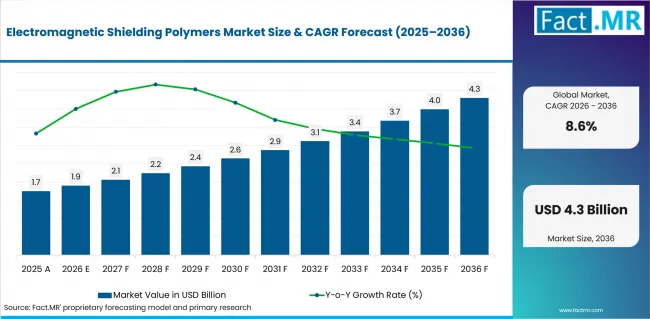
Electromagnetic Shielding Polymers Market Value Analysis | Source: Fact.MR
What are the defining numbers behind Electromagnetic Shielding Polymers Market growth?
USD 2.6 billion absolute opportunity by 2036, led by Conductive Thermoplastics and Carbon-based Fillers alongside Consumer Electronics.
- Demand Drivers in the Market
- Equipment manufacturers need shielding materials that support electromagnetic compatibility without forcing a return to heavier metal enclosures or secondary coating steps.
- 5G radios, high-speed data links, ADAS sensors; inverters; charging electronics; and compact medical circuitry add more potential paths for electromagnetic disturbance inside each system.
- OEM teams are evaluating molded-in shielding where one polymer part can combine enclosure geometry, structural duty, and electrical protection.
- Compounders need stable filler dispersion and local application support because final performance changes with frequency, wall thickness, flow direction; weld lines; apertures; and grounding.
- Key Segments Analyzed
- By Polymer Type: Conductive Thermoplastics are projected to hold 42.0% share in 2026 because they combine resin choice, established molding equipment, and integrated shielding.
- By Filler Type: Carbon-based Fillers are expected to account for 39.0% share in 2026 as compounders balance conductivity, weight, corrosion resistance; mechanical performance; and cost. The same qualification burden appears in the harness level EMI and shielding component systems and radio frequency test equipment markets.
- By Application: Consumer Electronics are anticipated to capture 34.0% share in 2026 because thin housings must accommodate radios, processors, displays; cameras; memory; and power-management circuits.
- By Processing Technology: Injection Molding is estimated to represent 48.0% share in 2026 because shielding can be incorporated into complex housings through established high-volume conversion equipment.
- By End Use: Electronics Manufacturers are forecast to account for 46.0% share in 2026 because their engineering teams set the electrical target and control material qualification for production parts.
- Analyst Opinion at Fact.MR
- Shambhu Nath Jha, Principal Consultant at Fact.MR, states: "Commercial adoption will depend on whether a compound solves the complete EMC part problem. Buyers will not accept conductivity that raises viscosity; tool wear; brittleness; or surface defects beyond the production window. Suppliers that combine part-level shielding data; stable filler dispersion; design guidance; and disciplined change control will move more programs from qualification into repeat production."
- Strategic Implications
- Compounders should report shielding performance across frequency, wall thickness, flow direction; and molded geometry instead of relying on a single material-level value.
- OEM and Tier 1 teams should qualify mechanical, thermal, flame; appearance; and aging performance alongside electrical shielding before approving a resin change.
- Processors should test weld lines, apertures, grounding; tool wear; cycle time; and surface quality before replacing a metal enclosure or secondary coating step.
- Suppliers should maintain regional technical support, inventory discipline, and formal change control because long product lives make unplanned formulation changes commercially disruptive.
How does the Electromagnetic Shielding Polymers Market break down by segment?
Conductive Thermoplastics lead at 42.0%, Carbon-based Fillers at 39.0%, Consumer Electronics at 34.0%; Injection Molding at 48.0%; and Electronics Manufacturers at 46.0%. Material selection connects this demand with the high performance polymers and automotive high performance polymers markets.
Why do Conductive Thermoplastics lead Polymer Type?
Conductive Thermoplastics hold 42.0% share in 2026.
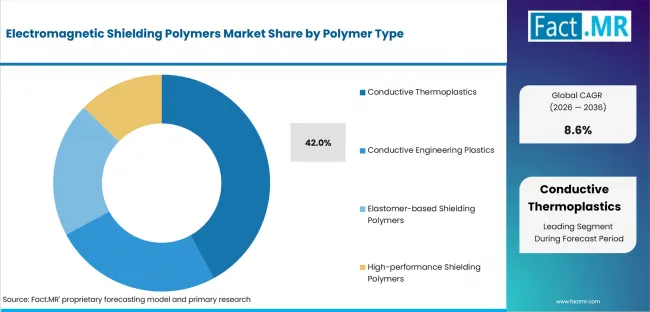
Electromagnetic Shielding Polymers Market Analysis By Polymer Type | Source: Fact.MR
Conductive thermoplastics lead because they place shielding inside a material form already used by molders and extruders. Designers can select among polycarbonate, ABS, polyamide; and related compound platforms while retaining scalable part production. Polycarbonate Compounds; ABS Compounds; and Polyamide Compounds remain alternatives where the matrix is chosen around the final part's mechanical; thermal; appearance; and processing requirements. The winning formulation must preserve that complete property set after conductive filler is added.
Why do Carbon-based Fillers lead Filler Type?
Carbon-based Fillers hold 39.0% share in 2026.
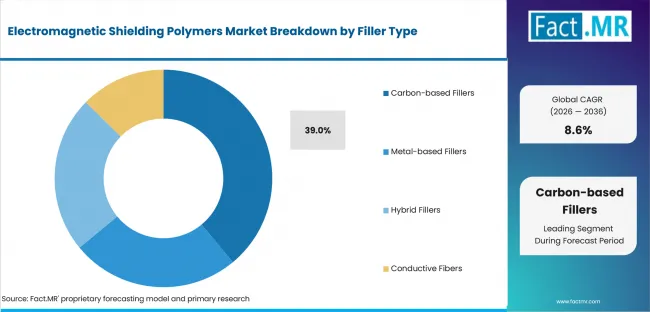
Electromagnetic Shielding Polymers Market Analysis By Filler Type | Source: Fact.MR
Carbon black, carbon nanotubes, graphene; and carbon fibers can create conductive pathways at lower density than many metal systems and avoid corrosion concerns associated with exposed metallic networks. Their commercial performance depends on loading; particle shape; aspect ratio; dispersion; and hybridization. Carbon Black remains a familiar option; while Carbon Nanotubes and Graphene are evaluated where suppliers can prove the required shielding without pushing viscosity; toughness; surface quality; or cost outside the approved window.
Why does Consumer Electronics lead Application?
Consumer Electronics hold 34.0% share in 2026.
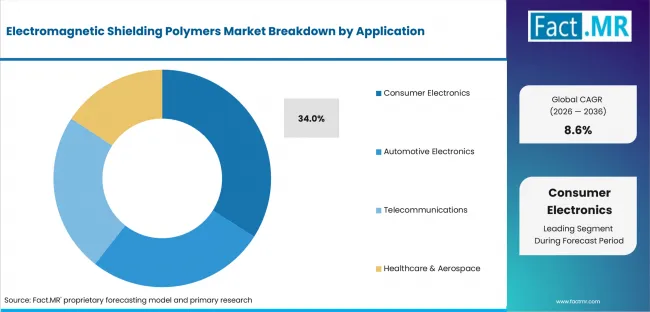
Electromagnetic Shielding Polymers Market Analysis By Application | Source: Fact.MR
Consumer electronics combine multiple radios, processors, displays; cameras; memory devices; and power-management circuits inside thin enclosures. A separate metal shield; coated shell; or gasket competes with battery volume; antenna clearance; thermal paths; and industrial design. Smartphones; Laptops; and Wearable Devices therefore create repeated design-in opportunities for polymeric shielding; provided the molded part passes frequency-specific EMC tests and retains appearance and mechanical integrity.
Why does Injection Molding lead Processing Technology?
Injection Molding holds 48.0% share in 2026.
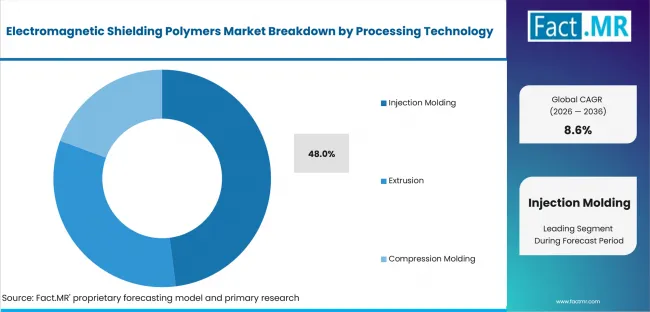
Electromagnetic Shielding Polymers Market Analysis By Processing Technology | Source: Fact.MR
Injection molding leads because it can integrate shielding into the geometry of housings, connectors, and other components through established production equipment. Standard Injection Molding supports the broadest conversion route; while Overmolding and Micro Injection Molding serve programs that need localized material placement or smaller features. Qualification remains part-specific because flow direction; weld lines; wall thickness; and filler orientation can change electrical performance after the melt enters the tool.
Why do Electronics Manufacturers lead End Use?
Electronics Manufacturers hold 46.0% share in 2026.
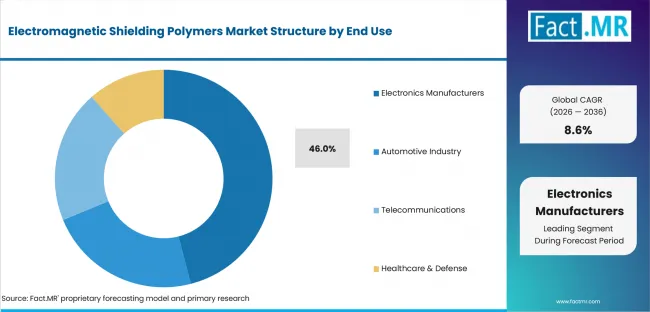
Electromagnetic Shielding Polymers Market Analysis By End Use | Source: Fact.MR
Electronics manufacturers lead because their design and reliability teams define the shielding target, approve resin substitutions, and control the documentation used by molders and contract manufacturers. Consumer Electronics OEMs focus on compact; high-volume devices; while Industrial Electronics OEMs and Component Manufacturers assess longer service life; process stability; and integration with the wider assembly. Suppliers gain repeat business when they support each participant without losing control of the approved formulation and processing window.
What is accelerating Electromagnetic Shielding Polymers Market adoption, and what is holding it back?
Tighter EMC requirements and denser electronics drive embedded shielding, while part-level qualification and processing variability restrain conversion.
Drivers Impact Analysis
- Compliance-led design-in: The demand mechanism starts with reliability and regulatory compliance, not with material novelty. The European Union EMC Directive requires equipment to function satisfactorily in its electromagnetic environment and not create intolerable disturbance. Vehicle components also face electromagnetic-compatibility approval under UNECE Regulation No. 10.
- Electronics density: As OEMs add 5G radios, high-speed links, ADAS sensors; inverters; charging electronics; and compact medical circuitry; the number of potential coupling paths rises. Embedded shielding becomes attractive when it controls those paths without adding a separate enclosure or assembly operation. Processing constraints also shape the conductive carbon black and thermal conductive sheet markets.
| DRIVER | QUALITATIVE RELEVANCE | GEOGRAPHIC RELEVANCE | IMPACT TIMELINE |
|---|---|---|---|
| Compliance-led design-in | High | USA | 2026 to 2036 |
| Electronics density | High | USA | 2026 to 2036 |
Source: Fact.MR analysis. Updated Aug 3, 2026
Opportunity Impact Analysis
- Multifunctional compounds: The clearest opportunity is a formulation that removes several components or operations rather than competing only on shielding decibels. Avient markets long-fiber thermoplastic shielding formulations for ADAS, medical devices, connectors; and other equipment. Laird Performance Materials combines conductive elastomers with environmental sealing; while thermal-conductive compound platforms show how heat and EMI functions can be designed together.
| OPPORTUNITY | QUALITATIVE RELEVANCE | GEOGRAPHIC RELEVANCE | IMPACT TIMELINE |
|---|---|---|---|
| Multifunctional compounds | High | USA | 2026 to 2036 |
Source: Fact.MR analysis. Updated Aug 3, 2026
Restraints Impact Analysis
- Part-level qualification: A material data sheet cannot prove the final component. Shielding changes with frequency, wall thickness, filler dispersion; flow direction; weld lines; apertures; gasket compression; surface contact; and grounding. Each program therefore requires molded-part testing before a supplier can claim production readiness.
- Processing trade-offs: Higher conductive-filler loading may raise viscosity, tool wear, density; brittleness; or surface defects. The September 2024 review of conductive polymer composites links shielding performance to effective conductive pathways; reinforcing why processing history and dispersion control matter.
| RESTRAINT | QUALITATIVE RELEVANCE | GEOGRAPHIC RELEVANCE | IMPACT TIMELINE |
|---|---|---|---|
| Part-level qualification | High | USA | 2026 to 2036 |
| Processing trade-offs | High | USA | 2026 to 2036 |
Source: Fact.MR analysis. Updated Aug 3, 2026
Which countries are scaling Electromagnetic Shielding Polymers Market fastest?
Japan 9.2%, USA 8.9%, UK 8.6%; Germany 8.3%; and France 8.0% through 2036.
Regional analysis covers North America, Latin America, Western Europe; Eastern Europe; East Asia; South Asia and Pacific; and the Middle East and Africa.
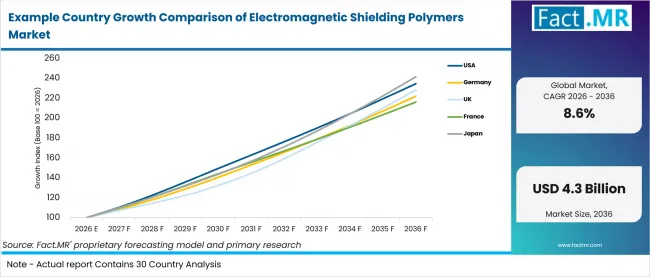
Example Country Growth Comparison Of Electromagnetic Shielding Polymers Market | Source: Fact.MR
| COUNTRY | CAGR, 2026 to 2036 |
|---|---|
| USA | 8.9% |
| Germany | 8.3% |
| UK | 8.6% |
| France | 8.0% |
| Japan | 9.2% |
Source: Fact.MR analysis. Updated Aug 3, 2026
What is shaping USA's outlook through 2036?
8.9% CAGR through 2036, supported by electronics, data-infrastructure; and vehicle qualification programs.
USA programs often separate material specification from high-volume conversion, so compounders must support OEM engineers, Tier 1 suppliers; molders; and contract manufacturers. Local supply and rapid application support matter because a laboratory formulation can behave differently after production-scale flow; wall-thickness; or grounding changes. Demand for electromagnetic shielding polymers in the USA is forecast to rise at an 8.9% CAGR from 2026 to 2036.
What is shaping Germany's outlook through 2036?
8.3% CAGR through 2036, driven by automotive-grade traceability and long validation cycles.
German buyers place strong weight on engineering documentation, process capability, material traceability; and long production life. A conductive compound must remain stable across supplier change control; molding sites; and repeated vehicle or industrial qualification. Adoption of electromagnetic shielding polymers in Germany is forecast to expand at an 8.3% CAGR from 2026 to 2036.
What is shaping the UK's outlook through 2036?
8.6% CAGR through 2036, supported by advanced electronics design and scale-up requirements.
UK purchasing is shaped by design houses, compound-semiconductor specialists, research organizations; telecom suppliers; and smaller-volume advanced electronics manufacturers. The critical commercial step is moving from prototype material to a repeatable compound; qualified molder; and secure production route. Sales of electromagnetic shielding polymers in the UK are forecast to increase at an 8.6% CAGR from 2026 to 2036.
What is shaping France's outlook through 2036?
8.0% CAGR through 2036, shaped by formal qualification and supply-security requirements.
French programs combine automotive, telecom, medical; aerospace; and defense demand. Procurement often depends on documented electrical performance; controlled processing; and a credible supply route across the program life. Demand for electromagnetic shielding polymers in France is forecast to advance at an 8.0% CAGR from 2026 to 2036. Supplier approval conditions remain relevant to the specialty phase change materials for electronics and electronic thermal management materials etmm markets.
What is shaping Japan's outlook through 2036?
9.2% CAGR through 2036, the highest profiled rate, supported by precision qualification and local problem solving.
Japanese OEMs and component makers place strong weight on consistency, long supplier relationships, precise process windows; and local technical response. These conditions favor suppliers that can prove stable filler dispersion and maintain the approved formulation over long product cycles. Adoption of electromagnetic shielding polymers in Japan is forecast to rise at a 9.2% CAGR from 2026 to 2036.
Who leads the Electromagnetic Shielding Polymers Market?
RTP Company accounts for 14.0% of the market; competition beyond the leader is shaped by compound breadth, filler engineering, and finished-part support.
RTP Company, Avient Corporation, Premix Group; and Techmer PM emphasize formulated conductive compounds and application engineering. Their commercial position depends on translating electrical targets into a moldable grade with a controlled processing window. Sabic; Toray Industries; Inc.; and Celanese Corporation connect shielding to broader engineered-resin and fiber platforms; giving customers more options for mechanical and thermal integration.
Laird Performance Materials, 3M Company, and Ensinger GmbH address interfaces; enclosure grounding; gaskets; and integrated shielding housings. Buyers compare these providers on part-level test evidence; lot consistency; regional technical support; and change-control discipline.
In October 2023, Avient Corporation launched Stat-Tech static-dissipative and electrically conductive thermoplastic elastomers with electrical resistivity spanning 10^0 to 10^10 ohms. The materials were positioned for critical electrical components requiring protection from EMI/RFI and static buildup.
In June 2024, Sabic showcased a new LNP FARADEX 9X23246 polycarbonate-blend compound in a camera-based automotive exterior-mirror housing at PIAE 2024. The molded housing used the material to provide EMI shielding within the structural component.
In May 2025, Premix Group opened a manufacturing facility in Apple Creek, North Carolina; supported by a USD 79 million investment from the U.S. Department of Defense and Department of Health and Human Services. The plant produces conductive PE- and PP-based compounds and concentrates for extrusion and injection molding. Performance testing also influences the injection molding and sheet molding compound markets.
Which companies are the key providers?
RTP Company and Laird Performance Materials are leading companies in the market.
- RTP Company
- Laird Performance Materials
- Avient Corporation
- Premix Group
- 3M Company
- Sabic
- Toray Industries, Inc.
- Ensinger GmbH
- Celanese Corporation
- Techmer PM
Bibliography
- European Parliament and Council. (2014, February 26). Directive 2014/30/EU on the harmonisation of the laws of the Member States relating to electromagnetic compatibility.
- United Nations Economic Commission for Europe. (2015). UN Regulation No. 10, Revision 5: Uniform provisions concerning the approval of vehicles with regard to electromagnetic compatibility.
- Nan, X., Zhang, Y., Shen, J., et al. (2024, September 7). A Review of the Establishment of Effective Conductive Pathways of Conductive Polymer Composites and Advances in Electromagnetic Shielding.
- RTP Company. (n.d.). EMI Shielding Plastic Compounds.
- Avient Corporation. (2023, October 9). Avient to Unveil New Specialized and Sustainable Solutions at Fakuma 2023.
This Report Addresses
- What is the Electromagnetic Shielding Polymers Market worth in 2026, and what value is forecast for 2036?
- Which compliance, design, processing; and qualification pressures shape demand for electromagnetic shielding polymers?
- Why do Conductive Thermoplastics and Carbon-based Fillers hold their leading positions?
- How do growth conditions differ across USA, Germany, UK; France; and Japan?
- Which companies are profiled and what determines competitive credibility?
- What scope boundary, evidence base, segmentation; and methodology support the market assessment?
What does the Electromagnetic Shielding Polymers Market cover?
Conductive polymer compounds and semi-finished polymeric materials sold specifically for EMI/RFI shielding.
The Electromagnetic Shielding Polymers Market covers polymer pellets, compounds, concentrates; elastomer formulations; and semi-finished polymeric materials deliberately sold for EMI/RFI shielding. Coverage includes conductive thermoplastic systems; carbon-based filler routes; consumer-electronics applications; injection-molding technologies; and electronics-manufacturer demand within the approved segmentation.
Commercial value is assigned to the shielding polymer material rather than the downstream device, vehicle, or enclosure. The market therefore differs from the broader conductive-materials universe because ESD-only or thermal-only materials remain outside the boundary unless they carry explicit EMI/RFI shielding functionality.
What is included in the scope?
EMI/RFI shielding polymer materials across Polymer Type, Filler Type, Application; Processing Technology; and End Use.
The scope includes Conductive Thermoplastics and the listed Polycarbonate, ABS, and Polyamide compound categories. It includes Carbon-based Fillers through Carbon Black; Carbon Nanotubes; and Graphene. Application coverage spans Consumer Electronics; Smartphones; Laptops; and Wearable Devices. Processing coverage includes Injection Molding; Standard Injection Molding; Overmolding; and Micro Injection Molding; while End Use covers Electronics Manufacturers; Consumer Electronics OEMs; Industrial Electronics OEMs; and Component Manufacturers.
What is excluded from the scope?
Downstream finished products, pure fillers, metal shielding systems; and non-shielding conductive materials are outside the scope.
The scope excludes revenue from downstream finished devices and components. Pure fillers sold without a polymer formulation are excluded, as are metal enclosures, stand-alone metal foils; coatings or metallization services; and other secondary shielding operations. ESD-only or thermal-only materials are outside the boundary when they are not explicitly sold for EMI/RFI shielding.
How was the analysis built?
- Primary Research
- Fact.MR engages manufacturers of conductive compounds and fillers, polymer processors, component suppliers; electronics and automotive OEMs; distributors; procurement teams; and subject-matter experts.
- Desk Research
- The analysis reviews company filings and technical literature, regulator and standards documents, government industrial announcements; trade and manufacturing information; product data sheets; and peer-reviewed studies.
- Market-Sizing and Forecasting
- A hybrid bottom-up and top-down approach uses supplier participation, material and processing splits, end-use demand; qualification cycles; pricing; regional production patterns; and technology substitution.
- Data Validation and Update Cycle
- Supplier, product, application; country; processing; and end-use signals are reconciled across independent source types and checked against the stated values; shares; CAGRs; and market boundary. Production economics connect this demand with the advanced polymer composites and thermoplastic elastomers markets.
Segmentation
What is the report’s scope and coverage?
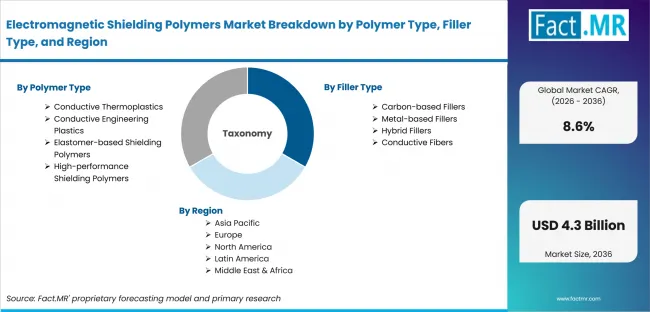
Electromagnetic Shielding Polymers Market Breakdown By Polymer Type, Filler Type, And Region | Source: Fact.MR
| Attribute | Details |
|---|---|
| Quantitative Units | USD Billion in 2026 to USD Billion by 2036 at CAGR |
| Market Definition | Revenue includes polymer pellets, compounds, concentrates; elastomer formulations; and semi-finished polymeric materials deliberately sold for EMI/RFI shielding within the stated segmentation universe. |
| Polymer Type | Conductive Thermoplastics; Polycarbonate Compounds; ABS Compounds; Polyamide Compounds |
| Filler Type | Carbon-based Fillers; Carbon Black; Carbon Nanotubes; Graphene |
| Application | Consumer Electronics; Smartphones; Laptops; Wearable Devices |
| Processing Technology | Injection Molding; Standard Injection Molding; Overmolding; Micro Injection Molding |
| End Use | Electronics Manufacturers; Consumer Electronics OEMs; Industrial Electronics OEMs; Component Manufacturers |
| Regions Covered | North America; Latin America; Western Europe; Eastern Europe; East Asia; South Asia and Pacific; Middle East and Africa |
| Countries Covered | USA; Germany; UK; France; Japan; and more than twenty-five additional countries in the full report |
| Key Companies Profiled | RTP Company; Laird Performance Materials; Avient Corporation; Premix Group; 3M Company; Sabic; Toray Industries, Inc.; Ensinger GmbH; Celanese Corporation; Techmer PM |
| Forecast Period | 2026 to 2036 |
| Approach | Hybrid bottom-up and top-down sizing that reconciles supplier participation, material and processing splits, application demand; end-use qualification cycles; regional production; pricing; and technology substitution. |
Source: Fact.MR analysis. Updated Aug 3, 2026
How is the market segmented?
-
By Polymer Type
- Conductive Thermoplastics
- Polycarbonate Compounds
- ABS Compounds
- Polyamide Compounds
- Conductive Engineering Plastics
- PEEK Compounds
- PPS Compounds
- PBT Compounds
- Elastomer-based Shielding Polymers
- Silicone Elastomers
- Thermoplastic Elastomers
- Fluoroelastomers
- High-performance Shielding Polymers
- LCP Compounds
- PEI Compounds
- Polyimide Compounds
- Conductive Thermoplastics
-
By Filler Type
- Carbon-based Fillers
- Carbon Black
- Carbon Nanotubes
- Graphene
- Metal-based Fillers
- Silver
- Copper
- Nickel
- Hybrid Fillers
- Metal-coated Carbon Fibers
- Carbon-Metal Hybrid Fillers
- Conductive Ceramic Fillers
- Conductive Fibers
- Stainless Steel Fibers
- Carbon Fibers
- Metal-coated Glass Fibers
- Carbon-based Fillers
-
By Processing Technology
- Consumer Electronics
- Smartphones
- Laptops
- Wearable Devices
- Automotive Electronics
- Electric Vehicles
- Advanced Driver Assistance Systems
- Infotainment Systems
- Telecommunications
- 5G Infrastructure
- Network Equipment
- Data Centers
- Healthcare & Aerospace
- Medical Devices
- Aerospace Electronics
- Defense Electronics
- Consumer Electronics
-
By End Use
- Electronics Manufacturers
- Consumer Electronics OEMs
- Industrial Electronics OEMs
- Component Manufacturers
- Automotive Industry
- Passenger Vehicles
- Commercial Vehicles
- Electric Vehicles
- Telecommunications
- Communication Equipment
- 5G Infrastructure
- Network Hardware
- Healthcare & Defense
- Medical Equipment
- Defense Systems
- Aerospace Equipment
- Electronics Manufacturers
-
By Region
- North America
- Latin America
- Western Europe
- Eastern Europe
- East Asia
- South Asia and Pacific
- Middle East and Africa
- USA
- Germany
- UK
- France
- Japan
- and more than twenty-five additional countries in the full report
- North America
Frequently Asked Questions
Which Polymer Type leads the Electromagnetic Shielding Polymers Market?
Which Filler Type leads the Electromagnetic Shielding Polymers Market?
Which Application leads the Electromagnetic Shielding Polymers Market?
Which Processing Technology leads the Electromagnetic Shielding Polymers Market?
Which End Use leads the Electromagnetic Shielding Polymers Market?
Which country records the highest profiled CAGR?
How does the USA perform in the Electromagnetic Shielding Polymers Market?
How does the UK perform in the Electromagnetic Shielding Polymers Market?
How does Germany perform in the Electromagnetic Shielding Polymers Market?
How does France perform in the Electromagnetic Shielding Polymers Market?
What is the primary driver in the Electromagnetic Shielding Polymers Market?
What is the main restraint in the Electromagnetic Shielding Polymers Market?
Why are Carbon-based Fillers important?
Why does Injection Molding dominate?
Which company has a measured market share?
Who worked on this report


Preview the report firsthand - request a free sample
Free SampleGet the brochure for pricing and purchase details
Download PDF