- Market Value (2025): USD 148.7 Mn
- Estimated Value (2026): USD 160.0 Mn
- Forecast Value (2036): USD 332.8 Mn
- CAGR (2026-2036): 7.6%
Functional Gut Health Carriers Market Forecast and Outlook 2026 to 2036
The functional gut health carriers market was valued at approximately USD 148.7 million in 2025 and USD 160.0 million in 2026. It is projected to reach USD 332.8 million by 2036, registering a 7.6% CAGR during the 2026–2036 assessment period.
Functional gut health carriers are gaining traction as supplement, infant formula and medical nutrition companies look for effective ways to incorporate prebiotics, probiotics; postbiotics and butyrate into finished products without compromising ingredient stability. This has encouraged the use of microencapsulation, synbiotic blends and fiber-based delivery matrices.
In 2025, dsm-firmenich introduced an allergen-free version of its Humiome® Post LB postbiotic for use in formats such as gummies, while TopGum developed chewable synbiotic gummies using its prebiotic fiber-based Gummiceuticals matrix. In October 2026, TopGum expanded this approach with a new range of prebiotic, probiotic and postbiotic gummies built on the same patented platform. These product innovations are creating fresh opportunities for specialized gut health carrier manufacturers.
Key Takeaways from the Functional Gut Health Carriers Market
- Sales of functional gut health carriers stood at USD 148.7 million in 2025
- Functional Gut Health Carriers Market Value (2026): USD 160.0 million
- Functional Gut Health Carriers Market Forecast Value (2036): USD 332.8 million
- Functional Gut Health Carriers Market Forecast CAGR (2026-2036): 7.6%
- Leading Gut-health carrier: Synbiotic matrix (26.0%)
- Key Market Participants: DSM-Firmenich, Lonza, Balchem; Kerry Group; Glanbia Nutritionals; IFF
- Key Growth Regions: China, United States, Denmark; Germany; Japan
In 2025, ADM partnered with Japan's Asahi Group Foods to commercialize its CP2305 postbiotic for stress, mood and sleep applications; while dsm-firmenich introduced an allergen-free version of Humiome® Post LB for use in formats such as gummies. In 2026, Probi launched Rham271h™, its first postbiotic ingredient; with improved heat; pH and shelf stability for food and beverage formulations. These launches show how ingredient companies are moving beyond conventional probiotic formats and creating opportunities for specialized functional gut health carriers.
Functional Gut Health Carriers Market
| Metric | Value |
|---|---|
| Estimated Value in (2025) | USD 148.7 million |
| Estimated Value in (2026) | USD 160.0 million |
| Forecast Value in (2036) | USD 332.8 million |
| Forecast CAGR (2026 to 2036) | 7.6% |
Source: Fact.MR analysis. Updated Nov 19, 2026
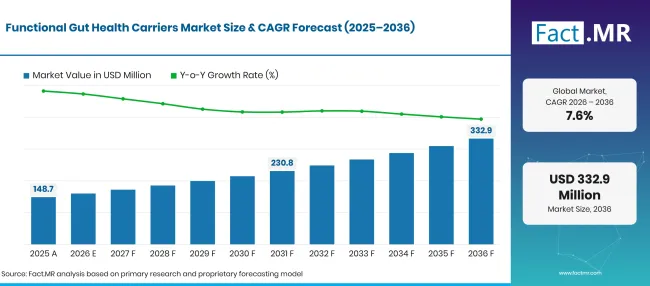
Functional Gut Health Carriers Forecast Global | Source: Fact.MR
Category
| Category | Segments |
|---|---|
| Gut-health carrier | Prebiotic fiber, Probiotic microcapsule, Postbiotic carrier; Butyrate delivery; Synbiotic matrix |
| Commercial form | Powder, Capsule / tablet, Liquid; Microcapsule; Ready-to-use blend |
| End application | Clinical nutrition, Supplements, Functional foods; Infant / pediatric; Specialized medical |
| Sales channel | Ingredient OEM, Medical nutrition brand, Hospital procurement; Pharmacy; Direct consumer |
| Region | China; United States; Denmark; Germany; Japan |
Source: Fact.MR analysis. Updated Nov 19, 2026
Segmental Analysis
Why does Synbiotic Matrix lead carrier demand in the Functional Gut Health Carriers Market?
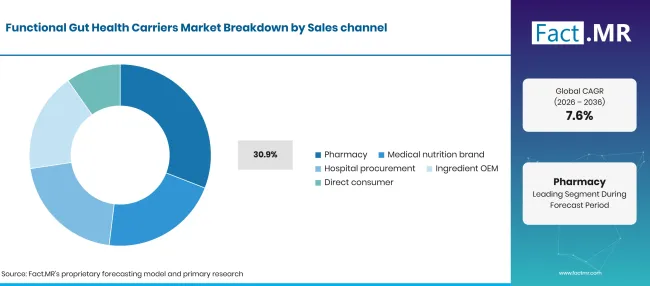
Functional Gut Health Carriers Breakdown Sales Channel | Source: Fact.MR
Synbiotic matrix carriers hold a 26.0% revenue share in 2026, valued at approximately USD 41.6 million. Their appeal comes from combining probiotic strains with prebiotic fibers in one delivery system, helping protect microbial viability while providing a substrate for beneficial bacteria. Prebiotic fiber carriers and probiotic microcapsules follow. A July 2025 study published in Carbohydrate Polymers found that incorporating 4% fructooligosaccharides into probiotic microcapsules improved freeze-drying survival to 83.36%, demonstrating the practical value of combined carrier formulations.
Why does Capsule / Tablet lead commercial-form demand in the Functional Gut Health Carriers Market?
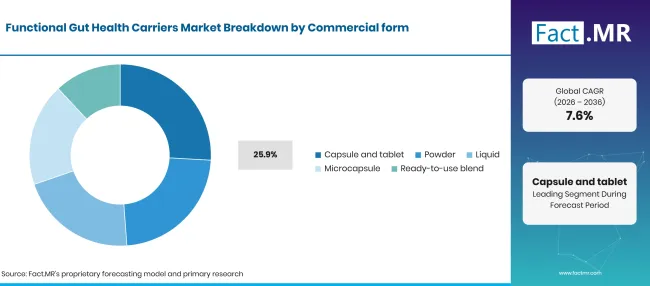
Functional Gut Health Carriers Breakdown Commercial Form | Source: Fact.MR
Capsule and tablet formats generate 25.9% of market revenue in 2026, equivalent to around USD 41.4 million. Their familiar dosage format makes them convenient for consumers taking gut-health supplements as part of a daily routine. Microcapsules follow as manufacturers look for better protection against stomach acidity and processing conditions. In May 2026, research published in Food Hydrocolloids demonstrated a controlled-release probiotic tablet using gelatin and sodium carboxymethyl cellulose, designed to withstand gastric conditions and release its contents in the intestine.
Why does Infant / Pediatric lead end-application demand in the Functional Gut Health Carriers Market?
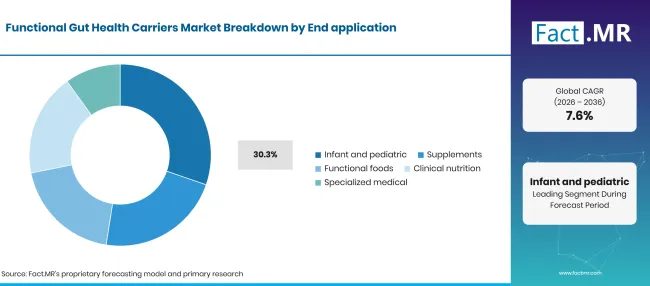
Functional Gut Health Carriers Breakdown End Application | Source: Fact.MR
Infant and pediatric nutrition accounts for 30.3% of revenue in 2026, reaching approximately USD 48.5 million. Formula manufacturers are incorporating HMOs, prebiotic fibers and selected probiotic strains to address the developing gut microbiome of infants. Supplements represent another important application. In January 2026, the European Society for Paediatric Gastroenterology, Hepatology and Nutrition (ESPGHAN) published recommendations reviewing the safety and health outcomes of infant formulas containing probiotics; prebiotics; HMOs; synbiotics and postbiotics. This scientific assessment keeps biotic formulation quality in focus among infant nutrition manufacturers.
Why does Pharmacy lead sales-channel demand in the Functional Gut Health Carriers Market?
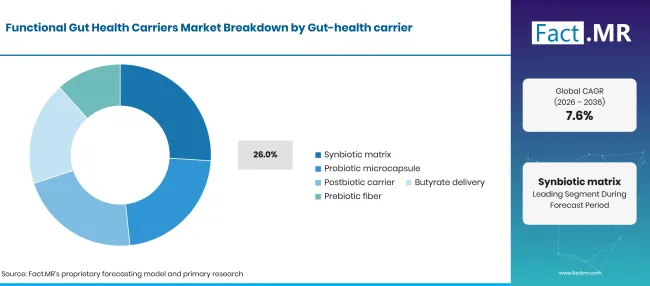
Functional Gut Health Carriers Breakdown Gut Health Carrier | Source: Fact.MR
Pharmacies account for 30.9% of revenue in 2026, worth approximately USD 49.4 million. Consumers often approach pharmacists when choosing digestive supplements, particularly when gastrointestinal discomfort occurs during or after antibiotic treatment. Medical nutrition brands and other retail channels also contribute to sales. A 2026 study published in Healthcare examined community pharmacists' knowledge and practices around recommending probiotics alongside antibiotics in North Macedonia, identifying both frequent recommendation practices and gaps in clinical counselling. The findings underline the role of pharmacy professionals in guiding consumers towards appropriate gut-health products.
Functional Gut Health Carriers Market-Drivers, Restraints & Trends
Drivers
Rising focus on gut microbiome health: Greater awareness of the connection between gut bacteria, immunity, metabolism and mental well-being is bringing digestive health into everyday nutrition choices. This is creating room for functional gut health carriers that combine multiple bioactive ingredients while maintaining their stability and delivery performance. In February 2026, ISAPP published an expert consensus statement defining gut health, adding scientific clarity to an area receiving increasing consumer and industry attention.
Restraints
Regulatory and clinical evidence gaps: Functional gut health carriers face commercial hurdles because health claims must be backed by credible evidence, while results can vary across microbial strains, formulations and study populations. EU rules also restrict unapproved or misleading health claims, making product positioning costly and complicated for manufacturers.
Trends
Postbiotic Ingredients: Postbiotics are gaining attention because inactivated microbial ingredients can withstand processing conditions that often affect live probiotics. A 2026 review in npj Science of Food examined their stability under heat, dehydration and storage conditions, highlighting their wider formulation potential. Future opportunities lie in carrier systems that preserve postbiotic activity across different food, supplement and medical nutrition applications.
Trends
Human Milk Oligosaccharides (HMOs): HMOs are moving beyond specialist infant nutrition research as manufacturers explore their role in gut microbiome development and broader nutritional applications. In May 2025, BENEO and WACKER launched 2'-Fucosyllactose through their global partnership, adding European production capacity and improving ingredient availability. Future opportunities include carrier systems that accommodate different HMO structures and improve their integration into infant, pediatric and adult nutrition formulations.
Functional Gut Health Carriers Market by Analysis by Key Country
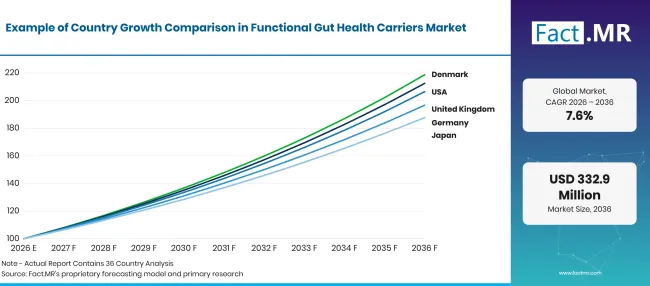
Functional Gut Health Carriers Growth Index | Source: Fact.MR
| Country | CAGR (2026-2036) |
|---|---|
| China | 9.2% |
| United States | 7.7% |
| Denmark | 7.7% |
| Germany | 7.0% |
| Japan | 6.5% |
Source: Fact.MR analysis. Updated Nov 19, 2026
Why is China the fastest-growing market for functional gut health carriers?
China is set to record the fastest growth as infant nutrition manufacturers expand the use of specialized microbial ingredients and prebiotic formulations.
In February 2026, China's National Health Commission approved Bifidobacterium longum subsp. infantis YLGB-1496 for use in infant and young children's foods. This regulatory progress creates room for specialized carriers that maintain microbial stability and support formulation safety. Infant formula innovation, rising interest in digestive wellness and wider acceptance of functional nutrition are driving sales.
What is shaping functional gut health carrier sales in the United States?
Consumer interest in probiotic supplements is giving the US market a strong commercial base.
A September 2026 study from the University of Michigan reported that probiotic supplement use among American adults increased 287% between 2009 and 2023, while use among people below 20 years increased 786%. This shift is creating opportunities for carriers that improve ingredient stability and delivery in supplements and functional foods. Preventive nutrition habits and expanding microbiome research are reinforcing market expansion.
What is shaping functional gut health carrier demand in Denmark?
Denmark's strong microbiome research ecosystem is helping shape interest in nutrition-based gut health solutions.
In October 2026, researchers at the University of Copenhagen published findings comparing gut microbiomes among 75 vegans and 75 omnivores, identifying differences in bacterial diversity and dietary influences. Such research is drawing attention to how food composition affects gut bacteria. Interest in fiber-rich diets, functional nutrition and scientifically grounded digestive health products is creating opportunities for specialized carrier formulations.
What is shaping functional gut health carrier demand in Germany?
Scientific scrutiny of infant nutrition is influencing how German manufacturers approach microbiome-related ingredients.
In February 2026, the Federal Institute for Risk Assessment (BfR) updated its assessment of probiotics in infant formula, stating that available evidence was still insufficient to establish certain claimed health benefits. This puts greater emphasis on strain-specific evidence, safety and formulation quality. Germany's advanced food research base, infant nutrition industry and focus on clinically substantiated ingredients will shape sales of functional gut health carriers.
Why is functional gut health carrier growth slower in Japan?
Japan's distinctive gut microbiome profile is creating an interesting foundation for specialized nutrition research. In February 2026, the University of Tokyo published findings from a comparison involving more than 5,000 Japanese individuals and 25;000 people across 36 countries.
Researchers identified a higher abundance of Bifidobacterium among Japanese participants and distinctive microbial traits associated with dietary patterns. This research strengthens interest in microbiome-focused nutrition, while functional food consumption, preventive healthcare and probiotic supplementation continue to create opportunities for carrier manufacturers.
Competitive Landscape for Functional Gut Health Carriers Market
Market rivalry increasingly depends on the ability to pair specialized gut-health ingredients with reliable delivery technologies. dsm-firmenich, Kerry Group, IFF and Glanbia Nutritionals compete across prebiotics; probiotics and HMOs; while Balchem and Lonza bring expertise in encapsulation and capsule technologies. In 2025, dsm-firmenich introduced an allergen-free Humiome® Post LB format for applications such as gummies.
The same year, BENEO and WACKER launched 2’-Fucosyllactose to expand HMO availability for infant nutrition manufacturers. In March 2026, dsm-firmenich secured further HMO approvals across China, Malaysia and Thailand. Competition is increasingly centered on clinical evidence, ingredient stability, regulatory access and formulation flexibility rather than portfolio size alone.
Recent Developments
- On February 11, 2025, DSM-Firmenich agreed to sell its stake in the Feed Enzymes Alliance to Novonesis for €1.5 billion. The transaction was completed on June 2, 2025.
- On April 7, 2025, Lonza partnered with Ethris to develop spray-dried mRNA vaccine formulations designed to remain stable at room temperature and support respiratory disease prevention.
- Balchem announced a facility investment in December 2025. For functional gut health carriers, the development is relevant to the production scale available for encapsulated ingredients used in digestive health formulations.
- On February 14, 2025, Kerry Group announced a new Digital Centre of Excellence in Naas; Ireland; with a €7.5 million grant from Enterprise Ireland. The centre will focus on using digital technologies to improve operations, research and customer services.
- On August 1, 2025, Glanbia Nutritionals acquired Sweetmix; a Brazil-based nutritional premix and ingredients business; to expand its Health and Nutrition operations in Latin America.
- On May 29, 2026, IFF agreed to sell its Food Ingredients business to CVC Capital Partners in a transaction valued at approximately USD 4.3 billion. IFF will retain a minority stake of around 10% in the business.
Key Players in Functional Gut Health Carriers Market
Key companies profiled include DSM-Firmenich; Lonza; Balchem; Kerry Group; Glanbia Nutritionals; and IFF.
- DSM-Firmenich
- Lonza
- Balchem
- Kerry Group
- Glanbia Nutritionals
- IFF
Bibliography
- Bundesinstitut für Risikobewertung. (2026, February 3). Gesundheitlicher Nutzen von Säuglingsnahrung mit Zusatz von „Probiotika“ wissenschaftlich weiterhin nicht belegt [Health benefits of infant formula supplemented with probiotics not yet scientifically established] (Statement No. 005/2026)
- Dahmouni, S., Benabdelmoumene; D.; Bengharbi; Z.; Fodil; M. K., Umar, K. M., Qadi, W. S. M., Krache, F.; Waqar; M.; Tong; X.; Han; R.; Abu Bakar; Z. H., Sarian, M. N., Mediani, A.; Jam; F. A., & Hamezah, H. S. (2026). Postbiotics and paraprobiotics in food biochemistry mechanisms stability and nutritional applications. npj Science of Food, 10, Article 242.
- Dinleyici, E. C., Indrio, F.; Szajewska; H.; Hojsak; I.; Salvatore; S.; Mihatsch; W. A., Berni Canani, R.; Campoy; C.; Domellöf; M.; Francavilla; R.; Guarino; A.; Gutierrez-Castrellón; P.; Haiden; N.; Mosca; A.; Orel; R.; Savino; F.; Shamir; R.; van Goudoever; J. B., van den Akker, C. H. P., ... Vandenplas, Y. (2026). Recommendations on the health outcomes of infant formula supplemented with biotics by the ESPGHAN Special Interest Group on Gut Microbiota and Modifications. Journal of Pediatric Gastroenterology and Nutrition, 82(1), 289–304.
- European Commission. (n.d.). Nutrition and health claims
- Marco, M. L., Cunningham, M.; Bischoff; S. C., Clarke, G.; Delzenne; N.; Lewis; J. D., Meisel, M.; Merenstein; D.; O’Toole; P. W., Staudacher, H. M., Szajewska, H.; Wells; J. M., & Quigley, E. M. M. (2026). The International Scientific Association for Probiotics and Prebiotics (ISAPP) consensus statement on the definition and scope of gut health. Nature Reviews Gastroenterology & Hepatology, 23, 432–448.
- Naumovska, Z., Djurdjic; B.; Mladenovska; K.; Atanasovska; E.; Petreska Ivanovska; T.; Tasevska; T.; Stavrikj; K.; Bozhinovska; B.; Andonoska; J.; Smilkov; K.; & Simonoska Crcarevska; M. (2026). Use of probiotics with antibiotics: Knowledge, attitudes, and practices in community pharmacy. Healthcare, 14(16), Article 2602.
- National Health Commission of the People's Republic of China. (2026, February 5).[Interpretation of the announcement on 22 new food products, including gardenia oil (2026 No. 1)].
- Page, S. (2026, September 8). As probiotic use surges, microbiome-supportive food consumption stagnates. University of Michigan Medical School.
- Thinkohkaew, K., Jonjaroen; V.; Niamsiri; N.; McClements; D. J., Panya, A.; Suppavorasatit; I.; & Potiyaraj; P. (2025). Fabrication of synbiotic carbohydrate polymer-based microcapsules: Effect of prebiotics on probiotic viability during freeze-drying, gastrointestinal transit and storage. Carbohydrate Polymers, 123582.
- University of Copenhagen. (2026, October 30). Discovery in gut microbiome of vegans surprises researcher. https://news.ku.dk/all_news/2026/10/discovery-in-gut-microbiome-of-vegans-surprises-researcher
- The University of Tokyo. (2026, February 13). What makes the Japanese gut microbiome unique? Insights from a global comparison.
Segmentation
Scope of Report
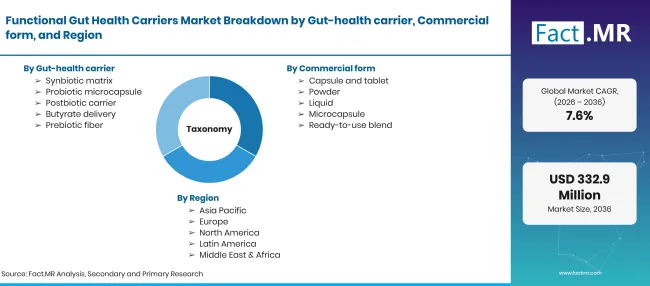
Functional Gut Health Carriers Taxonomy | Source: Fact.MR
| Items | Values |
|---|---|
| Quantitative Units (2026) | USD 160.0 Million |
| Gut-health carrier | Prebiotic fiber, Probiotic microcapsule, Postbiotic carrier; Butyrate delivery; Synbiotic matrix |
| Commercial form | Powder, Capsule / tablet, Liquid; Microcapsule; Ready-to-use blend |
| End application | Clinical nutrition, Supplements, Functional foods; Infant / pediatric; Specialized medical |
| Sales channel | Ingredient OEM, Medical nutrition brand, Hospital procurement; Pharmacy; Direct consumer |
| Regions Covered | North America, Latin America, Europe; East Asia; South Asia and Pacific; Middle East & Africa |
| Countries Covered | China, United States, Denmark; Germany; Japan; and other countries |
| Key Companies Profiled | DSM-Firmenich, Lonza, Balchem; Kerry Group; Glanbia Nutritionals; IFF |
| Additional Attributes | Dollar revenue in the Functional Gut Health Carriers Market is segmented by gut-health carrier (prebiotic fiber, probiotic microcapsule, postbiotic carrier; butyrate delivery; synbiotic matrix); commercial form (powder; capsule / tablet; liquid; microcapsule; ready-to-use blend); end application (clinical nutrition; supplements; functional foods; infant / pediatric; specialized medical); sales channel (ingredient oem; medical nutrition brand; hospital procurement; pharmacy; direct consumer) and region. |
Source: Fact.MR analysis. Updated Nov 19, 2026
Functional Gut Health Carriers Market by Segments
-
Gut-health carrier
- Prebiotic fiber
- Probiotic microcapsule
- Postbiotic carrier
- Butyrate delivery
- Synbiotic matrix
-
Commercial form
- Powder
- Capsule / tablet
- Liquid
- Microcapsule
- Ready-to-use blend
-
End application
- Clinical nutrition
- Supplements
- Functional foods
- Infant / pediatric
- Specialized medical
-
Sales channel
- Ingredient OEM
- Medical nutrition brand
- Hospital procurement
- Pharmacy
- Direct consumer
-
Region:
- North America
- United States
- Canada
- Mexico
- Europe
- Germany
- United Kingdom
- France
- Italy
- Spain
- Rest of Europe
- Asia Pacific
- China
- India
- Japan
- South Korea
- Australia
- Rest of Asia Pacific
- Latin America
- Brazil
- Mexico
- Argentina
- Rest of Latin America
- Middle East & Africa
- GCC Countries
- South Africa
- Rest of Middle East & Africa
- North America
Frequently Asked Questions
How big is the global Functional Gut Health Carriers Market in 2026?
What will be the size of the Functional Gut Health Carriers Market by 2036?
How fast will the Functional Gut Health Carriers Market grow during the forecast period?
Which gut-health carrier segment holds the largest share of the Functional Gut Health Carriers Market?
Who worked on this report


Preview the report firsthand - request a free sample
Free SampleGet the brochure for pricing and purchase details
Download PDF