- Market Value (2025): USD 148.7 Mn
- Estimated Value (2026): USD 160.0 Mn
- Forecast Value (2036): USD 332.9 Mn
- CAGR (2026-2036): 7.6%
Microencapsulated Nutrient Systems Market Forecast and Outlook 2026 to 2036
The microencapsulated nutrient systems market was valued at approximately USD 148.7 million in 2025 and USD 160.0 million in 2026. It is set to reach USD 332.9 million by 2036, expanding at a CAGR of 7.6% during the 2026 to 2036 assessment period.
Food, infant formula and supplement manufacturers are increasingly using microencapsulation to protect sensitive nutrients such as vitamins, minerals and omega-3 fatty acids from oxygen; heat; moisture and unwanted ingredient interactions. The technology also helps mask unpleasant flavours, including the fishy taste of omega-3 oils and metallic notes associated with iron.
For example, dsm-firmenich offers encapsulated omega-3 DHA ingredients for infant nutrition and fortified food applications. These formulation needs are creating opportunities for microencapsulated nutrient systems across specialised nutrition and food manufacturing.
Key Takeaways from the Microencapsulated Nutrient Systems Market
- Sales of microencapsulated nutrient systems reached USD 148.7 million in 2025.
- Microencapsulated Nutrient Systems Market Value (2026): USD 160.0 million.
- Microencapsulated Nutrient Systems Market Forecast Value (2036): USD 332.9 million.
- Microencapsulated Nutrient Systems Market CAGR (2026–2036): 7.6%.
- Leading Nutrient Encapsulation Carrier: Lipid (30.3%).
- Key Market Participants: DSM-Firmenich, Lonza, Balchem; Kerry Group; Glanbia Nutritionals and IFF.
- Key Growth Regions: India, China, United States; Germany and Japan.
Government nutrition initiatives and commercial food fortification programmes are keeping micronutrient stability in focus. India's fortified rice programme, for example, was reviewed in February 2026 after concerns emerged about nutrient losses during prolonged storage. The government temporarily discontinued the fortification process until a more effective nutrient delivery mechanism could be developed.
This decision highlights the importance of improving nutrient retention, packaging and storage performance in large-scale fortification applications. Similar formulation challenges create opportunities for advanced nutrient protection technologies in food and nutrition manufacturing.
Microencapsulated Nutrient Systems Market
| Metric | Value |
|---|---|
| Estimated Value in 2025 | USD 148.7 million |
| Estimated Value in 2026 | USD 160.0 million |
| Forecast Value in 2036 | USD 332.9 million |
| Forecast CAGR (2026 to 2036) | 7.6% |
Source: Fact.MR analysis. Updated Nov 19, 2026
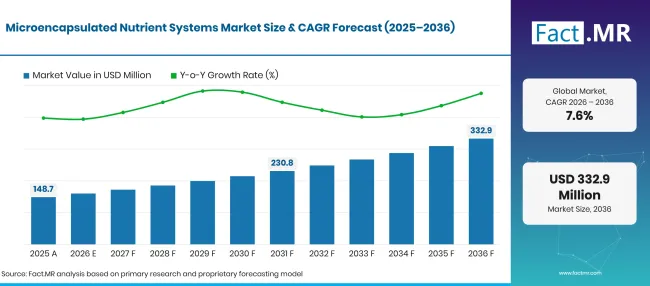
Microencapsulated Nutrient Systems Forecast Global | Source: Fact.MR
Category
| Category | Segments |
|---|---|
| Nutrient encapsulation carrier | Lipid, Polysaccharide, Protein; Cyclodextrin; Hybrid multilayer |
| Commercial form | Powder, Capsule / tablet, Liquid; Microcapsule; Ready-to-use blend |
| End application | Clinical nutrition, Supplements, Functional foods; Infant / pediatric; Specialized medical |
| Sales channel | Ingredient OEM, Medical nutrition brand, Hospital procurement; Pharmacy; Direct consumer |
| Region | India, China, United States; Germany; Japan |
Source: Fact.MR analysis. Updated Nov 19, 2026
Segmental Analysis
Why do Lipid carriers lead encapsulation demand in the Microencapsulated Nutrient Systems Market?
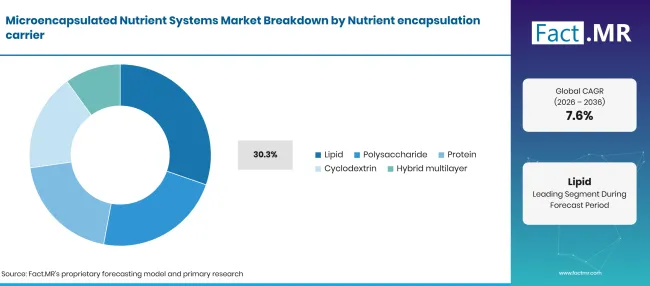
Microencapsulated Nutrient Systems Breakdown Nutrient Encapsulation Carrier | Source: Fact.MR
Lipid-based coatings create a protective barrier against oxygen and moisture, making them suitable for sensitive nutrients such as omega-3 fatty acids and fat-soluble vitamins. These characteristics help lipid carriers secure the leading position, accounting for 30.3% of market revenue in 2026, equivalent to approximately USD 48.5 million. Polysaccharide and cyclodextrin carriers follow as alternative encapsulation materials.
Manufacturers are developing lipid-coated nutrient premixes that can be incorporated into existing food and supplement production processes. The European Food Safety Authority's scientific work on supplemental DHA also keeps attention on safe intake levels and formulation requirements. These considerations encourage manufacturers to balance nutrient protection, dosage accuracy and product stability when selecting lipid-based encapsulation systems.
Why do Liquid formats lead commercial-form demand in the Microencapsulated Nutrient Systems Market?
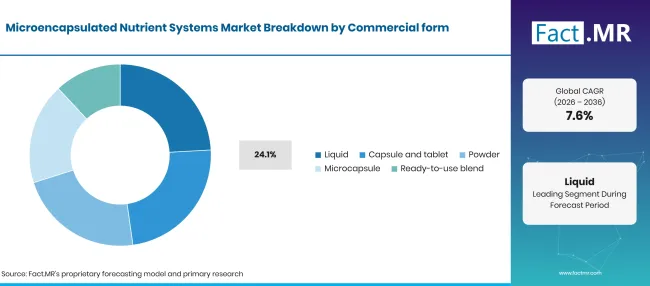
Microencapsulated Nutrient Systems Breakdown Commercial Form | Source: Fact.MR
Liquid formulations hold 24.1% of market revenue in 2026, equivalent to approximately USD 38.6 million. Their position is linked to the use of nutritional emulsions in infant formula, oral nutrition drinks and specialised dietary products. Encapsulation technologies help maintain the stability of sensitive nutrients in liquid matrices and reduce unwanted interactions with other ingredients. Ready-to-use blends and powders also serve manufacturers looking for convenient nutrient incorporation formats.
In April 2026, the U.S. Food and Drug Administration released findings from its largest infant formula contaminant testing programme. The agency tested more than 300 infant formula samples and generated over 120,000 data points. Although the exercise focused on product safety rather than encapsulation performance, it highlighted the importance of ingredient quality, manufacturing controls and product consistency in infant nutrition. These factors influence formulation decisions involving protected nutrients in liquid products.
Why does Infant / pediatric lead end-application demand in the Microencapsulated Nutrient Systems Market?
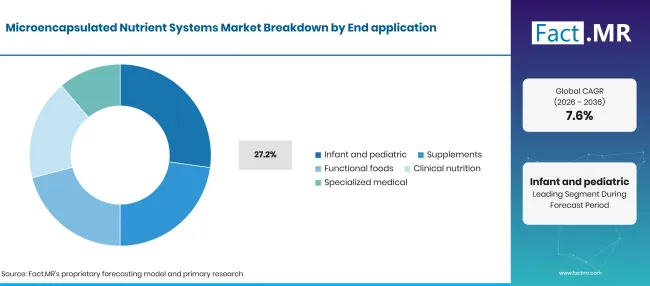
Microencapsulated Nutrient Systems Breakdown End Application | Source: Fact.MR
Infant and pediatric nutrition accounts for 27.2% of market revenue in 2026, equivalent to approximately USD 43.5 million. Infant formula manufacturers work with sensitive nutrients such as DHA, ARA, iron and vitamins; which must retain their quality throughout processing and storage. Microencapsulation helps protect these ingredients and maintain consistent nutrient distribution in specialised formulations. Clinical nutrition follows as another important application.
The U.S. FDA announced its proposed infant formula nutrient requirements update on 29 October 2026. The first phase of the agency's review covers eight nutrients and proposes changes to specifications for vitamin A, vitamin D, iodine and manganese; among others. The proposed minimum vitamin D level would increase from 1 μg to 2 μg per 100 kcal. Such regulatory reviews keep nutrient composition, dosage accuracy and formulation stability in focus among infant formula manufacturers.
Why does Pharmacy lead sales-channel demand in the Microencapsulated Nutrient Systems Market?
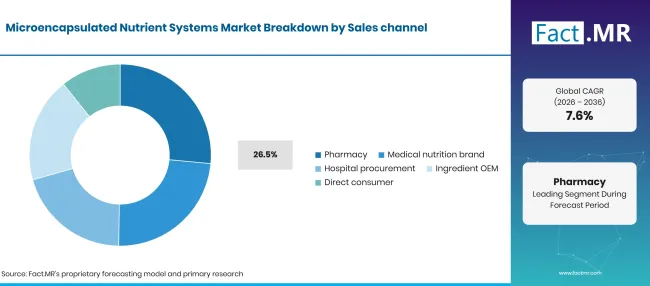
Microencapsulated Nutrient Systems Breakdown Sales Channel | Source: Fact.MR
Pharmacies account for 26.5% of market revenue in 2026, equivalent to approximately USD 42.4 million. Their position is linked to the sale of vitamin supplements, specialised nutritional products and products targeting specific dietary requirements. Direct consumer sales and medical nutrition brands also contribute to the distribution of encapsulated nutrient formulations.
The U.S. Centers for Disease Control and Prevention reported in May 2026 that 35.7% of young people aged 0–19 years and 60.2% of adults aged 20 years and older had used a dietary supplement during the previous 30 days. These findings indicate a substantial consumer base for nutritional supplements, although the survey does not identify pharmacy sales separately. The figures help explain the wider commercial relevance of supplement distribution channels.
Microencapsulated Nutrient Systems Market - Drivers, Restraints & Trends
Driver: Expansion of Food Fortification Programmes to Address Micronutrient Deficiencies
Government initiatives and commercial food fortification activities are creating opportunities for microencapsulated nutrient systems because iron, vitamins and minerals must retain their nutritional quality during processing and storage. Food manufacturers are exploring improved nutrient protection technologies to limit degradation, unwanted flavour changes and nutrient losses. India's fortified rice initiative illustrates the importance of this requirement. In February 2026, the government temporarily discontinued rice fortification after a review identified nutrient stability concerns during prolonged storage. This development has brought the need for more reliable nutrient delivery and storage technologies into focus.
Restraint: High Encapsulation Costs and Bioavailability Testing Limit Wider Adoption
The higher cost of encapsulated ingredients compared with conventional vitamins and minerals creates challenges for manufacturers operating with limited product budgets. Companies must also establish that nutrients retain their bioavailability after encapsulation, since improved stability does not automatically guarantee effective absorption by the body. Additional testing, material selection and formulation adjustments increase production expenses. These factors can discourage smaller manufacturers, particularly those serving price-sensitive food and supplement markets, from adopting specialised encapsulation technologies.
Trend: Wider Use of Nutrient Fortification in Everyday Foods
Food fortification is extending beyond specialised nutrition products as manufacturers explore the addition of iron, vitamins and minerals to commonly consumed foods such as rice, flour; dairy products and packaged staples. China's Food and Nutrition Development Outline for 2025–2030, issued by the Ministry of Agriculture and Rural Affairs, the National Health Commission and the Ministry of Industry and Information Technology; places emphasis on improving food quality and nutritional intake. This policy direction creates opportunities for advanced nutrient delivery technologies in fortified food manufacturing.
Trend: Shift Towards Naturally Derived Encapsulation Materials
Food manufacturers are paying closer attention to encapsulation materials as clean-label preferences influence ingredient selection. Interest in plant-derived materials, including starches and plant proteins, is creating opportunities for polysaccharide- and protein-based encapsulation systems. These materials can serve as alternatives to conventional carrier ingredients, depending on nutrient compatibility and processing requirements. By 2036, manufacturers developing naturally sourced and technically reliable encapsulation materials could gain opportunities across functional foods, dietary supplements and specialised nutrition products.
Microencapsulated Nutrient Systems Market Analysis by Key Country
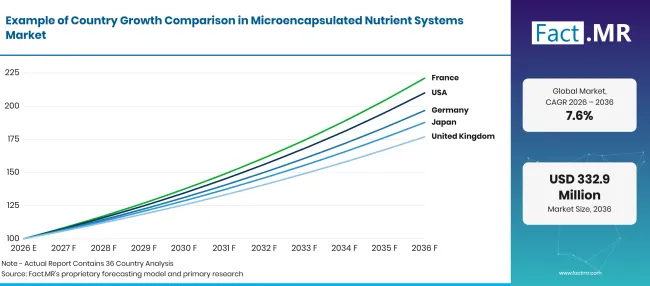
Microencapsulated Nutrient Systems Growth Index | Source: Fact.MR
| Country | CAGR (2026–2036) |
|---|---|
| India | 9.9% |
| China | 9.2% |
| United States | 7.7% |
| Germany | 7.0% |
| Japan | 6.5% |
Source: Fact.MR analysis. Updated Nov 19, 2026
Why is India the fastest-growing market for microencapsulated nutrient systems?
India is set to record the fastest growth at a CAGR of 9.9% during the assessment period.
The country's large food processing industry, nutritional supplement manufacturing base and focus on micronutrient deficiencies create opportunities for specialised nutrient delivery technologies. In February 2026, the government temporarily discontinued fortified rice distribution under PMGKAY and related welfare schemes after identifying nutrient stability and storage concerns. The review highlighted the need for improved nutrient retention during prolonged storage. Manufacturers are also exploring opportunities in fortified packaged foods, dietary supplements and specialised nutrition formulations.
What is driving microencapsulated nutrient demand in China?
China's microencapsulated nutrient systems market is set to expand at a CAGR of 9.2% between 2026 and 2036.
Food manufacturers are placing greater attention on nutritional quality, particularly in products targeting children and health-conscious consumers. The country's Food and Nutrition Development Outline (2025–2030), issued on 27 February 2025, emphasises balanced nutrition; improved food quality and innovation in food processing. These priorities create opportunities for encapsulated nutrients in fortified foods, infant nutrition and dietary supplements. Manufacturers are also focusing on protecting sensitive ingredients against processing-related degradation.
What is shaping microencapsulated nutrient sales in the United States?
The United States market is set to grow at a CAGR of 7.7% during the forecast period.
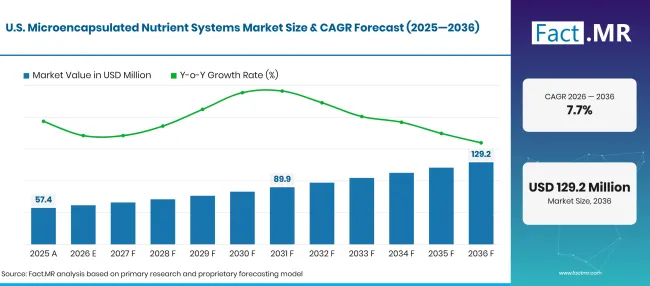
Microencapsulated Nutrient Systems Forecast Usa | Source: Fact.MR
The expansion of specialised nutrition products and regulatory attention towards infant formula composition are creating opportunities for advanced nutrient delivery technologies. In March 2025, the FDA and HHS announced Operation Stork Speed to improve infant formula safety, nutritional adequacy and supply resilience. The initiative includes a comprehensive review of infant formula nutrient requirements and expanded product testing. These activities keep ingredient quality, formulation accuracy and nutrient stability in focus among manufacturers of infant formula, fortified beverages and dietary supplements.
What is shaping microencapsulated nutrient demand in Germany?
Germany's microencapsulated nutrient systems market is set to expand at a CAGR of 7.0% between 2026 and 2036.
The country's dietary supplement manufacturing industry creates opportunities for encapsulated vitamins, minerals and other sensitive ingredients. According to Destatis, Germany produced approximately 241,000 tonnes of dietary supplements in 2025; with a production value exceeding EUR 2.08 billion. The figures were published on 3 November 2026. This manufacturing activity supports opportunities for nutrient protection technologies in supplements, functional foods and specialised nutritional products.
Why is microencapsulated nutrient growth slower in Japan?
Japan's microencapsulated nutrient systems market is set to grow at a CAGR of 6.5% during the assessment period.
An ageing population and greater attention to nutritional intake among older consumers are influencing the country's supplement and functional food industries. In 2025, Japan's Ministry of Health, Labour and Welfare published the revised Dietary Reference Intakes for Japanese; applicable from fiscal 2025 through fiscal 2029. The guidelines establish nutritional reference values across different age groups. These recommendations create opportunities for encapsulated vitamins and minerals in elderly nutrition, dietary supplements and functional foods.
Competitive Landscape for Microencapsulated Nutrient Systems Market
The microencapsulated nutrient systems market includes large nutrition ingredient manufacturers and companies specialising in encapsulation technologies. dsm-firmenich, IFF, Kerry Group and Glanbia Nutritionals compete through broad nutrient portfolios; specialised ingredients and customised premixes. Balchem focuses on encapsulation and ingredient delivery technologies, while Lonza participates in specialised ingredient and nutraceutical delivery solutions. Manufacturers generally evaluate these offerings based on nutrient stability, bioavailability, taste retention; formulation compatibility and production costs.
Since 2024, greater attention to food fortification, specialised nutrition and naturally derived encapsulation materials has influenced product development. Companies with established encapsulation expertise, reliable stability data and experience in large-scale nutritional applications are better positioned to address the formulation needs of food, supplement and infant nutrition manufacturers.
Recent Developments
- On October 15, 2025, BASF launched Lutavit® A/D3 1000/200 NXT; a microencapsulated formulation combining vitamins A and D3 in a single product for animal nutrition.
- Balchem's December 2025 facility announcement is directly relevant to microencapsulated nutrient systems. Added production infrastructure can strengthen the ability to manufacture protected nutrient ingredients for food and supplement applications.
- In October 2025, Lonza launched Organicaps™, its first USDA-certified organic; plant-based pullulan capsule for the nutraceutical market. The capsules offer oxygen protection for organic supplement formulations.
- On November 4, 2025, Cargill completed an expansion of its micronutrition facility in Engerwitzdorf; Austria; increasing annual production capacity by 50% to 30;000 metric tons.
- On March 26, 2025, dsm-firmenich partnered with MedAccess to make vitamin A more affordable for edible oil fortification in low- and middle-income countries. The partnership aims to improve access to fortified cooking oil and address nutritional deficiencies.
Key Players in Microencapsulated Nutrient Systems Market
Key companies operating in the market include DSM-Firmenich, BASF SE, Balchem Corporation, Lonza Group, Kerry Group, Glanbia Nutritionals, International Flavors & Fragrances (IFF), and Cargill, Incorporated.
- DSM-Firmenich
- BASF SE
- Balchem Corporation
- Lonza Group
- Kerry Group
- Glanbia Nutritionals
- International Flavors & Fragrances (IFF)
- Cargill, Incorporated
Scope of Report
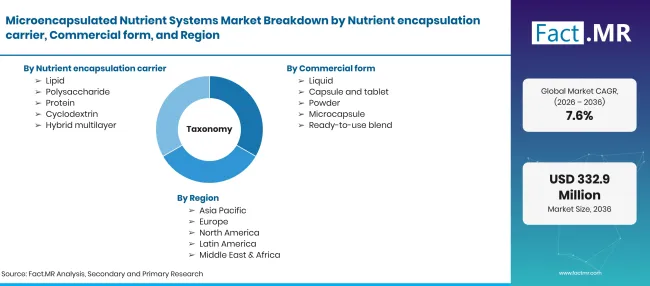
Microencapsulated Nutrient Systems Taxonomy | Source: Fact.MR
| Items | Values |
|---|---|
| Quantitative Units (2026) | USD 160.0 million |
| Nutrient encapsulation carrier | Lipid, Polysaccharide, Protein; Cyclodextrin; Hybrid multilayer |
| Commercial form | Powder, Capsule / tablet, Liquid; Microcapsule; Ready-to-use blend |
| End application | Clinical nutrition, Supplements, Functional foods; Infant / pediatric; Specialized medical |
| Sales channel | Ingredient OEM, Medical nutrition brand, Hospital procurement; Pharmacy; Direct consumer |
| Regions Covered | North America, Latin America, Europe; East Asia; South Asia and Pacific; Middle East & Africa |
| Countries Covered | India, China, United States; Germany; Japan and other countries |
| Key Companies Profiled | DSM-Firmenich, Lonza, Balchem; Kerry Group; Glanbia Nutritionals; IFF |
| Additional Attributes | Dollar revenue in the Microencapsulated Nutrient Systems Market is segmented by nutrient encapsulation carrier (lipid, polysaccharide, protein; cyclodextrin; hybrid multilayer); commercial form (powder; capsule / tablet; liquid; microcapsule; ready-to-use blend); end application (clinical nutrition; supplements; functional foods; infant / pediatric; specialized medical); sales channel (ingredient OEM; medical nutrition brand; hospital procurement; pharmacy; direct consumer) and region. |
Source: Fact.MR analysis. Updated Nov 19, 2026
Microencapsulated Nutrient Systems Market by Segments
-
Nutrient encapsulation carrier
- Lipid
- Polysaccharide
- Protein
- Cyclodextrin
- Hybrid multilayer
-
Commercial form
- Powder
- Capsule / tablet
- Liquid
- Microcapsule
- Ready-to-use blend
-
End application
- Clinical nutrition
- Supplements
- Functional foods
- Infant / pediatric
- Specialized medical
-
Sales channel
- Ingredient OEM
- Medical nutrition brand
- Hospital procurement
- Pharmacy
- Direct consumer
-
Region
- North America
- United States
- Canada
- Mexico
- Europe
- Germany
- United Kingdom
- France
- Italy
- Spain
- Rest of Europe
- Asia Pacific
- China
- India
- Japan
- South Korea
- Australia
- Rest of Asia Pacific
- Latin America
- Brazil
- Mexico
- Argentina
- Rest of Latin America
- Middle East & Africa
- GCC Countries
- South Africa
- Rest of Middle East & Africa
- North America
Bibliography
- Centers for Disease Control and Prevention. (2026, May). Dietary supplement use: United States, August 2021–August 2023 (NCHS Data Brief No. 561). National Center for Health Statistics.
- Destatis. (2026, November 3). Produktion von Nahrungsergänzungsmitteln seit 2019 um 48,4 % gestiegen. Federal Statistical Office of Germany.
- Food Safety and Standards Authority of India. (2021). Food Safety and Standards (Fortification of Foods) Regulations, 2018: Compendium.
- Ministry of Agriculture and Rural Affairs, National Health Commission, & Ministry of Industry and Information Technology. (2025, February 27). China Food and Nutrition Development Outline (2025–2030). Government of China.
- Ministry of Health, Labour and Welfare. (2025). Dietary Reference Intakes for Japanese (2025). Government of Japan.
- Press Information Bureau. (2026, February 27). Recalibration of nutrition intervention – Temporary discontinuation of rice fortification. Ministry of Consumer Affairs, Food and Public Distribution, Government of India.
- U.S. Food and Drug Administration. (2025, March 18). HHS, FDA announce Operation Stork Speed to expand options for safe, reliable; and nutritious infant formula for American families.
- U.S. Food and Drug Administration. (2026). FDA's infant formula product testing results
- U.S. Food and Drug Administration. (2026, October 29). Infant formula notice of proposed rulemaking: Infant formula nutrient requirements.
Frequently Asked Questions
How big is the global Microencapsulated Nutrient Systems Market in 2026?
What will be the size of the Microencapsulated Nutrient Systems Market by 2036?
How fast will the Microencapsulated Nutrient Systems Market grow during the forecast period?
Which nutrient encapsulation carrier segment holds the largest share of the Microencapsulated Nutrient Systems Market?
Who worked on this report


Preview the report firsthand - request a free sample
Free SampleGet the brochure for pricing and purchase details
Download PDF