Biodegradable Wrap Systems Market (2026 - 2036)
Biodegradable Wrap Systems Market Size and Share Forecast Outlook 2026 to 2036
Core Findings
Biodegradable Wrap Systems Market Forecast and Outlook 2026 to 2036
The biodegradable wrap systems market is anticipated to grow from USD 1.1 billion in 2026 to USD 2.7 billion in 2036 at a CAGR of 9.3%.
Key Takeaways from Biodegradable Wrap Systems Market
- Market Value (2026): USD 1.1 billion
- Market Forecast Value (2036): USD 2.7 billion
- Market Forecast CAGR: 9.3%
- Leading Material Type: Plant-Based Wraps (34.7%)
- Leading Application: Food Storage (29.3%)
- Key Growth Regions: China, India, Brazil, Germany, USA, UK, Japan
- Key Players: Glad, Saran, AEP Industries, Polyvinyl Films, Wrap Film Systems, Lakeland, Wrapex, Linpac Packaging, Melitta, Comcoplast, Fora, Victorgroup, Wentus Kunststoff, Sphere
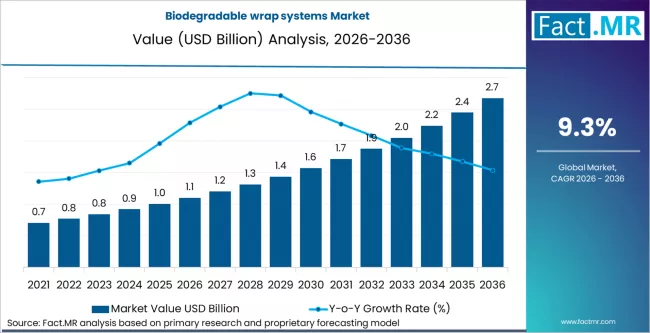
Plant-based wraps dominate the material type segment, followed by beeswax wraps, muslin wraps, pulp-based wraps, and compostable films. Food storage is the leading application, supported by takeout and delivery packaging, lunch packing, market produce wrapping, and baking and cooking uses, reflecting broad versatility across consumer and commercial applications.
Market expansion is reinforced by rising consumer environmental awareness, policies incentivizing plastic alternatives, and increased product accessibility in emerging economies. High-growth regions such as China and India are spearheading adoption, while mature markets including the United States, Germany, and Japan are focusing on premium biodegradable options and functional design improvements. Companies offering a combination of performance, sustainability, and affordability are well-positioned to capture long-term market share.
Biodegradable Wrap Systems Market
| Metric | Value |
|---|---|
| Market Value 2026 | USD 1.1 Billion |
| Market Forecast Value 2036 | USD 2.7 Billion |
| Forecast CAGR 2026 to 2036 | 9.3% |
Category
| Category | Segments |
|---|---|
| Material Type | Plant-Based Wraps; Beeswax Wraps; Muslin Wraps; Pulp-Based Wraps; Compostable Films; Other |
| Application | Food Storage; Packaging for Takeout and Delivery; Lunch Packing; Market Produce Wrapping; Baking and Cooking Uses; Other |
| Distribution Channel | Retail; E-commerce; Food Service Suppliers; Other |
| End User | Consumers; Restaurants; Food Retailers; Other |
| Region | North America; Europe; Asia Pacific; Latin America; Middle East & Africa |
Segmental Analysis
Which Material Type Holds the Largest Share in the Biodegradable Wrap Systems Market?
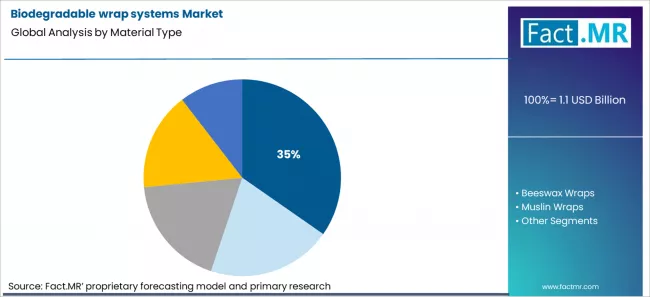
Plant-based wraps lead the market with a 34.7% share. These wraps are valued for their natural composition, compostability, and suitability for a range of food applications, making them a preferred choice among environmentally conscious consumers and commercial users. Their combination of functionality and eco-friendly properties drives adoption in both household and professional settings.
- Manufacturers continue to enhance plant-based wraps with improved flexibility, durability, and barrier performance.
- Increasing consumer demand for sustainable alternatives ensures plant-based wraps remain the dominant material type in the market.
Which Application Drives the Highest Demand in the Biodegradable Wrap Systems Market?
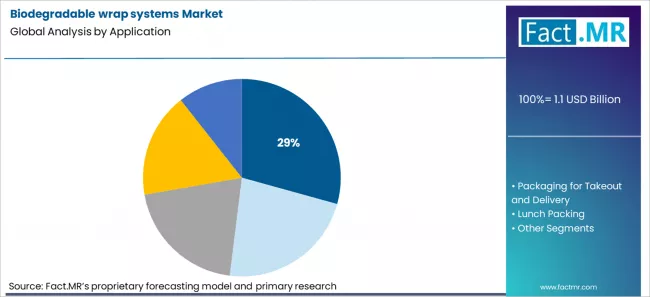
Food storage accounts for the largest share at 29.3%. Biodegradable wraps are widely used for preserving freshness, preventing contamination, and reducing reliance on single-use plastics. The segment benefits from both consumer awareness of sustainability and operational adoption in foodservice environments.
- Companies are positioning food storage solutions as environmentally responsible alternatives to conventional plastic wraps.
- Growing focus on reducing food packaging waste reinforces food storage as the primary application segment in the market.
What are the Drivers, Restraints, and Key Trends in the Biodegradable Wrap Systems Market?
- Drivers: Increasing regulatory pressure to reduce single use plastics and growing consumer preference for eco friendly alternatives are expanding demand for plant based wraps, beeswax wraps, muslin wraps, pulp based wraps, and compostable films in food storage, takeout packaging, lunch packing, and produce wrapping. Manufacturers are investing in next generation biopolymers to improve barrier performance and food contact compliance, prompting broader rollout of biodegradable wrap products by established packaging companies. Rising environmental awareness and coordinated industry initiatives to reduce plastic waste are supporting adoption in households and food service sectors across China, India, Brazil, Germany, the U.S., the U.K., and Japan.
- Restraints: Widespread adoption is limited by higher material and production costs relative to conventional plastic wraps, and by inconsistent composting infrastructure across regions. Some food service operators and retailers delay deployment due to challenges in verifying compostable claims and meeting diverse regional food safety and packaging standards, which can slow procurement and integration into existing supply chains.
- Trend 1: Development of durable and transparent biodegradable films that balance performance with compostability, enabling broader use in food storage, delivery, and baking applications.
- Trend 2: Expansion of distribution through specialty and online retail channels, improving accessibility for eco aware consumers and supporting uptake of biodegradable wrap solutions in both household and commercial settings.
Analysis of the Biodegradable Wrap Systems Market by Key Country
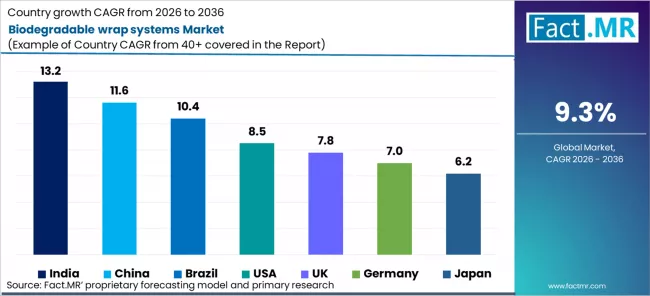
| Country | CAGR |
|---|---|
| China | 11.6% |
| India | 13.2% |
| Brazil | 10.4% |
| Germany | 7.0% |
| USA | 8.5% |
| UK | 7.8% |
| Japan | 6.2% |
How Are Sustainable Practices Driving Biodegradable Wrap Systems Demand in China?
The Biodegradable Wrap Systems market in China is projected to grow at a CAGR of 11.6% from 2026 to 2036. Urban consumers and commercial food operators are increasingly adopting eco-friendly wraps for food storage and packaging. Plant-based and compostable materials are gaining traction due to growing environmental awareness. Retailers and specialty stores are expanding availability, while e-commerce platforms enhance accessibility. Demand is concentrated in metropolitan areas where sustainability initiatives and regulatory guidance encourage the use of biodegradable alternatives.
Why Is India Emerging as a High-Growth Market for Biodegradable Wrap Systems?
India’s market is expected to expand at a CAGR of 13.2% from 2026 to 2036. Plant-based wraps are widely adopted for food storage and packaging in commercial and household settings. Urban consumers are increasingly aware of environmental impact and prefer reusable and biodegradable options. Retail networks and online channels facilitate product access, while rising disposable income and lifestyle changes support adoption of sustainable packaging solutions in metropolitan regions.
What Factors Are Influencing Biodegradable Wrap Systems Demand in Brazil?
Brazil’s Biodegradable Wrap Systems market is projected to grow at a CAGR of 10.4% from 2026 to 2036. Beeswax wraps are gaining popularity for takeout, delivery, and food preservation applications. Specialty stores, supermarkets, and local distributors are expanding product accessibility. Urban consumers show strong preference for reusable and environmentally friendly alternatives. Growing awareness of plastic reduction initiatives and sustainable packaging practices supports steady adoption across metropolitan and semi-urban areas.
How Are Functional Applications Supporting Biodegradable Wrap Systems Growth in Germany?
Germany’s market is expected to expand at a CAGR of 7.0% from 2026 to 2036. Muslin wraps for lunch packing and home food storage are increasingly preferred by urban households. Retailers emphasize biodegradable and reusable packaging solutions to meet consumer demand for sustainability. Urban adoption is reinforced by environmental regulations, corporate sustainability initiatives, and growing awareness of eco-friendly food packaging alternatives in daily life.
Why Does the USA Remain a Key Market for Biodegradable Wrap Systems?
The USA Biodegradable Wrap Systems market is projected to grow at a CAGR of 8.5% from 2026 to 2036. Pulp-based wraps are widely adopted for market produce wrapping and household food storage. Retailers and online platforms provide broad access, while environmentally conscious consumers increasingly favor biodegradable and compostable materials. Adoption is further supported by urban initiatives promoting sustainable packaging and efforts to reduce single-use plastics across commercial and residential settings.
What Is Supporting Biodegradable Wrap Systems Adoption in the UK?
The UK market is expected to expand at a CAGR of 7.8% from 2026 to 2036. Compostable films for baking, cooking, and food storage are gaining traction among urban consumers. Retailers and specialty stores are enhancing availability to meet growing demand for sustainable solutions. Awareness campaigns and lifestyle trends promoting eco-conscious practices encourage adoption of biodegradable wraps in metropolitan areas and commercial food service channels.
How Is Market Maturity Affecting Biodegradable Wrap Systems Demand in Japan?
Japan’s Biodegradable Wrap Systems market is projected to grow at a CAGR of 6.2% from 2026 to 2036. Urban households and commercial kitchens prioritize plant-based and pulp-derived wraps for food storage, packaging, and cooking applications. Mature retail networks and high consumer expectations for product quality and safety influence purchasing decisions. Both domestic and international brands compete to offer efficient, eco-friendly wrap solutions, sustaining adoption in metropolitan areas despite a mature market environment.
How is Competition Structured in the Biodegradable Wrap Systems Market?
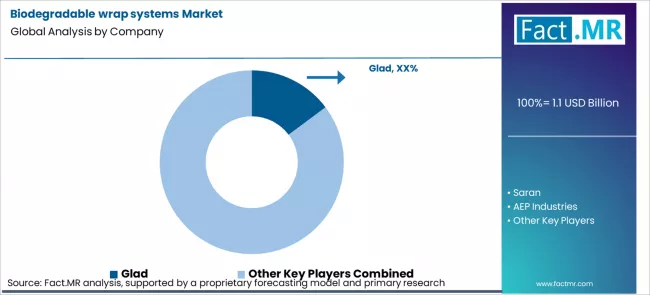
Competition in the Biodegradable Wrap Systems Market is focused on material performance, versatility of application, and convenience. Glad and Saran lead with plant-based and beeswax wraps targeting food storage and packaging for takeout and delivery. AEP Industries and Polyvinyl Films focus on muslin and pulp-based wraps, serving lunch packing and market produce wrapping needs.
Wrap Film Systems, Lakeland, Wrapex, Linpac Packaging, Melitta, Comcoplast, Fora, Victorgroup, Wentus Kunststoff, and Sphere differentiate through compostable films and specialty wraps for baking, cooking, and niche packaging applications. Competitive advantage arises from material quality, usability, and adaptability to diverse food handling requirements. Buyers evaluate suppliers based on product durability, application flexibility, and compatibility with operational workflows. From 2026 onward, strategies are expected to emphasize enhanced material performance, multi-use wrap solutions, and integration with retail and foodservice ecosystems, supported by R&D in plant-based and functional films to expand adoption across consumer and commercial segments.
Key Players in the Biodegradable Wrap Systems Market
- Glad
- Saran
- AEP Industries
- Polyvinyl Films
- Wrap Film Systems
- Lakeland
- Wrapex
- Linpac Packaging
- Melitta
- Comcoplast
- Fora
- Victorgroup
- Wentus Kunststoff
- Sphere
Scope of the Report
| Items | Values |
|---|---|
| Quantitative Units (2026) | USD 1.1 Billion |
| Material Type | Plant-Based Wraps, Beeswax Wraps, Muslin Wraps, Pulp-Based Wraps, Compostable Films, Other |
| Application | Food Storage, Packaging for Takeout and Delivery, Lunch Packing, Market Produce Wrapping, Baking and Cooking Uses, Other |
| Regions Covered | Asia Pacific, North America, Europe, Latin America, and Middle East & Africa |
| Countries Covered | China, India, Brazil, Germany, USA, UK, Japan, and other countries |
| Key Companies Profiled | Glad, Saran, AEP Industries, Polyvinyl Films, Wrap Film Systems, Lakeland, Wrapex, Linpac Packaging, Melitta, Comcoplast, Fora, Victorgroup, Wentus Kunststoff, Sphere, and other leading biodegradable wrap manufacturers |
| Additional Attributes | Dollar revenue by material type, application, and region; regional demand trends, competitive landscape, innovations in biodegradable and compostable wrap technology, sustainable packaging strategies, regulatory compliance trends, and brand positioning analysis |
Biodegradable Wrap Systems Market by Segments
-
Material Type :
- Plant-Based Wraps
- Beeswax Wraps
- Muslin Wraps
- Pulp-Based Wraps
- Compostable Films
-
Application :
- Food Storage
- Packaging for Takeout and Delivery
- Lunch Packing
- Market Produce Wrapping
- Baking and Cooking Uses
-
Region :
- North America
- U.S.
- Canada
- Mexico
- Europe
- Germany
- Italy
- UK
- France
- Spain
- Netherlands
- Switzerland
- Rest of Europe
- Asia Pacific
- Japan
- Australia
- South Korea
- China
- India
- Rest of Asia Pacific
- Latin America
- Brazil
- Argentina
- Rest of Latin America
- Middle East and Africa
- United Arab Emirates
- South Africa
- Rest of Middle East and Africa
- North America
Bibliography
- United Nations Environment Programme. (2023). Turning off the tap: how the world can end plastic pollution and create a circular economy. United Nations Environment Programme.
- Organisation for Economic Co-operation and Development. (2023). Global plastics outlook: economic drivers, environmental impacts and policy options. OECD.
- European Commission. (2024). Packaging and packaging waste regulation: impact assessment. European Commission.
- Food and Agriculture Organization of the United Nations. (2023). Food packaging and sustainability. FAO.
- International Organization for Standardization. (2023). Plastics: environmental aspects and biodegradable materials. ISO.
Table of Content
- Executive Summary
- Global Market Outlook
- Demand to side Trends
- Supply to side Trends
- Technology Roadmap Analysis
- Analysis and Recommendations
- Market Overview
- Market Coverage / Taxonomy
- Market Definition / Scope / Limitations
- Research Methodology
- Chapter Orientation
- Analytical Lens and Working Hypotheses
- Market Structure, Signals, and Trend Drivers
- Benchmarking and Cross-market Comparability
- Market Sizing, Forecasting, and Opportunity Mapping
- Research Design and Evidence Framework
- Desk Research Programme (Secondary Evidence)
- Company Annual and Sustainability Reports
- Peer-reviewed Journals and Academic Literature
- Corporate Websites, Product Literature, and Technical Notes
- Earnings Decks and Investor Briefings
- Statutory Filings and Regulatory Disclosures
- Technical White Papers and Standards Notes
- Trade Journals, Industry Magazines, and Analyst Briefs
- Conference Proceedings, Webinars, and Seminar Materials
- Government Statistics Portals and Public Data Releases
- Press Releases and Reputable Media Coverage
- Specialist Newsletters and Curated Briefings
- Sector Databases and Reference Repositories
- FMR Internal Proprietary Databases and Historical Market Datasets
- Subscription Datasets and Paid Sources
- Social Channels, Communities, and Digital Listening Inputs
- Additional Desk Sources
- Expert Input and Fieldwork (Primary Evidence)
- Primary Modes
- Qualitative Interviews and Expert Elicitation
- Quantitative Surveys and Structured Data Capture
- Why Primary Evidence is Used
- Field Techniques
- Interviews
- Surveys
- Focus Groups
- Observational and In-context Research
- Social and Community Interactions
- Stakeholder Universe Engaged
- C-suite Leaders
- Board Members
- Presidents and Vice Presidents
- R&D and Innovation Heads
- Technical Specialists
- Domain Subject-matter Experts
- Scientists
- Physicians and Other Healthcare Professionals
- Governance, Ethics, and Data Stewardship
- Research Ethics
- Data Integrity and Handling
- Primary Modes
- Tooling, Models, and Reference Databases
- Desk Research Programme (Secondary Evidence)
- Data Engineering and Model Build
- Data Acquisition and Ingestion
- Cleaning, Normalisation, and Verification
- Synthesis, Triangulation, and Analysis
- Quality Assurance and Audit Trail
- Market Background
- Market Dynamics
- Drivers
- Restraints
- Opportunity
- Trends
- Scenario Forecast
- Demand in Optimistic Scenario
- Demand in Likely Scenario
- Demand in Conservative Scenario
- Opportunity Map Analysis
- Product Life Cycle Analysis
- Supply Chain Analysis
- Investment Feasibility Matrix
- Value Chain Analysis
- PESTLE and Porter’s Analysis
- Regulatory Landscape
- Regional Parent Market Outlook
- Production and Consumption Statistics
- Import and Export Statistics
- Market Dynamics
- Global Market Analysis 2021 to 2025 and Forecast, 2026 to 2036
- Historical Market Size Value (USD Million) Analysis, 2021 to 2025
- Current and Future Market Size Value (USD Million) Projections, 2026 to 2036
- Y to o to Y Growth Trend Analysis
- Absolute $ Opportunity Analysis
- Global Market Pricing Analysis 2021 to 2025 and Forecast 2026 to 2036
- Global Market Analysis 2021 to 2025 and Forecast 2026 to 2036, By Material Type
- Introduction / Key Findings
- Historical Market Size Value (USD Million) Analysis By Material Type, 2021 to 2025
- Current and Future Market Size Value (USD Million) Analysis and Forecast By Material Type, 2026 to 2036
- Plant-Based Wraps
- Beeswax Wraps
- Muslin Wraps
- Pulp-Based Wraps
- Compostable Films
- Plant-Based Wraps
- Y to o to Y Growth Trend Analysis By Material Type, 2021 to 2025
- Absolute $ Opportunity Analysis By Material Type, 2026 to 2036
- Global Market Analysis 2021 to 2025 and Forecast 2026 to 2036, By Application
- Introduction / Key Findings
- Historical Market Size Value (USD Million) Analysis By Application, 2021 to 2025
- Current and Future Market Size Value (USD Million) Analysis and Forecast By Application, 2026 to 2036
- Food Storage
- Packaging for Takeout and Delivery
- Lunch Packing
- Market Produce Wrapping
- Baking and Cooking Uses
- Food Storage
- Y to o to Y Growth Trend Analysis By Application, 2021 to 2025
- Absolute $ Opportunity Analysis By Application, 2026 to 2036
- Global Market Analysis 2021 to 2025 and Forecast 2026 to 2036, By End User
- Introduction / Key Findings
- Historical Market Size Value (USD Million) Analysis By End User, 2021 to 2025
- Current and Future Market Size Value (USD Million) Analysis and Forecast By End User, 2026 to 2036
- Residential Consumers
- Food Service Industry
- Retail Stores
- Food Manufacturers
- Catering Services
- Residential Consumers
- Y to o to Y Growth Trend Analysis By End User, 2021 to 2025
- Absolute $ Opportunity Analysis By End User, 2026 to 2036
- Global Market Analysis 2021 to 2025 and Forecast 2026 to 2036, By Distribution Channel
- Introduction / Key Findings
- Historical Market Size Value (USD Million) Analysis By Distribution Channel, 2021 to 2025
- Current and Future Market Size Value (USD Million) Analysis and Forecast By Distribution Channel, 2026 to 2036
- Online Retail
- Hypermarkets or Supermarkets
- Specialty Stores
- Convenience Stores
- Direct Sales
- Online Retail
- Y to o to Y Growth Trend Analysis By Distribution Channel, 2021 to 2025
- Absolute $ Opportunity Analysis By Distribution Channel, 2026 to 2036
- Global Market Analysis 2021 to 2025 and Forecast 2026 to 2036, By Thickness Or Quality
- Introduction / Key Findings
- Historical Market Size Value (USD Million) Analysis By Thickness Or Quality, 2021 to 2025
- Current and Future Market Size Value (USD Million) Analysis and Forecast By Thickness Or Quality, 2026 to 2036
- Standard Thickness
- Heavy-Duty Quality
- Lightweight Options
- Extra-Thickness For Commercial Use
- Customized Quality For Specific Needs
- Standard Thickness
- Y to o to Y Growth Trend Analysis By Thickness Or Quality, 2021 to 2025
- Absolute $ Opportunity Analysis By Thickness Or Quality, 2026 to 2036
- Global Market Analysis 2021 to 2025 and Forecast 2026 to 2036, By Region
- Introduction
- Historical Market Size Value (USD Million) Analysis By Region, 2021 to 2025
- Current Market Size Value (USD Million) Analysis and Forecast By Region, 2026 to 2036
- North America
- Latin America
- Western Europe
- Eastern Europe
- East Asia
- South Asia and Pacific
- Middle East & Africa
- Market Attractiveness Analysis By Region
- North America Market Analysis 2021 to 2025 and Forecast 2026 to 2036, By Country
- Historical Market Size Value (USD Million) Trend Analysis By Market Taxonomy, 2021 to 2025
- Market Size Value (USD Million) Forecast By Market Taxonomy, 2026 to 2036
- By Country
- USA
- Canada
- Mexico
- By Material Type
- By Application
- By End User
- By Distribution Channel
- By Thickness Or Quality
- By Country
- Market Attractiveness Analysis
- By Country
- By Material Type
- By Application
- By End User
- By Distribution Channel
- By Thickness Or Quality
- Key Takeaways
- Latin America Market Analysis 2021 to 2025 and Forecast 2026 to 2036, By Country
- Historical Market Size Value (USD Million) Trend Analysis By Market Taxonomy, 2021 to 2025
- Market Size Value (USD Million) Forecast By Market Taxonomy, 2026 to 2036
- By Country
- Brazil
- Chile
- Rest of Latin America
- By Material Type
- By Application
- By End User
- By Distribution Channel
- By Thickness Or Quality
- By Country
- Market Attractiveness Analysis
- By Country
- By Material Type
- By Application
- By End User
- By Distribution Channel
- By Thickness Or Quality
- Key Takeaways
- Western Europe Market Analysis 2021 to 2025 and Forecast 2026 to 2036, By Country
- Historical Market Size Value (USD Million) Trend Analysis By Market Taxonomy, 2021 to 2025
- Market Size Value (USD Million) Forecast By Market Taxonomy, 2026 to 2036
- By Country
- Germany
- UK
- Italy
- Spain
- France
- Nordic
- BENELUX
- Rest of Western Europe
- By Material Type
- By Application
- By End User
- By Distribution Channel
- By Thickness Or Quality
- By Country
- Market Attractiveness Analysis
- By Country
- By Material Type
- By Application
- By End User
- By Distribution Channel
- By Thickness Or Quality
- Key Takeaways
- Eastern Europe Market Analysis 2021 to 2025 and Forecast 2026 to 2036, By Country
- Historical Market Size Value (USD Million) Trend Analysis By Market Taxonomy, 2021 to 2025
- Market Size Value (USD Million) Forecast By Market Taxonomy, 2026 to 2036
- By Country
- Russia
- Poland
- Hungary
- Balkan & Baltic
- Rest of Eastern Europe
- By Material Type
- By Application
- By End User
- By Distribution Channel
- By Thickness Or Quality
- By Country
- Market Attractiveness Analysis
- By Country
- By Material Type
- By Application
- By End User
- By Distribution Channel
- By Thickness Or Quality
- Key Takeaways
- East Asia Market Analysis 2021 to 2025 and Forecast 2026 to 2036, By Country
- Historical Market Size Value (USD Million) Trend Analysis By Market Taxonomy, 2021 to 2025
- Market Size Value (USD Million) Forecast By Market Taxonomy, 2026 to 2036
- By Country
- China
- Japan
- South Korea
- By Material Type
- By Application
- By End User
- By Distribution Channel
- By Thickness Or Quality
- By Country
- Market Attractiveness Analysis
- By Country
- By Material Type
- By Application
- By End User
- By Distribution Channel
- By Thickness Or Quality
- Key Takeaways
- South Asia and Pacific Market Analysis 2021 to 2025 and Forecast 2026 to 2036, By Country
- Historical Market Size Value (USD Million) Trend Analysis By Market Taxonomy, 2021 to 2025
- Market Size Value (USD Million) Forecast By Market Taxonomy, 2026 to 2036
- By Country
- India
- ASEAN
- Australia & New Zealand
- Rest of South Asia and Pacific
- By Material Type
- By Application
- By End User
- By Distribution Channel
- By Thickness Or Quality
- By Country
- Market Attractiveness Analysis
- By Country
- By Material Type
- By Application
- By End User
- By Distribution Channel
- By Thickness Or Quality
- Key Takeaways
- Middle East & Africa Market Analysis 2021 to 2025 and Forecast 2026 to 2036, By Country
- Historical Market Size Value (USD Million) Trend Analysis By Market Taxonomy, 2021 to 2025
- Market Size Value (USD Million) Forecast By Market Taxonomy, 2026 to 2036
- By Country
- Kingdom of Saudi Arabia
- Other GCC Countries
- Turkiye
- South Africa
- Other African Union
- Rest of Middle East & Africa
- By Material Type
- By Application
- By End User
- By Distribution Channel
- By Thickness Or Quality
- By Country
- Market Attractiveness Analysis
- By Country
- By Material Type
- By Application
- By End User
- By Distribution Channel
- By Thickness Or Quality
- Key Takeaways
- Key Countries Market Analysis
- USA
- Pricing Analysis
- Market Share Analysis, 2025
- By Material Type
- By Application
- By End User
- By Distribution Channel
- By Thickness Or Quality
- Canada
- Pricing Analysis
- Market Share Analysis, 2025
- By Material Type
- By Application
- By End User
- By Distribution Channel
- By Thickness Or Quality
- Mexico
- Pricing Analysis
- Market Share Analysis, 2025
- By Material Type
- By Application
- By End User
- By Distribution Channel
- By Thickness Or Quality
- Brazil
- Pricing Analysis
- Market Share Analysis, 2025
- By Material Type
- By Application
- By End User
- By Distribution Channel
- By Thickness Or Quality
- Chile
- Pricing Analysis
- Market Share Analysis, 2025
- By Material Type
- By Application
- By End User
- By Distribution Channel
- By Thickness Or Quality
- Germany
- Pricing Analysis
- Market Share Analysis, 2025
- By Material Type
- By Application
- By End User
- By Distribution Channel
- By Thickness Or Quality
- UK
- Pricing Analysis
- Market Share Analysis, 2025
- By Material Type
- By Application
- By End User
- By Distribution Channel
- By Thickness Or Quality
- Italy
- Pricing Analysis
- Market Share Analysis, 2025
- By Material Type
- By Application
- By End User
- By Distribution Channel
- By Thickness Or Quality
- Spain
- Pricing Analysis
- Market Share Analysis, 2025
- By Material Type
- By Application
- By End User
- By Distribution Channel
- By Thickness Or Quality
- France
- Pricing Analysis
- Market Share Analysis, 2025
- By Material Type
- By Application
- By End User
- By Distribution Channel
- By Thickness Or Quality
- India
- Pricing Analysis
- Market Share Analysis, 2025
- By Material Type
- By Application
- By End User
- By Distribution Channel
- By Thickness Or Quality
- ASEAN
- Pricing Analysis
- Market Share Analysis, 2025
- By Material Type
- By Application
- By End User
- By Distribution Channel
- By Thickness Or Quality
- Australia & New Zealand
- Pricing Analysis
- Market Share Analysis, 2025
- By Material Type
- By Application
- By End User
- By Distribution Channel
- By Thickness Or Quality
- China
- Pricing Analysis
- Market Share Analysis, 2025
- By Material Type
- By Application
- By End User
- By Distribution Channel
- By Thickness Or Quality
- Japan
- Pricing Analysis
- Market Share Analysis, 2025
- By Material Type
- By Application
- By End User
- By Distribution Channel
- By Thickness Or Quality
- South Korea
- Pricing Analysis
- Market Share Analysis, 2025
- By Material Type
- By Application
- By End User
- By Distribution Channel
- By Thickness Or Quality
- Russia
- Pricing Analysis
- Market Share Analysis, 2025
- By Material Type
- By Application
- By End User
- By Distribution Channel
- By Thickness Or Quality
- Poland
- Pricing Analysis
- Market Share Analysis, 2025
- By Material Type
- By Application
- By End User
- By Distribution Channel
- By Thickness Or Quality
- Hungary
- Pricing Analysis
- Market Share Analysis, 2025
- By Material Type
- By Application
- By End User
- By Distribution Channel
- By Thickness Or Quality
- Kingdom of Saudi Arabia
- Pricing Analysis
- Market Share Analysis, 2025
- By Material Type
- By Application
- By End User
- By Distribution Channel
- By Thickness Or Quality
- Turkiye
- Pricing Analysis
- Market Share Analysis, 2025
- By Material Type
- By Application
- By End User
- By Distribution Channel
- By Thickness Or Quality
- South Africa
- Pricing Analysis
- Market Share Analysis, 2025
- By Material Type
- By Application
- By End User
- By Distribution Channel
- By Thickness Or Quality
- USA
- Market Structure Analysis
- Competition Dashboard
- Competition Benchmarking
- Market Share Analysis of Top Players
- By Regional
- By Material Type
- By Application
- By End User
- By Distribution Channel
- By Thickness Or Quality
- Competition Analysis
- Competition Deep Dive
- Glad
- Overview
- Product Portfolio
- Profitability by Market Segments (Product/Age /Sales Channel/Region)
- Sales Footprint
- Strategy Overview
- Marketing Strategy
- Product Strategy
- Channel Strategy
- Saran
- AEP Industries
- Polyvinyl Films
- Wrap Film Systems
- Lakeland
- Wrapex
- Linpac Packaging
- Melitta
- Comcoplast
- Fora
- Victorgroup
- Wentus Kunststoff
- Sphere
- Glad
- Competition Deep Dive
- Assumptions & Acronyms Used
List Of Table
- Table 1: Global Market Value (USD Million) Forecast by Region, 2021 to 2036
- Table 2: Global Market Value (USD Million) Forecast by Material Type, 2021 to 2036
- Table 3: Global Market Value (USD Million) Forecast by Application, 2021 to 2036
- Table 4: Global Market Value (USD Million) Forecast by End User, 2021 to 2036
- Table 5: Global Market Value (USD Million) Forecast by Distribution Channel, 2021 to 2036
- Table 6: Global Market Value (USD Million) Forecast by Thickness Or Quality, 2021 to 2036
- Table 7: North America Market Value (USD Million) Forecast by Country, 2021 to 2036
- Table 8: North America Market Value (USD Million) Forecast by Material Type, 2021 to 2036
- Table 9: North America Market Value (USD Million) Forecast by Application, 2021 to 2036
- Table 10: North America Market Value (USD Million) Forecast by End User, 2021 to 2036
- Table 11: North America Market Value (USD Million) Forecast by Distribution Channel, 2021 to 2036
- Table 12: North America Market Value (USD Million) Forecast by Thickness Or Quality, 2021 to 2036
- Table 13: Latin America Market Value (USD Million) Forecast by Country, 2021 to 2036
- Table 14: Latin America Market Value (USD Million) Forecast by Material Type, 2021 to 2036
- Table 15: Latin America Market Value (USD Million) Forecast by Application, 2021 to 2036
- Table 16: Latin America Market Value (USD Million) Forecast by End User, 2021 to 2036
- Table 17: Latin America Market Value (USD Million) Forecast by Distribution Channel, 2021 to 2036
- Table 18: Latin America Market Value (USD Million) Forecast by Thickness Or Quality, 2021 to 2036
- Table 19: Western Europe Market Value (USD Million) Forecast by Country, 2021 to 2036
- Table 20: Western Europe Market Value (USD Million) Forecast by Material Type, 2021 to 2036
- Table 21: Western Europe Market Value (USD Million) Forecast by Application, 2021 to 2036
- Table 22: Western Europe Market Value (USD Million) Forecast by End User, 2021 to 2036
- Table 23: Western Europe Market Value (USD Million) Forecast by Distribution Channel, 2021 to 2036
- Table 24: Western Europe Market Value (USD Million) Forecast by Thickness Or Quality, 2021 to 2036
- Table 25: Eastern Europe Market Value (USD Million) Forecast by Country, 2021 to 2036
- Table 26: Eastern Europe Market Value (USD Million) Forecast by Material Type, 2021 to 2036
- Table 27: Eastern Europe Market Value (USD Million) Forecast by Application, 2021 to 2036
- Table 28: Eastern Europe Market Value (USD Million) Forecast by End User, 2021 to 2036
- Table 29: Eastern Europe Market Value (USD Million) Forecast by Distribution Channel, 2021 to 2036
- Table 30: Eastern Europe Market Value (USD Million) Forecast by Thickness Or Quality, 2021 to 2036
- Table 31: East Asia Market Value (USD Million) Forecast by Country, 2021 to 2036
- Table 32: East Asia Market Value (USD Million) Forecast by Material Type, 2021 to 2036
- Table 33: East Asia Market Value (USD Million) Forecast by Application, 2021 to 2036
- Table 34: East Asia Market Value (USD Million) Forecast by End User, 2021 to 2036
- Table 35: East Asia Market Value (USD Million) Forecast by Distribution Channel, 2021 to 2036
- Table 36: East Asia Market Value (USD Million) Forecast by Thickness Or Quality, 2021 to 2036
- Table 37: South Asia and Pacific Market Value (USD Million) Forecast by Country, 2021 to 2036
- Table 38: South Asia and Pacific Market Value (USD Million) Forecast by Material Type, 2021 to 2036
- Table 39: South Asia and Pacific Market Value (USD Million) Forecast by Application, 2021 to 2036
- Table 40: South Asia and Pacific Market Value (USD Million) Forecast by End User, 2021 to 2036
- Table 41: South Asia and Pacific Market Value (USD Million) Forecast by Distribution Channel, 2021 to 2036
- Table 42: South Asia and Pacific Market Value (USD Million) Forecast by Thickness Or Quality, 2021 to 2036
- Table 43: Middle East & Africa Market Value (USD Million) Forecast by Country, 2021 to 2036
- Table 44: Middle East & Africa Market Value (USD Million) Forecast by Material Type, 2021 to 2036
- Table 45: Middle East & Africa Market Value (USD Million) Forecast by Application, 2021 to 2036
- Table 46: Middle East & Africa Market Value (USD Million) Forecast by End User, 2021 to 2036
- Table 47: Middle East & Africa Market Value (USD Million) Forecast by Distribution Channel, 2021 to 2036
- Table 48: Middle East & Africa Market Value (USD Million) Forecast by Thickness Or Quality, 2021 to 2036
List Of Figures
- Figure 1: Global Market Pricing Analysis
- Figure 2: Global Market Value (USD Million) Forecast 2021 to 2036
- Figure 3: Global Market Value Share and BPS Analysis by Material Type, 2026 and 2036
- Figure 4: Global Market Y to o to Y Growth Comparison by Material Type, 2026 to 2036
- Figure 5: Global Market Attractiveness Analysis by Material Type
- Figure 6: Global Market Value Share and BPS Analysis by Application, 2026 and 2036
- Figure 7: Global Market Y to o to Y Growth Comparison by Application, 2026 to 2036
- Figure 8: Global Market Attractiveness Analysis by Application
- Figure 9: Global Market Value Share and BPS Analysis by End User, 2026 and 2036
- Figure 10: Global Market Y to o to Y Growth Comparison by End User, 2026 to 2036
- Figure 11: Global Market Attractiveness Analysis by End User
- Figure 12: Global Market Value Share and BPS Analysis by Distribution Channel, 2026 and 2036
- Figure 13: Global Market Y to o to Y Growth Comparison by Distribution Channel, 2026 to 2036
- Figure 14: Global Market Attractiveness Analysis by Distribution Channel
- Figure 15: Global Market Value Share and BPS Analysis by Thickness Or Quality, 2026 and 2036
- Figure 16: Global Market Y to o to Y Growth Comparison by Thickness Or Quality, 2026 to 2036
- Figure 17: Global Market Attractiveness Analysis by Thickness Or Quality
- Figure 18: Global Market Value (USD Million) Share and BPS Analysis by Region, 2026 and 2036
- Figure 19: Global Market Y to o to Y Growth Comparison by Region, 2026 to 2036
- Figure 20: Global Market Attractiveness Analysis by Region
- Figure 21: North America Market Incremental Dollar Opportunity, 2026 to 2036
- Figure 22: Latin America Market Incremental Dollar Opportunity, 2026 to 2036
- Figure 23: Western Europe Market Incremental Dollar Opportunity, 2026 to 2036
- Figure 24: Eastern Europe Market Incremental Dollar Opportunity, 2026 to 2036
- Figure 25: East Asia Market Incremental Dollar Opportunity, 2026 to 2036
- Figure 26: South Asia and Pacific Market Incremental Dollar Opportunity, 2026 to 2036
- Figure 27: Middle East & Africa Market Incremental Dollar Opportunity, 2026 to 2036
- Figure 28: North America Market Value Share and BPS Analysis by Country, 2026 and 2036
- Figure 29: North America Market Value Share and BPS Analysis by Material Type, 2026 and 2036
- Figure 30: North America Market Y to o to Y Growth Comparison by Material Type, 2026 to 2036
- Figure 31: North America Market Attractiveness Analysis by Material Type
- Figure 32: North America Market Value Share and BPS Analysis by Application, 2026 and 2036
- Figure 33: North America Market Y to o to Y Growth Comparison by Application, 2026 to 2036
- Figure 34: North America Market Attractiveness Analysis by Application
- Figure 35: North America Market Value Share and BPS Analysis by End User, 2026 and 2036
- Figure 36: North America Market Y to o to Y Growth Comparison by End User, 2026 to 2036
- Figure 37: North America Market Attractiveness Analysis by End User
- Figure 38: North America Market Value Share and BPS Analysis by Distribution Channel, 2026 and 2036
- Figure 39: North America Market Y to o to Y Growth Comparison by Distribution Channel, 2026 to 2036
- Figure 40: North America Market Attractiveness Analysis by Distribution Channel
- Figure 41: North America Market Value Share and BPS Analysis by Thickness Or Quality, 2026 and 2036
- Figure 42: North America Market Y to o to Y Growth Comparison by Thickness Or Quality, 2026 to 2036
- Figure 43: North America Market Attractiveness Analysis by Thickness Or Quality
- Figure 44: Latin America Market Value Share and BPS Analysis by Country, 2026 and 2036
- Figure 45: Latin America Market Value Share and BPS Analysis by Material Type, 2026 and 2036
- Figure 46: Latin America Market Y to o to Y Growth Comparison by Material Type, 2026 to 2036
- Figure 47: Latin America Market Attractiveness Analysis by Material Type
- Figure 48: Latin America Market Value Share and BPS Analysis by Application, 2026 and 2036
- Figure 49: Latin America Market Y to o to Y Growth Comparison by Application, 2026 to 2036
- Figure 50: Latin America Market Attractiveness Analysis by Application
- Figure 51: Latin America Market Value Share and BPS Analysis by End User, 2026 and 2036
- Figure 52: Latin America Market Y to o to Y Growth Comparison by End User, 2026 to 2036
- Figure 53: Latin America Market Attractiveness Analysis by End User
- Figure 54: Latin America Market Value Share and BPS Analysis by Distribution Channel, 2026 and 2036
- Figure 55: Latin America Market Y to o to Y Growth Comparison by Distribution Channel, 2026 to 2036
- Figure 56: Latin America Market Attractiveness Analysis by Distribution Channel
- Figure 57: Latin America Market Value Share and BPS Analysis by Thickness Or Quality, 2026 and 2036
- Figure 58: Latin America Market Y to o to Y Growth Comparison by Thickness Or Quality, 2026 to 2036
- Figure 59: Latin America Market Attractiveness Analysis by Thickness Or Quality
- Figure 60: Western Europe Market Value Share and BPS Analysis by Country, 2026 and 2036
- Figure 61: Western Europe Market Value Share and BPS Analysis by Material Type, 2026 and 2036
- Figure 62: Western Europe Market Y to o to Y Growth Comparison by Material Type, 2026 to 2036
- Figure 63: Western Europe Market Attractiveness Analysis by Material Type
- Figure 64: Western Europe Market Value Share and BPS Analysis by Application, 2026 and 2036
- Figure 65: Western Europe Market Y to o to Y Growth Comparison by Application, 2026 to 2036
- Figure 66: Western Europe Market Attractiveness Analysis by Application
- Figure 67: Western Europe Market Value Share and BPS Analysis by End User, 2026 and 2036
- Figure 68: Western Europe Market Y to o to Y Growth Comparison by End User, 2026 to 2036
- Figure 69: Western Europe Market Attractiveness Analysis by End User
- Figure 70: Western Europe Market Value Share and BPS Analysis by Distribution Channel, 2026 and 2036
- Figure 71: Western Europe Market Y to o to Y Growth Comparison by Distribution Channel, 2026 to 2036
- Figure 72: Western Europe Market Attractiveness Analysis by Distribution Channel
- Figure 73: Western Europe Market Value Share and BPS Analysis by Thickness Or Quality, 2026 and 2036
- Figure 74: Western Europe Market Y to o to Y Growth Comparison by Thickness Or Quality, 2026 to 2036
- Figure 75: Western Europe Market Attractiveness Analysis by Thickness Or Quality
- Figure 76: Eastern Europe Market Value Share and BPS Analysis by Country, 2026 and 2036
- Figure 77: Eastern Europe Market Value Share and BPS Analysis by Material Type, 2026 and 2036
- Figure 78: Eastern Europe Market Y to o to Y Growth Comparison by Material Type, 2026 to 2036
- Figure 79: Eastern Europe Market Attractiveness Analysis by Material Type
- Figure 80: Eastern Europe Market Value Share and BPS Analysis by Application, 2026 and 2036
- Figure 81: Eastern Europe Market Y to o to Y Growth Comparison by Application, 2026 to 2036
- Figure 82: Eastern Europe Market Attractiveness Analysis by Application
- Figure 83: Eastern Europe Market Value Share and BPS Analysis by End User, 2026 and 2036
- Figure 84: Eastern Europe Market Y to o to Y Growth Comparison by End User, 2026 to 2036
- Figure 85: Eastern Europe Market Attractiveness Analysis by End User
- Figure 86: Eastern Europe Market Value Share and BPS Analysis by Distribution Channel, 2026 and 2036
- Figure 87: Eastern Europe Market Y to o to Y Growth Comparison by Distribution Channel, 2026 to 2036
- Figure 88: Eastern Europe Market Attractiveness Analysis by Distribution Channel
- Figure 89: Eastern Europe Market Value Share and BPS Analysis by Thickness Or Quality, 2026 and 2036
- Figure 90: Eastern Europe Market Y to o to Y Growth Comparison by Thickness Or Quality, 2026 to 2036
- Figure 91: Eastern Europe Market Attractiveness Analysis by Thickness Or Quality
- Figure 92: East Asia Market Value Share and BPS Analysis by Country, 2026 and 2036
- Figure 93: East Asia Market Value Share and BPS Analysis by Material Type, 2026 and 2036
- Figure 94: East Asia Market Y to o to Y Growth Comparison by Material Type, 2026 to 2036
- Figure 95: East Asia Market Attractiveness Analysis by Material Type
- Figure 96: East Asia Market Value Share and BPS Analysis by Application, 2026 and 2036
- Figure 97: East Asia Market Y to o to Y Growth Comparison by Application, 2026 to 2036
- Figure 98: East Asia Market Attractiveness Analysis by Application
- Figure 99: East Asia Market Value Share and BPS Analysis by End User, 2026 and 2036
- Figure 100: East Asia Market Y to o to Y Growth Comparison by End User, 2026 to 2036
- Figure 101: East Asia Market Attractiveness Analysis by End User
- Figure 102: East Asia Market Value Share and BPS Analysis by Distribution Channel, 2026 and 2036
- Figure 103: East Asia Market Y to o to Y Growth Comparison by Distribution Channel, 2026 to 2036
- Figure 104: East Asia Market Attractiveness Analysis by Distribution Channel
- Figure 105: East Asia Market Value Share and BPS Analysis by Thickness Or Quality, 2026 and 2036
- Figure 106: East Asia Market Y to o to Y Growth Comparison by Thickness Or Quality, 2026 to 2036
- Figure 107: East Asia Market Attractiveness Analysis by Thickness Or Quality
- Figure 108: South Asia and Pacific Market Value Share and BPS Analysis by Country, 2026 and 2036
- Figure 109: South Asia and Pacific Market Value Share and BPS Analysis by Material Type, 2026 and 2036
- Figure 110: South Asia and Pacific Market Y to o to Y Growth Comparison by Material Type, 2026 to 2036
- Figure 111: South Asia and Pacific Market Attractiveness Analysis by Material Type
- Figure 112: South Asia and Pacific Market Value Share and BPS Analysis by Application, 2026 and 2036
- Figure 113: South Asia and Pacific Market Y to o to Y Growth Comparison by Application, 2026 to 2036
- Figure 114: South Asia and Pacific Market Attractiveness Analysis by Application
- Figure 115: South Asia and Pacific Market Value Share and BPS Analysis by End User, 2026 and 2036
- Figure 116: South Asia and Pacific Market Y to o to Y Growth Comparison by End User, 2026 to 2036
- Figure 117: South Asia and Pacific Market Attractiveness Analysis by End User
- Figure 118: South Asia and Pacific Market Value Share and BPS Analysis by Distribution Channel, 2026 and 2036
- Figure 119: South Asia and Pacific Market Y to o to Y Growth Comparison by Distribution Channel, 2026 to 2036
- Figure 120: South Asia and Pacific Market Attractiveness Analysis by Distribution Channel
- Figure 121: South Asia and Pacific Market Value Share and BPS Analysis by Thickness Or Quality, 2026 and 2036
- Figure 122: South Asia and Pacific Market Y to o to Y Growth Comparison by Thickness Or Quality, 2026 to 2036
- Figure 123: South Asia and Pacific Market Attractiveness Analysis by Thickness Or Quality
- Figure 124: Middle East & Africa Market Value Share and BPS Analysis by Country, 2026 and 2036
- Figure 125: Middle East & Africa Market Value Share and BPS Analysis by Material Type, 2026 and 2036
- Figure 126: Middle East & Africa Market Y to o to Y Growth Comparison by Material Type, 2026 to 2036
- Figure 127: Middle East & Africa Market Attractiveness Analysis by Material Type
- Figure 128: Middle East & Africa Market Value Share and BPS Analysis by Application, 2026 and 2036
- Figure 129: Middle East & Africa Market Y to o to Y Growth Comparison by Application, 2026 to 2036
- Figure 130: Middle East & Africa Market Attractiveness Analysis by Application
- Figure 131: Middle East & Africa Market Value Share and BPS Analysis by End User, 2026 and 2036
- Figure 132: Middle East & Africa Market Y to o to Y Growth Comparison by End User, 2026 to 2036
- Figure 133: Middle East & Africa Market Attractiveness Analysis by End User
- Figure 134: Middle East & Africa Market Value Share and BPS Analysis by Distribution Channel, 2026 and 2036
- Figure 135: Middle East & Africa Market Y to o to Y Growth Comparison by Distribution Channel, 2026 to 2036
- Figure 136: Middle East & Africa Market Attractiveness Analysis by Distribution Channel
- Figure 137: Middle East & Africa Market Value Share and BPS Analysis by Thickness Or Quality, 2026 and 2036
- Figure 138: Middle East & Africa Market Y to o to Y Growth Comparison by Thickness Or Quality, 2026 to 2036
- Figure 139: Middle East & Africa Market Attractiveness Analysis by Thickness Or Quality
- Figure 140: Global Market - Tier Structure Analysis
- Figure 141: Global Market - Company Share Analysis
- FAQs -
How big is the biodegradable wrap systems market in 2026?
The global biodegradable wrap systems market is estimated to be valued at USD 1.1 billion in 2026.
What will be the size of biodegradable wrap systems market in 2036?
The market size for the biodegradable wrap systems market is projected to reach USD 2.7 billion by 2036.
How much will be the biodegradable wrap systems market growth between 2026 and 2036?
The biodegradable wrap systems market is expected to grow at a 9.3% CAGR between 2026 and 2036.
What are the key product types in the biodegradable wrap systems market?
The key product types in biodegradable wrap systems market are plant-based wraps, beeswax wraps, muslin wraps, pulp-based wraps and compostable films.
Which application segment to contribute significant share in the biodegradable wrap systems market in 2026?
In terms of application, food storage segment to command 29.3% share in the biodegradable wrap systems market in 2026.