- Base Value(2026): 0.4 Bn
- Estimated Value(2026): 0.4 Bn
- Forecast Value (2036): 1.0 Bn
- CAGR (2026 - 2036): 10.9%
Light-Emitting Safety Wraps Market Forecast and Outlook 2026 to 2036
The global market for light-emitting safety wraps is projected to total USD 0.36 billion in 2026, and reach USD 1.01 billion by 2036, advancing at a 10.9% CAGR. This growth trajectory is driven by escalating global emphasis on supply chain safety, particularly for hazardous and high-value goods transported during low-light conditions.
Key Takeaways from the Light-Emitting Safety Wraps Market
- Market Value for 2026: USD 0.36 Billion
- Market Value for 2036: USD 1.01 Billion
- Forecast CAGR 2026 to 2036: 10.9%
- Leading End-Use Segment (2026): Hazardous Goods & Logistics (40.4%)
- Leading Packaging Format Segment (2026): Pallet Wraps & Protective Films (47.3%)
- Leading Material Segment (2026): PE Films with EL Layers (52.5%)
- Leading Technology Segment (2026): Printed Electroluminescent Films (56.0%)
- Key Growth Countries: India (13.7% CAGR), China (13.1% CAGR), USA (10.3% CAGR), Brazil (8.9% CAGR), Germany (8.6% CAGR), Japan (5.8% CAGR)
- Key Players: Berry Global, Mondi, Shenzhen LED, Nitto Denko, DuPont
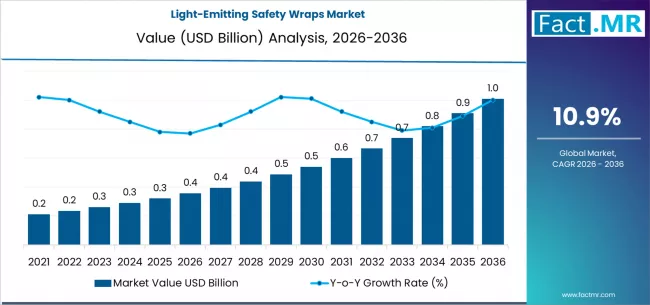
Light Emitting Safety Wraps Market Market Value Analysis | Source: Fact.MR
Regulatory frameworks mandating enhanced visibility for workplace and transport safety are converging with technological advancements in flexible electronics to create a new category of active, intelligent packaging.
Unlike passive reflective solutions, light-emitting wraps provide superior, self-illuminated visibility that significantly reduces collision and mishandling risks in ports, warehouses, and on roads. The integration of these smart materials into existing logistics operations represents a tangible upgrade in risk mitigation, directly impacting insurance premiums and liability.
For logistics operators, the value proposition extends beyond compliance to encompass operational efficiency, asset protection, and brand differentiation through demonstrated safety leadership.
Light-Emitting Safety Wraps Market
| Metric | Value |
|---|---|
| Market Value (2026) | USD 0.36 Billion |
| Market Forecast Value (2036) | USD 1.01 Billion |
| Forecast CAGR 2026 to 2036 | 10.9% |
Source: Fact.MR analysis. Updated Jan 12, 2026
Category
| Category | Segments |
|---|---|
| End-Use | Hazardous Goods & Logistics, Industrial Transport, Night-time Logistics, Road Transport Safety, Warehouse Safety, Precision Logistics |
| Packaging Format | Pallet Wraps & Protective Films, Safety Stretch Wraps, Reflective Wraps, Wrap Films, Others |
| Material | PE Films with EL Layers, PE Composites, PE Blends, PE, Others |
| Technology | Printed Electroluminescent Films, Flexible LED Integration, Low-Cost Light-Emitting Inks, Battery-Free Luminescence, Others |
| Region | North America, Latin America, Western Europe, Eastern Europe, East Asia, South Asia & Pacific, Middle East & Africa |
Source: Fact.MR analysis. Updated Jan 12, 2026
How will B2B Dynamics, Regulation, and Supply Chain Pressures Influence Growth Patterns?
Adoption is fundamentally a B2B decision, driven by total cost of risk calculations rather than consumer appeal. Regulatory pressure from occupational safety bodies and stringent UN recommendations for transporting hazardous materials is a primary catalyst. Concurrently, supply chain dynamics favoring 24/7 operations and faster throughput in dimly lit environments create a practical operational need.
The convergence of these factors, regulatory mandates, the economic impact of warehouse/transport accidents, and the need for uninterrupted logistics, transforms light-emitting wraps from a novel material into a critical operational safety component. Material innovation is closely tied to meeting these rugged, cost-sensitive industrial demands.
Segmental Analysis
By Technology, Which Segment Offers the Best Balance of Flexibility and Reliability for Industrial Use?
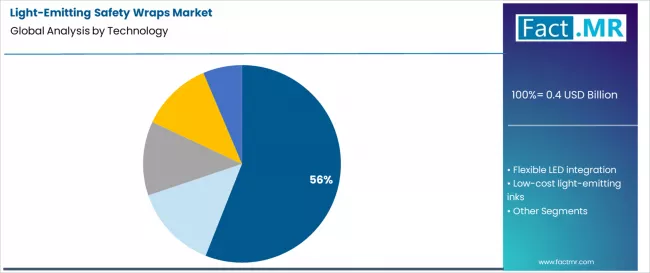
Light Emitting Safety Wraps Market Analysis By Technology | Source: Fact.MR
Printed electroluminescent film technology commands a 56.0% share. This method allows for the creation of large-area, uniform light-emitting surfaces directly onto flexible polyethylene substrates, making it ideal for pallet-sized wraps.
Unlike discrete LEDs, EL films are thin, impact-resistant, and provide consistent illumination without hot spots, which is critical for ensuring all-around visibility of large loads. Their low power consumption and ability to be powered by compact, integrated batteries suit them perfectly for the multi-day journeys common in logistics.
- Uniform Illumination: Provides consistent, wide-area visibility crucial for identifying large palletized loads.
- Durability & Integration: Robust, flexible construction withstands handling while integrating seamlessly into film extrusion processes.
By End-Use, Which Segment Faces the Most Stringent Regulatory and Insurance Imperatives?
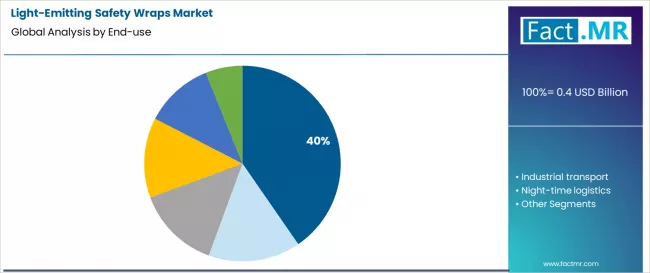
Light Emitting Safety Wraps Market Analysis By End Use | Source: Fact.MR
Hazardous goods and logistics constitute the primary end-use segment at 40.4%. The transport of chemicals, pharmaceuticals, and flammable materials carries elevated risk and stringent regulatory oversight.
For this sector, light-emitting wraps are not merely an enhancement but a risk mitigation tool that can lower insurance premiums and ensure compliance with safety protocols for loading, unloading, and transit, especially during night operations or in poorly lit storage areas.
- Risk Mitigation Driver: Directly addresses high-stakes liability and regulatory compliance for dangerous goods.
- Insurance Incentive: Adoption can be incentivized through reduced insurance costs for demonstrably safer practices.
By Material, Which Configuration is Dominating Early Commercialization?
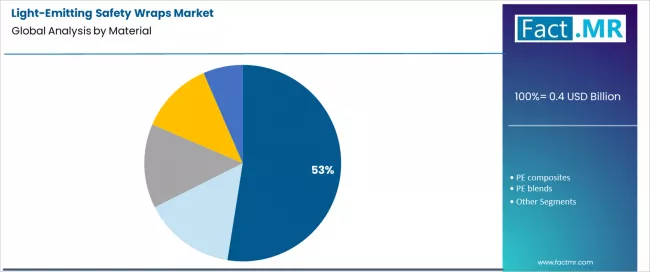
Light Emitting Safety Wraps Market Analysis By Material | Source: Fact.MR
Polyethylene films integrated with electroluminescent layers hold a dominant 52.5% share. This configuration leverages the well-established, cost-effective, and durable properties of PE film as a carrier, onto which functional light-emitting layers are added.
The result is a product that retains the necessary tensile strength, stretchability, and weather resistance of traditional industrial stretch wrap while adding an active safety function, easing adoption within existing logistical workflows.
- Incumbent Compatibility: Builds upon the familiar properties and handling of conventional polyethylene stretch wrap.
- Functional Hybrid: Successfully merges established film performance with novel light-emitting functionality.
What are the Dynamics of the Light-Emitting Safety Wraps Market?
Growth is propelled by stringent occupational health and safety regulations and UN transport guidelines for hazardous materials, creating a compliance-driven demand. However, significant adoption constraints include high per-unit costs compared to passive wraps and lingering questions regarding end-of-life recycling for composite electronic films.
Opportunity lies in the expansion of night-time and 24/7 logistics operations in emerging economies, where infrastructure limitations amplify safety risks. A key market trend is the integration of these wraps with IoT and sensor platforms, evolving them from simple illumination tools into smart assets capable of reporting location, shock events, or tampering, thereby adding layered value to logistics management.
Analysis of the Light-Emitting Safety Wraps Market by Key Countries
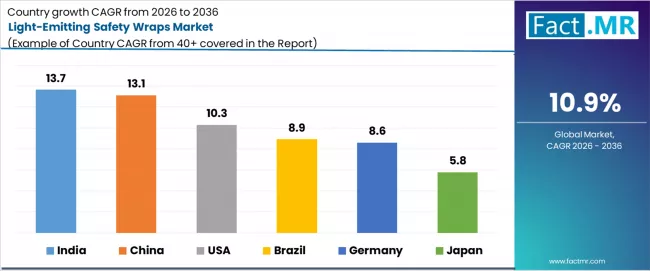
Light Emitting Safety Wraps Market Cagr Analysis By Country | Source: Fact.MR
| Country | CAGR 2026 to 2036 |
|---|---|
| USA | 10.3% |
| Germany | 8.6% |
| China | 13.1% |
| India | 13.7% |
| Brazil | 8.9% |
| Japan | 5.8% |
Source: Fact.MR analysis. Updated Jan 12, 2026
How do Evolving OSHA Guidelines and a Mature Logistics Sector Influence the USA's Trajectory?
A 10.3% CAGR reflects proactive adoption within a sophisticated logistics and manufacturing base. Evolving Occupational Safety and Health Administration guidelines around warehouse and dock safety, combined with a strong culture of liability management, are key drivers.
Large third-party logistics providers and retailers are early adopters, integrating these solutions to reduce accident rates in round-the-clock distribution centers and to protect high-value electronics and pharmaceutical shipments.
- Regulatory & Liability Culture: OSHA standards and a high-litigation environment accelerate investment in proven safety tech.
- 3PL Leadership: Major logistics firms serve as primary adopters, driving volume demand and operational validation.
What Characterizes Germany's Focus on Engineering and Hazardous Material Handling Standards?
An 8.6% CAGR underscores a demand landscape focused on precision engineering and adherence to rigorous EU and German safety standards for industrial and chemical logistics. German engineering firms and chemical manufacturers seek high-reliability, durable solutions that integrate seamlessly with automated handling systems. Demand centers on products with certified performance under specific conditions, such as low temperatures or corrosive environments, often requiring custom configurations.
- Standards-Driven Demand: Strict national and EU regulations for hazardous material handling dictate technical specifications.
- Engineering Integration: Focus on compatibility with highly automated warehouse and manufacturing ecosystems.
What Underpins the Manufacturing-Led Scalability and Government Backing in China?
China's 13.1% CAGR is fueled by massive government initiatives to modernize industrial safety and become a global leader in advanced flexible electronics manufacturing. The domestic manufacturing scale for both base PE films and electronic components creates a significant cost and supply chain advantage. Deployment is rapid in state-supported logistics hubs and ports, aiming to set a global benchmark for high-tech safety infrastructure.
- Industrial Policy Support: National safety modernization campaigns directly fund deployment in key logistics corridors.
- Manufacturing Ecosystem: Vertical integration from chemicals to electronics enables rapid scaling and cost reduction.
How is Rapid Logistics Expansion and Infrastructure Development Shaping Demand in India?
India's leading 13.7% CAGR is driven by the explosive growth of its formal logistics sector, coupled with significant night-time transportation on often poorly lit roads. The expansion of large, modern warehouses and the government’s focus on reducing road accidents create immediate demand for cost-optimized solutions. Price sensitivity fosters innovation in lower-cost technologies like light-emitting inks, targeting applications for fleet visibility and warehouse aisle marking.
- Infrastructure-Led Growth: New warehouse and transport corridor development incorporates modern safety features from inception.
- Cost-Sensitive Innovation: High-growth potential drives R&D toward affordable, scalable solutions for mass adoption.
Why is Brazil's Growth Closely Tied to Road Safety Initiatives and Transport Sector Modernization?
An 8.9% CAGR is linked to national road safety campaigns and efforts to reduce accidents involving freight transport. The vast geographic distances and reliance on road transport for goods movement make vehicle and load visibility a critical concern. Adoption is growing among large fleet operators and agribusiness exporters seeking to protect cargo and enhance brand reputation through demonstrable safety investments.
- Road Safety Priority: National initiatives to reduce transport accidents create a favorable policy environment.
- Fleet Operator Adoption: Large domestic and export-oriented transport companies are key early adopters.
What Defines Japan's Focus on High-Density, Precision Logistics and Automation Compatibility?
A 5.8% CAGR reflects a mature market focused on precision and integration within space-constrained, highly automated logistics environments. In Japan’s dense urban warehouses and manufacturing sites, the priority is on wraps that offer reliable illumination without interfering with robotic pickers, conveyor sensors, or inventory scanning systems. Demand is for high-reliability, low-profile solutions that contribute to zero-accident workplace goals within advanced Industry 4.0 settings.
- Automation-First Integration: Solutions must not interfere with, and ideally enhance, automated guided vehicles and robotic systems.
- Precision & Reliability: Emphasis on failure-proof performance in high-throughput, technologically dense environments.
Competitive Landscape of the Light-Emitting Safety Wraps Market
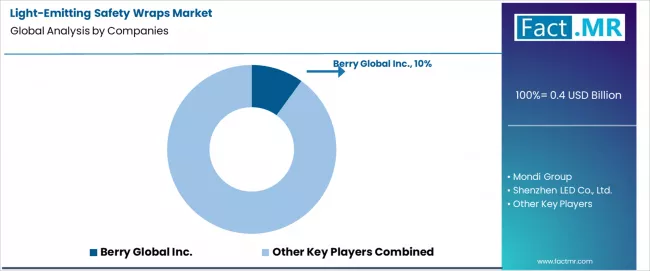
Light Emitting Safety Wraps Market Analysis By Company | Source: Fact.MR
The competitive arena features a blend of global packaging material giants and specialized electronics firms. Established players like Berry Global and Mondi leverage their deep expertise in polymer extrusion and vast distribution networks for industrial films, integrating new light-emitting functionalities into their existing product portfolios. Specialists such as Nitto Denko and Shenzhen LED bring core competencies in flexible electronics and printed circuitry, often partnering with film manufacturers.
Success increasingly depends on developing robust, field-proven products that meet industrial durability standards and offer clear total cost of ownership benefits. The frontier of competition is shifting toward smart systems that combine illumination with sensor-based monitoring and data connectivity.
| Key Player | Notable Portfolio Focus |
|---|---|
| Berry Global Inc. | PE-based safety films with integrated electroluminescent systems for pallet wrapping. |
| Mondi Group | Industrial stretch wraps and protective packaging solutions incorporating visibility features. |
| Shenzhen LED Co., Ltd. | Flexible LED lighting modules and strips designed for integration into transport safety gear and wraps. |
| Nitto Denko Corporation | Advanced functional films, optically clear adhesives, and flexible printed electronics for hybrid solutions. |
| DuPont de Nemours, Inc. | High-performance specialty materials and inks for printed electronics and durable coatings. |
Source: Fact.MR analysis. Updated Jan 12, 2026
Key Players in the Light-Emitting Safety Wraps Market
- Berry Global Inc.
- Mondi Group
- Shenzhen LED Co., Ltd.
- Nitto Denko Corporation
- DuPont de Nemours, Inc.
References
- International Labour Organization. (2025). Safety and health in ports: Guidelines for implementing active visibility solutions.
- Journal of Transportation Safety & Security. (2024). Evaluating the efficacy of active illumination versus passive reflectors in nighttime logistics accident prevention.
- National Safety Council. (2025). Workplace Injury Report: The role of enhanced visibility in industrial settings.
- United Nations Economic Commission for Europe. (2024). Recommendations on the Transport of Dangerous Goods: Model Regulations (Rev. 25).
- U.S. Department of Transportation. (2025). Emerging Technologies for Commercial Motor Vehicle Safety.
- Warehousing Education and Research Council. (2024). Technology Trends in Warehouse Safety and Operations.
Segmentation
Scope of Report
| Items | Metrics |
|---|---|
| Quantitative Units | USD Billion |
| Technology | Printed Electroluminescent Films, Flexible LED Integration, Low-Cost Light-Emitting Inks, Battery-Free Luminescence, Others |
| Packaging Format | Pallet Wraps & Protective Films, Safety Stretch Wraps, Reflective Wraps, Wrap Films, Others |
| End-Use | Hazardous Goods & Logistics, Industrial Transport, Night-time Logistics, Road Transport Safety, Warehouse Safety, Precision Logistics |
| Material | PE Films with EL Layers, PE Composites, PE Blends, PE, Others |
| Key Countries | India, China, USA, Brazil, Germany, Japan |
| Key Companies | Berry Global, Mondi, Shenzhen LED, Nitto Denko, DuPont |
| Additional Analysis | Total cost of ownership analysis vs. traditional wraps and accident rates; study of power source integration (battery, energy harvesting); analysis of end-of-life pathways for electronic composite films; impact on logistics insurance models; integration case studies with Warehouse Management Systems and IoT platforms. |
Source: Fact.MR analysis. Updated Jan 12, 2026
Market by Segments
-
End-Use :
- Hazardous Goods & Logistics
- Industrial Transport
- Night Time Logistics
- Road Transport Safety
- Warehouse Safety
- Precision Logistics
-
Packaging Format :
- Pallet Wraps & Protective Films
- Safety Stretch Wraps
- Reflective Wraps
- Wrap Films
- Others
-
Material :
- PE Films with EL Layers
- PE Composites
- PE Blends
- PE
- Others
-
Technology :
- Printed Electroluminescent Films
- Flexible LED Integration
- Low-Cost Light-Emitting Inks
- Battery-Free Luminescence
- Others
-
Region :
- North America
- USA
- Canada
- Latin America
- Brazil
- Mexico
- Argentina
- Rest of Latin America
- Western Europe
- Germany
- France
- Italy
- Spain
- UK
- BENELUX
- Rest of Western Europe
- Eastern Europe
- Russia
- Poland
- Czech Republic
- Rest of Eastern Europe
- East Asia
- China
- Japan
- South Korea
- Rest of East Asia
- South Asia & Pacific
- India
- ASEAN
- Australia
- Rest of South Asia & Pacific
- MEA
- GCC Countries
- South Africa
- Turkiye
- Rest of MEA
- North America
Frequently Asked Questions
How big is the light-emitting safety wraps market in 2026?
What will be the size of light-emitting safety wraps market in 2036?
How much will be the light-emitting safety wraps market growth between 2026 and 2036?
What are the key product types in the light-emitting safety wraps market?
Which packaging format segment to contribute significant share in the light-emitting safety wraps market in 2026?
Who worked on this report


Preview the report firsthand - request a free sample
Free SampleGet the brochure for pricing and purchase details
Download PDF