- Base Value(2026): 312.0 Mn
- Estimated Value(2026): 312.0 Mn
- Forecast Value (2036): 905.0 Mn
- CAGR (2026 - 2036): 11.2%
Canopy Cooling Adjuvant Systems Market Forecast and Outlook 2026 to 2036
The global canopy cooling adjuvant systems market is projected to grow from USD 312 million in 2026 to approximately USD 905 million by 2036, recording a CAGR of 11.2%. The fruits & vegetables segment leads crop type with a 39% share, surfactant-based cooling agents dominate adjuvant chemistry with 36%, and foliar spray (tank-mix) commands the application mode segment with a 64% market share. This expansion is fueled by escalating global temperatures and the rising frequency of heat stress events, which directly threaten crop yield and quality. Canopy cooling adjuvants offer a targeted mitigation strategy, lowering plant surface temperature and reducing transpirational water loss.
Key Takeaways from the Canopy Cooling Adjuvant Systems Market Report
- Canopy Cooling Adjuvant Systems Market Value (2026): USD 312 million
- Canopy Cooling Adjuvant Systems Market Forecast Value (2036): USD 905 million
- Canopy Cooling Adjuvant Systems Market Forecast CAGR (2026 to 2036): 11.2%
- Leading Crop Type: Fruits & Vegetables (39%)
- Leading Adjuvant Chemistry: Surfactant-based Cooling Agents (36%)
- Leading Application Mode: Foliar Spray (Tank-Mix) (64%)
- Key Growth Regions: North America, Latin America, Western Europe, Eastern Europe, East Asia, South Asia & Pacific, Middle East & Africa
- Key Players: BASF SE, Corteva Agriscience, Bayer CropScience, UPL Limited, Clariant AG
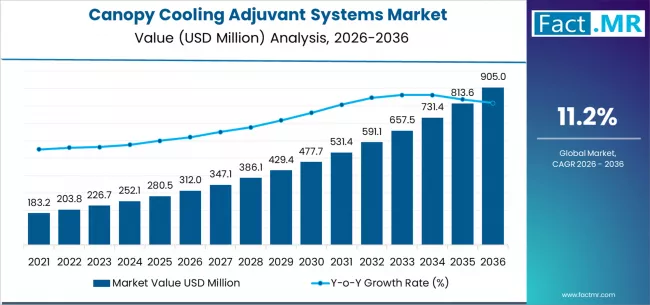
Canopy Cooling Adjuvant Systems Market Market Value Analysis | Source: Fact.MR
Advancements in adjuvant chemistry and precision application technologies are critical market enablers. The integration of these systems into integrated pest management and stress resilience programs is gaining traction among growers focused on maximizing productivity under climatic pressure. Regulatory trends favoring environmentally benign and non-toxic crop protection solutions further support the adoption of cooling adjuvants.
The convergence of climate-smart agriculture initiatives, increasing investment in high-value protected cultivation, and the need to protect agricultural investments ensures significant market growth. Expansion is particularly pronounced in regions with intensive horticulture and viticulture, positioning canopy cooling as an essential component of modern crop management.
Canopy Cooling Adjuvant Systems Market
| Metric | Value |
|---|---|
| Estimated Value (2026E) | USD 312 million |
| Forecast Value (2036F) | USD 905 million |
| Forecast CAGR (2026 to 2036) | 11.2% |
Source: Fact.MR analysis. Updated Dec 22, 2025
Category
| Category | Segments |
|---|---|
| Crop Type | Fruits & Vegetables, Vineyard & Horticulture Crops, Cereals & Field Crops, Plantation Crops, Others |
| Adjuvant Chemistry | Surfactant-based Cooling Agents, Humectants & Evaporation Modifiers, Oil-based Spreaders, Polymer-based Film Formers, Others |
| Application Mode | Foliar Spray (Tank-Mix), Chemigation, Drone & Precision Spraying |
| Region | North America, Latin America, Western Europe, Eastern Europe, East Asia, South Asia & Pacific, Middle East & Africa |
Source: Fact.MR analysis. Updated Dec 22, 2025
Segmental Analysis
How do Fruits & Vegetables Anchor Market Demand through Sensitivity to Heat Stress?
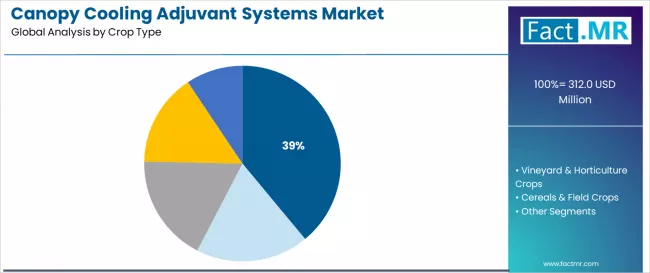
Canopy Cooling Adjuvant Systems Market Analysis By Crop Type | Source: Fact.MR
The fruits and vegetables segment, holding a 39% market share, is the primary driver due to the high economic value and extreme sensitivity of these crops to heat stress. Heat can cause sunscald, blossom drop, poor fruit set, and reduced quality, leading to significant revenue loss for growers.
High-value crops like tomatoes, peppers, berries, and leafy greens cultivated in open fields and protected environments justify the investment in cooling adjuvant systems. The segment benefits from extensive research demonstrating tangible benefits in yield preservation and quality maintenance, encouraging adoption among commercial horticulturists and contract farming operations focused on delivering consistent, high-grade produce to markets.
What Secures the Dominance of Surfactant-Based Chemistry in Cooling Efficacy?
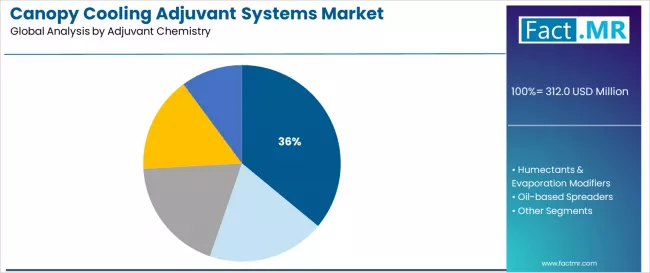
Canopy Cooling Adjuvant Systems Market Analysis By Adjuvant Chemistry | Source: Fact.MR
Surfactant-based cooling agents lead the adjuvant chemistry segment with a 36% share, prized for their ability to enhance droplet spread and lower the surface tension of spray solutions on the leaf canopy. This action promotes the formation of a thin, uniform film that facilitates more efficient evaporative cooling.
Their compatibility with a wide range of pesticides and fertilizers allows for convenient tank-mixing, reducing application costs and labor. The well-established manufacturing base for agricultural surfactants ensures product availability and cost-effectiveness. This chemistry's proven, reliable performance in field conditions underpin its preference as the foundational technology for canopy cooling applications.
Why does Foliar Spray (Tank-Mix) Remain the Unchallenged Primary Application Mode?

Canopy Cooling Adjuvant Systems Market Analysis By Application Mode | Source: Fact.MR
Foliar spray, specifically the tank-mix method, commands a dominant 64% share of application modes. Its supremacy is rooted in operational practicality and seamless integration into existing crop protection routines. Growers can easily incorporate cooling adjuvants into their standard pesticide or nutrient application schedules without needing extra passes or specialized equipment.
This method ensures direct and comprehensive coverage of the plant canopy where cooling is most needed. The tank-mix approach offers cost efficiency and time savings, making it the most accessible and logistically straightforward adoption pathway for farmers of all scales, from smallholders to large agribusinesses.
What are the Drivers, Restraints, and Key Trends of the Canopy Cooling Adjuvant Systems Market?
Market growth is driven by the undeniable impact of climate change, increasing the incidence of heatwaves that compromise crop physiology and farm economics. The expansion of high-value, heat-sensitive horticulture and viticulture globally creates a ready market. A key restraint is the variable performance of adjuvants under extreme low-humidity conditions, which can limit evaporative cooling efficacy. Farmer education gaps regarding optimal usage timing and dosage, alongside cost sensitivity in bulk crop segments, also challenge widespread adoption.
Key trends include the development of multifunctional adjuvant blends that combine cooling with anti-transpirant or nutrient delivery properties. The adoption of drone and sensor-based spraying allows for precise, variable-rate application during the hottest parts of the day. There is also growing research into novel, biodegradable polymer film formers that provide longer-lasting cooling effects with minimal environmental impact.
Analysis of the Canopy Cooling Adjuvant Systems Market by Key Countries
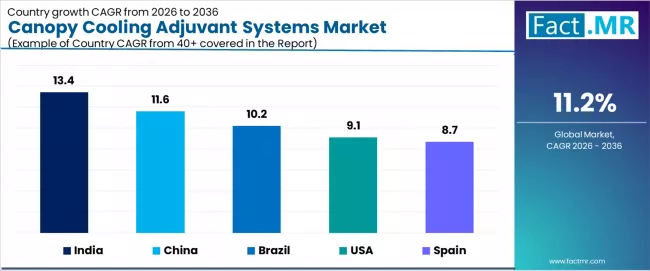
Canopy Cooling Adjuvant Systems Market Cagr Analysis By Country | Source: Fact.MR
| Country | CAGR (2026-2036) |
|---|---|
| India | 13.4% |
| China | 11.6% |
| Brazil | 10.2% |
| USA | 9.1% |
| Spain | 8.7% |
Source: Fact.MR analysis. Updated Dec 22, 2025
How does India Lead Global Growth with Intensive Horticulture and Climate Pressure?
India's market exhibits the highest CAGR of 13.4%, driven by its vast and growing horticulture sector facing increasingly erratic and extreme summer temperatures. Government missions to boost fruit and vegetable production align with the need for protective technologies.
The proliferation of protected cultivation and micro-irrigation infrastructure provides an ideal platform for integrating chemigation-based cooling systems. Local manufacturing of adjuvants improves affordability, driving adoption among both large commercial farms and progressive smallholders.
What Fuels China's Expansion through Large-Scale Protected Agriculture?
China follows with an 11.6% CAGR, supported by the world's largest area under protected cultivation, including greenhouses and solar tunnels. Maintaining optimal growing conditions in these facilities during hot seasons is critical for year-round production schedules.
The scale of operations justifies investments in advanced climate moderation tools. National food security strategies emphasize yield stability, encouraging the adoption of supportive technologies like cooling adjuvants, especially in regions producing high-value export-oriented produce.
Why does Brazil show Strong Growth in Diversifying Agriculture?
Brazil's market grows at a 10.2% CAGR, fueled not only by its massive field crop sector but also by a rapidly expanding high-value horticulture and fruit export industry. Heat stress in growing regions like the São Francisco Valley threatens production consistency.
The tech-savvy, export-focused nature of these segments makes growers early adopters of solutions that ensure quality and meet phytosanitary standards, driving demand for effective canopy cooling strategies.
What Supports Steady Adoption in the Technologically Advanced USA Market?
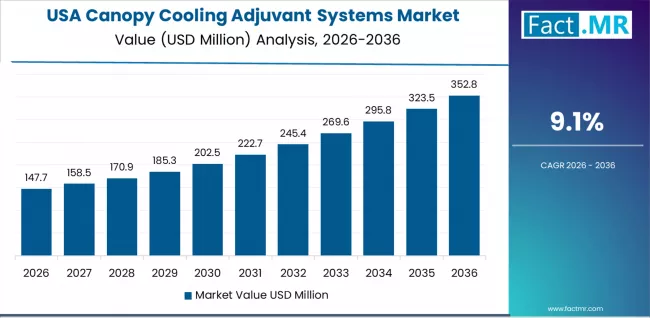
Canopy Cooling Adjuvant Systems Market Country Value Analysis | Source: Fact.MR
The USA progresses at a 9.1% CAGR, wherehigh-value specialty crop producers in heat-prone states like California, Arizona, and Florida lead adoption. The decision-making is highly data-driven, requiring demonstrable ROI through yield protection and quality enhancement.
The mature agricultural input sector facilitates easy access to these products through established distribution channels, and application is often integrated with sophisticated irrigation and pest management programs.
How does Spain's Specialized Agriculture Drive European Adoption?
Spain, with a CAGR of 8.7%, acts as a key European driver due to its leading position in Mediterranean horticulture and viticulture. Severe summer heat and water scarcity make cooling adjuvants a vital tool for preventing sunburn in grapes, citrus, and olive crops.
The country's advanced irrigation infrastructure readily supports chemigation applications. EU policies promoting sustainable water use and crop resilience further incentivize the use of such water-saving stress mitigation tools.
Competitive Landscape of the Canopy Cooling Adjuvant Systems Market
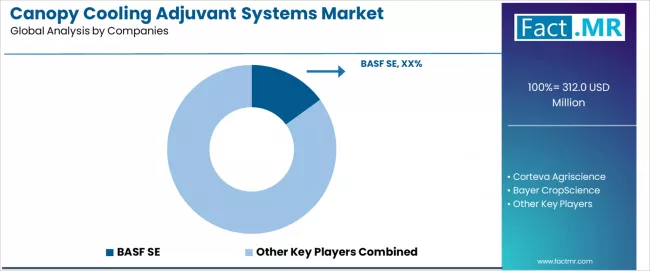
Canopy Cooling Adjuvant Systems Market Analysis By Company | Source: Fact.MR
The competitive landscape features a mix of global agrochemical leaders and specialty chemical companies. Competition centers on technological innovation in formulation science to improve cooling efficiency, longevity, and plant safety. Strategic activities include conducting extensive field demonstrations in key crops and geographies to generate validated performance data.
Companies are actively pursuing partnerships with irrigation system manufacturers and precision agriculture technology providers to integrate their adjuvants into holistic crop management systems. Building strong technical support and agronomic advisory networks is crucial for educating growers on proper usage protocols. Sustainability claims, such as biodegradable formulations and non-toxic profiles, are increasingly used as key brand differentiators in this market.
Key Players Profiled in the Canopy Cooling Adjuvant Systems Market
- BASF SE
- Corteva Agriscience
- Bayer CropScience
- UPL Limited
- Clariant AG
Segmentation
Scope of the Report
| Items | Values |
|---|---|
| Quantitative Units (2026) | USD 312 Million |
| Crop Type | Fruits & Vegetables, Vineyard & Horticulture Crops, Cereals & Field Crops, Plantation Crops, Others |
| Adjuvant Chemistry | Surfactant-based Cooling Agents, Humectants & Evaporation Modifiers, Oil-based Spreaders, Polymer-based Film Formers, Others |
| Application Mode | Foliar Spray (Tank-Mix), Chemigation, Drone & Precision Spraying |
| Regions Covered | North America, Latin America, Western Europe, Eastern Europe, East Asia, South Asia & Pacific, Middle East & Africa |
| Countries Covered | USA, India, China, Brazil, Spain and others |
| Key Companies Profiled | BASF SE, Corteva Agriscience, Bayer CropScience, UPL Limited, Clariant AG |
| Additional Attributes | Dollar sales by crop type, adjuvant chemistry, and application mode; regional demand analysis; competitive landscape; grower adoption patterns; regulatory framework analysis; product innovation and sustainability trends |
Source: Fact.MR analysis. Updated Dec 22, 2025
Key Segments List
-
Crop Type :
- Fruits & Vegetables
- Vineyard & Horticulture Crops
- Cereals & Field Crops
- Plantation Crops
- Others
-
Adjuvant Chemistry :
- Surfactant-based Cooling Agents
- Humectants & Evaporation Modifiers
- Oil-based Spreaders
- Polymer-based Film Formers
- Others
-
Application Mode :
- Foliar Spray (Tank-Mix)
- Chemigation
- Drone & Precision Spraying
-
Region :
-
North America
- USA
- Canada
-
Latin America
- Brazil
- Mexico
- Argentina
- Chile
- Rest of Latin America
-
Western Europe
- Germany
- UK
- France
- Spain
- Italy
- BENELUX
- Rest of Western Europe
-
Eastern Europe
- Poland
- Czech Republic
- Austria
- Hungary
- Rest of Eastern Europe
-
East Asia
- China
- Japan
- South Korea
- Rest of East Asia
-
South Asia & Pacific
- India
- Indonesia
- Australia
- Rest of South Asia & Pacific
-
MEA
- Saudi Arabia
- UAE
- Türkiye
- Rest of MEA
-
Frequently Asked Questions
How big is the canopy cooling adjuvant systems market in 2026?
What will be the size of canopy cooling adjuvant systems market in 2036?
How much will be the canopy cooling adjuvant systems market growth between 2026 and 2036?
What are the key product types in the canopy cooling adjuvant systems market?
Which adjuvant chemistry segment to contribute significant share in the canopy cooling adjuvant systems market in 2026?
Who worked on this report


Preview the report firsthand - request a free sample
Free SampleGet the brochure for pricing and purchase details
Download PDF