Regenerative No-Till Compatible Weed Control Adjuvant Market
Regenerative No-Till Compatible Weed Control Adjuvant Market Size and Share Forecast Outlook 2026 to 2036
Regenerative no-till compatible weed control adjuvant market is projected to grow from USD 0.5 billion in 2026 to USD 2.2 billion by 2036, at a CAGR of 14.7%. Residue-Compatible Penetration Enhancers will dominate with a 34.0% market share, while cover-crop termination programs will lead the herbicide program compatibility segment with a 37.0% share.
Regenerative No-Till Compatible Weed Control Adjuvant Market Forecast and Outlook 2026 to 2036
The global regenerative no-till compatible weed control adjuvant market is projected to reach USD 2.16 billion by 2036. The market is valued at USD 0.55 billion in 2026 and is set to rise at a CAGR of 14.7% during the assessment period. By adjuvant function type, residue-compatible penetration enhancers hold a leading 34% share. Compatibility with cover-crop termination programs represents a dominant 37% segment, while row crops account for 49% market share.
Key Takeaways from the Regenerative No-Till Compatible Weed Control Adjuvant Market
- Market Value for 2026: USD 0.55 Billion
- Market Value for 2036: USD 2.16 Billion
- Forecast CAGR (2026-2036): 14.7%
- Leading Adjuvant Function Type Share (2026): Residue-Compatible Penetration Enhancers (34%)
- Leading Herbicide Program Compatibility Share (2026): Cover-Crop Termination Programs (37%)
- Leading Crop System Share (2026): Row Crops (49%)
- Key Players in the Market: Wilbur-Ellis Agribusiness, CHS Inc. (Ag Retail & Solutions), Attune Agriculture, Brandt Consolidated, Simplot Grower Solutions

Significant trends include the development of adjuvant systems specifically engineered to perform through dense, multi-layered crop residues without binding to organic matter. Products are evolving to enhance the efficacy of low-dose herbicide regimes and improve soil-surface retention to prevent pre-emergent herbicide run-off. Integration of these adjuvants with high-clearance sprayers and precise application maps is becoming standard practice in advanced no-till systems.
Supportive regulatory and market frameworks promoting soil health and reduced erosion are key drivers. Policies that incentivize cover cropping and continuous no-till create a ready market for adjuvant technologies that enable these practices. Evolving pesticide labels increasingly consider performance in high-residue environments, favoring adjuvant use to ensure reliable weed control and meet conservation compliance standards.
Regenerative No-Till Compatible Weed Control Adjuvant Market
| Metric | Value |
|---|---|
| Market Value (2026) | USD 0.55 Billion |
| Market Forecast Value (2036) | USD 2.16 Billion |
| Forecast CAGR (2026-2036) | 14.7% |
Category
| Category | Segments |
|---|---|
| Adjuvant Function Type | Residue-Compatible Penetration Enhancers, Drift & Volatility Reduction Adjuvants, Soil-Surface Stability & Retention Agents, Rainfastness & Wash-Off Control Agents, Others |
| Herbicide Program Compatibility | Cover-Crop Termination Programs, Residual & Pre-Emergent Systems, Low-Dose Sequential Post-Emergent, Precision Spot-Spray Programs, Others |
| Crop System | Row Crops (Corn, Soybean, Cotton), Cereals & Grains, Oilseeds & Pulses, Plantation & Specialty Crops, Others |
| Region | North America, Latin America, Western Europe, Eastern Europe, East Asia, South Asia & Pacific, MEA |
Segmental Analysis
By Adjuvant Function, Which Technology Overcomes the Primary No-Till Challenge?
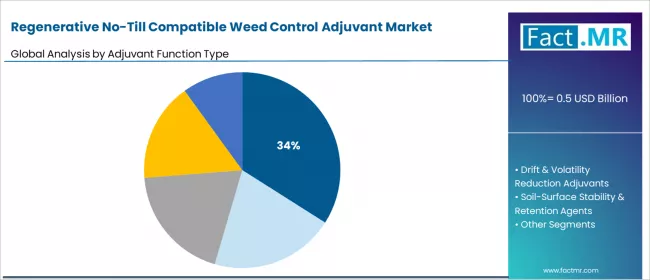
Residue-compatible penetration enhancers lead the segment with a 34% share. This dominance addresses the core obstacle in no-till: getting herbicide through a thick mat of previous crop residue to reach the soil surface or weed seedling. These adjuvants reduce the surface tension of spray droplets, helping them wick through residue rather than beading up and evaporating, ensuring the chemical reaches its target for effective control.
By Herbicide Program Compatibility, Which Practice is Most Adjuvant-Dependent?
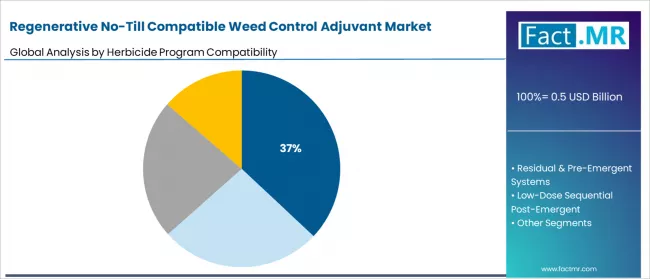
Cover-crop termination programs hold the largest compatibility share at 37%. Successfully and consistently terminating a cover crop without tillage is entirely reliant on effective herbicide penetration and translocation. The dense, often woody biomass of mature cover crops presents a formidable barrier, making specialized adjuvants a non-negotiable component of the termination recipe to ensure complete kill and prevent the cover from becoming a weed itself.
By Crop System, Where is the Adoption of Regenerative No-Till Most Advanced?
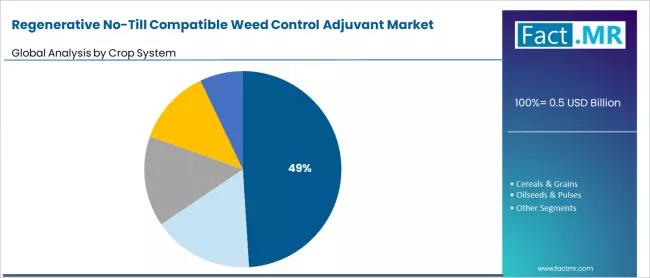
Row crops command a 49% share. The vast acreage of no-till and strip-till corn, soybeans, and cotton in North and South America represents the epicenter of regenerative practice at scale. These high-value systems generate the economic return to invest in premium adjuvant technologies that protect and enable the soil health benefits of continuous no-till, making this the largest and most mature market segment.
What are the Drivers, Restraints, and Key Trends of the Regenerative No-Till Compatible Weed Control Adjuvant Market?
Market growth is propelled by the rapid expansion of regenerative agriculture protocols that mandate no-till and cover cropping. The financial value of soil carbon credits and premium markets for sustainably grown grain creates a direct incentive. The increasing complexity of herbicide-resistant weeds demands optimized application, which these adjuvants provide, especially when using lower rates of active ingredients in conservation systems.
A key restraint is the need for precise adjuvant selection and application knowledge, which can overwhelm farmers new to no-till. Variable residue loads and weather conditions can affect adjuvant performance, requiring careful management. The additional input cost, though often justified, can be perceived as a barrier in commodity crop markets with tight operating margins.
Key trends feature the formulation of multi-functional adjuvant packages that address penetration, retention, and volatility in a single product. Adjuvant recommendations are becoming increasingly customized based on real-time residue biomass measurements. There is a growing integration of adjuvant use with sprayer automation systems to dynamically adjust rates based on field conditions.
Analysis of the Regenerative No-Till Compatible Weed Control Adjuvant Market by Key Countries
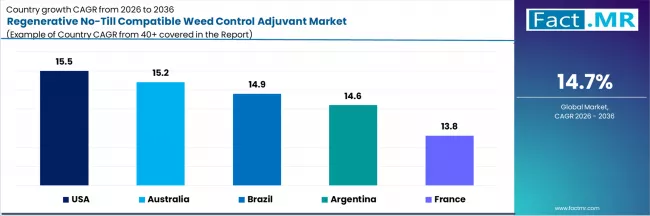
| Country | CAGR (2026-2036) |
|---|---|
| USA | 15.50% |
| Australia | 15.20% |
| Brazil | 14.90% |
| Argentina | 14.60% |
| France | 13.80% |
How does the USA's Mature No-Till Landscape Drive Sophisticated Adjuvant Demand?

The USA leads with a 15.50% CAGR, building on decades of no-till adoption. The market has evolved beyond basic surfactants to adjuvants engineered for specific challenges like terminating cereal rye cover crops ahead of soybeans or managing volatility in dry, windy conditions. Demand is fueled by carbon market participation and the need for absolute reliability in weed control to protect yield potential in high-stakes row crop systems.
Why is Australia's Focus on Moisture Conservation a Key Market Driver?
Australia's 15.20% growth is fundamentally tied to its reliance on no-till for moisture retention in arid cropping regions. Protecting soil moisture from weed competition is critical. Adjuvants that ensure herbicide efficacy through retained stubble, while also reducing evaporation from the soil surface, are viewed as essential yield-protection tools, making them a standard input in Australian broadacre farming.
What Role Does Brazil's Large-Scale No-Till Adoption Play in Market Volume?
The sheer scale of its no-till soybean and corn production drives Brazil’s 14.90% growth. The tropical climate generates massive amounts of crop residue, creating a persistent challenge for herbicide contact. Brazilian farmers and applicators have become sophisticated users of penetration enhancers and deposition agents, creating a high-volume market for adjuvants proven to work in these demanding, high-residue conditions.
How do Argentina's Unique Agronomic Challenges Shape Adjuvant Needs?
Argentina's 14.60% growth occurs within a context of high no-till adoption combined with significant regulatory pressure on certain herbicide volatilities. This creates a dual demand for adjuvants that both penetrate heavy wheat stubble and also minimize the off-target movement of herbicides like 2,4-D and dicamba. Adjuvant selection is a critical component of responsible application and social license to operate.
What Factors Underpin France's Steady Adoption Within the EU Framework?
France's 13.80% growth is channeled through the EU's push for sustainable agriculture and soil protection. French farmers adopting no-till or reduced tillage within an integrated crop management framework utilize adjuvants to maximize the performance of limited herbicide options. The focus is on products that enhance rainfastness and soil binding to comply with water quality directives while making conservation tillage viable.
Competitive Landscape of the Regenerative No-Till Compatible Weed Control Adjuvant Market
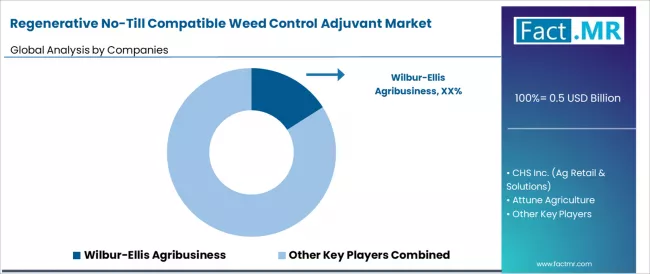
The market is characterized by strong competition from regional agri-distributors and specialized formulation companies. Major agricultural retailers like Wilbur-Ellis, CHS Inc., and Simplot Grower Solutions compete by leveraging their direct agronomic relationships with farmers. They offer proprietary adjuvant brands supported by field trial data specific to local crop residues and herbicide programs, often bundling them with other inputs and services.
Specialty adjuvant firms like Attune Agriculture and Brandt Consolidated compete through focused R&D and technical differentiation, developing advanced chemistries for specific challenges like cover-crop termination or volatility suppression. Competition centers on providing demonstrable efficacy data in high-residue environments, robust technical support, and building trust as essential partners in making regenerative no-till systems both agronomically and economically successful.
Key Players in the Regenerative No-Till Compatible Weed Control Adjuvant Market
- Wilbur-Ellis Agribusiness
- CHS Inc. (Ag Retail & Solutions)
- Attune Agriculture
- Brandt Consolidated
- Simplot Grower Solutions
Scope of Report
| Items | Values |
|---|---|
| Quantitative Units | USD Billion |
| Adjuvant Function Type | Residue-Compatible Penetration Enhancers, Drift & Volatility Reduction Adjuvants, Soil-Surface Stability & Retention Agents, Rainfastness & Wash-Off Control Agents, Others |
| Herbicide Program Compatibility | Cover-Crop Termination Programs, Residual & Pre-Emergent Systems, Low-Dose Sequential Post-Emergent, Precision Spot-Spray Programs, Others |
| Crop System | Row Crops (Corn, Soybean, Cotton), Cereals & Grains, Oilseeds & Pulses, Plantation & Specialty Crops, Others |
| Key Countries | USA, Australia, Brazil, Argentina, France |
| Key Companies | Wilbur-Ellis Agribusiness, CHS Inc. (Ag Retail & Solutions), Attune Agriculture, Brandt Consolidated, Simplot Grower Solutions |
| Additional Analysis | Analysis of adjuvant performance across different residue types and biomass levels, integration with spray application technology in high-residue conditions, soil health impact assessments, and economic ROI models for regenerative systems. |
Regenerative No-Till Compatible Weed Control Adjuvant Market by Segments
-
Adjuvant Function Type :
- Residue-Compatible Penetration Enhancers
- Drift & Volatility Reduction Adjuvants
- Soil-Surface Stability & Retention Agents
- Rainfastness & Wash-Off Control Agents
- Others
-
Herbicide Program Compatibility :
- Cover-Crop Termination Programs
- Residual & Pre-Emergent Systems
- Low-Dose Sequential Post-Emergent
- Precision Spot-Spray Programs
- Others
-
Crop System :
- Row Crops (Corn, Soybean, Cotton)
- Cereals & Grains
- Oilseeds & Pulses
- Plantation & Specialty Crops
- Others
-
Region :
-
North America
- USA
- Canada
-
Latin America
- Brazil
- Mexico
- Argentina
- Rest of Latin America
-
Western Europe
- Germany
- UK
- France
- Spain
- Italy
- BENELUX
- Rest of Western Europe
-
Eastern Europe
- Czech Republic
- Poland
- Russia
- Rest of Eastern Europe
-
East Asia
- China
- Japan
- South Korea
- Rest of East Asia
-
South Asia & Pacific
- India
- Indonesia
- Australia
- Rest of South Asia & Pacific
-
MEA
- GCC Countries
- Turkiye
- Saudi Arabia
- Rest of MEA
-
Table of Content
- Executive Summary
- Global Market Outlook
- Demand to side Trends
- Supply to side Trends
- Technology Roadmap Analysis
- Analysis and Recommendations
- Market Overview
- Market Coverage / Taxonomy
- Market Definition / Scope / Limitations
- Market Background
- Market Dynamics
- Drivers
- Restraints
- Opportunity
- Trends
- Scenario Forecast
- Demand in Optimistic Scenario
- Demand in Likely Scenario
- Demand in Conservative Scenario
- Opportunity Map Analysis
- Product Life Cycle Analysis
- Supply Chain Analysis
- Investment Feasibility Matrix
- Value Chain Analysis
- PESTLE and Porter’s Analysis
- Regulatory Landscape
- Regional Parent Market Outlook
- Production and Consumption Statistics
- Import and Export Statistics
- Market Dynamics
- Global Market Analysis 2021 to 2025 and Forecast, 2026 to 2036
- Historical Market Size Value (USD Million) Analysis, 2021 to 2025
- Current and Future Market Size Value (USD Million) Projections, 2026 to 2036
- Y to o to Y Growth Trend Analysis
- Absolute $ Opportunity Analysis
- Global Market Pricing Analysis 2021 to 2025 and Forecast 2026 to 2036
- Global Market Analysis 2021 to 2025 and Forecast 2026 to 2036, By Adjuvant Function Type
- Introduction / Key Findings
- Historical Market Size Value (USD Million) Analysis By Adjuvant Function Type, 2021 to 2025
- Current and Future Market Size Value (USD Million) Analysis and Forecast By Adjuvant Function Type, 2026 to 2036
- Residue-Compatible Penetration Enhancers
- Drift & Volatility Reduction Adjuvants
- Soil-Surface Stability & Retention Agents
- Rainfastness & Wash-Off Control Agents
- Others
- Residue-Compatible Penetration Enhancers
- Y to o to Y Growth Trend Analysis By Adjuvant Function Type, 2021 to 2025
- Absolute $ Opportunity Analysis By Adjuvant Function Type, 2026 to 2036
- Global Market Analysis 2021 to 2025 and Forecast 2026 to 2036, By Herbicide Program Compatibility
- Introduction / Key Findings
- Historical Market Size Value (USD Million) Analysis By Herbicide Program Compatibility, 2021 to 2025
- Current and Future Market Size Value (USD Million) Analysis and Forecast By Herbicide Program Compatibility, 2026 to 2036
- Cover-Crop Termination Programs
- Residual & Pre-Emergent Systems
- Low-Dose Sequential Post-Emergent
- Precision Spot-Spray Programs
- Cover-Crop Termination Programs
- Y to o to Y Growth Trend Analysis By Herbicide Program Compatibility, 2021 to 2025
- Absolute $ Opportunity Analysis By Herbicide Program Compatibility, 2026 to 2036
- Global Market Analysis 2021 to 2025 and Forecast 2026 to 2036, By Crop System
- Introduction / Key Findings
- Historical Market Size Value (USD Million) Analysis By Crop System, 2021 to 2025
- Current and Future Market Size Value (USD Million) Analysis and Forecast By Crop System, 2026 to 2036
- Row Crops (Corn, Soybean, Cotton)
- Cereals & Grains
- Oilseeds & Pulses
- Plantation & Specialty Crops
- Others
- Row Crops (Corn, Soybean, Cotton)
- Y to o to Y Growth Trend Analysis By Crop System, 2021 to 2025
- Absolute $ Opportunity Analysis By Crop System, 2026 to 2036
- Global Market Analysis 2021 to 2025 and Forecast 2026 to 2036, By Region
- Introduction
- Historical Market Size Value (USD Million) Analysis By Region, 2021 to 2025
- Current Market Size Value (USD Million) Analysis and Forecast By Region, 2026 to 2036
- North America
- Latin America
- Western Europe
- Eastern Europe
- East Asia
- South Asia and Pacific
- Middle East & Africa
- Market Attractiveness Analysis By Region
- North America Market Analysis 2021 to 2025 and Forecast 2026 to 2036, By Country
- Historical Market Size Value (USD Million) Trend Analysis By Market Taxonomy, 2021 to 2025
- Market Size Value (USD Million) Forecast By Market Taxonomy, 2026 to 2036
- By Country
- USA
- Canada
- Mexico
- By Adjuvant Function Type
- By Herbicide Program Compatibility
- By Crop System
- By Country
- Market Attractiveness Analysis
- By Country
- By Adjuvant Function Type
- By Herbicide Program Compatibility
- By Crop System
- Key Takeaways
- Latin America Market Analysis 2021 to 2025 and Forecast 2026 to 2036, By Country
- Historical Market Size Value (USD Million) Trend Analysis By Market Taxonomy, 2021 to 2025
- Market Size Value (USD Million) Forecast By Market Taxonomy, 2026 to 2036
- By Country
- Brazil
- Chile
- Rest of Latin America
- By Adjuvant Function Type
- By Herbicide Program Compatibility
- By Crop System
- By Country
- Market Attractiveness Analysis
- By Country
- By Adjuvant Function Type
- By Herbicide Program Compatibility
- By Crop System
- Key Takeaways
- Western Europe Market Analysis 2021 to 2025 and Forecast 2026 to 2036, By Country
- Historical Market Size Value (USD Million) Trend Analysis By Market Taxonomy, 2021 to 2025
- Market Size Value (USD Million) Forecast By Market Taxonomy, 2026 to 2036
- By Country
- Germany
- UK
- Italy
- Spain
- France
- Nordic
- BENELUX
- Rest of Western Europe
- By Adjuvant Function Type
- By Herbicide Program Compatibility
- By Crop System
- By Country
- Market Attractiveness Analysis
- By Country
- By Adjuvant Function Type
- By Herbicide Program Compatibility
- By Crop System
- Key Takeaways
- Eastern Europe Market Analysis 2021 to 2025 and Forecast 2026 to 2036, By Country
- Historical Market Size Value (USD Million) Trend Analysis By Market Taxonomy, 2021 to 2025
- Market Size Value (USD Million) Forecast By Market Taxonomy, 2026 to 2036
- By Country
- Russia
- Poland
- Hungary
- Balkan & Baltic
- Rest of Eastern Europe
- By Adjuvant Function Type
- By Herbicide Program Compatibility
- By Crop System
- By Country
- Market Attractiveness Analysis
- By Country
- By Adjuvant Function Type
- By Herbicide Program Compatibility
- By Crop System
- Key Takeaways
- East Asia Market Analysis 2021 to 2025 and Forecast 2026 to 2036, By Country
- Historical Market Size Value (USD Million) Trend Analysis By Market Taxonomy, 2021 to 2025
- Market Size Value (USD Million) Forecast By Market Taxonomy, 2026 to 2036
- By Country
- China
- Japan
- South Korea
- By Adjuvant Function Type
- By Herbicide Program Compatibility
- By Crop System
- By Country
- Market Attractiveness Analysis
- By Country
- By Adjuvant Function Type
- By Herbicide Program Compatibility
- By Crop System
- Key Takeaways
- South Asia and Pacific Market Analysis 2021 to 2025 and Forecast 2026 to 2036, By Country
- Historical Market Size Value (USD Million) Trend Analysis By Market Taxonomy, 2021 to 2025
- Market Size Value (USD Million) Forecast By Market Taxonomy, 2026 to 2036
- By Country
- India
- ASEAN
- Australia & New Zealand
- Rest of South Asia and Pacific
- By Adjuvant Function Type
- By Herbicide Program Compatibility
- By Crop System
- By Country
- Market Attractiveness Analysis
- By Country
- By Adjuvant Function Type
- By Herbicide Program Compatibility
- By Crop System
- Key Takeaways
- Middle East & Africa Market Analysis 2021 to 2025 and Forecast 2026 to 2036, By Country
- Historical Market Size Value (USD Million) Trend Analysis By Market Taxonomy, 2021 to 2025
- Market Size Value (USD Million) Forecast By Market Taxonomy, 2026 to 2036
- By Country
- Kingdom of Saudi Arabia
- Other GCC Countries
- Turkiye
- South Africa
- Other African Union
- Rest of Middle East & Africa
- By Adjuvant Function Type
- By Herbicide Program Compatibility
- By Crop System
- By Country
- Market Attractiveness Analysis
- By Country
- By Adjuvant Function Type
- By Herbicide Program Compatibility
- By Crop System
- Key Takeaways
- Key Countries Market Analysis
- USA
- Pricing Analysis
- Market Share Analysis, 2025
- By Adjuvant Function Type
- By Herbicide Program Compatibility
- By Crop System
- Canada
- Pricing Analysis
- Market Share Analysis, 2025
- By Adjuvant Function Type
- By Herbicide Program Compatibility
- By Crop System
- Mexico
- Pricing Analysis
- Market Share Analysis, 2025
- By Adjuvant Function Type
- By Herbicide Program Compatibility
- By Crop System
- Brazil
- Pricing Analysis
- Market Share Analysis, 2025
- By Adjuvant Function Type
- By Herbicide Program Compatibility
- By Crop System
- Chile
- Pricing Analysis
- Market Share Analysis, 2025
- By Adjuvant Function Type
- By Herbicide Program Compatibility
- By Crop System
- Germany
- Pricing Analysis
- Market Share Analysis, 2025
- By Adjuvant Function Type
- By Herbicide Program Compatibility
- By Crop System
- UK
- Pricing Analysis
- Market Share Analysis, 2025
- By Adjuvant Function Type
- By Herbicide Program Compatibility
- By Crop System
- Italy
- Pricing Analysis
- Market Share Analysis, 2025
- By Adjuvant Function Type
- By Herbicide Program Compatibility
- By Crop System
- Spain
- Pricing Analysis
- Market Share Analysis, 2025
- By Adjuvant Function Type
- By Herbicide Program Compatibility
- By Crop System
- France
- Pricing Analysis
- Market Share Analysis, 2025
- By Adjuvant Function Type
- By Herbicide Program Compatibility
- By Crop System
- India
- Pricing Analysis
- Market Share Analysis, 2025
- By Adjuvant Function Type
- By Herbicide Program Compatibility
- By Crop System
- ASEAN
- Pricing Analysis
- Market Share Analysis, 2025
- By Adjuvant Function Type
- By Herbicide Program Compatibility
- By Crop System
- Australia & New Zealand
- Pricing Analysis
- Market Share Analysis, 2025
- By Adjuvant Function Type
- By Herbicide Program Compatibility
- By Crop System
- China
- Pricing Analysis
- Market Share Analysis, 2025
- By Adjuvant Function Type
- By Herbicide Program Compatibility
- By Crop System
- Japan
- Pricing Analysis
- Market Share Analysis, 2025
- By Adjuvant Function Type
- By Herbicide Program Compatibility
- By Crop System
- South Korea
- Pricing Analysis
- Market Share Analysis, 2025
- By Adjuvant Function Type
- By Herbicide Program Compatibility
- By Crop System
- Russia
- Pricing Analysis
- Market Share Analysis, 2025
- By Adjuvant Function Type
- By Herbicide Program Compatibility
- By Crop System
- Poland
- Pricing Analysis
- Market Share Analysis, 2025
- By Adjuvant Function Type
- By Herbicide Program Compatibility
- By Crop System
- Hungary
- Pricing Analysis
- Market Share Analysis, 2025
- By Adjuvant Function Type
- By Herbicide Program Compatibility
- By Crop System
- Kingdom of Saudi Arabia
- Pricing Analysis
- Market Share Analysis, 2025
- By Adjuvant Function Type
- By Herbicide Program Compatibility
- By Crop System
- Turkiye
- Pricing Analysis
- Market Share Analysis, 2025
- By Adjuvant Function Type
- By Herbicide Program Compatibility
- By Crop System
- South Africa
- Pricing Analysis
- Market Share Analysis, 2025
- By Adjuvant Function Type
- By Herbicide Program Compatibility
- By Crop System
- USA
- Market Structure Analysis
- Competition Dashboard
- Competition Benchmarking
- Market Share Analysis of Top Players
- By Regional
- By Adjuvant Function Type
- By Herbicide Program Compatibility
- By Crop System
- Competition Analysis
- Competition Deep Dive
- Wilbur-Ellis Agribusiness
- Overview
- Product Portfolio
- Profitability by Market Segments (Product/Age /Sales Channel/Region)
- Sales Footprint
- Strategy Overview
- Marketing Strategy
- Product Strategy
- Channel Strategy
- CHS Inc. (Ag Retail & Solutions)
- Attune Agriculture
- Brandt Consolidated
- Simplot Grower Solutions
- Others
- Wilbur-Ellis Agribusiness
- Competition Deep Dive
- Assumptions & Acronyms Used
- Research Methodology
List Of Table
- Table 1: Global Market Value (USD Million) Forecast by Region, 2021 to 2036
- Table 2: Global Market Value (USD Million) Forecast by Adjuvant Function Type, 2021 to 2036
- Table 3: Global Market Value (USD Million) Forecast by Herbicide Program Compatibility, 2021 to 2036
- Table 4: Global Market Value (USD Million) Forecast by Crop System, 2021 to 2036
- Table 5: North America Market Value (USD Million) Forecast by Country, 2021 to 2036
- Table 6: North America Market Value (USD Million) Forecast by Adjuvant Function Type, 2021 to 2036
- Table 7: North America Market Value (USD Million) Forecast by Herbicide Program Compatibility, 2021 to 2036
- Table 8: North America Market Value (USD Million) Forecast by Crop System, 2021 to 2036
- Table 9: Latin America Market Value (USD Million) Forecast by Country, 2021 to 2036
- Table 10: Latin America Market Value (USD Million) Forecast by Adjuvant Function Type, 2021 to 2036
- Table 11: Latin America Market Value (USD Million) Forecast by Herbicide Program Compatibility, 2021 to 2036
- Table 12: Latin America Market Value (USD Million) Forecast by Crop System, 2021 to 2036
- Table 13: Western Europe Market Value (USD Million) Forecast by Country, 2021 to 2036
- Table 14: Western Europe Market Value (USD Million) Forecast by Adjuvant Function Type, 2021 to 2036
- Table 15: Western Europe Market Value (USD Million) Forecast by Herbicide Program Compatibility, 2021 to 2036
- Table 16: Western Europe Market Value (USD Million) Forecast by Crop System, 2021 to 2036
- Table 17: Eastern Europe Market Value (USD Million) Forecast by Country, 2021 to 2036
- Table 18: Eastern Europe Market Value (USD Million) Forecast by Adjuvant Function Type, 2021 to 2036
- Table 19: Eastern Europe Market Value (USD Million) Forecast by Herbicide Program Compatibility, 2021 to 2036
- Table 20: Eastern Europe Market Value (USD Million) Forecast by Crop System, 2021 to 2036
- Table 21: East Asia Market Value (USD Million) Forecast by Country, 2021 to 2036
- Table 22: East Asia Market Value (USD Million) Forecast by Adjuvant Function Type, 2021 to 2036
- Table 23: East Asia Market Value (USD Million) Forecast by Herbicide Program Compatibility, 2021 to 2036
- Table 24: East Asia Market Value (USD Million) Forecast by Crop System, 2021 to 2036
- Table 25: South Asia and Pacific Market Value (USD Million) Forecast by Country, 2021 to 2036
- Table 26: South Asia and Pacific Market Value (USD Million) Forecast by Adjuvant Function Type, 2021 to 2036
- Table 27: South Asia and Pacific Market Value (USD Million) Forecast by Herbicide Program Compatibility, 2021 to 2036
- Table 28: South Asia and Pacific Market Value (USD Million) Forecast by Crop System, 2021 to 2036
- Table 29: Middle East & Africa Market Value (USD Million) Forecast by Country, 2021 to 2036
- Table 30: Middle East & Africa Market Value (USD Million) Forecast by Adjuvant Function Type, 2021 to 2036
- Table 31: Middle East & Africa Market Value (USD Million) Forecast by Herbicide Program Compatibility, 2021 to 2036
- Table 32: Middle East & Africa Market Value (USD Million) Forecast by Crop System, 2021 to 2036
List Of Figures
- Figure 1: Global Market Pricing Analysis
- Figure 2: Global Market Value (USD Million) Forecast 2021 to 2036
- Figure 3: Global Market Value Share and BPS Analysis by Adjuvant Function Type, 2026 and 2036
- Figure 4: Global Market Y to o to Y Growth Comparison by Adjuvant Function Type, 2026 to 2036
- Figure 5: Global Market Attractiveness Analysis by Adjuvant Function Type
- Figure 6: Global Market Value Share and BPS Analysis by Herbicide Program Compatibility, 2026 and 2036
- Figure 7: Global Market Y to o to Y Growth Comparison by Herbicide Program Compatibility, 2026 to 2036
- Figure 8: Global Market Attractiveness Analysis by Herbicide Program Compatibility
- Figure 9: Global Market Value Share and BPS Analysis by Crop System, 2026 and 2036
- Figure 10: Global Market Y to o to Y Growth Comparison by Crop System, 2026 to 2036
- Figure 11: Global Market Attractiveness Analysis by Crop System
- Figure 12: Global Market Value (USD Million) Share and BPS Analysis by Region, 2026 and 2036
- Figure 13: Global Market Y to o to Y Growth Comparison by Region, 2026 to 2036
- Figure 14: Global Market Attractiveness Analysis by Region
- Figure 15: North America Market Incremental Dollar Opportunity, 2026 to 2036
- Figure 16: Latin America Market Incremental Dollar Opportunity, 2026 to 2036
- Figure 17: Western Europe Market Incremental Dollar Opportunity, 2026 to 2036
- Figure 18: Eastern Europe Market Incremental Dollar Opportunity, 2026 to 2036
- Figure 19: East Asia Market Incremental Dollar Opportunity, 2026 to 2036
- Figure 20: South Asia and Pacific Market Incremental Dollar Opportunity, 2026 to 2036
- Figure 21: Middle East & Africa Market Incremental Dollar Opportunity, 2026 to 2036
- Figure 22: North America Market Value Share and BPS Analysis by Country, 2026 and 2036
- Figure 23: North America Market Value Share and BPS Analysis by Adjuvant Function Type, 2026 and 2036
- Figure 24: North America Market Y to o to Y Growth Comparison by Adjuvant Function Type, 2026 to 2036
- Figure 25: North America Market Attractiveness Analysis by Adjuvant Function Type
- Figure 26: North America Market Value Share and BPS Analysis by Herbicide Program Compatibility, 2026 and 2036
- Figure 27: North America Market Y to o to Y Growth Comparison by Herbicide Program Compatibility, 2026 to 2036
- Figure 28: North America Market Attractiveness Analysis by Herbicide Program Compatibility
- Figure 29: North America Market Value Share and BPS Analysis by Crop System, 2026 and 2036
- Figure 30: North America Market Y to o to Y Growth Comparison by Crop System, 2026 to 2036
- Figure 31: North America Market Attractiveness Analysis by Crop System
- Figure 32: Latin America Market Value Share and BPS Analysis by Country, 2026 and 2036
- Figure 33: Latin America Market Value Share and BPS Analysis by Adjuvant Function Type, 2026 and 2036
- Figure 34: Latin America Market Y to o to Y Growth Comparison by Adjuvant Function Type, 2026 to 2036
- Figure 35: Latin America Market Attractiveness Analysis by Adjuvant Function Type
- Figure 36: Latin America Market Value Share and BPS Analysis by Herbicide Program Compatibility, 2026 and 2036
- Figure 37: Latin America Market Y to o to Y Growth Comparison by Herbicide Program Compatibility, 2026 to 2036
- Figure 38: Latin America Market Attractiveness Analysis by Herbicide Program Compatibility
- Figure 39: Latin America Market Value Share and BPS Analysis by Crop System, 2026 and 2036
- Figure 40: Latin America Market Y to o to Y Growth Comparison by Crop System, 2026 to 2036
- Figure 41: Latin America Market Attractiveness Analysis by Crop System
- Figure 42: Western Europe Market Value Share and BPS Analysis by Country, 2026 and 2036
- Figure 43: Western Europe Market Value Share and BPS Analysis by Adjuvant Function Type, 2026 and 2036
- Figure 44: Western Europe Market Y to o to Y Growth Comparison by Adjuvant Function Type, 2026 to 2036
- Figure 45: Western Europe Market Attractiveness Analysis by Adjuvant Function Type
- Figure 46: Western Europe Market Value Share and BPS Analysis by Herbicide Program Compatibility, 2026 and 2036
- Figure 47: Western Europe Market Y to o to Y Growth Comparison by Herbicide Program Compatibility, 2026 to 2036
- Figure 48: Western Europe Market Attractiveness Analysis by Herbicide Program Compatibility
- Figure 49: Western Europe Market Value Share and BPS Analysis by Crop System, 2026 and 2036
- Figure 50: Western Europe Market Y to o to Y Growth Comparison by Crop System, 2026 to 2036
- Figure 51: Western Europe Market Attractiveness Analysis by Crop System
- Figure 52: Eastern Europe Market Value Share and BPS Analysis by Country, 2026 and 2036
- Figure 53: Eastern Europe Market Value Share and BPS Analysis by Adjuvant Function Type, 2026 and 2036
- Figure 54: Eastern Europe Market Y to o to Y Growth Comparison by Adjuvant Function Type, 2026 to 2036
- Figure 55: Eastern Europe Market Attractiveness Analysis by Adjuvant Function Type
- Figure 56: Eastern Europe Market Value Share and BPS Analysis by Herbicide Program Compatibility, 2026 and 2036
- Figure 57: Eastern Europe Market Y to o to Y Growth Comparison by Herbicide Program Compatibility, 2026 to 2036
- Figure 58: Eastern Europe Market Attractiveness Analysis by Herbicide Program Compatibility
- Figure 59: Eastern Europe Market Value Share and BPS Analysis by Crop System, 2026 and 2036
- Figure 60: Eastern Europe Market Y to o to Y Growth Comparison by Crop System, 2026 to 2036
- Figure 61: Eastern Europe Market Attractiveness Analysis by Crop System
- Figure 62: East Asia Market Value Share and BPS Analysis by Country, 2026 and 2036
- Figure 63: East Asia Market Value Share and BPS Analysis by Adjuvant Function Type, 2026 and 2036
- Figure 64: East Asia Market Y to o to Y Growth Comparison by Adjuvant Function Type, 2026 to 2036
- Figure 65: East Asia Market Attractiveness Analysis by Adjuvant Function Type
- Figure 66: East Asia Market Value Share and BPS Analysis by Herbicide Program Compatibility, 2026 and 2036
- Figure 67: East Asia Market Y to o to Y Growth Comparison by Herbicide Program Compatibility, 2026 to 2036
- Figure 68: East Asia Market Attractiveness Analysis by Herbicide Program Compatibility
- Figure 69: East Asia Market Value Share and BPS Analysis by Crop System, 2026 and 2036
- Figure 70: East Asia Market Y to o to Y Growth Comparison by Crop System, 2026 to 2036
- Figure 71: East Asia Market Attractiveness Analysis by Crop System
- Figure 72: South Asia and Pacific Market Value Share and BPS Analysis by Country, 2026 and 2036
- Figure 73: South Asia and Pacific Market Value Share and BPS Analysis by Adjuvant Function Type, 2026 and 2036
- Figure 74: South Asia and Pacific Market Y to o to Y Growth Comparison by Adjuvant Function Type, 2026 to 2036
- Figure 75: South Asia and Pacific Market Attractiveness Analysis by Adjuvant Function Type
- Figure 76: South Asia and Pacific Market Value Share and BPS Analysis by Herbicide Program Compatibility, 2026 and 2036
- Figure 77: South Asia and Pacific Market Y to o to Y Growth Comparison by Herbicide Program Compatibility, 2026 to 2036
- Figure 78: South Asia and Pacific Market Attractiveness Analysis by Herbicide Program Compatibility
- Figure 79: South Asia and Pacific Market Value Share and BPS Analysis by Crop System, 2026 and 2036
- Figure 80: South Asia and Pacific Market Y to o to Y Growth Comparison by Crop System, 2026 to 2036
- Figure 81: South Asia and Pacific Market Attractiveness Analysis by Crop System
- Figure 82: Middle East & Africa Market Value Share and BPS Analysis by Country, 2026 and 2036
- Figure 83: Middle East & Africa Market Value Share and BPS Analysis by Adjuvant Function Type, 2026 and 2036
- Figure 84: Middle East & Africa Market Y to o to Y Growth Comparison by Adjuvant Function Type, 2026 to 2036
- Figure 85: Middle East & Africa Market Attractiveness Analysis by Adjuvant Function Type
- Figure 86: Middle East & Africa Market Value Share and BPS Analysis by Herbicide Program Compatibility, 2026 and 2036
- Figure 87: Middle East & Africa Market Y to o to Y Growth Comparison by Herbicide Program Compatibility, 2026 to 2036
- Figure 88: Middle East & Africa Market Attractiveness Analysis by Herbicide Program Compatibility
- Figure 89: Middle East & Africa Market Value Share and BPS Analysis by Crop System, 2026 and 2036
- Figure 90: Middle East & Africa Market Y to o to Y Growth Comparison by Crop System, 2026 to 2036
- Figure 91: Middle East & Africa Market Attractiveness Analysis by Crop System
- Figure 92: Global Market - Tier Structure Analysis
- Figure 93: Global Market - Company Share Analysis
- FAQs -
How big is the regenerative no-till compatible weed control adjuvant market in 2026?
The global regenerative no-till compatible weed control adjuvant market is estimated to be valued at USD 0.5 billion in 2026.
What will be the size of regenerative no-till compatible weed control adjuvant market in 2036?
The market size for the regenerative no-till compatible weed control adjuvant market is projected to reach USD 2.2 billion by 2036.
How much will be the regenerative no-till compatible weed control adjuvant market growth between 2026 and 2036?
The regenerative no-till compatible weed control adjuvant market is expected to grow at a 14.7% CAGR between 2026 and 2036.
What are the key product types in the regenerative no-till compatible weed control adjuvant market?
The key product types in regenerative no-till compatible weed control adjuvant market are residue-compatible penetration enhancers, drift & volatility reduction adjuvants, soil-surface stability & retention agents, rainfastness & wash-off control agents and others.
Which herbicide program compatibility segment to contribute significant share in the regenerative no-till compatible weed control adjuvant market in 2026?
In terms of herbicide program compatibility, cover-crop termination programs segment to command 37.0% share in the regenerative no-till compatible weed control adjuvant market in 2026.