Low-Drift Ultra-High Load Herbicide Adjuvant Market

Low-Drift Ultra-High Load Herbicide Adjuvant Market Size and Share Forecast Outlook 2026 to 2036

Low-drift ultra-high load herbicide adjuvant market is projected to grow from USD 0.5 billion in 2026 to USD 1.6 billion by 2036, at a CAGR of 12.4%. Drift-Reduction Polymers (DRAs) will dominate with a 34.0% market share, while glyphosate-based programs will lead the herbicide compatibility segment with a 36.0% share.

Low-Drift Ultra-High Load Herbicide Adjuvant Market Forecast and Outlook 2026 to 2036

The global low-drift ultra-high load herbicide adjuvant market is projected to reach USD 1.65 billion by 2036. The market is valued at USD 0.51 billion in 2026 and is set to rise at a CAGR of 12.4% during the assessment period. By adjuvant technology type, drift-reduction polymers hold a leading 34% share. Compatibility with glyphosate-based programs represents a dominant 36% segment, while the row crops application segment accounts for 48% market share.

Key Takeaways from the Low-Drift Ultra-High Load Herbicide Adjuvant Market

  • Market Value for 2026: USD 0.51 Billion
  • Market Value for 2036: USD 1.65 Billion
  • Forecast CAGR (2026-2036): 12.4%
  • Leading Adjuvant Technology Type Share (2026): Drift-Reduction Polymers (34%)
  • Leading Herbicide Compatibility Share (2026): Glyphosate-Based Programs (36%)
  • Leading Crop Type Share (2026): Row Crops (48%)
  • Key Players in the Market: BASF SE, Corteva Agriscience, Bayer CropScience, Syngenta Group, Helena Agri-Enterprises
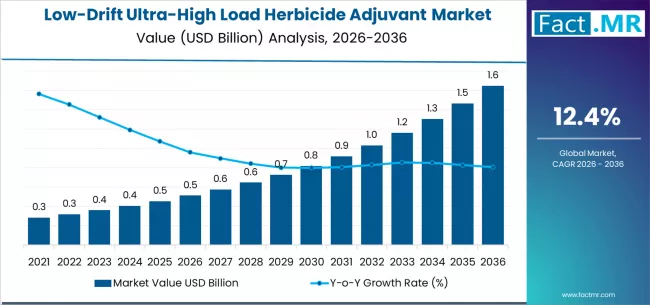
Low Drift Ultra High Load Herbicide Adjuvant Market Market Value Analysis

Critical trends include the development of multifunctional adjuvant systems that combine drift control with enhanced herbicide loading and deposition. Innovation is focused on next-generation polymer chemistries that maintain efficacy across a wider range of water qualities and temperatures. The integration of these adjuvants into precision spraying systems and closed transfer handling protocols is becoming a standard for modern large-scale agriculture.

Stringent regulatory mandates on pesticide drift and volatile organic compound emissions are primary market catalysts. Regulations in North America and Europe specifically governing the application of auxin herbicides have created a compliance-driven demand for certified low-drift adjuvants. These policies are effectively shaping product development and accelerating the replacement of conventional surfactant systems.

Low-Drift Ultra-High Load Herbicide Adjuvant Market

Metric Value
Market Value (2026) USD 0.51 Billion
Market Forecast Value (2036) USD 1.65 Billion
Forecast CAGR (2026-2036) 12.4%

Category

Category Segments
Adjuvant Technology Type Drift-Reduction Polymers (DRAs), Ultra-High-Load Surfactant Systems, Oil-Based Deposition Enhancers, Rheology-Modifying Thickeners, Others
Herbicide Compatibility Glyphosate-Based Programs, Auxin Herbicides (2,4-D, Dicamba), Contact Herbicides, Residual & Pre-Emergent Herbicides, Others
Crop Type Row Crops (Corn, Soybean, Cotton), Cereals & Grains, Plantation & Industrial Crops, Horticulture & Specialty Crops, Others
Region North America, Latin America, Western Europe, Eastern Europe, East Asia, South Asia & Pacific, MEA

Segmental Analysis

By Adjuvant Technology, Which Solution Addresses the Most Press Regulatory Concern?
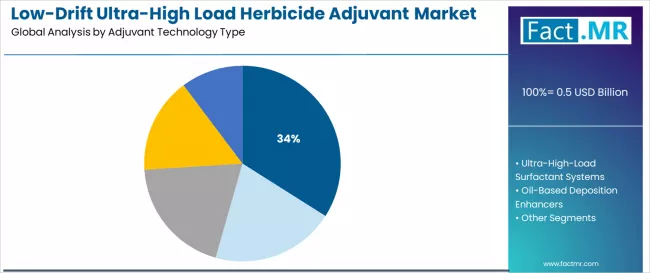
Low Drift Ultra High Load Herbicide Adjuvant Market Analysis By Adjuvant Technology Type

Drift-reduction polymers lead the segment with a 34% share. This dominance is directly linked to stringent anti-drift regulations for volatile herbicides like dicamba and 2,4-D. These polymers modify droplet size and rheology, minimizing off-target movement. Their adoption is often mandatory for legal herbicide application in key markets, making them a compliance essential rather than an optional enhancement for growers.

By Herbicide Compatibility, Which Chemistry Drives Foundational Demand?
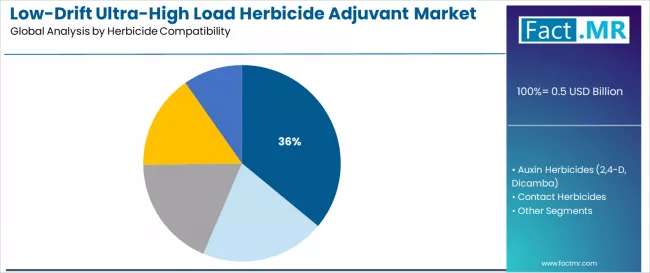
Low Drift Ultra High Load Herbicide Adjuvant Market Analysis By Herbicide Compatibility

Compatibility with glyphosate-based programs holds the largest share at 36%. Glyphosate remains the cornerstone of global weed management. The need to improve its efficacy under hard water conditions, increase rainfastness, and reduce drift in tank mixes with other chemistries creates sustained, high-volume demand for advanced adjuvant systems tailored to this herbicide.

By Crop Type, Where is Operational Scale a Primary Adoption Driver?
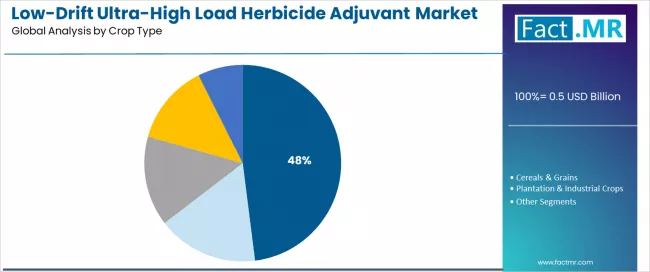
Low Drift Ultra High Load Herbicide Adjuvant Market Analysis By Crop Type

The row crops segment commands a 48% share. The vast acreage of corn, soybean, and cotton cultivation, combined with the uniform aerial or ground-broadcast application methods used, makes drift control and spray efficiency paramount. The economic impact of both weed control failure and off-target damage in these crops justifies investment in premium adjuvant technologies that ensure precise application.

What are the Drivers, Restraints, and Key Trends of the Low-Drift Ultra-High Load Herbicide Adjuvant Market?

Market growth is propelled by unequivocal regulatory mandates requiring drift reduction technology for specific herbicide labels. The increasing prevalence of herbicide-resistant weeds necessitates higher effective doses and superior spray deposition, which high-load adjuvants enable. The expansion of precision sprayer adoption creates a compatible platform for these advanced formulations.

A primary restraint is the added cost per acre, which can deter adoption in commodity crop markets during periods of low farm income. Technical complexity regarding tank-mix compatibility and water quality interactions can lead to user error and inconsistent results. The slow rate of replacement for older adjuvant inventories among distributors also tempers market expansion.

Key trends feature the rise of digital tools for adjuvant selection based on real-time weather and water quality data. Formulation science is advancing towards single-bottle, multi-mode products that combine drift control, deposition, and compatibility agents. A growing emphasis on lower volatile organic compound formulations aligns with broader environmental goals.

Analysis of the Low-Drift Ultra-High Load Herbicide Adjuvant Market by Key Countries
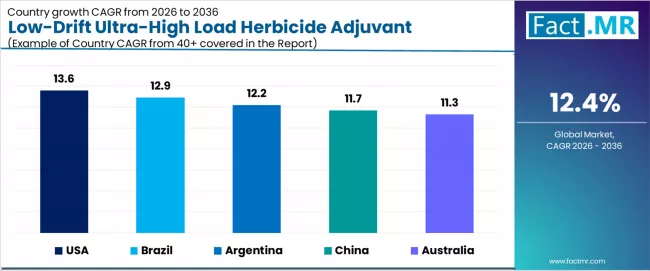
Low Drift Ultra High Load Herbicide Adjuvant Market Cagr Analysis By Country

Country CAGR (2026-2036)
USA 13.60%
Brazil 12.90%
Argentina 12.20%
China 11.70%
Australia 11.30%

How do Regulations influence Adjuvant Innovation and Adoption in USA?
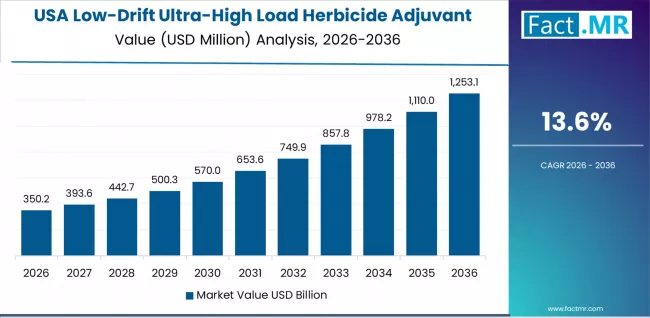
Low Drift Ultra High Load Herbicide Adjuvant Market Country Value Analysis

The USA leads with a 13.60% CAGR, driven by federally enforced label requirements for dicamba and 2,4-D products that mandate the use of approved low-drift adjuvants. This regulatory environment has transformed the adjuvant market into a compliance-driven sector. Large-scale row crop farmers in the Midwest and Plains states are compelled to adopt these technologies, with product choice heavily influenced by herbicide manufacturer lists and insurance considerations.

Why is Brazil's Large-Scale Agriculture Ideal for High-Load Adjuvant Systems?

Brazil's 12.90% growth is fueled by its massive soybean, corn, and cotton acreage farmed under intensive, multi-crop systems. The challenge of managing resistant weeds like goosegrass and ryegrass demands robust herbicide programs. The scale of operations makes adjuvant performance critical for cost-effective weed control. Local adjuvant manufacturing and blending facilities support the development of products tailored to tropical spray conditions and common tank mixes.

What Role do Auxin Herbicides Play in Argentina's Adjuvant Market Growth?

Argentina's 12.20% CAGR is closely tied to the widespread adoption of auxin herbicides, particularly 2,4-D and dicamba, for post-emergent weed control in soybeans and cereals. Similar to the US, this drives compliance-based demand for low-drift adjuvants. The prevalence of contract aerial application services further professionalizes the market, as applicators strictly follow label requirements to minimize liability from off-target damage incidents.

How is China's Evolving Agriculture Sector Creating New Adjuvant Demand?

China's 11.70% growth reflects the consolidation of farmland and mechanization of herbicide application. As large farming cooperatives emerge, they seek professional-grade inputs to maximize efficiency. Government policies encouraging reduced pesticide usage through increased efficiency support the adoption of high-performance adjuvants. Domestic production of generic glyphosate and growing use of complex tank mixes create a specific need for compatibility and drift-control agents.

What Environmental and Social Factors Drive Adjuvant Use in Australia?

Australia's 11.30% growth is underpinned by acute social and environmental sensitivity to pesticide drift, especially near vineyards, horticulture, and residential areas. This social license to operate drives voluntary adoption of best-in-class drift reduction technology beyond regulatory minimums. The extensive use of herbicides in dryland wheat and barley production also benefits from deposition-enhancing adjuvants that combat rapid droplet evaporation in arid conditions.

Competitive Landscape of the Low-Drift Ultra-High Load Herbicide Adjuvant Market
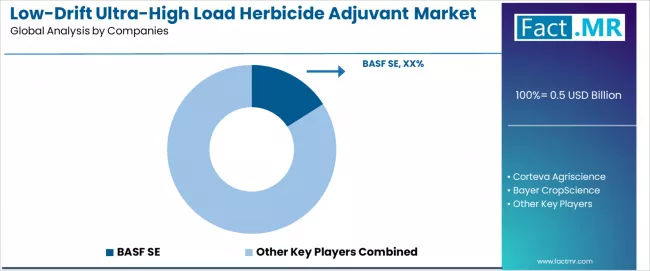
Low Drift Ultra High Load Herbicide Adjuvant Market Analysis By Company

The market is characterized by competition between global agrochemical leaders and specialized adjuvant manufacturers. BASF SE, Corteva Agriscience, Bayer CropScience, and Syngenta Group compete by developing proprietary adjuvant systems that are often co-packaged or specifically recommended for use with their flagship herbicide products. This strategy creates integrated, branded solutions and drives customer loyalty.

Specialty players like Helena Agri-Enterprises compete through deep regional distribution networks, tailored technical support, and a broad portfolio of adjuvant brands. Competition hinges on securing official listing on herbicide labels, generating robust field trial data across diverse conditions, and providing clear application guidance. Success requires navigating complex regulatory landscapes and building trust with both growers and custom applicators.

Key Players in the Low-Drift Ultra-High Load Herbicide Adjuvant Market

  • BASF SE
  • Corteva Agriscience
  • Bayer CropScience
  • Syngenta Group
  • Helena Agri-Enterprises

Scope of Report

Items Values
Quantitative Units USD Billion
Adjuvant Technology Type Drift-Reduction Polymers (DRAs), Ultra-High-Load Surfactant Systems, Oil-Based Deposition Enhancers, Rheology-Modifying Thickeners, Others
Herbicide Compatibility Glyphosate-Based Programs, Auxin Herbicides (2,4-D, Dicamba), Contact Herbicides, Residual & Pre-Emergent Herbicides, Others
Crop Type Row Crops (Corn, Soybean, Cotton), Cereals & Grains, Plantation & Industrial Crops, Horticulture & Specialty Crops, Others
Key Countries USA, Brazil, Argentina, China, Australia
Key Companies BASF SE, Corteva Agriscience, Bayer CropScience, Syngenta Group, Helena Agri-Enterprises
Additional Analysis Analysis of regulatory label requirements by country, tank-mix compatibility databases, spray application technology synergy (droplet size spectra), environmental fate of adjuvant polymers, and cost-benefit modeling for large-acreage farms.

Low-Drift Ultra-High Load Herbicide Adjuvant Market by Segments

  • Adjuvant Technology Type :

    • Drift-Reduction Polymers (DRAs)
    • Ultra-High-Load Surfactant Systems
    • Oil-Based Deposition Enhancers
    • Rheology-Modifying Thickeners
    • Others
  • Herbicide Compatibility :

    • Glyphosate-Based Programs
    • Auxin Herbicides (2,4-D, Dicamba)
    • Contact Herbicides
    • Residual & Pre-Emergent Herbicides
    • Others
  • Crop Type :

    • Row Crops (Corn, Soybean, Cotton)
    • Cereals & Grains
    • Plantation & Industrial Crops
    • Horticulture & Specialty Crops
    • Others
  • Region :

    • North America

      • USA
      • Canada
    • Latin America

      • Brazil
      • Mexico
      • Argentina
      • Rest of Latin America
    • Western Europe

      • Germany
      • UK
      • France
      • Spain
      • Italy
      • BENELUX
      • Rest of Western Europe
    • Eastern Europe

      • Czech Republic
      • Poland
      • Russia
      • Rest of Eastern Europe
    • East Asia

      • China
      • Japan
      • South Korea
      • Rest of East Asia
    • South Asia & Pacific

      • India
      • Indonesia
      • Australia
      • Rest of South Asia & Pacific
    • MEA

      • GCC Countries
      • Turkiye
      • Saudi Arabia
      • Rest of MEA

Table of Content

  1. Executive Summary
    • Global Market Outlook
    • Demand to side Trends
    • Supply to side Trends
    • Technology Roadmap Analysis
    • Analysis and Recommendations
  2. Market Overview
    • Market Coverage / Taxonomy
    • Market Definition / Scope / Limitations
  3. Market Background
    • Market Dynamics
      • Drivers
      • Restraints
      • Opportunity
      • Trends
    • Scenario Forecast
      • Demand in Optimistic Scenario
      • Demand in Likely Scenario
      • Demand in Conservative Scenario
    • Opportunity Map Analysis
    • Product Life Cycle Analysis
    • Supply Chain Analysis
    • Investment Feasibility Matrix
    • Value Chain Analysis
    • PESTLE and Porter’s Analysis
    • Regulatory Landscape
    • Regional Parent Market Outlook
    • Production and Consumption Statistics
    • Import and Export Statistics
  4. Global Market Analysis 2021 to 2025 and Forecast, 2026 to 2036
    • Historical Market Size Value (USD Million) Analysis, 2021 to 2025
    • Current and Future Market Size Value (USD Million) Projections, 2026 to 2036
      • Y to o to Y Growth Trend Analysis
      • Absolute $ Opportunity Analysis
  5. Global Market Pricing Analysis 2021 to 2025 and Forecast 2026 to 2036
  6. Global Market Analysis 2021 to 2025 and Forecast 2026 to 2036, By Adjuvant Technology Type
    • Introduction / Key Findings
    • Historical Market Size Value (USD Million) Analysis By Adjuvant Technology Type, 2021 to 2025
    • Current and Future Market Size Value (USD Million) Analysis and Forecast By Adjuvant Technology Type, 2026 to 2036
      • Drift-Reduction Polymers (DRAs)
      • Ultra-High-Load Surfactant Systems
      • Oil-Based Deposition Enhancers
      • Rheology-Modifying Thickeners
      • Others
    • Y to o to Y Growth Trend Analysis By Adjuvant Technology Type, 2021 to 2025
    • Absolute $ Opportunity Analysis By Adjuvant Technology Type, 2026 to 2036
  7. Global Market Analysis 2021 to 2025 and Forecast 2026 to 2036, By Herbicide Compatibility
    • Introduction / Key Findings
    • Historical Market Size Value (USD Million) Analysis By Herbicide Compatibility, 2021 to 2025
    • Current and Future Market Size Value (USD Million) Analysis and Forecast By Herbicide Compatibility, 2026 to 2036
      • Glyphosate-Based Programs
      • Auxin Herbicides (2,4-D, Dicamba)
      • Contact Herbicides
      • Residual & Pre-Emergent Herbicides
      • Others
    • Y to o to Y Growth Trend Analysis By Herbicide Compatibility, 2021 to 2025
    • Absolute $ Opportunity Analysis By Herbicide Compatibility, 2026 to 2036
  8. Global Market Analysis 2021 to 2025 and Forecast 2026 to 2036, By Crop Type
    • Introduction / Key Findings
    • Historical Market Size Value (USD Million) Analysis By Crop Type, 2021 to 2025
    • Current and Future Market Size Value (USD Million) Analysis and Forecast By Crop Type, 2026 to 2036
      • Row Crops (Corn, Soybean, Cotton)
      • Cereals & Grains
      • Plantation & Industrial Crops
      • Horticulture & Specialty Crops
      • Others
    • Y to o to Y Growth Trend Analysis By Crop Type, 2021 to 2025
    • Absolute $ Opportunity Analysis By Crop Type, 2026 to 2036
  9. Global Market Analysis 2021 to 2025 and Forecast 2026 to 2036, By Region
    • Introduction
    • Historical Market Size Value (USD Million) Analysis By Region, 2021 to 2025
    • Current Market Size Value (USD Million) Analysis and Forecast By Region, 2026 to 2036
      • North America
      • Latin America
      • Western Europe
      • Eastern Europe
      • East Asia
      • South Asia and Pacific
      • Middle East & Africa
    • Market Attractiveness Analysis By Region
  10. North America Market Analysis 2021 to 2025 and Forecast 2026 to 2036, By Country
    • Historical Market Size Value (USD Million) Trend Analysis By Market Taxonomy, 2021 to 2025
    • Market Size Value (USD Million) Forecast By Market Taxonomy, 2026 to 2036
      • By Country
        • USA
        • Canada
        • Mexico
      • By Adjuvant Technology Type
      • By Herbicide Compatibility
      • By Crop Type
    • Market Attractiveness Analysis
      • By Country
      • By Adjuvant Technology Type
      • By Herbicide Compatibility
      • By Crop Type
    • Key Takeaways
  11. Latin America Market Analysis 2021 to 2025 and Forecast 2026 to 2036, By Country
    • Historical Market Size Value (USD Million) Trend Analysis By Market Taxonomy, 2021 to 2025
    • Market Size Value (USD Million) Forecast By Market Taxonomy, 2026 to 2036
      • By Country
        • Brazil
        • Chile
        • Rest of Latin America
      • By Adjuvant Technology Type
      • By Herbicide Compatibility
      • By Crop Type
    • Market Attractiveness Analysis
      • By Country
      • By Adjuvant Technology Type
      • By Herbicide Compatibility
      • By Crop Type
    • Key Takeaways
  12. Western Europe Market Analysis 2021 to 2025 and Forecast 2026 to 2036, By Country
    • Historical Market Size Value (USD Million) Trend Analysis By Market Taxonomy, 2021 to 2025
    • Market Size Value (USD Million) Forecast By Market Taxonomy, 2026 to 2036
      • By Country
        • Germany
        • UK
        • Italy
        • Spain
        • France
        • Nordic
        • BENELUX
        • Rest of Western Europe
      • By Adjuvant Technology Type
      • By Herbicide Compatibility
      • By Crop Type
    • Market Attractiveness Analysis
      • By Country
      • By Adjuvant Technology Type
      • By Herbicide Compatibility
      • By Crop Type
    • Key Takeaways
  13. Eastern Europe Market Analysis 2021 to 2025 and Forecast 2026 to 2036, By Country
    • Historical Market Size Value (USD Million) Trend Analysis By Market Taxonomy, 2021 to 2025
    • Market Size Value (USD Million) Forecast By Market Taxonomy, 2026 to 2036
      • By Country
        • Russia
        • Poland
        • Hungary
        • Balkan & Baltic
        • Rest of Eastern Europe
      • By Adjuvant Technology Type
      • By Herbicide Compatibility
      • By Crop Type
    • Market Attractiveness Analysis
      • By Country
      • By Adjuvant Technology Type
      • By Herbicide Compatibility
      • By Crop Type
    • Key Takeaways
  14. East Asia Market Analysis 2021 to 2025 and Forecast 2026 to 2036, By Country
    • Historical Market Size Value (USD Million) Trend Analysis By Market Taxonomy, 2021 to 2025
    • Market Size Value (USD Million) Forecast By Market Taxonomy, 2026 to 2036
      • By Country
        • China
        • Japan
        • South Korea
      • By Adjuvant Technology Type
      • By Herbicide Compatibility
      • By Crop Type
    • Market Attractiveness Analysis
      • By Country
      • By Adjuvant Technology Type
      • By Herbicide Compatibility
      • By Crop Type
    • Key Takeaways
  15. South Asia and Pacific Market Analysis 2021 to 2025 and Forecast 2026 to 2036, By Country
    • Historical Market Size Value (USD Million) Trend Analysis By Market Taxonomy, 2021 to 2025
    • Market Size Value (USD Million) Forecast By Market Taxonomy, 2026 to 2036
      • By Country
        • India
        • ASEAN
        • Australia & New Zealand
        • Rest of South Asia and Pacific
      • By Adjuvant Technology Type
      • By Herbicide Compatibility
      • By Crop Type
    • Market Attractiveness Analysis
      • By Country
      • By Adjuvant Technology Type
      • By Herbicide Compatibility
      • By Crop Type
    • Key Takeaways
  16. Middle East & Africa Market Analysis 2021 to 2025 and Forecast 2026 to 2036, By Country
    • Historical Market Size Value (USD Million) Trend Analysis By Market Taxonomy, 2021 to 2025
    • Market Size Value (USD Million) Forecast By Market Taxonomy, 2026 to 2036
      • By Country
        • Kingdom of Saudi Arabia
        • Other GCC Countries
        • Turkiye
        • South Africa
        • Other African Union
        • Rest of Middle East & Africa
      • By Adjuvant Technology Type
      • By Herbicide Compatibility
      • By Crop Type
    • Market Attractiveness Analysis
      • By Country
      • By Adjuvant Technology Type
      • By Herbicide Compatibility
      • By Crop Type
    • Key Takeaways
  17. Key Countries Market Analysis
    • USA
      • Pricing Analysis
      • Market Share Analysis, 2025
        • By Adjuvant Technology Type
        • By Herbicide Compatibility
        • By Crop Type
    • Canada
      • Pricing Analysis
      • Market Share Analysis, 2025
        • By Adjuvant Technology Type
        • By Herbicide Compatibility
        • By Crop Type
    • Mexico
      • Pricing Analysis
      • Market Share Analysis, 2025
        • By Adjuvant Technology Type
        • By Herbicide Compatibility
        • By Crop Type
    • Brazil
      • Pricing Analysis
      • Market Share Analysis, 2025
        • By Adjuvant Technology Type
        • By Herbicide Compatibility
        • By Crop Type
    • Chile
      • Pricing Analysis
      • Market Share Analysis, 2025
        • By Adjuvant Technology Type
        • By Herbicide Compatibility
        • By Crop Type
    • Germany
      • Pricing Analysis
      • Market Share Analysis, 2025
        • By Adjuvant Technology Type
        • By Herbicide Compatibility
        • By Crop Type
    • UK
      • Pricing Analysis
      • Market Share Analysis, 2025
        • By Adjuvant Technology Type
        • By Herbicide Compatibility
        • By Crop Type
    • Italy
      • Pricing Analysis
      • Market Share Analysis, 2025
        • By Adjuvant Technology Type
        • By Herbicide Compatibility
        • By Crop Type
    • Spain
      • Pricing Analysis
      • Market Share Analysis, 2025
        • By Adjuvant Technology Type
        • By Herbicide Compatibility
        • By Crop Type
    • France
      • Pricing Analysis
      • Market Share Analysis, 2025
        • By Adjuvant Technology Type
        • By Herbicide Compatibility
        • By Crop Type
    • India
      • Pricing Analysis
      • Market Share Analysis, 2025
        • By Adjuvant Technology Type
        • By Herbicide Compatibility
        • By Crop Type
    • ASEAN
      • Pricing Analysis
      • Market Share Analysis, 2025
        • By Adjuvant Technology Type
        • By Herbicide Compatibility
        • By Crop Type
    • Australia & New Zealand
      • Pricing Analysis
      • Market Share Analysis, 2025
        • By Adjuvant Technology Type
        • By Herbicide Compatibility
        • By Crop Type
    • China
      • Pricing Analysis
      • Market Share Analysis, 2025
        • By Adjuvant Technology Type
        • By Herbicide Compatibility
        • By Crop Type
    • Japan
      • Pricing Analysis
      • Market Share Analysis, 2025
        • By Adjuvant Technology Type
        • By Herbicide Compatibility
        • By Crop Type
    • South Korea
      • Pricing Analysis
      • Market Share Analysis, 2025
        • By Adjuvant Technology Type
        • By Herbicide Compatibility
        • By Crop Type
    • Russia
      • Pricing Analysis
      • Market Share Analysis, 2025
        • By Adjuvant Technology Type
        • By Herbicide Compatibility
        • By Crop Type
    • Poland
      • Pricing Analysis
      • Market Share Analysis, 2025
        • By Adjuvant Technology Type
        • By Herbicide Compatibility
        • By Crop Type
    • Hungary
      • Pricing Analysis
      • Market Share Analysis, 2025
        • By Adjuvant Technology Type
        • By Herbicide Compatibility
        • By Crop Type
    • Kingdom of Saudi Arabia
      • Pricing Analysis
      • Market Share Analysis, 2025
        • By Adjuvant Technology Type
        • By Herbicide Compatibility
        • By Crop Type
    • Turkiye
      • Pricing Analysis
      • Market Share Analysis, 2025
        • By Adjuvant Technology Type
        • By Herbicide Compatibility
        • By Crop Type
    • South Africa
      • Pricing Analysis
      • Market Share Analysis, 2025
        • By Adjuvant Technology Type
        • By Herbicide Compatibility
        • By Crop Type
  18. Market Structure Analysis
    • Competition Dashboard
    • Competition Benchmarking
    • Market Share Analysis of Top Players
      • By Regional
      • By Adjuvant Technology Type
      • By Herbicide Compatibility
      • By Crop Type
  19. Competition Analysis
    • Competition Deep Dive
      • BASF SE
        • Overview
        • Product Portfolio
        • Profitability by Market Segments (Product/Age /Sales Channel/Region)
        • Sales Footprint
        • Strategy Overview
          • Marketing Strategy
          • Product Strategy
          • Channel Strategy
      • Corteva Agriscience
      • Bayer CropScience
      • Syngenta Group
      • Helena Agri-Enterprises
  20. Assumptions & Acronyms Used
  21. Research Methodology

List Of Table

  • Table 1: Global Market Value (USD Million) Forecast by Region, 2021 to 2036
  • Table 2: Global Market Value (USD Million) Forecast by Adjuvant Technology Type, 2021 to 2036
  • Table 3: Global Market Value (USD Million) Forecast by Herbicide Compatibility, 2021 to 2036
  • Table 4: Global Market Value (USD Million) Forecast by Crop Type, 2021 to 2036
  • Table 5: North America Market Value (USD Million) Forecast by Country, 2021 to 2036
  • Table 6: North America Market Value (USD Million) Forecast by Adjuvant Technology Type, 2021 to 2036
  • Table 7: North America Market Value (USD Million) Forecast by Herbicide Compatibility, 2021 to 2036
  • Table 8: North America Market Value (USD Million) Forecast by Crop Type, 2021 to 2036
  • Table 9: Latin America Market Value (USD Million) Forecast by Country, 2021 to 2036
  • Table 10: Latin America Market Value (USD Million) Forecast by Adjuvant Technology Type, 2021 to 2036
  • Table 11: Latin America Market Value (USD Million) Forecast by Herbicide Compatibility, 2021 to 2036
  • Table 12: Latin America Market Value (USD Million) Forecast by Crop Type, 2021 to 2036
  • Table 13: Western Europe Market Value (USD Million) Forecast by Country, 2021 to 2036
  • Table 14: Western Europe Market Value (USD Million) Forecast by Adjuvant Technology Type, 2021 to 2036
  • Table 15: Western Europe Market Value (USD Million) Forecast by Herbicide Compatibility, 2021 to 2036
  • Table 16: Western Europe Market Value (USD Million) Forecast by Crop Type, 2021 to 2036
  • Table 17: Eastern Europe Market Value (USD Million) Forecast by Country, 2021 to 2036
  • Table 18: Eastern Europe Market Value (USD Million) Forecast by Adjuvant Technology Type, 2021 to 2036
  • Table 19: Eastern Europe Market Value (USD Million) Forecast by Herbicide Compatibility, 2021 to 2036
  • Table 20: Eastern Europe Market Value (USD Million) Forecast by Crop Type, 2021 to 2036
  • Table 21: East Asia Market Value (USD Million) Forecast by Country, 2021 to 2036
  • Table 22: East Asia Market Value (USD Million) Forecast by Adjuvant Technology Type, 2021 to 2036
  • Table 23: East Asia Market Value (USD Million) Forecast by Herbicide Compatibility, 2021 to 2036
  • Table 24: East Asia Market Value (USD Million) Forecast by Crop Type, 2021 to 2036
  • Table 25: South Asia and Pacific Market Value (USD Million) Forecast by Country, 2021 to 2036
  • Table 26: South Asia and Pacific Market Value (USD Million) Forecast by Adjuvant Technology Type, 2021 to 2036
  • Table 27: South Asia and Pacific Market Value (USD Million) Forecast by Herbicide Compatibility, 2021 to 2036
  • Table 28: South Asia and Pacific Market Value (USD Million) Forecast by Crop Type, 2021 to 2036
  • Table 29: Middle East & Africa Market Value (USD Million) Forecast by Country, 2021 to 2036
  • Table 30: Middle East & Africa Market Value (USD Million) Forecast by Adjuvant Technology Type, 2021 to 2036
  • Table 31: Middle East & Africa Market Value (USD Million) Forecast by Herbicide Compatibility, 2021 to 2036
  • Table 32: Middle East & Africa Market Value (USD Million) Forecast by Crop Type, 2021 to 2036

List Of Figures

  • Figure 1: Global Market Pricing Analysis
  • Figure 2: Global Market Value (USD Million) Forecast 2021 to 2036
  • Figure 3: Global Market Value Share and BPS Analysis by Adjuvant Technology Type, 2026 and 2036
  • Figure 4: Global Market Y to o to Y Growth Comparison by Adjuvant Technology Type, 2026 to 2036
  • Figure 5: Global Market Attractiveness Analysis by Adjuvant Technology Type
  • Figure 6: Global Market Value Share and BPS Analysis by Herbicide Compatibility, 2026 and 2036
  • Figure 7: Global Market Y to o to Y Growth Comparison by Herbicide Compatibility, 2026 to 2036
  • Figure 8: Global Market Attractiveness Analysis by Herbicide Compatibility
  • Figure 9: Global Market Value Share and BPS Analysis by Crop Type, 2026 and 2036
  • Figure 10: Global Market Y to o to Y Growth Comparison by Crop Type, 2026 to 2036
  • Figure 11: Global Market Attractiveness Analysis by Crop Type
  • Figure 12: Global Market Value (USD Million) Share and BPS Analysis by Region, 2026 and 2036
  • Figure 13: Global Market Y to o to Y Growth Comparison by Region, 2026 to 2036
  • Figure 14: Global Market Attractiveness Analysis by Region
  • Figure 15: North America Market Incremental Dollar Opportunity, 2026 to 2036
  • Figure 16: Latin America Market Incremental Dollar Opportunity, 2026 to 2036
  • Figure 17: Western Europe Market Incremental Dollar Opportunity, 2026 to 2036
  • Figure 18: Eastern Europe Market Incremental Dollar Opportunity, 2026 to 2036
  • Figure 19: East Asia Market Incremental Dollar Opportunity, 2026 to 2036
  • Figure 20: South Asia and Pacific Market Incremental Dollar Opportunity, 2026 to 2036
  • Figure 21: Middle East & Africa Market Incremental Dollar Opportunity, 2026 to 2036
  • Figure 22: North America Market Value Share and BPS Analysis by Country, 2026 and 2036
  • Figure 23: North America Market Value Share and BPS Analysis by Adjuvant Technology Type, 2026 and 2036
  • Figure 24: North America Market Y to o to Y Growth Comparison by Adjuvant Technology Type, 2026 to 2036
  • Figure 25: North America Market Attractiveness Analysis by Adjuvant Technology Type
  • Figure 26: North America Market Value Share and BPS Analysis by Herbicide Compatibility, 2026 and 2036
  • Figure 27: North America Market Y to o to Y Growth Comparison by Herbicide Compatibility, 2026 to 2036
  • Figure 28: North America Market Attractiveness Analysis by Herbicide Compatibility
  • Figure 29: North America Market Value Share and BPS Analysis by Crop Type, 2026 and 2036
  • Figure 30: North America Market Y to o to Y Growth Comparison by Crop Type, 2026 to 2036
  • Figure 31: North America Market Attractiveness Analysis by Crop Type
  • Figure 32: Latin America Market Value Share and BPS Analysis by Country, 2026 and 2036
  • Figure 33: Latin America Market Value Share and BPS Analysis by Adjuvant Technology Type, 2026 and 2036
  • Figure 34: Latin America Market Y to o to Y Growth Comparison by Adjuvant Technology Type, 2026 to 2036
  • Figure 35: Latin America Market Attractiveness Analysis by Adjuvant Technology Type
  • Figure 36: Latin America Market Value Share and BPS Analysis by Herbicide Compatibility, 2026 and 2036
  • Figure 37: Latin America Market Y to o to Y Growth Comparison by Herbicide Compatibility, 2026 to 2036
  • Figure 38: Latin America Market Attractiveness Analysis by Herbicide Compatibility
  • Figure 39: Latin America Market Value Share and BPS Analysis by Crop Type, 2026 and 2036
  • Figure 40: Latin America Market Y to o to Y Growth Comparison by Crop Type, 2026 to 2036
  • Figure 41: Latin America Market Attractiveness Analysis by Crop Type
  • Figure 42: Western Europe Market Value Share and BPS Analysis by Country, 2026 and 2036
  • Figure 43: Western Europe Market Value Share and BPS Analysis by Adjuvant Technology Type, 2026 and 2036
  • Figure 44: Western Europe Market Y to o to Y Growth Comparison by Adjuvant Technology Type, 2026 to 2036
  • Figure 45: Western Europe Market Attractiveness Analysis by Adjuvant Technology Type
  • Figure 46: Western Europe Market Value Share and BPS Analysis by Herbicide Compatibility, 2026 and 2036
  • Figure 47: Western Europe Market Y to o to Y Growth Comparison by Herbicide Compatibility, 2026 to 2036
  • Figure 48: Western Europe Market Attractiveness Analysis by Herbicide Compatibility
  • Figure 49: Western Europe Market Value Share and BPS Analysis by Crop Type, 2026 and 2036
  • Figure 50: Western Europe Market Y to o to Y Growth Comparison by Crop Type, 2026 to 2036
  • Figure 51: Western Europe Market Attractiveness Analysis by Crop Type
  • Figure 52: Eastern Europe Market Value Share and BPS Analysis by Country, 2026 and 2036
  • Figure 53: Eastern Europe Market Value Share and BPS Analysis by Adjuvant Technology Type, 2026 and 2036
  • Figure 54: Eastern Europe Market Y to o to Y Growth Comparison by Adjuvant Technology Type, 2026 to 2036
  • Figure 55: Eastern Europe Market Attractiveness Analysis by Adjuvant Technology Type
  • Figure 56: Eastern Europe Market Value Share and BPS Analysis by Herbicide Compatibility, 2026 and 2036
  • Figure 57: Eastern Europe Market Y to o to Y Growth Comparison by Herbicide Compatibility, 2026 to 2036
  • Figure 58: Eastern Europe Market Attractiveness Analysis by Herbicide Compatibility
  • Figure 59: Eastern Europe Market Value Share and BPS Analysis by Crop Type, 2026 and 2036
  • Figure 60: Eastern Europe Market Y to o to Y Growth Comparison by Crop Type, 2026 to 2036
  • Figure 61: Eastern Europe Market Attractiveness Analysis by Crop Type
  • Figure 62: East Asia Market Value Share and BPS Analysis by Country, 2026 and 2036
  • Figure 63: East Asia Market Value Share and BPS Analysis by Adjuvant Technology Type, 2026 and 2036
  • Figure 64: East Asia Market Y to o to Y Growth Comparison by Adjuvant Technology Type, 2026 to 2036
  • Figure 65: East Asia Market Attractiveness Analysis by Adjuvant Technology Type
  • Figure 66: East Asia Market Value Share and BPS Analysis by Herbicide Compatibility, 2026 and 2036
  • Figure 67: East Asia Market Y to o to Y Growth Comparison by Herbicide Compatibility, 2026 to 2036
  • Figure 68: East Asia Market Attractiveness Analysis by Herbicide Compatibility
  • Figure 69: East Asia Market Value Share and BPS Analysis by Crop Type, 2026 and 2036
  • Figure 70: East Asia Market Y to o to Y Growth Comparison by Crop Type, 2026 to 2036
  • Figure 71: East Asia Market Attractiveness Analysis by Crop Type
  • Figure 72: South Asia and Pacific Market Value Share and BPS Analysis by Country, 2026 and 2036
  • Figure 73: South Asia and Pacific Market Value Share and BPS Analysis by Adjuvant Technology Type, 2026 and 2036
  • Figure 74: South Asia and Pacific Market Y to o to Y Growth Comparison by Adjuvant Technology Type, 2026 to 2036
  • Figure 75: South Asia and Pacific Market Attractiveness Analysis by Adjuvant Technology Type
  • Figure 76: South Asia and Pacific Market Value Share and BPS Analysis by Herbicide Compatibility, 2026 and 2036
  • Figure 77: South Asia and Pacific Market Y to o to Y Growth Comparison by Herbicide Compatibility, 2026 to 2036
  • Figure 78: South Asia and Pacific Market Attractiveness Analysis by Herbicide Compatibility
  • Figure 79: South Asia and Pacific Market Value Share and BPS Analysis by Crop Type, 2026 and 2036
  • Figure 80: South Asia and Pacific Market Y to o to Y Growth Comparison by Crop Type, 2026 to 2036
  • Figure 81: South Asia and Pacific Market Attractiveness Analysis by Crop Type
  • Figure 82: Middle East & Africa Market Value Share and BPS Analysis by Country, 2026 and 2036
  • Figure 83: Middle East & Africa Market Value Share and BPS Analysis by Adjuvant Technology Type, 2026 and 2036
  • Figure 84: Middle East & Africa Market Y to o to Y Growth Comparison by Adjuvant Technology Type, 2026 to 2036
  • Figure 85: Middle East & Africa Market Attractiveness Analysis by Adjuvant Technology Type
  • Figure 86: Middle East & Africa Market Value Share and BPS Analysis by Herbicide Compatibility, 2026 and 2036
  • Figure 87: Middle East & Africa Market Y to o to Y Growth Comparison by Herbicide Compatibility, 2026 to 2036
  • Figure 88: Middle East & Africa Market Attractiveness Analysis by Herbicide Compatibility
  • Figure 89: Middle East & Africa Market Value Share and BPS Analysis by Crop Type, 2026 and 2036
  • Figure 90: Middle East & Africa Market Y to o to Y Growth Comparison by Crop Type, 2026 to 2036
  • Figure 91: Middle East & Africa Market Attractiveness Analysis by Crop Type
  • Figure 92: Global Market - Tier Structure Analysis
  • Figure 93: Global Market - Company Share Analysis

- FAQs -

How big is the low-drift ultra-high load herbicide adjuvant market in 2026?

The global low-drift ultra-high load herbicide adjuvant market is estimated to be valued at USD 0.5 billion in 2026.

What will be the size of low-drift ultra-high load herbicide adjuvant market in 2036?

The market size for the low-drift ultra-high load herbicide adjuvant market is projected to reach USD 1.6 billion by 2036.

How much will be the low-drift ultra-high load herbicide adjuvant market growth between 2026 and 2036?

The low-drift ultra-high load herbicide adjuvant market is expected to grow at a 12.4% CAGR between 2026 and 2036.

What are the key product types in the low-drift ultra-high load herbicide adjuvant market?

The key product types in low-drift ultra-high load herbicide adjuvant market are drift-reduction polymers (dras), ultra-high-load surfactant systems, oil-based deposition enhancers, rheology-modifying thickeners and others.

Which herbicide compatibility segment to contribute significant share in the low-drift ultra-high load herbicide adjuvant market in 2026?

In terms of herbicide compatibility, glyphosate-based programs segment to command 36.0% share in the low-drift ultra-high load herbicide adjuvant market in 2026.

Low-Drift Ultra-High Load Herbicide Adjuvant Market