- Base Value(2025): 197 Mn
- Forecast Value (2035): 454 Mn
- CAGR (2035): 9.5%
Bioresorbable Orthopedic Scaffolds Market Outlook 2025 to 2035
The global bioresorbable orthopedic scaffolds market is expected to reach USD 454 million by 2035, up from USD 197 million in 2025. During the forecast period 2025 to 2035, the industry is projected to expand at a CAGR of 8.7%.
The market of bioresorbable orthopedic scaffolds has been steadily growing in the past because of the rising needs in energy-efficient, durable, and patient-safe regenerative systems that can be adjusted to a variety of clinical environments. There is the wide use of automation, 3D printing, and bioactive material integration in orthopedic and trauma care.
The proposed sustainable scaffold design has potential to increase biocompatibility, regulated degradation, and cost-effectiveness, which will lead to the growth of the global market and technological diversification.
Quick Stats for Bioresorbable Orthopedic Scaffolds Market
- Industry Value (2025): USD 197 Million
- Projected Value (2035): USD 454 Million
- Forecast CAGR (2025 to 2035): 8.7%
- Leading Segment (2025): Polymer-based (36.5% Market Share)
- Fastest Growing Country (2025-2035): India (11.3% CAGR)
- Top Key Players: Evonik Industries AG, Poly-Med Inc., and Osteopore Limited.
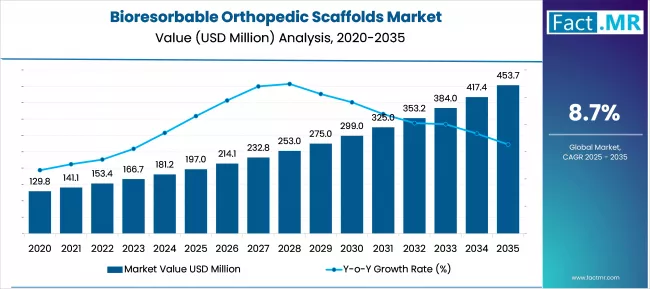
Bioresorbable Orthopedic Scaffolds Market Market Value Analysis | Source: Fact.MR
What are the drivers of the bioresorbable orthopedic scaffolds market?
The market for bioresorbable orthopedic scaffolds is most likely to be stimulated by the intensive growth in the biomaterials science, additive manufacturing, and regenerative medicine. The increasing demand for patient-specific, bio-compatible and complete resorbable implants is driving their use in trauma, spinal and reconstructive surgery.
Increasing investments in 3D printing and polymer engineering are enhancing the porosity of scaffolds, mechanical strength, and degradation. The medical device companies and institutes are forming strategic partnerships that are facilitating scalable manufacturing and clinical trials of next-generation scaffolds.
Sustainability is also an important factor-manufacturers are moving towards bio-based polymers, low-emission fabrication, and materials which are compliant to the regulations of REACH in order to create less harm to the environment. Also, the growth in regulatory approvals and knowledge of minimally invasive bone healing technologies have continued to drive higher growth in the global market.
What are the regional trends of the bioresorbable orthopedic scaffolds market?
The U.S. dominates the bioresorbable orthopedic scaffold market, which is underpinned by the high level of healthcare facilities, well established regulatory policies, and high level of investments in the research and development of biomaterials and 3D printing in North America. The interaction of universities and medical devices companies can increase product innovation and FDA approvals keep promoting the commercialization of new scaffold technologies.
The European market has been under consistent growth due to strict regulations over medical devices, sustainability measures and technological advancement in bioresorbable polymers. Germany, France, and U.K. emphasize on the significance of compliance with REACH, patient protection, and sustainable production and the region becomes a capital of orthopedic biomaterial innovations that meets the EU green agenda.
The Asia Pacific region is highly growing with China, Japan and India leading the pack in growth in additive manufacturing, regenerative medicine, and localized production. The use of bioresorbable orthopedic scaffolds is gaining momentum due to government programs to encourage the use of smart healthcare infrastructure and investment in medical technologies.
Market adoption is driven in Latin America and the Middle East & Africa by the emergence of new healthcare infrastructure, increased orthopedic operations, and increased awareness of the benefits of biodegradable implants. More access to sustainable orthopedic solutions in such regions is being spread through heightened foreign investments and collaborations with other international medical technology companies.
What are the challenges and restraining factors of the Bioresorbable Orthopedic Scaffolds market?
There are a number of issues with the bioresorbable orthopedic scaffolds market, which restricts mass adoption and commercialization. The advanced polymers, precision 3D printing, and clinical validation mean that the production of such implants is expensive making them less accessible in cost sensitive markets. Lack of standardized testing procedures and long regulatory approval processes also help in slowing down penetration into the market and granting reimbursements.
Traceability of the material used and the high standards through FDA and REACH increase the cost of R&D and operations. The trade-offs between the strength of the scaffold, degradation rate, and biocompatibility are also vital design issues that affect the consistency in performance. Long-term reliability in surgical environments can also be influenced by environmental exposure, sensitivity to sterilization and mechanical fatigue.
There is also fragmented supply chain and access of high-purity biomaterials in the developing regions which discourage scalability. Inadequate technical skills in the manufacture of scaffolds and post-surgical incorporation, rivalry with traditional metallic implants and bone graft substitutes also inhibits uptake. Nevertheless, such barriers should be slowly overcome by constant R&D, local production, and better material technology.
Country-Wise Insights
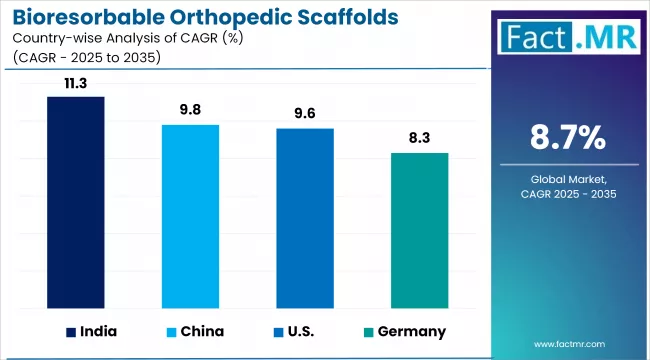
Bioresorbable Orthopedic Scaffolds Market Cagr Analysis By Country | Source: Fact.MR
Sustainability Standards and Precision Engineering Drive Germany’s Bioresorbable Orthopedic Scaffolds Expansion
The good background of Germany in industrial design and precision manufacturing has enhanced the uptake of bioresorbable orthopedic scaffolds. Compliance with the strict requirements of REACH, the automation and the sustainable processing of polymer support the growth. German manufacturers incorporate digital validation, high-level molding apparatus, and traceable bio-based agents to offer a consistent and sustainable product production in the medical device manufacturing procedure.
Technological Innovation and Robotics Integration Accelerate Japan’s Bioresorbable Orthopedic Scaffolds Market Growth
The ecosystem of robotics and smart manufacturing in Japan is leading to innovations in the creation of scaffolds and encouraging precision and flexibility. Local manufacturers are using AI-assisted fabrication, and PFAS-free materials and automated handling to control processes. The collaboration between medical schools and innovation centers make Japan a leader in the development of high-tech bioresorbable implantation.
Energy Diversification and Industrial Resilience Propel Middle East’s Bioresorbable Orthopedic Scaffolds Adoption
Local production of scaffolds is being developed in the Middle East, including Saudi Arabia and the UAE, which pay attention to the manufacture of scaffolds with low energy consumption. Circular high-efficiency production in harsh environmental conditions is possible through investments in temperature-resistant materials, hybrid reactors, and automation. Such activities are in line with the regional diversification vision and medical technology self-sufficiency.
Category-Wise Analysis
Polymer and Composite Scaffolds Define Core Regenerative Efficiency
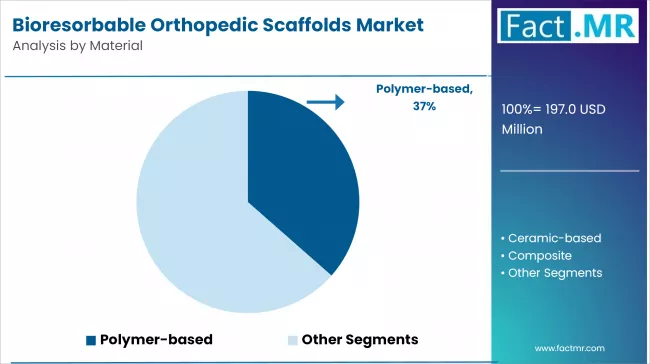
Bioresorbable Orthopedic Scaffolds Market Analysis By Material | Source: Fact.MR
The growing usage of orthopedic surgery scaffolds based on polymer like PLA and PCL in high-load surgeries is due to their long durability and biocompatibility, although polymer-ceramic composites are proving to be viable alternatives. With these hybrid scaffolds, there is a level of control in terms of degradation, osteoconductivity and each of them is easily integrated with the available surgical systems so that there are assured healing capabilities, decreased inflammation and good clinical throughput.
3D Printing and Bioactive Material Technologies Anchor Market Advancements
The technologies of 3D printing that will be used to dominate market are those that enable the optimization of scaffold geometry and porosity to achieve control over bone regeneration. Bioactive materials, growth factors and stem cell integration increase osteogenesis and tissue regeneration. Scalability and patient outcomes are being enhanced through continuous innovation of scaffold design, biofunctional coatings and additive manufacturing.
Orthopedic, Spinal, and Trauma Applications Drive Core Market Utilization
The first field of application is still Osteo reconstruction, which is fuelled by the increasing number of bone injuries and joint replacement. The next followed are spinal fusion and trauma repair, where the bioresorbable scaffolds are used to repair defects and to support load. This can be guaranteed by their capacity to abolish second surgeries and fit regenerative medicine and orthopedics because it is sustainable in medical practice.
Competitive Analysis
The use of bioresorbable orthopedic scaffolds has become a trend among medical manufacturers and healthcare providers as the focus is on biocompatibility, degradation, and sustainability in the design of implants. The world tendency to the eco-safe materials and high standards in medical procedures is increasing the process of substituting the conventional metal implants with the polymer and composite scaffolds. Significant manufacturers are producing next-generation scaffolds with superior 3D printing, tailor-made biomaterials and closed-loop manufacturing systems that are in line with the specifications of the FDA and REACH.
The concept of commercialization is forwarding with the strategic partnership between biomaterial developers, medical research centers and orthopedic device companies. Osteopore Limited, Evonik Industries AG and Poly-Med Inc. Companies are undertaking extensive production and clinical trials in an attempt to increase their regenerative implant portfolios. Consistent innovation in terms of bioactive material integration, process automation and design of scaffold provides a competitive advantage based on safety, efficiency and global scalability.
Key players in the bioresorbable orthopedic scaffolds market include Evonik Industries AG, Corbion N.V., Poly-Med Inc., Osteopore Limited, Meril Life Sciences, Atreon Orthopedics, Zimmer Biomet Holdings, Inc., Smith & Nephew plc, Stryker Corporation, REVA Medical, Inc.
Recent Development
- In July 2025, Evonik announced the opening of a large centre dealing with medical-device applications in Shanghai, which will cater to the full Asian market. The hi-tech plant specializes in the research, development and processing of semi-finished parts of bioresorbable medical equipment such as orthopedics.
Fact.MR has provided detailed information about the price points of key manufacturers of Bioresorbable Orthopedic Scaffolds Market positioned across regions, sales growth, production capacity, and speculative technological expansion, in the recently published report.
Segmentation
Segmentation of Bioresorbable Orthopedic Scaffolds Market
-
By Material :
- Polymer-based
- Ceramic-based
- Composite
- Metal-based
- Natural polymer
-
By Technology :
- 3D Printing
- Electrospinning
- Conventional Fabrication
- Biofunctionalized Scaffolds
-
By Application :
- Bone Regeneration
- Spinal Fusion
- Joint Repair
- Cranio-maxillofacial
- Trauma Reconstruction
-
By End User :
- Hospitals
- Specialty Clinics
- Research Institutes
-
By Region :
- North America
- Latin America
- Western Europe
- Eastern Europe
- East Asia
- South Asia & Pacific
- Middle East & Africa
Frequently Asked Questions
What was the Global Bioresorbable Orthopedic Scaffolds Market Size Reported by Fact.MR for 2025?
Who are the Major Players Operating in the Bioresorbable Orthopedic Scaffolds Market?
What is the Estimated Valuation of the Bioresorbable Orthopedic Scaffolds Market in 2035?
What Value CAGR did the Bioresorbable Orthopedic Scaffolds Market Exhibit Over the Last Five Years?
Who worked on this report


Preview the report firsthand - request a free sample
Free SampleGet the brochure for pricing and purchase details
Download PDF