Bitter Blockers for Plant-Based Foods Market
Bitter Blockers for Plant-Based Foods Market Size and Share Forecast Outlook 2026 to 2036
Bitter blockers for plant-based foods market is projected to grow from USD 985.0 million in 2026 to USD 2,166.3 million by 2036, at a CAGR of 8.2%. Taste receptor blockers will dominate with a 37.0% market share, while pea protein will lead the plant protein target segment with a 34.0% share.
Bitter Blockers for Plant-Based Foods Market Size and Share Forecast Outlook 2026 to 2036
The bitter blockers for plant-based foods market is likely to be valued at USD 985 million in 2026, projected to reach USD 2,166 million by 2036, reflecting a CAGR of 8.2%.
Key Takeaways from Bitter Blockers for Plant-Based Foods Market
- Bitter Blockers for Plant-Based Foods Market Value (2026): USD 985 million
- Bitter Blockers for Plant-Based Foods Market Forecast Value (2036): USD 2,166 million
- Bitter Blockers for Plant-Based Foods Market Forecast CAGR 2026 to 2036: 8.2%
- Leading Segment in Bitter Blockers for Plant-Based Foods Market: Plant-Based Meat Alternatives (40%)
- Key Growth Region in Bitter Blockers for Plant-Based Foods Market: Asia Pacific
- Key Players in Bitter Blockers for Plant-Based Foods Market: Givaudan SA, IFF (International Flavors & Fragrances), Symrise AG, DSMFirmenich, Sensient Technologies Corporation, ADM, BASF SE, Cargill, Incorporated, Blue California, Kerry Group plc
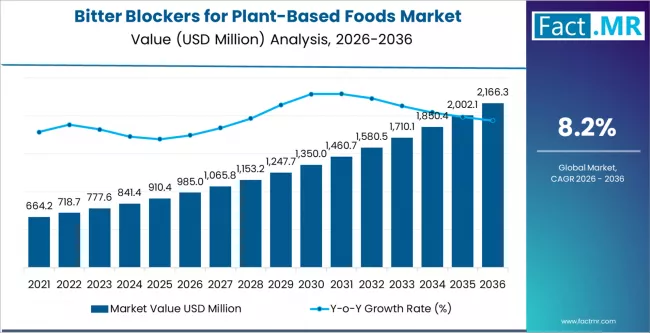
Over the next decade, cost structures in this market will be influenced by the dynamic relationship between raw material sourcing, production processes, and distribution networks. As production costs fluctuate, pricing control will become a key factor in maintaining profitability, with premium products commanding higher margins.
Value capture will be concentrated among key players with robust intellectual property, innovative formulations, and strategic partnerships, enabling them to set pricing standards. Companies focusing on value-added products will secure competitive advantages by commanding premium prices, thus capturing more value. In contrast, those relying on volume sales alone will face pressure from cost inflation and price competition, resulting in reduced margins. Performance in this market will largely hinge on how effectively companies manage cost efficiency while optimizing pricing strategies.
Bitter Blockers for Plant-Based Foods Market
| Metric | Value |
|---|---|
| Estimated Value in (2026E) | USD 985 million |
| Forecast Value in (2036F) | USD 2,166 million |
| Forecast CAGR (2026 to 2036) | 8.2% |
Category
| Category | Segments |
|---|---|
| Blocking Mechanism | Taste receptor blockers; Enzymatic inhibitors; Natural bitter blockers; Synthetic bitter blockers; Other mechanism types |
| Plant Protein Target | Pea protein; Soy protein; Wheat protein; Other plant proteins |
| Application Segment | Plant-Based Meat Alternatives; Plant-Based Dairy Alternatives; Functional & Nutritional Foods; Snacks & Beverages; Other food categories |
| Region | North America; Europe; Asia Pacific; Latin America; Middle East & Africa |
Segmental Analysis
What Is the Impact of Application Segment on the Bitter Blockers for Plant-Based Foods Market?
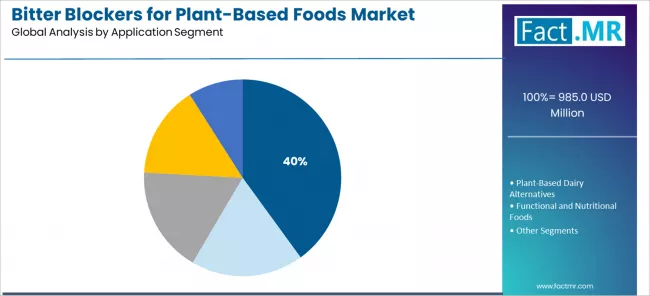
In the bitter blockers for plant-based foods market, the application segment plays a crucial role in determining demand, with plant-based meat alternatives holding a 40% share. As the popularity of plant-based meats increases, bitter blockers are essential for masking the off-flavors and improving the overall sensory experience. These blockers help enhance the taste profile of plant-based meats, making them more appealing to consumers. As the market for plant-based products continues to grow, especially in meat substitutes, the use of bitter blockers will be critical to ensuring that plant-based food products meet consumer taste expectations, driving market growth.
How Does Blocking Mechanism Influence the Bitter Blockers for Plant-Based Foods Market?
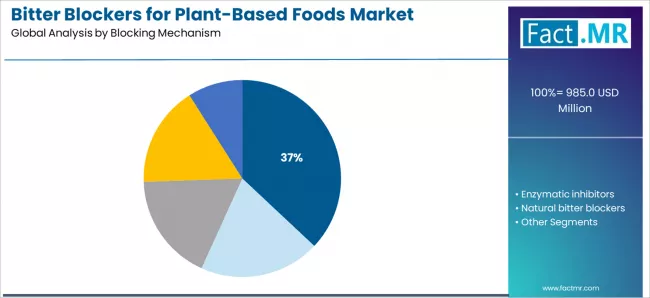
Blocking mechanism is a key factor in shaping the effectiveness of bitter blockers, with taste receptor blockers leading the market at 37%. These blockers function by directly targeting and inhibiting the taste receptors that perceive bitterness, providing a more immediate and efficient solution for improving the flavor profile of plant-based foods. As consumer demand for plant-based foods rises, particularly in meat and dairy alternatives, the demand for effective bitter blockers will continue to increase, ensuring that products are more palatable and better accepted in the market. The adoption of taste receptor blockers will remain a dominant trend in the industry as manufacturers focus on enhancing the flavor of plant-based foods.
What are the Key Drivers, Restraints, and Emerging Trends in the Bitter Blockers for Plant Based Foods Market?
- Drivers: Demand for bitter blockers is shaped by formulation challenges in plant based proteins and ingredients that present inherent bitter or off flavors. Food manufacturers specify these agents to improve palatability and broaden consumer acceptance of meat alternatives, dairy substitutes, and nutritional products. Consistent taste profiles are central to repeat purchase and brand positioning.
- Restraints: Effectiveness of bitter blockers varies with protein type, pH, and processing conditions, requiring extensive trial work in product development. Some blockers can interact with other flavor components, affecting overall sensory balance. Regulatory labeling requirements for flavor modifiers differ across regions and influence ingredient choice.
- Trend 1: Development of targeted blockers that act on specific bitter compounds in pea, soy, and other plant sources.
- Trend 2: Integration of sensory driven formulation tools that correlate blocker performance with consumer taste data.
Analysis of the Bitter Blockers for Plant-Based Foods Market by Key Country
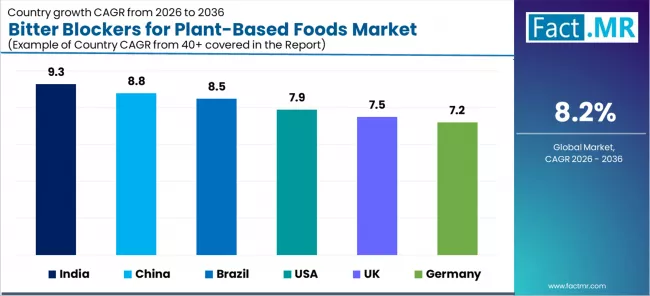
| Country | CAGR (2026-2036) |
|---|---|
| India | 9.3% |
| China | 8.8% |
| Brazil | 8.5% |
| USA | 7.9% |
| UK | 7.5% |
| Germany | 7.2% |
The report covers an in-depth analysis of 40+ countries; top-performing countries are highlighted below.
What is the Growth Outlook for Bitter Blockers for Plant-Based Foods Market in India?
India’s bitter blockers for plant-based foods market is projected to grow at a CAGR of 9.3% from 2026 to 2036. As the demand for plant-based foods continues to rise in India, particularly due to health-conscious consumers and the growing interest in vegan and vegetarian diets, the need for effective bitter blockers is increasing. These blockers are crucial in masking the naturally bitter taste of plant-based proteins and other ingredients, improving the overall palatability of plant-based foods. With India’s expanding middle class and changing dietary habits, the market for bitter blockers in plant-based foods is expected to experience rapid growth, supported by both consumer preferences and industry innovations.
How is the Bitter Blockers for Plant-Based Foods Market Performing in China?
China’s bitter blockers for plant-based foods market is expected to grow at a CAGR of 8.8% from 2026 to 2036. As China’s interest in plant-based products grows, driven by both health trends and sustainability concerns, the demand for bitter blockers is also increasing. These ingredients are vital for masking the bitter aftertaste commonly associated with plant-based proteins, improving the sensory experience for consumers. With China’s growing focus on innovation in food processing and the rise in plant-based diets, the market for bitter blockers for plant-based foods is set to grow steadily, driven by both the expanding plant-based food sector and changing consumer preferences.
What is the Market Outlook for Bitter Blockers for Plant-Based Foods Market in Brazil?
Brazil’s bitter blockers for plant-based foods market is projected to grow at a CAGR of 8.5% from 2026 to 2036. As the demand for plant-based products rises in Brazil, particularly in response to growing health awareness and environmental concerns, the need for bitter blockers is increasing. These blockers help mask the unpleasant flavors of plant-based proteins, making them more appealing to consumers. Brazil’s market for plant-based foods is expanding, and with the growing trend toward more sustainable, plant-based eating, the demand for bitter blockers is expected to grow steadily, driven by innovations in food processing and flavor enhancement.
What is the Growth Potential for Bitter Blockers for Plant-Based Foods Market in the USA?
The USA’s bitter blockers for plant-based foods market is forecast to grow at a CAGR of 7.9% from 2026 to 2036. As the plant-based food industry continues to thrive, the demand for ingredients like bitter blockers, which improve the taste and texture of plant-based products, is increasing. These blockers help mask the naturally bitter taste of plant-based proteins, making them more palatable for consumers. The USA’s market for plant-based foods is driven by consumer trends favoring healthier and more sustainable diets, and with growing product innovation, the market for bitter blockers will continue to grow steadily, driven by both demand and advancements in food technology.
What is the Demand for Bitter Blockers for Plant-Based Foods Market in the UK?
The UK’s bitter blockers for plant-based foods market is set to grow at a CAGR of 7.5% from 2026 to 2036. With the increasing adoption of plant-based diets in the UK, driven by health and environmental concerns, the demand for bitter blockers is on the rise. These blockers are essential in improving the taste profile of plant-based foods, particularly in products like meat substitutes and dairy alternatives. As the UK’s market for plant-based foods continues to expand, the need for flavor-enhancing ingredients such as bitter blockers will grow, supporting steady market growth driven by changing consumer preferences and the continued innovation in plant-based food products.
What is the Market Expansion Outlook for Bitter Blockers for Plant-Based Foods Market in Germany?
Germany’s bitter blockers for plant-based foods market is projected to grow at a CAGR of 7.2% from 2026 to 2036. As Germany’s food industry continues to innovate with plant-based alternatives, the demand for bitter blockers is increasing. These ingredients help mask the bitter taste of plant-based proteins, enhancing the flavor and overall consumer experience. Germany’s strong focus on sustainability, health, and plant-based eating will continue to drive the market for these blockers, ensuring steady growth as both consumer demand and the plant-based food sector expand.
How is Competition Structured in the Bitter Blockers for Plant Based Foods Market?
Competition in the bitter blockers market is shaped by functional effectiveness, sensory neutrality, and ease of integration into plant based formulations. Givaudan SA, IFF, Symrise AG, and DSM Firmenich lead with flavor science platforms that combine bitter masking with complementary flavor balancing. Their systems are supported by sensory analytics and formulation guidance that aid rapid adoption in clean label products.
Sensient Technologies Corporation and Blue California differentiate with ingredient systems tailored to specific plant protein matrices, with emphasis on natural source options. ADM and Cargill, Incorporated position broad portfolios that include carbohydrate and lipid based carriers to support bitter blocker performance in beverages and meat alternatives. BASF SE focuses on engineered functional blends that support process stability, while Kerry Group plc integrates bitter suppression with broader taste modulation systems. Competitive factors include documented masking performance, regulatory compliance across markets, and technical support for scaling from pilot to commercial production.
Key Players in the Bitter Blockers for Plant Based Foods Market
- Givaudan SA
- IFF (International Flavors & Fragrances)
- Symrise AG
- DSM Firmenich
- Sensient Technologies Corporation
- ADM
- BASF SE
- Cargill, Incorporated
- Blue California
- Kerry Group plc
Scope of the Report
| Items | Values |
|---|---|
| Quantitative Units (2026) | USD Million |
| Blocking Mechanism | Taste receptor blockers, Enzymatic inhibitors, Natural bitter blockers, Synthetic bitter blockers, Other mechanism types |
| Plant Protein Target | Pea protein, Soy protein, Wheat protein, Other plant proteins |
| Application Segment | Plant-Based Meat Alternatives, Plant-Based Dairy Alternatives, Functional & Nutritional Foods, Snacks & Beverages, Other food categories |
| Regions Covered | North America, Europe, Asia Pacific, Latin America, Middle East & Africa |
| Countries Covered | United States, Canada, Mexico, Brazil, Germany, United Kingdom, France, Italy, Spain, China, Japan, South Korea, India, Australia & New Zealand |
| Key Companies Profiled | Givaudan SA, IFF (International Flavors & Fragrances), Symrise AG, DSM-Firmenich, Sensient Technologies Corporation, ADM, BASF SE, Cargill, Incorporated, Blue California, Kerry Group plc |
| Additional Attributes | Dollar revenue by blocking mechanism, plant protein target, and application segment; regional demand trends, competitive landscape, technological advancements in bitter blockers, and innovations in plant-based food formulations |
Bitter Blockers for Plant-Based Foods Market Key Segments
-
Blocking Mechanism :
- Taste receptor blockers
- Enzymatic inhibitors
- Natural bitter blockers
- Synthetic bitter blockers
- Other mechanism types
-
Plant Protein Target :
- Pea protein
- Soy protein
- Wheat protein
- Other plant proteins
-
Application Segment :
- Plant-Based Meat Alternatives
- Plant-Based Dairy Alternatives
- Functional & Nutritional Foods
- Snacks & Beverages
- Other food categories
-
Region :
- North America
- U.S.
- Canada
- Mexico
- Europe
- Germany
- UK
- France
- Italy
- Spain
- Nordic Countries
- BENELUX
- Rest of Europe
- Asia Pacific
- China
- Japan
- South Korea
- India
- Australia
- Rest of Asia Pacific
- Latin America
- Brazil
- Argentina
- Rest of Latin America
- Middle East and Africa
- Kingdom of Saudi Arabia
- United Arab Emirates
- South Africa
- Rest of Middle East and Africa
- Other Regions
- Oceania
- Central Asia
- Other Markets
- North America
Bibliographies
- Drewnowski, A., & Gomez-Carneros, C. (2023). Bitter taste perception and masking strategies in plant-derived food systems. Critical Reviews in Food Science and Nutrition, 63(18), 3294-3310.
- Meyerhof, W., Batram, C., Kuhn, C., Brockhoff, A., Chudoba, E., Bufe, B., & Behrens, M. (2024). The molecular basis of bitter taste receptor inhibition and relevance for food applications. Chemical Senses, 49(2), 123-137.
- European Food Safety Authority (EFSA). (2024). Scientific opinion on flavoring substances and taste-modulating compounds in plant-based foods. EFSA Journal, 22(3), e08741.
- U.S. Food and Drug Administration. (2023). Flavoring substances and adjuvants permitted for use in food: Regulatory considerations for taste modifiers. FDA Center for Food Safety and Applied Nutrition.
- Institute of Food Technologists. (2024). Managing bitterness in plant-based proteins: Sensory and formulation strategies. Food Technology, 78(6), 42-51.
Table of Content
- Executive Summary
- Global Market Outlook
- Demand to side Trends
- Supply to side Trends
- Technology Roadmap Analysis
- Analysis and Recommendations
- Market Overview
- Market Coverage / Taxonomy
- Market Definition / Scope / Limitations
- Market Background
- Market Dynamics
- Drivers
- Restraints
- Opportunity
- Trends
- Scenario Forecast
- Demand in Optimistic Scenario
- Demand in Likely Scenario
- Demand in Conservative Scenario
- Opportunity Map Analysis
- Product Life Cycle Analysis
- Supply Chain Analysis
- Investment Feasibility Matrix
- Value Chain Analysis
- PESTLE and Porter’s Analysis
- Regulatory Landscape
- Regional Parent Market Outlook
- Production and Consumption Statistics
- Import and Export Statistics
- Market Dynamics
- Global Market Analysis 2021 to 2025 and Forecast, 2026 to 2036
- Historical Market Size Value (USD Million) Analysis, 2021 to 2025
- Current and Future Market Size Value (USD Million) Projections, 2026 to 2036
- Y to o to Y Growth Trend Analysis
- Absolute $ Opportunity Analysis
- Global Market Pricing Analysis 2021 to 2025 and Forecast 2026 to 2036
- Global Market Analysis 2021 to 2025 and Forecast 2026 to 2036, By Blocking Mechanism
- Introduction / Key Findings
- Historical Market Size Value (USD Million) Analysis By Blocking Mechanism, 2021 to 2025
- Current and Future Market Size Value (USD Million) Analysis and Forecast By Blocking Mechanism, 2026 to 2036
- Taste receptor blockers
- Enzymatic inhibitors
- Natural bitter blockers
- Synthetic bitter blockers
- Other mechanism types
- Taste receptor blockers
- Y to o to Y Growth Trend Analysis By Blocking Mechanism, 2021 to 2025
- Absolute $ Opportunity Analysis By Blocking Mechanism, 2026 to 2036
- Global Market Analysis 2021 to 2025 and Forecast 2026 to 2036, By Plant Protein Target
- Introduction / Key Findings
- Historical Market Size Value (USD Million) Analysis By Plant Protein Target, 2021 to 2025
- Current and Future Market Size Value (USD Million) Analysis and Forecast By Plant Protein Target, 2026 to 2036
- Pea protein
- Soy protein
- Wheat protein
- Other plant proteins
- Pea protein
- Y to o to Y Growth Trend Analysis By Plant Protein Target, 2021 to 2025
- Absolute $ Opportunity Analysis By Plant Protein Target, 2026 to 2036
- Global Market Analysis 2021 to 2025 and Forecast 2026 to 2036, By Application Segment
- Introduction / Key Findings
- Historical Market Size Value (USD Million) Analysis By Application Segment, 2021 to 2025
- Current and Future Market Size Value (USD Million) Analysis and Forecast By Application Segment, 2026 to 2036
- Plant‑Based Meat Alternatives
- Plant‑Based Dairy Alternatives
- Functional and Nutritional Foods
- Snacks and Beverages
- Other food categories
- Plant‑Based Meat Alternatives
- Y to o to Y Growth Trend Analysis By Application Segment, 2021 to 2025
- Absolute $ Opportunity Analysis By Application Segment, 2026 to 2036
- Global Market Analysis 2021 to 2025 and Forecast 2026 to 2036, By Region
- Introduction
- Historical Market Size Value (USD Million) Analysis By Region, 2021 to 2025
- Current Market Size Value (USD Million) Analysis and Forecast By Region, 2026 to 2036
- North America
- Latin America
- Western Europe
- Eastern Europe
- East Asia
- South Asia and Pacific
- Middle East & Africa
- Market Attractiveness Analysis By Region
- North America Market Analysis 2021 to 2025 and Forecast 2026 to 2036, By Country
- Historical Market Size Value (USD Million) Trend Analysis By Market Taxonomy, 2021 to 2025
- Market Size Value (USD Million) Forecast By Market Taxonomy, 2026 to 2036
- By Country
- USA
- Canada
- Mexico
- By Blocking Mechanism
- By Plant Protein Target
- By Application Segment
- By Country
- Market Attractiveness Analysis
- By Country
- By Blocking Mechanism
- By Plant Protein Target
- By Application Segment
- Key Takeaways
- Latin America Market Analysis 2021 to 2025 and Forecast 2026 to 2036, By Country
- Historical Market Size Value (USD Million) Trend Analysis By Market Taxonomy, 2021 to 2025
- Market Size Value (USD Million) Forecast By Market Taxonomy, 2026 to 2036
- By Country
- Brazil
- Chile
- Rest of Latin America
- By Blocking Mechanism
- By Plant Protein Target
- By Application Segment
- By Country
- Market Attractiveness Analysis
- By Country
- By Blocking Mechanism
- By Plant Protein Target
- By Application Segment
- Key Takeaways
- Western Europe Market Analysis 2021 to 2025 and Forecast 2026 to 2036, By Country
- Historical Market Size Value (USD Million) Trend Analysis By Market Taxonomy, 2021 to 2025
- Market Size Value (USD Million) Forecast By Market Taxonomy, 2026 to 2036
- By Country
- Germany
- UK
- Italy
- Spain
- France
- Nordic
- BENELUX
- Rest of Western Europe
- By Blocking Mechanism
- By Plant Protein Target
- By Application Segment
- By Country
- Market Attractiveness Analysis
- By Country
- By Blocking Mechanism
- By Plant Protein Target
- By Application Segment
- Key Takeaways
- Eastern Europe Market Analysis 2021 to 2025 and Forecast 2026 to 2036, By Country
- Historical Market Size Value (USD Million) Trend Analysis By Market Taxonomy, 2021 to 2025
- Market Size Value (USD Million) Forecast By Market Taxonomy, 2026 to 2036
- By Country
- Russia
- Poland
- Hungary
- Balkan & Baltic
- Rest of Eastern Europe
- By Blocking Mechanism
- By Plant Protein Target
- By Application Segment
- By Country
- Market Attractiveness Analysis
- By Country
- By Blocking Mechanism
- By Plant Protein Target
- By Application Segment
- Key Takeaways
- East Asia Market Analysis 2021 to 2025 and Forecast 2026 to 2036, By Country
- Historical Market Size Value (USD Million) Trend Analysis By Market Taxonomy, 2021 to 2025
- Market Size Value (USD Million) Forecast By Market Taxonomy, 2026 to 2036
- By Country
- China
- Japan
- South Korea
- By Blocking Mechanism
- By Plant Protein Target
- By Application Segment
- By Country
- Market Attractiveness Analysis
- By Country
- By Blocking Mechanism
- By Plant Protein Target
- By Application Segment
- Key Takeaways
- South Asia and Pacific Market Analysis 2021 to 2025 and Forecast 2026 to 2036, By Country
- Historical Market Size Value (USD Million) Trend Analysis By Market Taxonomy, 2021 to 2025
- Market Size Value (USD Million) Forecast By Market Taxonomy, 2026 to 2036
- By Country
- India
- ASEAN
- Australia & New Zealand
- Rest of South Asia and Pacific
- By Blocking Mechanism
- By Plant Protein Target
- By Application Segment
- By Country
- Market Attractiveness Analysis
- By Country
- By Blocking Mechanism
- By Plant Protein Target
- By Application Segment
- Key Takeaways
- Middle East & Africa Market Analysis 2021 to 2025 and Forecast 2026 to 2036, By Country
- Historical Market Size Value (USD Million) Trend Analysis By Market Taxonomy, 2021 to 2025
- Market Size Value (USD Million) Forecast By Market Taxonomy, 2026 to 2036
- By Country
- Kingdom of Saudi Arabia
- Other GCC Countries
- Turkiye
- South Africa
- Other African Union
- Rest of Middle East & Africa
- By Blocking Mechanism
- By Plant Protein Target
- By Application Segment
- By Country
- Market Attractiveness Analysis
- By Country
- By Blocking Mechanism
- By Plant Protein Target
- By Application Segment
- Key Takeaways
- Key Countries Market Analysis
- USA
- Pricing Analysis
- Market Share Analysis, 2025
- By Blocking Mechanism
- By Plant Protein Target
- By Application Segment
- Canada
- Pricing Analysis
- Market Share Analysis, 2025
- By Blocking Mechanism
- By Plant Protein Target
- By Application Segment
- Mexico
- Pricing Analysis
- Market Share Analysis, 2025
- By Blocking Mechanism
- By Plant Protein Target
- By Application Segment
- Brazil
- Pricing Analysis
- Market Share Analysis, 2025
- By Blocking Mechanism
- By Plant Protein Target
- By Application Segment
- Chile
- Pricing Analysis
- Market Share Analysis, 2025
- By Blocking Mechanism
- By Plant Protein Target
- By Application Segment
- Germany
- Pricing Analysis
- Market Share Analysis, 2025
- By Blocking Mechanism
- By Plant Protein Target
- By Application Segment
- UK
- Pricing Analysis
- Market Share Analysis, 2025
- By Blocking Mechanism
- By Plant Protein Target
- By Application Segment
- Italy
- Pricing Analysis
- Market Share Analysis, 2025
- By Blocking Mechanism
- By Plant Protein Target
- By Application Segment
- Spain
- Pricing Analysis
- Market Share Analysis, 2025
- By Blocking Mechanism
- By Plant Protein Target
- By Application Segment
- France
- Pricing Analysis
- Market Share Analysis, 2025
- By Blocking Mechanism
- By Plant Protein Target
- By Application Segment
- India
- Pricing Analysis
- Market Share Analysis, 2025
- By Blocking Mechanism
- By Plant Protein Target
- By Application Segment
- ASEAN
- Pricing Analysis
- Market Share Analysis, 2025
- By Blocking Mechanism
- By Plant Protein Target
- By Application Segment
- Australia & New Zealand
- Pricing Analysis
- Market Share Analysis, 2025
- By Blocking Mechanism
- By Plant Protein Target
- By Application Segment
- China
- Pricing Analysis
- Market Share Analysis, 2025
- By Blocking Mechanism
- By Plant Protein Target
- By Application Segment
- Japan
- Pricing Analysis
- Market Share Analysis, 2025
- By Blocking Mechanism
- By Plant Protein Target
- By Application Segment
- South Korea
- Pricing Analysis
- Market Share Analysis, 2025
- By Blocking Mechanism
- By Plant Protein Target
- By Application Segment
- Russia
- Pricing Analysis
- Market Share Analysis, 2025
- By Blocking Mechanism
- By Plant Protein Target
- By Application Segment
- Poland
- Pricing Analysis
- Market Share Analysis, 2025
- By Blocking Mechanism
- By Plant Protein Target
- By Application Segment
- Hungary
- Pricing Analysis
- Market Share Analysis, 2025
- By Blocking Mechanism
- By Plant Protein Target
- By Application Segment
- Kingdom of Saudi Arabia
- Pricing Analysis
- Market Share Analysis, 2025
- By Blocking Mechanism
- By Plant Protein Target
- By Application Segment
- Turkiye
- Pricing Analysis
- Market Share Analysis, 2025
- By Blocking Mechanism
- By Plant Protein Target
- By Application Segment
- South Africa
- Pricing Analysis
- Market Share Analysis, 2025
- By Blocking Mechanism
- By Plant Protein Target
- By Application Segment
- USA
- Market Structure Analysis
- Competition Dashboard
- Competition Benchmarking
- Market Share Analysis of Top Players
- By Regional
- By Blocking Mechanism
- By Plant Protein Target
- By Application Segment
- Competition Analysis
- Competition Deep Dive
- Givaudan SA
- Overview
- Product Portfolio
- Profitability by Market Segments (Product/Age /Sales Channel/Region)
- Sales Footprint
- Strategy Overview
- Marketing Strategy
- Product Strategy
- Channel Strategy
- IFF (International Flavors & Fragrances)
- Symrise AG
- DSM‑Firmenich
- Sensient Technologies Corporation
- ADM
- BASF SE
- Cargill, Incorporated
- Blue California
- Kerry Group plc
- Givaudan SA
- Competition Deep Dive
- Assumptions & Acronyms Used
- Research Methodology
List Of Table
- Table 1: Global Market Value (USD Million) Forecast by Region, 2021 to 2036
- Table 2: Global Market Value (USD Million) Forecast by Blocking Mechanism, 2021 to 2036
- Table 3: Global Market Value (USD Million) Forecast by Plant Protein Target, 2021 to 2036
- Table 4: Global Market Value (USD Million) Forecast by Application Segment, 2021 to 2036
- Table 5: North America Market Value (USD Million) Forecast by Country, 2021 to 2036
- Table 6: North America Market Value (USD Million) Forecast by Blocking Mechanism, 2021 to 2036
- Table 7: North America Market Value (USD Million) Forecast by Plant Protein Target, 2021 to 2036
- Table 8: North America Market Value (USD Million) Forecast by Application Segment, 2021 to 2036
- Table 9: Latin America Market Value (USD Million) Forecast by Country, 2021 to 2036
- Table 10: Latin America Market Value (USD Million) Forecast by Blocking Mechanism, 2021 to 2036
- Table 11: Latin America Market Value (USD Million) Forecast by Plant Protein Target, 2021 to 2036
- Table 12: Latin America Market Value (USD Million) Forecast by Application Segment, 2021 to 2036
- Table 13: Western Europe Market Value (USD Million) Forecast by Country, 2021 to 2036
- Table 14: Western Europe Market Value (USD Million) Forecast by Blocking Mechanism, 2021 to 2036
- Table 15: Western Europe Market Value (USD Million) Forecast by Plant Protein Target, 2021 to 2036
- Table 16: Western Europe Market Value (USD Million) Forecast by Application Segment, 2021 to 2036
- Table 17: Eastern Europe Market Value (USD Million) Forecast by Country, 2021 to 2036
- Table 18: Eastern Europe Market Value (USD Million) Forecast by Blocking Mechanism, 2021 to 2036
- Table 19: Eastern Europe Market Value (USD Million) Forecast by Plant Protein Target, 2021 to 2036
- Table 20: Eastern Europe Market Value (USD Million) Forecast by Application Segment, 2021 to 2036
- Table 21: East Asia Market Value (USD Million) Forecast by Country, 2021 to 2036
- Table 22: East Asia Market Value (USD Million) Forecast by Blocking Mechanism, 2021 to 2036
- Table 23: East Asia Market Value (USD Million) Forecast by Plant Protein Target, 2021 to 2036
- Table 24: East Asia Market Value (USD Million) Forecast by Application Segment, 2021 to 2036
- Table 25: South Asia and Pacific Market Value (USD Million) Forecast by Country, 2021 to 2036
- Table 26: South Asia and Pacific Market Value (USD Million) Forecast by Blocking Mechanism, 2021 to 2036
- Table 27: South Asia and Pacific Market Value (USD Million) Forecast by Plant Protein Target, 2021 to 2036
- Table 28: South Asia and Pacific Market Value (USD Million) Forecast by Application Segment, 2021 to 2036
- Table 29: Middle East & Africa Market Value (USD Million) Forecast by Country, 2021 to 2036
- Table 30: Middle East & Africa Market Value (USD Million) Forecast by Blocking Mechanism, 2021 to 2036
- Table 31: Middle East & Africa Market Value (USD Million) Forecast by Plant Protein Target, 2021 to 2036
- Table 32: Middle East & Africa Market Value (USD Million) Forecast by Application Segment, 2021 to 2036
List Of Figures
- Figure 1: Global Market Pricing Analysis
- Figure 2: Global Market Value (USD Million) Forecast 2021 to 2036
- Figure 3: Global Market Value Share and BPS Analysis by Blocking Mechanism, 2026 and 2036
- Figure 4: Global Market Y to o to Y Growth Comparison by Blocking Mechanism, 2026 to 2036
- Figure 5: Global Market Attractiveness Analysis by Blocking Mechanism
- Figure 6: Global Market Value Share and BPS Analysis by Plant Protein Target, 2026 and 2036
- Figure 7: Global Market Y to o to Y Growth Comparison by Plant Protein Target, 2026 to 2036
- Figure 8: Global Market Attractiveness Analysis by Plant Protein Target
- Figure 9: Global Market Value Share and BPS Analysis by Application Segment, 2026 and 2036
- Figure 10: Global Market Y to o to Y Growth Comparison by Application Segment, 2026 to 2036
- Figure 11: Global Market Attractiveness Analysis by Application Segment
- Figure 12: Global Market Value (USD Million) Share and BPS Analysis by Region, 2026 and 2036
- Figure 13: Global Market Y to o to Y Growth Comparison by Region, 2026 to 2036
- Figure 14: Global Market Attractiveness Analysis by Region
- Figure 15: North America Market Incremental Dollar Opportunity, 2026 to 2036
- Figure 16: Latin America Market Incremental Dollar Opportunity, 2026 to 2036
- Figure 17: Western Europe Market Incremental Dollar Opportunity, 2026 to 2036
- Figure 18: Eastern Europe Market Incremental Dollar Opportunity, 2026 to 2036
- Figure 19: East Asia Market Incremental Dollar Opportunity, 2026 to 2036
- Figure 20: South Asia and Pacific Market Incremental Dollar Opportunity, 2026 to 2036
- Figure 21: Middle East & Africa Market Incremental Dollar Opportunity, 2026 to 2036
- Figure 22: North America Market Value Share and BPS Analysis by Country, 2026 and 2036
- Figure 23: North America Market Value Share and BPS Analysis by Blocking Mechanism, 2026 and 2036
- Figure 24: North America Market Y to o to Y Growth Comparison by Blocking Mechanism, 2026 to 2036
- Figure 25: North America Market Attractiveness Analysis by Blocking Mechanism
- Figure 26: North America Market Value Share and BPS Analysis by Plant Protein Target, 2026 and 2036
- Figure 27: North America Market Y to o to Y Growth Comparison by Plant Protein Target, 2026 to 2036
- Figure 28: North America Market Attractiveness Analysis by Plant Protein Target
- Figure 29: North America Market Value Share and BPS Analysis by Application Segment, 2026 and 2036
- Figure 30: North America Market Y to o to Y Growth Comparison by Application Segment, 2026 to 2036
- Figure 31: North America Market Attractiveness Analysis by Application Segment
- Figure 32: Latin America Market Value Share and BPS Analysis by Country, 2026 and 2036
- Figure 33: Latin America Market Value Share and BPS Analysis by Blocking Mechanism, 2026 and 2036
- Figure 34: Latin America Market Y to o to Y Growth Comparison by Blocking Mechanism, 2026 to 2036
- Figure 35: Latin America Market Attractiveness Analysis by Blocking Mechanism
- Figure 36: Latin America Market Value Share and BPS Analysis by Plant Protein Target, 2026 and 2036
- Figure 37: Latin America Market Y to o to Y Growth Comparison by Plant Protein Target, 2026 to 2036
- Figure 38: Latin America Market Attractiveness Analysis by Plant Protein Target
- Figure 39: Latin America Market Value Share and BPS Analysis by Application Segment, 2026 and 2036
- Figure 40: Latin America Market Y to o to Y Growth Comparison by Application Segment, 2026 to 2036
- Figure 41: Latin America Market Attractiveness Analysis by Application Segment
- Figure 42: Western Europe Market Value Share and BPS Analysis by Country, 2026 and 2036
- Figure 43: Western Europe Market Value Share and BPS Analysis by Blocking Mechanism, 2026 and 2036
- Figure 44: Western Europe Market Y to o to Y Growth Comparison by Blocking Mechanism, 2026 to 2036
- Figure 45: Western Europe Market Attractiveness Analysis by Blocking Mechanism
- Figure 46: Western Europe Market Value Share and BPS Analysis by Plant Protein Target, 2026 and 2036
- Figure 47: Western Europe Market Y to o to Y Growth Comparison by Plant Protein Target, 2026 to 2036
- Figure 48: Western Europe Market Attractiveness Analysis by Plant Protein Target
- Figure 49: Western Europe Market Value Share and BPS Analysis by Application Segment, 2026 and 2036
- Figure 50: Western Europe Market Y to o to Y Growth Comparison by Application Segment, 2026 to 2036
- Figure 51: Western Europe Market Attractiveness Analysis by Application Segment
- Figure 52: Eastern Europe Market Value Share and BPS Analysis by Country, 2026 and 2036
- Figure 53: Eastern Europe Market Value Share and BPS Analysis by Blocking Mechanism, 2026 and 2036
- Figure 54: Eastern Europe Market Y to o to Y Growth Comparison by Blocking Mechanism, 2026 to 2036
- Figure 55: Eastern Europe Market Attractiveness Analysis by Blocking Mechanism
- Figure 56: Eastern Europe Market Value Share and BPS Analysis by Plant Protein Target, 2026 and 2036
- Figure 57: Eastern Europe Market Y to o to Y Growth Comparison by Plant Protein Target, 2026 to 2036
- Figure 58: Eastern Europe Market Attractiveness Analysis by Plant Protein Target
- Figure 59: Eastern Europe Market Value Share and BPS Analysis by Application Segment, 2026 and 2036
- Figure 60: Eastern Europe Market Y to o to Y Growth Comparison by Application Segment, 2026 to 2036
- Figure 61: Eastern Europe Market Attractiveness Analysis by Application Segment
- Figure 62: East Asia Market Value Share and BPS Analysis by Country, 2026 and 2036
- Figure 63: East Asia Market Value Share and BPS Analysis by Blocking Mechanism, 2026 and 2036
- Figure 64: East Asia Market Y to o to Y Growth Comparison by Blocking Mechanism, 2026 to 2036
- Figure 65: East Asia Market Attractiveness Analysis by Blocking Mechanism
- Figure 66: East Asia Market Value Share and BPS Analysis by Plant Protein Target, 2026 and 2036
- Figure 67: East Asia Market Y to o to Y Growth Comparison by Plant Protein Target, 2026 to 2036
- Figure 68: East Asia Market Attractiveness Analysis by Plant Protein Target
- Figure 69: East Asia Market Value Share and BPS Analysis by Application Segment, 2026 and 2036
- Figure 70: East Asia Market Y to o to Y Growth Comparison by Application Segment, 2026 to 2036
- Figure 71: East Asia Market Attractiveness Analysis by Application Segment
- Figure 72: South Asia and Pacific Market Value Share and BPS Analysis by Country, 2026 and 2036
- Figure 73: South Asia and Pacific Market Value Share and BPS Analysis by Blocking Mechanism, 2026 and 2036
- Figure 74: South Asia and Pacific Market Y to o to Y Growth Comparison by Blocking Mechanism, 2026 to 2036
- Figure 75: South Asia and Pacific Market Attractiveness Analysis by Blocking Mechanism
- Figure 76: South Asia and Pacific Market Value Share and BPS Analysis by Plant Protein Target, 2026 and 2036
- Figure 77: South Asia and Pacific Market Y to o to Y Growth Comparison by Plant Protein Target, 2026 to 2036
- Figure 78: South Asia and Pacific Market Attractiveness Analysis by Plant Protein Target
- Figure 79: South Asia and Pacific Market Value Share and BPS Analysis by Application Segment, 2026 and 2036
- Figure 80: South Asia and Pacific Market Y to o to Y Growth Comparison by Application Segment, 2026 to 2036
- Figure 81: South Asia and Pacific Market Attractiveness Analysis by Application Segment
- Figure 82: Middle East & Africa Market Value Share and BPS Analysis by Country, 2026 and 2036
- Figure 83: Middle East & Africa Market Value Share and BPS Analysis by Blocking Mechanism, 2026 and 2036
- Figure 84: Middle East & Africa Market Y to o to Y Growth Comparison by Blocking Mechanism, 2026 to 2036
- Figure 85: Middle East & Africa Market Attractiveness Analysis by Blocking Mechanism
- Figure 86: Middle East & Africa Market Value Share and BPS Analysis by Plant Protein Target, 2026 and 2036
- Figure 87: Middle East & Africa Market Y to o to Y Growth Comparison by Plant Protein Target, 2026 to 2036
- Figure 88: Middle East & Africa Market Attractiveness Analysis by Plant Protein Target
- Figure 89: Middle East & Africa Market Value Share and BPS Analysis by Application Segment, 2026 and 2036
- Figure 90: Middle East & Africa Market Y to o to Y Growth Comparison by Application Segment, 2026 to 2036
- Figure 91: Middle East & Africa Market Attractiveness Analysis by Application Segment
- Figure 92: Global Market - Tier Structure Analysis
- Figure 93: Global Market - Company Share Analysis
- FAQs -
How big is the bitter blockers for plant-based foods market in 2026?
The global bitter blockers for plant-based foods market is estimated to be valued at USD 985.0 million in 2026.
What will be the size of bitter blockers for plant-based foods market in 2036?
The market size for the bitter blockers for plant-based foods market is projected to reach USD 2,166.3 million by 2036.
How much will be the bitter blockers for plant-based foods market growth between 2026 and 2036?
The bitter blockers for plant-based foods market is expected to grow at a 8.2% CAGR between 2026 and 2036.
What are the key product types in the bitter blockers for plant-based foods market?
The key product types in bitter blockers for plant-based foods market are taste receptor blockers, enzymatic inhibitors, natural bitter blockers, synthetic bitter blockers and other mechanism types.
Which plant protein target segment to contribute significant share in the bitter blockers for plant-based foods market in 2026?
In terms of plant protein target, pea protein segment to command 34.0% share in the bitter blockers for plant-based foods market in 2026.