- Base Value(2025): 490 Mn
- Forecast Value (2035): 783 Mn
- CAGR (2035): 5.3%
Bitumen Boiler Market Outlook 2025 to 2035
The global Bitumen Boiler market is expected to reach USD 783 million by 2035, up from USD 490 million in 2025. During the forecast period 2025 to 2035, the industry is projected to expand at a CAGR of 4.8%.
The bitumen boiler market is fueled by the growth in infrastructure and road building projects, the need for more efficient systems for heating bitumen, and the transition to cleaner, safer and energy-efficient alternatives. Urbanization, government expenditure on transportation systems, and the modernization of ageing machinery will continue to enhance the demand for more efficient heating technologies.
Furthermore, tightening emission regulations and the use of electric and thermal-oil heating systems are encouraging operators to upgrade their technology which will support growth in the bitumen boiler market in the long run, especially in developing and developed regions.
Quick Stats for Bitumen Boiler Market
- Industry Value (2025): USD 490 Million
- Projected Value (2035): USD 783 Million
- Forecast CAGR (2025 to 2035): 4.8%
- Leading Segment (2025): Small Capacity (Below 100 Liters) (48.5% Market Share)
- Fastest Growing Country (2025-2035): China (5.5% CAGR)
- Top Key Players: Crafco, Inc., SealMaster, Marathon Equipment, Inc., Aimix Group, and Jining Furuide Machinery
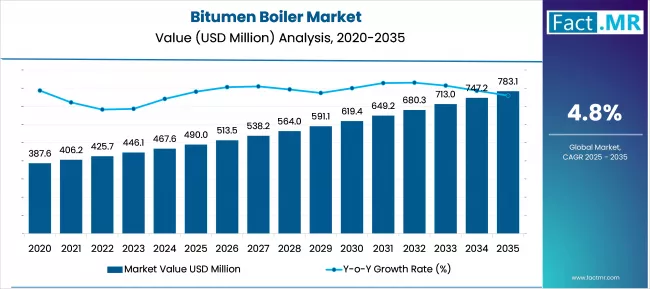
Bitumen Boiler Market Market Value Analysis | Source: Fact.MR
What are the drivers of the Bitumen Boiler market?
The bitumen boiler market is primarily driven by increasing infrastructure and road-building projects that increase demand for equipment to heat asphalt. Rapid urbanization and the growth of vehicle fleets drive maintenance and rehabilitation activity for existing pavements, allowing for relatively constant replacement cycles. More stringent standards for safety and emissions have prompted a shift from open-flame kettles to indirect thermal-oil type or electric heated boilers.
The volatility of energy prices and fuel availability are motivating buyers towards more productive and lower-emission equipment to heat asphalt. Product designs are being developed to increase the efficiency of the equipment: digital temperature control systems, recirculation systems, automation for controls, etc., improve how well the device works and ultimately increase sales for a higher price. Roofs and waterproofing for foundation installations, along with other industrial uses for bitumen, expands the base market.
Rental and lease structures, particularly in emerging regions minimize the initial purchase costs and increase the demand that can be met. Finally, strong local manufacturing in APAC, and a strong aftermarket support product for parts, service, and maintenance, allows for better access and adoption of technology at a low cost with longer equipment life cycles.
What are the regional trends of the Bitumen Boiler market?
Demand is driven in East Asia (China, Japan, Korea) principally by large local production of asphalt along with local boiler manufacturing and existing infrastructure spend that continues to provide sufficient unit volumes and exports. Demand growth is fastest in India and South Asia as highway programs and rapid urbanization promote repair work and the sale of portable and plant-scale boilers.
Demand in North America is largely replacement-oriented, with modernization and the demand for safe, cleaner heating systems promoted by federal infrastructure funding. Western Europe favours indirect and electric approaches due to stringent emission and safety regulations.
The Middle East and Africa are still largely project driven, led over the current decade by GCC megaprojects in Saudi Arabia and the UAE along with road development in parts of Africa. Demand in Latin America is moderate but somewhat steady, driven by road rehabilitation and government public infrastructure funding programs.
What are the challenges and restraining factors of the Bitumen Boiler market?
The Bitumen Boiler industry is confronted with a number of difficulties and factors that restrain growth in this particular arena. Safety hazards associated with open flames and hot-bitumen handling present liability risks and increases insurance costs for manufacturers, urging them to improve designs with a focus on risk reduction. The increasing cost of fuel sources (such as diesel, LPG) can elevate operating costs and discourage purchases.
Changes in government emissions and workplace requirements can entail expensive retrofitting or sourcing cleaner alternatives that can include electric/thermal-oil devices, ultimately deterring the adoption of newer technologies in cost-sensitive markets / regions. An abundance of manufacturers in each supplier category, coupled with variances in product quality, erodes buyer confidence and impacts adoption and standardization processes.
The capital investment for direct and more sophisticated electric bitumen heating systems - particularly equipment relying on electric heaters - limits new-technology penetration among contractors who cannot absorb the upfront costs. For example, limited municipal grid capacity or site electrical service limits the use of electric heating newer devices in several markets. Cycle times for replacing bitumen equipment are extensive, and even if funding were available users often prefer to rent versus purchase new equipment.
Country-Wise Insights
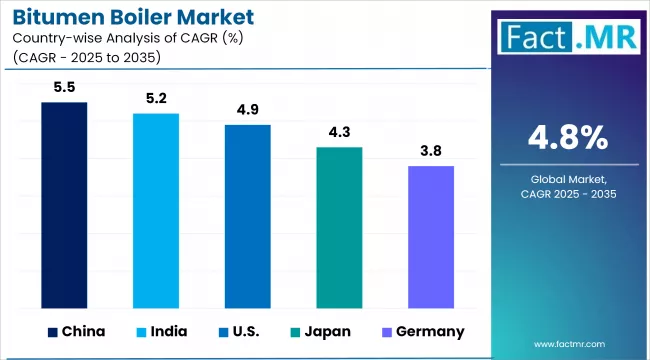
Bitumen Boiler Market Cagr Analysis By Country | Source: Fact.MR
China Accelerates Bitumen Boiler Manufacturing and Technological Integration
China is rapidly expanding cost-efficient, high-volume manufacturing and deployment of bitumen boilers leading to widespread application in infrastructure and paving projects. With its well-established manufacturing ecosystem, competitive supply chain, and robust domestic demand from road construction and urban development, China offers an extensive range of bitumen boilers from simple portable direct-fire kettles to large thermal-oil circulation systems, for local contractors and export to global markets.
Domestic manufacturers emphasize durable, low-cost construction, rapid aftermarket support, and incremental improvements in energy efficiency, temperature control, and safety features to meet the diverse demands of job sites. Government infrastructure programs, regional contractors, and the ongoing expansion of asphalt plants stimulate demand, and a growing interest in clean indirect heating and electrified solutions is nudging manufacturers toward higher-value, technology-enabled product lines.
India is Scaling Affordable, High-Volume Bitumen Boiler Solutions for Rapid Infrastructure Growth
India is quickly introducing affordable, high-volume bitumen boiler solutions to accommodate an unprecedented pipeline of infrastructure activity, particularly road construction and urbanization. While a significant portion of contractors prefers portable, low-capex direct-fire kettles and open-oil jacketed unit options from a fragmented domestic manufacturing base, the resulting pricing and capabilities remain competitive.
The demand for these systems can be attributed to government lifecycle spending, improved rural road conditions and renewal, as well as some momentum associated with the rental and on-site equipment models. In addition, awareness of emissions and safety continues to grow, which is leading to a slow acceptance of thermal-oil systems and electric options in higher-value applications. Aftermarket services, spare-parts and local engineering options are also important factors that can differentiate suppliers.
If the trend toward modernized and standardized product offerings continues, the market may transition toward durable, energy efficient systems over the next ten years. Financing solutions will ultimately help mid-sized contractors build on the momentum, as well.
The United States is accelerating tech-driven modernization of bitumen boiler systems.
The United States is speeding up the modernization of bitumen boiler systems through technology updates, regulatory initiatives, and demand for replacements. Manufacturers and the service and aftermarket sectors are focused on developing direct and indirect heating designs that are safer, and better temperature control, thermal-oil circulation slip on machines, and electric products that lowers emissions and enhances safety in the work environment.
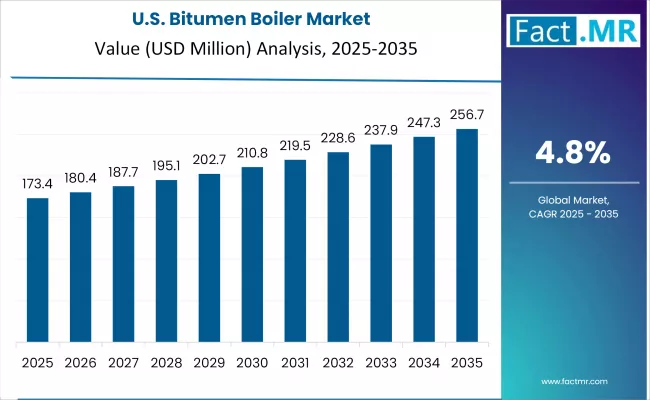
Bitumen Boiler Market Country Value Analysis | Source: Fact.MR
Government funded infrastructure programs and reliable road maintenance budgets will keep the aftermarket, and retrofit service markets, sustained in demand while stricter safety and emissions regulation force total contract towards additional equipment specifications. Advances in digital controls, IoT-based monitoring, and predictive maintenance are all improving machine uptime and reducing their total lifecycle costs to owners.
Growth will be stable but driven more by replacement cycles for regulatory compliance than new build volume. This creates share opportunity for higher value equipment, retrofit services, rental models, and a product or service geared towards municipal contractors, private contractor, and commercial developments. Several factors continue to support a movement towards innovative product, safety and emissions.
Category-Wise Analysis
Large-Capacity Boilers are the Powerhouse of Modern Bitumen Handling.
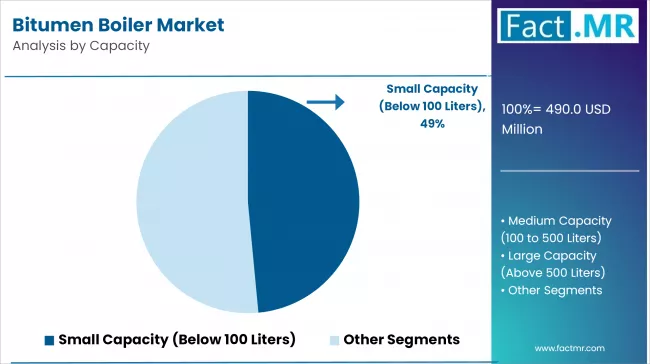
Bitumen Boiler Market Analysis By Capacity | Source: Fact.MR
The large-capacity (over 500 liters) segment is becoming a primary growth engine in the Bitumen Boiler Market, driven by the need for continued and uniform heating of bitumen in large-scale infrastructure, highway, and industrial projects. These solutions provide superior temperature stability, higher efficiency, and enhanced compatibility with thermal-oil or recirculation systems, making them very suitable for use directly in asphalt plants or large storage facilities.
As construction contractors and refineries shift towards centralized heating alternatives, the need for large scale boilers is on the rise and will continue to expand at a steady rate. Their scalability and safety features, in addition to their ability to produce extended operational cycles, continue to position these units as the favorable choice for new development of infrastructure, which represents a noticeable shift from a preference for smaller and portable units to larger sustainable energy-efficient units.
Electrification is the Catalyst Powering the Next Generation of Bitumen Heating.
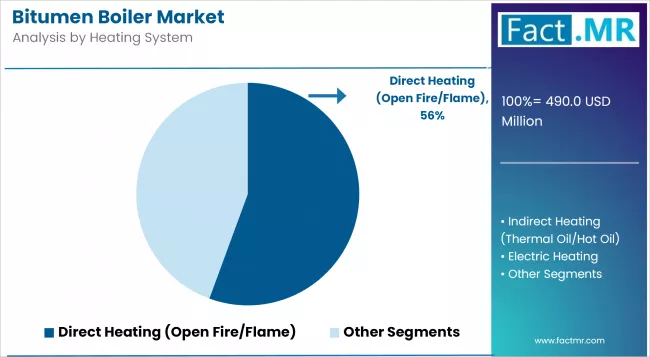
Bitumen Boiler Market Analysis By Heating System | Source: Fact.MR
The electric heating segment is quickly evolving into a disruptive player in the Bitumen Boiler Market. Underpinned by a global movement for sustainability, carbon footprint reduction and improved safety standards, electric systems provide enhanced temperature control, quicker heating response and cleaner operation than traditional fuel-fired units. Their low maintenance, energy efficient operation, and utilitarian approach to renewable energy sources make them a perfect fit for modern construction and asphalt applications.
Increasing investment in smart infrastructure and paving the way for automation, the electric heating segment is set to proliferate into this market. As regulations on future and decarbonization requirements on preparation of asphalt will begin, it is anticipated that electric heating technology will be the preferred heating method of choice to influence the future of efficient, safe and environmentally-friendly bitumen processes.
Competitive Analysis
Key players in the Bitumen Boiler market are Crafco, Inc., SealMaster, Marathon Equipment, Inc., Aimix Group, Jining Furuide Machinery, Kaifeng Yucheng Precision Machinery, Shandong MACPEX Machinery, Contrust Machinery, Premier Engineering, Kesar Road Equipments, Revotherm Automations, Rotomech Industries, Nilang Asphalt, Ideal Machinery, Jaldhara Industries.
The Bitumen Boiler market is competitive, with fragmented regional manufacturers and changing technology preferences. Organizations compete based on efficiency, safety, and fuel flexibility, with increasing preference for electric systems and thermal-oil systems over traditional direct-fired units. Product differentiation is influenced more by innovation especially emission control, automation, and digital temperature monitoring rather than by costs.
Price sensitivity and aftersales support and service are key factors in the buyer decision-making process. Furthermore, compliance with safety and environmental regulations plays a role in defining market position, longevity, and competitiveness globally and in regional market segments.
Recent Development
- In July 2025, Moglix, one of Asia’s largest B2B e-commerce and supply chain technology companies, has inaugurated a new greenfield bitumen processing plant under its manufacturing arm, DRG Industries, in Kosi Kalan, Mathura. The facility is slated to begin commercial production in July 2025.
Fact.MR has provided detailed information about the price points of key manufacturers of Bitumen Boiler Market positioned across regions, sales growth, production capacity, and speculative technological expansion, in the recently published report.
Methodology and Industry Tracking Approach
The Bitumen Boiler Market Report, published in 2025 by Fact.MR, compiles comprehensive insights from more than 1,200 stakeholders in 12 countries—each providing at least 75 validated responses. Most participants (65%) identified as end users, from infrastructure developers and road builders to equipment rental companies and OEM procurement leads. The remaining 35% of study participants identified as supply chain managers, consultants in regulatory matters, energy-efficiency auditors, and sustainability consultants.
Fieldwork took place between September 2024 and August 2025, and engaged participants to assess important heating system variables such as system efficiencies, compliance with emissions regulations, operational safety, optimization of lifecycle costs, and the use of electric and thermal-oil technologies. Careful sampling ensured a balanced representation across geographic regions including North America, Europe, and Asia.
The study integrated insights from over 95 credible published evaluations which included credible audits on the potential for industry equipment, government assessments of infrastructure impacts, energy management evaluations, trade data linked to heating alternatives for Bitumen, and machinery registries on construction machinery. Rigorous triangulation protocols were used to ensure data were validated and accurate.
Fact.MR incorporated cutting-edge analytical approaches, such as multi-variable regression, comparative scenario modeling, and analysis of market elasticity, to ensure forecast accuracy. This report builds on previous studies tracking heating equipment used across industrial sectors since 2018, to provide data-driven decision analysis for companies looking for better efficiencies, innovations, and a sustainable system for the Bitumen Boiler ecosystem.
Segmentation
Segmentation of Bitumen Boiler Market
-
By Capacity :
- Small Capacity (Below 100 Liters)
- Medium Capacity (100 to 500 Liters)
- Large Capacity (Above 500 Liters)
-
By Heating System :
- Direct Heating (Open Fire/Flame)
- Indirect Heating (Thermal Oil/Hot Oil)
- Electric Heating
-
By Mobility :
- Portable/Trailer-Mounted
- Stationary/Skid-Mounted
- Truck-Mounted
-
By End-Use Industry :
- Pyrometallurgical Feedstock
- Hydrometallurgical Feedstock
- Mechanical Separation Feedstock
-
By Region :
- North America
- Latin America
- Western Europe
- Eastern Europe
- East Asia
- South Asia & Pacific
- Middle East & Africa
Frequently Asked Questions
What was the Global Bitumen Boiler Market Size Reported by Fact.MR for 2025?
Who are the Major Players Operating in the Bitumen Boiler Market?
What is the Estimated Valuation of the Bitumen Boiler Market in 2035?
What Value CAGR did the Bitumen Boiler Market Exhibit Over the Last Five Years?
Who worked on this report


Preview the report firsthand - request a free sample
Free SampleGet the brochure for pricing and purchase details
Download PDF