- Market Value (2025): USD 11.4 Bn
- Estimated Value (2026): USD 12.4 Bn
- Forecast Value (2036): USD 27.8 Bn
- CAGR (2026-2036): 8.4%
What is the Blister and Thermoform Contract Packaging Services Market forecast to be worth by 2036?
USD 27.8 billion by 2036.
- The Blister and Thermoform Contract Packaging Services Market reached USD 11.4 billion in 2025.
- Demand is projected to increase from USD 12.4 billion in 2026 to USD 27.8 billion by 2036.
- The market is forecast to record an 8.4% CAGR from 2026 to 2036.
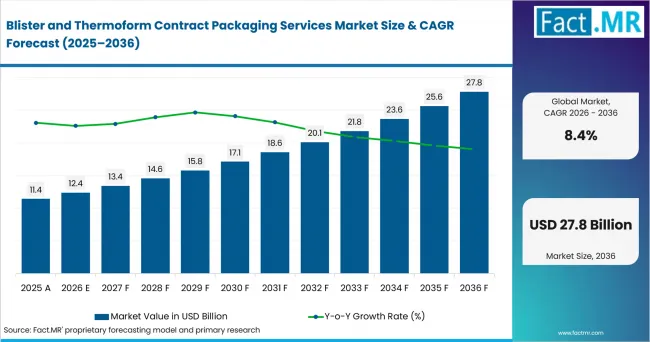
Blister And Thermoform Contract Packaging Services Market Value Analysis | Source: Fact.MR
What are the defining numbers behind Blister and Thermoform Contract Packaging Services Market growth?
An absolute opportunity of USD 15.4 billion is expected between 2026 and 2036.
- Demand Drivers in the Market
- Pharmaceutical launch activity creates recurring demand for qualified packaging capacity. The U.S. Food and Drug Administration approved 46 novel drugs in 2025, while many established medicines also require new strengths, indications or country packs. Contract packagers absorb this variable workload without forcing each product owner to maintain dedicated blister and thermoform lines for every launch profile.
- Traceability requirements increase the amount of packaging work attached to each commercial pack. The FDA Drug Supply Chain Security Act framework requires interoperable electronic tracing of certain prescription drugs at package level. Packaging partners therefore need to connect blistering and cartoning with coding, serialization and controlled release of packaging records.
- Primary-pack performance remains a technical purchase criterion. FDA guidance describes blister packages as a combination of forming film and lidding material, with the container-closure system expected to protect the dosage form through its shelf life. Moisture-sensitive products can require cold-form structures or barrier laminates, which increases the value of contractors with qualified tooling and material experience.
- Material transition is creating additional qualification work. Regulation (EU) 2025/40 on packaging and packaging waste generally applies from August 2026, increasing pressure on packaging design, recyclability and producer responsibility. Pharmaceutical buyers need contractors that can assess alternative structures without disrupting barrier performance, line efficiency or approved specifications.
- Outsourcing also converts fixed packaging investment into qualified external capacity. This matters when commercial demand is uncertain, pack versions vary by country or launches require short campaigns. The purchase case improves when a contractor can manage forming, inspection, cartoning and serialization within one validated workflow.
- Key Segments Analyzed
- Blister Packaging Services account for 47.0% of the Service Category segment in 2026 because primary-pack qualification combines forming, product loading, lidding and seal control within one regulated process.
- Pharmaceutical Packaging holds 45.0% of the Application segment in 2026 as solid oral medicines generate recurring demand for unit-dose protection, coding and country-specific commercial packs.
- Pharmaceutical Companies represent 49.0% of the End User segment in 2026 because product owners remain responsible for packaging specifications, stability protection and commercial release even when execution is outsourced.
- Cold Form Blister Packaging accounts for 43.0% of the Packaging Type segment in 2026 because aluminum-based cold-form structures provide barrier protection for moisture- and light-sensitive formulations.
- Polyvinyl Chloride holds 42.0% of the Material Type segment in 2026 because PVC remains widely used as a thermoform blister forming film and works across established pharmaceutical packaging equipment and laminate structures.
- Analyst Opinion at Fact.MR
- Shambhu Nath Jha, Principal Consultant at Fact.MR, states, “Blister and thermoform outsourcing is increasingly tied to launch flexibility and packaging compliance rather than line capacity alone. Pharmaceutical buyers need contractors that can validate materials, control artwork and serialization, and maintain pack performance through product transfers. Providers that reduce qualification friction while supporting smaller country-specific campaigns can strengthen long-term client relationships.”
- Strategic Implications
- Contract packagers should align capacity planning with launch variability and smaller country-specific campaigns rather than relying only on long production runs.
- Serialization, vision inspection and artwork governance should be integrated into commercial packaging workflows so product owners can reduce handoffs between vendors.
- Material-transition programs need barrier testing and line trials before customers can move from PVC or multilayer structures to alternative formats.
- Supplier-transfer proposals should quantify tooling, validation and stability requirements because a lower unit price can be outweighed by requalification cost and launch delay.
How does the Blister and Thermoform Contract Packaging Services Market break down by segment?
The market is segmented by Service Category, Application, End User, Packaging Type and Material Type.
Why do Blister Packaging Services lead Service Category?
Blister Packaging Services are projected to account for a 47.0% share in 2026.
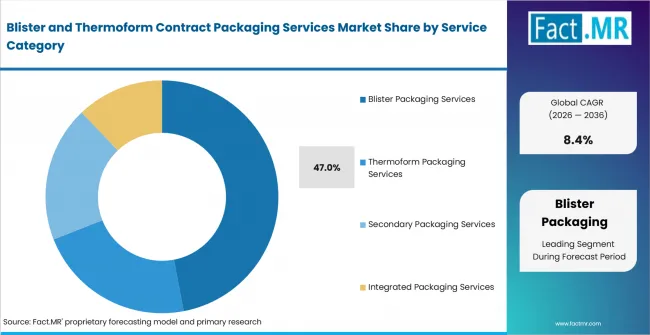
Blister And Thermoform Contract Packaging Services Market Analysis By Service Category | Source: Fact.MR
Blistering is the point at which a contractor forms the cavity, loads the dose and seals the lidding material around the product. This process directly affects package integrity and shelf-life protection, so buyers place more weight on validated tooling and seal control than they do for packaging steps that can be transferred after the primary pack is released.
The service also supports several commercial requirements in one operation. PCI Pharma Services lists blister packaging among its primary packaging capabilities, while Almac operates multi-product and humidity-sensitive blistering. These workflows make blistering a recurring outsourced activity across launches and established products.
Why does Pharmaceutical Packaging lead Application?
Pharmaceutical Packaging is projected to account for a 45.0% share in 2026.
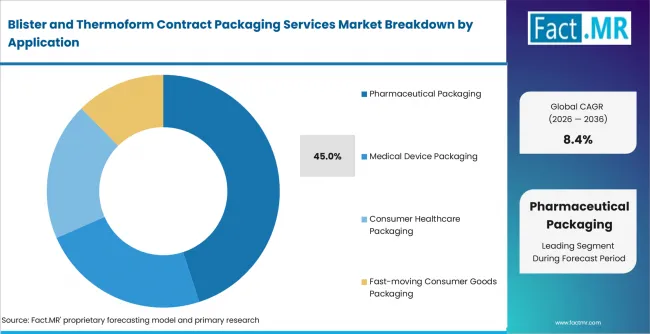
Blister And Thermoform Contract Packaging Services Market Analysis By Application | Source: Fact.MR
Pharmaceutical programs combine barrier protection with regulated identity and release controls. Tablets and capsules can be packed as individual units, while moisture-sensitive products may require higher-barrier structures. Country launches add coding and artwork requirements after the forming process.
The commercial requirement is recurring because approved products remain in supply after launch. Almac reported that its Audubon facility received approval for a multi-product blister pack following a pre-approval inspection, illustrating the validation work attached to commercial blister operations.
Why do Pharmaceutical Companies lead End User?
Pharmaceutical Companies are projected to account for a 49.0% share in 2026.
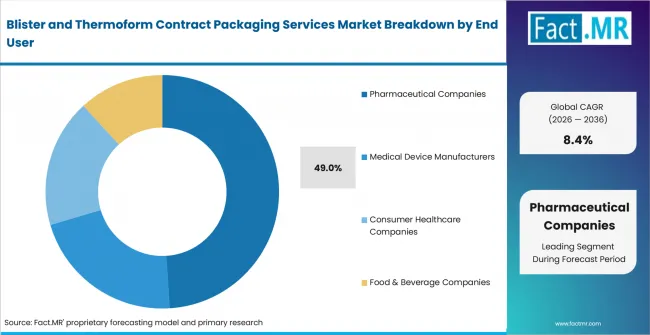
Blister And Thermoform Contract Packaging Services Market Analysis By End User | Source: Fact.MR
Pharmaceutical companies lead because they remain accountable for the packaging system even when physical execution is outsourced. They define the forming material, lidding structure, artwork and coding requirements while linking packaging changes to stability and regulatory files.
Outsourcing becomes attractive when a sponsor needs flexible campaign sizes or several regional pack versions. A qualified partner can provide dedicated blister capacity, cartoning and serialization without requiring the product owner to build separate packaging assets for every portfolio need.
Why does Cold Form Blister Packaging lead Packaging Type?
Cold Form Blister Packaging is projected to account for a 43.0% share in 2026.
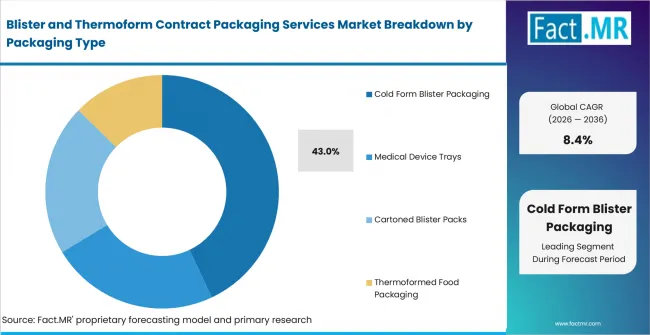
Blister And Thermoform Contract Packaging Services Market Analysis By Packaging Type | Source: Fact.MR
Cold-form blister packs are selected when barrier requirements are more demanding than a standard thermoformed cavity can meet. Aluminum-based structures protect sensitive products from moisture, oxygen and light, making tooling and seal integrity central to qualification.
The format carries trade-offs in cavity size and forming speed, so buyers value contractors that can balance product protection with line efficiency. PCI has documented commercial work involving oversized cold-form cavities, showing how pack design and equipment capability need to be coordinated before scale-up.
Why does Polyvinyl Chloride lead Material Type?
Polyvinyl Chloride is projected to account for a 42.0% share in 2026.
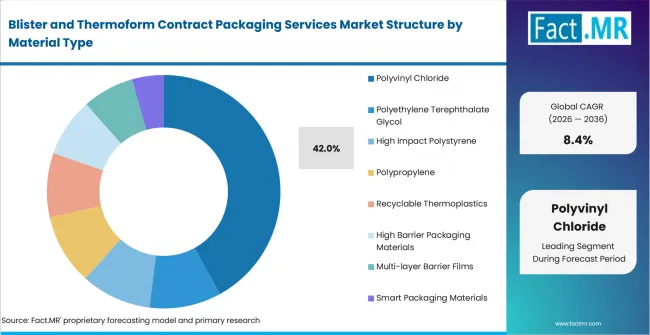
Blister And Thermoform Contract Packaging Services Market Analysis By Material Type | Source: Fact.MR
PVC leads because it is an established forming film for pharmaceutical blister packs and can be combined with barrier coatings or lidding structures to meet different product requirements. FDA packaging references identify PVC among materials used in blister-film systems, while existing packaging equipment is widely configured around thermoformable polymer films.
Material substitution is becoming more active as recyclability requirements change. Amcor has developed vinyl-free blister structures as alternatives to traditional PVC-containing formats, which shows that PVC remains an important installed-base material even as pharmaceutical customers evaluate new options.
What is accelerating Blister and Thermoform Contract Packaging Services Market adoption, and what is holding it back?
Drivers Impact Analysis
| Factor | (~) % Impact on CAGR | Geographic Relevance | Impact Timeline |
|---|---|---|---|
| Outsourcing of variable pharmaceutical launch and lifecycle packaging volumes | +1.5% | Global | 2026-2036 |
| Package-level serialization and traceability requirements | +1.3% | USA, Europe and China | 2026-2036 |
| Demand for validated high-barrier blister and thermoform capability | +1.0% | Global | 2026-2036 |
| Material redesign linked to recyclability and packaging regulation | +0.8% | Europe | 2026-2036 |
Source: Fact.MR analysis. Updated Aug 11, 2026
Restraints Impact Analysis
| Factor | (~) % Impact on CAGR | Geographic Relevance | Impact Timeline |
|---|---|---|---|
| Tooling, validation and stability work during supplier transfers | -1.1% | Global | 2026-2032 |
| Artwork and regulatory approval cycles for country-specific packs | -0.8% | USA, Europe and Japan | 2026-2032 |
| Qualified-material availability and line-change complexity | -0.6% | Global | 2026-2032 |
Source: Fact.MR analysis. Updated Aug 11, 2026
Which countries are scaling the Blister and Thermoform Contract Packaging Services Market?
- The USA is forecast to grow at a 9.6% CAGR from 2026 to 2036. FDA recorded 46 novel drug approvals in 2025, sustaining a flow of new commercial packaging programs alongside lifecycle changes for established medicines.
- Germany is projected to expand at a 9.2% CAGR. Packaging suppliers are preparing for the EU Packaging and Packaging Waste Regulation, while Germany has been adapting national packaging law to the EU framework that applies from August 2026.
- The UK is expected to record an 8.9% CAGR. From January 2025, medicinal products for the UK market must carry a clearly legible “UK Only” label, increasing country-specific artwork and pack-version requirements.
- France is forecast to post an 8.5% CAGR. Extended producer responsibility for household packaging and updated packaging-recovery reporting increase the attention given to material choice and end-of-life documentation.
- Japan is projected to grow at an 8.1% CAGR. PMDA enables users to scan a barcode or two-dimensional code on the outer box to reach electronic package information, reinforcing the need for accurate coding and controlled outer-pack execution.
- India is expected to expand at a 7.7% CAGR. Pharmaceutical exports reached about USD 30.5 billion in 2024-25, creating recurring demand for export-ready blister packs that meet destination-market artwork and compliance requirements.
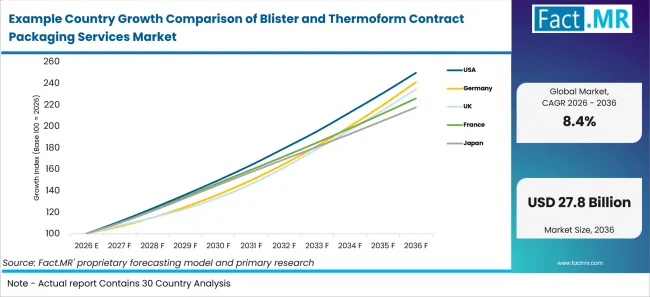
Example Country Growth Comparison Of Blister And Thermoform Contract Packaging Services Market | Source: Fact.MR
Country CAGR (2026-2036)
| Country | CAGR (2026-2036) |
|---|---|
| USA | 9.6% |
| Germany | 9.2% |
| UK | 8.9% |
| France | 8.5% |
| Japan | 8.1% |
Source: Fact.MR analysis. Updated Aug 11, 2026
What is driving the USA’s growth through 2036?
The USA is forecast to expand at a 9.6% CAGR from 2026 to 2036.
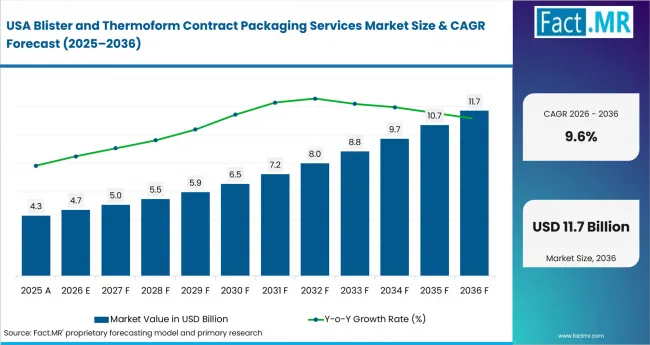
Blister And Thermoform Contract Packaging Services Market Country Value Analysis | Source: Fact.MR
The U.S. packaging environment combines new product launches with package-level traceability. FDA’s DSCSA framework calls for interoperable electronic tracing of certain prescription drugs at package level, which increases the value of packaging lines that can coordinate serialization with cartoning and release controls.
Contract packagers also benefit when sponsors need capacity without committing to a dedicated line before demand is proven. This favors providers that can support launch quantities and then scale campaigns while keeping the same validated pack configuration.
What is driving Germany’s growth through 2036?
Germany is forecast to expand at a 9.2% CAGR from 2026 to 2036.
Germany is adapting its packaging framework to Regulation (EU) 2025/40. The Federal Environment Ministry states that the EU regulation applies from 12 August 2026, while producer responsibility remains central to packaging-waste management.
For pharmaceutical packaging contractors, this adds material-review work alongside product protection. Customers need evidence that a revised blister or thermoform structure can meet barrier and line-performance requirements before it is introduced into a regulated commercial pack.
What is driving the UK’s growth through 2036?
The UK is forecast to expand at an 8.9% CAGR from 2026 to 2036.
The Windsor Framework changed medicine packaging requirements from January 2025. MHRA guidance requires UK medicinal products to carry the “UK Only” label, while common packs shared with other countries can no longer enter the UK supply chain in the same way.
This creates recurring work in artwork control and late-stage customization. Contract packagers can add value by managing UK-specific print versions without forcing pharmaceutical companies to hold excessive finished-pack inventory before demand is known.
What is driving France’s growth through 2036?
France is forecast to expand at an 8.5% CAGR from 2026 to 2036.
France operates an extended producer responsibility framework for household packaging and graphic papers, while ADEME continues to update national packaging-recovery information. Material choices therefore carry a wider documentation burden beyond the pharmaceutical product specification itself.
Contract packagers serving French programs can support customers by coordinating material changes with artwork and production trials. The opportunity is clearer where a revised structure can improve end-of-life performance without forcing a full redesign of the approved pack format.
What is driving Japan’s growth through 2036?
Japan is forecast to expand at an 8.1% CAGR from 2026 to 2036.
PMDA’s electronic package-insert system uses codes on the outer box to connect users with current safety information. Packaging execution therefore needs reliable print quality and code placement so the physical pack remains linked to the approved electronic information.
This requirement fits contract packaging models that combine blistering with secondary packaging and inspection. Product owners can centralize coding and pack verification with the same partner that controls cartoning and country-specific artwork.
Who leads the Blister and Thermoform Contract Packaging Services Market?
PCI Pharma Services is one of the leading company in the Blister and Thermoform Contract Packaging Services Market. Its commercial packaging capabilities include blister formats alongside secondary packaging and launch support, giving pharmaceutical customers access to integrated execution across product-development and commercial stages.
Sharp Services and Almac Group also compete through pharmaceutical packaging and launch support. West Pharmaceutical Services, Nelipak Healthcare Packaging and Oliver Healthcare Packaging bring healthcare packaging or device-focused capabilities, while Constantia Flexibles and Amcor contribute pharmaceutical films and lidding structures used within blister and thermoform systems.
CCL Industries participates through regulated labels and identification components. Sonoco Products Company changed its position after completing the sale of its Thermoformed and Flexibles Packaging business to TOPPAN Holdings in April 2025, so its current role is different from its earlier thermoform portfolio.
Unipex Solutions Canada is a legacy operating name that was integrated into Azelis Canada following the acquisition of Koda Distribution Group. Competitive interpretation should therefore distinguish between active contract-packaging operations and companies whose role is now primarily materials or specialty distribution.
Supplier selection depends on validated line capability and barrier expertise. Serialization integration, tooling control and geographic service capacity also matter because pharmaceutical buyers need repeatable pack performance across launches and lifecycle changes.
Which companies are the key providers?
- PCI Pharma Services
- Sharp Services, LLC
- West Pharmaceutical Services, Inc.
- Constantia Flexibles Group GmbH
- Sonoco Products Company
- Amcor plc
- CCL Industries Inc.
- Almac Group
- Unipex Solutions Canada Inc.
- Nelipak Healthcare Packaging
- Oliver Healthcare Packaging
Bibliography
- U.S. Food and Drug Administration. (2025). Novel Drug Approvals for 2025. U.S. Department of Health and Human Services.
- U.S. Food and Drug Administration. (2025). Drug Supply Chain Security Act (DSCSA). U.S. Department of Health and Human Services.
- U.S. Food and Drug Administration. (1999). Container Closure Systems for Packaging Human Drugs and Biologics. U.S. Department of Health and Human Services.
- European Commission. (2025). Packaging and Packaging Waste Regulation (EU) 2025/40. European Union.
- Medicines and Healthcare products Regulatory Agency. (2025). Labelling and Packaging of Medicinal Products for Human Use Following Agreement of the Windsor Framework. UK Government.
- Federal Ministry for the Environment, Climate Action, Nature Conservation and Nuclear Safety. (2026). European Law on Packaging and Packaging Waste. Government of Germany.
- German Bundestag. (2026). New Packaging Rules Adopted. Federal Republic of Germany.
- Ministry for Ecological Transition. (2025). Household Packaging and Graphic Papers. Government of France.
- ADEME. (2025). Recovery of Packaging in France: 2023 Data. French Agency for Ecological Transition.
- Pharmaceuticals and Medical Devices Agency. (2021). Information Regarding Newly Introduced Electronic Package Inserts. Government of Japan.
- National Medical Products Administration. (2022). Provisions for the Supervision and Administration of Drug Manufacturing. Government of China.
- Press Information Bureau, Government of India. (2025). Indian Pharmaceutical Products Are Globally Recognized; Pharmaceutical Exports Expand. Ministry of Commerce and Industry.
- PCI Pharma Services. (2026). Pharmaceutical Packaging Services. PCI Pharma Services.
- Almac Group. (2022). Almac Pharma Services Audubon Site Receives Product Approval Following Pre-Approval Inspection. Almac Group.
- Constantia Flexibles. (2025). Constantia Flexibles and Aluflexpack Join Forces. Constantia Flexibles.
- Amcor. (2021). Recyclable Pharmaceutical Blister Packaging Development. Amcor plc.
- Sonoco Products Company. (2025). Sonoco Completes Sale of Thermoformed and Flexibles Packaging Business to TOPPAN Holdings. Sonoco Products Company.
- Azelis. (2016). American Focus for Azelis: Integration of Unipex Solutions Canada. Azelis.
This Report Answers
- The report examines demand for Blister and Thermoform Contract Packaging Services across Service Category, Application, End User, Packaging Type and Material Type.
- Segment analysis assesses blister packaging, pharmaceutical applications, pharmaceutical-company demand, cold-form formats and established forming materials within their respective categories.
- Country analysis evaluates market development across the USA, Germany, the UK, France, Japan, India and China.
- Competitive analysis examines pharmaceutical contract packagers alongside healthcare packaging specialists and packaging-material suppliers.
- The analysis considers validation requirements, serialization, barrier performance, material transition and launch flexibility that influence outsourcing decisions.
What does the Blister and Thermoform Contract Packaging Services Market cover?
The market covers outsourced packaging services that form, fill, seal, inspect, label or complete products using blister and thermoform formats. The assessment includes pharmaceutical, medical-device, consumer-healthcare and selected fast-moving consumer-goods applications within the stated segmentation.
Service coverage extends from primary blister and thermoform execution to secondary packaging and integrated support when those activities are directly tied to the packaged product.
What is included in the scope?
The scope includes Blister Packaging Services, Thermoform Packaging Services, Secondary Packaging Services and Integrated Packaging Services. Applications include Pharmaceutical Packaging, Medical Device Packaging, Consumer Healthcare Packaging and Fast-moving Consumer Goods Packaging.
End User coverage includes Pharmaceutical Companies, Medical Device Manufacturers, Consumer Healthcare Companies and Food & Beverage Companies. Packaging Type covers cold-form blister packs, medical-device trays, cartoned blister packs and thermoformed food formats. Material Type includes PVC, PETG, recyclable thermoplastics and high-barrier packaging materials together with the stated subsegments.
What is excluded from the scope?
The scope excludes packaging materials sold without contract packaging execution when no service component is provided. Standalone packaging machinery and tooling sold directly to product owners are also outside the market unless supplied as part of a contract-packaging engagement.
Bottle filling, pouching, sachet packaging and other formats are excluded when they are delivered without blister or thermoform activity. General freight, warehousing and distribution are included only when they are directly integrated with the packaging services defined in this assessment.
How Was the Analysis Built?
- Primary Research:
- Discussions with pharmaceutical packaging contractors, healthcare packaging suppliers, pharmaceutical companies, medical-device manufacturers and packaging-material specialists examine capacity utilization, validation timelines, material selection and outsourcing requirements.
- Desk Research:
- The review covers pharmaceutical packaging regulation, traceability requirements, packaging-waste rules, product approvals, company disclosures and technical guidance on blister materials and container-closure systems. Sources used in the analysis are recorded in the bibliography.
- Market Sizing and Forecasting:
- Estimates combine contract-packaging demand with pharmaceutical and healthcare packaging volumes, blister and thermoform adoption, material mix, service intensity, segment shares and country-level growth. The model also considers product launches, serialization requirements and material-transition activity.
- Validation and Update Cycle:
- Findings are cross-checked against public evidence and company activity. Updates account for regulatory changes, packaging-capacity investments, portfolio transactions, material developments and changes in pharmaceutical launch activity.
Segmentation
What is the report's scope and coverage?
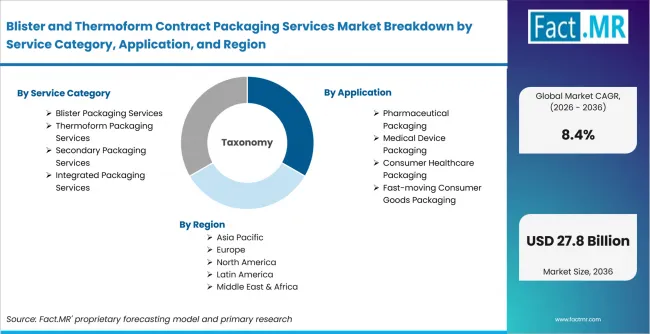
Blister And Thermoform Contract Packaging Services Market Breakdown By Service Category, Application, And Region | Source: Fact.MR
| Attribute | Details |
|---|---|
| Quantitative Units | USD billion in 2026 to USD billion by 2036 at a CAGR |
| Market Definition | Contract packaging services for blister and thermoform formats supplied across the stated service categories, applications, end users, packaging types and material types |
| Segments Covered | Service Category; Application; End User; Packaging Type; Material Type |
| Regions Covered | North America; Latin America; Europe; East Asia; South Asia and Pacific; Middle East and Africa |
| Countries Covered | USA; Germany; UK; France; Japan |
| Key Companies Profiled | PCI Pharma Services; Sharp Services, LLC; West Pharmaceutical Services, Inc.; Constantia Flexibles Group GmbH; Sonoco Products Company; and others |
| Forecast Period | 2026 to 2036 |
| Approach | Hybrid top-down and bottom-up approach using packaging-service demand, pharmaceutical and healthcare application volumes, packaging-format mix, material requirements, country growth and provider capability review |
Source: Fact.MR analysis. Updated Aug 11, 2026
How is the market segmented?
-
By Service Category
- Blister Packaging Services
- Cold Form Blister Packaging
- Thermoform Blister Packaging
- Thermoform Packaging Services
- Custom Thermoformed Trays
- Custom Thermoformed Clamshells
- Secondary Packaging Services
- Cartoning Services
- Labeling Services
- Integrated Packaging Services
- Supply Chain Management
- Serialization & Track and Trace
- Blister Packaging Services
-
By Application
- Pharmaceutical Packaging
- Solid Oral Dosage Packaging
- Unit Dose Packaging
- Medical Device Packaging
- Sterile Medical Device Packaging
- Diagnostic Kit Packaging
- Consumer Healthcare Packaging
- Over the Counter Drug Packaging
- Dietary Supplement Packaging
- Fast-moving Consumer Goods Packaging
- Personal Care Product Packaging
- Electronics Packaging
- Pharmaceutical Packaging
-
By End User
- Pharmaceutical Companies
- Generic Drug Manufacturers
- Biopharmaceutical Companies
- Medical Device Manufacturers
- Healthcare Product Manufacturers
- Diagnostic Product Manufacturers
- Consumer Healthcare Companies
- Nutraceutical Manufacturers
- Contract Manufacturing Organizations
- Food & Beverage Companies
- Personal Care Manufacturers
- Electronics Manufacturers
- Pharmaceutical Companies
-
By Packaging Type
- Cold Form Blister Packaging
- Cold Form Blister Packs
- Thermoform Blister Packs
- Medical Device Trays
- Custom Thermoformed Trays
- Clamshell Packaging
- Cartoned Blister Packs
- Multi-pack Blister Packaging
- Combination Packaging
- Thermoformed Food Packaging
- Thermoformed Cosmetic Packaging
- Protective Thermoformed Inserts
- Cold Form Blister Packaging
-
By Material Type
- Polyvinyl Chloride
- Polyvinyl Chloride Polyvinylidene Chloride Films
- Polyethylene Terephthalate Films
- Polyethylene Terephthalate Glycol
- High Impact Polystyrene
- Polypropylene
- Recyclable Thermoplastics
- Post-consumer Recycled Plastics
- Bio-based Thermoplastics
- High Barrier Packaging Materials
- Multi-layer Barrier Films
- Smart Packaging Materials
- Polyvinyl Chloride
-
By Region
- North America
- Latin America
- Western Europe
- Eastern Europe
- East Asia
- South Asia and Pacific
- Middle East & Africa
Frequently Asked Questions
Which Service Category leads the market?
Which Application leads the market?
Which End User leads the market?
Which Packaging Type leads the market?
Which Material Type leads the market?
Which country records a 9.6% CAGR from 2026 to 2036?
Which companies are included in the market assessment?
Who worked on this report


Preview the report firsthand - request a free sample
Free SampleGet the brochure for pricing and purchase details
Download PDF