- Base Value(2025): 2.4 Bn
- Estimated Value(2026): 2.8 Bn
- Forecast Value (2036): 10.9 Bn
- CAGR (2026 - 2036): 15%
Blood Clot Retrieval Devices Market Forecast 2026 to 2036
In 2025, the blood clot retrieval devices market was valued at USD 2.4 billion. Based on Fact MR analysis, demand for blood clot retrieval devices is estimated to grow to USD 2.8 billion in 2026 and USD 10.9 billion by 2036. FMR projects a CAGR of 15% during the forecast period.
The absolute dollar growth from 2026 to 2036 is USD 8.1 billion. This rapid growth is driven by the increasing prevalence of cardiovascular diseases, rising awareness of stroke management, and the growing adoption of minimally invasive procedures. Blood clot retrieval devices, essential in the treatment of ischemic stroke, are increasingly being used to improve patient outcomes. However, challenges such as high procedure costs and limited access to advanced healthcare in some regions could affect market growth.
As Adam Elsesser, Chairman, Chief Executive Officer and President of Penumbra, Inc., noted regarding adoption and physician preference for their thrombectomy devices, ‘Even though it is early, we are already starting to see conversion to Lightning Bolt 7 from physicians who might historically have performed open surgery or lytics.’
China leads with a CAGR of 20.3%, driven by the large patient population and increasing healthcare infrastructure. India follows with an 18.8% CAGR, supported by rising healthcare access and awareness about stroke treatment. Germany grows at 17.3%, reflecting strong demand for advanced medical devices in the European healthcare market. France grows at 15.8%, fueled by increasing adoption of advanced stroke treatment technologies. The UK grows at 14.3%, benefiting from steady demand for medical devices in stroke care and intervention.
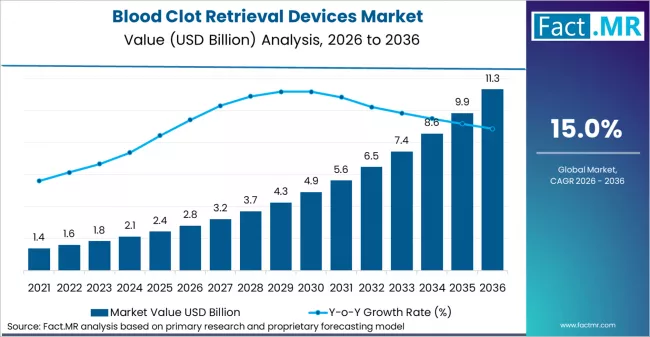
Blood Clot Retrieval Devices Market Market Value Analysis | Source: Fact.MR
Blood Clot Retrieval Devices Market
| Metric | Value |
|---|---|
| Estimated Value in (2026E) | USD 2.8 billion |
| Forecast Value in (2036F) | USD 10.9 billion |
| Forecast CAGR (2026 to 2036) | 15% |
Source: Fact.MR analysis. Updated Mar 5, 2026
Blood Clot Retrieval Devices Market Definition
The blood clot retrieval devices market involves the manufacture and sale of medical devices (such as mechanical thrombectomy systems and aspiration catheters) used to remove thrombi from blood vessels to restore blood flow in conditions like acute ischemic stroke and deep vein thrombosis.
Market Inclusions
This report covers global and regional market sizes for blood clot retrieval devices over a defined forecast period, including device types (stent retrievers, aspiration systems), clinical applications (neurology, peripheral vascular), and end‑use settings (hospitals, stroke centers, interventional labs).
Market Exclusions
The scope excludes anticoagulant drugs, thrombolytic pharmaceutical therapies, and diagnostic imaging systems not directly part of clot retrieval procedures. Rehabilitation equipment and unrelated vascular devices outside thrombectomy are also omitted.
Research Methodology
- Primary Research: Interviews were conducted with interventional cardiologists, neurologists, device engineers, and hospital procurement specialists.
- Desk Research: Data was sourced from clinical publications, regulatory filings, and industry reports.
- Market‑Sizing and Forecasting: A hybrid model combining top‑down clinical procedure forecasts with bottom‑up device sales and shipment data was used.
- Data Validation and Update Cycle: Findings were validated through expert review and aligned with recent clinical adoption and production figures.
Summary of the Blood Clot Retrieval Devices Market
- Market Definition
- The Blood Clot Retrieval Devices Market includes medical devices such as mechanical thrombectomy systems and aspiration catheters, used to remove thrombi from blood vessels to restore blood flow in conditions like ischemic stroke and deep vein thrombosis.
- Demand Drivers
- Increasing Prevalence of Cardiovascular Diseases: The rising incidence of stroke, especially ischemic strokes, is driving the demand for blood clot retrieval devices, which play a crucial role in the early treatment of strokes.
- Shift to Minimally Invasive Procedures: Blood clot retrieval devices, which offer minimally invasive alternatives to traditional surgical methods, are gaining popularity for stroke management due to their ability to improve patient outcomes with less risk and recovery time.
- Rising Awareness of Stroke Management: As awareness about stroke management grows, the adoption of blood clot retrieval devices is increasing, with a focus on improving clinical outcomes in stroke patients.
- Technological Advancements: Ongoing innovations in thrombectomy and clot retrieval devices, offering higher efficacy, precision, and easier use, are fueling market growth.
- Key Segments Analyzed
- Stroke Type: Ischemic stroke (blood clot) is expected to capture 39.6% of the market share by 2026. This is due to the high prevalence of ischemic strokes, where blood clot retrieval devices play a critical role in removing clots to restore blood flow and minimize brain damage.
- Device Type: Stent retrievers are widely used, contributing significantly to the growth of the market due to their effectiveness in clot removal during thrombectomy procedures.
- Application: Cerebral arteries are projected to dominate, accounting for 47.7% of the market share by 2026. This segment is driven by the high incidence of strokes affecting the brain and the increasing use of clot retrieval devices in treating these strokes.
- Geography: China leads with a CAGR of 20.3%, followed by India with an 18.8% CAGR. These markets are benefiting from improved healthcare infrastructure and increasing adoption of advanced stroke treatment technologies.
- Analyst Opinion at Fact MR
- Shambhu Nath Jha, Principal Consultant at Fact MR, highlighted, "The growing focus on stroke management and the increasing adoption of mechanical thrombectomy is expected to continue driving the demand for blood clot retrieval devices globally."
- Strategic Implications/Executive Takeaways
- Emphasis on Minimally Invasive Devices: Manufacturers should focus on developing and refining minimally invasive devices to enhance efficacy and patient outcomes, particularly in stroke management.
- Expand into Emerging Markets: The increasing healthcare access in emerging markets such as China and India presents an opportunity for companies to expand their market reach and cater to the rising demand for stroke treatment devices.
- Focus on Clinical Outcomes: As clinical outcomes and performance drive device adoption, continuous innovation and validation through clinical studies are key to maintaining a competitive edge in this market.
- Methodology
- Primary Research: Interviews with interventional cardiologists, neurologists, device engineers, and hospital procurement specialists.
- Desk Research: Data was sourced from clinical publications, regulatory filings, and industry reports.
- Market Sizing & Forecasting: A hybrid model combining top-down clinical procedure forecasts with bottom-up device sales and shipment data was used to project market growth.
Segmental Analysis
Blood Clot Retrieval Devices Market Analysis by Application
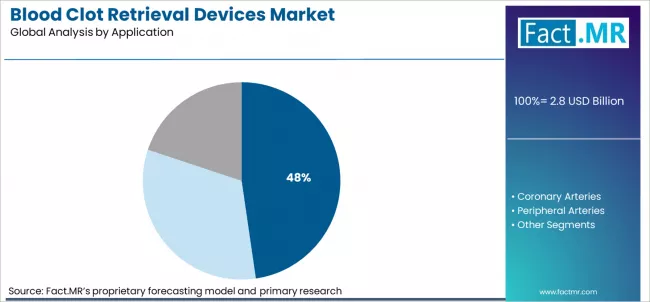
Blood Clot Retrieval Devices Market Analysis By Application | Source: Fact.MR
- Market Overview: Cerebral arteries are projected to account for 47.7% of the market share by 2026. Blood clot retrieval devices used in cerebral arteries are critical in treating ischemic strokes caused by blockages in the brain’s arteries, where timely intervention is essential to restore blood flow and prevent brain damage.
- Demand Drivers:
- Increasing Incidence of Strokes: The rising global prevalence of ischemic strokes, especially in aging populations, is driving demand for blood clot retrieval devices targeting cerebral arteries. The need for effective and quick intervention in stroke patients is contributing to the growth of this segment.
- Improved Treatment Outcomes: Blood clot retrieval devices offer a minimally invasive option to restore blood flow in the brain, reducing the risk of severe disability and death following a stroke. This effectiveness is a major driver for their adoption in cerebral artery applications.
- Advancements in Neurovascular Intervention: Continued advancements in neurovascular technologies, including clot retrieval devices, are making these treatments more precise, efficient, and accessible, further driving the demand for devices targeting cerebral arteries.
Blood Clot Retrieval Devices Market Analysis by Stroke Type
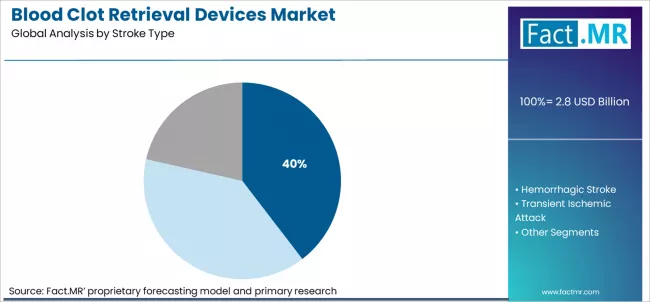
Blood Clot Retrieval Devices Market Analysis By Stroke Type | Source: Fact.MR
- Market Overview: Ischemic stroke (blood clot) is expected to capture 39.6% of the market share by 2026. Ischemic stroke occurs when a blood clot blocks a blood vessel in the brain, and blood clot retrieval devices are crucial in quickly removing the clot to restore blood flow and minimize brain damage.
- Demand Drivers:
- High Prevalence of Ischemic Strokes: Ischemic strokes account for a majority of all strokes, which significantly drives the demand for blood clot retrieval devices designed to address these types of strokes. Early intervention using these devices helps improve patient outcomes, which is critical in stroke treatment.
- Effectiveness in Emergency Situations: Blood clot retrieval devices are most effective when used in the early stages of ischemic stroke, as they can quickly remove the clot and restore circulation. This ability to improve recovery chances drives the adoption of these devices in stroke management.
- Improved Access to Treatment: The growing availability and adoption of advanced medical technologies in hospitals and stroke centers are making blood clot retrieval devices more accessible to patients, further boosting their use in ischemic stroke cases.
Blood Clot Retrieval Devices Market Drivers, Restraints, and Opportunities
FMR analysts observe that the blood clot retrieval devices market is a growing segment driven by the increasing incidence of ischemic stroke and the shift toward mechanical thrombectomy for improved patient outcomes. Historically, pharmacological treatments were the main approach; however, as evidence shows better reperfusion results with mechanical devices, the demand for clot retrieval systems has surged. The 2026 market valuation reflects this shift, with adoption linked to updated stroke care guidelines and hospital infrastructure improvements.
While thrombolytic drugs remain in use, mechanical thrombectomy devices are gaining traction because they offer more effective restoration of blood flow, especially in large vessel occlusions. These systems are higher priced, contributing to market value growth as procedural volumes increase with rising stroke cases.
- Clinical Guideline Expansion: Updated stroke care protocols recommend thrombectomy as the standard treatment, driving demand for retrieval devices over pharmacologic therapies.
- Regulatory & Performance Standards: Regulatory approvals and safety standards push the adoption of certified mechanical thrombectomy devices with proven efficacy.
- Regional Trends: In North America and Europe, strong healthcare infrastructure supports higher device uptake, while Asia‑Pacific shows growth with increasing access to neurointervention.
Regional Analysis
The market analysis covers key global regions, including East Asia, South Asia, Western Europe, and North America. It is segmented geographically, with specific market dynamics for each region. The full report provides a detailed market attractiveness analysis.
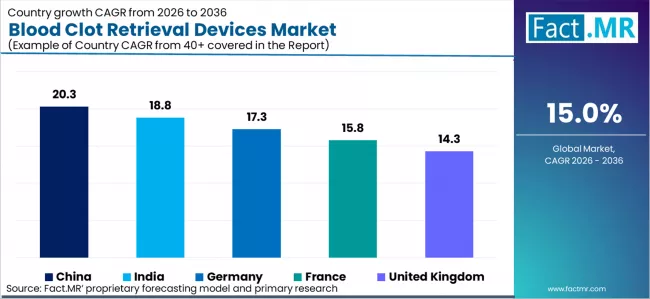
Blood Clot Retrieval Devices Market Cagr Analysis By Country | Source: Fact.MR
| Country | CAGR (2026-2036) |
|---|---|
| China | 20.3% |
| India | 18.8% |
| Germany | 17.3% |
| France | 15.8% |
| United Kingdom | 14.3% |
Source: Fact.MR analysis. Updated Mar 5, 2026
Source: Fact MR (FMR) analysis, based on proprietary forecasting model and primary research.
East Asia:
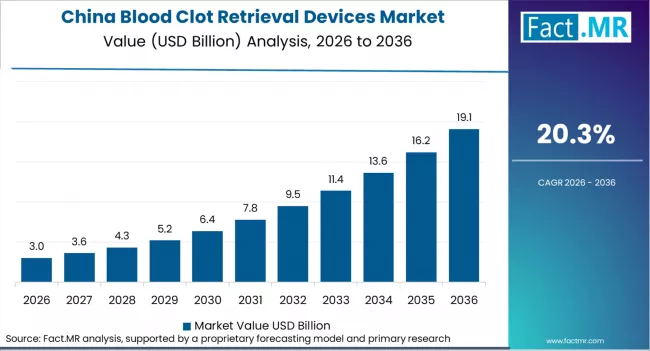
Blood Clot Retrieval Devices Market Country Value Analysis | Source: Fact.MR
In East Asia, China is leading the demand for blood clot retrieval devices, driven by the increasing prevalence of stroke, advancements in medical technology, and the rising healthcare infrastructure in the country.
- China: Demand for blood clot retrieval devices in China is projected to rise at 20.3% CAGR through 2036. China’s expanding healthcare infrastructure, rising incidence of stroke, and increased adoption of advanced medical technologies continue to drive market growth.
South Asia:
In South Asia, India is a key market for blood clot retrieval devices, supported by increasing awareness of stroke management, growing healthcare facilities, and rising investments in medical technologies.
- India: Demand for blood clot retrieval devices in India is projected to rise at 18.8% CAGR through 2036. India’s growing healthcare sector, rising stroke incidences, and growing demand for advanced medical treatments contribute to the steady growth of the market.
Western Europe:
In Western Europe, Germany and France are prominent markets for blood clot retrieval devices, driven by high healthcare standards, rising stroke awareness, and increasing government and private sector investments in healthcare technologies.
- Germany: Demand for blood clot retrieval devices in Germany is projected to rise at 17.3% CAGR through 2036. Germany’s advanced healthcare infrastructure, growing incidence of stroke, and increasing adoption of cutting-edge medical devices continue to fuel market demand.
- France: Demand for blood clot retrieval devices in France is projected to rise at 15.8% CAGR through 2036. France’s increasing stroke management programs and growing adoption of blood clot retrieval technologies contribute to steady market growth.
- United Kingdom: Demand for blood clot retrieval devices in the UK is projected to rise at 14.3% CAGR through 2036. The UK’s rising stroke incidences and increased focus on advanced stroke treatment devices continue to drive market demand.
Fact MR's analysis of the blood clot retrieval devices market in East Asia, South Asia, Western Europe consists of country-wise assessments that include China, India, Germany, France, and the United Kingdom. Readers can find detailed trends, regulatory updates, and company-specific investments shaping the market’s growth in these countries.
What is the Competitive Structure and Buyer Behavior in the Blood Clot Retrieval Devices Market?
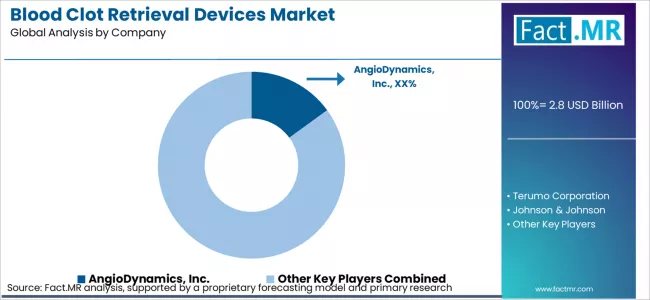
Blood Clot Retrieval Devices Market Analysis By Company | Source: Fact.MR
The blood clot retrieval devices market is moderately concentrated, with key players such as AngioDynamics, Inc., Terumo Corporation, Johnson & Johnson, and Boston Scientific Corporation capturing a significant share. The primary competitive variables are product efficacy, clinical outcomes, and the breadth of the product portfolio. Companies with advanced technologies, strong R&D capabilities, and regulatory expertise have structural advantages, allowing them to innovate quickly and maintain a competitive edge. Large healthcare providers and group purchasing organizations exert considerable leverage, often qualifying multiple suppliers and negotiating long-term contracts based on quality and performance rather than price alone. To manage supplier dependency, these buyers diversify their sources and emphasize proven clinical outcomes, which limits individual suppliers’ pricing power. As a result, competition focuses on delivering value, reliable service, and consistent clinical performance.
Recent Industry Developments
- 2026 Acute Ischemic Stroke Guideline Update: In February 2026, the American Stroke Association (ASA) released updated guidelines that formally endorse tenecteplase (TNK) alongside traditional alteplase and provide new, structured recommendations for pediatric mechanical thrombectomy. These guidelines are a major market driver, as they standardize the "hub-and-spoke" model for rapid clot retrieval across smaller regional hospitals.
- FDA Clearance for Nipro’s DVT Thrombectomy System: In February 2026, Avantec Vascular (a Nipro Company) received FDA 510(k) clearance for a novel DVT Thrombectomy System. This device is specifically engineered to treat Deep Vein Thrombosis in vessels larger than 7mm by combining a rotating tip mechanism with vacuum aspiration in a single session, aiming to reduce procedural time and the need for thrombolytic drugs.
- New 2026 Pulmonary Embolism (PE) Management Guidelines: A multi-society report (AHA/ACC/CHEST) published in February 2026 has introduced a new "Category A-E" clinical classification for Acute Pulmonary Embolism. The guidelines now classify mechanical thrombectomy as a "reasonable" first-line advanced therapy for high-risk Category E1 patients, signaling a shift away from systemic "clot-busting" drugs that carry higher bleeding risks.
Key Players of the Blood Clot Retrieval Devices Market
- AngioDynamics, Inc.
- Terumo Corporation
- Johnson & Johnson
- ECKOS Corporation
- Bayer HealthCare LLC
- Boston Scientific Corporation
- Argon Medical Devices, Inc.
- Medtronic plc
- Teleflex Incorporated
- Penumbra, Inc.
Report Scope
| Metric | Value |
|---|---|
| Quantitative Units | USD 2.8 billion (2026) to USD 10.9 billion (2036), at a CAGR of 15% |
| Market Definition | The Blood Clot Retrieval Devices Market includes devices designed for removing blood clots in patients suffering from stroke-related conditions, such as ischemic stroke and hemorrhagic stroke. |
| By Stroke Type | Ischemic Stroke (Blood Clot), Hemorrhagic Stroke (Rupturing of Arteries), Transient Ischemic Attack |
| By Device | Stent Retrievers, Mechanical Embolus Removal Devices, Penumbra Blood Clot Retrieval Devices, Aspiration Device, Ultrasound Assisted Devices |
| By Application | Cerebral Arteries, Coronary Arteries, Peripheral Arteries |
| By End-User | Hospitals, Diagnostic Centers, Clinics, Ambulatory Surgical Centers |
| Regions Covered | North America, Latin America, Europe, East Asia, South Asia, Oceania, Middle East and Africa |
| Countries Covered | United States, Canada, Mexico, Brazil, Argentina, Germany, France, United Kingdom, Italy, Spain, China, India, Japan, South Korea, Indonesia, Australia, and 40+ countries |
| Key Companies Profiled | AngioDynamics, Inc., Terumo Corporation, Johnson & Johnson, ECKOS Corporation, Bayer HealthCare LLC, Boston Scientific Corporation, Argon Medical Devices, Inc., Medtronic plc, Teleflex Incorporated, Penumbra, Inc. |
| Forecast Period | 2026 to 2036 |
| Approach | Hybrid top-down and bottom-up market modeling validated through primary interviews with manufacturers and supported by trade data benchmarking and market research. |
Source: Fact.MR analysis. Updated Mar 5, 2026
Bibliographies
- AngioDynamics, Inc. (2023). Advancing thrombectomy treatments with innovative blood clot retrieval devices. AngioDynamics, Inc.
- Boston Scientific Corporation. (2023). Leading the way in stroke intervention with advanced blood clot retrieval devices. Boston Scientific Corporation.
- Penumbra, Inc. (2023). Penumbra's Lightning Bolt 7: A breakthrough in thrombectomy procedures. Penumbra, Inc.
- Terumo Corporation. (2023). Pioneering clot retrieval solutions for stroke management. Terumo Corporation.
- Nipro Group. (2026, February 3). Avantec Vascular Receives FDA 510(k) Clearance for DVT Thrombectomy System [FDA approval]. Nipro Group.
- NeurologyLive. (2026, March 1). Breaking Down the 2026 Acute Ischemic Stroke Guidelines [Industry news]. NeurologyLive.
- American Heart Association. (2026, February 19). 2026 Guideline for the Evaluation and Management of Acute Pulmonary Embolism in Adults [Guideline update]. American Heart Association.
This report addresses:
- Market intelligence enabling comprehensive assessment of leading countries and product segments across the Blood Clot Retrieval Devices Market globally.
- Market volume (sales units) estimates and 10-year revenue forecasts from 2026 to 2036, validated through manufacturer shipment data, channel partner surveys, and country-level demand modeling.
- Growth opportunity mapping across stroke types (Ischemic Stroke, Hemorrhagic Stroke, Transient Ischemic Attack), device types (Stent Retrievers, Mechanical Embolus Removal Devices, Penumbra Blood Clot Retrieval Devices, Aspiration Device, Ultrasound Assisted Devices), applications (Cerebral Arteries, Coronary Arteries, Peripheral Arteries), and end-user industries.
- Segment and regional revenue forecasts by stroke type, device type, application, end-user industry, and geography across 40+ countries.
- Competition strategy analysis covering dealer network structure, recent developments, product portfolio, USPs, and market share analysis.
- Product and regulatory compliance tracking aligned with stroke care guidelines, clinical safety standards, and minimally invasive treatment protocols.
- Regulatory impact analysis addressing healthcare regulations, medical device safety standards, and clinical approval processes across key markets.
- Report delivery in PDF, Excel, PowerPoint, and interactive dashboard formats for executive, procurement, and operational planning use.
Segmentation
Blood Clot Retrieval Devices Market Key Segments
-
Stroke Type :
- Ischemic Stroke (Blood Clot)
- Hemorrhagic Stroke (Rupturing of Arteries)
- Transient Ischemic Attack
-
Device :
- Stent Retrievers
- Mechanical Embolus Removal Devices
- Penumbra Blood Clot Retrieval Devices
- Aspiration Device
- Ultrasound Assisted Devices
-
Application :
- Cerebral Arteries
- Coronary Arteries
- Peripheral Arteries
-
End-Use Industry :
- Hospitals
- Diagnostic Centers
- Clinics
- Ambulatory Surgical Centers
-
Region :
- North America
- USA
- Canada
- Mexico
- Europe
- Germany
- UK
- France
- Italy
- Spain
- Nordic Countries
- BENELUX
- Rest of Europe
- Asia Pacific
- China
- Japan
- South Korea
- India
- Australia
- Rest of Asia Pacific
- Latin America
- Brazil
- Argentina
- Rest of Latin America
- Middle East and Africa
- Kingdom of Saudi Arabia
- United Arab Emirates
- South Africa
- Rest of Middle East and Africa
- Other Regions
- Oceania
- Central Asia
- Other Markets
- North America
Frequently Asked Questions
How large is the demand for Blood Clot Retrieval Devices in the global market in 2026?
What will be the market size of Blood Clot Retrieval Devices in the global market by 2036?
What is the expected demand growth for Blood Clot Retrieval Devices in the global market between 2026 and 2036?
Which application is expected to dominate the market?
Which region is expected to show the highest growth rate for Blood Clot Retrieval Devices?
How significant is the growth outlook for India in this market?
What is the growth outlook for Germany in the Blood Clot Retrieval Devices market?
What is the growth forecast for France in the Blood Clot Retrieval Devices market?
What is the growth forecast for the United Kingdom in the Blood Clot Retrieval Devices market?
Which company is identified as a leading player in the Blood Clot Retrieval Devices market?
What are Blood Clot Retrieval Devices used for?
What does the Blood Clot Retrieval Devices market include in this report?
How is the market forecast developed in this report?
What is meant by the Blood Clot Retrieval Devices market in this report?
Who worked on this report


Preview the report firsthand - request a free sample
Free SampleGet the brochure for pricing and purchase details
Download PDF