- Market Value (2025): USD 94.6 Mn
- Estimated Value (2026): USD 107.2 Mn
- Forecast Value (2036): USD 373.7 Mn
- CAGR (2026-2036): 13.3%
What is the At-Home Biological-Age Tests Market forecast to be worth by 2036?
USD 107.2 million in 2026 to USD 373.7 million by 2036 at a 13.3% CAGR.
- As per Fact.MR analysis, the at-home biological-age tests market was valued at USD 94.6 million in 2025.
- Demand is projected to increase from USD 107.2 million in 2026 to USD 373.7 million by 2036.
- The market is forecast to expand at a 13.3% CAGR from 2026 to 2036 as consumers increasingly explore personalized health assessments and biological aging indicators.
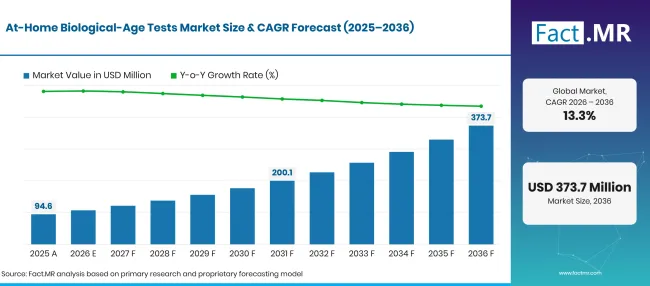
At Home Biological Age Tests Market Forecast Global | Source: Fact.MR
| Year | Basis | Market Value (USD million) |
|---|---|---|
| 2025 | Actual | 94.6 |
| 2026 | Estimate | 107.2 |
| 2036 | Forecast | 373.7 |
| CAGR 2026 to 2036 | Forecast period | 13.3% |
Source: Fact.MR analysis. Updated Nov 9, 2026
What are the defining numbers behind At-Home Biological-Age Tests Market growth?
USD 266.5 million absolute opportunity between 2026 and 2036.
- Demand Drivers in the Market
- Growing interest in preventive health assessment: Consumers are increasingly exploring biological-age testing to understand health patterns beyond chronological age. This is encouraging demand for testing services that translate molecular and biochemical measurements into accessible wellness information.
- Increasing adoption of personalized wellness programs: Demand for individualized nutrition, exercise and lifestyle recommendations is creating opportunities for biological-age testing providers. Consumers may use biological-age estimates to explore wellness trends, although the clinical utility of these measurements for individual decisions remains uncertain. Measurement methods and biological variability can affect the estimates.
- Advancements in aging biomarker analysis: Improvements in DNA methylation analysis and proteomic and metabolomic testing are expanding the range of biological indicators that can be assessed. These developments are supporting more comprehensive testing panels and differentiated service offerings.
- Direct-to-consumer testing models: Selected providers allow consumers to order biological-age assessments online and collect eligible samples at home. Availability depends on the provider, sample type, and laboratory arrangements. Digital result delivery and laboratory partnerships can simplify the testing process and support adoption among consumers seeking convenient health information.
- Key Segments Analyzed
- By Biological-Age Test Modality: Composite Blood Biomarker leads with 27.2% of the market in 2026, reflecting demand for assessments that combine multiple measurable indicators.
- By Sample / Examination: Multi-source Panel accounts for 28.0% of the market in 2026, supported by the ability to evaluate different biological indicators through combined testing approaches.
- By Testing Location: At-Home Self-Test leads with 30.0% of the market in 2026, reflecting consumer preference for convenient sample collection and remote testing services.
- By Result Delivery: AI Decision Support accounts for 24.8% of the market in 2026, supported by demand for accessible interpretation and personalized wellness insights.
- Analyst Opinion at Fact.MR
- Shambhu Nath Jha, Principal Consultant at Fact.MR, states, “At-home biological-age testing is gaining relevance as consumers look beyond conventional health measurements to understand biological aging and individual wellness patterns. Testing providers that combine reliable biomarker analysis with accessible reporting and longitudinal tracking can strengthen consumer engagement. However, transparent explanations of test limitations and the distinction between biological-age estimates and clinical diagnoses will remain essential to sustained market development.”
- Strategic Implications
- Testing providers should explain the biomarkers and analytical methods used to estimate biological age. Clear reporting of sample requirements and measurement limitations can help consumers understand the meaning of their results and distinguish wellness assessments from clinically validated diagnostic tests.
- Laboratory companies need to strengthen sample-processing standards and quality-control procedures across blood, saliva, buccal and urine-based testing. Consistent analytical methods can improve result reliability and support repeat testing for consumers interested in monitoring biological aging over time.
- Digital platform providers must develop AI-supported reporting tools that translate complex biomarker results into understandable wellness insights. Personalized dashboards and longitudinal tracking can improve consumer engagement while helping users compare results across testing periods.
- Testing companies can expand partnerships with longevity clinics and wellness providers to improve access to professional result interpretation. Combining at-home sample collection with specialist guidance can strengthen customer confidence and create opportunities for repeat testing and personalized wellness services.
- Manufacturers need to prioritize transparent data privacy policies and secure handling of genetic and molecular information. Clear consent procedures and controlled access to personal test results can address consumer concerns and support wider adoption of direct-to-consumer biological-age testing.
How does the At-Home Biological-Age Tests Market break down by segment?
Fact.MR finds that Composite Blood Biomarker leads Biological-Age Test Modality at 27.2%; Multi-source Panel leads Sample / Examination at 28.0%; At-Home Self-Test leads Testing Location at 30.0%; and AI Decision Support leads Result Delivery at 24.8%.
Which Biological-Age Test Modality dominates?
Composite Blood Biomarker is set to hold 27.2% share in 2026.
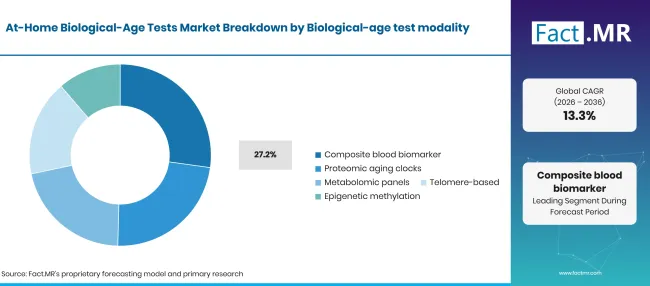
At Home Biological Age Tests Market Breakdown Biological Age Test Modality | Source: Fact.MR
| Biological-Age Test Modality | Share (2026) |
|---|---|
| Composite Blood Biomarker (Leading segment) | 27.2% |
| Other segments combined | 72.8%* |
| Total | 100.0% |
Source: Fact.MR analysis. Updated Nov 9, 2026
Composite blood biomarker testing combines multiple measurable indicators to provide a broader assessment of biological aging. Consumers may prefer these approaches because they offer insights beyond a single molecular marker. Testing providers can differentiate their offerings through comprehensive biomarker panels and clear explanations of how individual measurements contribute to the overall biological-age estimate.
What leads the Sample / Examination segment?
Multi-source Panel is set to represent 28.0% share in 2026.
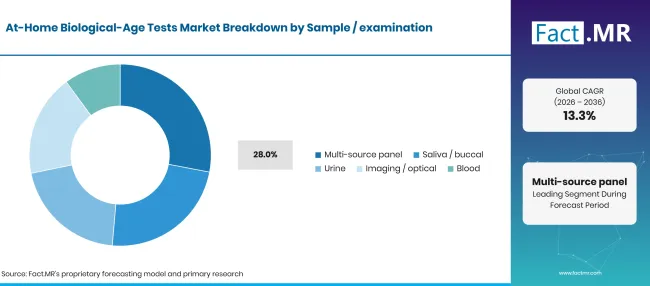
At Home Biological Age Tests Market Breakdown Sample Examination | Source: Fact.MR
| Sample / Examination | Share (2026) |
|---|---|
| Multi-source Panel (Leading segment) | 28.0% |
| Other segments combined | 72.0%* |
| Total | 100.0% |
Source: Fact.MR analysis. Updated Nov 9, 2026
Multi-source panels combine information from different biological samples or examination methods to provide broader aging assessments. This approach can help testing providers evaluate multiple biological indicators rather than relying on a single sample category. Blood, saliva, buccal and urine-based testing remain relevant alternatives depending on the analytical method and collection requirements.
How does Testing Location shape demand?
At-Home Self-Test is likely to account for 30.0% share in 2026.
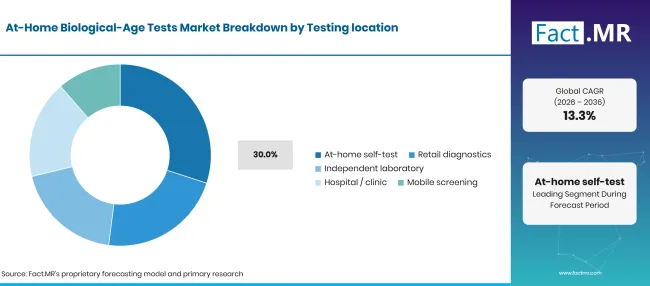
At Home Biological Age Tests Market Breakdown Testing Location | Source: Fact.MR
| Testing Location | Share (2026) |
|---|---|
| At-Home Self-Test (Leading segment) | 30.0% |
| Other segments combined | 70.0%* |
| Total | 100.0% |
Source: Fact.MR analysis. Updated Nov 9, 2026
At-home self-testing appeals to consumers seeking convenient biological-age assessments without routine visits to healthcare facilities. Finger-prick blood collection and cheek-swab kits allow users to collect samples at home and send them to laboratories for analysis. Digital registration and online result delivery further simplify the process and support repeat testing.
What drives the Result Delivery segment?
AI Decision Support is set to account for 24.8% share in 2026.
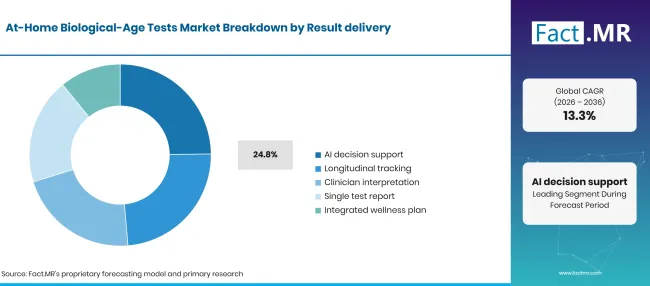
At Home Biological Age Tests Market Breakdown Result Delivery | Source: Fact.MR
| Result Delivery | Share (2026) |
|---|---|
| AI Decision Support (Leading segment) | 24.8% |
| Other segments combined | 75.2%* |
| Total | 100.0% |
Source: Fact.MR analysis. Updated Nov 9, 2026
AI decision support helps translate complex biological measurements into accessible digital insights. Testing providers can use algorithm-based interpretation to organize biomarker results and present personalized wellness recommendations. This approach can improve report accessibility and support consumer engagement. However, AI-generated guidance should communicate uncertainty and avoid presenting biological-age estimates as medical diagnoses.
What is accelerating At-Home Biological-Age Tests Market adoption, and what is holding it back?
Growing interest in preventive wellness and personalized aging assessments supports demand, while scientific uncertainty and concerns about test reliability can restrict wider adoption.
Drivers Impact Analysis
| DRIVER | (~) % IMPACT ON CAGR | GEOGRAPHIC RELEVANCE | IMPACT TIMELINE |
|---|---|---|---|
| Growing consumer interest in longevity | +1.0% | North America, Europe, Asia | Medium term (2–4 years) |
| Expansion of direct-to-consumer testing | +0.9% | USA, Germany, Japan | Short term (≤ 2 years) |
| Advancements in epigenetic testing | +0.8% | USA, Europe, Asia | Long term (≥ 4 years) |
| Demand for personalized wellness insights | +0.7% | Global | Medium term (2–4 years) |
| Increasing adoption of digital health platforms | +0.5% | Global | Short term (≤ 2 years) |
Source: Fact.MR analysis. Updated Nov 9, 2026
Opportunity Impact Analysis
| OPPORTUNITY | (~) % IMPACT ON CAGR | GEOGRAPHIC RELEVANCE | IMPACT TIMELINE |
|---|---|---|---|
| Multi-biomarker testing panels | +0.9% | USA, Germany, Japan | Medium term (2–4 years) |
| AI-supported personalized reporting | +0.8% | Global | Medium term (2–4 years) |
| Longitudinal biological-age tracking | +0.7% | North America, Europe | Long term (≥ 4 years) |
| Partnerships with longevity clinics | +0.5% | USA, Germany, South Korea | Medium term (2–4 years) |
| Affordable at-home collection kits | +0.4% | China, Asia, Americas | Short term (≤ 2 years) |
Source: Fact.MR analysis. Updated Nov 9, 2026
Restraints Impact Analysis
| RESTRAINT | (~) % IMPACT ON CAGR | GEOGRAPHIC RELEVANCE | IMPACT TIMELINE |
|---|---|---|---|
| Uncertainty around individual test accuracy | -0.9% | Global | Short term (≤ 2 years) |
| High testing and laboratory costs | -0.8% | Global | Medium term (2–4 years) |
| Limited clinical interpretation standards | -0.7% | Global | Long term (≥ 4 years) |
| Consumer concerns about genetic data privacy | -0.5% | USA, Europe | Medium term (2–4 years) |
| Differences between testing methodologies | -0.4% | Global | Long term (≥ 4 years) |
Source: Fact.MR analysis. Updated Nov 9, 2026
Which countries are scaling the At-Home Biological-Age Tests Market through 2036?
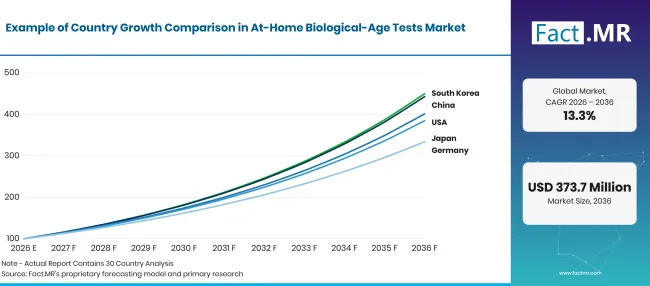
At Home Biological Age Tests Market Growth Index | Source: Fact.MR
| Country | CAGR (2026–2036) |
|---|---|
| South Korea | 16.2% |
| China | 16.1% |
| USA | 14.9% |
| Japan | 14.4% |
| Germany | 12.8% |
Source: Fact.MR analysis. Updated Nov 9, 2026
What is driving growth in the US?
14.9% CAGR, supported by consumer interest in longevity testing and established direct-to-consumer health services.
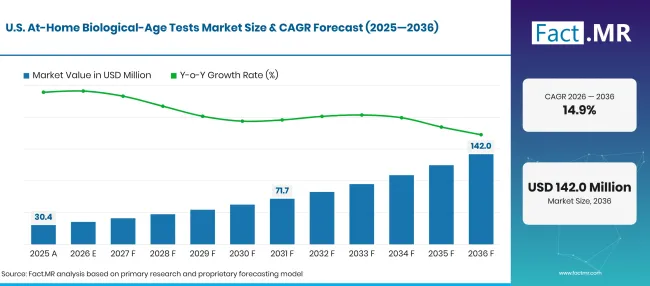
At Home Biological Age Tests Market Forecast Usa | Source: Fact.MR
The United States is an important market for at-home biological-age testing because of its established consumer genomics and personalized wellness ecosystem. Companies are offering blood-based and saliva-based testing solutions that allow consumers to explore biological aging through molecular biomarkers. Growing interest in preventive health and longevity programs is encouraging demand for comprehensive biomarker assessments. The presence of providers such as TruDiagnostic and Tally Health also supports product visibility and consumer access to at-home testing services. The U.S. Census Bureau's population projections highlight the growing relevance of healthy aging and longer-term wellness management. [1]
How is China developing At-Home Biological-Age Tests Market adoption?
16.1% CAGR, driven by growing interest in personalized wellness and expanding digital health services.
China's market is developing through increasing consumer interest in preventive wellness and technology-enabled health assessments. The country's expanding digital healthcare ecosystem and large consumer electronics market create opportunities for providers offering accessible biological-age testing and personalized wellness platforms. Growing attention to healthy aging is also supporting demand for services that assess metabolic health and molecular aging indicators. China's National Bureau of Statistics reported a continued increase in the proportion of older residents in its 2025 population data, reinforcing the importance of healthy-aging solutions. [2]
Why is Japan an important growth market?
14.4% CAGR, shaped by an aging population and growing interest in preventive health management.
Japan's market is supported by strong demand for healthy-aging solutions and personalized wellness assessments. Its aging population is encouraging greater attention to maintaining physical function and understanding age-related health changes. At-home biological-age tests can provide consumers with additional information about molecular aging and selected wellness indicators. The country's established healthcare infrastructure and consumer familiarity with health monitoring technologies can support the adoption of laboratory-based testing services. Government attention to aging-related social and healthcare challenges further strengthens the long-term relevance of preventive wellness solutions. [3]
What is shaping market growth in Germany?
12.8% CAGR, driven by preventive healthcare awareness and demand for science-based wellness assessments.
Germany's at-home biological-age tests market is developing through increasing interest in preventive healthcare and personalized health management. Consumers are showing interest in understanding metabolic health and biological aging through laboratory-supported assessments. The country's established diagnostic laboratory infrastructure can support the processing of blood and other biological samples collected at home. Growing demand for individualized wellness recommendations and professional interpretation can create opportunities for providers offering comprehensive biomarker panels. Germany's demographic transition is also strengthening the importance of healthy-aging strategies and preventive health services. [4]
What supports South Korea adoption?
16.2% CAGR, supported by digital health adoption and increasing attention to longevity and personalized wellness.
South Korea's market is supported by growing consumer interest in advanced health technologies and personalized wellness services. The country's digital infrastructure and technology-oriented consumer market create favorable conditions for online testing platforms and connected wellness applications. Increasing attention to healthy aging is also encouraging interest in biological-age assessments that examine molecular and metabolic indicators. The country's rapidly aging population can further support demand for preventive health services and personalized lifestyle management. Testing providers can benefit from integrating convenient sample collection with digital reporting and ongoing wellness guidance. [5]
Who leads the At-Home Biological-Age Tests Market?
Fact.MR finds that TruDiagnostic, Tally Health, Elysium Health, Generation Lab, GlycanAge, NOVOS Labs and myDNAge are profiled across the biological-age testing and personalized longevity assessment value chain.
Competition is shaped by differences in biomarker selection and sample collection methods as well as laboratory capabilities and result interpretation. TruDiagnostic focuses on blood-based biological-age and multi-system assessments. Tally Health offers cheek-swab-based epigenetic testing, while Elysium Health provides saliva-based DNA methylation analysis through its Index test. Generation Lab offers at-home blood collection and system-level aging assessments.
GlycanAge differentiates its offering through IgG glycan analysis, while NOVOS Labs provides blood-based biological-age assessments with additional aging metrics and AI-supported reporting. myDNAge offers epigenetic age testing through at-home blood and urine collection. These different approaches create opportunities for providers to target consumers seeking specialized molecular assessments and ongoing wellness tracking.
Commercial competition depends on analytical reliability and transparent reporting as well as sample collection convenience and repeat-testing capabilities. Providers need to communicate the limitations of biological-age estimates and demonstrate how their testing methods differ. Digital reporting and professional interpretation can further differentiate services in an increasingly competitive consumer longevity market.
Which companies are the key providers?
Key companies include TruDiagnostic; Tally Health; Elysium Health; Generation Lab; GlycanAge; NOVOS Labs; and myDNAge.
- TruDiagnostic
- Tally Health
- Elysium Health
- Generation Lab
- GlycanAge
- NOVOS Labs
- myDNAge
Bibliography
- [1] U.S. Census Bureau. (2026, August 31). Global Older Adult Population Projected to Nearly Double by 2060.
- [2] National Bureau of Statistics of China. (2026, February 28). Statistical Communiqué of the People’s Republic of China on the 2025 National Economic and Social Development.
- [3] Cabinet Office, Government of Japan. (2026). Annual Report on the Ageing Society, 2026.
- [4] Statistisches Bundesamt (Destatis). (2025, December 11). By 2035, one quarter of Germany’s population will be aged 67 or over.
- [5] Ministry of Data and Statistics, Republic of Korea. (2026, July 28). 2025 Population and Housing Census (Register-based Census).
- [6] From population science to the clinic? Limits of epigenetic clocks as personal biomarkers. (2025). PubMed Central.
This Report Answers
- The report examines how at-home biological-age tests are used across different biomarker and testing methodologies.
- Segment analysis compares the specified test modalities and their respective 2026 market shares.
- Sample analysis evaluates multi-source panels and individual biological sample categories.
- Country analysis discusses the USA, China, Japan, Germany and South Korea alongside demographic and wellness adoption factors.
- The competitive overview profiles TruDiagnostic, Tally Health, Elysium Health, Generation Lab, GlycanAge, NOVOS Labs and myDNAge.
- Result delivery analysis compares AI decision support, longitudinal tracking, clinician interpretation and integrated wellness plans.
What does the At-Home Biological-Age Tests Market cover?
The market covers consumer-oriented testing solutions that estimate biological age through the analysis of molecular and biochemical indicators. It includes at-home sample collection kits and associated laboratory testing services that evaluate biological aging through blood biomarkers and epigenetic, proteomic, metabolomic or telomere-based methods. Digital reporting and associated result interpretation services are also included.
What is included in the scope?
Included products comprise biological-age testing kits and associated laboratory services that allow consumers to collect samples at home or access testing through supported collection channels.
The market includes blood, saliva, buccal and urine-based testing alongside multi-source assessment panels. Digital result delivery, AI-supported interpretation and longitudinal tracking are included when directly associated with biological-age testing.
What is excluded from the scope?
The analysis excludes conventional diagnostic blood tests that do not estimate biological age and general wellness applications that provide lifestyle tracking without molecular or biomarker-based aging assessments.
Pharmaceutical anti-aging treatments and longevity supplements are excluded. Research-only laboratory assays without a commercial consumer testing offering are also outside the defined market. General genetic ancestry tests and conventional genetic screening services are excluded unless they directly provide a biological-age assessment.
How Was the Analysis Built?
The analysis draws on 120+ sources, 35+ company portfolios, 25+ countries and more than 20 industry interviews.
- Primary Research: Primary research includes discussions with biological-age testing providers and laboratory operators as well as technology developers, distributors, wellness service providers and subject-matter experts. These conversations examine testing preferences and biomarker selection alongside consumer adoption and sample collection challenges.
- Desk Research: Desk research covers government demographic statistics and scientific publications as well as regulatory information, company product portfolios, laboratory testing methods, industry developments and consumer health trends. Every source used in the analysis is documented in the bibliography.
- Market Sizing and Forecasting: Market estimates combine historical performance and demand indicators alongside testing volumes, pricing trends, segment shares, company participation, country-level growth and consumer adoption patterns.
- Data Validation and Update Cycle: Findings are validated by comparing primary interviews with company product information and scientific publications as well as demographic developments and changes in consumer testing services. Regular updates review new test launches and laboratory partnerships alongside product improvements and changes in commercial availability.
Segmentation
What is the report's scope and coverage?
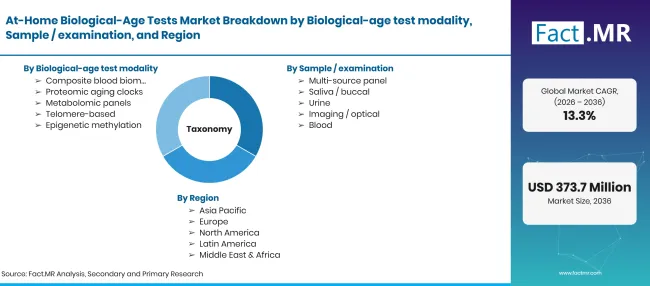
At Home Biological Age Tests Market Taxonomy | Source: Fact.MR
| Attribute | Details |
|---|---|
| Quantitative Units | USD million |
| Market Definition | At-home biological-age testing solutions that analyze molecular, biochemical and physiological biomarkers from consumer-collected samples to estimate biological age and provide insights into aging patterns and overall wellness. |
| Biological-Age Test Modality | Composite Blood Biomarker; Proteomic Aging Clocks; Metabolomic Panels; Telomere-Based; Epigenetic Methylation |
| Sample / Examination | Multi-source Panel; Saliva / Buccal; Urine; Imaging / Optical; Blood |
| Testing Location | At-Home Self-Test; Retail Diagnostics; Independent Laboratory; Hospital / Clinic; Mobile Screening |
| Result Delivery | AI Decision Support; Longitudinal Tracking; Clinician Interpretation; Single Test Report; Integrated Wellness Plan |
| Regions Covered | North America; Latin America; Western Europe; Eastern Europe; East Asia; South Asia & Pacific; Middle East & Africa |
| Countries Covered | USA; China; Japan; Germany; South Korea |
| Companies Profiled | TruDiagnostic; Tally Health; Elysium Health; Generation Lab; GlycanAge; NOVOS Labs; myDNAge |
| Forecast Period | 2026 to 2036 |
| Approach | Market segmentation and scenario-based analysis supported by official demographic statistics, company product information and industry developments |
Source: Fact.MR analysis. Updated Nov 9, 2026
How is the market segmented?
-
By Biological-Age Test Modality
- Composite Blood Biomarker
- Proteomic Aging Clocks
- Metabolomic Panels
- Telomere-Based
- Epigenetic Methylation
-
By Sample / Examination
- Multi-source Panel
- Saliva / Buccal
- Urine
- Imaging / Optical
- Blood
-
By Testing Location
- At-Home Self-Test
- Retail Diagnostics
- Independent Laboratory
- Hospital / Clinic
- Mobile Screening
-
By Result Delivery
- AI Decision Support
- Longitudinal Tracking
- Clinician Interpretation
- Single Test Report
- Integrated Wellness Plan
-
By Region
- North America
- Latin America
- Western Europe
- Eastern Europe
- East Asia
- South Asia & Pacific
- Middle East & Africa
Frequently Asked Questions
How big is the At-Home Biological-Age Tests Market in 2026?
What is the CAGR from 2026 to 2036?
Which Biological-Age Test Modality has the largest share?
Which Sample / Examination category leads?
Which Testing Location dominates?
Which Result Delivery category leads?
Which country is projected to grow fastest?
Which companies are covered?
Who worked on this report


Preview the report firsthand - request a free sample
Free SampleGet the brochure for pricing and purchase details
Download PDF