- Base Value(2026): 0.48 Bn
- Estimated Value(2026): 0.5 Bn
- Forecast Value (2036): 1.1 Bn
- CAGR (2026 - 2036): 8.7%
Hydrogen Sulfide Scavengers in Sewage Systems Market Forecast and Outlook 2026 to 2036
The global market for hydrogen sulfide scavengers in sewage systems is projected to reach USD 1.11 billion by 2036. The market is valued at USD 0.48 billion in 2026 and is set to rise at a CAGR of 8.7% during the assessment period.
Key Takeaways from the Hydrogen Sulfide Scavengers in Sewage Systems Market
- Market Value for 2026: USD 0.48 Billion
- Market Value for 2036: USD 1.11 Billion
- Forecast CAGR (2026-2036): 8.7%
- Leading Scavenger Chemistry Share (2026): Triazine-Based Scavengers (28%)
- Leading Application Area Share (2026): Sewage Collection & Pipeline Networks (36%)
- Leading Treatment Method Share (2026): Continuous Liquid Chemical Dosing (38%)
- Key Players in the Market: Ecolab Inc., Kemira Oyj., Solenis, Veolia Environnement S.A., Suez Water Technologies
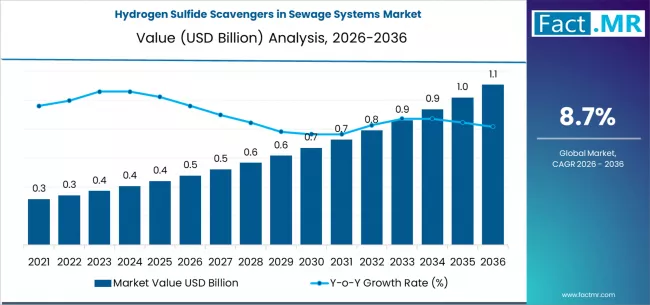
Hydrogen Sulfide Scavengers In Sewage Systems Market Market Value Analysis | Source: Fact.MR
By scavenger chemistry, triazine-based formulations hold a leading 28% share. The application area for sewage collection and pipeline networks represents the dominant segment at 36%. Continuous liquid chemical dosing is the foremost treatment method, accounting for a 38% share.
This growth is propelled by the critical need to mitigate the severe corrosion, toxicity, and odor problems caused by hydrogen sulfide in wastewater infrastructure. As urban sewer networks age and expand, and as regulatory pressure to control sewer gas emissions intensifies, the demand for effective and reliable H₂S abatement chemicals increases correspondingly.
H₂S scavengers are essential for protecting concrete and metal infrastructure from sulfuric acid corrosion, ensuring worker safety, and controlling nuisance odors. Their application is fundamental to extending the lifecycle of costly sewer assets and maintaining operational safety and community relations for municipalities and utilities.
Hydrogen Sulfide Scavengers in Sewage Systems Market
| Metric | Value |
|---|---|
| Market Value (2026) | USD 0.48 Billion |
| Market Forecast Value (2036) | USD 1.11 Billion |
| Forecast CAGR (2026-2036) | 8.7% |
Source: Fact.MR analysis. Updated Dec 29, 2025
Category
| Category | Segments |
|---|---|
| Scavenger Chemistry | Triazine-Based Scavengers, Iron Salt-Based Scavengers (FeCl₃, FeSO₄), Nitrate-Based & Oxidative Scavengers, Bio-Organic & Enzyme-Based Scavengers, Other Specialty H₂S Control Formulations |
| Application Area | Sewage Collection & Pipeline Networks, Sewage Treatment Plants (Anaerobic & Sludge Processing), Pumping Stations & Lift Stations, Septic & Decentralized Sanitation Systems, Industrial Sewer & Trade Effluent Streams |
| Treatment Method | Continuous Liquid Chemical Dosing, Batch / Shock Dosing, Gas-Phase Scrubbing & Odor Control Systems, Bio-Augmented & Enzyme-Based Treatment, Hybrid H₂S Control Systems |
| Region | North America, Latin America, Western Europe, Eastern Europe, East Asia, South Asia & Pacific, MEA |
Source: Fact.MR analysis. Updated Dec 29, 2025
Segmental Analysis
Which Scavenger Chemistry is Most Prevalent for Direct Sulfide Removal?
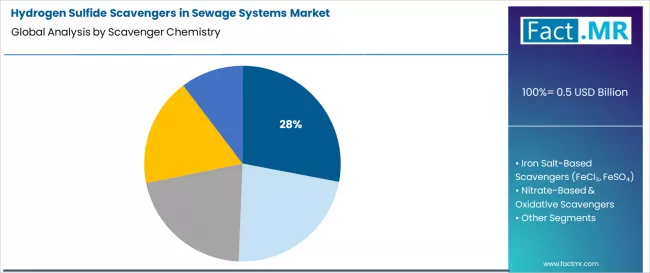
Hydrogen Sulfide Scavengers In Sewage Systems Market Analysis By Scavenger Chemistry | Source: Fact.MR
Triazine-based scavengers lead the segment with a 28% share. Their dominance is attributed to their high reactivity and efficiency in directly and irreversibly binding with dissolved H₂S in wastewater, converting it to a non-volatile, non-corrosive byproduct.
They are particularly effective in force mains and pressurized sections where H₂S generation is high. While handling and residual management require care, their proven performance in preventing crown corrosion in concrete sewers makes them a widely specified chemical solution.
Where is H₂S Generation and Corrosion Risk Most Acute in Sewer Systems?
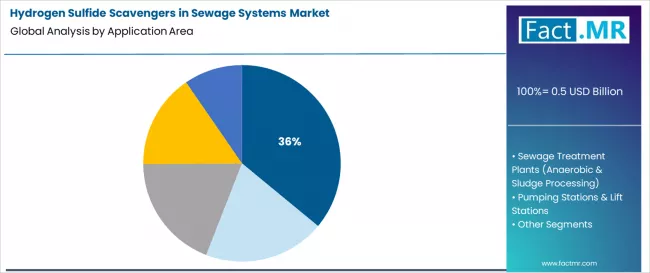
Hydrogen Sulfide Scavengers In Sewage Systems Market Analysis By Application Area | Source: Fact.MR
Sewage collection and pipeline networks represent the largest application area with a 36% share. This vast, often anaerobic, underground infrastructure is where sulfate-reducing bacteria thrive, converting sulfates to H₂S.
The gas then releases into the pipe headspace, condenses, and oxidizes to sulfuric acid, causing catastrophic corrosion. Protecting this extensive, hard-to-replace asset base from deterioration is a primary driver for scavenger use, focusing on preventing corrosion at its source.
What Method Provides Consistent Protection in High-Risk, Continuous Flow Systems?
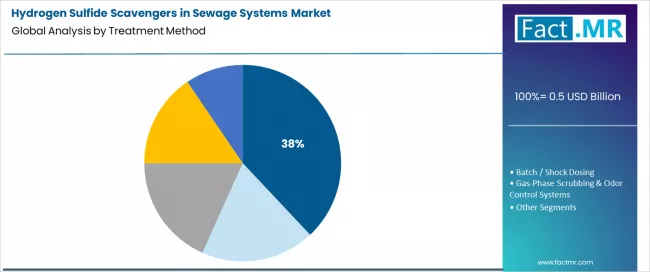
Hydrogen Sulfide Scavengers In Sewage Systems Market Analysis By Treatment Method | Source: Fact.MR
Continuous liquid chemical dosing is the leading treatment method with a 38% share. This involves the automated injection of liquid scavenger such as triazine or iron salts directly into the wastewater stream at strategic locations like pump station discharges.
It provides round-the-clock protection, maintains a consistent residual, and is effective for long conveyance lines. Its suitability for integration with pump controls and flow meters makes it the preferred method for proactive corrosion and odor management in large networks.
What are the Drivers, Restraints, and Key Trends of the Hydrogen Sulfide Scavengers in Sewage Systems Market?
The primary market driver is the immense economic burden of sewer infrastructure corrosion and the high cost of rehabilitation or replacement. Proactive chemical treatment with scavengers is a cost-effective strategy to extend asset life by decades. Stricter workplace safety regulations regarding exposure to toxic H₂S gas and community odor ordinances further compel utilities to implement robust control programs to protect workers and maintain public relations.
A significant restraint is the total cost of chemical programs, including the price of the scavenger, dosing equipment, and ongoing monitoring. Some chemistries, like triazines, can produce byproducts that require management. Furthermore, accurately dosing a variable and widely distributed sewer system to achieve cost-effective control without over or under-treating remains a persistent technical and operational challenge.
Key trends include the growing adoption of nitrate-based scavengers, which work by promoting the growth of beneficial bacteria that outcompete sulfate-reducers, offering a more indirect but often longer-lasting effect. There is increasing use of real-time H₂S monitoring networks coupled with smart dosing pumps to transition from fixed dosing to responsive, demand-based treatment.
The market is also seeing development of multi-functional products that combine sulfide scavenging with grease digestion or pH control. Bio-augmentation strategies, adding specialized bacteria to enhance natural sulfide oxidation, are gaining traction as a complementary green technology.
Analysis of the Hydrogen Sulfide Scavengers in Sewage Systems Market by Key Countries
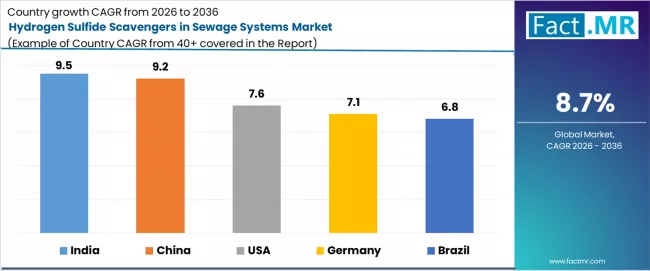
Hydrogen Sulfide Scavengers In Sewage Systems Market Cagr Analysis By Country | Source: Fact.MR
| Country | CAGR (2026-2036) |
|---|---|
| India | 9.50% |
| China | 9.20% |
| USA | 7.60% |
| Germany | 7.10% |
| Brazil | 6.80% |
Source: Fact.MR analysis. Updated Dec 29, 2025
How is India's Massive Urban Sanitation Infrastructure Push Driving Demand?
India's leading CAGR of 9.50% is driven by unprecedented investments in sewer network construction and rehabilitation under missions like AMRUT and the National Clean Ganga Mission. Protecting these new and aging assets from rapid corrosion in India's warm climate is a top priority, creating massive, sustained demand for chemical scavenger programs as a standard operational practice for utilities.
What is the Impact of China's Urbanization and Infrastructure Modernization?
China's 9.20% growth is supported by its continuous expansion of deep-tunnel sewer systems and wastewater treatment in megacities. The government's focus on improving urban living standards and extending infrastructure lifespan makes H₂S control a critical operational expenditure. The scale of China's sewer network ensures it remains one of the world's largest markets for scavenger chemicals.
How do Aging Infrastructure and Regulatory Enforcement Shape the US Market?
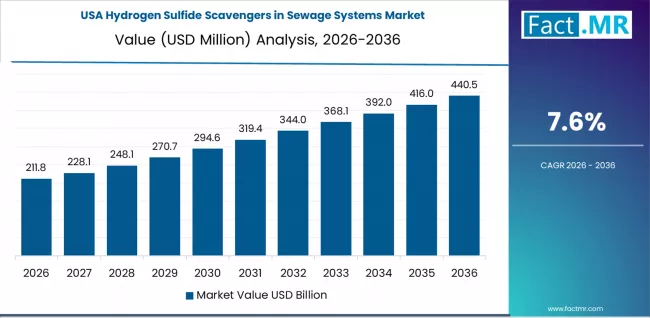
Hydrogen Sulfide Scavengers In Sewage Systems Market Country Value Analysis | Source: Fact.MR
The USA's 7.60% growth is underpinned by the need to manage H₂S in its extensive and aging sewer infrastructure, particularly in sunbelt states where conditions favor generation. Strict OSHA standards for confined space entry and local odor regulations drive utilities to invest in reliable chemical control programs. The market is characterized by demand for technologically advanced dosing and monitoring systems.
Why is Germany a Market for Precision Engineering and Dosing Solutions?
Germany's 7.10% CAGR reflects its engineering-driven approach to infrastructure management. German utilities prioritize precise, automated chemical dosing systems that optimize scavenger use and integrate with broader sewer management software. The demand is for high-efficiency products and smart control technologies that deliver measurable protection and cost savings.
What Role does Brazil's Sanitation Expansion and Corrosive Environments Play?
Brazil's 6.80% growth is anchored in its national sanitation law and the challenging conditions in many coastal cities with long, flat, warm sewers ideal for H₂S production. New sanitation projects must include corrosion control measures, while existing systems require upgrades. This drives demand for both traditional and innovative scavenger solutions.
Competitive Landscape of the Hydrogen Sulfide Scavengers in Sewage Systems Market
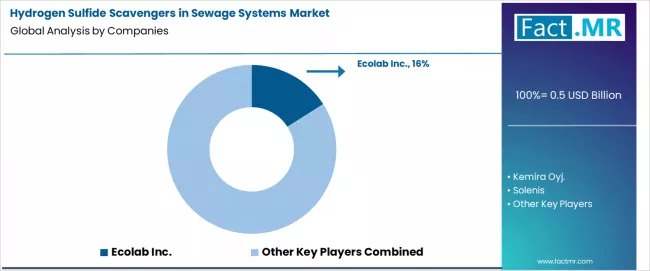
Hydrogen Sulfide Scavengers In Sewage Systems Market Analysis By Company | Source: Fact.MR
The competitive landscape is concentrated among global water treatment chemical companies with strong municipal market positions. Leaders like Ecolab and Kemira compete through proprietary chemical formulations, comprehensive service offerings, and integrated dosing equipment.
Competition centers on demonstrating total cost-effectiveness through reduced infrastructure repair costs, providing robust technical support for system design and optimization, and offering monitoring and data reporting services that help utilities prove regulatory and operational compliance.
Key Players in the Hydrogen Sulfide Scavengers in Sewage Systems Market
- Ecolab Inc.
- Kemira Oyj.
- Solenis
- Veolia Environnement S.A.
- Suez Water Technologies
Segmentation
Scope of Report
| Items | Values |
|---|---|
| Quantitative Units | USD Billion |
| Scavenger Chemistry | Triazine-Based, Iron Salt-Based, Nitrate-Based & Oxidative, Bio-Organic, Other |
| Application Area | Collection Networks, Treatment Plants, Pump Stations, Decentralized Systems, Industrial Sewers |
| Treatment Method | Continuous Dosing, Batch Dosing, Gas-Phase Scrubbing, Bio-Augmented, Hybrid |
| Key Countries | India, China, USA, Germany, Brazil |
| Key Companies | Ecolab Inc., Kemira Oyj., Solenis, Veolia Environnement S.A., Suez Water Technologies |
| Additional Analysis | Analysis of H₂S generation kinetics in sewers; corrosion rate measurement and modeling; scavenger performance testing under varying pH, temperature, and retention time; environmental fate and impact of scavenger byproducts; total cost of ownership models comparing chemical programs to infrastructure repair. |
Source: Fact.MR analysis. Updated Dec 29, 2025
Market by Segments
-
Scavenger Chemistry :
- Triazine-Based Scavengers
- Iron Salt-Based Scavengers (FeCl₃, FeSO₄)
- Nitrate-Based & Oxidative Scavengers
- Bio-Organic & Enzyme-Based Scavengers
- Other Specialty H₂S Control Formulations
-
Application Area :
- Sewage Collection & Pipeline Networks
- Sewage Treatment Plants (Anaerobic & Sludge Processing)
- Pumping Stations & Lift Stations
- Septic & Decentralized Sanitation Systems
- Industrial Sewer & Trade Effluent Streams
-
Treatment Method :
- Continuous Liquid Chemical Dosing
- Batch/Shock Dosing
- Gas-Phase Scrubbing & Odor Control Systems
- Bio-Augmented & Enzyme-Based Treatment
- Hybrid H₂S Control Systems
-
Region :
-
North America
- USA
- Canada
-
Latin America
- Brazil
- Mexico
- Argentina
- Rest of Latin America
-
Western Europe
- Germany
- UK
- France
- Spain
- Italy
- BENELUX
- Rest of Western Europe
-
Eastern Europe
- Russia
- Poland
- Czech Republic
- Rest of Eastern Europe
-
East Asia
- China
- Japan
- South Korea
- Rest of East Asia
-
South Asia & Pacific
- India
- ASEAN
- Australia
- Rest of South Asia & Pacific
-
MEA
- Saudi Arabia
- UAE
- Turkiye
- Rest of MEA
-
Frequently Asked Questions
How big is the hydrogen sulfide scavengers in sewage systems market in 2026?
What will be the size of hydrogen sulfide scavengers in sewage systems market in 2036?
How much will be the hydrogen sulfide scavengers in sewage systems market growth between 2026 and 2036?
What are the key product types in the hydrogen sulfide scavengers in sewage systems market?
Which application area segment to contribute significant share in the hydrogen sulfide scavengers in sewage systems market in 2026?
Who worked on this report


Preview the report firsthand - request a free sample
Free SampleGet the brochure for pricing and purchase details
Download PDF