- Market Value (2025): USD 1.1 Bn
- Estimated Value (2026): USD 1.3 Bn
- Forecast Value (2036): USD 3.8 Bn
- CAGR (2026-2036): 11.7%
What is the Blue Mussel Powders Market forecast to be worth by 2036?
USD 1.3 billion in 2026 to USD 3.8 billion by 2036 at an 11.7% CAGR.
- The Blue Mussel Powders Market reached USD 1.1 billion in 2025.
- Demand is projected to rise from USD 1.3 billion in 2026 to USD 3.8 billion by 2036.
- The market is forecast to record 11.7% CAGR from 2026 to 2036 as pet brands use documented mussel powders.
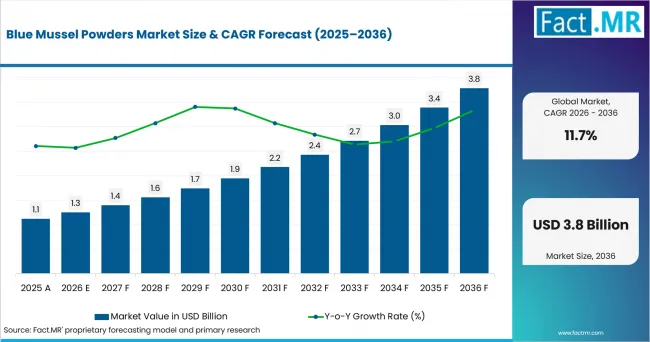
Blue Mussel Powders Market Value Analysis | Source: Fact.MR
What are the defining numbers behind Blue Mussel Powders Market growth?
USD 2.5 billion absolute opportunity is expected between 2026 and 2036.
- Demand Drivers in the Market
- Pet brands need mussel powders that fit joint-health chews and toppers while keeping species records clear for labels.
- Supplement manufacturers need marine lipid inputs for mature wellness channels. CDC NCHS reported in May 2026 that 60.2% of U.S. adults age 20 and older used any dietary supplement in the past 30 days during August 2021-August 2023.
- Ingredient processors need low-temperature drying because heat control protects lipid quality during conversion from edible mussel biomass.
- Aquaculture harvesters need higher-value outlets when fresh-table channels face seasonality and freight limits.
- Brand owners need clear species identification and applicable seafood-safety controls before using mussel powder in capsules or snacks.
- Key Segments Analyzed
- By Powder Type: Whole blue mussel powder is expected to hold 34.00% share in 2026 because it keeps protein, lipids and minerals in one recognizable format.
- By Processing: Low-temperature drying is projected to account for 31.00% share in 2026 as processors protect lipid quality and odor control.
- By Application: Pet joint-health nutrition is anticipated to capture 36.00% share in 2026 since mobility products accept mussel powders readily.
- By Value Proposition: Omega-3 and lipid nutrition is estimated to represent 29.00% share in 2026 owing to marine lipid use.
- Analyst Opinion at Fact.MR
- Shambhu Nath Jha, Principal Consultant at Fact.MR, states, “Blue mussel powders draw attention when processors convert small shellfish streams into higher-value ingredients. Demand is expected to deepen where suppliers prove drying control in each batch. Better suppliers combine farm traceability with capsule-ready and chew-ready powder technology.”
- Strategic Implications
- Ingredient processors should document drying temperature and particle size so formulators can compare material quality before plant trials.
- Pet brands should test whole powder and hydrolyzed fractions separately because palatability and mobility positioning use different specifications.
- Aquaculture exporters should connect farm traceability with powder-grade segregation so edible mussel streams move into higher-value pet and supplement channels.
- Contract manufacturers should align capsule and soft-chew trials with applicable ingredient-labeling and seafood-safety requirements before adding mussel ingredients to finished products.
Norway is expected to post 13.2% CAGR through 2036, supported by blue mussel aquaculture recovery. New Zealand is projected to record 12.5% CAGR as Greenshell processing supports export-grade powder supply. Canada is anticipated to reach 11.7% CAGR due to Atlantic mussel farming. The United Kingdom is estimated to hold 11.0% CAGR, backed by Scottish shellfish output. Chile is forecast to record 10.5% CAGR as mitilid aquaculture gives processors a large mollusc base.
How does the Blue Mussel Powders Market break down by segment?
Pet joint-health nutrition is projected to lead Application at 36.00% share in 2026; Whole blue mussel powder leads Powder Type at 34.00%.
Which Powder Type dominates?
Whole blue mussel powder is expected to hold 34.00% share in 2026.
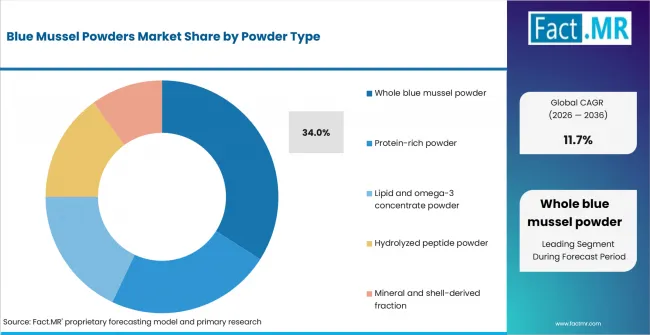
Blue Mussel Powders Market Analysis By Powder Type | Source: Fact.MR
Whole blue mussel powder is expected to lead because it gives formulators a simple marine ingredient story. It carries protein, lipids and minerals in one powder format. Protein-rich powder serves cleaner nutrition panels. Marine-derived powders can support formulations seeking naturally occurring lipid and Omega-3 content.
What leads the Processing segment?
Low-temperature drying is projected to account for 31.00% share in 2026.
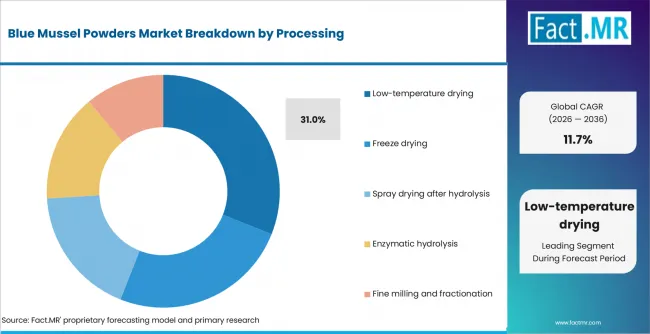
Blue Mussel Powders Market Analysis By Processing | Source: Fact.MR
Low-temperature drying is projected to lead because mussel powders lose value when heat damages lipids or worsens odor. Freeze drying serves premium supplements where active fractions need stronger backing. Spray drying after hydrolysis fits larger powder runs. Fine milling and fractionation serve mineral or shell-derived fractions.
How does Application shape demand?
Pet joint-health nutrition is anticipated to lead with 36.00% share in 2026.
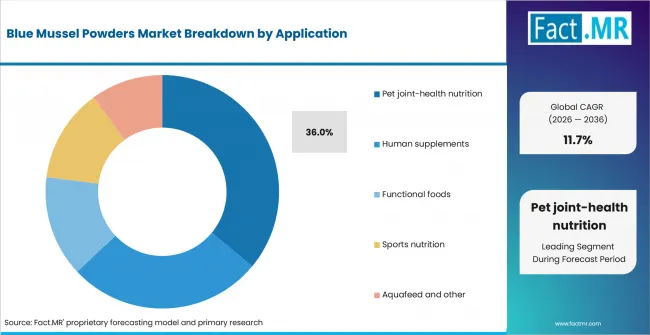
Blue Mussel Powders Market Analysis By Application | Source: Fact.MR
Pet joint-health nutrition is anticipated to lead because mobility formulas accept mussel powders more easily than mainstream foods. Human supplements follow where capsules carry marine omega-3 claims. Functional foods remain selective due to taste and seafood-safety handling. The American Pet Products Association reported in June 2025 that joint health and mobility supplements were among the most popular supplement types for dog owners in 2024.
What supports Omega-3 and lipid nutrition within Value Proposition?
Omega-3 and lipid nutrition is estimated to represent 29.00% share in 2026.
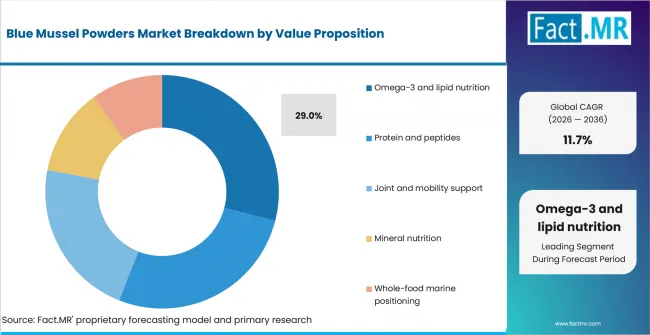
Blue Mussel Powders Market Analysis By Value Proposition | Source: Fact.MR
Omega-3 and lipid nutrition is estimated to lead because marine lipid content separates mussel powders from ordinary protein powders. Protein and peptide positioning support smaller serving formats. Joint and mobility support works across pet and human supplements.
What is accelerating Blue Mussel Powders Market adoption, and what is holding it back?
Joint-health positioning drives it; shellfish quality control restrains it.
Drivers Impact Analysis
| DRIVER | (~) % IMPACT ON CAGR | GEOGRAPHIC RELEVANCE | IMPACT TIMELINE |
|---|---|---|---|
| Pet joint-health nutrition formulas | +1.8% | North America, Western Europe, Oceania | Short term (<= 2 years) |
| Low-temperature drying and lipid retention | +1.4% | Norway, New Zealand, Canada | Medium term (2-4 years) |
| Marine omega-3 and lipid positioning | +1.1% | Global supplement markets | Medium term (2-4 years) |
| Aquaculture by-product valorization | +0.8% | Chile, Canada, Norway, UK | Long term (>= 4 years) |
Source: Fact.MR analysis. Updated Sep 3, 2026
- Pet joint-health nutrition formulas: Pet brands use mussel powders in mobility-focused chews, capsules, and toppers because they provide a recognizable marine ingredient story. Adoption is supported where suppliers provide clear species identification, contaminant controls, and quality documentation.
- Low-temperature drying and lipid retention: Powder quality depends on controlled drying and clean milling. Suppliers that demonstrate lower odor, good lipid retention, and consistent processing can reduce reformulation risk and strengthen qualification for premium supplement and pet-nutrition applications.
- Marine omega-3 and lipid positioning: Mussel powders provide a whole-food route to marine lipid nutrition. Brands can use them when they want a seafood-derived ingredient beyond isolated fish oil, particularly in capsule products and pet mobility formulations.
- Aquaculture by-product valorization: Mussel farming generates biomass that can be redirected into higher-value ingredient applications through drying and fractionation. Coastal regions with established shellfish production can support powder processing and create additional outlets for marine raw materials.
Opportunity Impact Analysis
| OPPORTUNITY | (~) % IMPACT ON CAGR | GEOGRAPHIC RELEVANCE | IMPACT TIMELINE |
|---|---|---|---|
| Verified pet mobility powders | +1.3% | North America, UK, New Zealand | Short term (<= 2 years) |
| Hydrolyzed peptide and protein fractions | +0.9% | Oceania, Europe | Medium term (2-4 years) |
| Functional food and sports powder trials | +0.6% | Asia Pacific, Western Europe | Long term (>= 4 years) |
Source: Fact.MR analysis. Updated Sep 3, 2026
- Verified pet mobility powders: Pet brands are seeking marine ingredients with consistent odor, particle size, and clear label documentation. Suppliers that support soft-chew formulation and application testing can strengthen qualification and create a clearer path to repeat business.
- Hydrolyzed peptide and protein fractions: Hydrolysis gives processors a route beyond whole mussel powder. Protein-rich and peptide formats can support smaller serving sizes, easier blending, and more flexible formulation, particularly where sensory performance and digestion positioning are assessed early.
- Functional food and sports powder trials: Food and sports nutrition brands remain selective because shellfish flavor can be difficult to mask. Improved deodorization, blending, and formulation support can make pilot development more practical, although demand is likely to remain concentrated in niche marine nutrition concepts.
Restraints Impact Analysis
| RESTRAINT | (~) % IMPACT ON CAGR | GEOGRAPHIC RELEVANCE | IMPACT TIMELINE |
|---|---|---|---|
| Biotoxin and contaminant control burden | -0.6% | All shellfish-producing countries | Short term (<= 2 years) |
| Species identity and label discipline | -0.5% | Global | Medium term (2-4 years) |
| Odor, taste and food-safety limits | -0.4% | Human nutrition channels | Long term (>= 4 years) |
Source: Fact.MR analysis. Updated Sep 3, 2026
- Biotoxin and contaminant control burden: Mussels filter seawater and therefore require strict contaminant and biotoxin controls before use in food or supplement applications. Testing, batch-release procedures, and supporting documentation can increase qualification time, favoring processors with consistent quality-control systems.
- Species identity and label discipline: Blue mussel, Greenshell mussel, and Chilean mussel powders serve related applications but require accurate species identification and appropriate ingredient labeling. Suppliers need clear documentation covering species origin, seafood safety, and market-specific labeling requirements before commercial use.
- Odor, taste and food-safety limits: Mussel powder carries a distinct marine aroma that can restrict use in functional foods and sports nutrition. Brands may need deodorization, flavor masking, and application testing while also maintaining appropriate seafood safety and ingredient-identification controls.
Which countries are scaling the Blue Mussel Powders Market through 2036?
- The country comparison spans 2.69 percentage points and forms three practical growth bands across the forecast period.
- Norway remains 0.70 percentage point above New Zealand through blue mussel sales recovery and cold-water seafood infrastructure.
- New Zealand remains 0.82 percentage point above Canada as Greenshell processing and spat nursery investment provide an adjacent mussel-powder processing benchmark; New Zealand Greenshell mussel is Perna canaliculus rather than blue mussel (Mytilus edulis).
- Canada remains 0.71 percentage point above the United Kingdom through Atlantic mussel farming and shellfish production depth.
- The United Kingdom remains 0.46 percentage point above Chile through Scottish shellfish output and pet nutrition demand.
Comparable CAGRs create different entry conditions because each country has a different raw-material base and processing route. Full report coverage includes North America, Latin America, Western Europe, Eastern Europe, East Asia, South Asia & Pacific, Middle East & Africa.
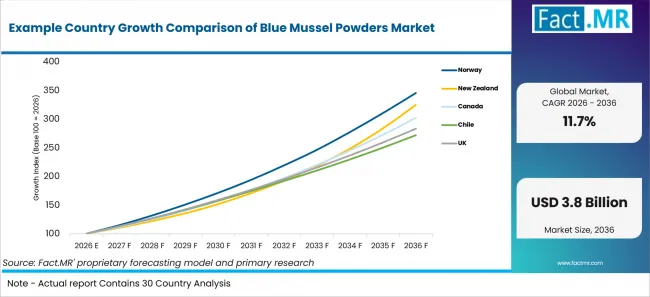
Example Country Growth Comparison Of Blue Mussel Powders Market | Source: Fact.MR
| Country | CAGR (2026-2036) |
|---|---|
| Norway | 13.2% |
| New Zealand | 12.5% |
| Canada | 11.7% |
| United Kingdom | 11.0% |
| Chile | 10.5% |
Source: Fact.MR analysis. Updated Sep 3, 2026
What supports Norway adoption?
13.2% CAGR, supported by blue mussel aquaculture recovery and cold-water seafood processing.
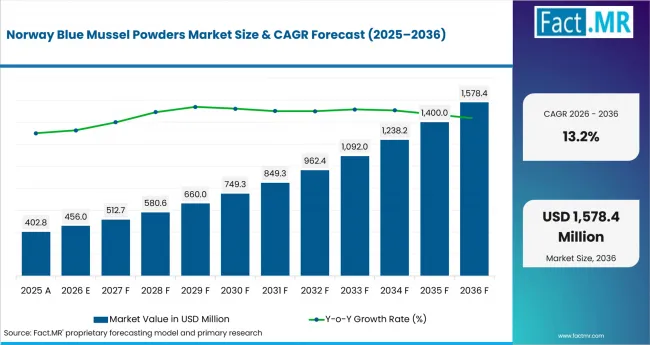
Blue Mussel Powders Market Country Value Analysis | Source: Fact.MR
Norway starts from a small but clearly measured blue mussel base. The Norwegian Directorate of Fisheries reported in May 2026 that Norway sold 2,196 tonnes of blue mussels for human consumption in 2025. The market is expected to post 13.2% CAGR as processors use cold-water origin to support premium powder grades.
How is New Zealand scaling demand?
12.5% CAGR, driven by Greenshell processing and spat nursery investment.
New Zealand has a mature Greenshell powder identity that reaches supplement and pet nutrition channels. The New Zealand Government reported in March 2025 that Marlborough harvests about 65,000 tonnes of Greenshell mussels yearly. New Zealand Greenshell mussel is Perna canaliculus, so this evidence is used as an adjacent processing and formulation benchmark rather than direct Mytilus edulis species evidence. Demand is projected to record 12.5% CAGR as processors connect farmed mussels with branded powder supply.
What supports Canada’s outlook?
11.7% CAGR, backed by Atlantic mussel farming and shellfish production depth.
Canada benefits from Atlantic shellfish farming and public aquaculture statistics. Fisheries and Oceans Canada reported in January 2026 that Canadian mussel production reached 20,190 tonnes in 2024. The market is anticipated to reach 11.7% CAGR as Prince Edward Island supports powder-grade raw material flows.
What underpins the United Kingdom’s growth?
11.0% CAGR, led by Scottish shellfish output and pet nutrition demand.
The United Kingdom links mussel powder demand with Scottish shellfish output. The Scottish Government reported in May 2026 that Scotland produced 12,303 tonnes of common mussels for the table market in 2025. The market is estimated to hold 11.0% CAGR as pet mobility formats use marine-origin differentiation.
How does Chile perform?
10.5% CAGR, supported by mitilid aquaculture and Los Lagos processing capacity.
Chile gives processors a large mitilid base in Los Lagos. INE Los Lagos reported in March 2026 that December 2025 chorito harvest reached 18,725 tonnes. The Chilean statistic is used as an adjacent mussel-processing benchmark rather than direct blue-mussel species evidence. The market is forecast to record 10.5% CAGR as suppliers position mussel-derived material across marine nutrition applications.
Who leads the Blue Mussel Powders Market?
MaBitec GmbH is profiled among the key providers serving the Blue Mussel Powders Market. Its competitive relevance is tied to demand for documented mussel-derived ingredients used in pet mobility, supplements, and specialist nutrition formats, where species identity and processing quality influence supplier approval.
Blue Harvest / South Coast Mariculture is also included among the core providers. Its positioning aligns with the market’s emphasis on aquaculture-linked raw-material access, traceable mussel biomass, and powder-grade segregation for higher-value pet and supplement applications.
Nutraceuticals Group and PhosphoTech are likewise profiled in the competitive set, supporting a market where whole powders, protein-rich fractions, lipid concentrates, and hydrolyzed peptide formats serve different formulation needs across pet nutrition, human supplements, functional foods, sports nutrition, and aquafeed.
Competition therefore centers on species traceability, contaminant control, drying quality, odor management, particle consistency, and formulation support. Suppliers that combine farm-level documentation with capsule-ready, chew-ready, or hydrolyzed powder formats are better positioned to secure repeat programs across marine nutrition applications.
Which companies are the key providers?
Key companies include MaBitec GmbH, Blue Harvest / South Coast Mariculture, Nutraceuticals Group, and PhosphoTech.
- MaBitec GmbH
- Blue Harvest / South Coast Mariculture
- Nutraceuticals Group
- PhosphoTech
Bibliography
- American Pet Products Association. (2025, June 24). The American Pet Products Association (APPA) releases 2025 Dog & Cat Report, revealing a new era of pet ownership.
- Stierman, B., Couch, C. A., Gahche, J. J., & Mishra, S. (2026, May 21). Dietary supplement use: United States, August 2021–August 2023 (NCHS Data Brief No. 561). National Center for Health Statistics.
- Fisheries and Oceans Canada. (2026, January 14). Aquaculture production quantities and value, 2024.
- Jones, S. (2025, March 8). Aquaculture Plan key to economic growth. New Zealand Government.
- NOAA Fisheries. (2025, May 22). Blue mussel.
- Fiskeridirektoratet. (2026, May 28). Økt salg for akvakulturnæringen i 2025 [Increased sales for the aquaculture industry in 2025].
- Scottish Government. (2026, May 27). Scottish Shellfish Farm Production Survey 2025.
- Instituto Nacional de Estadísticas. (2026, March 3). INE Los Lagos publica Boletín Mitílidos de diciembre 2025 [INE Los Lagos publishes December 2025 mussel bulletin].
This Report Answers
- The report explains mussel powder use across powder type and processing route.
- Segment analysis explains the 2026 lead of pet joint-health nutrition and whole powder.
- Country analysis covers Norway, New Zealand, Canada, the United Kingdom and Chile.
- Competitive analysis reviews MaBitec GmbH, Blue Harvest / South Coast Mariculture, Nutraceuticals Group, PhosphoTech.
- Application analysis compares powder specifications across pet, supplement, food, sports and aquafeed uses.
What does the Blue Mussel Powders Market cover?
The Blue Mussel Powders Market covers dried ingredients derived from blue mussel (Mytilus edulis) for pet mobility formulas, capsules and related nutrition applications. Adjacent mussel species are used only where they provide relevant processing, formulation or competitive benchmarks.
The assessment covers whole powder, protein-rich powder, lipid concentrate powder and hydrolyzed peptide powder used near veterinary dietary supplements and dog joint supplements where mobility positioning guides selection.
What is included in the scope?
The core scope includes powders produced from edible blue mussel (Mytilus edulis) biomass for pet joint-health nutrition, human supplements, functional foods and aquafeed. It includes low-temperature drying, freeze drying, hydrolysis-linked spray drying and fine milling. Other mussel species are referenced only as adjacent processing or formulation benchmarks where powder format overlaps with buyer needs.
Finished dietary products are covered when mussel powder remains visible in the product proposition. Bulk ingredient routes are compared with dietary supplements and functional aquafeeds where marine powder inputs support trials.
What is excluded from the scope?
Fresh mussels, frozen shell-on mussels, live shellfish and commodity seafood meals are outside the scope. Pure fish oils, krill oils and standalone marine collagen powder are excluded unless sold in a mussel powder blend.
Broad seafood farming infrastructure is outside the core revenue boundary. Wider aquaculture feed and pharmaceutical activity is used only to understand raw-material availability. Standalone marine collagen ingredients are adjacent categories unless a mussel powder blend is present.
How Was the Analysis Built?
The analysis draws on 120+ sources, 35+ company portfolios, 25+ countries, and more than 20 industry interviews.
- Primary Research: Primary research includes discussions with manufacturers, service providers, technology developers, distributors, end users, and subject-matter experts. These conversations examine purchasing priorities, product adoption, operational challenges, approval requirements, competitive positioning, and the factors that influence wider market acceptance.
- Desk Research: Desk research covers government statistics, regulatory publications, company filings, trade data, technical studies, industry associations, standards, public policy, and other authoritative sources. Every source used in the analysis is documented in the bibliography.
- Market Sizing and Forecasting: Market estimates combine historical performance, demand indicators, pricing and volume trends, segment shares, company participation, country-level growth, adoption patterns, investment activity, and barriers to market expansion.
- Data Validation and Update Cycle: Findings are validated by comparing primary interviews with public data, company activity, regulatory changes, trade patterns, and industry developments. Regular updates review new product launches, capacity changes, partnerships, approvals, and shifts in commercial adoption.
Segmentation
What is the report’s scope and coverage?
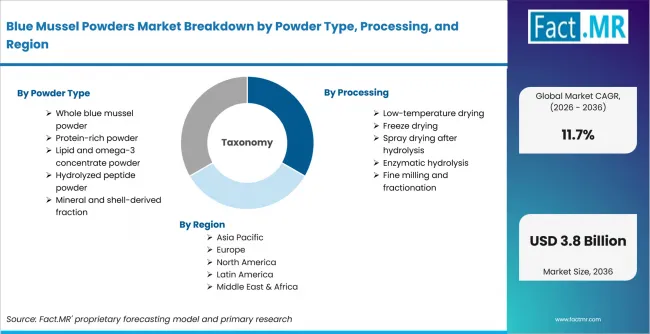
Blue Mussel Powders Market Breakdown By Powder Type, Processing, And Region | Source: Fact.MR
| Attribute | Details |
|---|---|
| Quantitative Units | USD billion |
| Market Definition | Core market scope covers dried, milled or fractionated powders derived from blue mussel (Mytilus edulis) for pet nutrition, human supplements, functional foods, sports nutrition and aquafeed applications. Evidence from Greenshell/green-lipped mussel (Perna canaliculus) and other mussel species is used only as an adjacent processing or formulation benchmark. |
| Powder Type | Whole blue mussel powder; Protein-rich powder; Lipid and omega-3 concentrate powder; Hydrolyzed peptide powder; Mineral and shell-derived fraction |
| Processing | Low-temperature drying; Freeze drying; Spray drying after hydrolysis; Enzymatic hydrolysis; Fine milling and fractionation |
| Application | Pet joint-health nutrition; Human supplements; Functional foods; Sports nutrition; Aquafeed and other |
| Value Proposition | Omega-3 and lipid nutrition; Protein and peptides; Joint and mobility support; Mineral nutrition; Whole-food marine positioning |
| Regions Covered | North America; Latin America; Western Europe; Eastern Europe; East Asia; South Asia & Pacific; Middle East & Africa |
| Countries Covered | Norway; New Zealand; Canada; United Kingdom; Chile |
| Key Companies Profiled | MaBitec GmbH, Blue Harvest / South Coast Mariculture, Nutraceuticals Group, and PhosphoTech |
| Forecast Period | 2026 to 2036 |
| Approach | Hybrid top-down and bottom-up approach using aquaculture output, powder applications, drying technology mix, country growth and provider portfolio review. |
Source: Fact.MR analysis. Updated Sep 3, 2026
How is the market segmented?
-
By Powder Type
- Whole blue mussel powder
- Protein-rich powder
- Lipid and omega-3 concentrate powder
- Hydrolyzed peptide powder
- Mineral and shell-derived fraction
-
By Processing
- Low-temperature drying
- Freeze drying
- Spray drying after hydrolysis
- Enzymatic hydrolysis
- Fine milling and fractionation
-
By Application
- Pet joint-health nutrition
- Human supplements
- Functional foods
- Sports nutrition
- Aquafeed and other
-
By Value Proposition
- Omega-3 and lipid nutrition
- Protein and peptides
- Joint and mobility support
- Mineral nutrition
- Whole-food marine positioning
-
By Region
- North America
- Latin America
- Western Europe
- Eastern Europe
- East Asia
- South Asia & Pacific
- Middle East & Africa
Frequently Asked Questions
How big is the blue mussel powders market in 2026?
What is the CAGR of the blue mussel powders market from 2026 to 2036?
Which powder type leads the blue mussel powders market?
Which processing method leads the blue mussel powders market?
Who are the leading companies in the blue mussel powders market?
Who worked on this report


Preview the report firsthand - request a free sample
Free SampleGet the brochure for pricing and purchase details
Download PDF