- Market Value (2025): USD 8.14 Bn
- Estimated Value (2026): USD 8.62 Bn
- Forecast Value (2036): USD 15.3 Bn
- CAGR (2026-2036): 5.9%
What is the Frozen Breakfast Entrees Market forecast to be worth by 2036?
USD 8.6 billion in 2026 to USD 15.3 billion by 2036, at a 5.9% CAGR.
- The frozen breakfast entrees market was valued at USD 8.14 billion in 2025.
- As per Fact.MR analysis, sales are forecast to increase from USD 8.62 billion in 2026 to USD 15.3 billion by 2036.
- The market is projected to record a 5.9% CAGR during 2026 to 2036 as households continue buying convenient frozen morning meals.
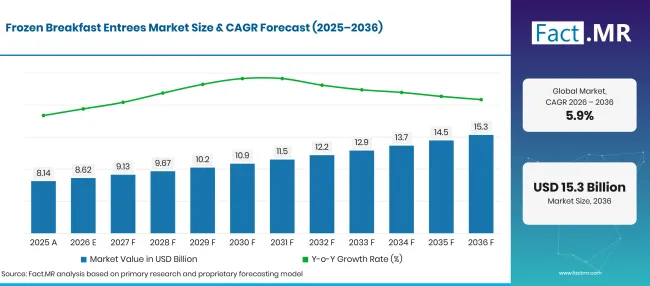
Factmr Frozen Breakfast Entrees Market Forecast Global | Source: Fact.MR
| Year | Basis | Market Value (USD billion) |
|---|---|---|
| 2025 | Actual | 8.1 |
| 2026 | Estimate | 8.6 |
| 2036 | Forecast | 15.3 |
| CAGR 2026 to 2036 | Forecast period | 5.9% |
Source: Fact.MR analysis. Updated Oct 21, 2026
What are the defining numbers behind Frozen Breakfast Entrees Market growth?
USD 6.7 billion absolute opportunity between 2026 and 2036, with breakfast sandwiches and supermarket sales shaping purchases.
- Demand Drivers in the Market
- Families often choose breakfast foods they can heat straight from the freezer in a microwave or toaster oven. Sandwiches offer a familiar meal with fewer morning preparation steps, especially before work or school.
- Supermarket customers compare the cost per serving with flavor and portion size. A well-stocked freezer encourages them to try different meals, while simple cooking directions make it easier to choose between brands.
- Frozen breakfast brands depend on steady store deliveries and packaging that protects the product in the freezer. When a preferred item stays available throughout the week, families can plan it as a regular breakfast rather than an occasional substitute.
- Key Segments Analyzed
- By Product Type: Breakfast Sandwiches are projected to hold 38.4% share in 2026, reflecting their portable format and range of bread and filling choices.
- By Sales Channel: Supermarkets/Hypermarkets are expected to represent 54.3% share in 2026, supported by established frozen-food aisles and frequent grocery trips.
- By End-User: Households are forecast to account for 68.4% share in 2026, where at-home heating offers a convenient morning meal.
- Analyst Opinion at Fact.MR
- Shambhu Nath Jha, Principal Consultant at Fact.MR, states, “Frozen breakfast entrée brands compete by making morning meals easier without compromising product quality. Buyers respond to formats that heat evenly, offer familiar flavors, and fit into busy routines. Manufacturers can strengthen their position by improving recipe consistency, offering practical portion sizes, and keeping products easy to store, prepare, and serve.”
- Strategic Implications
- Food manufacturers can test sandwiches after reheating to see how bread texture changes between a microwave and an oven. The finished meal matters most to shoppers, so testing should reflect the preparation methods they actually use.
- Supermarket teams can compare weekday and weekend sales to see which breakfast flavors deserve more freezer space. Clear shelf labels then help customers find familiar products during a routine grocery trip.
- Cold-chain distributors need to keep products properly frozen as they move between warehouses and stores. Temperature changes may affect bread-based meals, so even shorter delivery routes require consistent handling.
- Brands can help first-time customers by showing serving sizes and simple cooking instructions on each pack. This makes it easier to compare frozen sandwiches with pancakes, waffles and other breakfast choices.
Brazil is projected to record a 7.7% CAGR, followed by the United States at 7.0%. Japan is forecast at 6.5%, while Germany records 6.1% and the United Kingdom 5.3%.
How does the Frozen Breakfast Entrees Market break down by segment?
Breakfast Sandwiches 38.4%; Supermarkets/Hypermarkets 54.3%; Households 68.4% in 2026.
Which Product Type leads?
Breakfast Sandwiches hold 38.4% share in 2026.
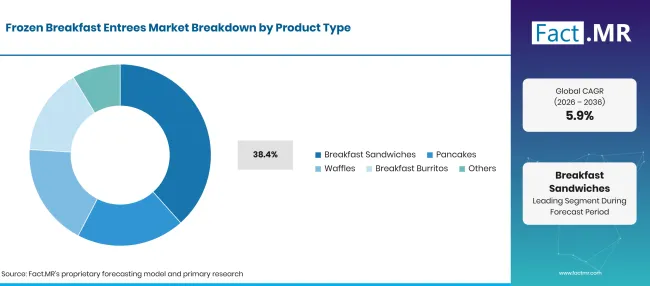
Factmr Frozen Breakfast Entrees Market Breakdown Product Type | Source: Fact.MR
| Which Product Type leads | Share (2026) |
|---|---|
| Breakfast Sandwiches (Leading segment) | 38.4% |
| Other segments combined | 61.6% |
| Total | 100.0% |
Source: Fact.MR analysis. Updated Oct 21, 2026
Breakfast Sandwiches is projected to account for the highest listed share in 2026. Pancakes, waffles and breakfast burritos serve different preferences in the same freezer cabinet. Sandwiches offer a single handheld portion, while pancakes and waffles suit shoppers who want to choose their own toppings. Breakfast burritos provide an enclosed filling that heats as one item.
What leads the Sales Channel segment?
Supermarkets/Hypermarkets lead with 54.3% share in 2026.
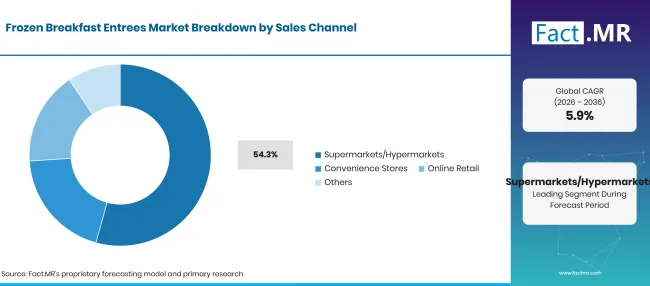
Factmr Frozen Breakfast Entrees Market Breakdown Sales Channel | Source: Fact.MR
| What leads the Sales Channel segment | Share (2026) |
|---|---|
| Supermarkets/Hypermarkets (Leading segment) | 54.3% |
| Other segments combined | 45.7% |
| Total | 100.0% |
Source: Fact.MR analysis. Updated Oct 21, 2026
Supermarkets/Hypermarkets is projected to account for the highest listed share in 2026. Supermarkets bring frozen breakfast entrees into the same trip as other household groceries. Shoppers can compare multipacks and single portions against shelf prices before deciding how much to buy. Convenience stores serve smaller immediate purchases, while online retail depends on suitable frozen delivery and dependable collection times.
How does End-User purchasing shape sales?
Households account for 68.4% share in 2026.
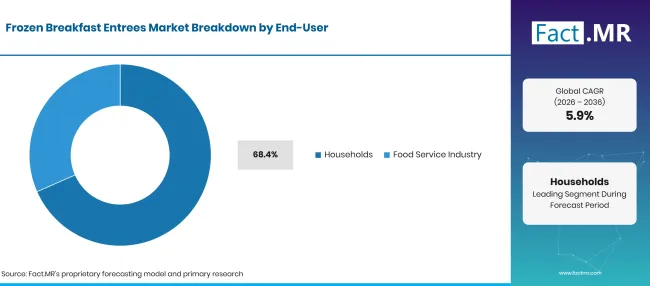
Factmr Frozen Breakfast Entrees Market Breakdown End User | Source: Fact.MR
| How does End-User purchasing shape sales | Share (2026) |
|---|---|
| Households (Leading segment) | 68.4% |
| Other segments combined | 31.6% |
| Total | 100.0% |
Source: Fact.MR analysis. Updated Oct 21, 2026
Households is projected to account for the highest listed share in 2026. Household buyers usually choose familiar meal types that can be heated using equipment already at home. A food-service operator has different needs, including portion consistency and the ability to prepare several servings in a short period. Family size also changes pack choice.
What is accelerating Frozen Breakfast Entrees Market adoption, and what is holding it back?
Quick meal preparation supports purchases; freezer capacity and food-price pressure limit some buying decisions.
Drivers Impact Analysis
| DRIVER | (~) % IMPACT ON CAGR | GEOGRAPHIC RELEVANCE | IMPACT TIMELINE |
|---|---|---|---|
| Time-saving preparation | +0.9% | Global | Medium term (2–4 years) |
| Familiar sandwich formats | +0.7% | North America, Europe | Short term (<= 2 years) |
| Supermarket freezer access | +0.6% | Global | Medium term (2–4 years) |
| Product variety | +0.4% | Global | Medium term (2–4 years) |
| Protein-led product options | +0.3% | United States, Japan | Long term (>= 4 years) |
Source: Fact.MR analysis. Updated Oct 21, 2026
Opportunity Impact Analysis
| OPPORTUNITY | (~) % IMPACT ON CAGR | GEOGRAPHIC RELEVANCE | IMPACT TIMELINE |
|---|---|---|---|
| Multipack development | +0.6% | North America, Europe | Medium term (2–4 years) |
| Online frozen delivery | +0.5% | Urban markets | Medium term (2–4 years) |
| Portion-specific offerings | +0.4% | Global | Short term (<= 2 years) |
| Retailer own-label products | +0.3% | Europe, North America | Medium term (2–4 years) |
Source: Fact.MR analysis. Updated Oct 21, 2026
Restraints Impact Analysis
| RESTRAINT | (~) % IMPACT ON CAGR | GEOGRAPHIC RELEVANCE | IMPACT TIMELINE |
|---|---|---|---|
| Food-price sensitivity | -0.7% | Global | Short term (<= 2 years) |
| Cold-chain costs | -0.6% | Global | Medium term (2–4 years) |
| Quality after reheating | -0.5% | Global | Medium term (2–4 years) |
| Product safety controls | -0.3% | Global | Long term (>= 4 years) |
Source: Fact.MR analysis. Updated Oct 21, 2026
Which countries are scaling the Frozen Breakfast Entrees Market through 2036?
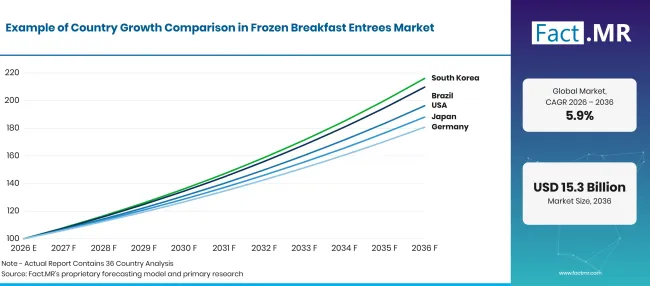
Factmr Frozen Breakfast Entrees Market Growth Index | Source: Fact.MR
| Country | CAGR (2026–2036) |
|---|---|
| Brazil | 7.7% |
| United States | 7.0% |
| Japan | 6.5% |
| Germany | 6.1% |
| United Kingdom | 5.3% |
Source: Fact.MR analysis. Updated Oct 21, 2026
How is Brazil widening the frozen breakfast choice?
7.7% CAGR, supported by supermarket access and convenient breakfast choices.
Brazilian supermarkets can introduce frozen breakfasts to shoppers who already buy other prepared foods. In February 2026, IBGE reported a 0.8% rise in 2025 sales volume across hypermarkets, supermarkets, food products, beverages and tobacco [5]. Familiar fillings and smaller packs may help families try the products without using much freezer space.
Why are U.S. shoppers buying prepared frozen breakfasts?
7.0% CAGR, linked to established frozen breakfast brands and supermarket choice.
U.S. consumers can select frozen breakfast sandwiches for mornings when heating a portion is easier than preparing a meal from separate ingredients. In March 2026, Tyson Foods expanded its Jimmy Dean protein range with frozen breakfast options and bowls [1]. Supermarket multipacks help households arrange weekday breakfasts in advance, while familiar bread and egg combinations make product selection straightforward.
What supports the Japanese frozen breakfast outlook?
6.5% CAGR, influenced by individual servings and familiar local meal choices.
Japanese households offer an opening for small frozen portions that fit individual breakfast routines. In February 2026, Japan's Statistics Bureau reported average monthly consumption expenditure of JPY 314,001 per household among households with two or more people in 2025 [4]. Portion control and reliable heating instructions are relevant when manufacturers introduce breakfast waffles or filled sandwiches alongside familiar morning foods.
How is Germany shaping frozen morning meal sales?
6.1% CAGR, shaped by frozen bakery familiarity and careful food spending.
Price remains central to the decision between frozen breakfast entrees and basic bread-based meals. In January 2026, Germany's Federal Statistical Office reported that food prices had increased by 2.0% on average in 2025 [2]. Limited freezer space can favor smaller packs, while ingredient labels need to communicate the contents clearly to local consumers.
What shapes the United Kingdom breakfast entrée opportunity?
5.3% CAGR, connected to prepared breakfast convenience and grocery shopping.
Price comparisons shape how often households purchase prepared frozen breakfasts. The Office for National Statistics reported an annual change in food and non-alcoholic beverage prices of 1.7% in June 2026 [3]. A higher per-serving cost than basic breakfast ingredients can encourage shoppers to alternate between prepared and home-cooked meals.
Who leads the Frozen Breakfast Entrees Market?
Tyson Foods, Conagra Brands, General Mills and other branded food manufacturers compete across frozen breakfast and adjacent prepared foods.
Tyson Foods participates in frozen breakfast through Jimmy Dean sandwiches and waffles. Conagra Brands has an established frozen prepared-food portfolio, while General Mills has experience in breakfast and refrigerated or frozen bakery categories. Product participation varies by country and by breakfast format.
Nestlé S.A. operates in related packaged-food categories with different product ranges. Amy’s Kitchen is known for prepared frozen meals, while Hormel Foods bring experience in branded food manufacturing. Competition among breakfast entrees centers on the exact product offered, reliable distribution and taste after heating. No company share is assigned in this report.
Which companies are the key providers?
Key companies include Nestlé S.A.; General Mills Inc.; Conagra Brands Inc.; Amy’s Kitchen Inc.; Tyson Foods Inc.; and Hormel Foods Corporation.
- Nestlé S.A.
- General Mills Inc.
- Conagra Brands Inc.
- Amy’s Kitchen Inc.
- Tyson Foods Inc.
- Hormel Foods Corporation
Bibliography
- [1] Tyson Foods. (2026, March 16). Jimmy Dean® protein lineup expands with new bowls featuring 40 grams of protein.
- [2] Statistisches Bundesamt (Destatis). (2026, January 16). Correction: Inflation rate at +2.2% in 2025.
- [3] Office for National Statistics. (2026, July 22). Consumer price inflation, UK: June 2026.
- [4] Statistics Bureau of Japan. (2026, February 6). 2025 yearly average: Family Income and Expenditure Survey.
- [5] Instituto Brasileiro de Geografia e Estatística. (2026, February 13). Retail sales close 2025 with rise of 1.6%.
This Report Answers
- The report examines how consumers choose between frozen breakfast sandwiches and other ready-to-heat breakfast formats.
- Product analysis explains the commercial position of breakfast sandwiches within the main frozen morning meal choices.
- Sales channel analysis compares supermarket shopping with convenience-store and online buying.
- The country review considers the different retail and household conditions in Brazil, the United States, Japan, Germany and the United Kingdom.
- The report discusses why reheating quality and portion choice can determine repeat purchases.
- Competitive analysis reviews relevant packaged-food manufacturers without attributing company market shares.
What does the Frozen Breakfast Entrees Market cover?
The market covers prepared frozen breakfast entrees intended for reheating before eating. These include breakfast sandwiches, pancakes, waffles and breakfast burritos, together with other frozen meal formats primarily marketed for breakfast.
Adjacent frozen product information appears only where it explains cold-chain handling or supplier capabilities. Related Fact.MR research covers frozen food products and frozen meat products that share some production and storage considerations.
What is included in the scope?
Finished products count when their intended use is a prepared morning meal and they are marketed as frozen breakfast entrees.
Sales may occur through supermarkets, convenience stores or suitable online channels. Food-service sales are included where operators purchase the same kind of prepared breakfast products.
What is excluded from the scope?
The separate category of prepared ready meals offers a comparison for products kept outside frozen storage.
Prepared ready meals stored at room temperature belong to a different storage category. Freshly made breakfasts served without frozen prepared products are outside the market boundary. Shelf-stable cereals and dry pancake mixes are separate products. Raw eggs, bread and meat ingredients are counted only after they become part of a finished frozen entrée.
How Was the Analysis Built?
The analysis draws on 120+ sources, 35+ company portfolios, 25+ countries, and more than 20 industry interviews.
- Primary Research: Primary research includes discussions with manufacturers, service providers, technology developers, distributors, end users, and subject-matter experts. These conversations examine purchasing priorities, product adoption, operational challenges, approval requirements, competitive positioning, and the factors that influence wider market acceptance.
- Desk Research: Desk research covers government statistics, regulatory publications, company filings, trade data, technical studies, industry associations, standards, public policy, and other authoritative sources. Every source used in the analysis is documented in the bibliography.
- Market Sizing and Forecasting: Market estimates combine historical performance, demand indicators, pricing and volume trends, segment shares, company participation, country-level growth, adoption patterns, investment activity, and barriers to market expansion.
- Data Validation and Update Cycle: Findings are validated by comparing primary interviews with public data, company activity, regulatory changes, trade patterns, and industry developments. Regular updates review new product launches, capacity changes, partnerships, approvals, and shifts in commercial adoption.
Segmentation
What is the report’s scope and coverage?
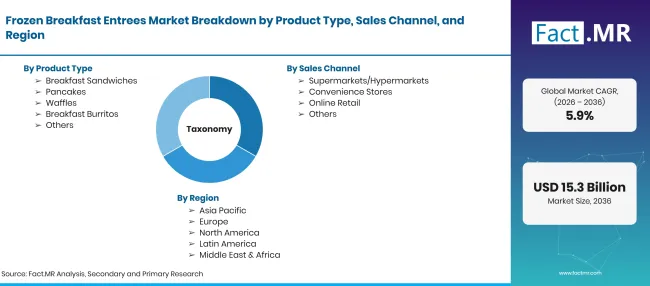
Factmr Frozen Breakfast Entrees Market Taxonomy | Source: Fact.MR
| Attribute | Details |
|---|---|
| Quantitative Units | USD billion in 2026 to USD billion by 2036 at CAGR |
| Market Definition | Frozen prepared breakfast meals sold for reheating and consumption as morning entrees |
| Product Type | Breakfast Sandwiches; Pancakes; Waffles; Breakfast Burritos; Others |
| Sales Channel | Supermarkets/Hypermarkets; Convenience Stores; Online Retail; Others |
| End-User | Households; Food Service Industry |
| Regions Covered | North America; Latin America; Western Europe; Eastern Europe; East Asia; South Asia & Pacific; Middle East & Africa |
| Countries Covered | Germany; Brazil; United States; United Kingdom; Japan |
| Companies Profiled | Nestlé S.A.; General Mills Inc.; Conagra Brands Inc.; Amy’s Kitchen Inc.; Tyson Foods Inc.; and Hormel Foods Corporation |
| Forecast Period | 2026 to 2036 |
| Approach | Product-format analysis, retailer channel review, country-level conditions and official public evidence |
Source: Fact.MR analysis. Updated Oct 21, 2026
How is the market segmented?
-
By Product Type
- Breakfast Sandwiches
- Pancakes
- Waffles
- Breakfast Burritos
- Others
-
By Sales Channel
- Supermarkets/Hypermarkets
- Convenience Stores
- Online Retail
- Others
-
By End-User
- Households
- Food Service Industry
-
By Region
- North America
- Latin America
- Western Europe
- Eastern Europe
- East Asia
- South Asia & Pacific
- Middle East & Africa
Frequently Asked Questions
How big is the Frozen Breakfast Entrees Market in 2026?
What is the CAGR of the Frozen Breakfast Entrees Market from 2026 to 2036?
Which product type leads the Frozen Breakfast Entrees Market?
Which sales channel leads the Frozen Breakfast Entrees Market?
Who are the leading companies in the Frozen Breakfast Entrees Market?
Who worked on this report


Preview the report firsthand - request a free sample
Free SampleGet the brochure for pricing and purchase details
Download PDF