- Market Value (2025): USD 2.01 Bn
- Estimated Value (2026): USD 2.16 Bn
- Forecast Value (2036): USD 4.41 Bn
- CAGR (2026-2036): 7.4%
What is the Organic Soup Market forecast to be worth by 2036?
USD 2.2 Billion in 2026 to USD 4.4 Billion by 2036, at a 7.4% CAGR.
- As per Fact.MR analysis, the organic soup market reached USD 2.01 Billion in 2025.
- Demand will increase from USD 2.16 Billion in 2026 to USD 4.41 Billion in 2036.
- The market is forecast to record a 7.4% CAGR during 2026 to 2036 as urban working professionals prioritize nutrient-dense organic ready-to-serve meals, plant-forward flexitarian recipes, and clean-label comfort foods free from synthetic additives.
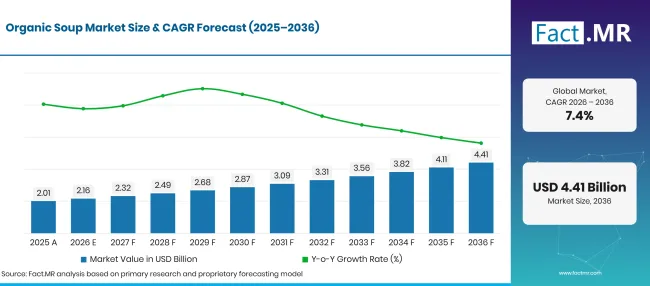
Factmr Organic Soup Market Forecast Global | Source: Fact.MR
| Year | Basis | Market Value (USD Billion) |
|---|---|---|
| 2025 | Actual | 2.01 |
| 2026 | Estimate | 2.16 |
| 2036 | Forecast | 4.41 |
| CAGR 2026 to 2036 | Forecast period | 7.4% |
Source: Fact.MR analysis. Updated Oct 21, 2026
What are the defining numbers behind Organic Soup Market growth?
USD 2.2 Billion absolute chance between 2026 and 2036, with ready-to-serve formats and vegetable ingredients generating the largest processing volume.
- Demand Drivers in the Market
- Rising consumer preference for certified clean-label packaged meals is prompting widespread migration away from conventional canned soups laden with artificial flavor enhancers, chemical preservatives, and excessive sodium. Federal organic handling and crop production regulations establish stringent verification requirements that prevent synthetic pesticides and genetic modification across all ingredient streams [1]. Discerning grocery shoppers routinely inspect ingredient labels to confirm certified organic seals before purchasing weekly meal kits.
- Rapid acceleration of fast-paced urban lifestyles is fueling massive household demand for shelf-stable, microwaveable ready-to-serve soup formats that eliminate elaborate home culinary preparation. Mandatory low-acid thermal processing and hermetic container sealing standards ensure that pre-cooked organic broths achieve commercial sterility without sacrificing nutritional integrity [2]. Busy families and single professionals rely on packaged organic soups as wholesome weekday dinner solutions that provide authentic homemade flavor profiles.
- Surging adoption of plant-forward, vegan, and flexitarian dietary patterns is driving rapid recipe development centered around organic root vegetables, leafy greens, lentils, and ancient grains. Modern non-thermal and thermo-sonication food processing technologies demonstrate remarkable efficacy in preserving heat-sensitive polyphenols and fresh vegetable vibrancy during commercial liquid broth bottling [3]. Food brands formulate rich, creamy textures using organic coconut milk, blended cauliflower, and oats rather than synthetic emulsifiers.
- Growing health awareness regarding gut microbiome wellness and systemic inflammation is expanding retail procurement of collagen-rich organic bone broths and prebiotic vegetable purees. Advanced processing protocols prevent oxidative flavor deterioration and aroma fading in packaged liquid broths, maintaining deep culinary notes across multi-month distribution cycles [4]. Functional soup startups differentiate products by emphasizing organic digestive herbs, adaptogenic mushrooms, and verified mineral contents.
- Key Segments Analyzed
- By Product Type: Ready-to-Serve holds 38.5% share in 2026, preferred across busy urban households and office professionals for its convenient heat-and-eat convenience requiring zero water dilution.
- By Ingredient: Vegetable accounts for 42.3% share in 2026 as health-conscious consumers embrace nutrient-rich tomato, butternut squash, carrot ginger, and hearty minestrone organic recipes.
- By Packaging: Canned accounts for 44.8% share in 2026, offering long-standing pantry shelf stability, robust barrier protection against ambient oxygen, and established recycling convenience.
- By Sales Channel: Supermarkets/Hypermarkets accounts for 52.4% share in 2026, providing high-visibility center-aisle shelf space, multi-brand organic assortment displays, and competitive multi-can retail promotions.
- Analyst Opinion at Fact.MR
- Shambhu Nath Jha, Lead Consultant at Fact.MR, states, “The commercial growth of organic soup is moving beyond conventional cream of mushroom and chicken noodle cans toward artisanal, restorative bone broths and globally inspired plant-based stews. Consumers will pay premium retail price points only when packaging formats preserve garden-fresh sensory profiles and ingredient decks remain strictly free of artificial gums and synthetic flavorings. Food processors who invest in gentle retort pouch sterilization and maintain direct farm-level traceability will win dedicated shelf placement across major supermarket banners.”
- Strategic Implications
- Culinary processing facilities are transitioning from aggressive high-heat canning retorts toward gentle microwave-assisted thermal sterilization and aseptic pouch packaging lines. Multi-variable botanical optimization models verify that precisely modulated thermal kinetics retain delicate volatile aromatic compounds and vibrant carotenoid pigments in pureed vegetable matrices [5]. Commercial kitchens that preserve natural mouthfeel and fresh flavors command premium retail positioning over commodity canned brands.
- Soup manufacturers are forming direct long-term contract farming alliances with certified organic agricultural grower collectives to secure reliable harvests of heirloom tomatoes, organic butternut squash, and non-GMO celery. Forward supply agreements protect processors from sudden harvest shocks while verifying strict residue-free pesticide testing documentation.
- Packaging development teams are engineering BPA non-intent can linings, recyclable multi-layer stand-up pouches, and FSC-certified aseptic cartons to cater to environmentally conscious consumers. Clear on-pack sustainability messaging regarding sustainable packaging materials reinforces brand authenticity and supports premium retail pricing models.
- Food technology laboratories are formulating innovative clean-label thickeners utilizing organic tapioca starch, pea protein isolates, and potato starch to replace synthetic texturants. These natural hydrocolloids ensure freeze-thaw stability and prevent phase separation in commercial organic ready-to-serve wet soup lines.
Germany is projected to lead global expansion with an 8.6% CAGR, supported by deep-seated organic food culture and strict European organic certifications. Brazil advances at a robust 7.9% CAGR, propelled by expanding urban organic supermarkets and rising health awareness among young professionals. The United States records a 7.1% CAGR, driven by high penetration of certified organic ready meals, busy working demographics, and clean-label retail expansion. The United Kingdom expands at 6.4%, underpinned by strong retail private-label organic soup lines and traditional hot soup consumption habits. Japan achieves a 5.6% CAGR, supported by aging demographics seeking easily digestible organic nutrition and premium single-serve cup soups.
How does the Organic Soup Market break down by segment?
Ready-to-Serve 38.5%; Vegetable 42.3%; Canned 44.8%; Supermarkets/Hypermarkets 52.4% in 2026.
Which Product Type dominates?
Ready-to-Serve holds 38.5% share in 2026.
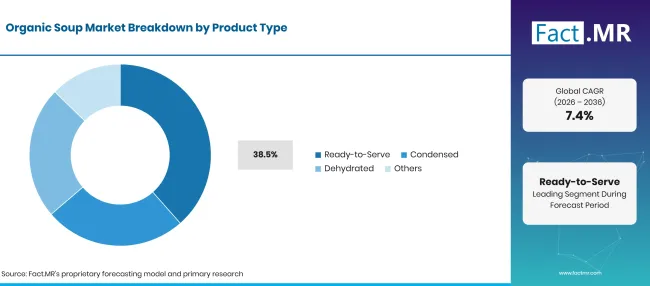
Factmr Organic Soup Market Breakdown Product Type | Source: Fact.MR
| Product Type | Share (2026) |
|---|---|
| Ready-to-Serve (Leading segment) | 38.5% |
| Other segments combined | 61.5%* |
| Total | 100.0% |
Source: Fact.MR analysis. Updated Oct 21, 2026
Ready-to-serve organic soups dominate retail and foodservice procurement channels because they eliminate measuring, water dilution, and complex culinary preparation. Urban consumers seeking wholesome mid-day lunches or quick evening dinners simply reheat the product in a microwave or saucepan for immediate consumption. Commercial brands formulate ready-to-eat stews, bisques, and purees featuring rich particulates such as whole organic black beans, diced carrots, and roasted corn kernels. Sourcing managers evaluate commercial soup and broth bases to achieve authentic savory richness across high-volume production lines. In fast-paced institutional settings, single-serve instant soup sachets provide rapid hot meal convenience for students and shift workers. Industrial kitchens also process high-viscosity ready to eat wet soup batches for bulk deli counter dispensing, reinforcing sustained demand across commercial food outlets.
What leads the Ingredient segment?
Vegetable accounts for 42.3% share in 2026.
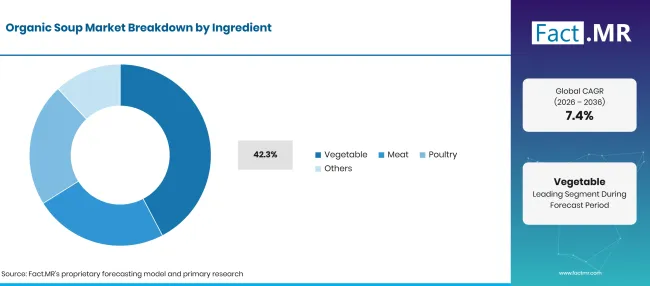
Factmr Organic Soup Market Breakdown Ingredient | Source: Fact.MR
| Ingredient | Share (2026) |
|---|---|
| Vegetable (Leading segment) | 42.3% |
| Other segments combined | 57.7%* |
| Total | 100.0% |
Source: Fact.MR analysis. Updated Oct 21, 2026
Vegetable ingredients command the largest raw material allocation in organic soup manufacturing, fueled by the worldwide surge in vegan, vegetarian, and flexitarian lifestyle choices. Popular commercial recipes feature organic vine-ripened tomatoes, sweet butternut squash, garden peas, roasted bell peppers, and tender sweet potatoes. Packaged food innovators incorporate organic ready to eat soup blends formulated with high-protein legumes, lentils, and ancient grains to deliver satisfying satiety for health-conscious shoppers. Culinary formulators also deploy certified organic stock cubes to build concentrated umami foundations without introducing synthetic monosodium glutamate or artificial yeast extracts. In institutional supply chains, quick-frozen organic vegetable medleys sourced from frozen food formulations maintain year-round recipe consistency across seasonal harvest cycles.
How does Packaging influence retail distribution?
Canned accounts for 44.8% share in 2026.
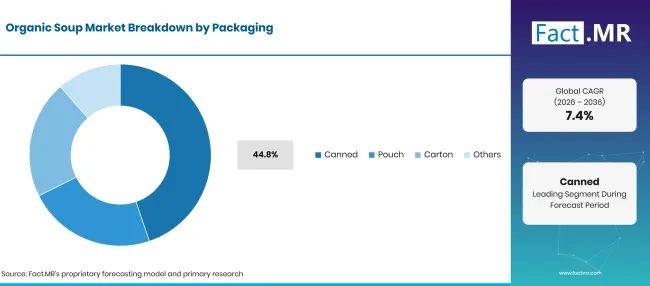
Factmr Organic Soup Market Breakdown Packaging | Source: Fact.MR
| Packaging | Share (2026) |
|---|---|
| Canned (Leading segment) | 44.8% |
| Other segments combined | 55.2%* |
| Total | 100.0% |
Source: Fact.MR analysis. Updated Oct 21, 2026
Traditional metal cans represent the primary packaging format across supermarket shelves, offering unmatched shelf life, complete barrier protection against ultraviolet light and oxygen degradation, and widespread consumer familiarity. Leading soup brands utilize non-BPA internal lacquer coatings to prevent acidic organic tomato broths from interacting with tinplate metal. Modern food brands are increasingly adopting lightweight aseptic packaging solutions like Tetra Recart cartons to reduce transport emissions and provide space-efficient rectangular shelf displays. Contract packaging facilities invest in automated aseptic in-line pouches designed with tear notches and reclosable spouts for microwaveable single-serve convenience. Food manufacturers deploy specialized pouch sterilizers to ensure complete commercial sterility while preserving fragile particulate vegetable textures.
What is accelerating Organic Soup Market adoption, and what is holding it back?
Rising consumer demand for clean-label convenience meals, proliferation of plant-forward organic recipes, and adoption of BPA-free recyclable packaging accelerate market expansion. High premiums for certified organic agricultural ingredients, thermal sterilization texture degradation risks, and short chilled shelf lives restrict frictionless adoption.
Drivers Impact Analysis
| DRIVER | (~) % IMPACT ON CAGR | GEOGRAPHIC RELEVANCE | IMPACT TIMELINE |
|---|---|---|---|
| Consumer migration toward clean-label and certified organic convenience meals | +1.4% | North America, Europe | Short term (<= 2 years) |
| Expanding flexitarian and plant-based dietary adoption boosting vegetable soups | +1.2% | Global | Medium term (2–4 years) |
| Growth of premium collagen-rich bone broths and digestive functional recipes | +1.0% | North America, East Asia | Medium term (2–4 years) |
| Adoption of eco-friendly BPA-free cans and recyclable aseptic cartons | +0.8% | Western Europe, USA | Medium term (2–4 years) |
| Rapid retail expansion of organic private-label grocery product lines | +0.6% | Global | Long term (>= 4 years) |
Source: Fact.MR analysis. Updated Oct 21, 2026
Opportunity Impact Analysis
| OPPORTUNITY | (~) % IMPACT ON CAGR | GEOGRAPHIC RELEVANCE | IMPACT TIMELINE |
|---|---|---|---|
| Microwaveable single-serve sipping cups tailored for on-the-go office snacking | +1.3% | USA, UK, Japan | Short term (<= 2 years) |
| Functional wellness broths infused with organic adaptogenic mushrooms and herbs | +1.1% | North America, Western Europe | Medium term (2–4 years) |
| Low-sodium heart-healthy formulations targeting aging demographic cohorts | +0.9% | Europe, East Asia | Medium term (2–4 years) |
| Direct-to-consumer frozen organic soup subscription meal kits | +0.7% | Global | Long term (>= 4 years) |
Source: Fact.MR analysis. Updated Oct 21, 2026
Restraints Impact Analysis
| RESTRAINT | (~) % IMPACT ON CAGR | GEOGRAPHIC RELEVANCE | IMPACT TIMELINE |
|---|---|---|---|
| High procurement costs and seasonal supply volatility of certified organic vegetables | -1.1% | Global | Short term (<= 2 years) |
| Thermal degradation of delicate vegetable colors and crunchiness in commercial retorts | -0.9% | Global | Medium term (2–4 years) |
| Retail shelf-space competition from conventional lower-priced canned soup brands | -0.7% | North America, Latin America | Medium term (2–4 years) |
| Cold-chain distribution bottlenecks for perishable fresh refrigerated organic soups | -0.5% | Emerging Markets, South Asia | Long term (>= 4 years) |
Source: Fact.MR analysis. Updated Oct 21, 2026
Which countries are scaling the Organic Soup Market through 2036?
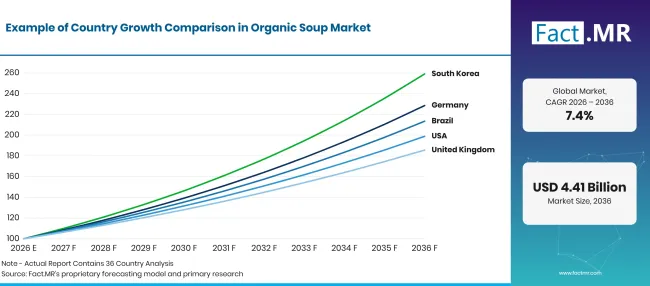
Factmr Organic Soup Market Growth Index | Source: Fact.MR
| Country | CAGR (2026–2036) |
|---|---|
| Germany | 8.6% |
| Brazil | 7.9% |
| USA | 7.1% |
| UK | 6.4% |
| Japan | 5.6% |
Source: Fact.MR analysis. Updated Oct 21, 2026
Why is Germany leading European organic soup expansion?
8.6% CAGR, driven by Germany’s deeply established Bio-Siegel certification culture, strong natural supermarket penetration, and discerning consumer preference for hearty organic vegetable and lentil stews.
German consumers place immense value on organic agriculture, transparency, and sustainable food production, making Germany Europe's largest national market for organic grocery goods. Major German organic retail chains like Denn’s Biomarkt and Alnatura dedicate extensive shelf space to glass-jarred and canned organic soups featuring local potatoes, root vegetables, and certified organic lentils. German food processors adhere to rigorous Bio-Siegel and EU Organic standards, formulating hearty Eintopf recipes completely free from synthetic flavor enhancers and modified starches. Leading culinary facilities across Bavaria and Baden-Württemberg blend certified organic seasonings like dry onion flakes to achieve robust, comforting flavor profiles in ready-to-serve lentil and pumpkin soups.
What makes Brazil an emerging high-growth market?
7.9% CAGR, supported by expanding organic agricultural production, surging health consciousness among urban middle-class families, and retail supermarket modernization in major metropolises.
Brazil is witnessing a transformative dietary shift across urban centers such as São Paulo, Rio de Janeiro, and Curitiba, where educated consumers actively seek wholesome alternatives to highly processed fast foods. Specialty organic markets and upscale supermarket chains are expanding packaged ready-to-serve soup sections, featuring locally inspired recipes based on organic cassava, black beans, pumpkin, and free-range chicken broths. Brazilian agricultural cooperatives are securing international organic certifications, providing domestic processors with steady access to certified organic vegetables and herbs. Expanding disposable incomes and the rise of two-income urban households drive strong demand for convenient, preservative-free dinner options.
How is the United States sustaining substantial market scale?
7.1% CAGR, driven by pervasive clean-label supermarket assortments, mainstream adoption of organic bone broths, and high consumer spending on quick, nutritious lunch options.
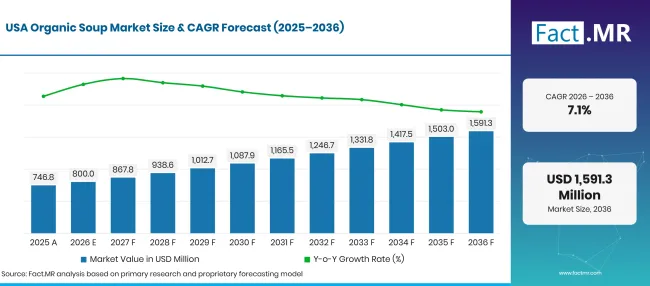
Factmr Organic Soup Market Forecast Usa | Source: Fact.MR
The United States represents the largest volume market for organic soup globally, with major national supermarket banners and natural food grocers dedicating entire aisles to certified organic canned and carton soups. American consumers routinely purchase organic chicken noodle, tomato basil, and lentil soups for quick workday lunches and comfort-food family dinners. The booming popularity of keto, paleo, and whole-food nutrition protocols has catalyzed extraordinary retail demand for organic sipping bone broths packaged in microwaveable grab-and-go cups. California, Oregon, and Colorado serve as hotbeds for artisanal soup startups that emphasize non-GMO verification, regenerative agriculture partnerships, and zero-sodium-added formulations.
What sustains organic soup adoption in the United Kingdom?
6.4% CAGR, rooted in Britain’s established soup-drinking heritage, robust supermarket private-label organic programs, and growing consumer preference for fresh chilled artisanal soups.
Soup is a beloved culinary staple across the United Kingdom, where cold weather and a strong tradition of hot luncheon meals sustain year-round consumption. Leading British grocery retailers like Waitrose, Marks & Spencer, and Sainsbury’s have developed extensive lines of organic private-label soups, making certified organic options accessible at competitive price points. British consumers are increasingly gravitating toward fresh refrigerated soup tubs located in the chilled produce aisle, which are perceived as fresher and less processed than conventional canned varieties. UK organic soup innovators in Devon and Yorkshire emphasize British-grown organic root vegetables, Scottish oats, and grass-fed beef stocks.
Why is Japan registering steady adoption across single-serve formats?
5.6% CAGR, propelled by an aging demographic seeking soft, nutritious, and easily digestible meals, high urban convenience store density, and appreciation for delicate natural broth flavors.
Japanese consumers prioritize nutritional balance, portion control, and natural umami taste profiles, creating a receptive market for premium organic soups. Tokyo’s expansive network of convenience stores and train station kiosks stocks single-serve freeze-dried and retort-pouched organic soups marketed to busy commuters and office workers. Japan’s rapidly aging population drives steady demand for easily digestible, nutrient-dense organic vegetable purees and mild miso-based vegetable broths that provide gentle nourishment without artificial additives. Japanese food processors formulate gentle, comforting soups utilizing certified organic kabocha squash, daikon radish, and organic soy milk to meet meticulous JAS (Japanese Agricultural Standards) organic certifications.
Who leads the Organic Soup Market?
Amy's Kitchen, Inc. holds a legendary position in the organic convenience food sector, pioneering canned vegetarian and vegan soups formulated with organic tomatoes, lentils, and garden vegetables. The Campbell's Company commands massive North American retail soup distribution, expanding its organic footprint through certified organic lines and its Pacific Foods subsidiary which specializes in organic broths, hearty stews, and plant-based creamy soups. The Hain Celestial Group Inc. markets premium natural and organic soups through its Imagine and Health Valley brands, emphasizing gluten-free, low-sodium, and certified organic recipes.
General Mills Inc. maintains a formidable presence through its Cascadian Farm and Muir Glen organic brand portfolios, sourcing certified organic tomatoes and vegetables for shelf-stable soup manufacturing. Baxters Food Group Ltd. brings rich European culinary heritage to organic soup production, crafting gourmet canned and jarred recipes for discerning UK and international retail markets. Kettle Cuisine LLC operates state-of-the-art commercial artisan kitchens, supplying fresh refrigerated and frozen organic soups to leading supermarket deli counters and restaurant chains. Tideford Organic Foods champions 100% organic, vegan, and gluten-free chilled soups across the United Kingdom, utilizing organic miso, ancient grains, and fresh vegetables. Multinational food conglomerates Unilever PLC and Nestlé S.A. actively participate through certified organic extensions of their global bouillon, soup, and dry culinary preparation portfolios.
Which companies are the key providers?
Key companies include Amy's Kitchen, Inc.; The Campbell's Company; The Hain Celestial Group Inc.; General Mills Inc.; Baxters Food Group Ltd.; Kettle Cuisine LLC; Tideford Organic Foods; Unilever PLC; and Nestlé S.A.
- Amy's Kitchen, Inc.
- The Campbell's Company
- The Hain Celestial Group Inc.
- General Mills Inc.
- Baxters Food Group Ltd.
- Kettle Cuisine LLC
- Tideford Organic Foods
- Unilever PLC
- Nestlé S.A.
Bibliography
- [1] USDA Agricultural Marketing Service. (2025). National Organic Program: Organic Production and Handling Standards (7 CFR Part 205). eCFR.
- [2] U.S. Food and Drug Administration. (2025). Thermally Processed Low-Acid Foods Packaged in Hermetically Sealed Containers (21 CFR Part 113). eCFR.
- [3] Kumar, S., et al. (2026). Effect of thermo-sonication on physicochemical properties and microbial safety in liquid food formulations. Ultrasonics Sonochemistry, 118, 107122.
- [4] Zhao, Y., et al. (2026). Non-thermal processing in inhibiting flavor deterioration of liquid vegetable and broth formulations. Food Chemistry: X, 25, 101894.
- [5] Silva, R., et al. (2026). Response surface modeling and optimization of nutrient-dense botanical and vegetable purees. Data in Brief, 58, 111245.
This Report Answers
- The report evaluates processing kinetics, retort sterilization parameters, and nutrient retention across canned, carton, and pouch organic soup packaging formats.
- Ingredient assessments detail why organic vegetable and legume recipes represent the largest share of retail shelf space and consumer demand.
- Country-level analysis investigates the certification standards and culinary traditions enabling Germany and Brazil to achieve exceptional market growth rates.
- Packaging comparisons examine oxygen barrier performance, microwave reheatability, and lifecycle carbon emissions across cans, aseptic cartons, and stand-up pouches.
- Competitive profiling benchmarks farm-to-table traceability systems, organic crop forward contracts, and clean-label recipe patents across premier global soup manufacturers.
What does the Organic Soup Market cover?
The market encompasses commercial shipments of certified organic ready-to-serve soups, condensed cooking soups, dehydrated soup mixes, and packaged organic broths. It evaluates value creation across industrial soup processing facilities, private-label contract packers, specialty organic food brands, and retail grocery distribution chains. The analysis tracks product flows across ambient shelf-stable retail aisles, refrigerated fresh deli counters, and foodservice supply networks.
What is included in the scope?
The scope covers merchant sales of packaged finished soups certified under recognized organic standards (such as USDA Organic, EU Organic, and JAS). It includes canned soups, retort pouches, aseptic cartons, plastic sipping cups, and dry mix packets sold through retail grocery channels, natural food stores, e-commerce platforms, and institutional foodservice operators. Revenue figures reflect finished packaged goods valued at factory-gate and wholesale distribution price points.
What is excluded from the scope?
The scope excludes non-certified conventional packaged soups containing synthetic preservatives, artificial flavors, or GMO ingredients. Unprocessed raw agricultural vegetables sold loose at farmers' markets without commercial packaging are excluded. Commercial kitchen appliances, industrial steam kettle boilers, and automated canning line machinery are excluded from food ingredient and finished product market totals.
How Was the Analysis Built?
The analysis draws on 120+ sources, 35+ company portfolios, 25+ countries, and more than 20 industry interviews.
- Primary Research: Primary research includes discussions with manufacturers, service providers, technology developers, distributors, end users, and subject-matter experts. These conversations examine purchasing priorities, product adoption, operational challenges, approval requirements, competitive positioning, and the factors that influence wider market acceptance.
- Desk Research: Desk research covers government statistics, regulatory publications, company filings, trade data, technical studies, industry associations, standards, public policy, and other authoritative sources. Every source used in the analysis is documented in the bibliography.
- Market Sizing and Forecasting: Market estimates combine historical performance, demand indicators, pricing and volume trends, segment shares, company participation, country-level growth, adoption patterns, investment activity, and barriers to market expansion.
- Data Validation and Update Cycle: Findings are validated by comparing primary interviews with public data, company activity, regulatory changes, trade patterns, and industry developments. Regular updates review new product launches, capacity changes, partnerships, approvals, and shifts in commercial adoption.
Segmentation
What is the report’s scope and coverage?
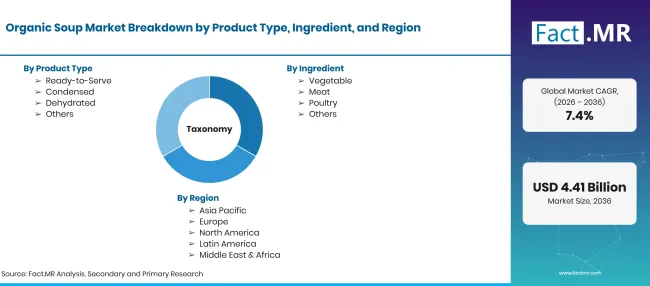
Factmr Organic Soup Market Taxonomy | Source: Fact.MR
| Attribute | Details |
|---|---|
| Quantitative Units | USD Billion in 2026 to USD Billion by 2036 at 7.4% CAGR |
| Market Definition | Commercial shipments of certified organic packaged soups, broths, and culinary stocks formulated with certified organic ingredients and packaged for retail and foodservice distribution. |
| Product Type | Ready-to-Serve; Condensed; Dehydrated; Others |
| Ingredient | Vegetable; Meat; Poultry; Others |
| Packaging | Canned; Pouch; Carton; Others |
| Sales Channel | Supermarkets/Hypermarkets; Convenience Stores; Online Retail; Others |
| Regions Covered | North America; Latin America; Western Europe; Eastern Europe; East Asia; South Asia & Pacific; Middle East & Africa |
| Countries Covered | Germany; Brazil; USA; UK; Japan |
| Companies Profiled | Amy's Kitchen, Inc.; The Campbell's Company; The Hain Celestial Group Inc.; General Mills Inc.; Baxters Food Group Ltd.; Kettle Cuisine LLC; Tideford Organic Foods; Unilever PLC; Nestlé S.A. |
| Forecast Period | 2026 to 2036 |
| Approach | Primary interviews with commercial soup chefs, organic food formulation scientists, packaging retort engineers, and grocery retail buyers combined with international organic food trade data audits. |
Source: Fact.MR analysis. Updated Oct 21, 2026
How is the market segmented?
-
By Product Type
- Ready-to-Serve
- Condensed
- Dehydrated
- Others
-
By Ingredient
- Vegetable
- Meat
- Poultry
- Others
-
By Packaging
- Canned
- Pouch
- Carton
- Others
-
By Sales Channel
- Supermarkets/Hypermarkets
- Convenience Stores
- Online Retail
- Others
-
By Region
- North America
- Latin America
- Western Europe
- Eastern Europe
- East Asia
- South Asia & Pacific
- Middle East & Africa
Frequently Asked Questions
How big is the organic soup market in 2026?
What is the CAGR from 2026 to 2036?
Which product type leads?
Which ingredient leads?
Which companies participate in organic soup?
Who worked on this report


Preview the report firsthand - request a free sample
Free SampleGet the brochure for pricing and purchase details
Download PDF