- Market Value (2025): USD 11.8 Bn
- Estimated Value (2026): USD 12.4 Bn
- Forecast Value (2036): USD 19.6 Bn
- CAGR (2026-2036): 4.7%
What is the Eleusine Coracana (Finger Millet) Market forecast to be worth by 2036?
USD 12.4 billion in 2026 to USD 19.6 billion by 2036, at a 4.7% CAGR.
- According to Fact.MR analysis, the finger millet market reached USD 11.8 billion in 2025.
- Sales are projected to rise from USD 12.4 billion in 2026 to USD 19.6 billion by 2036.
- The market is forecast to grow at a 4.7% CAGR during 2026 to 2036, as food processors and household shoppers purchase whole grain and ragi-based products.
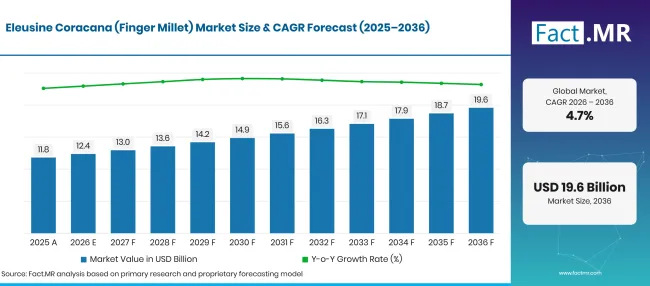
Factmr Eleusine Coracana Finger Millet Market Forecast Global | Source: Fact.MR
| Year | Basis | Market Value (USD billion) |
|---|---|---|
| 2025 | Actual | 11.8 |
| 2026 | Estimate | 12.4 |
| 2036 | Forecast | 19.6 |
| CAGR 2026 to 2036 | Forecast period | 4.7% |
Source: Fact.MR analysis. Updated Oct 21, 2026
What are the defining numbers behind Eleusine Coracana (Finger Millet) Market growth?
USD 7.2 billion absolute opportunity between 2026 and 2036, with whole grain and food applications forming the main sales base.
- Demand Drivers in the Market
- Households making porridge or flatbread look for ragi that cooks evenly and comes with clear storage guidance. Packaging also affects whether they buy the product again, particularly because milled flour needs different care from whole grain.
- Growers benefit when seed varieties suit local growing conditions and processors can source repeatable grain quality. In August 2025, India’s Press Information Bureau reported the release of 49 finger millet varieties during 2024–25 [1]. The Ministry of Agriculture and Farmers Welfare reported in May 2026 that India had planted 0.22 lakh hectares of summer ragi by May 22, 2026 [4].
- Retailers give ragi grain and flour a clear place on the shelf when customers want convenient packs of a familiar food. Accurate labels help shoppers choose plain finger millet instead of a mixed-grain product.
- Key Segments Analyzed
- By Product Type: Whole Grain holds 52.5% share in 2026, supported by purchases for traditional home preparation.
- By Application: Food and Beverages account for 58.3% share in 2026, reflecting regular use in flour and ready-to-cook foods.
- By Sales Channel: Supermarkets/Hypermarkets capture 43.7% share in 2026, aided by planned household purchases and packaged grain visibility.
- Analyst Opinion at Fact.MR
- Shambhu Nath Jha, Principal Consultant at Fact.MR, states, “Finger millet sales are shaped by consistent grain quality, dependable sourcing, and the ability to supply processors with uniform lots. Buyers pay close attention to moisture levels, cleanliness, and milling performance before approving suppliers. Producers that maintain steady crop handling and clear quality records can build stronger relationships with food manufacturers and ingredient buyers.”
- Strategic Implications
- Grain aggregators should maintain clear separation between finger millet and other millets, then check cleaning and grading before accepting large retail orders.
- Food processors should select flour particle size around the finished product, since flatbread mixes and beverage preparations need different handling.
- Retail chains should make pack sizes and ingredient labels easy to compare so customers can choose between whole grain and flour without confusion.
- Farm-linked brands should explain how their sourcing arrangements protect continuity during seasonal changes in grain availability.
Germany has a 5.6% CAGR outlook, followed by the United States at 5.1% and Japan at 4.6%. The United Kingdom follows at 3.6%, while Brazil has a 3.3% forecast. These rates describe finger millet market growth in each country and should be read separately from national statistics covering all cereal grains.
How does the Eleusine Coracana (Finger Millet) Market break down by segment?
Whole Grain 52.5%; Food and Beverages 58.3%; Supermarkets/Hypermarkets 43.7% in 2026.
Which Product Type dominates?
Whole Grain holds 52.5% share in 2026.
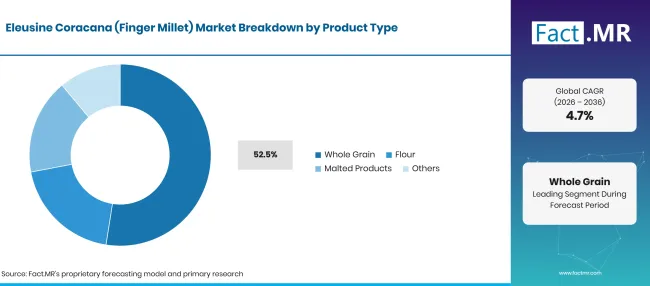
Factmr Eleusine Coracana Finger Millet Market Breakdown Product Type | Source: Fact.MR
| Product Type | Share (2026) |
|---|---|
| Whole Grain (Leading segment) | 52.5% |
| Other segments combined | 47.5% |
| Total | 100.0% |
Source: Fact.MR analysis. Updated Oct 21, 2026
Whole grain suits households that prefer to soak, cook or grind ragi themselves, and shoppers usually check its cleanliness before buying again. Flour saves preparation time, while malted products fit recipes that use processed millet. Some sellers also offer blended ingredients. Clear labeling with the name Eleusine coracana helps distinguish finger millet from pearl millet and other grains.
What leads the Application segment?
Food and Beverages account for 58.3% share in 2026.
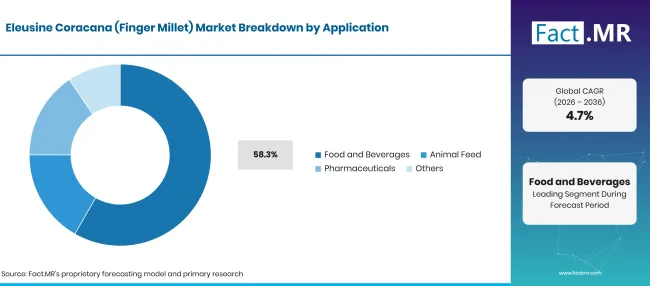
Factmr Eleusine Coracana Finger Millet Market Breakdown Application | Source: Fact.MR
| Application | Share (2026) |
|---|---|
| Food and Beverages (Leading segment) | 58.3% |
| Other segments combined | 41.7% |
| Total | 100.0% |
Source: Fact.MR analysis. Updated Oct 21, 2026
Finger millet is principally a food cereal used in porridge, flatbreads and formulated foods. Food companies can work with grain or flour according to the processing steps needed for the finished product. Animal feed applications depend on local feed economics, and pharmaceutical uses remain more specialized.
Which Sales Channel captures the largest share?
Supermarkets/Hypermarkets lead with 43.7% share in 2026.
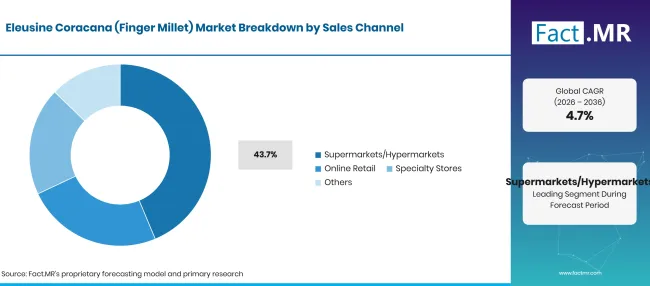
Factmr Eleusine Coracana Finger Millet Market Breakdown Sales Channel | Source: Fact.MR
| Sales Channel | Share (2026) |
|---|---|
| Supermarkets/Hypermarkets (Leading segment) | 43.7% |
| Other segments combined | 56.3% |
| Total | 100.0% |
Source: Fact.MR analysis. Updated Oct 21, 2026
Supermarkets display packaged ragi alongside familiar grains and flours, allowing shoppers to compare sizes and prices during a regular grocery trip. Online stores mainly help customers reorder products they know, while specialty shops may offer preparation advice or a smaller selection of millets. The preferred channel depends on whether the purchase is an everyday staple or a specific flour or malted product.
What is accelerating Finger Millet Market adoption, and what is holding it back?
Regular household food use and convenient grain formats support sales; grain consistency and storage losses can limit repeat orders.
Drivers Impact Analysis
| DRIVER | (~) % IMPACT ON CAGR | GEOGRAPHIC RELEVANCE | IMPACT TIMELINE |
|---|---|---|---|
| Household grain use | +1.0% | South Asia, global specialty food | Medium term (2–4 years) |
| Packaged ragi flour | +0.8% | Global retail | Medium term (2–4 years) |
| Food product development | +0.7% | Global | Long term (>= 4 years) |
| Crop variety improvement | +0.5% | Origin markets | Long term (>= 4 years) |
| Retail access | +0.4% | Global | Short term (<= 2 years) |
Source: Fact.MR analysis. Updated Oct 21, 2026
Opportunity Impact Analysis
| OPPORTUNITY | (~) % IMPACT ON CAGR | GEOGRAPHIC RELEVANCE | IMPACT TIMELINE |
|---|---|---|---|
| Ready-to-cook ragi foods | +0.8% | Global | Medium term (2–4 years) |
| Verified grain sourcing | +0.6% | Origin and destination markets | Medium term (2–4 years) |
| Specialty flour packs | +0.5% | North America, Europe | Short term (<= 2 years) |
| Foodservice recipes | +0.4% | Global | Long term (>= 4 years) |
Source: Fact.MR analysis. Updated Oct 21, 2026
Restraints Impact Analysis
| RESTRAINT | (~) % IMPACT ON CAGR | GEOGRAPHIC RELEVANCE | IMPACT TIMELINE |
|---|---|---|---|
| Raw grain variation | -0.8% | Global | Short term (<= 2 years) |
| Flour storage sensitivity | -0.6% | Global | Medium term (2–4 years) |
| Price sensitivity | -0.5% | Global | Medium term (2–4 years) |
| Limited product familiarity | -0.4% | Brazil, Europe, Japan | Long term (>= 4 years) |
Source: Fact.MR analysis. Updated Oct 21, 2026
Which countries are scaling the Finger Millet Market through 2036?
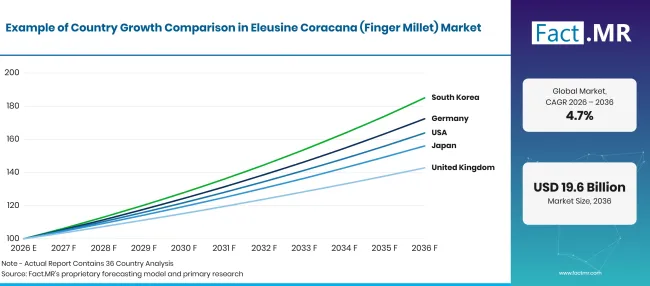
Factmr Eleusine Coracana Finger Millet Market Growth Index | Source: Fact.MR
| Country | CAGR (2026–2036) |
|---|---|
| Germany | 5.6% |
| United States | 5.1% |
| Japan | 4.6% |
| United Kingdom | 3.6% |
| Brazil | 3.3% |
Source: Fact.MR analysis. Updated Oct 21, 2026
Why is Germany expanding finger millet sales?
5.6% CAGR, shaped by specialty grain retail and careful ingredient labeling.
German specialty grocers serve households that already prepare meals with ragi, where accurate grain labels help shoppers find the right product. Food companies considering ragi flour need consistent cleaning and batch records before using it in recipes. Whole-grain packs also suit home cooks who prefer soaking or grinding millet themselves.
What supports finger millet purchases in the United States?
5.1% CAGR, shaped by specialty food channels and convenient flour formats.
Imported finger millet is exposed to changes in shipment costs and available pack sizes, which can make consistent store pricing harder. The USDA reported that U.S. proso millet production reached 14.2 million bushels in 2025 [2]. Specialty retailers offering finger millet alongside domestic cereal products need accurate grain identification to support informed purchases.
How is Japan developing finger millet availability?
4.6% CAGR, shaped by specialty food imports and carefully specified grain products.
Japanese importers can introduce finger millet through clearly labeled whole-grain packs, with local-language instructions explaining how to cook it. Packaged flour may also interest food developers testing recipes that suit ragi's texture. Smaller specialty stores offer a practical starting point for shoppers looking for this particular imported grain.
What shapes the United Kingdom finger millet outlook?
3.6% CAGR, shaped by ethnic grocery stores and repeat household use.
UK grocery shops serving customers familiar with ragi can offer both whole grain and flour, while online ordering helps buyers reach those products beyond their local store. Bakers testing ragi flour need to adjust their recipes to its handling properties. Clear labels are equally important for separating pure finger millet from mixed-grain products.
Why is Brazil a smaller-growth finger millet market?
3.3% CAGR, shaped by focused specialty retail rather than established mass-market use.
Local cereals have established retail supply chains that may place imported finger millet at a price disadvantage. In September 2026, Brazil's National Supply Company estimated total grain production at 361.7 million tonnes for the 2025–26 harvest [3]. The country's established grain supply chains influence the competitive setting for specialty cereals such as finger millet.
Who leads the Eleusine Coracana (Finger Millet) Market?
Tata Sampann and established Indian ragi brands serve packaged grain and flour buyers, while specialist sellers extend product access.
Tata Sampann offers Easy Cook Ragi Atta for households looking for flour suited to flatbread preparation. The product uses ragi as its base cereal and is presented as a simpler kneading and rolling option. Patanjali Ayurved and ITC Limited (24 Mantra Organic) serve shoppers who purchase branded staples, while Organic Tattva and Manna Foods are associated with grain or flour retail. Competition is shaped by stock availability and correct ingredient naming rather than an assumed global brand leader.
Marico Limited (True Elements) and Urban Platter operate in packaged foods and specialty online grocery channels. Pack size and clean sourcing records influence repeat sales more directly than promotional positioning.
Which companies are the key providers?
Key companies include Patanjali Foods Limited; Tata Sampann (Tata Consumer Products); ITC Limited (24 Mantra Organic); Organic Tattva; Manna Foods; Marico Limited (True Elements); and Urban Platter.
- Patanjali Foods Limited
- Tata Sampann (Tata Consumer Products)
- ITC Limited (24 Mantra Organic)
- Organic Tattva
- Manna Foods
- Marico Limited (True Elements)
- Urban Platter
Bibliography
- [1] Press Information Bureau, Government of India. (2025, August 8). Shree Anna for Shreshta Bharat: Empowering India through millets.
- [2] U.S. Department of Agriculture, National Agricultural Statistics Service. (2026, January 12). Crop production 2025 summary.
- [3] Companhia Nacional de Abastecimento. (2026, September 15). Conab estima produção de 361,7 milhões de toneladas de grãos na safra 2025/26.
- [4] Ministry of Agriculture & Farmers Welfare. (2026, May 25). Progress of area coverage under summer crops as on 22.05.2026. Press Information Bureau.
- [5] International Crops Research Institute for the Semi-Arid Tropics. (2025, June 19). ICRISAT’s Rapid-Ragi breakthrough promises faster, cost-effective finger millet breeding.
This Report Answers
- The report examines how whole grain and flour purchases influence finger millet sales in food channels.
- Segment analysis explains the expected position of food and beverage applications in 2026.
- Country comparisons assess the different retail barriers in Germany, the United States, Japan, the United Kingdom and Brazil.
- Competitive analysis focuses on branded ragi offers and the need to distinguish direct products from broader millet ranges.
- Scope analysis separates Eleusine coracana from proso millet, pearl millet and other cereal grains.
What does the Eleusine Coracana (Finger Millet) Market cover?
The finger millet market includes whole grain and food products identified with Eleusine coracana. It covers sales of flour and malted grain forms, as well as qualifying food applications. The market is distinct from wider millet totals that combine several different cereal species. Sales patterns depend on household food habits and whether suppliers provide the grain form needed for the intended recipe.
What is included in the scope?
Covered sales include packaged finger millet grain, ragi flour and malted products made from the same cereal. Food and beverage processing is the main application category.
The defined channels include supermarkets, online retailers, specialty stores and other grocery outlets. Country analysis examines consumer access and commercial conditions in five named markets, while the supply discussion draws on crop research and grain handling considerations. The study follows finished grain and food formats sold commercially, rather than combining every crop described as millet.
What is excluded from the scope?
Pearl millet, proso millet, sorghum and other grains are excluded when they do not contain finger millet.
Mixed-grain food is considered only for the finger millet component inside the defined market boundary. Crop research investments and public support programs are discussed as context but are not counted as direct retail sales of finger millet. Broad cereal statistics are therefore treated separately from the specific Eleusine coracana outlook.
How Was the Analysis Built?
The analysis draws on 120+ sources, 35+ company portfolios, 25+ countries, and more than 20 industry interviews.
- Primary Research: Primary research includes discussions with manufacturers, service providers, technology developers, distributors, end users, and subject-matter experts. These conversations examine purchasing priorities, product adoption, operational challenges, approval requirements, competitive positioning, and the factors that influence wider market acceptance.
- Desk Research: Desk research covers government statistics, regulatory publications, company filings, trade data, technical studies, industry associations, standards, public policy, and other authoritative sources. Every source used in the analysis is documented in the bibliography.
- Market Sizing and Forecasting: Market estimates combine historical performance, demand indicators, pricing and volume trends, segment shares, company participation, country-level growth, adoption patterns, investment activity, and barriers to market expansion.
- Data Validation and Update Cycle: Findings are validated by comparing primary interviews with public data, company activity, regulatory changes, trade patterns, and industry developments. Regular updates review new product launches, capacity changes, partnerships, approvals, and shifts in commercial adoption.
Segmentation
What is the report’s scope and coverage?
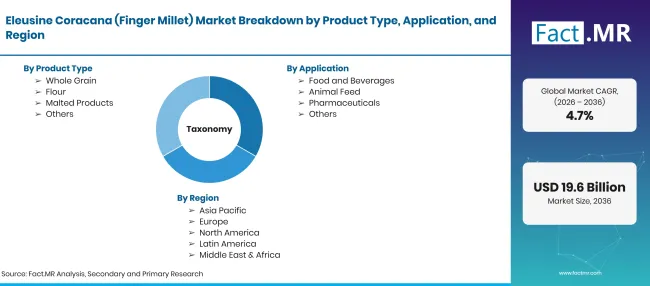
Factmr Eleusine Coracana Finger Millet Market Taxonomy | Source: Fact.MR
| Attribute | Details |
|---|---|
| Quantitative Units | USD billion in 2026 to USD billion in 2036, at CAGR |
| Market Definition | Commercial sales of finger millet grain and products mainly made from Eleusine coracana |
| Product Type | Whole Grain; Flour; Malted Products; Others |
| Application | Food and Beverages; Animal Feed; Pharmaceuticals; Others |
| Sales Channel | Supermarkets/Hypermarkets; Online Retail; Specialty Stores; Others |
| Regions Covered | North America; Latin America; Western Europe; Eastern Europe; East Asia; South Asia & Pacific; Middle East & Africa |
| Countries Covered | Germany; Brazil; United States; United Kingdom; Japan |
| Companies Profiled | Patanjali Foods Limited; Tata Sampann (Tata Consumer Products); ITC Limited (24 Mantra Organic); Organic Tattva; Manna Foods; Marico Limited (True Elements); and Urban Platter |
| Forecast Period | 2026 to 2036 |
| Approach | Market estimates, product and channel analysis, country outlook, primary-source evidence review |
Source: Fact.MR analysis. Updated Oct 21, 2026
How is the market segmented?
-
By Product Type
- Whole Grain
- Flour
- Malted Products
- Others
-
By Application
- Food and Beverages
- Animal Feed
- Pharmaceuticals
- Others
-
By Sales Channel
- Supermarkets/Hypermarkets
- Online Retail
- Specialty Stores
- Others
-
By Region
- North America
- Latin America
- Western Europe
- Eastern Europe
- East Asia
- South Asia & Pacific
- Middle East & Africa
Frequently Asked Questions
How big is the Eleusine Coracana (Finger Millet) Market in 2026?
What is the CAGR of the Eleusine Coracana (Finger Millet) Market from 2026 to 2036?
Which product type leads the Eleusine Coracana (Finger Millet) Market?
Which application leads the Eleusine Coracana (Finger Millet) Market?
Who are the leading companies in the Eleusine Coracana (Finger Millet) Market?
Who worked on this report


Preview the report firsthand - request a free sample
Free SampleGet the brochure for pricing and purchase details
Download PDF