- Market Value (2025): USD 2.35 Bn
- Estimated Value (2026): USD 2.54 Bn
- Forecast Value (2036): USD 5.48 Bn
- CAGR (2026-2036): 8.0%
What is the Organic Almonds Market forecast to be worth by 2036?
The market is estimated at USD 2.5 billion in 2026 and forecast to reach USD 5.5 billion by 2036, expanding at a 8.0% CAGR.
- The market was valued at USD 2.35 billion in 2025.
- Revenue is projected to rise from USD 2.54 billion in 2026 to USD 5.48 billion in 2036.
- The 8.0% forecast CAGR reflects a wider commercial role for certified almonds across snacks and food manufacturing, with purchasing costs remaining a constraint on penetration.
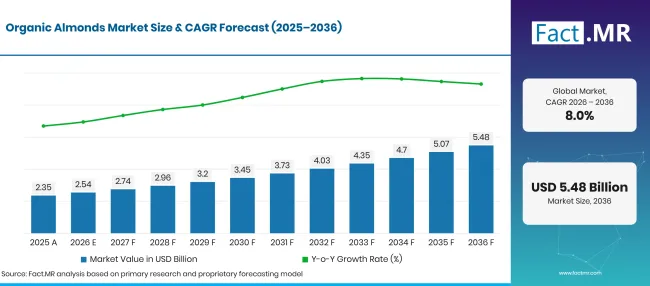
Organic Almonds Market Forecast Global | Source: Fact.MR
| Year | Basis | Market value in USD billion |
|---|---|---|
| 2025 | Actual | 2.35 |
| 2026 | Estimate | 2.54 |
| 2036 | Forecast | 5.48 |
| CAGR 2026 to 2036 | Forecast period | 8.0% |
Source: Fact.MR analysis. Updated Oct 24, 2026
What are the defining numbers behind Organic Almonds Market growth?
The forecast adds USD 2.9 billion between 2026 and 2036. Whole almonds account for 38.4% of 2026 product sales, while snacks represent 34.7% of application demand. Retail presentation matters, although ingredient customers provide outlets for kernels with different physical specifications.
- Demand Drivers in the Market
- Certification has a direct commercial consequence when an almond lot changes hands. USDA requirements extend import documentation to the shipment level, making the exporter and importer relationship part of an organic supply contract. [10] Fact.MR expects purchasers to place greater value on suppliers that can deliver usable product and complete shipment records together. A lower quoted price has little attraction if the goods cannot enter the intended certified channel.
- A harvest produces kernels of different sizes and appearances. USDA almond grades distinguish whole kernels from broken material and identify defects such as insect injury and rancidity. [9] Dedicated outlets for snack-grade nuts, baking pieces and milled ingredients can improve the commercial use of a certified crop. That flexibility supports contracts covering more than one product specification.
- The price on a retail shelf depends on pack weight as well as the almond price. Smaller packs can make a certified product accessible at a lower cash outlay, while larger resealable formats suit households that already buy regularly. The opportunity is to earn a place in the shopper's routine. An expensive organic pack that is purchased once contributes less reliable volume than a well-priced product with steady replenishment.
- Food manufacturers can introduce certified almonds through familiar recipes before developing entirely new products. Almond pieces in a biscuit and whole kernels in a nut mix create different purchasing requirements. Demand for almond powder also provides an adjacent outlet for material sold for milling. Suppliers need to match the almond specification to the finished food instead of offering the same premium whole-kernel grade to every account.
- Key Segments Analyzed
- Whole Almonds hold 38.4% of product-type sales in 2026, giving suppliers a large market for visibly intact kernels.
- Snacks account for 34.7% of application demand, where flavor and freshness determine whether an organic claim earns another purchase.
- Supermarkets/Hypermarkets represent 42.8% of distribution-channel revenue, concentrating a substantial part of the market in planned grocery assortments.
- Raw almonds hold 58.3% of the form segment, preserving options for customers that roast, blanch or otherwise prepare the nuts themselves.
- Analyst Opinion at Fact.MR
- Shambhu Nath Jha, Sr. Consultant, Fact.MR
- The most attractive organic almond accounts will combine a repeatable specification with a credible annual purchasing plan. Suppliers should be cautious about building capacity around an isolated premium launch. A manufacturer that uses certified almonds in several established recipes may offer a steadier outlet, even when its price per kilogram is lower. On the farm side, the commercial question is whether different kernel grades can all find buyers. On the retail side, the test is whether freshness, pack size and price justify a second purchase.
- Strategic Implications
- Processors should contract for a useful spread of whole kernels and manufacturing grades. Matching each grade to a customer reduces dependence on a single snack specification and gives sales teams a practical way to manage crop variation.
- Retail brands need a clear price architecture across small trial packs and repeat-purchase formats. Reducing pack size can support entry, but frequent buyers still need a competitive cost per serving to remain in the category.
- Importers should settle the certification route and responsible parties before agreeing shipment dates. Repacking arrangements deserve equal attention because a change in pack format can introduce another handler into the certified chain.
- Ingredient sellers can qualify organic alternatives alongside an existing conventional specification. Trials should establish the required roast, cut size and sensory profile early so a buyer can switch certified input without unnecessary changes to its recipe.
Germany carries the strongest forecast within the five-country comparison at 9.2%. The United Kingdom follows at 7.7%, ahead of Brazil at 7.3%. U.S. sales are projected to increase at 6.5%, while Japan records 5.6%. These outlooks describe organic almond sales in each market, rather than total almond imports or production.
How does the Organic Almonds Market break down by segment?
Whole almonds, snack applications, supermarket purchasing and raw forms lead their respective dimensions. Each share describes a separate view of the same market.
Why do whole almonds remain the largest product type?
Whole Almonds account for 38.4% of revenue in 2026.
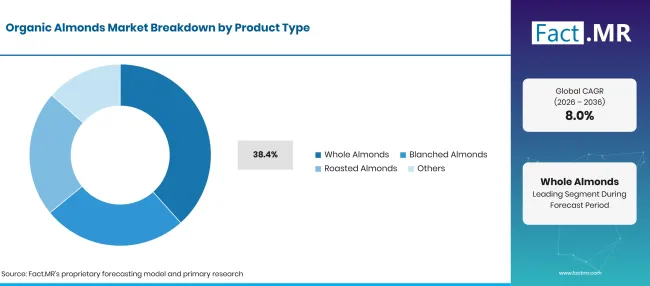
Organic Almonds Market Breakdown Product Type | Source: Fact.MR
| Product type | Share in 2026 |
|---|---|
| Whole Almonds | 38.4% |
| Other segments combined | 61.6% |
| Total | 100.0% |
Source: Fact.MR analysis. Updated Oct 24, 2026
A whole kernel lets the purchaser judge appearance directly. That suits transparent packs, premium nut mixes and products where an intact almond is visible in the finished food. Blanched grades serve recipes that need the skin removed, while roasting creates a different sensory proposition. For suppliers, the useful distinction is the customer's specification: visible defects matter more in a snack pouch than in ingredients destined for almond paste. The contract still needs clear limits for defects and consistency. Organic status does not replace a product grade.
What gives snack applications their 34.7% share?
Snacks form the largest application category in 2026 at 34.7%.
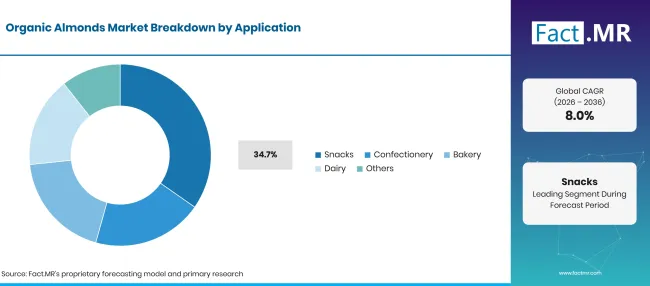
Organic Almonds Market Breakdown Application | Source: Fact.MR
| Application | Share in 2026 |
|---|---|
| Snacks | 34.7% |
| Other segments combined | 65.3% |
| Total | 100.0% |
Source: Fact.MR analysis. Updated Oct 24, 2026
Snack purchasers encounter the almond as the main product, so the organic premium is easy to see and easy to compare with a conventional alternative. Texture and flavor must justify the price premium on repeat purchases. In dry roasted almond snacks, roasting and seasoning create further differentiation, but every additional ingredient can complicate the finished-product organic claim. Confectionery and bakery buyers work from a different brief: they need almond flavor, a specified cut and predictable behavior in a larger recipe. Dairy applications include almond inclusions in suitable dairy foods.
How do supermarkets shape the route to the shopper?
Supermarkets/Hypermarkets represent 42.8% of distribution-channel sales.
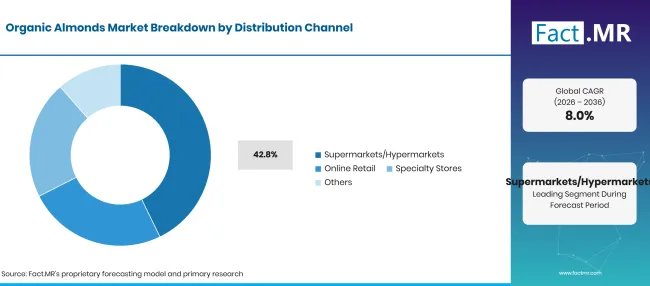
Organic Almonds Market Breakdown Distribution Channel | Source: Fact.MR
| Distribution channel | Share in 2026 |
|---|---|
| Supermarkets/Hypermarkets | 42.8% |
| Other segments combined | 57.2% |
| Total | 100.0% |
Source: Fact.MR analysis. Updated Oct 24, 2026
A supermarket listing puts organic almonds beside alternatives that the shopper already knows. Shelf position, pack weight and promotion timing can determine how the premium is judged. The channel consequently rewards dependable replenishment and a clear reason to buy each format. Specialty stores can carry narrower origin or certification offers, whereas online retail can support repeat orders and larger pack sizes. For a supplier, national distribution is most useful when sell-through is consistent. Expansion into additional stores without comparable repeat purchasing can leave the business holding more slow-moving inventory.
Why does the raw form retain a majority of sales?
Raw almonds account for 58.3% of the form segment in 2026.
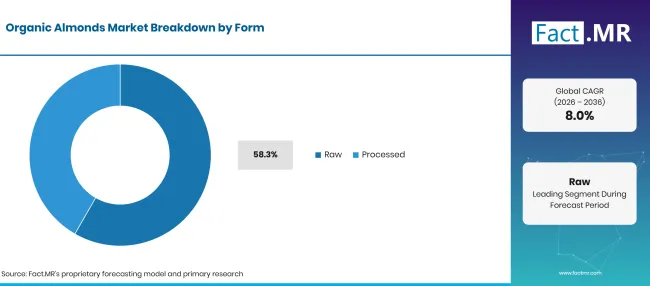
Organic Almonds Market Breakdown Form | Source: Fact.MR
| Form | Share in 2026 |
|---|---|
| Raw | 58.3% |
| Other segments combined | 41.7% |
| Total | 100.0% |
Source: Fact.MR analysis. Updated Oct 24, 2026
An unroasted kernel gives the next buyer control over preparation. A snack processor can choose the roast profile, while a bakery can decide whether the almond should be blanched, sliced or milled. Procurement documents should separately specify the product's food-safety treatment and handling requirements. Raw is a form description and should not substitute for that specification. Processed offerings sell convenience and a finished sensory result. In adjacent nut and seed spreads, for example, the almond must work within the intended texture and flavor rather than simply look attractive.
What supports wider organic almond use, and where does adoption stall?
Organic almonds gain repeat demand when certification, physical quality and price all suit the intended use. The main constraints arise when a premium becomes too large for routine grocery spending or when a processor cannot place the full range of harvested grades. Cross-border requirements add another commercial burden, especially for small consignments.
Drivers Impact Analysis
| DRIVER | (~) % IMPACT ON CAGR | GEOGRAPHIC RELEVANCE | IMPACT TIMELINE |
|---|---|---|---|
| Recurring organic grocery purchases | +0.9% | Germany, United Kingdom, United States | 2026 to 2030 |
| Certified ingredient use in established recipes | +0.7% | Europe, North America, Japan | 2027 to 2032 |
| Sale of multiple kernel grades from each crop | +0.5% | California and Mediterranean supply chains | 2026 to 2029 |
| Affordable pack sizes for new purchasers | +0.4% | Brazil, United Kingdom | 2026 to 2028 |
| Shipment traceability supporting approved sourcing | +0.6% | United States and international exporters | 2026 to 2031 |
Source: Fact.MR analysis. Updated Oct 24, 2026
Opportunity Impact Analysis
| OPPORTUNITY | (~) % IMPACT ON CAGR | GEOGRAPHIC RELEVANCE | IMPACT TIMELINE |
|---|---|---|---|
| Private-label organic almond ranges | +0.8% | Germany, United Kingdom | 2027 to 2031 |
| Dedicated baking and confectionery grades | +0.6% | Europe, Japan | 2027 to 2033 |
| Repeat online orders in larger packs | +0.3% | United States, United Kingdom | 2026 to 2029 |
| Certified regional packing partnerships | +0.5% | Brazil and importing markets | 2028 to 2034 |
Source: Fact.MR analysis. Updated Oct 24, 2026
Restraints Impact Analysis
| RESTRAINT | (~) % IMPACT ON CAGR | GEOGRAPHIC RELEVANCE | IMPACT TIMELINE |
|---|---|---|---|
| Retail premium beyond routine spending tolerance | -0.8% | Global | 2026 to 2030 |
| Limited supply of the required certified grade | -0.6% | Global sourcing chains | 2026 to 2032 |
| Small-lot certification and handling expense | -0.4% | Emerging import channels | 2026 to 2029 |
| Crop and quality variation disrupting contracts | -0.7% | Almond-producing regions | 2026 to 2036 |
Source: Fact.MR analysis. Updated Oct 24, 2026
Which countries are expanding Organic Almonds Market sales through 2036?
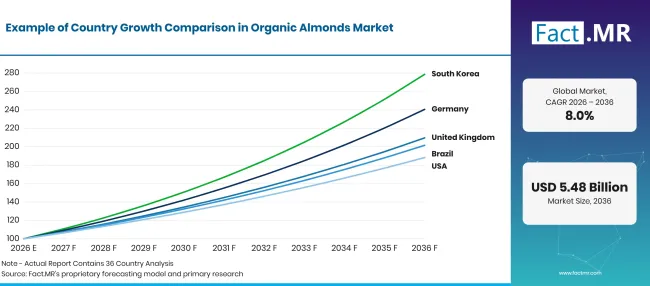
Organic Almonds Market Growth Index | Source: Fact.MR
| Country | CAGR 2026 to 2036 |
|---|---|
| Germany | 9.2% |
| Brazil | 7.3% |
| United States | 6.5% |
| United Kingdom | 7.7% |
| Japan | 5.6% |
Source: Fact.MR analysis. Updated Oct 24, 2026
Where does Germany offer the clearest repeat-order opportunity?
Germany is forecast to expand at 9.2% CAGR, with specialist ingredient demand alongside grocery sales.
CBI identifies Germany as a major European user of organic almonds and an important processing market for marzipan and plant-based drinks. [2] That combination gives an exporter more than one route to a recurring account. A processor may place larger scheduled orders for a narrowly defined ingredient, while a grocery supplier needs several pack formats. Fact.MR sees the best opportunity in matching these purchasing cycles: a seasonal confectionery buyer should receive an agreed specification and delivery window, while the retail range needs supply across the rest of the year. Pursuing both routes can reduce exposure to a single launch or festive selling period.
How can Brazilian distributors make the organic premium easier to sustain?
Brazil carries a 7.3% CAGR outlook, with price and local retail compliance shaping entry.
An imported organic label does not by itself settle the requirements for sale in Brazil. MAPA guidance requires the Brazilian organic seal on products sold through retail channels, including imported products. [6] A distributor therefore needs a compliant finished pack and a selling price appropriate to its customers. Fact.MR expects smaller formats to be useful for trial purchases, with larger packs aimed at established users and food businesses. The choice between packing at origin and packing locally should follow the complete landed offer, including approved handling and inventory turnover. The lower ex-factory price is not necessarily the stronger retail proposition.
What changes the purchasing decision for U.S. organic almond importers?
U.S. market revenue is projected to rise at 6.5% CAGR.
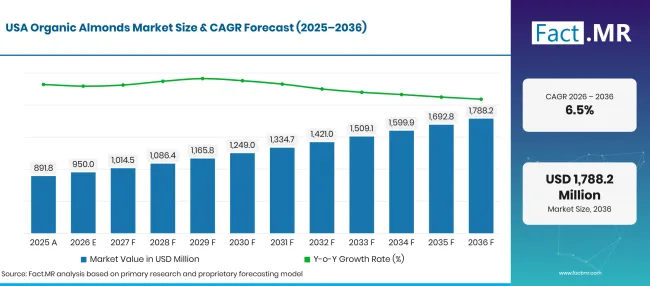
Organic Almonds Market Forecast Usa | Source: Fact.MR
The United States combines domestic almond supply with imported products sold under an organic claim. USDA states that, from October 1, 2025, organic shipments arriving without a valid NOP Import Certificate cannot be reconditioned to resolve that omission. [10] For commercial buyers, this makes pre-shipment readiness consequential to delivery reliability. Purchasing teams should agree which operation is responsible for the lot record and certificate before a container leaves origin. Domestic processors have a different opportunity: offer consistent certified grades close to the customer's production schedule. A buyer with a small initial organic line may value manageable order quantities more than a broad catalogue.
Why does the United Kingdom require a route-specific supply plan?
The UK forecast is 7.7% CAGR, with import origin affecting documentation and lead-time planning.
Defra's September 2026 guidance retains the certificate-of-inspection waiver for organic imports from the EU, EEA and Switzerland. Imports into Great Britain from outside those areas require a certificate for each consignment. [3] The distinction matters to an almond brand comparing a direct shipment with supply through a European processor. Purchasing decisions should weigh inventory, batch size and delivery frequency against the full documentation route. Fact.MR expects suppliers with a practical offer for mid-sized brands to find room between bulk industrial shipments and small consumer packs. Those customers need enough flexibility to test a range without committing to an excessive stock position.
What makes a Japanese organic almond account commercially durable?
Japan is projected to record 5.6% CAGR through 2036.
Japan's organic JAS framework allows eligible imports through overseas JAS-certified operators or through certified importers using the applicable equivalency route. [7] The route determines who can apply the organic JAS seal, making the importer relationship a substantive part of market entry. Once that route is established, a supplier can concentrate on the product brief: a snack buyer needs consistent appearance and eating quality, while a confectioner may prioritize a particular cut or roast. Fact.MR favors a focused account strategy built around a small number of repeatable specifications. Broadening the assortment too quickly can tie up capital in slow-moving variants without increasing the volume of the core product.
How do suppliers compete in the Organic Almonds Market?
Verified organic offerings separate this competitive field from the wider almond trade. Mariani Nut Company sells packaged organic whole almonds, giving it a direct consumer proposition. Harris Woolf Almonds offers almond ingredients produced through organic and conventional methods, which supports customer-specific industrial supply. [5] [4] These businesses face different selling tasks: the packaged brand must keep the product attractive on shelf, while an ingredient supplier must deliver the agreed specification to a production line.
Treehouse California Almonds appears in CCOF's certified-handler directory with almond processing, flour and butter among its listed activities. ofi offers organic almonds in multiple varieties and formats for food manufacturers. [1] [8] Their relevance rests on demonstrable product and handling capabilities. A sizeable presence in conventional almonds should not be treated as evidence of participation in certified organic sales.
Commercial differentiation will come from grade availability, delivery size and the ability to support the buyer's chosen certification route. A supplier that can offer both whole-kernel and manufacturing grades has scope to serve several applications, but each organic offering must remain identifiable. This makes product-specific documentation more useful to a customer than a broad sustainability statement about the group.
Which companies are the key providers?
- Mariani Nut Company
- Harris Woolf California Almonds
- Treehouse California Almonds
- ofi
Bibliography
- [1] CCOF (n.d.). Treehouse California Almonds, LLC.
- [2] Centre for the Promotion of Imports from developing countries (2025, December 16). The European market potential for almonds.
- [3] Department for Environment, Food & Rural Affairs (2026, September 4). Importing organic food, feed and seed to the UK.
- [5] Mariani Nut Company (n.d.). Organic almonds & walnuts.
- [6] Ministério da Agricultura e Pecuária (n.d.). Perguntas e respostas: Orgânicos.
- [7] Ministry of Agriculture, Forestry and Fisheries (2026, April). Inspection and certification system for organic foods.
- [9] U.S. Department of Agriculture, Agricultural Marketing Service (n.d.). Shelled almonds grades and standards.
- [10] U.S. Department of Agriculture, Agricultural Marketing Service (n.d.). Strengthening organic enforcement frequently asked questions.
This Report Answers
- Where do whole-kernel buyers and food manufacturers create different opportunities for the same certified crop?
- How do pack size and shelf price affect the commercial viability of a supermarket organic range?
- Which importing requirements change the responsibilities of suppliers serving the United States, the UK, Brazil and Japan?
- What distinguishes a verified organic almond provider from a company participating only in the broader almond industry?
- How do certification costs, product-grade availability and crop variation influence the 2026 to 2036 outlook?
What does the Organic Almonds Market cover?
Coverage follows almonds sold with an applicable organic certification claim across retail and industrial purchasing. It examines the relationship between kernel specification, product preparation and the customer's end use. The analysis distinguishes product type from form and distribution: a raw whole almond can be sold through several channels, and those views should not be added together.
What is included in the scope?
Included products comprise certified whole, blanched and roasted almonds, alongside other organic almond forms covered by the product taxonomy. Application coverage includes nuts purchased for snacks, confectionery, bakery and dairy foods. Other applications include eligible food formulations outside those named categories. The organic almond input remains the unit of commercial comparison when it enters a finished recipe.
What is excluded from the scope?
Conventional almonds and products marketed only as natural, non-GMO or sustainably grown without the relevant organic claim are excluded. Almond-containing beverages, biscuits, confectionery and spreads are not counted at their full finished-product selling value. Certification fees, orchard equipment and logistics services are outside the almond-sales boundary. Other tree nuts do not enter the total merely because they share a pack or processing facility.
How Was the Analysis Built?
The analysis draws on 120+ sources, 35+ company portfolios, 25+ countries, and more than 20 industry interviews.
- Primary Research: Primary research includes discussions with manufacturers, service providers, technology developers, distributors, end users, and subject-matter experts. These conversations examine purchasing priorities, product adoption, operational challenges, approval requirements, competitive positioning, and the factors that influence wider market acceptance.
- Desk Research: Desk research covers government statistics, regulatory publications, company filings, trade data, technical studies, industry associations, standards, public policy, and other authoritative sources. Every source used in the analysis is documented in the bibliography.
- Market Sizing and Forecasting: Market estimates combine historical performance, demand indicators, pricing and volume trends, segment shares, company participation, country-level growth, adoption patterns, investment activity, and barriers to market expansion.
- Data Validation and Update Cycle: Findings are validated by comparing primary interviews with public data, company activity, regulatory changes, trade patterns, and industry developments. Regular updates review new product launches, capacity changes, partnerships, approvals, and shifts in commercial adoption.
Segmentation
What is the report’s scope and coverage?
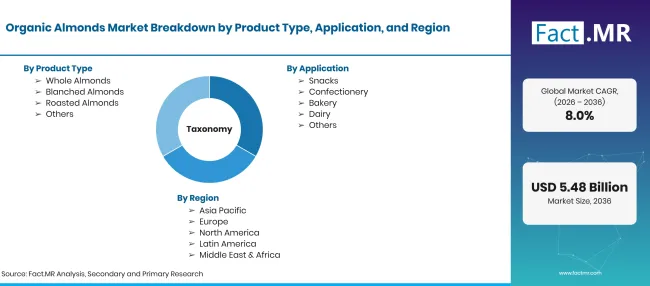
Organic Almonds Market Taxonomy | Source: Fact.MR
| Attribute | Details |
|---|---|
| Quantitative Units | USD billion; CAGR and segment shares in percent |
| Market Definition | Certified organic almonds sold as kernels and almond product forms for direct consumption or food manufacturing. |
| Product Type | Whole Almonds; Blanched Almonds; Roasted Almonds; Others |
| Application | Snacks; Confectionery; Bakery; Dairy; Others |
| Distribution Channel | Supermarkets/Hypermarkets; Online Retail; Specialty Stores; Others |
| Form | Raw; Processed |
| Regions Covered | North America; Latin America; Western Europe; Eastern Europe; East Asia; South Asia & Pacific; Middle East & Africa |
| Countries Covered | Germany; Brazil; United States; United Kingdom; Japan |
| Companies Profiled | Mariani Nut Company; Harris Woolf California Almonds; Treehouse California Almonds; ofi |
| Forecast Period | 2026 to 2036 |
| Approach | Assessment of certified almond supply, commercial grades, application demand, distribution and country purchasing conditions. |
Source: Fact.MR analysis. Updated Oct 24, 2026
How is the market segmented?
-
By Product Type
- Whole Almonds
- Blanched Almonds
- Roasted Almonds
- Others
-
By Application
- Snacks
- Confectionery
- Bakery
- Dairy
- Others
-
By Distribution Channel
- Supermarkets/Hypermarkets
- Online Retail
- Specialty Stores
- Others
-
By Form
- Raw
- Processed
-
By Region
- North America
- Latin America
- Western Europe
- Eastern Europe
- East Asia
- South Asia & Pacific
- Middle East & Africa
Frequently Asked Questions
How large is the organic almonds market in 2026?
What is the forecast for 2036?
Which product type and application lead?
Which distribution channel holds the largest share?
Which companies have verified organic almond offerings?
Who worked on this report


Preview the report firsthand - request a free sample
Free SampleGet the brochure for pricing and purchase details
Download PDF