- Base Value(2025): 162.5 Mn
- Estimated Value(2026): 200.7 Mn
- Forecast Value (2036): 1588.7 Mn
- CAGR (2026 - 2036): 23.5%
Body-Worn Temperature Sensors Market Forecast By Fact.MR
In 2025, the body-worn temperature sensors market was valued at USD 162.5 million. Based on Fact MR's analysis, demand for body-worn temperature sensors is estimated to grow to USD 200.7 million in 2026 and USD 1,588.7 million by 2036. FMR projects a CAGR of 23.5% during the forecast period.
The absolute dollar growth from 2026 to 2036 is USD 1,388 million. This represents transformational expansion as wearable health monitoring devices become integrated into clinical care, workplace safety, and remote patient monitoring systems. Hospitals, telehealth providers, and industrial employers are adopting continuous monitoring solutions to track real-time health indicators. Growth remains moderated by regulatory approval timelines, device certification requirements, and data privacy compliance across healthcare systems.
China leads with a CAGR of 10.5%, supported by large-scale manufacturing of wearable electronics and expansion of digital health infrastructure. The United States follows with 9.2%, driven by adoption in hospital monitoring systems and remote patient care programs. South Korea records 8.7%, reflecting demand for connected healthcare devices and advanced semiconductor manufacturing. The United Kingdom grows at 8.5% and Japan at 8.3%. These mature healthcare markets generate strong replacement demand, constrained by medical device regulatory approvals and reimbursement policies.
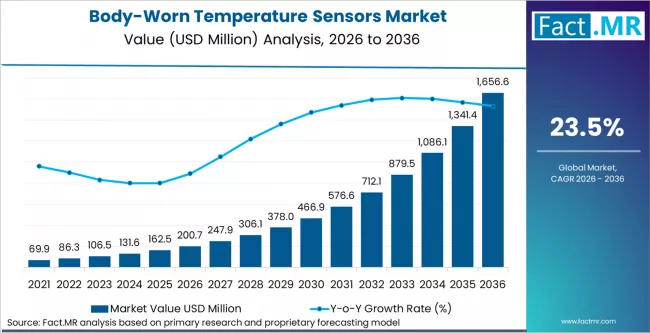
Body Worn Temperature Sensors Market Market Value Analysis | Source: Fact.MR
Body-Worn Temperature Sensors Market
| Metric | Value |
|---|---|
| Estimated Value in (2026E) | USD 200.7 million |
| Forecast Value in (2036F) | USD 1,588.7 million |
| Forecast CAGR (2026 to 2036) | 23.5% |
Source: Fact.MR analysis. Updated Mar 12, 2026
Body-Worn Temperature Sensors Market Definition
The Body-Worn Temperature Sensors Market involves the development and sale of wearable sensing devices that continuously monitor body temperature and transmit data to connected systems for health tracking and medical monitoring. These sensors are integrated into wearables such as patches, smartwatches, smart clothing, and medical monitoring devices to provide real-time physiological data. Their primary function is to support patient monitoring, early illness detection, and health management in clinical and non-clinical environments including hospitals, home care settings, industrial workplaces, and sports performance monitoring.
Market Inclusions
This report covers global and regional market sizes for body-worn temperature sensors over a defined forecast period. It includes segmentation by device type such as biosensor patches, smartwatches, smart garments, wearable patches, and handheld monitoring terminals. Application segments include healthcare and medical monitoring, industrial and military safety monitoring, telecommunications workforce monitoring, and information technology sector health tracking solutions.
Market Exclusions
The scope excludes conventional thermometers, stationary temperature monitoring equipment used in hospitals or laboratories, and wearable devices that do not include temperature sensing capability. It also omits general biometric wearables that monitor only heart rate, motion, or fitness metrics without body temperature measurement.
Research Methodology
- Primary Research: Interviews were conducted with wearable technology manufacturers, medical device developers, clinicians, and industry analysts.
- Desk Research: Data was sourced from healthcare technology publications, wearable device reports, and industry association statistics.
- Market-Sizing and Forecasting: A hybrid model combining top-down healthcare technology demand projections with bottom-up device shipment and revenue estimates was used.
- Data Validation and Update Cycle: Findings were validated through expert consultations and cross-checked with recent product deployment, adoption, and industry performance data.
Summary of the Body Worn Temperature Sensors Market
-
Market Definition
- The Body Worn Temperature Sensors Market involves the development and deployment of wearable sensing devices designed to continuously monitor body temperature and transmit physiological data to connected platforms. These sensors are embedded in wearables such as patches, smartwatches, smart garments, and handheld monitoring terminals. Their primary function is to support continuous patient monitoring, early illness detection, and health management across hospitals, home care environments, workplaces, and sports performance monitoring systems.
- Demand Drivers
- Increasing adoption of remote patient monitoring systems in hospitals and telehealth programs.
- Expansion of wearable health devices integrated with temperature monitoring capabilities.
- Rising demand for continuous physiological monitoring in clinical and home healthcare settings.
- Growing deployment of wearable sensors in industrial safety and workforce health monitoring.
- Integration of biosensor technologies with digital health platforms and mobile monitoring applications.
- Key Segments Analyzed
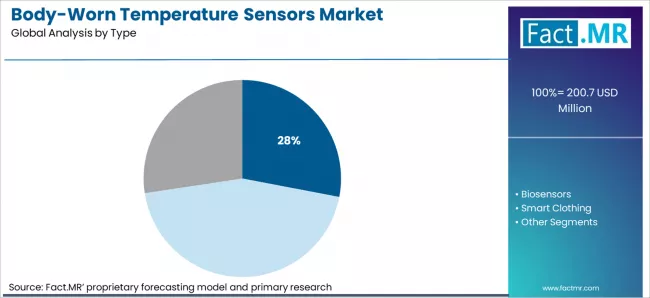
- Type: Smartwatches lead with 28% share in 2026, followed by Biosensors, Smart Clothing, Wearable Patches, Hand Worn Terminals, and Others.
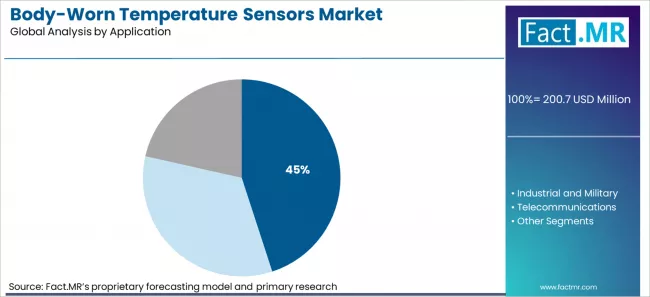
- Application: Healthcare and Medical dominates with 45% share in 2026, followed by Industrial and Military, Telecommunications, Information Technology, and Other Specialized Sectors.
- Device Category: Wearable biosensor patches, connected smartwatches, smart garments, and handheld monitoring devices.
- Geography: East Asia and North America lead adoption. China records the highest CAGR at 10.5%, followed by USA (9.2%), South Korea (8.7%), United Kingdom (8.5%), and Japan (8.3%).
- Analyst Opinion at Fact MR
- Shambhu Nath Jha, Principal Consultant, Fact MR, opines, "In this updated edition of the Body Worn Temperature Sensors Market report, industry participants will observe that value creation is shifting from basic clinical temperature measurement toward continuous digital health monitoring ecosystems. Wearable temperature sensors are no longer limited to episodic measurement devices but increasingly function as integrated biosensing platforms that transmit real time physiological data to healthcare monitoring systems. Manufacturers that invest in multi parameter biosensors, reliable wireless connectivity, and integration with telehealth platforms will capture stronger adoption across healthcare and workplace monitoring environments. The convergence of wearable electronics, biosensor technology, and digital healthcare platforms defines the competitive landscape through 2036."
- Strategic Implications or Executive Takeaways
- Invest in wearable biosensor technologies that enable continuous physiological monitoring.
- Expand integration of temperature sensing devices with telehealth and remote patient monitoring platforms.
- Strengthen partnerships between medical device manufacturers and healthcare technology providers.
- Develop multi parameter wearable sensors that combine temperature monitoring with additional vital sign tracking.
- Ensure compliance with medical device certification and regulatory approval requirements across global healthcare systems.
- Methodology
- Primary Research: Interviews with wearable device manufacturers, medical technology developers, clinicians, and healthcare system specialists.
- Desk Research: Data compiled from healthcare technology reports, wearable device publications, and industry association statistics.
- Market Sizing and Forecasting: Hybrid model combining top down healthcare technology demand projections with bottom up device shipment and revenue analysis.
- Data Validation: Findings validated through expert consultations and cross checked with recent device deployment, adoption patterns, and healthcare monitoring program data using Fact MR forecasting models.
Segmental Analysis
Body-Worn Temperature Sensors Market Analysis by Application
Body Worn Temperature Sensors Market Analysis By Application | Source: Fact.MR
Market Overview: Healthcare and medical applications are expected to capture 45% of the market share by 2026. Body-worn temperature sensors are widely used in hospitals, clinics, and home healthcare settings for continuous patient monitoring. These sensors enable real-time tracking of body temperature, helping healthcare professionals detect fever patterns and manage patient conditions more effectively.
Demand Drivers:
- Growing Adoption of Remote Patient Monitoring: Healthcare providers increasingly use wearable sensors to monitor patients continuously, reducing the need for frequent manual measurements.
- Rising Focus on Early Disease Detection: Continuous temperature monitoring supports early identification of infections and other health conditions.
- Expansion of Digital Healthcare Technologies: Integration of wearable sensors with healthcare platforms and mobile applications improves patient monitoring and clinical decision-making.
Body-Worn Temperature Sensors Market Analysis by Type
Body Worn Temperature Sensors Market Analysis By Type | Source: Fact.MR
Market Overview: Smartwatches are projected to hold 28% of the market share by 2026. Smartwatch-based temperature sensors combine health monitoring capabilities with wearable convenience, enabling users to track body temperature alongside other health metrics such as heart rate and activity levels.
Demand Drivers:
- Integration with Consumer Wearables: Smartwatches integrate multiple health tracking features, making temperature monitoring more accessible for everyday users.
- Growing Popularity of Health Wearables: Increasing consumer interest in wearable health devices supports adoption of smartwatch-based temperature monitoring.
- Real-Time Health Data Access: Smartwatches provide instant temperature readings and alerts, enabling users to track changes and take preventive health measures.
Body-Worn Temperature Sensors Market Drivers, Restraints, and Opportunities
FMR analysts observe that historical demand for body-worn temperature sensors emerged from hospital patient monitoring systems where continuous temperature tracking improved clinical observation. Traditional bedside thermometers required manual checks, which limited monitoring frequency and increased nursing workload in large hospital settings. The current market valuation reflects the expansion of wearable biosensors across healthcare monitoring, infectious disease surveillance, and remote patient management programs. Growth accelerated when healthcare systems adopted continuous physiological monitoring to detect fever patterns earlier in hospitalized or quarantined populations.
The market is currently transitioning from single-purpose medical thermometers toward multi-parameter wearable biosensors integrated into digital health platforms. Standard disposable temperature patches remain widely used in hospitals due to low cost and simple deployment across large patient groups. Higher-value wearable sensors combine temperature tracking with heart rate, respiration monitoring, and wireless data transmission to hospital dashboards or telemedicine platforms. These integrated devices carry higher unit costs even as deployment volumes remain selective in advanced care environments. Pricing gains from connected sensor systems partially offset slower growth in basic disposable monitoring products.
- Remote Patient Monitoring: Healthcare providers increasingly deploy wearable temperature sensors within remote patient monitoring programs that track vital signs outside traditional hospital environments.
- Medical Device Regulation: Regulatory frameworks such as the U.S. FDA 510(k) clearance process and the European Union Medical Device Regulation (EU MDR 2017/745) require clinical validation for wearable biosensors used in medical diagnostics.
- Asia Healthcare Expansion: Hospitals and telehealth providers across China, Japan, and South Korea are expanding digital patient monitoring infrastructure as aging populations increase demand for continuous vital sign tracking technologies.
Regional Analysis
The market analysis covers key global regions, including East Asia, North America, and Western Europe. It is segmented geographically, with specific market dynamics for each region. The full report provides a detailed market attractiveness analysis.
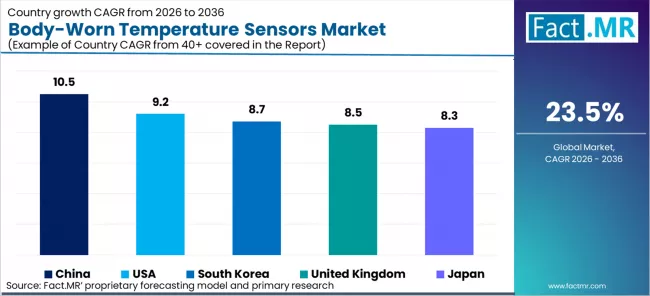
Body Worn Temperature Sensors Market Cagr Analysis By Country | Source: Fact.MR
| Country | CAGR (2026-2036) |
|---|---|
| China | 10.5% |
| USA | 9.2% |
| South Korea | 8.7% |
| United Kingdom | 8.5% |
| Japan | 8.3% |
Source: Fact.MR analysis. Updated Mar 12, 2026
Source: Fact MR (FMR) analysis, based on proprietary forecasting model and primary research
East Asia
China, South Korea, and Japan represent major markets supported by demand for wearable healthcare devices, digital patient monitoring, and integration of biosensor technologies in consumer electronics. Major companies include Omron Healthcare Co., Ltd., STMicroelectronics, and NXP Semiconductors.
- China: Demand for body-worn temperature sensors in China is projected to rise at 10.5% CAGR through 2036. Growth is supported by hospital digital monitoring programs approved by the National Health Commission (03-2025) and expansion of wearable health device production by STMicroelectronics in regional sensor supply chains (08-2025).
South Korea
Demand for body-worn temperature sensors in South Korea is projected to rise at 8.7% CAGR through 2036. Growth is influenced by remote patient monitoring programs promoted by the Ministry of Health and Welfare (02-2025) and wearable device sensor integration by NXP Semiconductors (07-2025).
- Japan: Demand for body-worn temperature sensors in Japan is projected to rise at 8.3% CAGR through 2036. Growth is supported by aging population healthcare monitoring initiatives (04-2025) and wearable medical device development by Omron Healthcare Co., Ltd. (09-2025).
North America
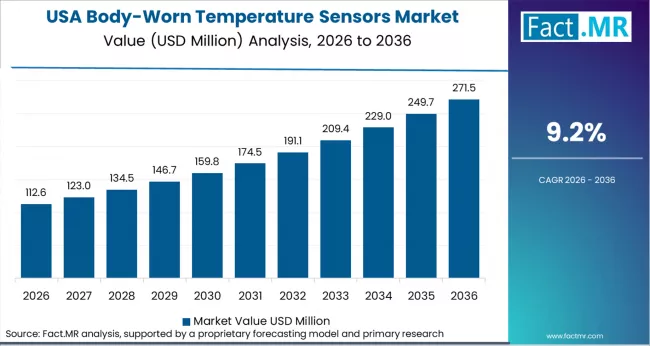
Body Worn Temperature Sensors Market Country Value Analysis | Source: Fact.MR
The USA remains a major market due to clinical remote monitoring adoption, wearable healthcare technologies, and digital health platforms.
- USA: Demand for body-worn temperature sensors in the U.S. is projected to rise at 9.2% CAGR through 2036. Growth is supported by remote patient monitoring reimbursement policies implemented by the Centers for Medicare & Medicaid Services (05-2025) and expansion of wearable sensor platforms by Medtronic plc (08-2025).
Western Europe
The United Kingdom represents an important market supported by digital healthcare infrastructure and adoption of wearable medical monitoring devices.
- United Kingdom: Demand for body-worn temperature sensors in the UK is projected to rise at 8.5% CAGR through 2036. Growth is supported by NHS remote patient monitoring programs (03-2025) and regional deployment of wearable monitoring solutions by Koninklijke Philips N.V. (07-2025).
Fact MR's analysis of the body-worn temperature sensors market in East Asia, North America, and Western Europe consists of country-wise assessments that include China, the USA, South Korea, the United Kingdom, and Japan. Readers can find detailed trends, regulatory updates, and company-specific investments shaping market growth in these countries.
What is the Competitive Structure and Buyer Behavior in the Body-Worn Temperature Sensors Market?
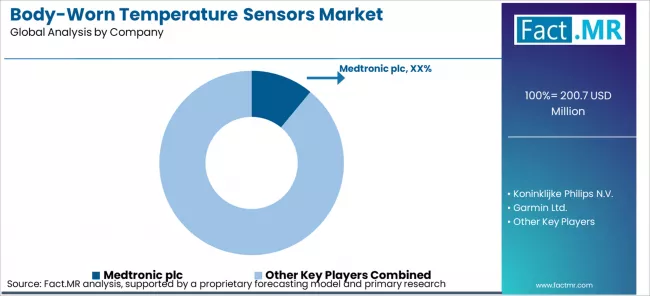
Body Worn Temperature Sensors Market Analysis By Company | Source: Fact.MR
The body-worn temperature sensors market is moderately fragmented, with a mix of medical device manufacturers, semiconductor companies, and wearable technology firms competing across healthcare monitoring applications. Companies such as Medtronic plc, Koninklijke Philips N.V., Garmin Ltd., Fitbit LLC (Google LLC), Texas Instruments Incorporated, Analog Devices, Inc., STMicroelectronics N.V., VitalConnect, Inc., NXP Semiconductors N.V., and Omron Healthcare Co., Ltd. contribute to the ecosystem through sensor components, wearable devices, and integrated remote monitoring systems. Competition is driven primarily by sensor accuracy, continuous monitoring capability, battery efficiency, and compatibility with digital health platforms used in hospitals and home care settings. Firms with strong engineering expertise, extensive research capabilities, and established healthcare device portfolios hold structural advantages because they can integrate sensors into broader patient monitoring and telehealth systems.
Structural advantages are strongest among companies that combine semiconductor design, medical device manufacturing, and data analytics platforms. These firms can provide end-to-end solutions that include sensing hardware, data transmission modules, and clinical monitoring software. Hospitals, healthcare providers, and research institutions represent major buyers and exert considerable leverage by qualifying multiple device suppliers and negotiating procurement contracts tied to reliability and regulatory compliance. To reduce supplier dependency, many healthcare organizations adopt multi-vendor monitoring systems that integrate with existing electronic health records and telemedicine platforms. This purchasing behavior limits individual supplier pricing power and places greater emphasis on sensor accuracy, device reliability, and interoperability with clinical monitoring systems.
Key Players
- Medtronic plc
- Koninklijke Philips N.V.
- Garmin Ltd.
- Fitbit LLC (Google LLC)
- Texas Instruments Incorporated
- Analog Devices, Inc.
- STMicroelectronics N.V.
- VitalConnect, Inc.
- NXP Semiconductors N.V.
- Omron Healthcare Co., Ltd.
Report Scope
| Metric | Value |
|---|---|
| Quantitative Units | USD 200.7 million (2026) to USD 1,588.7 million (2036), at a CAGR of 23.5% |
| Market Definition | The body-worn temperature sensors market includes production and integration of wearable sensing devices designed to continuously monitor body temperature across healthcare, industrial, and connected device environments. |
| Type Segmentation | Biosensors, Smartwatches, Smart Clothing, Wearable Patches, Hand-Worn Terminals, Others |
| Application Coverage | Healthcare and Medical, Industrial and Military, Telecommunications, Information Technology, Other Specialized Sectors |
| Key Companies Profiled | Medtronic plc, Koninklijke Philips N.V., Garmin Ltd., Fitbit LLC, Texas Instruments Incorporated, Analog Devices, Inc., STMicroelectronics N.V., VitalConnect, Inc., NXP Semiconductors N.V., Omron Healthcare Co., Ltd. |
| Forecast Period | 2026 to 2036 |
| Approach | Hybrid top-down and bottom-up market modeling validated through interviews with wearable device manufacturers and healthcare technology providers, supported by shipment analysis, semiconductor supply benchmarking, and device adoption trends. |
Source: Fact.MR analysis. Updated Mar 12, 2026
Bibliographies
- [1] U.S. Food and Drug Administration. (2025). Wearable biosensors for continuous temperature monitoring.
- [2] National Health Commission, China. (2025). Hospital digital monitoring programs.
- [3] Centers for Medicare & Medicaid Services. (2025). Remote patient monitoring reimbursement policies.
- [4] NHS England. (2025). Remote patient monitoring programs.
- [5] Ministry of Health and Welfare, South Korea. (2025). Remote patient monitoring programs.
- [6] Omron Healthcare Co., Ltd. (2025). Wearable medical device development.
- [7] STMicroelectronics. (2025). Wearable health device sensor production.
- [8] NXP Semiconductors. (2025). Wearable device sensor integration.
- [9] European Union. (2023). Medical Device Regulation (EU MDR 2017/745).
This report addresses
- Market intelligence enabling evaluation of global body worn temperature sensing technologies by device type (biosensors, smartwatches, smart clothing, wearable patches, hand worn terminals, and others) and application sectors including healthcare and medical, industrial and military, telecommunications, information technology, and other specialized sectors.
- Market volume (revenue) estimates and 10 year forecasts from 2026 to 2036, validated using wearable device shipment data, healthcare monitoring adoption trends, and semiconductor sensor deployment across digital health ecosystems.
- Growth opportunity mapping across wearable biosensor patches, smartwatch integrated temperature monitoring systems, connected health wearables, and remote patient monitoring platforms, with major markets including China, the United States, South Korea, the United Kingdom, and Japan.
- Segment and regional revenue forecasts for biosensor devices, wearable medical monitoring platforms, and connected temperature sensing technologies used across healthcare institutions and remote monitoring environments.
- Competitive strategy analysis highlighting sensor accuracy, device integration capability, battery performance, wireless data transmission, and interoperability with digital health platforms, with major players including Medtronic plc, Koninklijke Philips N.V., Garmin Ltd., Fitbit LLC (Google LLC), Texas Instruments Incorporated, Analog Devices, Inc., STMicroelectronics N.V., VitalConnect, Inc., NXP Semiconductors N.V., and Omron Healthcare Co., Ltd.
- Adoption dynamics emphasizing remote patient monitoring programs, expansion of wearable health technologies, integration of temperature sensing with multi parameter health tracking systems, and deployment of connected biosensor platforms across healthcare and industrial environments.
- Report delivery in PDF, Excel, PowerPoint, and interactive dashboard formats suitable for executive, operational, and strategic planning.
Segmentation
Body-Worn Temperature Sensors Market Key Segments
-
Type
- Biosensors
- Smartwatches
- Smart Clothing
- Wearable Patches
- Hand-Worn Terminals
- Others
-
Application
- Healthcare and Medical
- Industrial and Military
- Telecommunications
- Information Technology
- Other Specialized Sectors
-
Region
- North America
- USA
- Canada
- Mexico
- Europe
- Germany
- UK
- France
- Italy
- Spain
- Nordic Countries
- BENELUX
- Rest of Europe
- Asia Pacific
- China
- Japan
- South Korea
- India
- Australia
- Rest of Asia Pacific
- Latin America
- Brazil
- Argentina
- Rest of Latin America
- Middle East and Africa
- Kingdom of Saudi Arabia
- United Arab Emirates
- South Africa
- Rest of Middle East and Africa
- Other Regions
- Oceania
- Central Asia
- Other Markets
- North America
Frequently Asked Questions
How large is the demand for Body-Worn Temperature Sensors in the global market in 2026?
What will be the market size of Body-Worn Temperature Sensors in the global market by 2036?
What is the expected demand growth for Body-Worn Temperature Sensors in the global market between 2026 and 2036?
Which application segment is expected to dominate the market?
Which region is expected to show the highest growth rate for Body-Worn Temperature Sensors?
How significant is the growth outlook for the United States in this market?
What is the growth outlook for South Korea in the Body-Worn Temperature Sensors market?
What is the growth forecast for the United Kingdom in the Body-Worn Temperature Sensors market?
What is the growth forecast for Japan in the Body-Worn Temperature Sensors market?
Which company is identified as a leading player in the Body-Worn Temperature Sensors market?
What are Body-Worn Temperature Sensors used for?
What does the Body-Worn Temperature Sensors market include in this report?
How is the market forecast developed in this report?
What is meant by the Body-Worn Temperature Sensors market in this report?
Who worked on this report


Preview the report firsthand - request a free sample
Free SampleGet the brochure for pricing and purchase details
Download PDF