- Base Value(2025): 260 Mn
- Estimated Value(2026): 285 Mn
- Forecast Value (2036): 1020 Mn
- CAGR (2026 - 2036): 13.6%
Closed-Loop Enteral Feeding Sensors Market Size, Share and Forecast and Outlook By FACT.MR
In 2025, the closed-loop enteral feeding sensors market was valued at USD 260 million. Fact MR analysis indicates demand for closed-loop enteral feeding sensors is expected to reach USD 285 million in 2026 and USD 1,020 million by 2036. FMR estimates the market will expand at a CAGR of 13.6% across the forecast period.
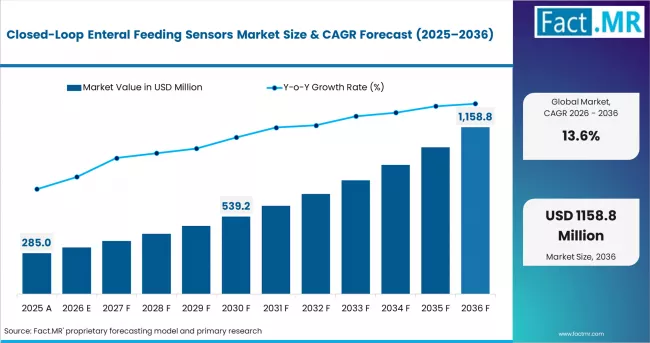
Closed Loop Enteral Feeding Sensors Market Value Analysis | Source: Fact.MR
Summary of Closed-Loop Enteral Feeding Sensors Market
- Market Definition
- The closed-loop enteral feeding sensors market consists of sensor-integrated medical technologies designed to monitor and regulate delivery of liquid nutrition through feeding tubes using automated feedback control mechanisms. These systems incorporate pressure, flow, air-in-line, and weight sensors to ensure accurate nutrient dosing, reduce risk of occlusion or aspiration, and improve clinical safety across intensive care, neonatal, and long-term nutrition therapy environments.
- Demand Drivers
- Increasing clinical focus on patient safety protocols requiring precise control of enteral nutrition delivery parameters.
- Rising adoption of smart infusion and sensor-enabled monitoring devices across intensive care units.
- Expansion of home nutrition therapy programs requiring automated feeding management with minimal manual intervention.
- Growth in aging population requiring long-duration enteral feeding support across chronic disease treatment pathways.
- Integration of digital health technologies enabling real-time monitoring of feeding accuracy and system performance.
- Increasing hospital investment in interoperable medical devices supporting automated dosing precision and clinical workflow optimization.
- Key Segments Analyzed
- End User: Hospitals account for 49% share due to high concentration of critical care nutrition management infrastructure.
- Application: Continuous enteral feeding represents 37% share reflecting requirement for stable nutrient delivery across extended treatment durations.
- Sensor Type: Pressure and flow sensors support real-time monitoring of occlusion risk, flow rate variability, and feeding consistency.
- Geography: China and India demonstrate strongest growth reflecting expansion of hospital digitalization initiatives, while the United States, Germany, and the United Kingdom reflect replacement-driven adoption across established installed base of enteral feeding systems.
- Analyst Opinion at Fact MR
- Shambhu Nath Jha, Principal Consultant, Fact MR, states, "Closed-loop enteral feeding architectures are transitioning clinical nutrition management toward sensor-driven precision therapy where real-time feedback mechanisms reduce dosing variability and improve patient safety outcomes. Demand expansion reflects integration of pressure, air-in-line, and flow sensing technologies capable of detecting occlusion, leakage, and air presence during continuous feeding procedures. Medical device manufacturers are aligning system interoperability with digital health infrastructure requirements supporting automated monitoring workflows across hospital and homecare environments through 2036."
- Strategic Implications
- Expand development of multimodal sensor platforms capable of integrating pressure, flow, and air detection technologies.
- Strengthen interoperability between enteral feeding devices and hospital digital health infrastructure.
- Improve sensor calibration accuracy supporting real-time feedback control across continuous feeding protocols.
- Increase investment in regulatory compliance pathways supporting certification of sensor-integrated feeding technologies.
- Enhance product integration capability enabling compatibility with installed enteral feeding pump systems.
- Develop portable closed-loop feeding systems supporting expansion of home nutrition therapy environments.
- Methodology
- Developed using primary interviews with medical device manufacturers, biomedical engineers, clinical nutrition specialists, and hospital procurement stakeholders.
- Supported through review of clinical research publications, regulatory device approval frameworks, and technical documentation relating to enteral feeding sensor integration.
- Market estimation applied hybrid modeling combining bottom-up revenue assessment of sensor-enabled feeding devices with top-down evaluation of enteral nutrition procedure volumes.
- Data validated through triangulation using clinical datasets, manufacturer disclosures, and expert consultation inputs.
- Periodic updates incorporate developments in sensor miniaturization, algorithm validation, interoperability standards, and hospital automation adoption patterns.
Closed-Loop Enteral Feeding Sensors Market
| Metric | Details |
|---|---|
| Industry Size (2026E) | USD 285 million |
| Industry Value (2036F) | USD 1,020 million |
| CAGR (2026 to 2036) | 13.6% |
Source: Fact.MR analysis. Updated Apr 23, 2026
A CAGR of 13.6%, with market value increasing from USD 285 million to USD 1,020 million, indicates an inflection point driven by transition from manual monitoring toward automated nutritional delivery systems in clinical care. Growth is supported by patient safety protocols and ICU digitization, while adoption pace may be influenced by device validation costs, interoperability requirements, and reimbursement pathway clarity.
China records the fastest growth at 14.8%, supported by increasing adoption of automated nutrition delivery monitoring in tertiary care hospitals. India follows at 14.3%, driven by expanding use of sensor-based enteral feeding systems in critical care nutrition management. The United Kingdom shows 14.0% growth, linked to integration of closed-loop safety monitoring in hospital enteral feeding protocols. Germany at 13.8% and the United States at 13.6% represent mature markets where demand is largely replacement-driven due to established installed base of clinical nutrition monitoring equipment. A structural constraint across mature markets is stringent medical device validation requirements, which extend product approval and procurement timelines.
Segmental Analysis
Closed-Loop Enteral Feeding Sensors Market Analysis by End User
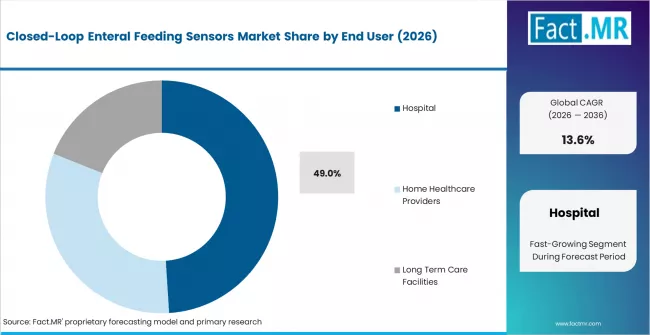
Closed Loop Enteral Feeding Sensors Market Analysis By End User | Source: Fact.MR
- Market Overview: Hospitals are projected to hold 49% share of the closed-loop enteral feeding sensors market in 2026. Adoption concentration reflects the presence of intensive care infrastructure and clinical nutrition management protocols requiring continuous monitoring of enteral feeding delivery parameters. Healthcare facilities prioritize sensor-integrated systems capable of supporting precision nutrition delivery across acute care environments where patient safety and dosage accuracy remain critical.
- Demand Drivers:
- Critical Care Nutrition Requirements: Hospitals manage high patient volumes requiring controlled enteral feeding administration supported by sensor-enabled monitoring systems integrated with clinical nutrition workflows.
- Patient Safety Protocols: Closed-loop sensor technologies assist in minimizing feeding interruptions, flow inconsistencies, and tube-related complications during extended nutritional support procedures.
- Clinical Equipment Integration: Healthcare providers deploy interoperable feeding monitoring devices compatible with existing infusion and patient monitoring infrastructure across hospital intensive care settings.
Closed-Loop Enteral Feeding Sensors Market Analysis by Application
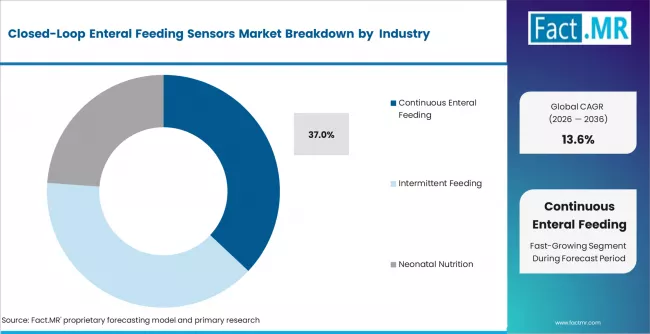
Closed Loop Enteral Feeding Sensors Market Analysis By Application | Source: Fact.MR
- Market Overview: Continuous enteral feeding is estimated to account for 37% share in 2026, supported by increased use of automated nutrition delivery systems designed to maintain consistent nutrient flow rates across prolonged feeding durations. Continuous feeding protocols are widely implemented in clinical settings requiring stable metabolic support for patients unable to consume oral nutrition.
- Demand Drivers:
- Precision Nutrition Delivery: Continuous feeding applications rely on sensor-based feedback mechanisms to maintain stable flow rates aligned with prescribed nutritional intake requirements.
- Monitoring Consistency: Sensor-enabled enteral feeding systems support real-time adjustment of feeding parameters to reduce variability in nutrient administration across extended treatment durations.
- Clinical Workflow Optimization: Hospitals utilize continuous enteral feeding technologies to improve efficiency of nutritional therapy management across intensive care units and long-term patient care environments.
Key Dynamics
Closed-Loop Enteral Feeding Sensors Market Drivers, Restraints, and Opportunities
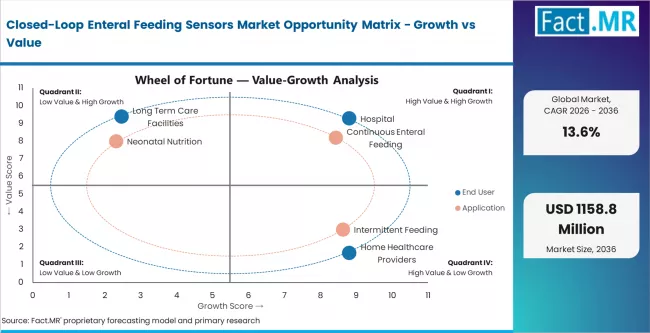
Closed Loop Enteral Feeding Sensors Market Opportunity Matrix Growth Vs Value | Source: Fact.MR
Fact MR analysis indicates the market reflects a specialized medical device control systems segment shaped by the shift from passive nutrition delivery toward sensor-driven therapeutic precision. Market size exists because enteral feeding accuracy directly affects clinical outcomes in critical care, oncology, and neonatal nutrition, where deviations in flow rate or pressure can create underfeeding or aspiration risk. Closed-loop architectures integrate pressure, flow, and air-in-line sensors to automatically adjust delivery parameters, forming a feedback-controlled system that continuously measures and corrects feeding performance without manual recalibration.
Current dynamics show declining reliance on open-loop feeding pumps that depend on manual programming, while sensor-integrated closed-loop platforms command higher per-unit pricing due to embedded electronics, algorithm validation, and compliance testing requirements. Value expansion is supported by hospital investment in patient safety infrastructure and homecare monitoring systems where automated occlusion detection and flow verification reduce nursing intervention frequency. Pressure and bubble sensors are increasingly used to detect tube blockage or air presence, ensuring consistent nutrient delivery in continuous feeding environments.
- Safety Standard Integration: ISO enteral feeding system standards and IEC medical electrical equipment requirements formalize accuracy, misconnection prevention, and flow monitoring benchmarks, reinforcing demand for sensor-integrated closed-loop feeding architectures.
- Homecare Expansion: North America and Western Europe show increasing adoption as chronic disease prevalence and aging populations expand demand for long-duration enteral nutrition outside hospital settings.
- Sensor Feedback Automation: Transition toward pressure, air-in-line, and flow sensors enables automated feed-rate adjustment, improving dosing precision and reducing clinical error exposure in continuous nutrition therapy.
Regional Analysis
The closed-loop enteral feeding sensors market is assessed across Asia Pacific, Europe, and North America, segmented by country-level demand for automated nutritional monitoring systems, sensor-integrated enteral feeding devices, and precision dosing technologies used in hospitals and long-term care settings. Geographic variation reflects clinical nutrition protocols, patient safety standards, and hospital automation adoption. The full report offers market attractiveness analysis.
.webp "Top Country Growth Comparison Closed Loop Enteral Feeding Sensors Market Cagr (2026 2036)")
Top Country Growth Comparison Closed Loop Enteral Feeding Sensors Market Cagr (2026 2036) | Source: Fact.MR
CAGR Table
| Country | CAGR (2026–2036) |
|---|---|
| China | 14.8% |
| India | 14.3% |
| United Kingdom | 14.0% |
| Germany | 13.8% |
| United States | 13.6% |
Source: Fact.MR analysis. Updated Apr 23, 2026
Source: Fact MR analysis, based on proprietary forecasting model and primary research
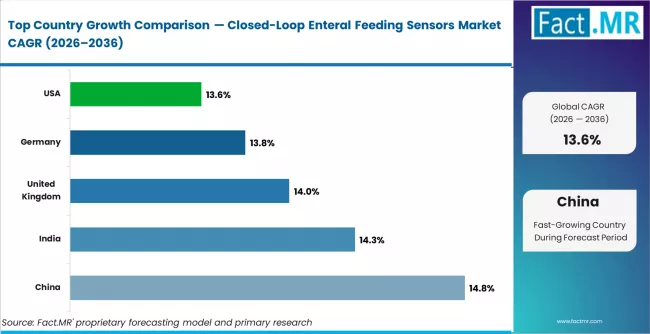
Closed Loop Enteral Feeding Sensors Market Cagr Analysis By Country | Source: Fact.MR
Asia Pacific
Asia Pacific functions as the clinical nutrition device adoption hub supported by hospital modernization initiatives and increasing integration of sensor-based feeding management systems. Fresenius Kabi AG strengthens enteral nutrition device portfolio capability. Cardinal Health expands clinical feeding technology distribution networks. B. Braun SE supports precision infusion monitoring innovation.
- China: China is projected to record 14.8% CAGR in closed-loop enteral feeding sensors through 2036. National Health Commission hospital digitalization framework update (March 2023) supports adoption of sensor-based clinical monitoring equipment. Fresenius Kabi AG expanded enteral feeding system collaboration initiatives (July 2023).
- India: India is expected to observe 14.3% CAGR in closed-loop enteral feeding sensors through 2036. National Medical Device Policy implementation framework (Department of Pharmaceuticals, April 2023) supports domestic production of clinical monitoring technologies. B. Braun India expanded enteral feeding technology distribution capability (June 2023).
Europe
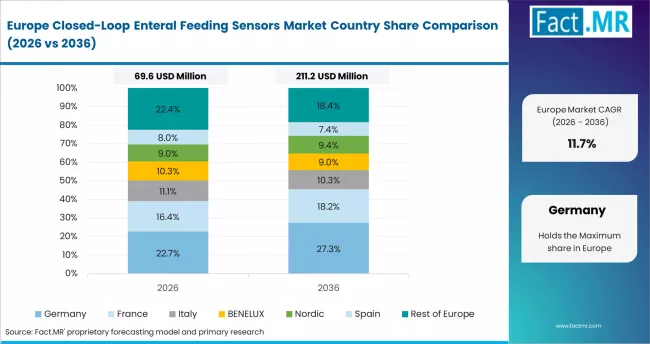
Closed Loop Enteral Feeding Sensors Market Europe Country Market Share Analysis, 2026 & 2036 | Source: Fact.MR
Europe operates as the patient safety compliance laboratory supported by structured clinical nutrition standards and strict medical device regulatory pathways. Fresenius Kabi AG strengthens automated enteral feeding innovation capability. B. Braun SE expands sensor-integrated infusion system portfolio depth. Danone Nutricia supports clinical nutrition technology integration.
- United Kingdom: The United Kingdom is anticipated to expand at 14.0% CAGR in closed-loop enteral feeding sensors through 2036. NHS MedTech funding mandate update (September 2023) supports adoption of automated clinical nutrition monitoring equipment. Danone Nutricia expanded digital enteral nutrition collaboration initiatives (May 2023).
- Germany: Germany is forecast to grow at 13.8% CAGR in closed-loop enteral feeding sensors through 2036. EU Medical Device Regulation implementation (European Commission, ongoing) supports certified clinical sensor adoption. B. Braun SE expanded sensor-enabled enteral feeding technology research (March 2023).
North America
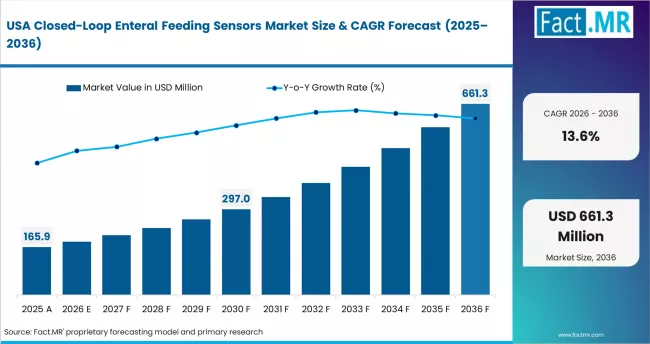
Closed Loop Enteral Feeding Sensors Market Country Value Analysis | Source: Fact.MR
North America functions as the clinical automation commercialization center supported by advanced hospital infrastructure and strong adoption of precision patient monitoring technologies. Cardinal Health strengthens automated feeding system distribution capability. Baxter International Inc. expands smart infusion technology expertise. ICU Medical Inc. supports sensor-based clinical monitoring innovation.
- United States: The United States is projected to register 13.6% CAGR in closed-loop enteral feeding sensors through 2036. U.S. Food and Drug Administration digital health guidance update (February 2023) supports sensor-integrated medical device approvals. Baxter International Inc. expanded smart feeding technology development program (August 2023).
Fact MR's analysis of closed-loop enteral feeding sensors market in global regions consists of country-wise assessment that includes China, India, United Kingdom, Germany, and United States. Readers can find clinical nutrition technology adoption trends, regulatory compliance developments, hospital automation patterns, and competitive device innovation insights.
Competitive Landscape
What is the Competitive Structure of the Closed-Loop Enteral Feeding Sensors Market?
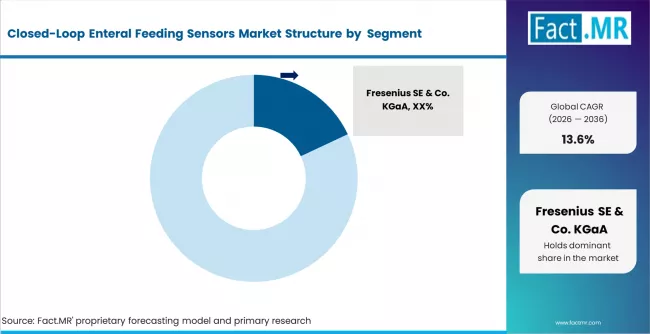
Closed Loop Enteral Feeding Sensors Market Analysis By Company | Source: Fact.MR
The Closed-Loop Enteral Feeding Sensors Market demonstrates a moderately concentrated competitive structure, supported by medical device manufacturers specializing in enteral nutrition delivery systems and monitoring technologies. Leading companies including Fresenius SE & Co. KGaA, Cardinal Health Inc., Becton Dickinson and Company, B. Braun Melsungen AG, Avanos Medical Inc., and Moog Inc. collectively account for nearly 60–70% of market share, particularly in sensor-enabled feeding pump systems designed to improve dosing accuracy and patient safety. Competitive positioning is primarily determined by sensor precision, compatibility with feeding pumps, alarm reliability, and compliance with clinical safety requirements. Regulatory approval requirements and integration complexity create entry barriers, limiting participation to established healthcare technology providers with validated enteral feeding device portfolios.
Structural advantages are observed among companies possessing integrated enteral nutrition product ecosystems covering feeding pumps, tubing sets, and sensor-enabled monitoring accessories. Fresenius SE & Co. KGaA and B. Braun Melsungen AG benefit from established hospital relationships and long-term supply agreements with healthcare providers. Buyers including hospitals and long-term care facilities typically manage supplier dependency through multi-vendor qualification and compatibility evaluation across installed feeding systems. Procurement decisions often consider reliability of sensor calibration, ease of integration into clinical workflows, and compliance with patient safety protocols. Pricing power remains relatively balanced, though suppliers retain moderate leverage where compatibility requirements and regulatory certifications create switching constraints for healthcare providers adopting automated enteral nutrition monitoring technologies.
Key Players of the Closed-Loop Enteral Feeding Sensors Market
- Fresenius SE & Co. KGaA
- Cardinal Health Inc.
- Avanos Medical Inc.
- Becton Dickinson and Company
- B. Braun Melsungen AG
- Moog Inc.
- Cook Medical Inc.
- Danone Nutricia
- Applied Medical Technology Inc.
- Vygon SA
Bibliographies
- [1] National Health Commission (China). (2023, March). Hospital digitalization framework update.
- [2] Department of Pharmaceuticals (India). (2023, April). National Medical Device Policy implementation framework.
- [3] National Health Service England. (2023, September). NHS MedTech funding mandate update.
- [4] European Commission. (ongoing). EU Medical Device Regulation implementation.
- [5] U.S. Food and Drug Administration. (2023, February). Digital health guidance update.
- [6] Fresenius SE & Co. KGaA. (2023, July). Enteral feeding system collaboration initiatives expansion.
- [7] B. Braun India. (2023, June). Enteral feeding technology distribution capability expansion.
- [8] Danone Nutricia. (2023, May). Digital enteral nutrition collaboration initiatives expansion.
- [9] B. Braun Melsungen AG. (2023, March). Sensor-enabled enteral feeding technology research expansion.
- [10] Baxter International Inc. (2023, August). Smart feeding technology development program expansion.
This Report Addresses
- Market size estimation and revenue forecasts from 2026 to 2036, supported by validated procedure volume benchmarks and adoption trends across automated clinical nutrition delivery systems.
- Growth opportunity mapping across pressure sensors, flow sensors, air bubble detectors, weight monitoring sensors, and multimodal sensing architectures aligned with precision enteral feeding control requirements.
- Segment and regional revenue forecasts covering continuous feeding, intermittent feeding, neonatal nutrition, ICU nutrition management, and home nutrition therapy applications across hospital and homecare environments.
- Competition strategy assessment including benchmarking of sensor calibration accuracy, device interoperability capability, and closed-loop algorithm performance across automated enteral nutrition platforms.
- Regulatory impact analysis covering ISO enteral device safety standards, IEC medical electrical equipment requirements, and digital health compliance frameworks influencing sensor-integrated nutrition delivery adoption.
- Market report delivery in PDF, Excel, PPT, and structured data formats designed for hospital procurement teams, biomedical engineers, clinical nutrition specialists, and connected medical device developers.
- Supply chain vulnerability assessments identifying concentration risks in medical-grade sensor manufacturing, microelectromechanical system component production, and embedded monitoring electronics supporting closed-loop feeding technologies.
Market Definition
The closed-loop enteral feeding sensors market refers to sensor-based medical technologies that automatically monitor and regulate delivery of liquid nutrition through feeding tubes. These systems use pressure, flow, and air detection sensors to adjust feeding rates in real time, improving dosing accuracy and reducing risks such as blockage, leakage, or incorrect nutrient delivery.
Closed-Loop Enteral Feeding Sensors Market Inclusions
The report covers global and regional market size, historical performance, and forecast outlook across the defined study period. It includes segmentation by sensor type such as pressure, flow, and occlusion sensors, application across hospitals and home care settings, and end users including critical care units and long-term care facilities. Pricing structure, supply chain, and technology integration analysis are included.
Closed-Loop Enteral Feeding Sensors Market Exclusions
The scope excludes standard enteral feeding pumps lacking automated sensor feedback functionality. Parenteral nutrition delivery devices, intravenous infusion monitoring systems, and standalone patient monitoring sensors are not included. Finished nutrition formulas and feeding tubes without integrated sensing capability are excluded, focusing strictly on sensor-enabled closed-loop enteral delivery technologies.
Closed-Loop Enteral Feeding Sensors Market Research Methodology
- Primary Research
- Interviews were conducted with medical device manufacturers, clinical nutrition specialists, biomedical engineers, and hospital procurement professionals involved in enteral feeding technologies.
- Desk Research
- Clinical publications, regulatory medical device databases, patent literature, and manufacturer technical documentation were reviewed to assess adoption trends in sensor-enabled feeding systems.
- Market-Sizing and Forecasting
- A hybrid estimation model combining bottom-up analysis of sensor-enabled device revenues and top-down evaluation of enteral nutrition procedure volumes was applied.
- Data Validation and Update Cycle
- Findings were validated using multiple clinical studies, supplier specifications, and expert inputs. Periodic updates reflect advances in sensor accuracy, integration with smart pumps, and evolving patient safety requirements.
Segmentation
Report Scope
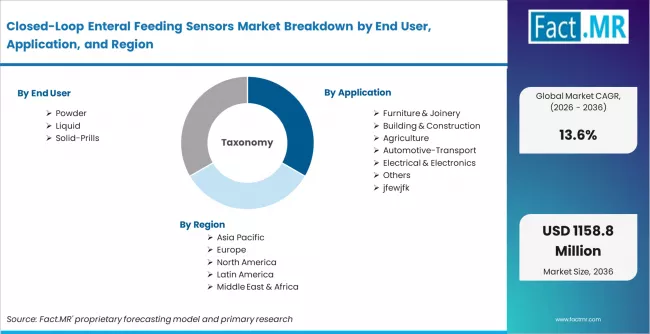
Closed Loop Enteral Feeding Sensors Market Breakdown By End User, Application, And Region | Source: Fact.MR
| Metric | Value |
|---|---|
| Quantitative Units | USD 285 million (2026) to USD 1,020 million (2036), at a CAGR of 13.6% |
| Market Definition | The closed-loop enteral feeding sensors market includes sensor-enabled monitoring technologies integrated into enteral nutrition delivery systems to enable automated feedback control of feeding flow, pressure conditions, and safety parameters. These systems support clinical nutrition management through continuous monitoring of feeding accuracy, obstruction detection, air bubble identification, and adaptive adjustment of enteral feeding protocols across hospital and home care environments. |
| Sensor Type Segmentation | Pressure sensors, Flow sensors, Air bubble detectors, Weight monitoring sensors, Multimodal sensors |
| Application Segmentation | Continuous enteral feeding, Intermittent feeding, Home nutrition therapy, ICU feeding management, Neonatal nutrition |
| End User Segmentation | Hospitals, Home healthcare providers, Long-term care facilities, Ambulatory care centers |
| Regions Covered | North America, Latin America, Europe, East Asia, South Asia, Oceania, Middle East and Africa |
| Countries Covered | United States, Canada, Mexico, Brazil, Argentina, Germany, France, United Kingdom, Italy, Spain, China, India, Japan, South Korea, Indonesia, Australia, and 40+ countries |
| Key Companies Profiled | Fresenius SE & Co. KGaA, Cardinal Health Inc., Avanos Medical Inc., Becton Dickinson and Company, B. Braun Melsungen AG, Moog Inc., Cook Medical Inc., Danone Nutricia, Applied Medical Technology Inc., Vygon SA |
| Forecast Period | 2026 to 2036 |
| Approach | Hybrid top-down and bottom-up market estimation validated through primary interviews with enteral feeding device manufacturers, clinical nutrition specialists, hospital procurement teams, and sensor technology developers, supported by healthcare procedure volume analysis, regulatory compliance benchmarking, and assessment of integration trends across smart medical nutrition delivery systems |
Source: Fact.MR analysis. Updated Apr 23, 2026
Closed Loop Enteral Feeding Sensors Market Key Segments
-
Sensor Type:
- Pressure Sensors
- Flow Sensors
- Air Bubble Detectors
- Weight Monitoring Sensors
- Multimodal Sensors
-
Application:
- Continuous Enteral Feeding
- Intermittent Feeding
- Home Nutrition Therapy
- ICU Feeding Management
- Neonatal Nutrition
-
End User:
- Hospitals
- Home Healthcare Providers
- Long Term Care Facilities
- Ambulatory Care Centers
-
Region:
- North America
- USA
- Canada
- Mexico
- Europe
- Germany
- UK
- France
- Italy
- Spain
- Nordic Countries
- BENELUX
- Rest of Europe
- Asia Pacific
- China
- Japan
- South Korea
- India
- Australia
- Rest of Asia Pacific
- Latin America
- Brazil
- Argentina
- Rest of Latin America
- Middle East and Africa
- Kingdom of Saudi Arabia
- United Arab Emirates
- South Africa
- Rest of Middle East and Africa
- Other Regions
- Oceania
- Central Asia
- Other Markets
- North America
Frequently Asked Questions
How large is the demand for Closed Loop Enteral Feeding Sensors in the global market in 2026?
What will be the market size of Closed Loop Enteral Feeding Sensors in the global market by 2036?
What is the expected demand growth for Closed Loop Enteral Feeding Sensors in the global market between 2026 and 2036?
Which End User is poised to lead global demand by 2026?
What is Driving Closed Loop Enteral Feeding Sensor Demand in China?
What is the China Growth Outlook in this Report?
What is Driving Closed Loop Enteral Feeding Sensor Demand in India?
What is the India Growth Outlook in this Report?
What is Driving Closed Loop Enteral Feeding Sensor Demand in the United Kingdom?
What is the United Kingdom Growth Outlook in this Report?
What is Driving Closed Loop Enteral Feeding Sensor Demand in Germany?
What is the Germany Growth Outlook in this Report?
What is Driving Closed Loop Enteral Feeding Sensor Demand in the United States?
What is the United States Growth Outlook in this Report?
Which Companies are Identified as Leading Participants in the Closed Loop Enteral Feeding Sensors Market?
What are Closed Loop Enteral Feeding Sensors and What are They Mainly Used For?
What does Closed Loop Enteral Feeding Sensors Market Mean in this Report?
What is Included in the Scope of this Closed Loop Enteral Feeding Sensors Market Report?
What is Excluded from the Scope of this Report?
What does Market Forecast Mean on this Page?
How is the Closed Loop Enteral Feeding Sensors Market Forecast Developed in this Report?
What does Data Validation Approach Mean in this Report?
Who worked on this report


Preview the report firsthand - request a free sample
Free SampleGet the brochure for pricing and purchase details
Download PDF