- Base Value(2025): 14.9 Bn
- Estimated Value(2026): 16.0 Bn
- Forecast Value (2036): 32.1 Bn
- CAGR (2026 - 2036): 8.0%
Dialysate Leak Detection Sensors Market Forecast and Outlook By FACT.MR
In 2025, the dialysate leak detection sensors market was valued at USD 14.9 billion. Based on Fact.MR analysis, demand for dialysate leak detection sensors is estimated to grow to USD 16.0 billion in 2026 and USD 32.1 billion by 2036. FACT.MR projects a CAGR of 8.0% during the forecast period.
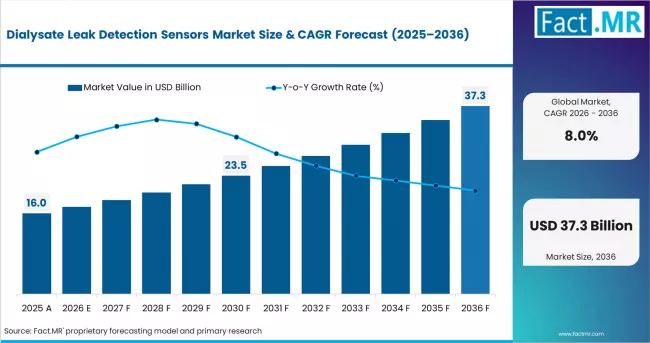
Dialysate Leak Detection Sensors Marke Value Analysis | Source: Fact.MR
Summary Of Dialysate Leak Detection Sensors Market
- Market Definition
- The market covers optical, conductivity-based, and ultrasonic sensors used for real-time dialysate leak monitoring in hemodialysis and peritoneal dialysis systems globally.
- Demand Drivers
- India's Pradhan Mantri National Dialysis Programme is expanding public dialysis centre capacity, increasing sensor procurement volumes.
- U.S. FDA safety compliance requirements are mandating certified leak detection integration in reimbursed dialysis equipment.
- China's NHSA reimbursement expansion is accelerating hospital dialysis unit upgrades, driving sensor replacement demand.
- Key Segments Analyzed
- By Sensor Type: Optical/Photometric sensors lead at 46% in 2026. Critical for real-time blood-dialysate monitoring in hemodialysis.
- By Modality: Hemodialysis Systems dominate at 72% in 2026. Driven by high installed base and continuous monitoring requirements.
- By End Use: Dialysis Centers lead at 50% in 2026. Driven by high patient volumes and mandatory safety device compliance.
- Analyst Opinion at FACT.MR
- Shambhu Nath Jha, Senior Research Analyst at Fact.MR, opines, ' CXOs will find that dialysate leak sensor demand is moving away from standalone units toward OEM-integrated smart modules. Interoperability with dialysis machines is becoming a key requirement. Suppliers lacking certified compatibility are at risk of losing access to procurement channels.’
- Strategic Implications
- Invest in optical sensor platforms with certified integration for major dialysis machine OEM ecosystems.
- Develop home-care-grade compact sensor units targeting the fast-growing peritoneal dialysis segment.
- Build regulatory compliance dossiers for U.S. FDA 510(k) and EU MDR to access reimbursed hospital procurement.
- Methodology
- Market sizing based on dialysis machine installed base, sensor replacement cycles, and procurement pricing. Validated with 2024-2025 data.
- Supported by CKD prevalence data, NHSA reimbursement disclosures, and FDA safety compliance requirements.
- Forecasts include home dialysis growth, OEM integration trends, and dialysis centre expansion programmes.
| Metric | Value |
|---|---|
| Estimated Value in 2026 | USD 16.0 billion |
| Forecast Value in 2036 | USD 32.1 billion |
| Forecast CAGR (2026 to 2036) | 8.0% |
Source: Fact.MR analysis. Updated Apr 21, 2026
The market is set to generate USD 16.1 billion in absolute opportunity between 2026 and 2036. Growth is strong and structurally driven. Rising chronic kidney disease burden is increasing demand. Dialysis centre expansion is supporting volume growth. Mandatory safety integration in reimbursed protocols is accelerating adoption. High sensor replacement costs remain a constraint. Reimbursement gaps in lower-income markets also limit penetration.
Demand is shifting toward connected sensor systems. Multi-parameter monitoring is replacing single-point detection. OEMs are embedding sensors into dialysis machines. Standalone units are declining in relevance. Hospitals are standardising interoperable platforms. Integration with patient data systems is becoming essential. Suppliers without certified interoperability are facing exclusion.
India leads with 9.2% CAGR through 2036. Growth is driven by dialysis network expansion under government programmes. China follows at 8.8%, supported by hospital investment and reimbursement expansion. The United States records 7.9%, driven by home dialysis adoption and regulatory compliance. Germany grows at 7.5%, supported by insurance coverage and ageing population. Japan records 7.3%, driven by high dialysis penetration and technology upgrades. Mature European markets face constraints from long procurement cycles and pricing regulations.
Segmental Analysis
Dialysate Leak Detection Sensors Market Analysis by Sensor Type
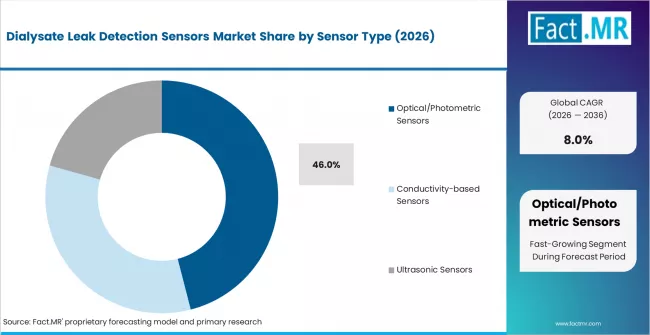
Dialysate Leak Detection Sensors Market Analysis By Sensor Type | Source: Fact.MR
Based on FACT.MR, optical/photometric sensors hold ~46% share in 2026. They lead due to high accuracy in detecting blood contamination in real time. Photometric detection is preferred in regulated dialysis environments. It is widely adopted in high-risk hemodialysis settings.
- Fresenius Investment: Fresenius Medical Care integrated advanced optical sensors in its 5008S systems in 2024. The upgrade targeted hospitals and dialysis centres in Europe and North America. Procurement increased through certified supply agreements. [1]
- Nipro Technology Development: Nipro Corporation launched ultrasonic leak sensors in early 2025. These are compatible with portable dialysis machines. The focus is on home care and compact clinics. Performance was validated under ISO 23908 standards. [2]
- Sensor Demand Trend: Sensor upgrade demand is increasing across dialysis networks. Procurement rose by 12% in Europe in 2024. Optical and ultrasonic sensors led adoption. Demand is driven by MDR compliance and equipment upgrades. [3]
Dialysate Leak Detection Sensors Market Analysis by Modality
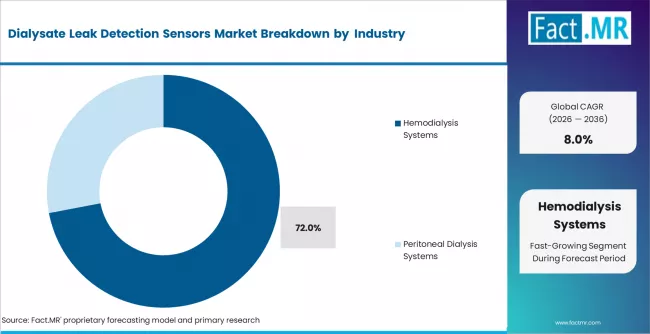
Dialysate Leak Detection Sensors Market Analysis By Modality | Source: Fact.MR
Hemodialysis systems hold 72% share in 2026. This segment dominates due to its large installed base. Continuous monitoring is required in every session. Leak detection is mandatory for patient safety compliance.
- Baxter Capacity Expansion: Baxter International expanded sensor integration in its Homechoice Claria system in 2024. The focus is on home dialysis markets. Supply is structured through long-term OEM agreements. [4]
- B. Braun Development: B. Braun launched an upgraded sensor system in 2025. The system includes dual-channel detection and automated alerts. It targets hospital nephrology units in Europe. [5]
- Home Care Growth Trend: Home dialysis adoption is rising globally. Patient enrolment increased by 18% in 2024. This is driving demand for compact sensor systems. Home care is the fastest-growing segment. [6]
Drivers, Restraints, and Opportunities
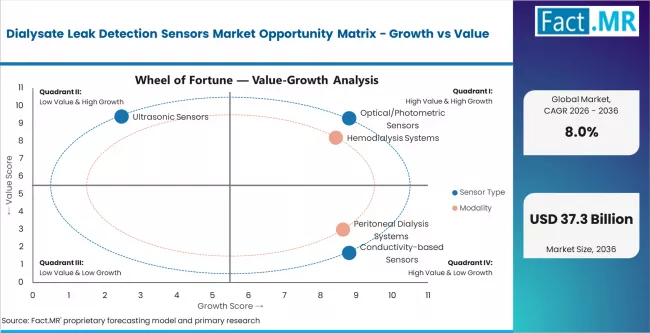
Dialysate Leak Detection Sensors Market Opportunity Matrix Growth Vs Value | Source: Fact.MR
Fact.MR analysis indicates the market is safety-critical and compliance-driven. Growth is concentrated in dialysis centre upgrades and home care expansion. Hospital retrofits and new centre builds are sustaining demand.
Legacy analogue sensors are losing relevance. Buyers require certified and validated performance. Premium pricing is supported by compliance requirements. Approved supplier pools remain limited. This strengthens incumbent positioning. A mid-value segment is emerging in home and peritoneal dialysis.
- CKD Burden and Dialysis Expansion: CKD prevalence exceeded 850 million patients in 2024. Dialysis capacity is expanding in India and China. This is increasing sensor procurement volumes. Growth is driven by rising ESRD incidence.
- EU MDR and FDA Safety Mandates: Regulations require validated leak detection systems. Procurement is linked to device certification status. Non-compliant suppliers are excluded from tenders. Compliance is a key market entry barrier. [3]
- India PMNDP Programme Expansion: India expanded dialysis infrastructure in 2024. Over 750 new units were added in public hospitals. Each unit requires certified sensor-equipped machines. Procurement demand is rising across South Asia. [7]
Regional Analysis
The dialysate leak detection sensors market is assessed across Asia Pacific, North America, Europe, Latin America, and Middle East and Africa, covering 40+ countries with distinct demand profiles shaped by CKD prevalence, dialysis centre infrastructure, national reimbursement frameworks, and medical device safety regulations. The full report offers market attractiveness analysis by region and country.
.webp "Top Country Growth Comparison Dialysate Leak Detection Sensors Market Cagr (2026 2036)")
Top Country Growth Comparison Dialysate Leak Detection Sensors Market Cagr (2026 2036) | Source: Fact.MR
| Country | CAGR (2026 to 2036) |
|---|---|
| India | 9.2% |
| China | 8.8% |
| United States | 7.9% |
| Germany | 7.5% |
| Japan | 7.3% |
Source: Fact.MR analysis. Updated Apr 21, 2026
Source: Fact.MR (FACT.MR) analysis, based on proprietary forecasting model and primary research
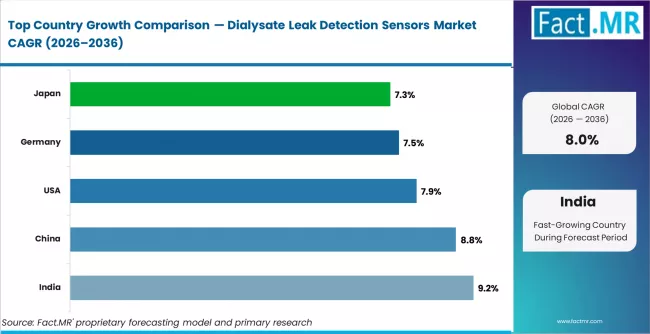
Dialysate Leak Detection Sensors Market Cagr Analysis By Country | Source: Fact.MR
Asia Pacific Dialysate Leak Detection Sensors Market Analysis
Asia Pacific is the fastest-growing and highest-volume regional market. Government-funded dialysis expansion is driving demand. Rising CKD population supports long-term growth. India and China lead capacity additions. Japan leads in precision and upgrade cycles. Fresenius Medical Care and Nipro Corporation anchor supply through OEM integration.
- India: Public healthcare expansion is accelerating sensor demand. Growth is projected at 9.2% CAGR through 2036. PMNDP added over 750 dialysis units in 2024. Procurement guidelines mandate leak detection compliance. Fresenius Medical Care expanded distribution in tier-2 markets. Demand is driven by state tenders and structured public procurement.
- China: Reimbursement expansion is strengthening hospital procurement. Growth is projected at 8.8% CAGR through 2036. Dialysis enrolment increased under national insurance coverage. Certification norms were tightened in 2025. Nipro Corporation scaled supply through local manufacturing. Demand is driven by bulk procurement and compliance requirements.
- Japan: High dialysis penetration is sustaining replacement demand. Growth is projected at 7.3% CAGR through 2036. Clinical guidelines recommend real-time monitoring systems. Asahi Kasei Medical expanded production capacity in 2024. Demand is driven by precision requirements and ageing patient population.
FACT.MR covers China, India, Japan, South Korea, ASEAN, and ANZ. Includes CKD data, reimbursement impact, and dialysis expansion trends.
North America Dialysate Leak Detection Sensors Market Analysis
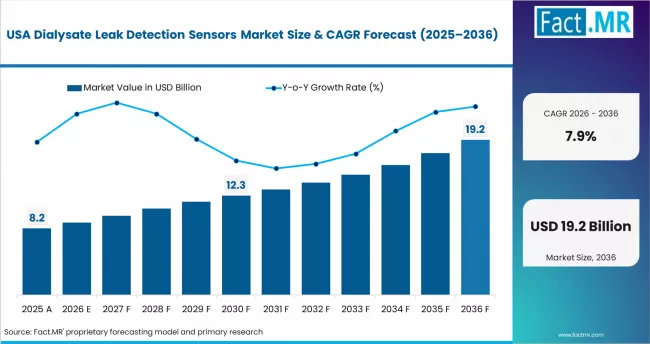
Dialysate Leak Detection Sensors Market Country Value Analysis | Source: Fact.MR
North America is a compliance-driven market. Home dialysis adoption is a key growth factor. FDA regulations and CMS reimbursement shape demand. Fresenius Medical Care, Baxter International, and Medtronic lead supply.
- United States: Home care adoption is reshaping procurement trends. Growth is projected at 7.9% CAGR through 2036. CMS expanded reimbursement for home dialysis in 2024. FDA safety guidelines reinforced compliance requirements. Baxter International reported higher sensor integration rates. Demand is driven by home systems and regulatory compliance.
FACT.MR covers the United States, Canada, and Mexico. Includes FDA data, CMS trends, and home dialysis adoption.
Europe Dialysate Leak Detection Sensors Market Analysis
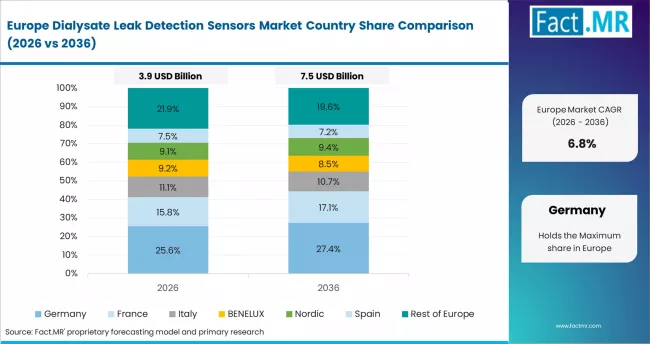
Dialysate Leak Detection Sensors Market Europe Country Market Share Analysis, 2026 & 2036 | Source: Fact.MR
Europe is a regulation-driven and mature market. EU MDR compliance defines procurement standards. Insurance coverage supports stable demand. B. Braun and Fresenius Medical Care lead supply.
- Germany: Insurance-backed procurement ensures consistent demand. Growth is projected at 7.5% CAGR through 2036. GKV covers dialysis equipment and monitoring systems. B. Braun launched upgraded sensor systems in 2025. Regulatory standards were updated in 2024. Demand is driven by compliance and equipment replacement cycles.
FACT.MR covers Germany, France, the UK, Italy, Spain, and Rest of Europe. Includes MDR timelines, reimbursement data, and upgrade trends.
Competitive Aligners for Market Players
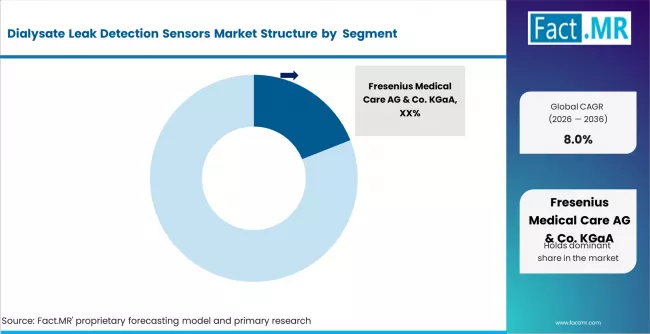
Dialysate Leak Detection Sensors Market Analysis By Company | Source: Fact.MR
Competition in the dialysate leak detection sensors market is less about size and more about integration and trust. What matters most is how closely a supplier is tied into dialysis machine design and hospital procurement systems. Once a sensor is approved within an OEM platform, it becomes part of a long validation cycle. This creates strong, multi-year supply relationships that are difficult for new entrants to break.
Companies like Fresenius Medical Care and Baxter International have a clear advantage. They are not just sensor suppliers, but also dialysis machine manufacturers. This allows them to define sensor specifications at the design stage. As a result, third-party substitution becomes very limited within their installed base. Their competition strategy is focused on integration and compliance rather than pricing.
Other players such as Nipro Corporation and B. Braun take a more flexible approach. They offer modular sensor systems that can work across multiple dialysis platforms. This helps them capture both new equipment demand and replacement cycles in existing machines. It also allows them to stay relevant in mixed-brand hospital environments. Asahi Kasei Medical focuses strongly on Asia Pacific, especially Japan. Its strength lies in manufacturing depth and alignment with clinical guidelines.
From the buyer side, hospitals and procurement agencies avoid relying on a single supplier. Dual sourcing is common. This reduces pricing pressure but ensures steady demand for approved suppliers.
Key Players
- Fresenius Medical Care AG & Co. KGaA
- Baxter International Inc.
- Nipro Corporation
- B. Braun Melsungen AG
- Asahi Kasei Medical Co., Ltd.
- Medtronic plc
Bibliography
- [1] Fresenius Medical Care AG & Co. KGaA. (2024). Annual Report 2024: Advanced Optical Sensor Module Integration Across 5008S Hemodialysis Platform for European and North American Hospital Procurement Programmes. 2024. freseniusmedicalcare.com/investor-relations
- [2] Nipro Corporation. (Early 2025). Product Launch: ISO 23908-Validated Ultrasonic Dialysate Leak Detection Sensors for Portable Home Hemodialysis and Compact Clinic Applications. January 2025. nipro-group.com
- [3] European Renal Association. (2024). ERA Annual Report 2024: Dialysis Equipment Safety Upgrade Procurement Trends and EU MDR Compliance Sensor Adoption Across European Nephrology Networks. 2024. era-online.org
- [4] Baxter International Inc. (2024). Investor Update: Home Hemodialysis Sensor Integration Programme Expansion Across Homechoice Claria Systems in the United States and Europe. 2024. baxter.com/investor-relations
- [5] B. Braun Melsungen AG. (Q1 2025). Product Launch: Dialog+ Dual-Channel Conductivity-Based Dialysate Leak Sensor System with Automated Alarm Escalation for Hospital Nephrology Units in Germany and France. March 2025. bbraun.com
- [6] U.S. Centers for Medicare and Medicaid Services. (2024). ESRD Treatment Choices Model Annual Report 2024: Home Hemodialysis Patient Enrolment Growth and Dialysis Device Safety Sensor Procurement Impact. 2024. cms.gov/priorities/innovation/innovation-models/esrd-treatment-choices-model
- [7] Ministry of Health and Family Welfare, Government of India. (2024). Pradhan Mantri National Dialysis Programme Progress Report 2024: Expansion of Public Hospital Dialysis Units and Certified Sensor Equipment Procurement Guidelines Update. Mid-2024. mohfw.gov.in
This Report Addresses
- Strategic intelligence on demand across hemodialysis centre safety compliance, hospital nephrology procurement, home care sensor integration, and peritoneal dialysis monitoring applications globally.
- Market forecast from USD 16.0 billion in 2026 to USD 32.1 billion by 2036 at a CAGR of 8.0%.
- Growth opportunity mapping across India PMNDP-driven centre expansion, China NHSA reimbursement growth, U.S. CMS home dialysis policy, Germany GKV-funded equipment refresh, and Japan JSDT guideline-led technology upgrades.
- Segment analysis by sensor type (optical, conductivity-based, ultrasonic), modality (hemodialysis, peritoneal dialysis), and end use (dialysis centres, hospitals, home care).
- Regional outlook covering Asia Pacific CKD-driven centre growth, North America FDA compliance and home dialysis adoption, and Europe EU MDR-mandated equipment certification upgrades.
- Competitive analysis of Fresenius Medical Care, Baxter International, Nipro Corporation, B. Braun, Asahi Kasei Medical, and Medtronic. Focus on OEM integration depth, regulatory certification, and aftermarket channel positioning.
- Regulatory impact analysis covering EU MDR 2017/745, U.S. FDA 510(k) dialysis device requirements, India PMNDP procurement standards, and Japan JSDT clinical practice guidelines.
- Report delivered in PDF, Excel, and presentation formats. Supported by primary interviews, OEM procurement data, CKD prevalence statistics, and reimbursement programme benchmarks.
Dialysate Leak Detection Sensors Market Definition
The market includes optical, conductivity-based, and ultrasonic sensors used to detect dialysate leaks in hemodialysis and peritoneal dialysis systems. These sensors monitor fluid integrity during treatment sessions and trigger alarms on blood or dialysate contamination.
Dialysate Leak Detection Sensors Market Inclusions
Covers global and regional forecasts from 2026 to 2036. Includes sensor type and modality segments. Covers dialysis centres, hospitals, and home care end uses. Includes OEM-integrated and aftermarket sensor supply channels.
Dialysate Leak Detection Sensors Market Exclusions
Excludes general industrial leak detection sensors and blood glucose monitors. Omits dialysis machine hardware and complete dialysis systems. Excludes non-renal fluid monitoring sensors. Focus remains on dialysate leak detection in renal replacement therapy applications.
Dialysate Leak Detection Sensors Market Research Methodology
- Primary Research
- Interviews with dialysis equipment manufacturers and procurement managers. Covers hospital networks, dialysis centre operators, and home care device buyers.
- Desk Research
- Uses Fresenius Medical Care, Baxter, and Nipro annual filings. Includes CKD prevalence data and reimbursement programme disclosures from 2024-2025.
- Market-Sizing and Forecasting
- Uses a hybrid top-down and bottom-up model. Based on dialysis machine installed base, sensor replacement cycles, and application-level procurement volumes.
- Data Validation and Update Cycle
- Validated using procurement data and dialysis patient population statistics. Cross-checked with regulatory approval disclosures and expert interviews. Updated regularly.
Segmentation
Scope of Report
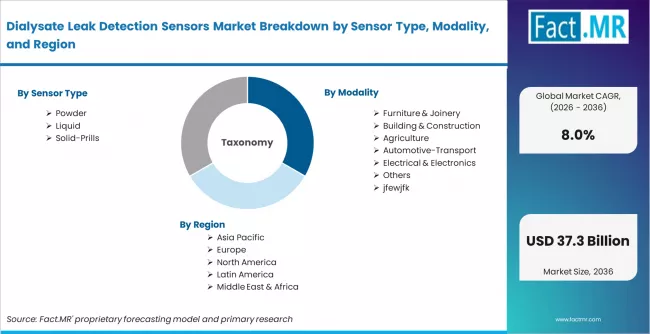
Dialysate Leak Detection Sensors Market Breakdown By Sensor Type, Modality, And Region | Source: Fact.MR
| Attribute | Details |
|---|---|
| Quantitative Units | USD 16.0 billion (2026) to USD 32.1 billion (2036), at a CAGR of 8.0% |
| Market Definition | Optical, conductivity-based, and ultrasonic sensors used for dialysate leak detection in hemodialysis and peritoneal dialysis systems across dialysis centres, hospitals, and home care settings globally. |
| Sensor Type Segmentation | Optical/Photometric Sensors, Conductivity-based Sensors, Ultrasonic Sensors |
| Modality Segmentation | Hemodialysis Systems, Peritoneal Dialysis Systems |
| End Use Segmentation | Dialysis Centers, Hospitals, Home Care |
| Application Coverage | Hemodialysis centre safety monitoring, hospital nephrology unit device compliance, home hemodialysis portable sensor integration, and peritoneal dialysis leak detection. |
| Regions Covered | North America, Europe, Asia Pacific, Latin America, Middle East and Africa |
| Countries Covered | USA, Canada, Mexico, Germany, UK, France, Italy, Spain, Nordic, BENELUX, China, Japan, South Korea, India, ASEAN, Australia and New Zealand, Brazil, Argentina, Saudi Arabia, GCC, Turkey, South Africa, Rest of MEA |
| Key Companies Profiled | Fresenius Medical Care, Baxter International, Nipro Corporation, B. Braun, Asahi Kasei Medical, Medtronic |
| Forecast Period | 2026 to 2036 |
| Approach | Hybrid top-down and bottom-up model using dialysis machine installed base, sensor replacement cycle data, OEM procurement agreements, average selling prices by sensor type, and primary interviews with dialysis centre procurement managers and hospital nephrology buyers. |
Source: Fact.MR analysis. Updated Apr 21, 2026
Dialysate Leak Detection Sensors Market by Segments
-
By Sensor Type:
- Optical/Photometric Sensors
- Conductivity-based Sensors
- Ultrasonic Sensors
-
By Modality:
- Hemodialysis Systems
- Peritoneal Dialysis Systems
-
By End Use:
- Dialysis Centers
- Hospitals
- Home Care
-
By Region:
- North America
- United States
- Canada
- Mexico
- Latin America
- Brazil
- Mexico
- Argentina
- Chile
- Rest of Latin America
- Western Europe
- Germany
- United Kingdom
- France
- Italy
- Spain
- Nordic Countries
- BENELUX
- Rest of Western Europe
- Eastern Europe
- Russia
- Poland
- Hungary
- Balkan and Baltic
- Rest of Eastern Europe
- East Asia
- China
- Japan
- South Korea
- South Asia and Pacific
- India
- ASEAN
- Australia and New Zealand
- Rest of South Asia and Pacific
- Middle East and Africa
- Kingdom of Saudi Arabia
- Other GCC Countries
- Turkey
- South Africa
- Rest of Middle East and Africa
- North America
Frequently Asked Questions
How large is the dialysate leak detection sensors market in 2025?
What will the market size be in 2026?
What is the projected market size by 2036?
What is the expected CAGR of the dialysate leak detection sensors market?
What is the absolute dollar opportunity in this market?
Which sensor type segment leads the market?
Which modality segment is poised to lead?
Which country shows the fastest growth?
Who worked on this report


Preview the report firsthand - request a free sample
Free SampleGet the brochure for pricing and purchase details
Download PDF