Disposable Medical Sensors Market
Disposable Medical Sensors Market Size and Share Forecast Outlook 2026 to 2036
Disposable medical sensors market is projected to grow from USD 7.2 billion in 2026 to USD 14.8 billion by 2036, at a CAGR of 7.5%. Temperature Sensors will dominate with a 38.4% market share, while hospitals will lead the application sector segment with a 58.7% share.
Disposable Medical Sensors Market Forecast and Outlook 2026 to 2036
The global disposable medical sensors market is valued at USD 7.2 billion in 2026 and is expected to reach USD 14.8 billion by 2036. This reflects an absolute increase of USD 7.6 billion and total growth of 105.6% over the period, with demand rising at a CAGR of 7.5%.
Market expansion of roughly 2.1X is supported by stricter infection control requirements, wider deployment of continuous patient monitoring systems, and sustained investment in biosafety and clinical efficiency across hospitals, diagnostic centers, and ambulatory care facilities.
Key Takeaways from the Disposable Medical Sensors Market
- Disposable Medical Sensors Market Value (2026): USD 7.2 billion
- Disposable Medical Sensors Market Forecast Value (2036): USD 14.8 billion
- Disposable Medical Sensors Market Forecast CAGR: 7.5%
- Leading Sensor Type in Disposable Medical Sensors Market: Temperature Sensors (38.4%)
- Key Growth Regions in Disposable Medical Sensors Market: North America, Europe, Asia Pacific
- Key Players in Disposable Medical Sensors Market: Medtronic PLC, Abbott Laboratories, Philips Healthcare, General Electric Company, Siemens Healthineers AG
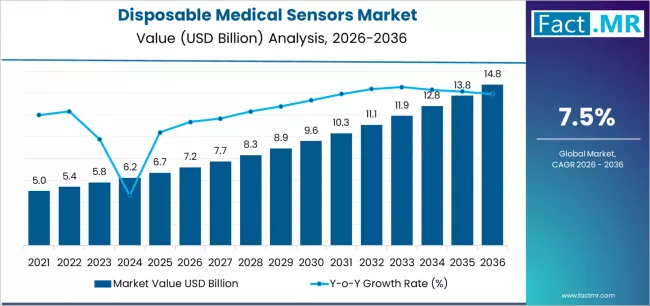
Temperature sensors represent the largest product category, accounting for 38.4% share in 2026. Their widespread use in routine monitoring, acute care, and post-operative settings continues to support steady adoption due to reliability, ease of integration, and low contamination risk. From an end-use perspective, hospitals dominate demand with a 58.7% share, reflecting high sensor consumption volumes in inpatient monitoring, intensive care units, and procedural environments.
At a broader level, market momentum is shaped by advances in disposable biosensor design, increasing use of wireless and connected monitoring devices, and growing acceptance of single-use components to reduce cross-contamination risks. Ongoing digitization of healthcare delivery, expansion of remote and wearable monitoring, and progress in sensor miniaturization and multi-parameter measurement are reinforcing long-term demand across clinical and homecare settings.
Disposable Medical Sensors Market
| Metric | Value |
|---|---|
| Estimated Value in (2026E) | USD 7.2 billion |
| Forecast Value in (2036F) | USD 14.8 billion |
| Forecast CAGR (2026 to 2036) | 7.5% |
Category
| Category | Segments |
|---|---|
| Sensor Type | Temperature Sensors; Pressure Sensors; ECG Sensors; Blood Glucose Sensors; Oxygen Sensors; Other Sensor Configurations |
| Application Sector | Hospitals; Ambulatory Surgical Centers; Home Healthcare; Diagnostic Laboratories; Others |
| Technology Platform | Wireless Sensors; Wired Systems; Biosensor Arrays; Smart Sensors; Other Technology Platforms |
| End-User Category | Public Hospitals; Private Healthcare Facilities; Home Care Providers; Other End-User Services |
| Region | North America; Europe; Asia Pacific; Latin America; Middle East & Africa |
Segmental Analysis
By Sensor Type, Which Segment Holds the Dominant Market Share?
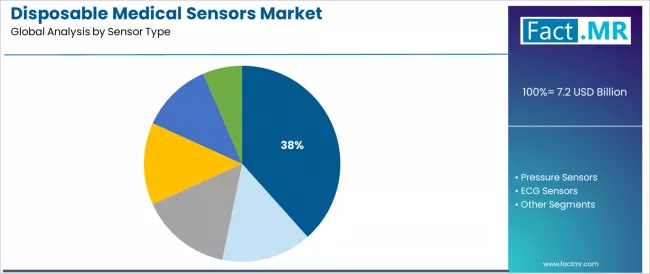
Temperature sensors are projected to account for 38.4% of the disposable medical sensors market in 2026, maintaining segment leadership. Their position is supported by reliable measurement accuracy, established clinical acceptance, and broad applicability across patient monitoring functions. Compatibility with existing monitoring systems and continued investment in diagnostic infrastructure further reinforce adoption across healthcare settings.
By Application Sector, Which Segment Registers the Highest Share?
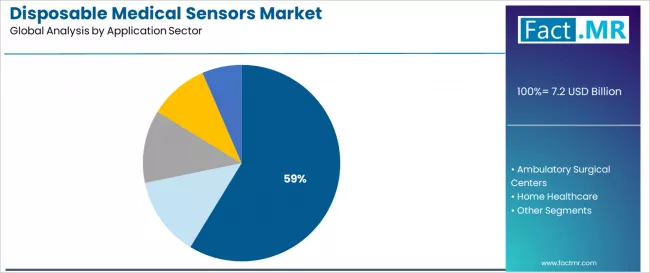
Hospitals are expected to represent 58.7% of market demand in 2026, reflecting their role as the primary setting for disposable sensor use. Centralized patient care, standardized monitoring protocols, and access to advanced clinical infrastructure support sustained utilization. Ongoing improvements in sensor performance are likely to strengthen hospital-led demand over the forecast period.
What are the Drivers, Restraints, and Key Trends of the Disposable Medical Sensors Market?
The disposable medical sensors market is advancing due to rising healthcare digitization and increasing demand for reliable, single-use monitoring solutions across clinical applications. Growth is supported by the need to reduce infection risks, streamline workflows, and enable continuous patient monitoring in hospitals and outpatient settings. However, the market faces restraints from competition with reusable sensor alternatives, device cost pressures, and technical integration challenges with existing healthcare IT systems.
A key trend is the expansion of wireless connectivity and data-driven applications, enabling real-time data collection, remote monitoring, and improved clinical decision-making. Wireless integration enhances monitoring consistency and supports operational efficiency across care settings. Another major trend is the integration of advanced biosensor technologies and patient-care systems. These innovations enable real-time data transmission, predictive monitoring, and automated alert mechanisms, extending the clinical value of disposable medical sensors beyond basic measurement functions.
Analysis of the Disposable Medical Sensors Market by Key Countries

| Country | CAGR (2026-2036) |
|---|---|
| China | 8.9% |
| India | 8.4% |
| Germany | 6.8% |
| Brazil | 7.8% |
| USA | 7.2% |
| UK | 6.5% |
| South Korea | 8.1% |
How is Healthcare Digitization Driving China’s Leadership in Disposable Medical Sensors?
China’s disposable medical sensors market is projected to grow at a CAGR of 8.9% through 2036, supported by rapid healthcare digitization, policy-backed modernization programs, and widespread adoption of digital monitoring in urban hospitals. Standardization initiatives and export-oriented manufacturing are strengthening demand for reliable, scalable sensor solutions. Global and domestic manufacturers are expanding installation, calibration, and integration capabilities to support hospital networks and public health systems.
- Rising digital healthcare adoption is increasing sensor usage across hospitals and remote monitoring environments.
- Infrastructure upgrades and policy alignment are accelerating uptake of high-quality disposable sensor platforms.
Why is Expanding Hospital Infrastructure Strengthening India’s Market Outlook?
India’s disposable medical sensors market is expanding at a CAGR of 8.4%, driven by growing healthcare investment, wider diagnostic access, and improving distributor reach. Expansion of tertiary hospitals and digital monitoring adoption in urban and semi-urban areas is supporting demand across acute and routine care settings. International suppliers and local firms are building regional service networks to address uneven infrastructure development.
- Growth in hospital construction and diagnostics capacity is supporting steady sensor adoption.
- Increasing awareness of continuous monitoring is driving demand for specialized disposable sensors.
How do Regulatory Stability and Technology Adoption Support Growth in South Korea?

South Korea’s disposable medical sensors market is projected to grow at a CAGR of 8.1% through 2036, supported by clear regulatory frameworks, advanced healthcare delivery models, and strong medical technology adoption. High clinical readiness and integration of digital monitoring systems are sustaining demand for precision-oriented disposable sensors. Manufacturers are aligning product portfolios with domestic standards and regional export requirements.
- Advanced healthcare technology adoption is driving demand for performance-focused sensor systems.
- Regulatory consistency supports wider use of innovative monitoring solutions.
Why is Healthcare Modernization Fueling Brazil’s Sensor Market Expansion?
Brazil’s disposable medical sensors market is expected to grow at a CAGR of 7.8% through 2036, driven by healthcare modernization initiatives, expanding hospital capacity, and improving distributor capabilities. Demand is rising across public and private facilities seeking cost-efficient monitoring tools suited to evolving care standards. Brazil’s regional healthcare influence supports broader adoption of standardized monitoring technologies.
- Hospital expansion and diagnostic access growth are increasing sensor deployment.
- Focus on efficiency and modernization supports adoption of specialized disposable sensors.
How does Integrated Care Delivery Sustain Growth in the USA?
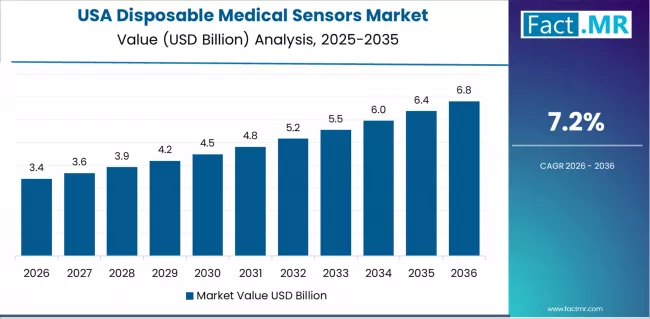
The USA’s disposable medical sensors market is projected to expand at a CAGR of 7.2% through 2036, supported by advanced care integration, remote monitoring adoption, and strong emphasis on clinical accuracy. Healthcare providers prioritize reliability, interoperability, and compliance, sustaining demand across inpatient and outpatient settings.
- Expansion of remote and precision monitoring programs is increasing sensor utilization.
- Strong quality benchmarks support adoption of validated disposable sensor solutions.
Why do Quality Assurance Standards Drive Steady Growth in Germany?
Germany’s disposable medical sensors market is forecast to grow at a CAGR of 6.8% through 2036, supported by mature healthcare systems, consistent funding, and strong emphasis on diagnostic accuracy. Hospitals and laboratories prioritize performance consistency, sustaining demand for premium disposable sensor solutions.
- Established healthcare infrastructure supports continuous sensor demand.
- Focus on quality and efficiency reinforces adoption of proven monitoring technologies.
How is Precision-Oriented Healthcare Supporting Market Growth in the UK?
The UK disposable medical sensors market is projected to grow at a CAGR of 6.5% through 2036, driven by emphasis on clinical precision, digital health integration, and standardized care pathways. Demand remains steady across hospitals and specialty care settings adopting technology-enabled monitoring.
- Digital health initiatives are expanding sensor use in clinical monitoring.
- Emphasis on precision and compliance supports uptake of high-reliability sensor systems.
Competitive Landscape of the Disposable Medical Sensors Market
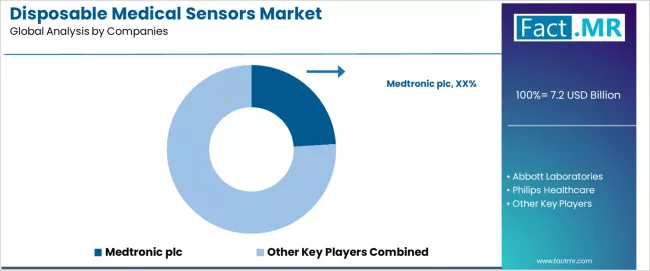
The disposable medical sensors market is shaped by competition among established medical device manufacturers, specialized sensor developers, and integrated healthcare solution providers. Companies are investing in advanced sensor architectures, real-time monitoring platforms, and scalable manufacturing capabilities to ensure consistent performance, clinical reliability, and regulatory compliance. Product development increasingly emphasizes digital signal processing, wireless connectivity, and seamless integration with hospital information systems to support continuous patient monitoring across care settings.
Market participants are also strengthening distribution networks and service capabilities to support large-scale hospital deployments and outpatient monitoring programs. Innovation is focused on improving sensor accuracy, reducing response time, and enhancing patient comfort while maintaining cost efficiency for high-volume clinical use.
Abbott Laboratories emphasizes precision monitoring solutions and integrated healthcare automation. Philips Healthcare focuses on clinical workflow integration and operational efficiency. General Electric Company specializes in advanced monitoring technologies for acute and critical care environments. Siemens Healthineers AG prioritizes sophisticated medical equipment design aligned with evolving diagnostic and monitoring requirements.
Key Players in the Disposable Medical Sensors Market
- Medtronic plc
- Abbott Laboratories
- Philips Healthcare
- General Electric Company
- Siemens Healthineers AG
- Honeywell International Inc.
- TE Connectivity Ltd.
- First Sensor AG
- Smiths Medical
- ICU Medical Inc.
- Analog Devices Inc.
- Texas Instruments Incorporated
- STMicroelectronics N.V.
- Sensirion AG
- Amphenol Corporation
Scope of the Report
| Items | Values |
|---|---|
| Quantitative Units (2026) | USD 7.2 Billion |
| Sensor Type | Temperature Sensors, Pressure Sensors, ECG Sensors, Blood Glucose Sensors, Oxygen Sensors, Other Sensor Configurations |
| Application Sector | Hospitals, Ambulatory Surgical Centers, Home Healthcare, Diagnostic Laboratories, Others |
| Technology Platform | Wireless Sensors, Wired Systems, Biosensor Arrays, Smart Sensors, Other Technology Platforms |
| End-User Category | Public Hospitals, Private Healthcare Facilities, Home Care Providers, Other End-User Services |
| Regions Covered | North America, Europe, Asia Pacific, Latin America, MEA, Other Regions |
| Countries Covered | China, India, Germany, Brazil, USA, UK, South Korea, and 40+ countries |
| Key Companies Profiled | Medtronic PLC, Abbott Laboratories, Philips Healthcare, General Electric Company, Siemens Healthineers AG, and other leading sensor companies |
| Additional Attributes | Dollar sales by sensor type, application sector, technology platform, end-user category, and region; regional demand trends, competitive landscape, technological advancements in sensor engineering, operational performance optimization initiatives, monitoring enhancement programs, and premium product development strategies |
Disposable Medical Sensors Market by Segments
-
Sensor Type :
- Temperature Sensors
- Pressure Sensors
- ECG Sensors
- Blood Glucose Sensors
- Oxygen Sensors
- Other Sensor Configurations
-
Application Sector :
- Hospitals
- Ambulatory Surgical Centers
- Home Healthcare
- Diagnostic Laboratories
- Others
-
Technology Platform :
- Wireless Sensors
- Wired Systems
- Biosensor Arrays
- Smart Sensors
- Other Technology Platforms
-
End-User Category :
- Public Hospitals
- Private Healthcare Facilities
- Home Care Providers
- Other End-User Services
-
Region :
-
North America
- USA
- Canada
- Mexico
-
Europe
- Germany
- UK
- France
- Italy
- Spain
- Nordic Countries
- BENELUX
- Rest of Europe
-
Asia Pacific
- China
- India
- Japan
- South Korea
- Australia
- Rest of Asia Pacific
-
Latin America
- Brazil
- Argentina
- Rest of Latin America
-
MEA
- Saudi Arabia
- UAE
- South Africa
- Rest of MEA
-
Table of Content
- Executive Summary
- Global Market Outlook
- Demand to side Trends
- Supply to side Trends
- Technology Roadmap Analysis
- Analysis and Recommendations
- Market Overview
- Market Coverage / Taxonomy
- Market Definition / Scope / Limitations
- Market Background
- Market Dynamics
- Drivers
- Restraints
- Opportunity
- Trends
- Scenario Forecast
- Demand in Optimistic Scenario
- Demand in Likely Scenario
- Demand in Conservative Scenario
- Opportunity Map Analysis
- Product Life Cycle Analysis
- Supply Chain Analysis
- Investment Feasibility Matrix
- Value Chain Analysis
- PESTLE and Porter’s Analysis
- Regulatory Landscape
- Regional Parent Market Outlook
- Production and Consumption Statistics
- Import and Export Statistics
- Market Dynamics
- Global Market Analysis 2021 to 2025 and Forecast, 2026 to 2036
- Historical Market Size Value (USD Million) Analysis, 2021 to 2025
- Current and Future Market Size Value (USD Million) Projections, 2026 to 2036
- Y to o to Y Growth Trend Analysis
- Absolute $ Opportunity Analysis
- Global Market Pricing Analysis 2021 to 2025 and Forecast 2026 to 2036
- Global Market Analysis 2021 to 2025 and Forecast 2026 to 2036, By Sensor Type
- Introduction / Key Findings
- Historical Market Size Value (USD Million) Analysis By Sensor Type, 2021 to 2025
- Current and Future Market Size Value (USD Million) Analysis and Forecast By Sensor Type, 2026 to 2036
- Temperature Sensors
- Pressure Sensors
- ECG Sensors
- Blood Glucose Sensors
- Oxygen Sensors
- Other Sensor Configurations
- Y to o to Y Growth Trend Analysis By Sensor Type, 2021 to 2025
- Absolute $ Opportunity Analysis By Sensor Type, 2026 to 2036
- Global Market Analysis 2021 to 2025 and Forecast 2026 to 2036, By Application Sector
- Introduction / Key Findings
- Historical Market Size Value (USD Million) Analysis By Application Sector, 2021 to 2025
- Current and Future Market Size Value (USD Million) Analysis and Forecast By Application Sector, 2026 to 2036
- Hospitals
- Ambulatory Surgical Centers
- Home Healthcare
- Diagnostic Laboratories
- Others
- Y to o to Y Growth Trend Analysis By Application Sector, 2021 to 2025
- Absolute $ Opportunity Analysis By Application Sector, 2026 to 2036
- Global Market Analysis 2021 to 2025 and Forecast 2026 to 2036, By Region
- Introduction
- Historical Market Size Value (USD Million) Analysis By Region, 2021 to 2025
- Current Market Size Value (USD Million) Analysis and Forecast By Region, 2026 to 2036
- North America
- Latin America
- Western Europe
- Eastern Europe
- East Asia
- South Asia and Pacific
- Middle East & Africa
- Market Attractiveness Analysis By Region
- North America Market Analysis 2021 to 2025 and Forecast 2026 to 2036, By Country
- Historical Market Size Value (USD Million) Trend Analysis By Market Taxonomy, 2021 to 2025
- Market Size Value (USD Million) Forecast By Market Taxonomy, 2026 to 2036
- By Country
- USA
- Canada
- Mexico
- By Sensor Type
- By Application Sector
- By Country
- Market Attractiveness Analysis
- By Country
- By Sensor Type
- By Application Sector
- Key Takeaways
- Latin America Market Analysis 2021 to 2025 and Forecast 2026 to 2036, By Country
- Historical Market Size Value (USD Million) Trend Analysis By Market Taxonomy, 2021 to 2025
- Market Size Value (USD Million) Forecast By Market Taxonomy, 2026 to 2036
- By Country
- Brazil
- Chile
- Rest of Latin America
- By Sensor Type
- By Application Sector
- By Country
- Market Attractiveness Analysis
- By Country
- By Sensor Type
- By Application Sector
- Key Takeaways
- Western Europe Market Analysis 2021 to 2025 and Forecast 2026 to 2036, By Country
- Historical Market Size Value (USD Million) Trend Analysis By Market Taxonomy, 2021 to 2025
- Market Size Value (USD Million) Forecast By Market Taxonomy, 2026 to 2036
- By Country
- Germany
- UK
- Italy
- Spain
- France
- Nordic
- BENELUX
- Rest of Western Europe
- By Sensor Type
- By Application Sector
- By Country
- Market Attractiveness Analysis
- By Country
- By Sensor Type
- By Application Sector
- Key Takeaways
- Eastern Europe Market Analysis 2021 to 2025 and Forecast 2026 to 2036, By Country
- Historical Market Size Value (USD Million) Trend Analysis By Market Taxonomy, 2021 to 2025
- Market Size Value (USD Million) Forecast By Market Taxonomy, 2026 to 2036
- By Country
- Russia
- Poland
- Hungary
- Balkan & Baltic
- Rest of Eastern Europe
- By Sensor Type
- By Application Sector
- By Country
- Market Attractiveness Analysis
- By Country
- By Sensor Type
- By Application Sector
- Key Takeaways
- East Asia Market Analysis 2021 to 2025 and Forecast 2026 to 2036, By Country
- Historical Market Size Value (USD Million) Trend Analysis By Market Taxonomy, 2021 to 2025
- Market Size Value (USD Million) Forecast By Market Taxonomy, 2026 to 2036
- By Country
- China
- Japan
- South Korea
- By Sensor Type
- By Application Sector
- By Country
- Market Attractiveness Analysis
- By Country
- By Sensor Type
- By Application Sector
- Key Takeaways
- South Asia and Pacific Market Analysis 2021 to 2025 and Forecast 2026 to 2036, By Country
- Historical Market Size Value (USD Million) Trend Analysis By Market Taxonomy, 2021 to 2025
- Market Size Value (USD Million) Forecast By Market Taxonomy, 2026 to 2036
- By Country
- India
- ASEAN
- Australia & New Zealand
- Rest of South Asia and Pacific
- By Sensor Type
- By Application Sector
- By Country
- Market Attractiveness Analysis
- By Country
- By Sensor Type
- By Application Sector
- Key Takeaways
- Middle East & Africa Market Analysis 2021 to 2025 and Forecast 2026 to 2036, By Country
- Historical Market Size Value (USD Million) Trend Analysis By Market Taxonomy, 2021 to 2025
- Market Size Value (USD Million) Forecast By Market Taxonomy, 2026 to 2036
- By Country
- Kingdom of Saudi Arabia
- Other GCC Countries
- Turkiye
- South Africa
- Other African Union
- Rest of Middle East & Africa
- By Sensor Type
- By Application Sector
- By Country
- Market Attractiveness Analysis
- By Country
- By Sensor Type
- By Application Sector
- Key Takeaways
- Key Countries Market Analysis
- USA
- Pricing Analysis
- Market Share Analysis, 2025
- By Sensor Type
- By Application Sector
- Canada
- Pricing Analysis
- Market Share Analysis, 2025
- By Sensor Type
- By Application Sector
- Mexico
- Pricing Analysis
- Market Share Analysis, 2025
- By Sensor Type
- By Application Sector
- Brazil
- Pricing Analysis
- Market Share Analysis, 2025
- By Sensor Type
- By Application Sector
- Chile
- Pricing Analysis
- Market Share Analysis, 2025
- By Sensor Type
- By Application Sector
- Germany
- Pricing Analysis
- Market Share Analysis, 2025
- By Sensor Type
- By Application Sector
- UK
- Pricing Analysis
- Market Share Analysis, 2025
- By Sensor Type
- By Application Sector
- Italy
- Pricing Analysis
- Market Share Analysis, 2025
- By Sensor Type
- By Application Sector
- Spain
- Pricing Analysis
- Market Share Analysis, 2025
- By Sensor Type
- By Application Sector
- France
- Pricing Analysis
- Market Share Analysis, 2025
- By Sensor Type
- By Application Sector
- India
- Pricing Analysis
- Market Share Analysis, 2025
- By Sensor Type
- By Application Sector
- ASEAN
- Pricing Analysis
- Market Share Analysis, 2025
- By Sensor Type
- By Application Sector
- Australia & New Zealand
- Pricing Analysis
- Market Share Analysis, 2025
- By Sensor Type
- By Application Sector
- China
- Pricing Analysis
- Market Share Analysis, 2025
- By Sensor Type
- By Application Sector
- Japan
- Pricing Analysis
- Market Share Analysis, 2025
- By Sensor Type
- By Application Sector
- South Korea
- Pricing Analysis
- Market Share Analysis, 2025
- By Sensor Type
- By Application Sector
- Russia
- Pricing Analysis
- Market Share Analysis, 2025
- By Sensor Type
- By Application Sector
- Poland
- Pricing Analysis
- Market Share Analysis, 2025
- By Sensor Type
- By Application Sector
- Hungary
- Pricing Analysis
- Market Share Analysis, 2025
- By Sensor Type
- By Application Sector
- Kingdom of Saudi Arabia
- Pricing Analysis
- Market Share Analysis, 2025
- By Sensor Type
- By Application Sector
- Turkiye
- Pricing Analysis
- Market Share Analysis, 2025
- By Sensor Type
- By Application Sector
- South Africa
- Pricing Analysis
- Market Share Analysis, 2025
- By Sensor Type
- By Application Sector
- USA
- Market Structure Analysis
- Competition Dashboard
- Competition Benchmarking
- Market Share Analysis of Top Players
- By Regional
- By Sensor Type
- By Application Sector
- Competition Analysis
- Competition Deep Dive
- Medtronic plc
- Overview
- Product Portfolio
- Profitability by Market Segments (Product/Age /Sales Channel/Region)
- Sales Footprint
- Strategy Overview
- Marketing Strategy
- Product Strategy
- Channel Strategy
- Abbott Laboratories
- Philips Healthcare
- General Electric Company
- Siemens Healthineers AG
- Honeywell International Inc.
- TE Connectivity Ltd.
- First Sensor AG
- Smiths Medical
- ICU Medical Inc.
- Analog Devices Inc.
- Texas Instruments Incorporated
- STMicroelectronics N.V.
- Sensirion AG
- Amphenol Corporation
- Medtronic plc
- Competition Deep Dive
- Assumptions & Acronyms Used
- Research Methodology
List Of Table
- Table 1: Global Market Value (USD Million) Forecast by Region, 2021 to 2036
- Table 2: Global Market Value (USD Million) Forecast by Sensor Type, 2021 to 2036
- Table 3: Global Market Value (USD Million) Forecast by Application Sector, 2021 to 2036
- Table 4: North America Market Value (USD Million) Forecast by Country, 2021 to 2036
- Table 5: North America Market Value (USD Million) Forecast by Sensor Type, 2021 to 2036
- Table 6: North America Market Value (USD Million) Forecast by Application Sector, 2021 to 2036
- Table 7: Latin America Market Value (USD Million) Forecast by Country, 2021 to 2036
- Table 8: Latin America Market Value (USD Million) Forecast by Sensor Type, 2021 to 2036
- Table 9: Latin America Market Value (USD Million) Forecast by Application Sector, 2021 to 2036
- Table 10: Western Europe Market Value (USD Million) Forecast by Country, 2021 to 2036
- Table 11: Western Europe Market Value (USD Million) Forecast by Sensor Type, 2021 to 2036
- Table 12: Western Europe Market Value (USD Million) Forecast by Application Sector, 2021 to 2036
- Table 13: Eastern Europe Market Value (USD Million) Forecast by Country, 2021 to 2036
- Table 14: Eastern Europe Market Value (USD Million) Forecast by Sensor Type, 2021 to 2036
- Table 15: Eastern Europe Market Value (USD Million) Forecast by Application Sector, 2021 to 2036
- Table 16: East Asia Market Value (USD Million) Forecast by Country, 2021 to 2036
- Table 17: East Asia Market Value (USD Million) Forecast by Sensor Type, 2021 to 2036
- Table 18: East Asia Market Value (USD Million) Forecast by Application Sector, 2021 to 2036
- Table 19: South Asia and Pacific Market Value (USD Million) Forecast by Country, 2021 to 2036
- Table 20: South Asia and Pacific Market Value (USD Million) Forecast by Sensor Type, 2021 to 2036
- Table 21: South Asia and Pacific Market Value (USD Million) Forecast by Application Sector, 2021 to 2036
- Table 22: Middle East & Africa Market Value (USD Million) Forecast by Country, 2021 to 2036
- Table 23: Middle East & Africa Market Value (USD Million) Forecast by Sensor Type, 2021 to 2036
- Table 24: Middle East & Africa Market Value (USD Million) Forecast by Application Sector, 2021 to 2036
List Of Figures
- Figure 1: Global Market Pricing Analysis
- Figure 2: Global Market Value (USD Million) Forecast 2021 to 2036
- Figure 3: Global Market Value Share and BPS Analysis by Sensor Type, 2026 and 2036
- Figure 4: Global Market Y to o to Y Growth Comparison by Sensor Type, 2026 to 2036
- Figure 5: Global Market Attractiveness Analysis by Sensor Type
- Figure 6: Global Market Value Share and BPS Analysis by Application Sector, 2026 and 2036
- Figure 7: Global Market Y to o to Y Growth Comparison by Application Sector, 2026 to 2036
- Figure 8: Global Market Attractiveness Analysis by Application Sector
- Figure 9: Global Market Value (USD Million) Share and BPS Analysis by Region, 2026 and 2036
- Figure 10: Global Market Y to o to Y Growth Comparison by Region, 2026 to 2036
- Figure 11: Global Market Attractiveness Analysis by Region
- Figure 12: North America Market Incremental Dollar Opportunity, 2026 to 2036
- Figure 13: Latin America Market Incremental Dollar Opportunity, 2026 to 2036
- Figure 14: Western Europe Market Incremental Dollar Opportunity, 2026 to 2036
- Figure 15: Eastern Europe Market Incremental Dollar Opportunity, 2026 to 2036
- Figure 16: East Asia Market Incremental Dollar Opportunity, 2026 to 2036
- Figure 17: South Asia and Pacific Market Incremental Dollar Opportunity, 2026 to 2036
- Figure 18: Middle East & Africa Market Incremental Dollar Opportunity, 2026 to 2036
- Figure 19: North America Market Value Share and BPS Analysis by Country, 2026 and 2036
- Figure 20: North America Market Value Share and BPS Analysis by Sensor Type, 2026 and 2036
- Figure 21: North America Market Y to o to Y Growth Comparison by Sensor Type, 2026 to 2036
- Figure 22: North America Market Attractiveness Analysis by Sensor Type
- Figure 23: North America Market Value Share and BPS Analysis by Application Sector, 2026 and 2036
- Figure 24: North America Market Y to o to Y Growth Comparison by Application Sector, 2026 to 2036
- Figure 25: North America Market Attractiveness Analysis by Application Sector
- Figure 26: Latin America Market Value Share and BPS Analysis by Country, 2026 and 2036
- Figure 27: Latin America Market Value Share and BPS Analysis by Sensor Type, 2026 and 2036
- Figure 28: Latin America Market Y to o to Y Growth Comparison by Sensor Type, 2026 to 2036
- Figure 29: Latin America Market Attractiveness Analysis by Sensor Type
- Figure 30: Latin America Market Value Share and BPS Analysis by Application Sector, 2026 and 2036
- Figure 31: Latin America Market Y to o to Y Growth Comparison by Application Sector, 2026 to 2036
- Figure 32: Latin America Market Attractiveness Analysis by Application Sector
- Figure 33: Western Europe Market Value Share and BPS Analysis by Country, 2026 and 2036
- Figure 34: Western Europe Market Value Share and BPS Analysis by Sensor Type, 2026 and 2036
- Figure 35: Western Europe Market Y to o to Y Growth Comparison by Sensor Type, 2026 to 2036
- Figure 36: Western Europe Market Attractiveness Analysis by Sensor Type
- Figure 37: Western Europe Market Value Share and BPS Analysis by Application Sector, 2026 and 2036
- Figure 38: Western Europe Market Y to o to Y Growth Comparison by Application Sector, 2026 to 2036
- Figure 39: Western Europe Market Attractiveness Analysis by Application Sector
- Figure 40: Eastern Europe Market Value Share and BPS Analysis by Country, 2026 and 2036
- Figure 41: Eastern Europe Market Value Share and BPS Analysis by Sensor Type, 2026 and 2036
- Figure 42: Eastern Europe Market Y to o to Y Growth Comparison by Sensor Type, 2026 to 2036
- Figure 43: Eastern Europe Market Attractiveness Analysis by Sensor Type
- Figure 44: Eastern Europe Market Value Share and BPS Analysis by Application Sector, 2026 and 2036
- Figure 45: Eastern Europe Market Y to o to Y Growth Comparison by Application Sector, 2026 to 2036
- Figure 46: Eastern Europe Market Attractiveness Analysis by Application Sector
- Figure 47: East Asia Market Value Share and BPS Analysis by Country, 2026 and 2036
- Figure 48: East Asia Market Value Share and BPS Analysis by Sensor Type, 2026 and 2036
- Figure 49: East Asia Market Y to o to Y Growth Comparison by Sensor Type, 2026 to 2036
- Figure 50: East Asia Market Attractiveness Analysis by Sensor Type
- Figure 51: East Asia Market Value Share and BPS Analysis by Application Sector, 2026 and 2036
- Figure 52: East Asia Market Y to o to Y Growth Comparison by Application Sector, 2026 to 2036
- Figure 53: East Asia Market Attractiveness Analysis by Application Sector
- Figure 54: South Asia and Pacific Market Value Share and BPS Analysis by Country, 2026 and 2036
- Figure 55: South Asia and Pacific Market Value Share and BPS Analysis by Sensor Type, 2026 and 2036
- Figure 56: South Asia and Pacific Market Y to o to Y Growth Comparison by Sensor Type, 2026 to 2036
- Figure 57: South Asia and Pacific Market Attractiveness Analysis by Sensor Type
- Figure 58: South Asia and Pacific Market Value Share and BPS Analysis by Application Sector, 2026 and 2036
- Figure 59: South Asia and Pacific Market Y to o to Y Growth Comparison by Application Sector, 2026 to 2036
- Figure 60: South Asia and Pacific Market Attractiveness Analysis by Application Sector
- Figure 61: Middle East & Africa Market Value Share and BPS Analysis by Country, 2026 and 2036
- Figure 62: Middle East & Africa Market Value Share and BPS Analysis by Sensor Type, 2026 and 2036
- Figure 63: Middle East & Africa Market Y to o to Y Growth Comparison by Sensor Type, 2026 to 2036
- Figure 64: Middle East & Africa Market Attractiveness Analysis by Sensor Type
- Figure 65: Middle East & Africa Market Value Share and BPS Analysis by Application Sector, 2026 and 2036
- Figure 66: Middle East & Africa Market Y to o to Y Growth Comparison by Application Sector, 2026 to 2036
- Figure 67: Middle East & Africa Market Attractiveness Analysis by Application Sector
- Figure 68: Global Market - Tier Structure Analysis
- Figure 69: Global Market - Company Share Analysis
- FAQs -
How big is the disposable medical sensors market in 2026?
The global disposable medical sensors market is estimated to be valued at USD 7.2 billion in 2026.
What will be the size of disposable medical sensors market in 2036?
The market size for the disposable medical sensors market is projected to reach USD 14.8 billion by 2036.
How much will be the disposable medical sensors market growth between 2026 and 2036?
The disposable medical sensors market is expected to grow at a 7.5% CAGR between 2026 and 2036.
What are the key product types in the disposable medical sensors market?
The key product types in disposable medical sensors market are temperature sensors, pressure sensors, ecg sensors, blood glucose sensors, oxygen sensors and other sensor configurations.
Which application sector segment to contribute significant share in the disposable medical sensors market in 2026?
In terms of application sector, hospitals segment to command 58.7% share in the disposable medical sensors market in 2026.