- Base Value(2025): 1.3 Bn
- Forecast Value (2035): 4.1 Bn
- CAGR (2035): 12.9%
Non-Contact ECG Sensors Market Outlook 2025 to 2035
The global non-contact ECG sensors market is expected to reach USD 4.1 billion by 2035, up from USD 1.3 billion in 2025. During the forecast period 2025 to 2035, the industry is projected to expand at a CAGR of 12.2%.
The non-contact ECG sensors are being demanded by the growing prevalence of cardiovascular diseases and the rising health awareness. Non-invasive monitoring is convenient and more comfortable and compliant to patients, hospitals, and homecare users. These sensors are becoming more precise, less expensive, and accessible since they can be updated with technological solutions of wireless connectivity, AI analysis, and baked-in wearables. The continuous remote cardiac monitoring makes the markets even more growing as telemedicine and preventative healthcare are becoming more and more popular and are supported by insurance.
Quick Stats for Non-Contact ECG Sensors Market
- Industry Value (2025): USD 1.3 Billion
- Projected Value (2035): USD 4.1 Billion
- Forecast CAGR (2025 to 2035): 12.2%
- Leading Segment (2025): Single-lead ECG Patches (64% Market Share)
- Fastest Growing Country (2025-2035): Japan (15.3% CAGR)
- Top Key Players: Philips Healthcare, iRhythm Technologies, AliveCor, VivaLNK, GE Healthcare, Cardiac Insight, Bittium, Medtronic, Baxter International and CardioNet
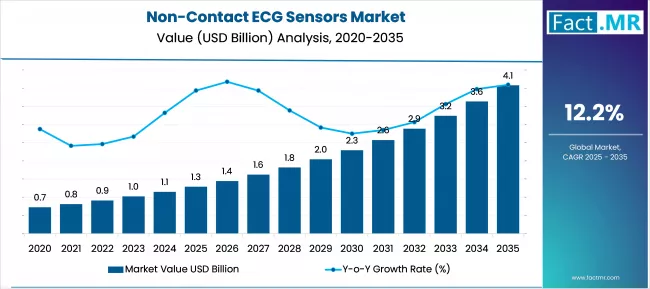
Non Contact Ecg Sensors Market Market Value Analysis | Source: Fact.MR
What are the drivers of the Non-Contact ECG Sensors Market?
There is a growing non-contact ECG sensors market with a preference of healthcare providers and patients towards convenient non-invasive heart monitoring products. The increasing cardiovascular diseases, high blood pressure and abnormal heartbeats are factors that necessitate constant cardiac monitoring. These sensors are highly comfortable, easy to use and are fitted in telemedicine facilities, making them popular in hospitals, clinics and homecare settings.
The development of wireless technology, AI-driven analytics, and compatibility of devices with wearable devices make them more precise, efficient, and user-friendly. Also, the spread of preventative healthcare awareness, remote monitoring insurance, and government subsidization of digital health solutions are speeding up the pace of global adoption, enhancing market growth in developed countries and emerging markets.
What are the regional trends of the Non-Contact ECG Sensors Market?
There is a regional disparity of the non-contact ECG sensors market in terms of healthcare infrastructure, awareness and technology adoption.
- North America is the top because it boasts of developed medical amenities, prevalence of cardiovascular diseases, and integration of telemedicine
- In Europe, there is a steady growth which is due to the ageing populations and preventive healthcare schemes, especially in Germany, UK and France
- The East Asian region (China and Japan) is developing at a high pace as more and more healthcare investments and wearable health technologies are adopted
- South Asia & Pacific is expanding as a result of raising awareness and low prices, India and Australia
- Latin America and Middle East and Africa are upcoming markets and are adopting sensors through hospitals, clinic and remote monitoring programs at a slow pace
What are the challenges and restraining factors of the Non-Contact ECG Sensors Market?
The non-contact ECG sensors market has had a number of threats that could limit growth. The cost of devices is prohibitive to the rest of the low-income areas and smaller clinics. Reliability over the long run, calibration, and maintenance may be a concern when it comes to adoption especially in homecare. Differences in regulatory licenses and non-uniform standards make it difficult to endure.
The lack of knowledge regarding non-invasive cardiac monitoring in emerging markets and the desire to use the conventional ECG method hinder penetration. It may be complicated to integrate with the existing hospital IT systems. Moreover, information security, reimbursement, and annual healthcare expenditures might also be an obstacle to market growth across the world.
Country-Wise Insights
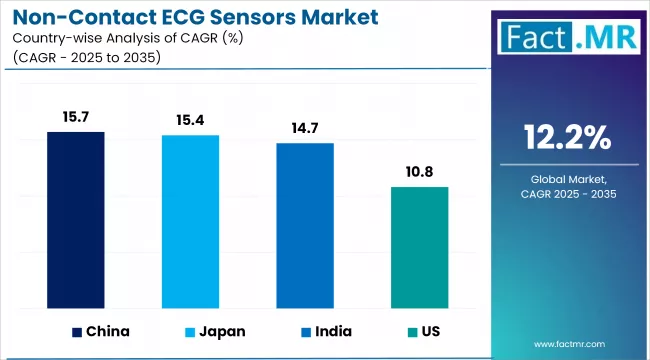
Non Contact Ecg Sensors Market Cagr Analysis By Country | Source: Fact.MR
United States leads in non-contact ECG sensor adoption
The United States controls the market of non-contact ECG sensors as it has the developed healthcare sector, high tendencies to cardiovascular diseases, and the focus on preventive care. Wearable ECG devices have been embraced in more and more hospitals, clinics and homecare settings as a means of continuous monitoring. The best firms in the technological innovation sector include AliveCor, Medtronic, and iRhythm, which have provided user-friendly, AI-based wireless solutions.
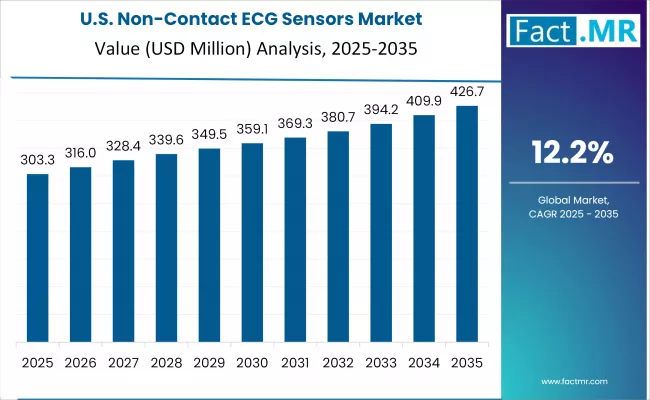
Non Contact Ecg Sensors Market Country Value Analysis | Source: Fact.MR
The policies of insurance reimbursement and integration of telemedicine also promote usage. Additionally, the leadership status of the U.S. market is supported by increasing awareness among patients and healthcare providers on the benefits of non-invasive monitoring, particularly, high investments in health technology through research and development and venture capital.
Japan grows rapidly due to aging population, tech adoption
The market in Japan of non-contact ECG sensors is an expanding market with an aging population increasing the need to monitor cardiac health. The government also insists on preventive health and promotes digital health solutions, which would make them more widespread. Japanese buyers are extremely receptive to wearable technologies containing AI and mobile applications.
Non-contact ECG monitoring is also becoming more popular with the introduction of non-contact monitoring in both in-patient and homecare settings. Adoption is made possible by technological advancement such as compact, accurate and user friendly devices. Existence of good R&D strength, community health enlightenment, and support of healthcare funding make Japan a top market in Asia in terms of non-contact ECG sensors.
India emerging market driven by awareness and telemedicine
India is a market with the potential to adopt non-contact ECG sensors, which are justified by the growing cardiovascular disease rates and the growing health-consciousness. Wearable ECG devices are being embraced in hospitals, diagnostic centers, and homecare platforms which allow monitoring to be done remotely and continuously. Market penetration is also being fueled by government measures to encourage telemedicine, digital health and preventive care. These sensors are easy to use, affordable, and non-invasive, which makes them attractive to the urban and semi-urban populations. There are also the local healthcare provider and technology firm alliances and the ever-increasing number of health-conscious consumers, leading to the gradual growth of the market, making India a prime growth area in the world.
Category-Wise Analysis
Single-lead ECG patches are simple, affordable, widely adopted.
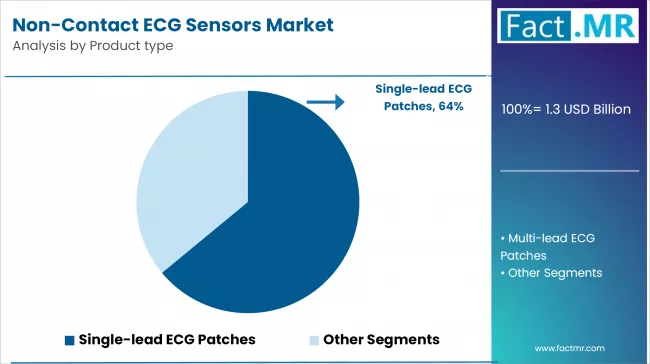
Non Contact Ecg Sensors Market Analysis By Product Type | Source: Fact.MR
The single-lead ECG patches prevail because of their simplicity, cost-effectiveness and easy use. They have a broad usage either in home or clinical basic cardiac monitoring. These patches offer real-time non-invasive monitoring of heart activity processes, allowing to identify arrhythmias and other heart diseases in time. They are very convenient in their small size, being wireless with an option to connect to mobile apps, thus useful to patients and medical staff.
Innovations in battery and AI-powered data analysis and wearable connectivity make them more accurate and usable. Their incorporation across the world is further enhanced by the increasing level of preventive healthcare awareness and the growing need to use remote monitoring.
Cardiac monitoring is primary application for non-contact sensors
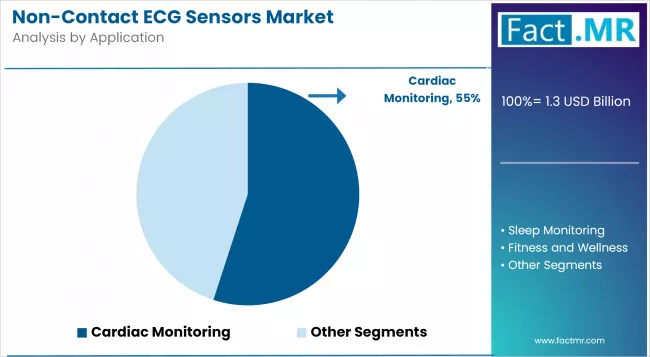
Non Contact Ecg Sensors Market Analysis By Application | Source: Fact.MR
The main use of non-contact ECG sensors is cardiac monitoring, which is facilitated by the increased prevalence of cardiovascular diseases in the world. These sensors are increasingly being used in hospitals, clinics and home care arrangements to monitor the heart activity in real-time. Non-contact sensors eliminate the problem of discomfort, skin irritation, and the frequent placement of electrodes, enhancing patient compliance. Combination with AI and telemedicine systems provides the possibility of automatic data analysis and remote supervision of the physician.
The segment has the advantage of growing awareness on the management of arrhythmia, hypertension and heart failure. The rise in the popularity of preventive medical care and the increase in technological strength leads to the constant growth of the market in cardiac monitoring.
Hospitals and clinics lead adoption of non-contact ECG sensors
The most significant end-users of non-contact ECG sensors are hospitals and clinics, because they use them in the in-patient rooms, as diagnostic tools, and during the outpatient treatment. It is adopted because it is required to provide continuous and accurate non-invasive cardiac monitoring, which enhances patient comfort and clinical efficiency. There is workflow and data management improvement through integration with the hospital IT systems and electronic medical records.
Market growth is supported by increasing the amount of investment in healthcare infrastructures, increasing the number of patients and the awareness of cardiovascular diseases. Non-contact ECG sensors are very appropriate in clinical settings worldwide due to technological advancements, including AI applications, wireless connection, and smaller size.
Competitive Analysis
Key players in the non-contact ECG sensors market include Philips Healthcare, iRhythm Technologies, AliveCor, VivaLNK, GE Healthcare, Cardiac Insight, Bittium, Medtronic, Baxter International and CardioNet
Non-Contact ECG Sensors Market is a very competitive one with the constant technological innovation, accuracy and easy to use design. The leading firms like AliveCor, Philips Healthcare, iRhythm Technologies, VivaLNK, and GE Healthcare work on compact solutions, wireless and AI-powered solutions to hospitals, clinics, and homecare users. Such competitive strategies as cooperation with hospitals, telemedicine services, and research institutes are aimed at increasing their adoption. It is differentiated with the help of sophisticated analytics, real-time tracking, the integration of a mobile application, and extended battery duration.
Emerging markets embrace a feature-rich, affordable, and basic device as compared to developed regions, which embrace sophisticated and advanced devices. Competitive positioning is also enhanced further through distribution of e-commerce, clinician education, and awareness programs at the international level.
Recent Development
- In May 2025, Fraunhofer Institute researchers presented non-contact ECG monitoring system based on radar technology to record heart and breathing of a person on a mattress and relay the information in real-time and observe it in the clinic.
- In January 2025, a paper described a wearable that has an electrocardiogram (ECG) and phonocardiogram (PCG) detector that offers a holistic way of cardiovascular health monitoring.
Fact.MR has provided detailed information about the price points of key manufacturers of Non-Contact ECG Sensors Market positioned across regions, sales growth, production capacity, and speculative technological expansion, in the recently published report.
Methodology and Industry Tracking Approach
The non-contact ECG sensors market analysis utilized both primary and secondary research to gain strength information. Primary research will involve 2,500 healthcare professionals, patients, hospitals, clinics, and homecare users (60 percent) and manufacturers, distributors, and technology providers (40 percent) interviewed and surveying them between January 2024 and June 2025.
The research evaluated the use rates, the product likes, the price, clinical usage and distribution channels. Secondary research was conducted through the review of company reports, product launches, scientific publications, regulatory filings and reports on telemedicine and wearable technology. The regression analysis, scenario modeling and trend extrapolation were used in developing market forecasts and this gave an accurate and reliable forecast to the growth of the global market.
With Fact.MR monitoring consumer behavior, product efficacy, industry trends, and market opportunities since 2018, this report is becoming an authoritative source of information that stakeholders can rely on.
Segmentation
Segmentation of Non-Contact ECG Sensors Market
-
By Product Type :
- Single-lead ECG Patches
- Multi-lead ECG Patches
-
By Application :
- Cardiac Monitoring
- Sleep Monitoring
- Fitness and Wellness
- Others
-
By Distribution Channel :
- Online
- Offline
-
By End-User :
- Hospitals & Clinics
- Ambulatory Surgical Centers
- Homecare Settings
- Others
-
By Region :
- North America
- Latin America
- Western Europe
- Eastern Europe
- East Asia
- South Asia & Pacific
- Middle East & Africa
Frequently Asked Questions
What was the global non-contact ECG sensors market Size Reported by Fact.MR for 2025?
Who are the major players operating in the non-contact ECG sensors market?
What is the estimated valuation of the non-contact ECG sensors market in 2035?
What value CAGR did the non-contact ECG sensors market Exhibit Over the Last Five Years?
Who worked on this report


Preview the report firsthand - request a free sample
Free SampleGet the brochure for pricing and purchase details
Download PDF