- Market Value (2025): USD 2.37 Bn
- Estimated Value (2026): USD 2.51 Bn
- Forecast Value (2036): USD 4.51 Bn
- CAGR (2026-2036): 6.0%
What is the Bone Cancer Market forecast to be worth by 2036?
USD 2.5 billion in 2026 to USD 4.5 billion by 2036 at a 6.0% CAGR.
- Bone cancer treatment and diagnosis revenue came to USD 2.37 billion in 2025, with imaging, chemotherapy and hospital-based surgery carrying most of that spend.
- Revenue will grow from USD 2.51 billion in 2026 to USD 4.51 billion by 2036 as more patients reach specialist sarcoma centers early enough for limb-sparing surgery and full chemotherapy courses.
- A 6.0% CAGR reflects steady case counts paired with richer care per patient, since each diagnosis now involves more imaging, more pathology and longer follow-up.
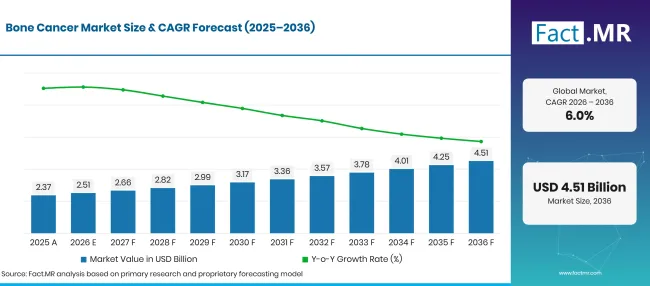
Bone Cancer Market Forecast Global | Source: Fact.MR
| Year | Basis | Market Value (USD billion) |
|---|---|---|
| 2025 | Actual | 2.37 |
| 2026 | Estimate | 2.51 |
| 2036 | Forecast | 4.51 |
| CAGR 2026 to 2036 | Forecast period | 6.0% |
Source: Fact.MR analysis. Updated Nov 9, 2026
What are the defining numbers behind Bone Cancer Market growth?
The 2026 to 2036 period adds USD 2.0 billion in new value, led by osteosarcoma care, imaging-based diagnosis, chemotherapy and hospital treatment.
- Demand Drivers in the Market
- Young patients form a visible share of the caseload. WHO estimates that about 400,000 children and adolescents aged 0 to 19 develop cancer each year, and notes that more than 80% are cured in high-income countries against less than 30% in most low- and middle-income countries [1]. Closing that gap means more imaging, biopsy and chemotherapy capacity for pediatric bone sarcomas.
- Regulators are giving osteosarcoma closer attention. The U.S. FDA held a joint FDA/OSI public workshop on advancing osteosarcoma drug development on October 10, 2025 [2]. It focused on trial design, biomarkers and regulatory pathways for a disease whose outcomes have changed little in decades.
- Chondrosarcoma, long treated with surgery alone, now has a drug candidate under formal review. Inhibrx Biosciences reported in June 2026 that the FDA accepted its Biologics License Application for ozekibart in unresectable or metastatic conventional chondrosarcoma [3].
- Giant cell tumor of bone keeps a biologic option in routine use. The June 2026 Xgeva label covers adults and skeletally mature adolescents whose tumor is unresectable or where surgery would likely cause severe morbidity [4].
- Key Segments Analyzed
- By Type: Osteosarcoma will capture 38.4% share in 2026, since it is the most common primary bone cancer and its care combines chemotherapy before and after surgery.
- By Diagnosis: Imaging Tests will account for 44.8% of 2026 revenue, given that X-ray, MRI and CT are needed at first suspicion, for biopsy planning and for staging.
- By Treatment: Chemotherapy will take 33.7% in 2026 owing to multi-cycle regimens for osteosarcoma and Ewing’s sarcoma that run for months around surgery.
- By End-User: Hospitals will hold 52.6% of 2026 value, as sarcoma surgery, inpatient chemotherapy and tumor boards are concentrated in hospital settings.
- Analyst Opinion at Fact.MR
- Shambhu Nath Jha, Principal Consultant at Fact.MR, states, “Bone cancer is rare, so every center that treats it has to justify scanners, pathology time and surgical skill against a thin caseload. Spend will follow the referral networks that bring patients to those centers quickly and keep them there through chemotherapy and follow-up. Suppliers with products approved for specific bone tumor types will gain ground as regulators open clearer pathways for these diseases.”
- Strategic Implications
- Drug developers should design trials with sarcoma networks from the outset, because single sites cannot enroll enough patients with osteosarcoma or chondrosarcoma.
- Imaging suppliers should package musculoskeletal MRI protocols and staging workflows for sarcoma units, where scan quality shapes biopsy planning and surgical margins.
- Hospital managers should route suspected bone tumors to designated centers before biopsy, since a poorly placed biopsy can limit later limb-sparing options.
- Payers should budget for long treatment episodes that join surgery, months of chemotherapy and years of surveillance imaging.
Brazil heads the country set at 7.1%, as public cancer services add orthopedic oncology training and capacity from a lower base. The United Kingdom follows at 6.7%, helped by centralized referral of bone tumors to a small group of highly specialised NHS centers. Japan grows at 6.0% thanks to a large national cancer caseload and an aging population that adds secondary demand on the same imaging capacity. The United States posts 5.0%, a pace held down by an already mature research and treatment base even as new approvals arrive. Germany closes the range at 4.7%, where dense hospital coverage leaves less room for new capacity.
How does the Bone Cancer Market break down by segment?
Osteosarcoma will lead Type at 38.4%; Imaging Tests will head Diagnosis at 44.8%; Chemotherapy will lead Treatment at 33.7%; Hospitals will hold End-User at 52.6% in 2026.
Which Type leads?
Osteosarcoma represents 38.4% of 2026 sales.
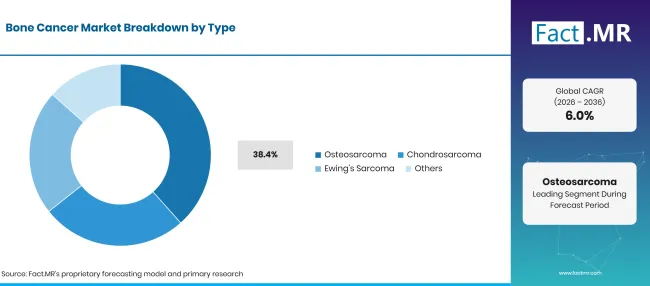
Bone Cancer Market Breakdown Type | Source: Fact.MR
| Type | Share (2026) |
|---|---|
| Osteosarcoma (Leading segment) | 38.4% |
| Other segments combined | 61.6%* |
| Total | 100.0% |
Source: Fact.MR analysis. Updated Nov 9, 2026
Teenagers and young adults in a growth spurt account for many osteosarcoma cases, often in the long bones near the knee. That age profile brings demand for detailed imaging, planned biopsy and limb-sparing surgery with reconstruction. Treatment draws on cytotoxic chemotherapy before and after the operation, which keeps the per-patient spend high. Chondrosarcoma occurs mostly in adults and has relied on surgery, which is why a drug filing in this subtype is a new source of value. Ewing’s sarcoma affects children and young adults and is treated with chemotherapy combined with surgery or radiation. The Others group covers rarer primary tumors such as chordoma.
What supports Imaging Tests within Diagnosis?
Imaging Tests take 44.8% of 2026 revenue.
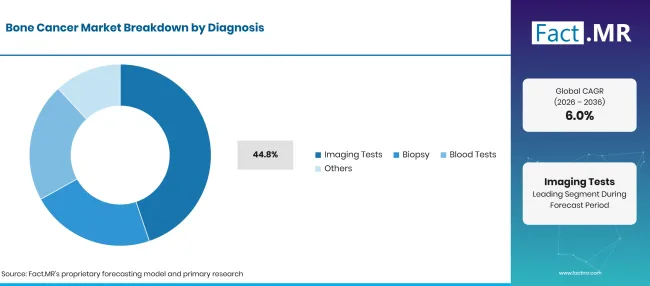
Bone Cancer Market Breakdown Diagnosis | Source: Fact.MR
| Diagnosis | Share (2026) |
|---|---|
| Imaging Tests (Leading segment) | 44.8% |
| Other segments combined | 55.2%* |
| Total | 100.0% |
Source: Fact.MR analysis. Updated Nov 9, 2026
A plain X-ray is usually the first test when a young patient reports bone pain or swelling. MRI then maps the tumor inside the bone and nearby soft tissue, while CT of the chest checks for spread. Hospitals also invest in robotic medical imaging systems and guided biopsy tools to make these steps faster and more precise. Biopsy confirms the diagnosis and must be planned with the surgeon so the tract can be removed later. Blood tests add supporting markers, and molecular work on biopsy tissue is growing within cancer profiling services. Pathology review by a sarcoma specialist is now standard in referral centers.
What leads the Treatment segment?
Chemotherapy accounts for 33.7% of 2026 demand.
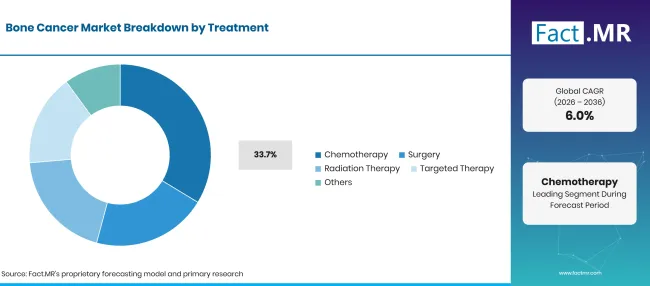
Bone Cancer Market Breakdown Treatment | Source: Fact.MR
| Treatment | Share (2026) |
|---|---|
| Chemotherapy (Leading segment) | 33.7% |
| Other segments combined | 66.3%* |
| Total | 100.0% |
Source: Fact.MR analysis. Updated Nov 9, 2026
Multi-agent regimens are given for several months before and after surgery in osteosarcoma and Ewing’s sarcoma. In the European Union, Mepact (mifamurtide) is authorised for children, adolescents and young adults with high-grade resectable osteosarcoma that has not spread [5]. It is given after complete surgical removal alongside postoperative multi-agent chemotherapy. Such add-on therapies widen the range of anticancer drugs used in bone sarcoma. Surgery remains the core local treatment, often with endoprosthetic reconstruction. Radiation therapy is used for Ewing’s sarcoma and tumors that cannot be removed. Targeted therapy is growing through denosumab and its biosimilars: Teva announced FDA approval of Degevma in September 2026, including use in giant cell tumor of bone [6].
What leads the End-User segment?
Hospitals command 52.6% of 2026 spending.
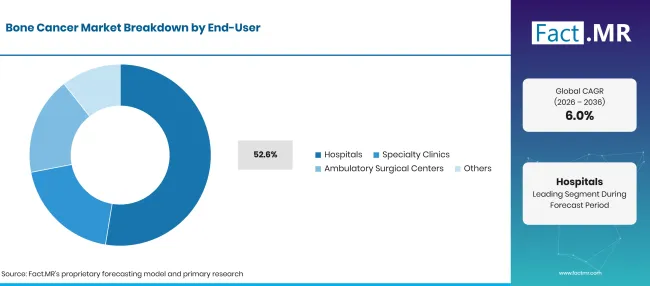
Bone Cancer Market Breakdown End User | Source: Fact.MR
| End-User | Share (2026) |
|---|---|
| Hospitals (Leading segment) | 52.6% |
| Other segments combined | 47.4%* |
| Total | 100.0% |
Source: Fact.MR analysis. Updated Nov 9, 2026
Bone tumor care needs radiology, pathology, orthopedic oncology and medical oncology working from the same case file. Hospital tumor boards review each patient before biopsy and again before surgery. Inpatient chemotherapy, complex reconstruction and intensive care cover keep most of the spend inside hospital walls. Specialty clinics handle outpatient chemotherapy, follow-up imaging and rehabilitation once the main treatment is complete. Ambulatory surgical centers take selected biopsies and minor procedures. Other settings include research institutes running early trials in cancer immunotherapy and other new approaches.
What is accelerating Bone Cancer Market adoption, and what is holding it back?
Earlier referral, better MRI and CT, and a growing list of approved and filed therapies are lifting spend per patient. Rarity works the other way, since small patient groups slow trials and leave many hospitals without enough cases to build skills. Treatment cost and the long distance to specialist centers also delay care in emerging health systems.
Drivers Impact Analysis
| DRIVER | (~) % IMPACT ON CAGR | GEOGRAPHIC RELEVANCE | IMPACT TIMELINE |
|---|---|---|---|
| Earlier diagnosis through MRI, CT and planned biopsy | +1.6% | Global | Medium term (2-4 years) |
| Wider use of multimodal treatment for primary bone sarcomas | +1.3% | North America, Western Europe, East Asia | Medium term (2-4 years) |
| Centralized referral to specialist sarcoma centers | +1.0% | Global | Long term (>=4 years) |
| Regulatory activity in osteosarcoma and chondrosarcoma | +0.7% | North America, Western Europe | Long term (>=4 years) |
| Broader access to sarcoma pathology and molecular testing | +0.4% | Global | Short term (<=2 years) |
Source: Fact.MR analysis. Updated Nov 9, 2026
Opportunity Impact Analysis
| OPPORTUNITY | (~) % IMPACT ON CAGR | GEOGRAPHIC RELEVANCE | IMPACT TIMELINE |
|---|---|---|---|
| Subtype-specific drugs for chondrosarcoma and relapsed osteosarcoma | +0.8% | North America, Western Europe, East Asia | Long term (>=4 years) |
| New orthopedic oncology training and capacity in emerging regions | +0.6% | Latin America, South Asia & Pacific, Middle East & Africa | Medium term (2-4 years) |
| Denosumab biosimilars widening access in giant cell tumor of bone | +0.5% | Global | Short term (<=2 years) |
| Advanced limb-sparing reconstruction | +0.3% | North America, Western Europe, East Asia | Long term (>=4 years) |
Source: Fact.MR analysis. Updated Nov 9, 2026
Restraints Impact Analysis
| RESTRAINT | (~) % IMPACT ON CAGR | GEOGRAPHIC RELEVANCE | IMPACT TIMELINE |
|---|---|---|---|
| High cost of specialist diagnosis and treatment | -0.7% | Global | Short term (<=2 years) |
| Shortage of sarcoma surgeons and pathologists | -0.5% | Emerging markets | Medium term (2-4 years) |
| Small patient groups that slow clinical trials | -0.4% | Global | Long term (>=4 years) |
| Long travel distances to designated centers | -0.2% | Latin America, South Asia & Pacific, Middle East & Africa | Long term (>=4 years) |
Source: Fact.MR analysis. Updated Nov 9, 2026
Which countries are scaling the Bone Cancer Market through 2036?
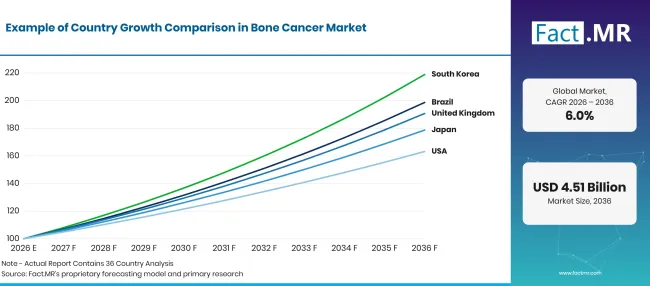
Bone Cancer Market Growth Index | Source: Fact.MR
| Country | CAGR (2026 to 2036) |
|---|---|
| Brazil | 7.1% |
| United Kingdom | 6.7% |
| Japan | 6.0% |
| United States | 5.0% |
| Germany | 4.7% |
Source: Fact.MR analysis. Updated Nov 9, 2026
How is Brazil developing demand?
7.1% CAGR, driven by public investment in cancer services and orthopedic oncology training.
INCA forecasts about 781,000 new cancer cases per year in Brazil from 2026 to 2028 [7]. Excluding non-melanoma skin tumors, the figure is about 518,000. That caseload puts pressure on the imaging and surgical capacity that bone sarcoma patients also need. INCA runs a two-year orthopedic oncology fellowship for orthopedic surgeons [8]. Its program covers imaging, biopsy and histopathology, along with chemotherapy, radiotherapy and reconstruction after bone sarcoma surgery.
What is supporting United Kingdom adoption?
6.7% CAGR, helped by centralized referral of bone tumors to specialist NHS centers.
The Royal National Orthopaedic Hospital describes itself as an NHS highly specialised commissioned centre for patients of all ages with confirmed or suspected bone or soft tissue tumors, and it released new patient information videos for its sarcoma service in May 2026 [9]. NHS Wales confirms in its November 2025 sarcoma specification that bone sarcoma care for Welsh patients is delivered at designated centres in NHS England [10]. This model concentrates scans, surgery and chemotherapy in a few high-volume units.
What supports Japan’s adoption?
6.0% CAGR, reflecting a large national cancer caseload and well-equipped hospitals.
For 2025, the National Cancer Center Japan forecasts 1,023,100 new cancer cases and 395,500 cancer deaths [11]. Bone sarcomas are a small part of that total, yet they draw on the same MRI, CT and pathology capacity in designated cancer hospitals. Rising cancer volumes in an aging population compete for the same scanner time that young sarcoma patients need.
How is the United States shaping demand?
5.0% CAGR, backed by an active regulatory pipeline for rare bone tumors.
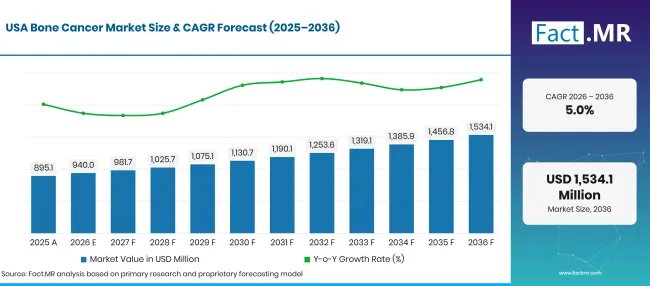
Bone Cancer Market Forecast Usa | Source: Fact.MR
The FDA has set an April 14, 2027 goal date for its decision on ozekibart in conventional chondrosarcoma [3]. Its 2025 osteosarcoma workshop brought researchers and regulators together to plan better trials [2]. Large children’s hospitals and NCI-designated centers handle most cases, which keeps imaging and chemotherapy volumes concentrated.
How does Germany perform?
4.7% CAGR, as dense hospital coverage limits room for new capacity.
Germany’s cancer registry data center at the Robert Koch Institute estimates about 517,800 new cancer diagnoses in 2023 [12]. Men accounted for 276,400 of them and women for 241,400. University hospitals and certified sarcoma centers already treat most bone tumor cases, so growth comes from newer drugs and imaging upgrades more than from new sites. Strict health technology assessment also slows the uptake of high-priced therapies.
Who leads the Bone Cancer Market?
The bone cancer market has no single owner, and competition splits into three groups with different strengths. Biologic suppliers form the first group: Amgen holds the reference denosumab product, Xgeva, whose June 2026 label covers giant cell tumor of bone [4].
Teva and Sandoz compete with biosimilar denosumab, and Teva’s Degevma gained FDA approval in September 2026 [6]. These companies win on price, supply and hospital formulary access. The second group brings together specialty developers such as Inhibrx Biosciences, whose ozekibart filing in conventional chondrosarcoma was accepted for FDA review in June 2026 [3]. Their edge lies in clinical data for narrow tumor types. Imaging companies form the third group, with Siemens Healthineers and GE HealthCare supplying MRI and CT platforms that carry musculoskeletal and oncology protocols. The winners through 2036 will be those that prove value in small patient groups and fit into sarcoma center workflows.
Which companies are the key providers?
Key companies in the Bone Cancer Market include Amgen, Teva Pharmaceuticals, Sandoz, Inhibrx Biosciences, Siemens Healthineers and GE HealthCare.
- Amgen
- Teva Pharmaceuticals
- Sandoz
- Inhibrx Biosciences
- Siemens Healthineers
- GE HealthCare
Bibliography
- [1] World Health Organization. (2026, March 10). Childhood cancer.
- [2] U.S. Food and Drug Administration. (2025, October 10). FDA/OSI Workshop: Advancing Osteosarcoma Drug Development: Connecting Research and Regulatory Pathways for Improved Outcomes.
- [3] Inhibrx Biosciences. (2026, June 15). Inhibrx Announces U.S. FDA Acceptance of BLA for Ozekibart in Patients with Conventional Chondrosarcoma.
- [4] U.S. Food and Drug Administration. (2026, June). XGEVA (denosumab) injection, for subcutaneous use: Prescribing Information.
- [5] European Medicines Agency. (2025, December 18). Mepact.
- [6] Teva Pharmaceuticals. (2026, September 28). Teva Continues Biosimilar Momentum with U.S. FDA Approval of DEGEVMA (denosumab-adet), a Biosimilar to Xgeva (denosumab).
- [7] Instituto Nacional de Câncer. (2026, February 4). INCA estima 781 mil novos casos de câncer por ano no Brasil de 2026 a 2028.
- [8] Instituto Nacional de Câncer. (2026, June 26). Oncologia Ortopédica: Apresentação.
- [9] Royal National Orthopaedic Hospital NHS Trust. (2026, May 7). Three new patient information videos for RNOH Sarcoma Service.
- [10] NHS Wales Joint Commissioning Committee. (2025, November). Soft Tissue Sarcoma Service Specification SS149.
- [11] National Cancer Center Japan. (2025, December 24). Projected Cancer Statistics.
- [12] Robert Koch Institute, Zentrum für Krebsregisterdaten. (2025, December 16). Neue Daten zu Krebs in Deutschland bis 2023 veröffentlicht.
This Report Answers
- How large will bone cancer diagnosis and treatment revenue be in 2026 and 2036, and what growth rate links the two?
- Why does osteosarcoma lead by type, and how do chondrosarcoma and Ewing’s sarcoma differ in care needs?
- What role do X-ray, MRI, CT and biopsy play in the leading diagnosis category?
- How are chemotherapy, surgery, radiation and targeted therapy combined across tumor types?
- Where will Brazil, the United Kingdom, Japan, the United States and Germany add value, and why do their growth rates differ?
- Which drug, biosimilar and imaging suppliers compete in bone cancer care, and on what basis?
What does the Bone Cancer Market cover?
This study tracks spending on the diagnosis and treatment of cancers that start in bone. It follows each patient from the first X-ray through MRI, CT, biopsy and pathology, then into chemotherapy, surgery, radiation and targeted therapy.
Values are measured in USD billion at the point of care, so they include drug sales, imaging and biopsy procedures, and surgical and radiation services delivered in hospitals, specialty clinics and ambulatory centers.
What is included in the scope?
Imaging tests, image-guided and open biopsies, blood tests and pathology used to diagnose primary bone tumors.
Chemotherapy, targeted drugs such as denosumab and its biosimilars for giant cell tumor of bone, and add-on therapies used in osteosarcoma.
Tumor resection, limb-sparing reconstruction and radiation therapy delivered for primary bone cancers.
Molecular tests on tumor tissue that guide treatment, as part of wider cancer biomarkers use.
What is excluded from the scope?
Cancers that start in other organs and spread to bone, including drug use for bone metastases.
Benign bone tumors other than giant cell tumor of bone, and routine fracture care.
Soft tissue sarcomas that do not arise in bone.
General orthopedic implants and imaging used for non-cancer conditions.
How Was the Analysis Built?
The analysis draws on 120+ sources, 35+ company portfolios, 25+ countries, and more than 20 industry interviews.
- Primary Research: Primary research includes discussions with manufacturers, service providers, technology developers, distributors, end users, and subject-matter experts. These conversations examine purchasing priorities, product adoption, operational challenges, approval requirements, competitive positioning, and the factors that influence wider market acceptance.
- Desk Research: Desk research covers government statistics, regulatory publications, company filings, trade data, technical studies, industry associations, standards, public policy, and other authoritative sources. Every source used in the analysis is documented in the bibliography.
- Market Sizing and Forecasting: Market estimates combine historical performance, demand indicators, pricing and volume trends, segment shares, company participation, country-level growth, adoption patterns, investment activity, and barriers to market expansion.
- Data Validation and Update Cycle: Findings are validated by comparing primary interviews with public data, company activity, regulatory changes, trade patterns, and industry developments. Regular updates review new product launches, capacity changes, partnerships, approvals, and shifts in commercial adoption.
Segmentation
What is the report’s scope and coverage?
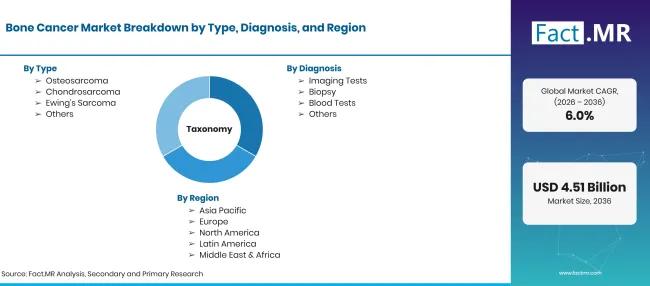
Bone Cancer Market Taxonomy | Source: Fact.MR
| Attribute | Details |
|---|---|
| Quantitative Units | USD billion in 2026 to USD billion by 2036 at CAGR |
| Market Definition | Revenue from the diagnosis and treatment of primary malignant bone tumors, including osteosarcoma, chondrosarcoma and Ewing’s sarcoma, across imaging, biopsy, drug therapy, surgery and radiation. |
| Type | Osteosarcoma; Chondrosarcoma; Ewing’s Sarcoma; Others |
| Diagnosis | Imaging Tests; Biopsy; Blood Tests; Others |
| Treatment | Chemotherapy; Surgery; Radiation Therapy; Targeted Therapy; Others |
| End-User | Hospitals; Specialty Clinics; Ambulatory Surgical Centers; Others |
| Regions Covered | North America; Latin America; Western Europe; Eastern Europe; East Asia; South Asia & Pacific; Middle East & Africa |
| Countries Covered | Brazil; United Kingdom; Japan; United States; Germany |
| Companies Profiled | Amgen; Teva Pharmaceuticals; Sandoz; Inhibrx Biosciences; Siemens Healthineers; GE HealthCare |
| Forecast Period | 2026 to 2036 |
| Approach | Country case counts for primary bone tumors combined with diagnostic and treatment pathways, care setting mix and product approvals. |
Source: Fact.MR analysis. Updated Nov 9, 2026
How is the market segmented?
-
By Type
- Osteosarcoma
- Chondrosarcoma
- Ewing’s Sarcoma
- Others
-
By Diagnosis
- Imaging Tests
- Biopsy
- Blood Tests
- Others
-
By Treatment
- Chemotherapy
- Surgery
- Radiation Therapy
- Targeted Therapy
- Others
-
By End-User
- Hospitals
- Specialty Clinics
- Ambulatory Surgical Centers
- Others
-
By Region
- North America
- Latin America
- Western Europe
- Eastern Europe
- East Asia
- South Asia & Pacific
- Middle East & Africa
Frequently Asked Questions
How large is the bone cancer market in 2026?
What growth rate will the bone cancer market record?
Which type leads?
Which diagnosis category leads?
Which treatment leads?
Which end-user leads?
Which country will grow quickest?
Who are the main companies?
What holds the market back?
Who worked on this report


Preview the report firsthand - request a free sample
Free SampleGet the brochure for pricing and purchase details
Download PDF