Cancer Wounds Treatment Market
Cancer Wounds Treatment Market Size and Share Forecast Outlook 2026 to 2036
Cancer wounds treatment market is projected to grow from USD 3.0 billion in 2026 to USD 5.8 billion by 2036, at a CAGR of 6.8%. Advanced & antimicrobial dressings will dominate with a 46.2% market share, while malignant fungating wounds will lead the indication segment with a 42.0% share.
Cancer Wounds Treatment Market Forecast and Outlook 2026 to 2036
The global cancer wounds treatment market is projected to total USD 2.99 billion in 2026, advancing to USD 5.79 billion by 2036, progressing at a 6.8% CAGR. This growth is driven by the increasing global cancer burden and a corresponding rise in the prevalence of complex, hard-to-heal wounds associated with malignancy and its treatments.
Key Takeaways from the Cancer Wounds Treatment Market
- Market Value for 2026: USD 2.99 Billion
- Market Value for 2036: USD 5.79 Billion
- Forecast CAGR 2026 to 2036: 6.8%
- Leading Treatment Type Segment (2026): Advanced & Antimicrobial Dressings (46.2%)
- Leading Indication Segment (2026): Malignant Fungating Wounds (42.0%)
- Leading Channel Segment (2026): Hospitals & Oncology Centers (44.1%)
- Key Growth Countries: India (9.5% CAGR), China (9.2% CAGR), Brazil (8.8% CAGR), USA (7.6% CAGR), France (7.5% CAGR), Germany (7.4% CAGR), UK (7.3% CAGR)
- Key Players: Smith & Nephew plc, Mölnlycke Health Care AB, 3M Company, Convatec Group plc, Coloplast A/S
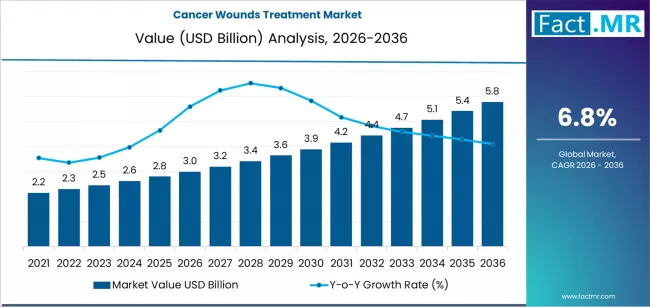
Malignant fungating wounds represent a particularly challenging indication, demanding specialized advanced dressings and palliative care protocols. The market is characterized by a product mix dominated by advanced and antimicrobial dressings, essential for managing bioburden and exudate in necrotic lesions.
A significant care shift toward home and community settings is expanding the channel for device-based therapies and topical agents, allowing for continuous management outside hospital walls. This evolution reflects the integrated need for both advanced medical intervention and quality-of-life-focused palliative care within oncology.
Cancer Wounds Treatment Market
| Metric | Value |
|---|---|
| Market Value (2026) | USD 2.99 Billion |
| Market Forecast Value (2036) | USD 5.79 Billion |
| Forecast CAGR 2026 to 2036 | 6.8% |
Category
| Category | Segments |
|---|---|
| Treatment Type | Advanced & Antimicrobial Dressings, Device-Based Wound Therapies (NPWT, Adjunct Devices), Topical Agents & Palliative Wound Care Solutions |
| Indication | Malignant Fungating Wounds, Post-Oncology Surgical Wounds, Radiation- & Therapy-Induced Skin Wounds |
| Channel | Hospitals & Oncology Centers, Home Healthcare & Community Nursing, Retail Pharmacies & E-commerce |
| Region | North America, Latin America, Western Europe, Eastern Europe, East Asia, South Asia & Pacific, Middle East & Africa |
What Macro Trends in Oncology and Healthcare Delivery are Reshaping Wound Care?
| Trend | Impact |
|---|---|
| Shift to Home-Based Oncology Care | Expands the channel for portable negative pressure wound therapy (NPWT) devices and dressings suitable for community nursing, reducing hospital readmissions. |
| Heightened Focus on Palliative Wound Management | Drives demand for odor-control dressings, topical barrier films, and non-adherent solutions aimed at symptom relief and dignity preservation, not just healing. |
| Rise of Multidrug-Resistant Organisms in Healthcare | Fuels the need for advanced antimicrobial dressings with sustained ionic silver or other broad-spectrum agents to manage infected malignant wounds. |
| Integration of Digital Health for Remote Monitoring | Supports the use of smart dressings with sensors in clinical trials, enabling remote tracking of wound parameters and early infection detection. |
Segmental Analysis
By Treatment Type, Which Products are Essential for Managing Infection and Exudate?
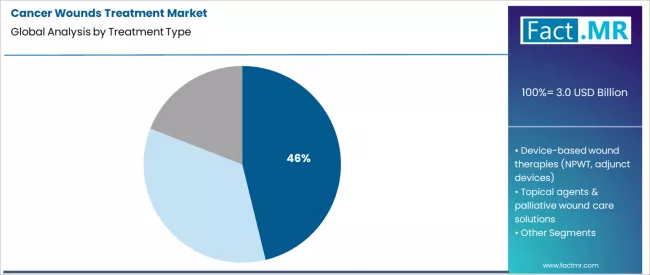
Advanced and antimicrobial dressings command a leading 46.2% share. This segment's prominence stems from the critical need to control the heavy exudate, odor, and bacterial colonization inherent in malignant fungating wounds.
These specialized dressings, including hydrocolloids, foams with antimicrobial agents, and odor-locking charcoal dressings, form the first line of daily management. Their recurrent use over often protracted periods, combined with the necessity to prevent systemic infection from the wound site, creates a consistent, high-volume demand within both institutional and home care settings.
By Indication, Which Wound Type Presents the Greatest Clinical and Care Challenge?
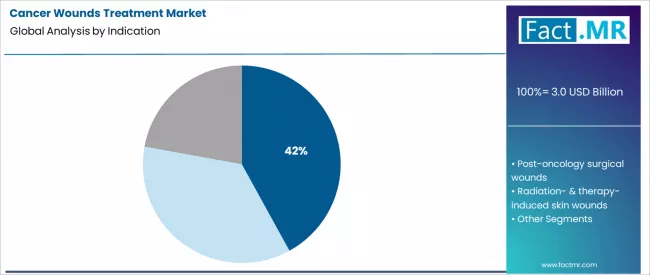
Malignant fungating wounds constitute the primary indication segment at 42.0%. These wounds arise from direct infiltration of the skin by underlying tumors and are typically non-healing.
Management focuses on palliation: controlling exudate, bleeding, odor, and pain. The complexity and labor-intensive nature of their care, requiring frequent dressing changes and often multidisciplinary input, generate sustained utilization of a wide array of advanced wound care products over the patient’s remaining lifespan.
By Channel, Where is Specialized Care for Complex Wounds Initiated?
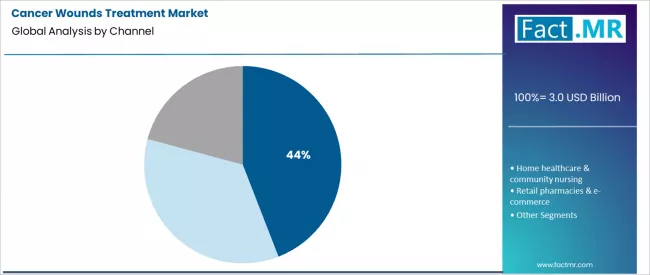
Hospitals and oncology centers hold a leading 44.1% share. These facilities are where complex cancer wounds are first assessed, diagnosed, and have their initial treatment protocols established.
Specialist oncologists and wound care nurses initiate therapy with advanced dressings or NPWT. While ongoing care may transition to the home, the high-acuity initial phase and the need for specialist-driven product selection ensure this channel captures significant value.
What Forces Govern the Expansion and Evolution of Cancer Wound Care?
Rising global cancer incidence and improved survivorship are creating a larger population living with the long-term sequelae of cancer, including chronic wounds from surgery, radiation, or the disease itself. This expanding patient pool directly underpins market volume.
The psychological burden and skilled nursing time required to manage malignant fungating wounds can limit consistent, optimal care in resource-constrained settings or overburdened home care systems. This can lead to suboptimal product usage or delayed intervention, negatively impacting patient outcomes and market potential.
The development of integrated care kits that bundle dressings, topical cleansers, odor neutralizers, and patient-friendly instructions addresses a clear need for simplified management in home settings. These kits improve caregiver confidence and standardize care, creating a premium product segment.
Clinical focus is intensifying on the use of prophylactic silicone-based dressings and barrier films in radiation oncology. Applying these dressings before radiation dermatitis develops is proven to reduce the incidence and severity of skin breakdown, creating a preventive application that expands the addressable market earlier in the patient journey.
Analysis of the Cancer Wounds Treatment Market by Key Countries
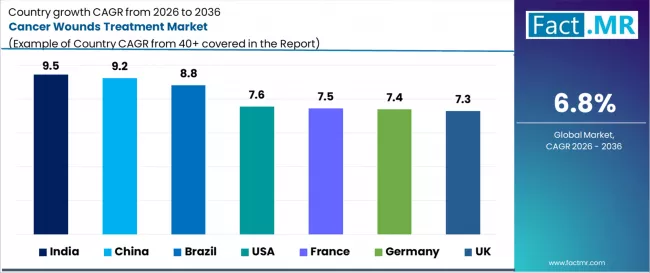
| Country | CAGR 2026 to 2036 |
|---|---|
| USA | 7.6% |
| Germany | 7.4% |
| China | 9.2% |
| India | 9.5% |
| Brazil | 8.8% |
| France | 7.5% |
| UK | 7.3% |
How do Integrated Oncology Networks in the USA Shape Product Adoption?
Extensive integrated hospital networks with dedicated wound care teams and established protocols for managing oncology-related wounds support a 7.6% CAGR. Strong reimbursement mechanisms exist for advanced dressings and NPWT in both inpatient and home settings.
The presence of key market players ensures rapid adoption of innovative products, and a well-developed home healthcare infrastructure supports the shift to community-based management.
What Influence does Germany's Outpatient Care Reimbursement Have?
Germany's 7.4% CAGR benefits from a robust outpatient care system where community nurses are reimbursed for providing complex wound care, including for cancer patients at home.
This system drives consistent demand for prescribed advanced dressings and devices. German clinics emphasize evidence-based protocols, favoring products with strong clinical data for exudate and odor management in palliative settings.
Which Dynamics are Propelling China's Hospital-Centric Market Growth?
China's 9.2% CAGR is fueled by massive investments in new tertiary cancer hospitals, which centralize the treatment of complex cases. Growth is currently concentrated within these hospital walls, where there is increasing adoption of international standard wound care products for managing surgical and radiation-induced wounds. The expansion of oncology services is directly translating into higher volumes of advanced wound care utilization.
Why does India's Growth Stem from Bridging Hospital and Home Care Gaps?
India's leading 9.5% CAGR is propelled by the emergence of home healthcare services specializing in oncology support. This is bridging a critical gap between hospital discharge and long-term wound management. Increasing awareness of palliative wound care principles among both physicians and families is driving demand for more advanced dressings beyond basic gauze, even in price-sensitive segments.
How is Brazil's Healthcare Segmentation Affecting Market Development?
Brazil's 8.8% CAGR operates within a segmented system where private hospitals and oncology clinics rapidly adopt premium advanced wound care solutions. In the public system, access is more limited. Market growth is therefore concentrated in the private sector and in major urban centers, with expansion closely tied to the development of specialized oncology palliative care services.
What Role does France's Hospital-Community Linkage Play?
France's 7.5% CAGR is strengthened by a well-coordinated system for hospital discharge and home care (HAD - Hospitalisation À Domicile). This ensures continuity of care and a steady supply of prescribed advanced wound products to the home. French protocols strongly emphasize patient dignity and odor control in palliative wound management, supporting the use of specific advanced dressing types.
How does the UK's Community Nursing Framework Direct Product Usage?
The UK’s 7.3% CAGR is guided by a strong community nursing network commissioned to provide wound care. Prescribing decisions by these nurses, following NHS formulary guidelines, significantly direct product demand. The focus on cost-effective care within the community favors advanced dressings that reduce visit frequency by managing exudate and infection effectively over longer wear times.
Competitive Landscape of the Cancer Wounds Treatment Market
Established global wound care conglomerates define the competitive environment. Companies like Smith & Nephew, Mölnlycke, and Convatec compete through comprehensive portfolios that specifically address oncological wound challenges, such as dressings for fragile radiated skin or high-exudate fungating wounds.
Success hinges on providing robust clinical education to oncology nurses, developing products that simplify complex care for home caregivers, and securing favorable inclusion in hospital and home care formularies. Competition also focuses on tailoring solutions for the unique needs of palliative care, where healing is not the goal, but symptom management is paramount.
Key Players in the Cancer Wounds Treatment Market
- Smith & Nephew plc
- Mölnlycke Health Care AB
- 3M Company
- Convatec Group plc
- Coloplast A/S
- Others
Scope of Report
| Items | Metrics |
|---|---|
| Quantitative Units | USD Billion |
| Treatment Type | Advanced & Antimicrobial Dressings, Device-Based Wound Therapies, Topical Agents & Palliative Solutions |
| Indication | Malignant Fungating Wounds, Post-Oncology Surgical Wounds, Radiation-Induced Skin Wounds |
| Channel | Hospitals & Oncology Centers, Home Healthcare & Community Nursing, Retail Pharmacies & E-commerce |
| Key Countries | India, China, Brazil, USA, France, Germany, UK |
| Key Companies | Smith & Nephew plc, Mölnlycke Health Care AB, 3M Company, Convatec Group plc, Coloplast A/S |
| Additional Analysis | Cost-benefit analysis of advanced dressings in reducing nursing time; review of quality-of-life metrics in palliative wound care; analysis of biofilm management strategies in malignant wounds; impact of radiation oncology techniques on skin toxicity profiles. |
Market by Segments
-
Treatment Type :
- Advanced & Antimicrobial Dressings
- Device-Based Wound Therapies (NPWT, Adjunct Devices)
- Topical Agents & Palliative Wound Care Solutions
-
Indication :
- Malignant Fungating Wounds
- Post-Oncology Surgical Wounds
- Radiation & Therapy-Induced Skin Wounds
-
Channel :
- Hospitals & Oncology Centers
- Home Healthcare & Community Nursing
- Retail Pharmacies & E-commerce
-
Region :
-
North America
- USA
- Canada
-
Latin America
- Brazil
- Mexico
- Argentina
- Rest of Latin America
-
Western Europe
- Germany
- France
- UK
- Italy
- Spain
- BENELUX
- Rest of Western Europe
-
Eastern Europe
- Poland
- Russia
- Czech Republic
- Rest of Eastern Europe
-
East Asia
- China
- Japan
- South Korea
- Rest of East Asia
-
South Asia & Pacific
- India
- ASEAN
- Australia & New Zealand
- Rest of South Asia & Pacific
-
Middle East & Africa
- GCC Countries
- South Africa
- Turkiye
- Rest of MEA
-
Bibliography
- European Oncology Nursing Society. (2025). Best practice guidelines for the management of malignant fungating wounds.
- International Palliative Wound Care Initiative. (2024). Principles of palliative wound care: A consensus document. Journal of Palliative Medicine.
- National Pressure Injury Advisory Panel. (2025). Prevention and treatment of skin injuries in the oncology patient.
- Siddiqui, M., & Garcia, A. D. (2023). Cutaneous manifestations of cancer and their management. Clinical Journal of Oncology Nursing.
- World Health Organization. (2024). Palliative care: symptom management and wound care.
- Woo, K. Y., & Krasner, D. L. (2025). Palliative wound management for the oncologic patient: An interprofessional approach. Springer.
Table of Content
- Executive Summary
- Global Market Outlook
- Demand to side Trends
- Supply to side Trends
- Technology Roadmap Analysis
- Analysis and Recommendations
- Market Overview
- Market Coverage / Taxonomy
- Market Definition / Scope / Limitations
- Market Background
- Market Dynamics
- Drivers
- Restraints
- Opportunity
- Trends
- Scenario Forecast
- Demand in Optimistic Scenario
- Demand in Likely Scenario
- Demand in Conservative Scenario
- Opportunity Map Analysis
- Product Life Cycle Analysis
- Supply Chain Analysis
- Investment Feasibility Matrix
- Value Chain Analysis
- PESTLE and Porter’s Analysis
- Regulatory Landscape
- Regional Parent Market Outlook
- Production and Consumption Statistics
- Import and Export Statistics
- Market Dynamics
- Global Market Analysis 2021 to 2025 and Forecast, 2026 to 2036
- Historical Market Size Value (USD Million) Analysis, 2021 to 2025
- Current and Future Market Size Value (USD Million) Projections, 2026 to 2036
- Y to o to Y Growth Trend Analysis
- Absolute $ Opportunity Analysis
- Global Market Pricing Analysis 2021 to 2025 and Forecast 2026 to 2036
- Global Market Analysis 2021 to 2025 and Forecast 2026 to 2036, By Treatment Type
- Introduction / Key Findings
- Historical Market Size Value (USD Million) Analysis By Treatment Type, 2021 to 2025
- Current and Future Market Size Value (USD Million) Analysis and Forecast By Treatment Type, 2026 to 2036
- Advanced & antimicrobial dressings
- Device-based wound therapies (NPWT, adjunct devices)
- Topical agents & palliative wound care solutions
- Advanced & antimicrobial dressings
- Y to o to Y Growth Trend Analysis By Treatment Type, 2021 to 2025
- Absolute $ Opportunity Analysis By Treatment Type, 2026 to 2036
- Global Market Analysis 2021 to 2025 and Forecast 2026 to 2036, By Indication
- Introduction / Key Findings
- Historical Market Size Value (USD Million) Analysis By Indication, 2021 to 2025
- Current and Future Market Size Value (USD Million) Analysis and Forecast By Indication, 2026 to 2036
- Malignant fungating wounds
- Post-oncology surgical wounds
- Radiation- & therapy-induced skin wounds
- Malignant fungating wounds
- Y to o to Y Growth Trend Analysis By Indication, 2021 to 2025
- Absolute $ Opportunity Analysis By Indication, 2026 to 2036
- Global Market Analysis 2021 to 2025 and Forecast 2026 to 2036, By Channel
- Introduction / Key Findings
- Historical Market Size Value (USD Million) Analysis By Channel, 2021 to 2025
- Current and Future Market Size Value (USD Million) Analysis and Forecast By Channel, 2026 to 2036
- Hospitals & oncology centers
- Home healthcare & community nursing
- Retail pharmacies & e-commerce
- Hospitals & oncology centers
- Y to o to Y Growth Trend Analysis By Channel, 2021 to 2025
- Absolute $ Opportunity Analysis By Channel, 2026 to 2036
- Global Market Analysis 2021 to 2025 and Forecast 2026 to 2036, By Region
- Introduction
- Historical Market Size Value (USD Million) Analysis By Region, 2021 to 2025
- Current Market Size Value (USD Million) Analysis and Forecast By Region, 2026 to 2036
- North America
- Latin America
- Western Europe
- Eastern Europe
- East Asia
- South Asia and Pacific
- Middle East & Africa
- Market Attractiveness Analysis By Region
- North America Market Analysis 2021 to 2025 and Forecast 2026 to 2036, By Country
- Historical Market Size Value (USD Million) Trend Analysis By Market Taxonomy, 2021 to 2025
- Market Size Value (USD Million) Forecast By Market Taxonomy, 2026 to 2036
- By Country
- USA
- Canada
- Mexico
- By Treatment Type
- By Indication
- By Channel
- By Country
- Market Attractiveness Analysis
- By Country
- By Treatment Type
- By Indication
- By Channel
- Key Takeaways
- Latin America Market Analysis 2021 to 2025 and Forecast 2026 to 2036, By Country
- Historical Market Size Value (USD Million) Trend Analysis By Market Taxonomy, 2021 to 2025
- Market Size Value (USD Million) Forecast By Market Taxonomy, 2026 to 2036
- By Country
- Brazil
- Chile
- Rest of Latin America
- By Treatment Type
- By Indication
- By Channel
- By Country
- Market Attractiveness Analysis
- By Country
- By Treatment Type
- By Indication
- By Channel
- Key Takeaways
- Western Europe Market Analysis 2021 to 2025 and Forecast 2026 to 2036, By Country
- Historical Market Size Value (USD Million) Trend Analysis By Market Taxonomy, 2021 to 2025
- Market Size Value (USD Million) Forecast By Market Taxonomy, 2026 to 2036
- By Country
- Germany
- UK
- Italy
- Spain
- France
- Nordic
- BENELUX
- Rest of Western Europe
- By Treatment Type
- By Indication
- By Channel
- By Country
- Market Attractiveness Analysis
- By Country
- By Treatment Type
- By Indication
- By Channel
- Key Takeaways
- Eastern Europe Market Analysis 2021 to 2025 and Forecast 2026 to 2036, By Country
- Historical Market Size Value (USD Million) Trend Analysis By Market Taxonomy, 2021 to 2025
- Market Size Value (USD Million) Forecast By Market Taxonomy, 2026 to 2036
- By Country
- Russia
- Poland
- Hungary
- Balkan & Baltic
- Rest of Eastern Europe
- By Treatment Type
- By Indication
- By Channel
- By Country
- Market Attractiveness Analysis
- By Country
- By Treatment Type
- By Indication
- By Channel
- Key Takeaways
- East Asia Market Analysis 2021 to 2025 and Forecast 2026 to 2036, By Country
- Historical Market Size Value (USD Million) Trend Analysis By Market Taxonomy, 2021 to 2025
- Market Size Value (USD Million) Forecast By Market Taxonomy, 2026 to 2036
- By Country
- China
- Japan
- South Korea
- By Treatment Type
- By Indication
- By Channel
- By Country
- Market Attractiveness Analysis
- By Country
- By Treatment Type
- By Indication
- By Channel
- Key Takeaways
- South Asia and Pacific Market Analysis 2021 to 2025 and Forecast 2026 to 2036, By Country
- Historical Market Size Value (USD Million) Trend Analysis By Market Taxonomy, 2021 to 2025
- Market Size Value (USD Million) Forecast By Market Taxonomy, 2026 to 2036
- By Country
- India
- ASEAN
- Australia & New Zealand
- Rest of South Asia and Pacific
- By Treatment Type
- By Indication
- By Channel
- By Country
- Market Attractiveness Analysis
- By Country
- By Treatment Type
- By Indication
- By Channel
- Key Takeaways
- Middle East & Africa Market Analysis 2021 to 2025 and Forecast 2026 to 2036, By Country
- Historical Market Size Value (USD Million) Trend Analysis By Market Taxonomy, 2021 to 2025
- Market Size Value (USD Million) Forecast By Market Taxonomy, 2026 to 2036
- By Country
- Kingdom of Saudi Arabia
- Other GCC Countries
- Turkiye
- South Africa
- Other African Union
- Rest of Middle East & Africa
- By Treatment Type
- By Indication
- By Channel
- By Country
- Market Attractiveness Analysis
- By Country
- By Treatment Type
- By Indication
- By Channel
- Key Takeaways
- Key Countries Market Analysis
- USA
- Pricing Analysis
- Market Share Analysis, 2025
- By Treatment Type
- By Indication
- By Channel
- Canada
- Pricing Analysis
- Market Share Analysis, 2025
- By Treatment Type
- By Indication
- By Channel
- Mexico
- Pricing Analysis
- Market Share Analysis, 2025
- By Treatment Type
- By Indication
- By Channel
- Brazil
- Pricing Analysis
- Market Share Analysis, 2025
- By Treatment Type
- By Indication
- By Channel
- Chile
- Pricing Analysis
- Market Share Analysis, 2025
- By Treatment Type
- By Indication
- By Channel
- Germany
- Pricing Analysis
- Market Share Analysis, 2025
- By Treatment Type
- By Indication
- By Channel
- UK
- Pricing Analysis
- Market Share Analysis, 2025
- By Treatment Type
- By Indication
- By Channel
- Italy
- Pricing Analysis
- Market Share Analysis, 2025
- By Treatment Type
- By Indication
- By Channel
- Spain
- Pricing Analysis
- Market Share Analysis, 2025
- By Treatment Type
- By Indication
- By Channel
- France
- Pricing Analysis
- Market Share Analysis, 2025
- By Treatment Type
- By Indication
- By Channel
- India
- Pricing Analysis
- Market Share Analysis, 2025
- By Treatment Type
- By Indication
- By Channel
- ASEAN
- Pricing Analysis
- Market Share Analysis, 2025
- By Treatment Type
- By Indication
- By Channel
- Australia & New Zealand
- Pricing Analysis
- Market Share Analysis, 2025
- By Treatment Type
- By Indication
- By Channel
- China
- Pricing Analysis
- Market Share Analysis, 2025
- By Treatment Type
- By Indication
- By Channel
- Japan
- Pricing Analysis
- Market Share Analysis, 2025
- By Treatment Type
- By Indication
- By Channel
- South Korea
- Pricing Analysis
- Market Share Analysis, 2025
- By Treatment Type
- By Indication
- By Channel
- Russia
- Pricing Analysis
- Market Share Analysis, 2025
- By Treatment Type
- By Indication
- By Channel
- Poland
- Pricing Analysis
- Market Share Analysis, 2025
- By Treatment Type
- By Indication
- By Channel
- Hungary
- Pricing Analysis
- Market Share Analysis, 2025
- By Treatment Type
- By Indication
- By Channel
- Kingdom of Saudi Arabia
- Pricing Analysis
- Market Share Analysis, 2025
- By Treatment Type
- By Indication
- By Channel
- Turkiye
- Pricing Analysis
- Market Share Analysis, 2025
- By Treatment Type
- By Indication
- By Channel
- South Africa
- Pricing Analysis
- Market Share Analysis, 2025
- By Treatment Type
- By Indication
- By Channel
- USA
- Market Structure Analysis
- Competition Dashboard
- Competition Benchmarking
- Market Share Analysis of Top Players
- By Regional
- By Treatment Type
- By Indication
- By Channel
- Competition Analysis
- Competition Deep Dive
- Smith & Nephew plc
- Overview
- Product Portfolio
- Profitability by Market Segments (Product/Age /Sales Channel/Region)
- Sales Footprint
- Strategy Overview
- Marketing Strategy
- Product Strategy
- Channel Strategy
- Mölnlycke Health Care AB
- 3M Company
- Convatec Group plc
- Coloplast A/S
- Others
- Smith & Nephew plc
- Competition Deep Dive
- Assumptions & Acronyms Used
- Research Methodology
List Of Table
- Table 1: Global Market Value (USD Million) Forecast by Region, 2021 to 2036
- Table 2: Global Market Value (USD Million) Forecast by Treatment Type, 2021 to 2036
- Table 3: Global Market Value (USD Million) Forecast by Indication, 2021 to 2036
- Table 4: Global Market Value (USD Million) Forecast by Channel, 2021 to 2036
- Table 5: North America Market Value (USD Million) Forecast by Country, 2021 to 2036
- Table 6: North America Market Value (USD Million) Forecast by Treatment Type, 2021 to 2036
- Table 7: North America Market Value (USD Million) Forecast by Indication, 2021 to 2036
- Table 8: North America Market Value (USD Million) Forecast by Channel, 2021 to 2036
- Table 9: Latin America Market Value (USD Million) Forecast by Country, 2021 to 2036
- Table 10: Latin America Market Value (USD Million) Forecast by Treatment Type, 2021 to 2036
- Table 11: Latin America Market Value (USD Million) Forecast by Indication, 2021 to 2036
- Table 12: Latin America Market Value (USD Million) Forecast by Channel, 2021 to 2036
- Table 13: Western Europe Market Value (USD Million) Forecast by Country, 2021 to 2036
- Table 14: Western Europe Market Value (USD Million) Forecast by Treatment Type, 2021 to 2036
- Table 15: Western Europe Market Value (USD Million) Forecast by Indication, 2021 to 2036
- Table 16: Western Europe Market Value (USD Million) Forecast by Channel, 2021 to 2036
- Table 17: Eastern Europe Market Value (USD Million) Forecast by Country, 2021 to 2036
- Table 18: Eastern Europe Market Value (USD Million) Forecast by Treatment Type, 2021 to 2036
- Table 19: Eastern Europe Market Value (USD Million) Forecast by Indication, 2021 to 2036
- Table 20: Eastern Europe Market Value (USD Million) Forecast by Channel, 2021 to 2036
- Table 21: East Asia Market Value (USD Million) Forecast by Country, 2021 to 2036
- Table 22: East Asia Market Value (USD Million) Forecast by Treatment Type, 2021 to 2036
- Table 23: East Asia Market Value (USD Million) Forecast by Indication, 2021 to 2036
- Table 24: East Asia Market Value (USD Million) Forecast by Channel, 2021 to 2036
- Table 25: South Asia and Pacific Market Value (USD Million) Forecast by Country, 2021 to 2036
- Table 26: South Asia and Pacific Market Value (USD Million) Forecast by Treatment Type, 2021 to 2036
- Table 27: South Asia and Pacific Market Value (USD Million) Forecast by Indication, 2021 to 2036
- Table 28: South Asia and Pacific Market Value (USD Million) Forecast by Channel, 2021 to 2036
- Table 29: Middle East & Africa Market Value (USD Million) Forecast by Country, 2021 to 2036
- Table 30: Middle East & Africa Market Value (USD Million) Forecast by Treatment Type, 2021 to 2036
- Table 31: Middle East & Africa Market Value (USD Million) Forecast by Indication, 2021 to 2036
- Table 32: Middle East & Africa Market Value (USD Million) Forecast by Channel, 2021 to 2036
List Of Figures
- Figure 1: Global Market Pricing Analysis
- Figure 2: Global Market Value (USD Million) Forecast 2021 to 2036
- Figure 3: Global Market Value Share and BPS Analysis by Treatment Type, 2026 and 2036
- Figure 4: Global Market Y to o to Y Growth Comparison by Treatment Type, 2026 to 2036
- Figure 5: Global Market Attractiveness Analysis by Treatment Type
- Figure 6: Global Market Value Share and BPS Analysis by Indication, 2026 and 2036
- Figure 7: Global Market Y to o to Y Growth Comparison by Indication, 2026 to 2036
- Figure 8: Global Market Attractiveness Analysis by Indication
- Figure 9: Global Market Value Share and BPS Analysis by Channel, 2026 and 2036
- Figure 10: Global Market Y to o to Y Growth Comparison by Channel, 2026 to 2036
- Figure 11: Global Market Attractiveness Analysis by Channel
- Figure 12: Global Market Value (USD Million) Share and BPS Analysis by Region, 2026 and 2036
- Figure 13: Global Market Y to o to Y Growth Comparison by Region, 2026 to 2036
- Figure 14: Global Market Attractiveness Analysis by Region
- Figure 15: North America Market Incremental Dollar Opportunity, 2026 to 2036
- Figure 16: Latin America Market Incremental Dollar Opportunity, 2026 to 2036
- Figure 17: Western Europe Market Incremental Dollar Opportunity, 2026 to 2036
- Figure 18: Eastern Europe Market Incremental Dollar Opportunity, 2026 to 2036
- Figure 19: East Asia Market Incremental Dollar Opportunity, 2026 to 2036
- Figure 20: South Asia and Pacific Market Incremental Dollar Opportunity, 2026 to 2036
- Figure 21: Middle East & Africa Market Incremental Dollar Opportunity, 2026 to 2036
- Figure 22: North America Market Value Share and BPS Analysis by Country, 2026 and 2036
- Figure 23: North America Market Value Share and BPS Analysis by Treatment Type, 2026 and 2036
- Figure 24: North America Market Y to o to Y Growth Comparison by Treatment Type, 2026 to 2036
- Figure 25: North America Market Attractiveness Analysis by Treatment Type
- Figure 26: North America Market Value Share and BPS Analysis by Indication, 2026 and 2036
- Figure 27: North America Market Y to o to Y Growth Comparison by Indication, 2026 to 2036
- Figure 28: North America Market Attractiveness Analysis by Indication
- Figure 29: North America Market Value Share and BPS Analysis by Channel, 2026 and 2036
- Figure 30: North America Market Y to o to Y Growth Comparison by Channel, 2026 to 2036
- Figure 31: North America Market Attractiveness Analysis by Channel
- Figure 32: Latin America Market Value Share and BPS Analysis by Country, 2026 and 2036
- Figure 33: Latin America Market Value Share and BPS Analysis by Treatment Type, 2026 and 2036
- Figure 34: Latin America Market Y to o to Y Growth Comparison by Treatment Type, 2026 to 2036
- Figure 35: Latin America Market Attractiveness Analysis by Treatment Type
- Figure 36: Latin America Market Value Share and BPS Analysis by Indication, 2026 and 2036
- Figure 37: Latin America Market Y to o to Y Growth Comparison by Indication, 2026 to 2036
- Figure 38: Latin America Market Attractiveness Analysis by Indication
- Figure 39: Latin America Market Value Share and BPS Analysis by Channel, 2026 and 2036
- Figure 40: Latin America Market Y to o to Y Growth Comparison by Channel, 2026 to 2036
- Figure 41: Latin America Market Attractiveness Analysis by Channel
- Figure 42: Western Europe Market Value Share and BPS Analysis by Country, 2026 and 2036
- Figure 43: Western Europe Market Value Share and BPS Analysis by Treatment Type, 2026 and 2036
- Figure 44: Western Europe Market Y to o to Y Growth Comparison by Treatment Type, 2026 to 2036
- Figure 45: Western Europe Market Attractiveness Analysis by Treatment Type
- Figure 46: Western Europe Market Value Share and BPS Analysis by Indication, 2026 and 2036
- Figure 47: Western Europe Market Y to o to Y Growth Comparison by Indication, 2026 to 2036
- Figure 48: Western Europe Market Attractiveness Analysis by Indication
- Figure 49: Western Europe Market Value Share and BPS Analysis by Channel, 2026 and 2036
- Figure 50: Western Europe Market Y to o to Y Growth Comparison by Channel, 2026 to 2036
- Figure 51: Western Europe Market Attractiveness Analysis by Channel
- Figure 52: Eastern Europe Market Value Share and BPS Analysis by Country, 2026 and 2036
- Figure 53: Eastern Europe Market Value Share and BPS Analysis by Treatment Type, 2026 and 2036
- Figure 54: Eastern Europe Market Y to o to Y Growth Comparison by Treatment Type, 2026 to 2036
- Figure 55: Eastern Europe Market Attractiveness Analysis by Treatment Type
- Figure 56: Eastern Europe Market Value Share and BPS Analysis by Indication, 2026 and 2036
- Figure 57: Eastern Europe Market Y to o to Y Growth Comparison by Indication, 2026 to 2036
- Figure 58: Eastern Europe Market Attractiveness Analysis by Indication
- Figure 59: Eastern Europe Market Value Share and BPS Analysis by Channel, 2026 and 2036
- Figure 60: Eastern Europe Market Y to o to Y Growth Comparison by Channel, 2026 to 2036
- Figure 61: Eastern Europe Market Attractiveness Analysis by Channel
- Figure 62: East Asia Market Value Share and BPS Analysis by Country, 2026 and 2036
- Figure 63: East Asia Market Value Share and BPS Analysis by Treatment Type, 2026 and 2036
- Figure 64: East Asia Market Y to o to Y Growth Comparison by Treatment Type, 2026 to 2036
- Figure 65: East Asia Market Attractiveness Analysis by Treatment Type
- Figure 66: East Asia Market Value Share and BPS Analysis by Indication, 2026 and 2036
- Figure 67: East Asia Market Y to o to Y Growth Comparison by Indication, 2026 to 2036
- Figure 68: East Asia Market Attractiveness Analysis by Indication
- Figure 69: East Asia Market Value Share and BPS Analysis by Channel, 2026 and 2036
- Figure 70: East Asia Market Y to o to Y Growth Comparison by Channel, 2026 to 2036
- Figure 71: East Asia Market Attractiveness Analysis by Channel
- Figure 72: South Asia and Pacific Market Value Share and BPS Analysis by Country, 2026 and 2036
- Figure 73: South Asia and Pacific Market Value Share and BPS Analysis by Treatment Type, 2026 and 2036
- Figure 74: South Asia and Pacific Market Y to o to Y Growth Comparison by Treatment Type, 2026 to 2036
- Figure 75: South Asia and Pacific Market Attractiveness Analysis by Treatment Type
- Figure 76: South Asia and Pacific Market Value Share and BPS Analysis by Indication, 2026 and 2036
- Figure 77: South Asia and Pacific Market Y to o to Y Growth Comparison by Indication, 2026 to 2036
- Figure 78: South Asia and Pacific Market Attractiveness Analysis by Indication
- Figure 79: South Asia and Pacific Market Value Share and BPS Analysis by Channel, 2026 and 2036
- Figure 80: South Asia and Pacific Market Y to o to Y Growth Comparison by Channel, 2026 to 2036
- Figure 81: South Asia and Pacific Market Attractiveness Analysis by Channel
- Figure 82: Middle East & Africa Market Value Share and BPS Analysis by Country, 2026 and 2036
- Figure 83: Middle East & Africa Market Value Share and BPS Analysis by Treatment Type, 2026 and 2036
- Figure 84: Middle East & Africa Market Y to o to Y Growth Comparison by Treatment Type, 2026 to 2036
- Figure 85: Middle East & Africa Market Attractiveness Analysis by Treatment Type
- Figure 86: Middle East & Africa Market Value Share and BPS Analysis by Indication, 2026 and 2036
- Figure 87: Middle East & Africa Market Y to o to Y Growth Comparison by Indication, 2026 to 2036
- Figure 88: Middle East & Africa Market Attractiveness Analysis by Indication
- Figure 89: Middle East & Africa Market Value Share and BPS Analysis by Channel, 2026 and 2036
- Figure 90: Middle East & Africa Market Y to o to Y Growth Comparison by Channel, 2026 to 2036
- Figure 91: Middle East & Africa Market Attractiveness Analysis by Channel
- Figure 92: Global Market - Tier Structure Analysis
- Figure 93: Global Market - Company Share Analysis
- FAQs -
How big is the cancer wounds treatment market in 2026?
The global cancer wounds treatment market is estimated to be valued at USD 3.0 billion in 2026.
What will be the size of cancer wounds treatment market in 2036?
The market size for the cancer wounds treatment market is projected to reach USD 5.8 billion by 2036.
How much will be the cancer wounds treatment market growth between 2026 and 2036?
The cancer wounds treatment market is expected to grow at a 6.8% CAGR between 2026 and 2036.
What are the key product types in the cancer wounds treatment market?
The key product types in cancer wounds treatment market are advanced & antimicrobial dressings, device-based wound therapies (npwt, adjunct devices) and topical agents & palliative wound care solutions.
Which indication segment to contribute significant share in the cancer wounds treatment market in 2026?
In terms of indication, malignant fungating wounds segment to command 42.0% share in the cancer wounds treatment market in 2026.