Cytotoxic Chemotherapy Market

Cytotoxic Chemotherapy Market Size and Share Forecast Outlook 2026 to 2036

Cytotoxic chemotherapy market is projected to grow from USD 2.3 billion in 2026 to USD 3.6 billion by 2036, at a CAGR of 4.3%. Alkylating agents will dominate with a 26.6% market share, while breast cancer will lead the application segment with a 24.7% share.

Cytotoxic Chemotherapy Market Forecast and Outlook 2026 to 2036

The global cytotoxic chemotherapy market is projected to grow from USD 2.34 billion in 2026 to USD 3.57 billion by 2036, progressing at a CAGR of 4.3%. This measured growth occurs within an oncology landscape increasingly dominated by targeted therapies and immunotherapies.
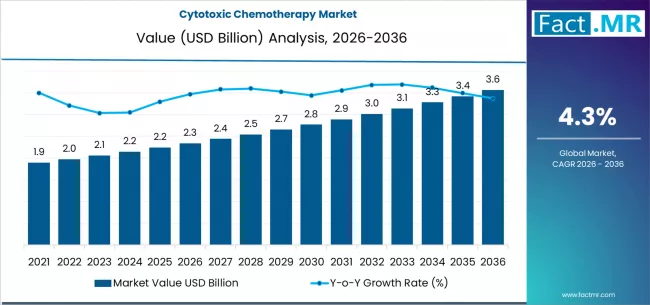
Key Takeaways from the Cytotoxic Chemotherapy Market

  • Market Value for 2026: USD 2.34 Billion
  • Market Value for 2036: USD 3.57 Billion
  • Forecast CAGR 2026 to 2036: 4.3%
  • Leading Product Segment (2026): Alkylating Agents (26.6%)
  • Leading Application Segment (2026): Breast Cancer (24.7%)
  • Leading Sales Channel Segment (2026): Hospital Pharmacies (55.1%)
  • Key Growth Countries: India (6.2% CAGR), China (6.0% CAGR), Brazil (5.7% CAGR), USA (5.1% CAGR)
  • Key Players in the Market: F. Hoffmann-La Roche Ltd, Pfizer Inc., Novartis AG, Bristol-Myers Squibb Company, Teva Pharmaceutical Industries Ltd.

Cytotoxic Chemotherapy Market Market Value Analysis

Cytotoxic agents remain a cornerstone of treatment, particularly in first-line regimens, combination therapies, and across a wide range of solid and hematological malignancies where newer modalities are inaccessible or ineffective. Their essential role in palliative care and in resource-limited settings further underpins sustained demand.

The market's evolution is characterized by a shift towards optimization and cost management. Key trends include the robust expansion of biosimilar versions of key cytotoxic drugs, which are enhancing access and reducing systemic costs. There is a pronounced focus on developing novel delivery mechanisms, such as liposomal encapsulation and ADCs, which utilize cytotoxic payloads with greater precision.

These refinements, aimed at improving therapeutic indices and mitigating severe side effects, ensuring cytotoxic chemotherapy's continued integration into modern, multimodal treatment protocols.

Metric

Metric Value
Market Value (2026) USD 2.34 Billion
Market Forecast Value (2036) USD 3.57 Billion
Forecast CAGR 2026 to 2036 4.3%

Category

Category Segments
Product Alkylating Agents, Antimetabolites, Anthracyclines, Plant Alkaloids, Others
Application Breast Cancer, Lung Cancer, Colorectal Cancer, Hematological Cancers, Others
Sales Channel Hospital Pharmacies, Specialty Oncology Centers, Retail Pharmacies
Region North America, Latin America, Western Europe, Eastern Europe, East Asia, South Asia & Pacific, Middle East & Africa

Segmental Analysis

By Product, Which Segment Maintains a Broad Spectrum of Activity Across Cancers?
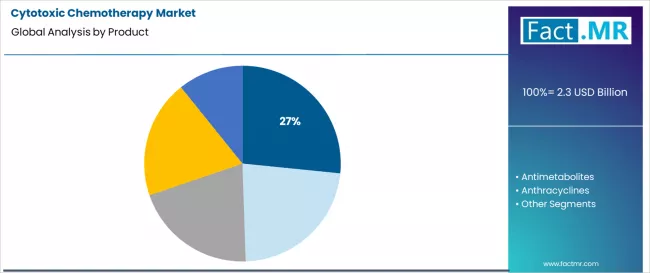
Cytotoxic Chemotherapy Market Analysis By Product

Alkylating agents command a leading 26.6% share. Their dominance stems from a mechanism of action that directly damages DNA, making them effective across a wide variety of solid tumors and hematological malignancies.

Drugs like cyclophosphamide and cisplatin remain fundamental components of many curative and palliative combination regimens. Their longstanding use, well-understood safety profiles, and role as backbone agents in protocols for cancers like breast and lymphoma secure their central market position.

By Application, Which High-Prevalence Cancer Sustains Volumetric Demand?

Cytotoxic Chemotherapy Market Analysis By Application

Breast cancer constitutes the primary application segment at 24.7%. The global high incidence of breast cancer ensures a large, consistent patient pool requiring systemic therapy. Cytotoxic chemotherapy is extensively used in neoadjuvant, adjuvant, and metastatic settings.

Even with advancements in targeted therapies, chemotherapeutic regimens remain a critical and often unavoidable component of treatment pathways, driving substantial and recurring demand.

By Sales Channel, Which Channel is Synonymous with the Administration of Infusion Therapies?
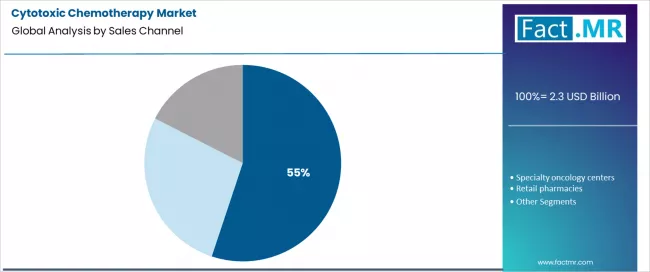
Cytotoxic Chemotherapy Market Analysis By Sales Channel

Hospital pharmacies form the dominant sales channel segment at 55.1%. This reflects the clinical reality that the majority of cytotoxic chemotherapies require intravenous administration under close medical supervision to manage acute side effects and potential emergencies. Hospital pharmacies are logistically central to procuring, preparing, and dispensing these high-risk injectables, controlling the primary route to market.

What are the Drivers, Constraints, and Evolving Dynamics Influencing the Cytotoxic Chemotherapy Landscape?

The principal driver for the cytotoxic chemotherapy market is the persistent global burden of cancer and the ongoing essential role of these agents in first-line and combination treatment protocols, especially where targeted therapies are not indicated or affordable. A major constraint is the severe side-effect profile and toxicity of these drugs, which continues to drive the oncology field toward more selective treatments, limiting growth potential.

A significant opportunity lies in the expansion of biosimilars for key cytotoxic drugs, which reduces healthcare costs and improves access in price-sensitive markets, thereby defending volume. The dominant trend is the innovation in drug delivery technology, particularly the development of antibody-drug conjugates, which marry the potent cell-killing effect of traditional cytotoxic payloads with the targeting precision of monoclonal antibodies, creating a high-value niche within the broader market.

Analysis of the Cytotoxic Chemotherapy Market by Key Countries
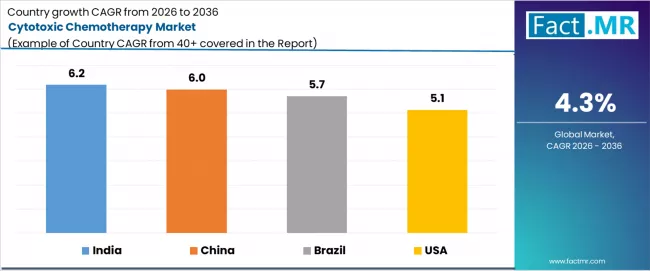
Cytotoxic Chemotherapy Market Cagr Analysis By Country

Country CAGR 2026 to 2036
India 6.2%
China 6.0%
Brazil 5.7%
USA 5.1%

How does the USA's Evolving Reimbursement Landscape Influence Cytotoxic Drug Utilization?

The USA’s 5.1% CAGR operates within a complex reimbursement system increasingly focused on value-based care. Payer pressures favoring lower-cost biosimilars and protocols that minimize hospitalization moderate growth.

The market is characterized by a shift in administration from hospital inpatient to specialized outpatient centers, impacting purchasing channels. Innovation is channeled towards supportive care drugs that manage chemotherapy-induced toxicities, improving the overall treatment paradigm.

Can Brazil's Public Healthcare System Balance Expanding Access with Cost Containment?

Brazil’s 5.7% CAGR is driven by the need to treat a large cancer population within its unified public health system (SUS). Government tenders for generic and biosimilar agents heavily influence the cytotoxic chemotherapy market.

Growth is tied to the state's capacity to fund and distribute these essential medicines, with a strong focus on cost-effective regimens for high-burden cancers like breast and cervical, often prioritizing older, well-established cytotoxic drugs.

Is China's Rapid Oncology Innovation Creating a Two-Tiered Market for Cytotoxic Therapies?

China’s 6.0% CAGR reflects a rapidly modernizing oncology sector. While investment pours into novel immunotherapies, a vast patient population still relies on cytotoxic chemotherapy. The market is bifurcated into major urban cancer centers adopt newer, often domestic, formulations and combination strategies, while broader regional hospitals depend on a stable volume of essential generic cytotoxics. Government initiatives to include more anticancer drugs in national insurance are key to growth.

Will India's Generic Manufacturing Prowess Define Its Role in the Global Cytotoxic Supply Chain?

India’s leading 6.2% CAGR is underpinned by its position as the pharmacy of the world. The domestic cytotoxic chemotherapy market is driven by high incidence rates and improving diagnosis.

Internationally, Indian manufacturers are pivotal in supplying affordable generic and biosimilar cytotoxic APIs and finished formulations globally. Growth is sustained by robust domestic demand and export opportunities to other price-sensitive markets, though it faces intense price competition.

Competitive Landscape of the Cytotoxic Chemotherapy Market
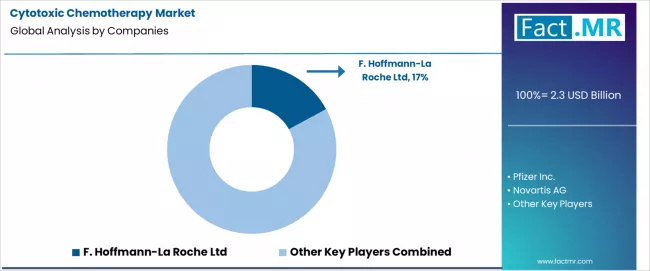
Cytotoxic Chemotherapy Market Analysis By Company

The competitive landscape is divided between originator pharmaceutical companies and generic/biospecialist manufacturers. Originators like Roche and Pfizer focus on defending key patented agents, often through life-cycle management strategies such as developing improved formulations or combinations. Their marketing efforts are directed towards differentiation through comprehensive support services and clinical data.

Companies such as Teva compete on scale, cost, and speed to market with generics and biosimilars, exerting continuous downward price pressure. Success in this mature market requires navigating complex cost-containment policies and diverse regional procurement systems.

Strategic Imperative Rationale & Action
Expand Biosimilar Portfolio Capitalize on patent expiries of blockbuster cytotoxics. Develop and launch high-quality biosimilars to capture market share in cost-driven healthcare systems.
Enhance Supportive Care Bundles Differentiate commodity drugs by bundling them with proprietary antiemetics, growth factors, or toxicity management digital tools, improving patient outcomes and loyalty.
Optimize for Outpatient Administration Develop ready-to-use formulations, shorter infusion protocols, and support services tailored for specialty oncology centers and hospital outpatient pharmacies, where care is migrating.
Secure Tender Contracts in Emerging Markets Build dedicated government affairs and supply chain teams to successfully bid in large-scale national and hospital tenders in countries like Brazil, India, and China, prioritizing volume over margin.

Key Players in the Cytotoxic Chemotherapy Market

  • F. Hoffmann-La Roche Ltd
  • Pfizer Inc.
  • Novartis AG
  • Bristol-Myers Squibb Company
  • Teva Pharmaceutical Industries Ltd.
  • Others

Scope of Report

Items Metrics
Quantitative Units USD Billion
Product Alkylating Agents, Antimetabolites, Anthracyclines, Plant Alkaloids, Others
Application Breast Cancer, Lung Cancer, Colorectal Cancer, Hematological Cancers, Others
Sales Channel Hospital Pharmacies, Specialty Oncology Centers, Retail Pharmacies
Key Countries India, China, Brazil, USA
Key Companies Roche, Pfizer, Novartis, Bristol-Myers Squibb, Teva, Others
Additional Analysis Comparative cost-effectiveness analysis of cytotoxic regimens vs. newer targeted therapies; impact of granulocyte-colony stimulating factors (G-CSFs) on chemotherapy dosing and market; analysis of supply chain vulnerabilities for key cytotoxic APIs; regulatory pathways and adoption rates for biosimilar cytotoxics across major markets.

Market by Segments

  • Product :

    • Alkylating Agents
    • Antimetabolites
    • Anthracyclines
    • Plant Alkaloids
    • Others
  • Application :

    • Breast Cancer
    • Lung Cancer
    • Colorectal Cancer
    • Hematological Cancers
    • Others
  • Sales Channel :

    • Hospital Pharmacies
    • Specialty Oncology Centers
    • Retail Pharmacies
  • Region :

    • North America

      • USA
      • Canada
    • Latin America

      • Brazil
      • Mexico
      • Argentina
      • Rest of Latin America
    • Western Europe

      • Germany
      • France
      • UK
      • Italy
      • Spain
      • BENELUX
      • Rest of Western Europe
    • Eastern Europe

      • Russia
      • Poland
      • Czech Republic
      • Rest of Eastern Europe
    • East Asia

      • China
      • Japan
      • South Korea
      • Rest of East Asia
    • South Asia & Pacific

      • India
      • ASEAN
      • Australia
      • Rest of South Asia & Pacific
    • MEA

      • GCC Countries
      • South Africa
      • Turkiye
      • Rest of MEA

Bibliography

  • American Cancer Society. (2025). Cancer Facts & Figures 2025. ACS.
  • European Society for Medical Oncology (ESMO). (2024). Clinical Practice Guidelines for the Use of Cytotoxic Chemotherapy. ESMO.
  • National Comprehensive Cancer Network (NCCN). (2025). NCCN Guidelines: Principles of Cytotoxic Chemotherapy.
  • World Health Organization (WHO). (2024). WHO Model List of Essential Medicines - Antineoplastic Section. WHO.

Table of Content

  1. Executive Summary
    • Global Market Outlook
    • Demand to side Trends
    • Supply to side Trends
    • Technology Roadmap Analysis
    • Analysis and Recommendations
  2. Market Overview
    • Market Coverage / Taxonomy
    • Market Definition / Scope / Limitations
  3. Market Background
    • Market Dynamics
      • Drivers
      • Restraints
      • Opportunity
      • Trends
    • Scenario Forecast
      • Demand in Optimistic Scenario
      • Demand in Likely Scenario
      • Demand in Conservative Scenario
    • Opportunity Map Analysis
    • Product Life Cycle Analysis
    • Supply Chain Analysis
    • Investment Feasibility Matrix
    • Value Chain Analysis
    • PESTLE and Porter’s Analysis
    • Regulatory Landscape
    • Regional Parent Market Outlook
    • Production and Consumption Statistics
    • Import and Export Statistics
  4. Global Market Analysis 2021 to 2025 and Forecast, 2026 to 2036
    • Historical Market Size Value (USD Million) Analysis, 2021 to 2025
    • Current and Future Market Size Value (USD Million) Projections, 2026 to 2036
      • Y to o to Y Growth Trend Analysis
      • Absolute $ Opportunity Analysis
  5. Global Market Pricing Analysis 2021 to 2025 and Forecast 2026 to 2036
  6. Global Market Analysis 2021 to 2025 and Forecast 2026 to 2036, By Product
    • Introduction / Key Findings
    • Historical Market Size Value (USD Million) Analysis By Product, 2021 to 2025
    • Current and Future Market Size Value (USD Million) Analysis and Forecast By Product, 2026 to 2036
      • Alkylating agents
      • Antimetabolites
      • Anthracyclines
      • Plant alkaloids
      • Others
    • Y to o to Y Growth Trend Analysis By Product, 2021 to 2025
    • Absolute $ Opportunity Analysis By Product, 2026 to 2036
  7. Global Market Analysis 2021 to 2025 and Forecast 2026 to 2036, By Application
    • Introduction / Key Findings
    • Historical Market Size Value (USD Million) Analysis By Application, 2021 to 2025
    • Current and Future Market Size Value (USD Million) Analysis and Forecast By Application, 2026 to 2036
      • Breast cancer
      • Lung cancer
      • Colorectal cancer
      • Hematological cancers
      • Others
    • Y to o to Y Growth Trend Analysis By Application, 2021 to 2025
    • Absolute $ Opportunity Analysis By Application, 2026 to 2036
  8. Global Market Analysis 2021 to 2025 and Forecast 2026 to 2036, By Sales Channel
    • Introduction / Key Findings
    • Historical Market Size Value (USD Million) Analysis By Sales Channel, 2021 to 2025
    • Current and Future Market Size Value (USD Million) Analysis and Forecast By Sales Channel, 2026 to 2036
      • Hospital pharmacies
      • Specialty oncology centers
      • Retail pharmacies
    • Y to o to Y Growth Trend Analysis By Sales Channel, 2021 to 2025
    • Absolute $ Opportunity Analysis By Sales Channel, 2026 to 2036
  9. Global Market Analysis 2021 to 2025 and Forecast 2026 to 2036, By Region
    • Introduction
    • Historical Market Size Value (USD Million) Analysis By Region, 2021 to 2025
    • Current Market Size Value (USD Million) Analysis and Forecast By Region, 2026 to 2036
      • North America
      • Latin America
      • Western Europe
      • Eastern Europe
      • East Asia
      • South Asia and Pacific
      • Middle East & Africa
    • Market Attractiveness Analysis By Region
  10. North America Market Analysis 2021 to 2025 and Forecast 2026 to 2036, By Country
    • Historical Market Size Value (USD Million) Trend Analysis By Market Taxonomy, 2021 to 2025
    • Market Size Value (USD Million) Forecast By Market Taxonomy, 2026 to 2036
      • By Country
        • USA
        • Canada
        • Mexico
      • By Product
      • By Application
      • By Sales Channel
    • Market Attractiveness Analysis
      • By Country
      • By Product
      • By Application
      • By Sales Channel
    • Key Takeaways
  11. Latin America Market Analysis 2021 to 2025 and Forecast 2026 to 2036, By Country
    • Historical Market Size Value (USD Million) Trend Analysis By Market Taxonomy, 2021 to 2025
    • Market Size Value (USD Million) Forecast By Market Taxonomy, 2026 to 2036
      • By Country
        • Brazil
        • Chile
        • Rest of Latin America
      • By Product
      • By Application
      • By Sales Channel
    • Market Attractiveness Analysis
      • By Country
      • By Product
      • By Application
      • By Sales Channel
    • Key Takeaways
  12. Western Europe Market Analysis 2021 to 2025 and Forecast 2026 to 2036, By Country
    • Historical Market Size Value (USD Million) Trend Analysis By Market Taxonomy, 2021 to 2025
    • Market Size Value (USD Million) Forecast By Market Taxonomy, 2026 to 2036
      • By Country
        • Germany
        • UK
        • Italy
        • Spain
        • France
        • Nordic
        • BENELUX
        • Rest of Western Europe
      • By Product
      • By Application
      • By Sales Channel
    • Market Attractiveness Analysis
      • By Country
      • By Product
      • By Application
      • By Sales Channel
    • Key Takeaways
  13. Eastern Europe Market Analysis 2021 to 2025 and Forecast 2026 to 2036, By Country
    • Historical Market Size Value (USD Million) Trend Analysis By Market Taxonomy, 2021 to 2025
    • Market Size Value (USD Million) Forecast By Market Taxonomy, 2026 to 2036
      • By Country
        • Russia
        • Poland
        • Hungary
        • Balkan & Baltic
        • Rest of Eastern Europe
      • By Product
      • By Application
      • By Sales Channel
    • Market Attractiveness Analysis
      • By Country
      • By Product
      • By Application
      • By Sales Channel
    • Key Takeaways
  14. East Asia Market Analysis 2021 to 2025 and Forecast 2026 to 2036, By Country
    • Historical Market Size Value (USD Million) Trend Analysis By Market Taxonomy, 2021 to 2025
    • Market Size Value (USD Million) Forecast By Market Taxonomy, 2026 to 2036
      • By Country
        • China
        • Japan
        • South Korea
      • By Product
      • By Application
      • By Sales Channel
    • Market Attractiveness Analysis
      • By Country
      • By Product
      • By Application
      • By Sales Channel
    • Key Takeaways
  15. South Asia and Pacific Market Analysis 2021 to 2025 and Forecast 2026 to 2036, By Country
    • Historical Market Size Value (USD Million) Trend Analysis By Market Taxonomy, 2021 to 2025
    • Market Size Value (USD Million) Forecast By Market Taxonomy, 2026 to 2036
      • By Country
        • India
        • ASEAN
        • Australia & New Zealand
        • Rest of South Asia and Pacific
      • By Product
      • By Application
      • By Sales Channel
    • Market Attractiveness Analysis
      • By Country
      • By Product
      • By Application
      • By Sales Channel
    • Key Takeaways
  16. Middle East & Africa Market Analysis 2021 to 2025 and Forecast 2026 to 2036, By Country
    • Historical Market Size Value (USD Million) Trend Analysis By Market Taxonomy, 2021 to 2025
    • Market Size Value (USD Million) Forecast By Market Taxonomy, 2026 to 2036
      • By Country
        • Kingdom of Saudi Arabia
        • Other GCC Countries
        • Turkiye
        • South Africa
        • Other African Union
        • Rest of Middle East & Africa
      • By Product
      • By Application
      • By Sales Channel
    • Market Attractiveness Analysis
      • By Country
      • By Product
      • By Application
      • By Sales Channel
    • Key Takeaways
  17. Key Countries Market Analysis
    • USA
      • Pricing Analysis
      • Market Share Analysis, 2025
        • By Product
        • By Application
        • By Sales Channel
    • Canada
      • Pricing Analysis
      • Market Share Analysis, 2025
        • By Product
        • By Application
        • By Sales Channel
    • Mexico
      • Pricing Analysis
      • Market Share Analysis, 2025
        • By Product
        • By Application
        • By Sales Channel
    • Brazil
      • Pricing Analysis
      • Market Share Analysis, 2025
        • By Product
        • By Application
        • By Sales Channel
    • Chile
      • Pricing Analysis
      • Market Share Analysis, 2025
        • By Product
        • By Application
        • By Sales Channel
    • Germany
      • Pricing Analysis
      • Market Share Analysis, 2025
        • By Product
        • By Application
        • By Sales Channel
    • UK
      • Pricing Analysis
      • Market Share Analysis, 2025
        • By Product
        • By Application
        • By Sales Channel
    • Italy
      • Pricing Analysis
      • Market Share Analysis, 2025
        • By Product
        • By Application
        • By Sales Channel
    • Spain
      • Pricing Analysis
      • Market Share Analysis, 2025
        • By Product
        • By Application
        • By Sales Channel
    • France
      • Pricing Analysis
      • Market Share Analysis, 2025
        • By Product
        • By Application
        • By Sales Channel
    • India
      • Pricing Analysis
      • Market Share Analysis, 2025
        • By Product
        • By Application
        • By Sales Channel
    • ASEAN
      • Pricing Analysis
      • Market Share Analysis, 2025
        • By Product
        • By Application
        • By Sales Channel
    • Australia & New Zealand
      • Pricing Analysis
      • Market Share Analysis, 2025
        • By Product
        • By Application
        • By Sales Channel
    • China
      • Pricing Analysis
      • Market Share Analysis, 2025
        • By Product
        • By Application
        • By Sales Channel
    • Japan
      • Pricing Analysis
      • Market Share Analysis, 2025
        • By Product
        • By Application
        • By Sales Channel
    • South Korea
      • Pricing Analysis
      • Market Share Analysis, 2025
        • By Product
        • By Application
        • By Sales Channel
    • Russia
      • Pricing Analysis
      • Market Share Analysis, 2025
        • By Product
        • By Application
        • By Sales Channel
    • Poland
      • Pricing Analysis
      • Market Share Analysis, 2025
        • By Product
        • By Application
        • By Sales Channel
    • Hungary
      • Pricing Analysis
      • Market Share Analysis, 2025
        • By Product
        • By Application
        • By Sales Channel
    • Kingdom of Saudi Arabia
      • Pricing Analysis
      • Market Share Analysis, 2025
        • By Product
        • By Application
        • By Sales Channel
    • Turkiye
      • Pricing Analysis
      • Market Share Analysis, 2025
        • By Product
        • By Application
        • By Sales Channel
    • South Africa
      • Pricing Analysis
      • Market Share Analysis, 2025
        • By Product
        • By Application
        • By Sales Channel
  18. Market Structure Analysis
    • Competition Dashboard
    • Competition Benchmarking
    • Market Share Analysis of Top Players
      • By Regional
      • By Product
      • By Application
      • By Sales Channel
  19. Competition Analysis
    • Competition Deep Dive
      • F. Hoffmann-La Roche Ltd
        • Overview
        • Product Portfolio
        • Profitability by Market Segments (Product/Age /Sales Channel/Region)
        • Sales Footprint
        • Strategy Overview
          • Marketing Strategy
          • Product Strategy
          • Channel Strategy
      • Pfizer Inc.
      • Novartis AG
      • Bristol-Myers Squibb Company
      • Teva Pharmaceutical Industries Ltd.
      • Others
  20. Assumptions & Acronyms Used
  21. Research Methodology

List Of Table

  • Table 1: Global Market Value (USD Million) Forecast by Region, 2021 to 2036
  • Table 2: Global Market Value (USD Million) Forecast by Product, 2021 to 2036
  • Table 3: Global Market Value (USD Million) Forecast by Application, 2021 to 2036
  • Table 4: Global Market Value (USD Million) Forecast by Sales Channel, 2021 to 2036
  • Table 5: North America Market Value (USD Million) Forecast by Country, 2021 to 2036
  • Table 6: North America Market Value (USD Million) Forecast by Product, 2021 to 2036
  • Table 7: North America Market Value (USD Million) Forecast by Application, 2021 to 2036
  • Table 8: North America Market Value (USD Million) Forecast by Sales Channel, 2021 to 2036
  • Table 9: Latin America Market Value (USD Million) Forecast by Country, 2021 to 2036
  • Table 10: Latin America Market Value (USD Million) Forecast by Product, 2021 to 2036
  • Table 11: Latin America Market Value (USD Million) Forecast by Application, 2021 to 2036
  • Table 12: Latin America Market Value (USD Million) Forecast by Sales Channel, 2021 to 2036
  • Table 13: Western Europe Market Value (USD Million) Forecast by Country, 2021 to 2036
  • Table 14: Western Europe Market Value (USD Million) Forecast by Product, 2021 to 2036
  • Table 15: Western Europe Market Value (USD Million) Forecast by Application, 2021 to 2036
  • Table 16: Western Europe Market Value (USD Million) Forecast by Sales Channel, 2021 to 2036
  • Table 17: Eastern Europe Market Value (USD Million) Forecast by Country, 2021 to 2036
  • Table 18: Eastern Europe Market Value (USD Million) Forecast by Product, 2021 to 2036
  • Table 19: Eastern Europe Market Value (USD Million) Forecast by Application, 2021 to 2036
  • Table 20: Eastern Europe Market Value (USD Million) Forecast by Sales Channel, 2021 to 2036
  • Table 21: East Asia Market Value (USD Million) Forecast by Country, 2021 to 2036
  • Table 22: East Asia Market Value (USD Million) Forecast by Product, 2021 to 2036
  • Table 23: East Asia Market Value (USD Million) Forecast by Application, 2021 to 2036
  • Table 24: East Asia Market Value (USD Million) Forecast by Sales Channel, 2021 to 2036
  • Table 25: South Asia and Pacific Market Value (USD Million) Forecast by Country, 2021 to 2036
  • Table 26: South Asia and Pacific Market Value (USD Million) Forecast by Product, 2021 to 2036
  • Table 27: South Asia and Pacific Market Value (USD Million) Forecast by Application, 2021 to 2036
  • Table 28: South Asia and Pacific Market Value (USD Million) Forecast by Sales Channel, 2021 to 2036
  • Table 29: Middle East & Africa Market Value (USD Million) Forecast by Country, 2021 to 2036
  • Table 30: Middle East & Africa Market Value (USD Million) Forecast by Product, 2021 to 2036
  • Table 31: Middle East & Africa Market Value (USD Million) Forecast by Application, 2021 to 2036
  • Table 32: Middle East & Africa Market Value (USD Million) Forecast by Sales Channel, 2021 to 2036

List Of Figures

  • Figure 1: Global Market Pricing Analysis
  • Figure 2: Global Market Value (USD Million) Forecast 2021 to 2036
  • Figure 3: Global Market Value Share and BPS Analysis by Product, 2026 and 2036
  • Figure 4: Global Market Y to o to Y Growth Comparison by Product, 2026 to 2036
  • Figure 5: Global Market Attractiveness Analysis by Product
  • Figure 6: Global Market Value Share and BPS Analysis by Application, 2026 and 2036
  • Figure 7: Global Market Y to o to Y Growth Comparison by Application, 2026 to 2036
  • Figure 8: Global Market Attractiveness Analysis by Application
  • Figure 9: Global Market Value Share and BPS Analysis by Sales Channel, 2026 and 2036
  • Figure 10: Global Market Y to o to Y Growth Comparison by Sales Channel, 2026 to 2036
  • Figure 11: Global Market Attractiveness Analysis by Sales Channel
  • Figure 12: Global Market Value (USD Million) Share and BPS Analysis by Region, 2026 and 2036
  • Figure 13: Global Market Y to o to Y Growth Comparison by Region, 2026 to 2036
  • Figure 14: Global Market Attractiveness Analysis by Region
  • Figure 15: North America Market Incremental Dollar Opportunity, 2026 to 2036
  • Figure 16: Latin America Market Incremental Dollar Opportunity, 2026 to 2036
  • Figure 17: Western Europe Market Incremental Dollar Opportunity, 2026 to 2036
  • Figure 18: Eastern Europe Market Incremental Dollar Opportunity, 2026 to 2036
  • Figure 19: East Asia Market Incremental Dollar Opportunity, 2026 to 2036
  • Figure 20: South Asia and Pacific Market Incremental Dollar Opportunity, 2026 to 2036
  • Figure 21: Middle East & Africa Market Incremental Dollar Opportunity, 2026 to 2036
  • Figure 22: North America Market Value Share and BPS Analysis by Country, 2026 and 2036
  • Figure 23: North America Market Value Share and BPS Analysis by Product, 2026 and 2036
  • Figure 24: North America Market Y to o to Y Growth Comparison by Product, 2026 to 2036
  • Figure 25: North America Market Attractiveness Analysis by Product
  • Figure 26: North America Market Value Share and BPS Analysis by Application, 2026 and 2036
  • Figure 27: North America Market Y to o to Y Growth Comparison by Application, 2026 to 2036
  • Figure 28: North America Market Attractiveness Analysis by Application
  • Figure 29: North America Market Value Share and BPS Analysis by Sales Channel, 2026 and 2036
  • Figure 30: North America Market Y to o to Y Growth Comparison by Sales Channel, 2026 to 2036
  • Figure 31: North America Market Attractiveness Analysis by Sales Channel
  • Figure 32: Latin America Market Value Share and BPS Analysis by Country, 2026 and 2036
  • Figure 33: Latin America Market Value Share and BPS Analysis by Product, 2026 and 2036
  • Figure 34: Latin America Market Y to o to Y Growth Comparison by Product, 2026 to 2036
  • Figure 35: Latin America Market Attractiveness Analysis by Product
  • Figure 36: Latin America Market Value Share and BPS Analysis by Application, 2026 and 2036
  • Figure 37: Latin America Market Y to o to Y Growth Comparison by Application, 2026 to 2036
  • Figure 38: Latin America Market Attractiveness Analysis by Application
  • Figure 39: Latin America Market Value Share and BPS Analysis by Sales Channel, 2026 and 2036
  • Figure 40: Latin America Market Y to o to Y Growth Comparison by Sales Channel, 2026 to 2036
  • Figure 41: Latin America Market Attractiveness Analysis by Sales Channel
  • Figure 42: Western Europe Market Value Share and BPS Analysis by Country, 2026 and 2036
  • Figure 43: Western Europe Market Value Share and BPS Analysis by Product, 2026 and 2036
  • Figure 44: Western Europe Market Y to o to Y Growth Comparison by Product, 2026 to 2036
  • Figure 45: Western Europe Market Attractiveness Analysis by Product
  • Figure 46: Western Europe Market Value Share and BPS Analysis by Application, 2026 and 2036
  • Figure 47: Western Europe Market Y to o to Y Growth Comparison by Application, 2026 to 2036
  • Figure 48: Western Europe Market Attractiveness Analysis by Application
  • Figure 49: Western Europe Market Value Share and BPS Analysis by Sales Channel, 2026 and 2036
  • Figure 50: Western Europe Market Y to o to Y Growth Comparison by Sales Channel, 2026 to 2036
  • Figure 51: Western Europe Market Attractiveness Analysis by Sales Channel
  • Figure 52: Eastern Europe Market Value Share and BPS Analysis by Country, 2026 and 2036
  • Figure 53: Eastern Europe Market Value Share and BPS Analysis by Product, 2026 and 2036
  • Figure 54: Eastern Europe Market Y to o to Y Growth Comparison by Product, 2026 to 2036
  • Figure 55: Eastern Europe Market Attractiveness Analysis by Product
  • Figure 56: Eastern Europe Market Value Share and BPS Analysis by Application, 2026 and 2036
  • Figure 57: Eastern Europe Market Y to o to Y Growth Comparison by Application, 2026 to 2036
  • Figure 58: Eastern Europe Market Attractiveness Analysis by Application
  • Figure 59: Eastern Europe Market Value Share and BPS Analysis by Sales Channel, 2026 and 2036
  • Figure 60: Eastern Europe Market Y to o to Y Growth Comparison by Sales Channel, 2026 to 2036
  • Figure 61: Eastern Europe Market Attractiveness Analysis by Sales Channel
  • Figure 62: East Asia Market Value Share and BPS Analysis by Country, 2026 and 2036
  • Figure 63: East Asia Market Value Share and BPS Analysis by Product, 2026 and 2036
  • Figure 64: East Asia Market Y to o to Y Growth Comparison by Product, 2026 to 2036
  • Figure 65: East Asia Market Attractiveness Analysis by Product
  • Figure 66: East Asia Market Value Share and BPS Analysis by Application, 2026 and 2036
  • Figure 67: East Asia Market Y to o to Y Growth Comparison by Application, 2026 to 2036
  • Figure 68: East Asia Market Attractiveness Analysis by Application
  • Figure 69: East Asia Market Value Share and BPS Analysis by Sales Channel, 2026 and 2036
  • Figure 70: East Asia Market Y to o to Y Growth Comparison by Sales Channel, 2026 to 2036
  • Figure 71: East Asia Market Attractiveness Analysis by Sales Channel
  • Figure 72: South Asia and Pacific Market Value Share and BPS Analysis by Country, 2026 and 2036
  • Figure 73: South Asia and Pacific Market Value Share and BPS Analysis by Product, 2026 and 2036
  • Figure 74: South Asia and Pacific Market Y to o to Y Growth Comparison by Product, 2026 to 2036
  • Figure 75: South Asia and Pacific Market Attractiveness Analysis by Product
  • Figure 76: South Asia and Pacific Market Value Share and BPS Analysis by Application, 2026 and 2036
  • Figure 77: South Asia and Pacific Market Y to o to Y Growth Comparison by Application, 2026 to 2036
  • Figure 78: South Asia and Pacific Market Attractiveness Analysis by Application
  • Figure 79: South Asia and Pacific Market Value Share and BPS Analysis by Sales Channel, 2026 and 2036
  • Figure 80: South Asia and Pacific Market Y to o to Y Growth Comparison by Sales Channel, 2026 to 2036
  • Figure 81: South Asia and Pacific Market Attractiveness Analysis by Sales Channel
  • Figure 82: Middle East & Africa Market Value Share and BPS Analysis by Country, 2026 and 2036
  • Figure 83: Middle East & Africa Market Value Share and BPS Analysis by Product, 2026 and 2036
  • Figure 84: Middle East & Africa Market Y to o to Y Growth Comparison by Product, 2026 to 2036
  • Figure 85: Middle East & Africa Market Attractiveness Analysis by Product
  • Figure 86: Middle East & Africa Market Value Share and BPS Analysis by Application, 2026 and 2036
  • Figure 87: Middle East & Africa Market Y to o to Y Growth Comparison by Application, 2026 to 2036
  • Figure 88: Middle East & Africa Market Attractiveness Analysis by Application
  • Figure 89: Middle East & Africa Market Value Share and BPS Analysis by Sales Channel, 2026 and 2036
  • Figure 90: Middle East & Africa Market Y to o to Y Growth Comparison by Sales Channel, 2026 to 2036
  • Figure 91: Middle East & Africa Market Attractiveness Analysis by Sales Channel
  • Figure 92: Global Market - Tier Structure Analysis
  • Figure 93: Global Market - Company Share Analysis

- FAQs -

How big is the cytotoxic chemotherapy market in 2026?

The global cytotoxic chemotherapy market is estimated to be valued at USD 2.3 billion in 2026.

What will be the size of cytotoxic chemotherapy market in 2036?

The market size for the cytotoxic chemotherapy market is projected to reach USD 3.6 billion by 2036.

How much will be the cytotoxic chemotherapy market growth between 2026 and 2036?

The cytotoxic chemotherapy market is expected to grow at a 4.3% CAGR between 2026 and 2036.

What are the key product types in the cytotoxic chemotherapy market?

The key product types in cytotoxic chemotherapy market are alkylating agents, antimetabolites, anthracyclines, plant alkaloids and others.

Which application segment to contribute significant share in the cytotoxic chemotherapy market in 2026?

In terms of application, breast cancer segment to command 24.7% share in the cytotoxic chemotherapy market in 2026.

Cytotoxic Chemotherapy Market