- Market Value (2025): USD 1.0 Bn
- Estimated Value (2026): USD 1.07 Bn
- Forecast Value (2036): USD 2.06 Bn
- CAGR (2026-2036): 6.8%
What is the Bridge Drivers Market forecast to be worth by 2036?
USD 1.1 billion in 2026 to USD 2.1 billion by 2036 at a 6.8% CAGR.
- Bridge driver revenue totalled USD 1.0 billion in 2025, with full-bridge parts for brushed DC motors accounting for most of the shipments.
- Turnover will move from USD 1.07 billion in 2026 to USD 2.06 billion by 2036 as vehicles and machines add motorized functions.
- Annual gains will average 6.8% CAGR between 2026 and 2036, since each new comfort, thermal or motion feature brings at least one more motor to drive.
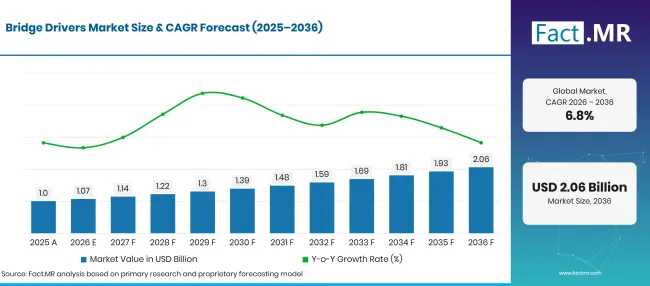
Bridge Drivers Market Forecast Global | Source: Fact.MR
| Year | Basis | Market Value (USD billion) |
|---|---|---|
| 2025 | Actual | 1.0 |
| 2026 | Estimate | 1.07 |
| 2036 | Forecast | 2.06 |
| CAGR 2026 to 2036 | Forecast period | 6.8% |
Source: Fact.MR analysis. Updated Oct 26, 2026
What are the defining numbers behind Bridge Drivers Market growth?
The 2026 to 2036 window adds USD 1.0 billion in new value, most of it from vehicle and factory motor control.
- Demand Drivers in the Market
- Electrified cars carry more motors per platform. The International Energy Agency reported that electric car sales grew 20% to exceed 20 million in 2025, about a quarter of new cars sold [1]. Pumps, fans and valves in these vehicles each need switching control from a bridge stage.
- Comfort features are moving from manual to motorized operation. Toshiba began shipping engineering samples of the TB9104FTG in January 2026. The part is a gate driver for bridge circuits that run high-current brushed DC motors in powered tailgates, sliding doors and seat adjusters [2]. Parts of this kind let one controller handle two motors at once.
- Factory and office equipment needs finer motion control. Printers, robots and conveyors rely on drivers that hold torque steady at low speed, so suppliers keep adding current regulation and diagnostics on chip.
- Design-in creates long, repeatable revenue. Once a driver passes qualification for an automotive or industrial platform, it usually stays for the full production run of that model.
- Integration is cutting board space and part count. Newer drivers fold charge pumps, current sensing and protection into one package, which lowers the cost of adding another motorized function.
- Key Segments Analyzed
- By Type: Full-Bridge Drivers will hold 42.3% share in 2026, given that brushed DC motors in seats, windows and pumps must run forward and in reverse.
- By Application: Automotive will account for 38.7% share in 2026 through the growing count of body, thermal and powertrain motors in each car.
- By Voltage: Below 20 V will capture 56.1% share in 2026, as 12 V vehicle networks and low-voltage consumer devices absorb the bulk of unit volume.
- Analyst Opinion at Fact.MR
- Shambhu Nath Jha, Principal Consultant at Fact.MR, states, “Every motor added to a car door, seat or cooling loop needs a bridge stage to turn it both ways. That unit count keeps rising. Suppliers that integrate current sensing and diagnostics will win more sockets because carmakers want fewer parts on the board. Long qualification cycles mean the designs won in the next three years will carry revenue well into the 2030s.”
- Strategic Implications
- Chipmakers should build automotive full-bridge families that share pinouts across current ratings, so one board layout can serve several motor sizes.
- Tier 1 suppliers should qualify drivers with built-in current sensing and diagnostic reporting, given that body electronics now face functional safety reviews.
- Industrial equipment builders should standardize on drivers with on-chip current regulation, since it removes sense resistors and tuning work from each new machine.
- Distributors should hold stock of qualified automotive grades, because a single missing driver can halt a vehicle module line.
At 8.3% CAGR, Germany will set the pace, where carmakers are moving fast into battery electric models. Brazil follows at 7.6% as vehicle output recovers and local assembly expands. The United States will track the market at 6.8%, helped by hybrid uptake and rising domestic chip output. Growth of 6.1% in the United Kingdom rests on a fast-growing zero emission fleet. Japan rounds out the group at 5.4%, drawing on its export-oriented vehicle and electronics industries.
How does the Bridge Drivers Market break down by segment?
Full-Bridge Drivers will lead Type at 42.3%; Automotive will head Application at 38.7%; Below 20 V will take first place in Voltage at 56.1%.
Which Type carries the most weight?
Full-Bridge Drivers take 42.3% of 2026 revenue.
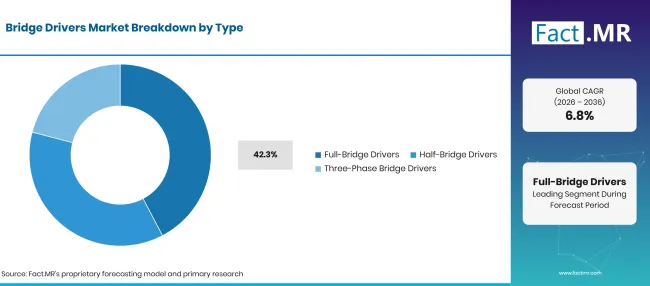
Bridge Drivers Market Breakdown Type | Source: Fact.MR
| Type | Share (2026) |
|---|---|
| Full-Bridge Drivers (Leading segment) | 42.3% |
| Other segments combined | 57.7%* |
| Total | 100.0% |
Source: Fact.MR analysis. Updated Oct 26, 2026
Brushed DC motors in window lifts, seat tracks and small pumps must reverse direction on command. A full bridge does this with four switches in one package, so designers avoid relays and extra discrete parts. Many of these motors appear in the broader motor driver IC category alongside stepper and brushless types. Toshiba launched the TB67H482FNG in February 2025, a single H-bridge driver rated at up to 50 V and 5 A for large brushed DC motors in air conditioners, office equipment and robotics [3]. Half-bridge drivers serve power conversion and split motor stages. Three-phase bridge drivers run brushless DC motors in fans, compressors and drives.
What leads the Application segment?
Automotive represents 38.7% of 2026 revenue.
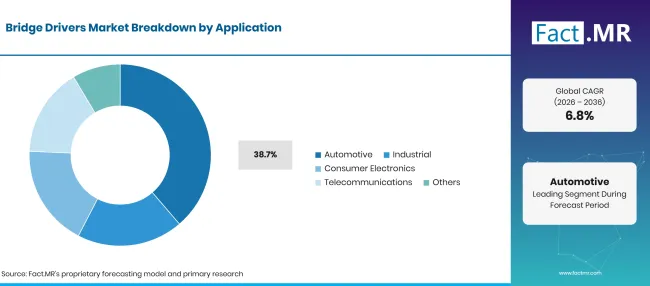
Bridge Drivers Market Breakdown Application | Source: Fact.MR
| Application | Share (2026) |
|---|---|
| Automotive (Leading segment) | 38.7% |
| Other segments combined | 61.3%* |
| Total | 100.0% |
Source: Fact.MR analysis. Updated Oct 26, 2026
A modern car contains dozens of small motors in doors, seats, mirrors and sunroofs as well as thermal systems. Each needs a driver that survives heat, vibration and load dump on the 12 V network. Body modules and automotive actuators for valves and flaps add further sockets per vehicle. Industrial users apply bridge drivers in conveyors, valves and industrial robots, where torque control and fault reporting reduce downtime. Consumer electronics makers use small drivers in cameras, printers and home appliances. Telecommunications gear uses them in cooling fans and antenna tilt units.
How does Voltage shape demand?
Below 20 V claims 56.1% of 2026 revenue.
| Voltage | Share (2026) |
|---|---|
| Below 20 V (Leading segment) | 56.1% |
| Other segments combined | 43.9%* |
| Total | 100.0% |
Source: Fact.MR analysis. Updated Oct 26, 2026
Battery-powered gadgets and 12 V vehicle loads run on low supply rails, and they ship in the greatest unit counts. Drivers for these jobs are small, cheap and often single-chip, which keeps their share of revenue high despite low unit prices. The 20 V to 60 V class serves 24 V industrial equipment, 48 V vehicle systems and office machines. Toshiba launched the TB67S579FTG in January 2026, a 40 V and 2.0 A stepper driver for printers, surveillance cameras and ATMs [4]. Above 60 V parts serve traction auxiliaries and industrial drives.
What is accelerating Bridge Drivers Market adoption, and what is holding it back?
Adoption grows with each motorized feature that carmakers and machine builders add, and with chips that integrate sensing and protection. Heat limits in compact modules, price pressure and long qualification cycles slow the pace.
Drivers Impact Analysis
| DRIVER | (~) % IMPACT ON CAGR | GEOGRAPHIC RELEVANCE | IMPACT TIMELINE |
|---|---|---|---|
| More motor-driven body, comfort and thermal functions per vehicle | +1.6% | North America, Western Europe, East Asia | Short term (<= 2 years) |
| Electric and hybrid platforms adding pumps, fans and valves | +1.3% | Western Europe, East Asia, North America | Medium term (2-4 years) |
| Factory automation and robotics needing precise motion control | +1.0% | East Asia, Western Europe | Medium term (2-4 years) |
| Small motors in printers, cameras and home appliances | +0.6% | East Asia, North America | Short term (<= 2 years) |
Source: Fact.MR analysis. Updated Oct 26, 2026
Opportunity Impact Analysis
| OPPORTUNITY | (~) % IMPACT ON CAGR | GEOGRAPHIC RELEVANCE | IMPACT TIMELINE |
|---|---|---|---|
| Drivers with integrated current sensing and diagnostics for functional safety | +0.8% | Global | Medium term (2-4 years) |
| 48 V vehicle systems opening a mid-voltage driver class | +0.6% | Western Europe, North America | Long term (>= 4 years) |
| Two-motor gate drivers replacing relay-based designs | +0.4% | Global | Short term (<= 2 years) |
Source: Fact.MR analysis. Updated Oct 26, 2026
Restraints Impact Analysis
| RESTRAINT | (~) % IMPACT ON CAGR | GEOGRAPHIC RELEVANCE | IMPACT TIMELINE |
|---|---|---|---|
| Heat build-up and switching losses in compact modules | -0.5% | Global | Short term (<= 2 years) |
| Price pressure on high-volume low-voltage parts | -0.4% | East Asia, Global | Short term (<= 2 years) |
| Long automotive qualification cycles delaying design wins | -0.3% | Western Europe, North America, East Asia | Medium term (2-4 years) |
Source: Fact.MR analysis. Updated Oct 26, 2026
Which countries are scaling the Bridge Drivers Market through 2036?
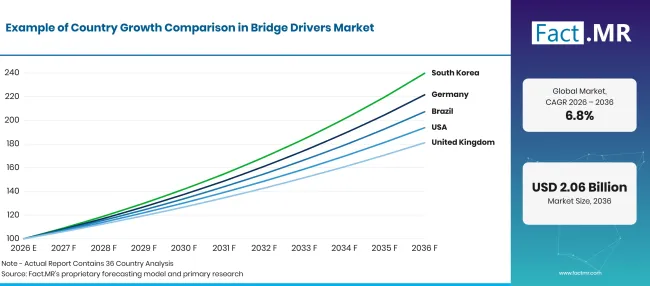
Bridge Drivers Market Growth Index 1 | Source: Fact.MR
| Country | CAGR (2026 to 2036) |
|---|---|
| Germany | 8.3% |
| Brazil | 7.6% |
| United States | 6.8% |
| United Kingdom | 6.1% |
| Japan | 5.4% |
Source: Fact.MR analysis. Updated Oct 26, 2026
What supports Germany’s adoption?
8.3% CAGR, driven by a fast shift to battery electric cars and a large vehicle export base.
The Kraftfahrt-Bundesamt reported 545,142 new battery electric car registrations in 2025, a 19.1% share and 43.2% more than in 2024 [5]. Destatis reported that about 2.0 million new cars were exported from January to July 2026, with battery electric models at 28.1% of the total [6]. Both trends add motors for thermal and comfort systems to cars built in German plants.
How is Brazil scaling demand?
7.6% CAGR, backed by a recovery in vehicle production.
IBGE reported that national industrial production rose 0.6% in 2025 compared with 2024 [7]. Output of motor vehicles, trailers and bodies stood 4.4% above its February 2020 level in May 2026, according to the agency’s monthly survey [8]. Local vehicle and appliance assembly creates steady demand for low-voltage motor drivers sold through distributors.
What supports United States adoption?
6.8% CAGR, helped by hybrid vehicle sales and rising domestic semiconductor output.
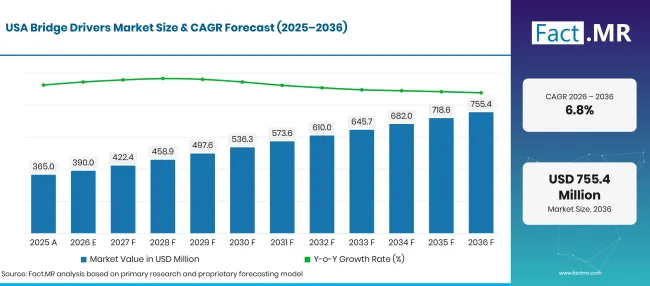
Bridge Drivers Market Forecast Usa | Source: Fact.MR
The Federal Reserve reported a 28.4% gain in the output of semiconductors and related electronic components in the third quarter of 2026 [9]. The Energy Information Administration reported that hybrid, battery electric and plug-in hybrid vehicles accounted for 24% of new light-duty vehicle sales in the second quarter of 2026 [10]. Hybrids alone reached a record 16% [10].
How is the United Kingdom developing demand?
6.1% CAGR, reflecting a growing zero emission vehicle fleet.
The Department for Transport reported 528,000 zero emission vehicles registered for the first time in 2025, an increase of 24% [11]. The Office for National Statistics reported that transport equipment output rose 8.9% in the three months to February 2026, the main positive contributor to manufacturing growth [12]. Vehicle and machinery plants buy drivers through Tier 1 suppliers.
How does Japan perform?
5.4% CAGR, as export-led vehicle and electronics makers keep orders flowing.
Japan Customs reported that semiconductor exports reached JPY 6.59 trillion in 2025, up 8.4% from 2024 [13]. Motor vehicle exports totalled 5,896,177 units in the same year [13]. Domestic chipmakers supply bridge drivers to car, printer and appliance makers that ship worldwide.
Who leads the Bridge Drivers Market?
Three groups shape the field. Broad analog suppliers such as Texas Instruments, STMicroelectronics and NXP Semiconductors offer full families of H-bridge and gate drivers, including ST’s VNH9030AQ to VNH9090AQ and NXP’s HB2000 and MC33926. Texas Instruments began production at its 300 mm fab in Sherman in December 2025, adding analog capacity for automotive and industrial customers [14].
Automotive power specialists such as Infineon Technologies, with its MOTIX full-bridge ICs, and Toshiba compete on qualification and integration. Toshiba sampled the TB9104FTG two-motor gate driver in January 2026 [2]. ROHM, Renesas Electronics and Microchip Technology serve focused niches, from Renesas HIP2103 half-bridge drivers to Microchip’s ATA6847L three-phase gate driver. Analog Devices brings TMC stepper drivers with integrated H-bridges for motion control. Winning the next round of platforms will depend on built-in diagnostics, thermal margin and secure long-term supply.
Which companies are the key providers?
Key companies include Texas Instruments Incorporated; Infineon Technologies AG; STMicroelectronics N.V.; NXP Semiconductors N.V.; Analog Devices, Inc.; ROHM Co., Ltd.; Toshiba Electronic Devices & Storage Corporation; Renesas Electronics Corporation; and Microchip Technology Incorporated.
- Texas Instruments Incorporated
- Infineon Technologies AG
- STMicroelectronics N.V.
- NXP Semiconductors N.V.
- Analog Devices, Inc.
- ROHM Co., Ltd.
- Toshiba Electronic Devices & Storage Corporation
- Renesas Electronics Corporation
- Microchip Technology Incorporated
Bibliography
- [1] International Energy Agency. (2026). Global EV Outlook 2026: Executive summary.
- [2] Toshiba Electronic Devices & Storage Corporation. (2026, January 29). Toshiba Announces Sample Availability of Gate Driver for Bridge Circuits Driving High-Current Automotive Brushed DC Motors.
- [3] Toshiba Electronic Devices & Storage Corporation. (2025, February 27). Toshiba launches H-bridge motor driver for high-torque applications.
- [4] Toshiba Electronic Devices & Storage Corporation. (2026, January 22). Toshiba launches stepper motor driver IC featuring next-generation Advanced Microstep Technology.
- [5] Kraftfahrt-Bundesamt. (2026, January 6). Fahrzeugzulassungen im Dezember 2025: Jahresbilanz [Vehicle registrations in December 2025: Annual review].
- [6] Statistisches Bundesamt (Destatis). (2026, September 21). Exporte von neuen Pkw in den ersten sieben Monaten 2026 um 4,0 % zum Vorjahreszeitraum gesunken [New car exports fell 4.0% in the first seven months of 2026].
- [7] Instituto Brasileiro de Geografia e Estatística (IBGE). (2026, February 10). Produção industrial fecha 2025 com avanço em 10 dos 18 locais pesquisados [Industrial production closes 2025 with gains in 10 of 18 locations].
- [8] Instituto Brasileiro de Geografia e Estatística (IBGE). (2026, July 3). Pesquisa Industrial Mensal: Produção Física, Brasil, Maio de 2026 [Monthly Industrial Survey: Physical Production, Brazil, May 2026].
- [9] Board of Governors of the Federal Reserve System. (2026, October 16). Industrial Production and Capacity Utilization: G.17.
- [10] U.S. Energy Information Administration. (2026, July 27). Hybrid sales rise while battery electric sales remain lower after tax credit expiration.
- [11] Department for Transport. (2026, April 29). Vehicle licensing statistics, United Kingdom: 2025.
- [12] Office for National Statistics. (2026, April 16). Index of Production, UK: February 2026.
- [13] Ministry of Finance, Japan (Customs and Tariff Bureau). (2026, March 12). Value of Exports and Imports 2025 (Calendar Year) (January-December) (Revised Data).
- [14] Texas Instruments. (2025, December 17). Texas Instruments begins production at its newest 300mm semiconductor manufacturing facility in Sherman, Texas.
This Report Answers
- Revenue for bridge drivers is split by type, application and voltage class from 2026 to 2036.
- Why full-bridge parts, automotive use and sub-20 V designs lead their segments is traced to motor counts and supply rails.
- Five countries are compared on vehicle electrification, factory output and chip production.
- Supplier profiles group chipmakers by portfolio breadth, automotive focus and niche strength.
- Drivers, opportunities and restraints are scored by their effect on the growth rate.
What does the Bridge Drivers Market cover?
ree-phase designs are counted, whether the power transistors are inside the package or outside it.
Revenue is measured at the chip level across automotive, industrial, consumer electronics, telecommunications and other uses. Voltage classes run from sub-20 V battery devices to above 60 V industrial drives.
What is included in the scope?
Integrated H-bridge motor drivers, stepper drivers with dual H-bridges and gate drivers built for bridge circuits are in scope. Drivers sold for automotive power electronics such as pump and fan controllers are counted at chip value.
Sales to vehicle makers, Tier 1 suppliers, machine builders and electronics brands are included. Distributor sales of the same parts also count.
What is excluded from the scope?
Standalone MOSFETs, IGBTs and other discrete switches sold on their own fall outside this study. General-purpose microcontrollers and other automotive semiconductor devices without a bridge-driving function are also left out.
Finished motors, motor modules, vehicles and machines are not counted. Isolated gate drivers for traction inverters are excluded unless they are sold as bridge driver products.
How Was the Analysis Built?
The analysis draws on 120+ sources, 35+ company portfolios, 25+ countries, and more than 20 industry interviews.
- Primary Research: Primary research includes discussions with manufacturers, service providers, technology developers, distributors, end users, and subject-matter experts. These conversations examine purchasing priorities, product adoption, operational challenges, approval requirements, competitive positioning, and the factors that influence wider market acceptance.
- Desk Research: Desk research covers government statistics, regulatory publications, company filings, trade data, technical studies, industry associations, standards, public policy, and other authoritative sources. Every source used in the analysis is documented in the bibliography.
- Market Sizing and Forecasting: Market estimates combine historical performance, demand indicators, pricing and volume trends, segment shares, company participation, country-level growth, adoption patterns, investment activity, and barriers to market expansion.
- Data Validation and Update Cycle: Findings are validated by comparing primary interviews with public data, company activity, regulatory changes, trade patterns, and industry developments. Regular updates review new product launches, capacity changes, partnerships, approvals, and shifts in commercial adoption.
Segmentation
What is the report’s scope and coverage?
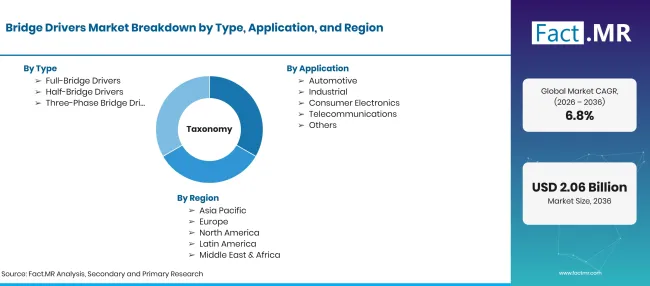
Bridge Drivers Market Taxonomy | Source: Fact.MR
| Attribute | Details |
|---|---|
| Quantitative Units | USD billion in 2026 to USD billion by 2036 at CAGR |
| Market Definition | Integrated circuits that drive high-side and low-side switches arranged in full-bridge, half-bridge or three-phase bridge configurations, either with built-in power stages or as gate drivers for external MOSFETs. Revenue is counted at the chip level for automotive, industrial, consumer, telecommunications and other uses. |
| Type | Full-Bridge Drivers; Half-Bridge Drivers; Three-Phase Bridge Drivers |
| Application | Automotive; Industrial; Consumer Electronics; Telecommunications; Others |
| Voltage | Below 20 V; 20 V to 60 V; Above 60 V |
| Regions Covered | North America; Latin America; Western Europe; Eastern Europe; East Asia; South Asia & Pacific; Middle East & Africa |
| Countries Covered | Germany; Brazil; United States; United Kingdom; Japan |
| Companies Profiled | Texas Instruments Incorporated; Infineon Technologies AG; STMicroelectronics N.V.; NXP Semiconductors N.V.; Analog Devices, Inc.; ROHM Co., Ltd.; Toshiba Electronic Devices & Storage Corporation; Renesas Electronics Corporation; Microchip Technology Incorporated |
| Forecast Period | 2026 to 2036 |
| Approach | Bottom-up count of motors per vehicle, machine and device; driver content per motor by bridge type and voltage class; average selling prices; and supplier portfolio review. |
Source: Fact.MR analysis. Updated Oct 26, 2026
How is the market segmented?
-
By Type
- Full-Bridge Drivers
- Half-Bridge Drivers
- Three-Phase Bridge Drivers
-
By Application
- Automotive
- Industrial
- Consumer Electronics
- Telecommunications
- Others
-
By Voltage
- Below 20 V
- 20 V to 60 V
- Above 60 V
-
By Region
- North America
- Latin America
- Western Europe
- Eastern Europe
- East Asia
- South Asia & Pacific
- Middle East & Africa
Frequently Asked Questions
How big is the bridge drivers market in 2026?
What is the CAGR of the bridge drivers market from 2026 to 2036?
Which type leads the bridge drivers market?
Which application leads the bridge drivers market?
Which voltage class leads the bridge drivers market?
Which country will grow the most in the bridge drivers market?
Who are the main companies in the bridge drivers market?
Who worked on this report


Preview the report firsthand - request a free sample
Free SampleGet the brochure for pricing and purchase details
Download PDF