- Market Value (2025): USD 2321.9 Mn
- Estimated Value (2026): USD 2456.6 Mn
- Forecast Value (2036): USD 4708.6 Mn
- CAGR (2026-2036): 5.8%
What is the Burrata Cheese Market forecast to be worth by 2036?
USD 2456.6 million in 2026 to USD 4708.6 million by 2036, at a 5.8% CAGR.
- The burrata cheese market reached USD 2321.9 million in 2025.
- Demand is projected to increase from USD 2456.6 million in 2026 to USD 4708.6 million by 2036.
- The market is forecast to record a 5.8% CAGR from 2026 to 2036.
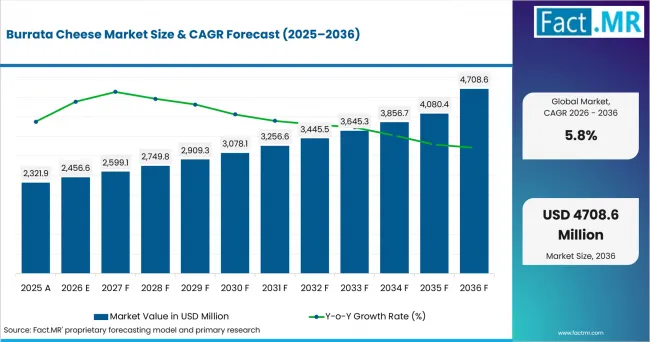
Burrata Cheese Market Value Analysis | Source: Fact.MR
What are the defining numbers behind Burrata Cheese Market growth?
USD 2252.1 million absolute opportunity is expected between 2026 and 2036.
- Demand Drivers in the Market
- Chilled dairy buyers place value on burrata when fresh texture and filling consistency survive delivery.
- Commercial kitchens use burrata more regularly when delivery timing and case size match menu planning.
- Retail access improves when chilled shelves show the product clearly without raising avoidable waste.
- Sourcing discipline protects flavor and fill quality so buyers can compare offers beyond price.
- Key Segments Analyzed
- By Type: Fresh Buffalo Mozzarella accounts for 61.5% share in 2026 and supports mozzarella cheese applications.
- By Application: Commercial leads with 53.6% share in 2026. Restaurants and catering buyers need repeatable product handling.
- Analyst Opinion at Fact.MR
- Shambhu Nath Jha, Senior Consultant at Fact.MR, states, “Buyer decisions in the burrata cheese market depend on how well product form matches the serving environment. Fresh formats need cold-chain discipline and predictable texture after delivery. Commercial buyers compare supply reliability with application fit. Household demand is shaped by pack size and retail access. This places burrata inside a wider dairy products assessment.”
- Strategic Implications
- Foodservice buyers gain clearer purchase control when product type and pack size are reviewed before menu adoption.
- Suppliers improve conversion when they explain texture retention and replenishment reliability in simple buyer language.
- Retail planning works better when fresh and frozen formats are matched to shelf life and store capability.
The UK and Australia record the highest country CAGR at 7.3% each. The USA follows at 7.2% through 2036. Canada advances at 6.3% and Germany is forecast to expand at 5.2% across the same period.
How does the Burrata Cheese Market break down by segment?
Fresh Buffalo Mozzarella leads Type with 61.5% share in 2026. Commercial leads Application with 53.6% share in 2026.
Why does Fresh Buffalo Mozzarella lead Type?
Fresh Buffalo Mozzarella is projected to account for 61.5% share in 2026.
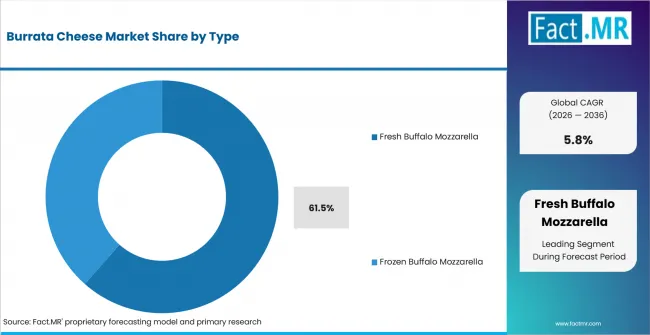
Burrata Cheese Market Analysis By Type | Source: Fact.MR
Fresh Buffalo Mozzarella leads because burrata use depends on soft texture and a fresh serving profile. Buyers prefer this format for premium plates and chilled retail displays. Frozen Buffalo Mozzarella serves users that need longer storage and tighter stock control. Fresh formats keep the advantage when texture decides repeat purchase.
Why does Commercial lead Application?
Commercial holds 53.6% share in 2026.
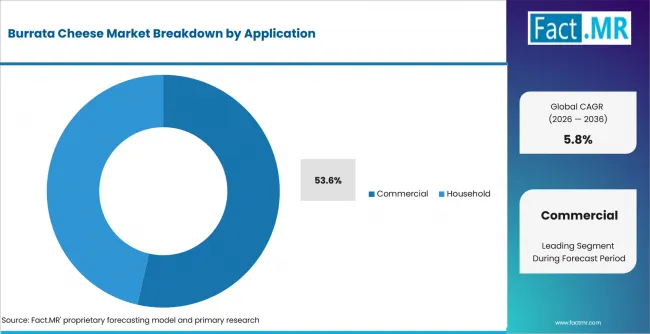
Burrata Cheese Market Analysis By Application | Source: Fact.MR
Commercial use has the leading share since restaurants and catering buyers order burrata for repeat menu work. These buyers need dependable case sizes and stable chilled delivery. Household use depends more on premium grocery trial and online basket fit. Commercial demand is easier to forecast when orders are based on planned menus.
What is accelerating Burrata Cheese Market adoption, and what is holding it back?
Burrata demand is growing through wider chilled availability and restaurant use. Clear serving guidance supports retail trial. Short shelf life and cold-chain costs may limit growth, making proper handling essential.
Drivers Impact Analysis
| DRIVER | (~) % IMPACT ON CAGR | GEOGRAPHIC RELEVANCE | IMPACT TIMELINE |
|---|---|---|---|
| Fresh texture preference | Not separately quantified | UK, Australia, USA | Short term (<= 2 years) |
| Commercial menu use | Not separately quantified | Foodservice markets | Short term (<= 2 years) |
| Retail chilled access | Not separately quantified | North America and Europe | Medium term (2-4 years) |
| Format and pack-size fit | Not separately quantified | Online and grocery channels | Medium term (2-4 years) |
| Supplier consistency | Not separately quantified | Mature dairy channels | Long term (>= 4 years) |
Source: Fact.MR analysis. Updated Aug 4, 2026
- Fresh texture preference: Buyers choose burrata when the soft centre remains intact during handling and serving.
- Menu standardization: Foodservice teams can list burrata dishes when pack size and delivery timing stay predictable.
- Chilled retail access: Stores support trial when displays explain serving use and protect the product from avoidable waste.
Opportunity Impact Analysis
| OPPORTUNITY | (~) % IMPACT ON CAGR | GEOGRAPHIC RELEVANCE | IMPACT TIMELINE |
|---|---|---|---|
| Premium chilled retail placement | Not separately quantified | UK, USA, Germany | Medium term (2-4 years) |
| Foodservice recipe fit | Not separately quantified | Commercial kitchens | Medium term (2-4 years) |
| Pack-size differentiation | Not separately quantified | Retail and household channels | Long term (>= 4 years) |
| Regional distribution build-out | Not separately quantified | Australia and Canada | Long term (>= 4 years) |
Source: Fact.MR analysis. Updated Aug 4, 2026
- Premium chilled retail placement: Burrata can earn more shelf space when packaging explains use and storage in simple terms.
- Foodservice recipe fit: Suppliers gain menu trials when chefs receive clear guidance on portioning and plating.
- Pack-size differentiation: Smaller retail packs can reduce waste risk and make household trial less expensive.
Restraints Impact Analysis
| RESTRAINT | (~) % IMPACT ON CAGR | GEOGRAPHIC RELEVANCE | IMPACT TIMELINE |
|---|---|---|---|
| Short chilled shelf life | Not separately quantified | Global | Short term (<= 2 years) |
| Cold-chain cost | Not separately quantified | Fresh dairy channels | Short term (<= 2 years) |
| Price sensitivity | Not separately quantified | Household retail | Medium term (2-4 years) |
| Labeling and market-entry checks | Not separately quantified | Import markets | Long term (>= 4 years) |
Source: Fact.MR analysis. Updated Aug 4, 2026
- Short chilled shelf life: Fresh burrata needs careful temperature control so texture does not fail before sale.
- Cold-chain cost: Distributors may limit wider listings when chilled handling reduces margin control.
- Labeling checks: Producers must meet local dairy rules and still protect the clean taste that makes burrata valued.
Which countries are scaling the Burrata Cheese Market fastest?
- The country comparison spans 2.1 percentage points across the forecast period.
- The UK and Australia share the top position at 7.3% CAGR.
- The USA follows at 7.2% CAGR as specialty retail and restaurant use keep adoption above the global rate.
- Canada reaches 6.3% CAGR with steady chilled dairy distribution.
- Germany records 5.2% CAGR in a mature cheese market that needs clear premium placement.
Comparable CAGRs can reflect different entry conditions. Shelf life and regional distribution change the buying path by country. Full report coverage includes North America and Europe. Latin America and East Asia are covered separately. South Asia and Oceania are included with the Middle East and Africa.
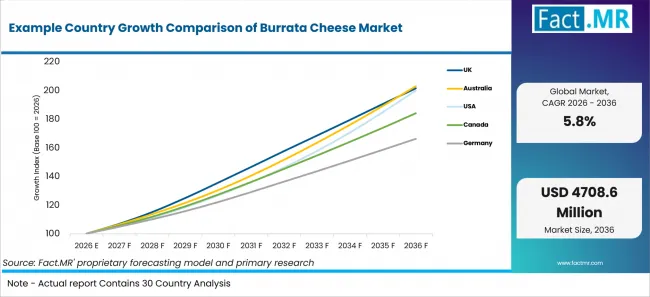
Example Country Growth Comparison Of Burrata Cheese Market | Source: Fact.MR
| Country | CAGR (2026-2036) |
|---|---|
| UK | 7.3% |
| Australia | 7.3% |
| USA | 7.2% |
| Canada | 6.3% |
| Germany | 5.2% |
Source: Fact.MR analysis. Updated Aug 4, 2026
What supports the UK's lead through 2036?
7.3% CAGR, shaped by premium chilled retail and foodservice use.
The UK benefits when chilled retail gives fresh cheese a clear premium role. Foodservice use adds a second route because restaurants can present burrata as a ready plate component. Buyers care about delivery timing since texture weakens when the cold chain is uneven. Suppliers that give clear storage guidance have a better route into repeat orders.
How is Australia matching the UK pace?
7.3% CAGR, backed by chilled distribution and commercial dairy use.
Australia matches the UK rate through urban foodservice and premium grocery interest. Distance between production and consumption points makes packaging more important. Commercial buyers are expected to ask for stable case formats before adding burrata to menus. Retail gains are strongest when product instructions reduce waste for first-time buyers.
What is building USA demand?
7.2% CAGR, driven by specialty retail and restaurant purchasing.
In the USA, burrata adoption is shaped by specialty cheese cases and commercial kitchens. Restaurants create repeat use when the product fits salads and appetizers. Share plates add another service occasion. Suppliers need broad coverage and steady freshness control to convert trial into regular purchase.
What supports Canada's growth?
6.3% CAGR, supported by steady chilled dairy distribution.
Canada grows above the global rate through dependable regional supply. The market is more measured than the UK and Australia as distribution distances can raise spoilage risk. Commercial buyers are expected to prefer suppliers that keep repeat orders simple. Household adoption improves when pack sizes match planned consumption.
How does Germany perform?
5.2% CAGR, led by mature cheese consumption and selective premium demand.
Germany's pace is closest to the global rate. The country already has a broad cheese culture so burrata must prove a clear use case. Retailers are expected to test premium placement before expanding shelf space. Suppliers need to explain freshness and application fit without making the product look difficult to handle.
Who leads the Burrata Cheese Market?
Granarolo shows direct relevance through burrata and mozzarella portfolios. Sabelli adds wider dairy reach.
Lactalis Group and Fattorie Garofalo widen the supplier group. Spinosa completes the retained provider set with BelGioioso Cheese.
Competition depends on how clearly suppliers match product form with channel needs. Buyers compare freshness control and case availability before they move from trial to repeat orders. Service levels matter when burrata is sold through chilled retail or foodservice. Providers with dependable logistics and simple product guidance are better placed to keep accounts active.
Which companies are the key providers?
Key companies include Granarolo; Sabelli; Lactalis Group; Fattorie Garofalo; Spinosa; and BelGioioso Cheese.
- Granarolo
- Sabelli
- Lactalis Group
- Fattorie Garofalo
- Spinosa
- BelGioioso Cheese
Bibliography
- Food and Agriculture Organization of the United Nations. (2025). Milk and milk products: Market summary.
- Organisation for Economic Co-operation and Development, & Food and Agriculture Organization of the United Nations. (2025). Dairy and dairy products. In OECD-FAO agricultural outlook 2025–2034. OECD Publishing.
- U.S. Food and Drug Administration. (2025). Guidance for industry: Questions and answers regarding food allergens, including the food allergen labeling requirements of the Federal Food, Drug, and Cosmetic Act (Edition 5).
This Report Answers
- The report provides strategic intelligence on the Burrata Cheese Market across Type and Application choices that shape commercial and household demand.
- Segment analysis covers Fresh Buffalo Mozzarella and Commercial use as the share leaders within the 2026 market.
- Country outlook evaluates the UK and Australia alongside the USA. Canada and Germany complete the growth comparison across the profiled markets.
- Competitive analysis profiles Granarolo alongside Sabelli. Lactalis Group extends the provider set. Fattorie Garofalo and Spinosa are included. BelGioioso Cheese complete the company view.
- Scope assessment covers fresh and frozen buffalo mozzarella. Commercial and household use complete the application view across the listed regions.
What does the Burrata Cheese Market cover?
Burrata cheese products are assessed when type and application determine purchase fit.
The Burrata Cheese Market covers products sold in fresh and frozen buffalo mozzarella formats. Coverage extends to commercial and household applications. Retail and foodservice routes are included when the product stays within the defined type and application categories.
What is included in the scope?
Burrata cheese formats are included when they are sold across the listed Type and Application categories.
The scope includes Fresh Buffalo Mozzarella and Frozen Buffalo Mozzarella. It covers Commercial and Household use. Regional coverage includes North America and Europe. Latin America and East Asia are included. South Asia and Oceania are covered with the Middle East and Africa. The country set includes the UK and Australia. The USA and Canada are included. Germany completes the country view.
What is excluded from the scope?
Products outside the defined burrata cheese type and application categories stay outside the scope.
The scope excludes unrelated cheese products and non-cheese dairy items. Services without a direct connection to burrata cheese sales are excluded. Company revenue is excluded when it cannot be traced to the defined burrata cheese formats or to the assessed applications.
How Was the Analysis Built?
The analysis draws on 120+ sources, 35+ company portfolios, 25+ countries, and more than 20 industry interviews.
- Primary Research: Primary research includes discussions with manufacturers, service providers, technology developers, distributors, end users, procurement teams, and subject-matter experts. These conversations examine purchasing priorities, product adoption, operational challenges, approval requirements, competitive positioning, and the factors that influence wider market acceptance.
- Desk Research: Desk research covers government statistics, regulatory publications, company filings, trade data, technical studies, industry associations, standards, public policy, and other authoritative sources. Every source used in the analysis is documented in the bibliography.
- Market Sizing and Forecasting: Market estimates combine historical performance, demand indicators, pricing and volume trends, segment shares, company participation, country-level growth, adoption patterns, investment activity, and barriers to market expansion.
- Data Validation and Update Cycle: Findings are validated by comparing primary interviews with public data, company activity, regulatory changes, trade patterns, and industry developments. Regular updates review new product launches, capacity changes, partnerships, approvals, procurement trends, and shifts in commercial adoption.
Segmentation
What is the report's scope and coverage?
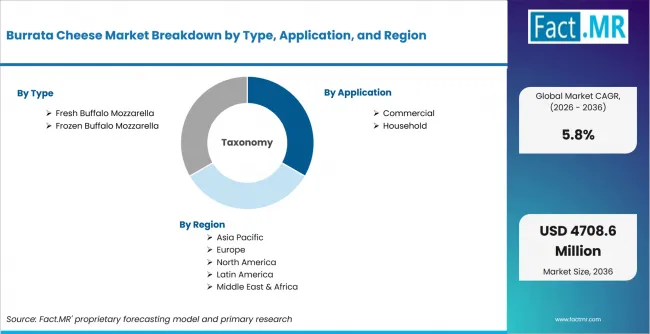
Burrata Cheese Market Breakdown By Type, Application, And Region | Source: Fact.MR
| Attribute | Details |
|---|---|
| Quantitative Units | USD million in 2026 to USD million by 2036, at a CAGR |
| Market Definition | Burrata cheese products sold across fresh and frozen buffalo mozzarella formats where application fit and chilled handling shape demand |
| Type | Fresh Buffalo Mozzarella; Frozen Buffalo Mozzarella |
| Application | Commercial; Household |
| Regions Covered | North America; Latin America; Europe; East Asia; South Asia and Oceania; Middle East and Africa |
| Countries Covered | UK; Australia; USA; Canada; Germany |
| Key Companies Profiled | Granarolo; Sabelli; Lactalis Group; Fattorie Garofalo; Spinosa; BelGioioso Cheese |
| Forecast Period | 2026 to 2036 |
| Approach | Hybrid top-down and bottom-up approach using product type demand; application fit; chilled distribution; retail and foodservice coverage; supplier participation; country adoption patterns; and company portfolio review |
Source: Fact.MR analysis. Updated Aug 4, 2026
How is the market segmented?
-
By Type:
- Fresh Buffalo Mozzarella
- Frozen Buffalo Mozzarella
-
By Application:
- Commercial
- Household
-
By Region:
- North America
- Latin America
- Europe
- East Asia
- South Asia and Oceania
- Middle East and Africa
Frequently Asked Questions
What is the forecast CAGR for the Burrata Cheese Market?
Which type leads the Burrata Cheese Market?
Which application leads the market?
Which country records the fastest growth?
Which companies are included in the market assessment?
Who worked on this report


Preview the report firsthand - request a free sample
Free SampleGet the brochure for pricing and purchase details
Download PDF