Cabin Air Sterilization Systems Market (2026 - 2036)

Cabin Air Sterilization Systems Market Size and Share Forecast Outlook 2026 to 2036

Core Findings

    Cabin Air Sterilization Systems Market Forecast and Outlook 2026 to 2036

    Cabin air sterilization systems market is likely to be valued at USD 0.52 billion in 2026 and is projected to reach USD 1.35 billion by 2036, reflecting a 10.0% CAGR, according to Fact.MR analysis.

    Summary of Cabin Air Sterilization Systems Market - Key Takeaways

    • The cabin air sterilization systems market comprises in-cabin technologies designed to reduce airborne pathogens, allergens, and odors through integrated sterilization solutions across passenger vehicles, commercial transport, and shared mobility platforms.
    • The global market is estimated at USD 0.52 billion in 2026 and is projected to reach USD 1.35 billion by 2036, expanding at a 10.0% CAGR based on Fact.MR analysis aligned with rising air hygiene standards and passenger safety expectations.
    • By technology, UV-C sterilization systems lead with a 34% share, supported by standardized efficacy validation, scalable deployment, and compatibility with existing cabin climate control architectures.
    • By integration type, HVAC-integrated sterilization systems account for a 54% share, reflecting preference for solutions that enable repeatable installation, predictable maintenance cycles, and operational efficiency across vehicle fleets.
    • China and Brazil represent the fastest-growing markets at 12.1% and 11.9% CAGR respectively, driven by urban air quality concerns, expanding EV production, and regulatory emphasis on in-cabin hygiene.
    • Competition is led by suppliers such as Panasonic, Honeywell, and Bosch, where validated sterilization efficacy, HVAC integration capability, and OEM alignment define long-term competitive positioning.
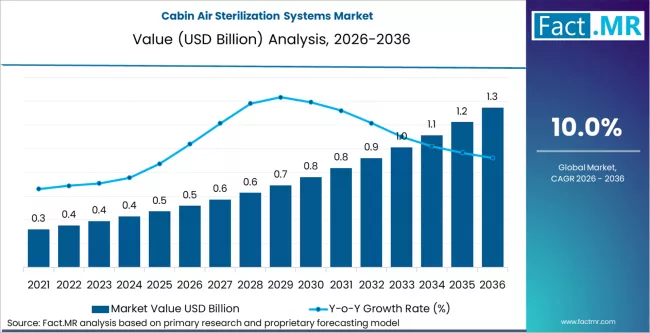
    Cabin Air Sterilization Systems Market Market Value Analysis

    Growth is being driven by rising demand for in-cabin infection control across commercial transport, passenger vehicles, and public mobility systems, where air sterilization enhances safety, comfort, and operational reliability. Adoption is influenced by the need for standardized sterilization efficacy, compatibility with existing HVAC infrastructure, and predictable system performance under high-frequency usage.

    Supply chain strategies focus on scalable manufacturing, consistent component quality, and multi-region deployment. Operational alignment with fleet management and maintenance schedules ensures minimal downtime and reliable air quality control. Competitive differentiation arises from companies developing high-efficiency sterilization modules, energy-optimized designs, and adaptive control systems. The market trajectory demonstrates a strategic shift toward reliable, scalable, and technology-driven cabin air sterilization solutions that meet evolving regulatory standards and passenger safety expectations worldwide.

    Cabin Air Sterilization Systems Market

    Metric Value
    Market Value (2026) USD 0.52.0 billion
    Forecast Value (2036) USD 1.35 billion
    Forecast CAGR (2026-2036) 10.0%

    Category

    Category Segments
    By Technology UV-C systems; Ionization / plasma; Photocatalytic oxidation; Other
    By Integration HVAC integrated; Standalone cabin unit; Filter + sterilization combo; Other
    By Vehicle Segment Passenger vehicles; Premium / luxury; LCV; Other
    By Use Case Allergen / pathogen reduction; Odor / VOC control; Shared mobility hygiene; Other
    Region North America; Europe; Asia Pacific; Latin America; Middle East & Africa

    Segmental Analysis

    By Technology, Why Do UV-C Systems Lead the Market?
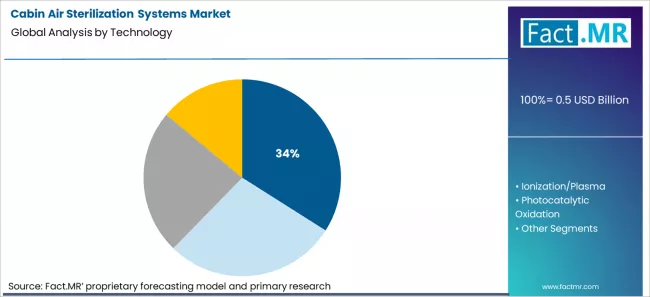
    Cabin Air Sterilization Systems Market Analysis By Technology

    UV-C systems lead the market with 34% share, reflecting adoption across automotive OEMs, commercial fleets, and connected vehicle platforms where predictable procurement and repeatable deployment drive market demand. The market emphasizes scalable integration, standardized installation protocols, and consistent operational performance to support efficient supply chain and logistics management. Suppliers benefit from recurring orders, repeatable production runs, and multi-platform distribution. Segment dominance is defined by structural market factors such as volume adoption, repeatable workflow integration, and channel penetration rather than the specific sterilization mechanism itself. Predictable deployment and operational efficiency anchor UV-C systems as the primary market driver.

    By Integration, Why Does HVAC-Integrated Sterilization Represent the Largest Segment?
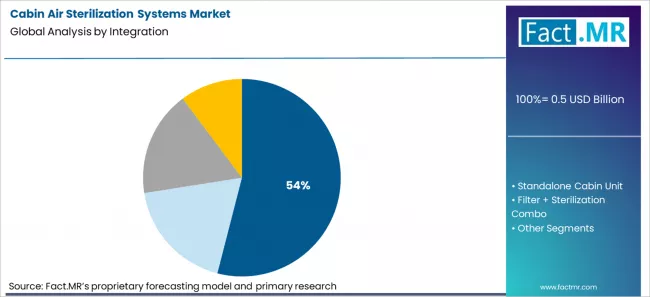
    Cabin Air Sterilization Systems Market Analysis By Integration

    HVAC-integrated systems account for 54% share, reflecting market preference for solutions that streamline installation, supply chain management, and recurring maintenance across fleets and passenger vehicles. Demand is concentrated in segments that prioritize repeatable deployment, predictable procurement cycles, and operational efficiency in large-scale integration. Suppliers benefit from standardized production, scalable logistics, and recurring orders across multiple vehicle platforms. Segment prominence arises from structural market drivers such as workflow repeatability, channel coverage, and supply chain efficiency rather than the system configuration itself. HVAC-integrated solutions dominate because high-frequency adoption and operational scalability define overall market activity.

    Country/Region

    Country/Region Driver Restraint Trend
    USA Rising consumer and regulatory focus on in-cabin air hygiene → drives adoption of sterilization systems OEM safety and regulatory certifications → increase CapEx and slow small supplier entry Growth of UV-C and plasma-based sterilization integrated with HVAC
    Germany Expansion of EV and premium vehicle production → fuels adoption of cabin air sterilization EU safety and environmental regulations → increases testing and compliance costs Adoption of multi-stage sterilization systems integrated with climate control
    India Urban pollution and health awareness → accelerates penetration of cabin sterilization systems Limited access to advanced sterilization tech → slows rollout for smaller suppliers Growth of affordable, locally manufactured cabin sterilization solutions
    China Rapid automotive and EV manufacturing → drives demand for high-performance cabin sterilization Regional quality and safety standards → delays approval of new systems Expansion of automated production and testing for sterilization units
    Brazil Automotive localization policies → increase demand for effective cabin sterilization Import restrictions and compliance requirements → raise production and integration costs Growth of energy-efficient, locally sourced cabin sterilization systems

    Analysis of the Cabin Air Sterilization Systems Market by Key Country
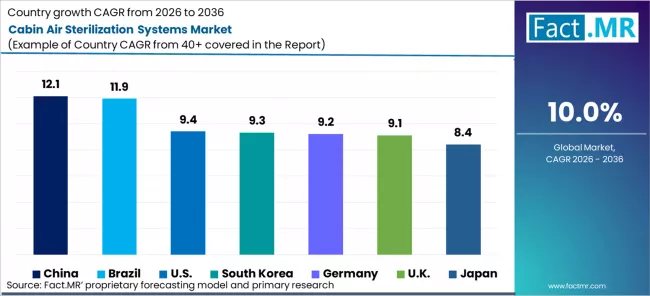
    Cabin Air Sterilization Systems Market Cagr Analysis By Country

    Country CAGR (2026-2036)
    U.S. 9.4%
    Japan 8.4%
    South Korea 9.3%
    Germany 9.2%
    China 12.1%
    U.K. 9.1%
    Brazil 11.9%

    The report covers an in-depth analysis of 40+ countries; top-performing countries are highlighted below.

    How Is Demand for Cabin Air Sterilization Systems Growing in the United States?

    Demand for cabin air sterilization systems in the United States grows at 9.4% CAGR through 2036. Automotive OEMs implement advanced sterilization solutions to improve air hygiene, enhance passenger safety, and optimize HVAC efficiency. Operational improvements focus on integrating UV, HEPA, and ionization technologies into assembly lines while ensuring consistent performance. Urban and suburban adoption is strongest in premium and EV vehicle segments. Market growth is driven by heightened consumer awareness of airborne pathogens, regulatory guidance on indoor air quality, and the need for differentiated cabin comfort and safety features across conventional and electrified vehicles.

    What Is the Growth in Adoption of Cabin Air Sterilization Systems in Japan?

    Growth in adoption of cabin air sterilization systems in Japan reaches 8.4% CAGR through 2036. OEMs prioritize air quality and health-focused cabin solutions for both conventional and electric vehicles. Operational improvements include precise integration of sterilization modules, sensor calibration, and quality assurance. Urban manufacturing hubs adopt automated testing and installation processes to ensure performance reliability. Consumer awareness of hygiene, coupled with increasing EV adoption, drives uptake in premium and mid-tier vehicles. Market expansion reflects regulatory encouragement for safe air environments, operational standardization, and increased demand for cabin health-focused innovations.

    How Is the Cabin Air Sterilization Systems Market Shaping in South Korea?

    Adoption of cabin air sterilization systems in South Korea grows at 9.3% CAGR through 2036. Automotive OEMs integrate UV, HEPA, and ionization systems to maintain clean cabin air and enhance passenger safety. Manufacturers focus on precision installation, system validation, and supply chain reliability. Urban production hubs adopt automated testing and calibration protocols. Market growth is driven by consumer expectations for hygienic cabin environments, regulatory emphasis on indoor air quality, and increasing electric and hybrid vehicle production. Premium segments lead adoption, while mid-tier vehicles gradually incorporate sterilization systems to meet functional and health requirements.

    What Is the Outlook on Cabin Air Sterilization Systems in Germany?

    Outlook on cabin air sterilization systems in Germany grows at 9.2% CAGR through 2036. OEMs prioritize integration of advanced filtration and sterilization to meet passenger safety and air quality standards. Operational improvements focus on system validation, assembly line integration, and quality assurance. Urban and industrial production facilities adopt automated testing protocols. Market expansion is supported by regulatory requirements for air hygiene, growing EV production, and consumer preference for clean cabin environments. Adoption is highest in premium vehicle segments, with mid-tier vehicles gradually integrating sterilization technologies to enhance operational and functional cabin performance.

    How Is the Cabin Air Sterilization Systems Market Growing in China?

    Growth in the cabin air sterilization systems market in China reaches 12.1% CAGR through 2036. Urban populations and high vehicle density drive OEMs to implement advanced sterilization systems to improve cabin air hygiene, reduce pathogen exposure, and optimize passenger comfort. Operational improvements emphasize automated assembly, quality control, and sensor integration. Manufacturers focus on consistent performance, material reliability, and regional distribution. Market expansion is fueled by rising awareness of air pollution and airborne pathogens, government regulations promoting air quality, and rapid EV adoption. Premium and mid-tier vehicle segments incorporate sterilization systems to enhance passenger safety and differentiate offerings.

    What Are the Growth Patterns in Cabin Air Sterilization Systems in the United Kingdom?

    Growth patterns in cabin air sterilization systems in the United Kingdom reach 9.1% CAGR through 2036. Automotive manufacturers integrate sterilization modules into cabin HVAC systems to improve air hygiene and passenger safety. Operational improvements include system calibration, automated testing, and supply chain efficiency. Urban production hubs prioritize quality assurance and component standardization. Premium vehicles lead adoption, while mid-tier segments gradually integrate systems. Market expansion is driven by consumer health awareness, government guidance on indoor air quality, and operational optimization to maintain consistent sterilization performance across vehicles. Functional efficacy and safety compliance support steady adoption.

    How Is the Cabin Air Sterilization Systems Market Developing in Brazil?

    Outlook on the cabin air sterilization systems market in Brazil grows at 11.9% CAGR through 2036. Urban populations face high particulate and pathogen exposure, driving demand for cabin-level sterilization solutions. OEMs implement HEPA, UV, and ionization technologies, integrating modules into assembly lines with automated calibration and quality assurance. Operational improvements emphasize supply chain efficiency, component reliability, and consistent system performance. Premium and mid-tier vehicles adopt sterilization systems to improve passenger comfort and safety. Market expansion is supported by rising awareness of air hygiene, EV adoption, and government guidance on safe cabin environments, positioning Brazil as a high-growth market.

    How Are Sterilization Efficacy, System Integration, and OEM Validation Creating Competitive Moats in the Cabin Air Sterilization Systems Market?
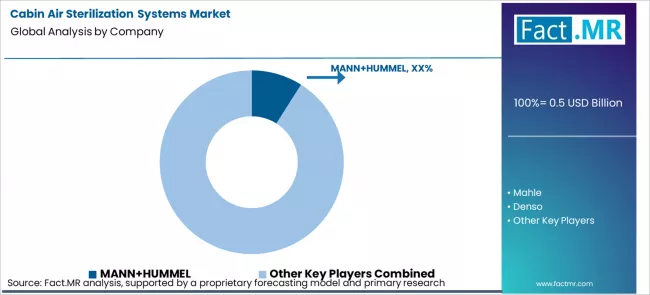
    Cabin Air Sterilization Systems Market Analysis By Company

    As per Fact.MR analysis, the cabin air sterilization systems market in 2026 is defined by a shift from basic filtration to validated sterilization outcomes, where germ reduction efficacy, integration with existing climate systems, and regulatory compliance determine competitive advantage. Panasonic and Sharp leverage proprietary UV C and plasma sterilization modules with documented pathogen reduction rates, which strengthens adoption by vehicle manufacturers seeking demonstrable air quality performance. Honeywell and Philips emphasise multi modal sterilization architectures that combine particulate capture with microbial inactivation, which increases system performance consistency across diverse environmental conditions. Denso and Bosch integrate sterilization controls with HVAC systems and sensor networks, which improves real time air quality response and reduces calibration requirements. LG focuses on compact, energy efficient modules suitable for electric and urban mobility segments, which enhances relevance in emerging vehicle platforms. MANN+HUMMEL and Mahle extend validated media and housing systems into combined filtration sterilization products, which simplifies qualification for OEM programs. 3M emphasises tested antimicrobial media and installation compatibility, which supports aftermarket penetration. Across the market, verified sterilization efficacy, system level integration, and multi region compliance form enduring competitive moats, reducing reliance on standalone claims.

    Recent Industry Developments

    • CabinAir technology powers healthy air in the Polestar 5 - The Advanced Air Cleaner (AAC) powered by CabinAir’s patented particle charging tech is featured in the Polestar 5, enhancing in-cabin air purification and particle/sterilization performance.
    • https://cabinair.com/blogs/press/cabinair-technology-powers-healthy-air-in-new-polestar-5
    • CabinAir wins Volvo Car Sustainability Long-term Partnership Award 2025 - CabinAir was honored with a sustainability partnership award by Volvo Cars, recognizing work on advanced air purification/sterilization systems integrated into vehicle HVAC/air quality solutions.
    • https://cabinair.com/blogs/press/cabinair-receives-volvo-car-sustainability-long-term-partnership-award-2025
    • Volvo Cars integrates advanced air-cleaning tech with CabinAir partnerships (2025) - Vehicle OEMs like Volvo and Polestar now incorporate CabinAir’s deeper sterilization and ultrafine particle removal systems as part of in-cabin air quality features.
    • https://cabinair.com/pages/healthy-air-is-a-competitive-advantage

    Key Players in Cabin Air Sterilization Systems Market

    • MANN+HUMMEL
    • Mahle
    • Denso
    • Bosch
    • Hanon Systems
    • Donaldson
    • Honeywell
    • 3M
    • Philips
    • Panasonic

    References

    • U.S. Environmental Protection Agency. (2024). Ultraviolet (UV) radiation for air disinfection and HVAC applications. EPA.
    • Centers for Disease Control and Prevention. (2023). Ventilation and air cleaning strategies to reduce airborne infectious disease transmission. CDC.
    • CEN. (2024). EN 17272: Chemical disinfectants and antiseptics - Airborne room disinfection processes. European Committee for Standardization.

    Scope of the Report

    Items Values
    Quantitative Units (2026) USD 0.52 billion
    By Technology UV-C Systems, Ionization / Plasma, Photocatalytic Oxidation, Other
    By Integration HVAC Integrated, Standalone Cabin Unit, Filter + Sterilization Combo, Other
    By Vehicle Segment Passenger Vehicles, Premium / Luxury, LCV, Other
    By Use Case Allergen / Pathogen Reduction, Odor / VOC Control, Shared Mobility Hygiene, Other
    Region Asia Pacific, Europe, North America, Latin America, Middle East & Africa
    Countries Covered China, Japan, South Korea, India, Australia & New Zealand, ASEAN, Rest of Asia Pacific, Germany, UK, France, Italy, Spain, Nordic, BENELUX, Rest of Europe, USA, Canada, Mexico, Brazil, Chile, Rest of Latin America, KSA, Other GCC, Turkey, South Africa, Other African Union, Rest of Middle East & Africa
    Key Companies Profiled MANN+HUMMEL, Mahle, Denso, Bosch, Hanon Systems, Donaldson, Honeywell, 3M, Philips, Panasonic
    Additional Attributes Dollar by sales by technology, integration type, vehicle segment, and use case; validated pathogen reduction and sterilization efficacy; HVAC compatibility; energy efficiency and compact design; predictive maintenance capability; scalable production; operational reliability; multi-region deployment; sensor and control integration; repeatable performance under high-frequency use; compliance with regulatory safety and hygiene standards; integration with EV, hybrid, and conventional vehicles; aftermarket and fleet service support; automated quality testing and validation workflows.

    Cabin Air Sterilization Systems Market Segmentation

    • By Technology :

      • UV-C Systems
      • Ionization/Plasma
      • Photocatalytic Oxidation
      • Other
    • By Integration :

      • HVAC Integrated
      • Standalone Cabin Unit
      • Filter + Sterilization Combo
      • Other
    • By Vehicle Segment :

      • Passenger Vehicles
      • Premium/Luxury
      • LCV
      • Other
    • By Use Case :

      • Allergen/Pathogen Reduction
      • Odor/VOC Control
      • Shared Mobility Hygiene
      • Other
    • Region :

      • Asia Pacific
        • China
        • Japan
        • South Korea
        • India
        • Australia & New Zealand
        • ASEAN
        • Rest of Asia Pacific
      • Europe
        • Germany
        • United Kingdom
        • France
        • Italy
        • Spain
        • Nordic
        • BENELUX
        • Rest of Europe
      • North America
        • United States
        • Canada
        • Mexico
      • Latin America
        • Brazil
        • Chile
        • Rest of Latin America
      • Middle East & Africa
        • Kingdom of Saudi Arabia
        • Other GCC Countries
        • Turkey
        • South Africa
        • Other African Union
        • Rest of Middle East & Africa

    Table of Content

    1. Executive Summary
      • Global Market Outlook
      • Demand to side Trends
      • Supply to side Trends
      • Technology Roadmap Analysis
      • Analysis and Recommendations
    2. Market Overview
      • Market Coverage / Taxonomy
      • Market Definition / Scope / Limitations
    3. Research Methodology
      • Chapter Orientation
      • Analytical Lens and Working Hypotheses
        • Market Structure, Signals, and Trend Drivers
        • Benchmarking and Cross-market Comparability
        • Market Sizing, Forecasting, and Opportunity Mapping
      • Research Design and Evidence Framework
        • Desk Research Programme (Secondary Evidence)
          • Company Annual and Sustainability Reports
          • Peer-reviewed Journals and Academic Literature
          • Corporate Websites, Product Literature, and Technical Notes
          • Earnings Decks and Investor Briefings
          • Statutory Filings and Regulatory Disclosures
          • Technical White Papers and Standards Notes
          • Trade Journals, Industry Magazines, and Analyst Briefs
          • Conference Proceedings, Webinars, and Seminar Materials
          • Government Statistics Portals and Public Data Releases
          • Press Releases and Reputable Media Coverage
          • Specialist Newsletters and Curated Briefings
          • Sector Databases and Reference Repositories
          • FMR Internal Proprietary Databases and Historical Market Datasets
          • Subscription Datasets and Paid Sources
          • Social Channels, Communities, and Digital Listening Inputs
          • Additional Desk Sources
        • Expert Input and Fieldwork (Primary Evidence)
          • Primary Modes
            • Qualitative Interviews and Expert Elicitation
            • Quantitative Surveys and Structured Data Capture
            • Blended Approach
          • Why Primary Evidence is Used
          • Field Techniques
            • Interviews
            • Surveys
            • Focus Groups
            • Observational and In-context Research
            • Social and Community Interactions
          • Stakeholder Universe Engaged
            • C-suite Leaders
            • Board Members
            • Presidents and Vice Presidents
            • R&D and Innovation Heads
            • Technical Specialists
            • Domain Subject-matter Experts
            • Scientists
            • Physicians and Other Healthcare Professionals
          • Governance, Ethics, and Data Stewardship
            • Research Ethics
            • Data Integrity and Handling
        • Tooling, Models, and Reference Databases
      • Data Engineering and Model Build
        • Data Acquisition and Ingestion
        • Cleaning, Normalisation, and Verification
        • Synthesis, Triangulation, and Analysis
      • Quality Assurance and Audit Trail
    4. Market Background
      • Market Dynamics
        • Drivers
        • Restraints
        • Opportunity
        • Trends
      • Scenario Forecast
        • Demand in Optimistic Scenario
        • Demand in Likely Scenario
        • Demand in Conservative Scenario
      • Opportunity Map Analysis
      • Product Life Cycle Analysis
      • Supply Chain Analysis
      • Investment Feasibility Matrix
      • Value Chain Analysis
      • PESTLE and Porter’s Analysis
      • Regulatory Landscape
      • Regional Parent Market Outlook
      • Production and Consumption Statistics
      • Import and Export Statistics
    5. Global Market Analysis 2021 to 2025 and Forecast, 2026 to 2036
      • Historical Market Size Value (USD Million) Analysis, 2021 to 2025
      • Current and Future Market Size Value (USD Million) Projections, 2026 to 2036
        • Y to o to Y Growth Trend Analysis
        • Absolute $ Opportunity Analysis
    6. Global Market Pricing Analysis 2021 to 2025 and Forecast 2026 to 2036
    7. Global Market Analysis 2021 to 2025 and Forecast 2026 to 2036, By Technology
      • Introduction / Key Findings
      • Historical Market Size Value (USD Million) Analysis By Technology, 2021 to 2025
      • Current and Future Market Size Value (USD Million) Analysis and Forecast By Technology, 2026 to 2036
        • UV-C Systems
        • Ionization/Plasma
        • Photocatalytic Oxidation
        • Other
      • Y to o to Y Growth Trend Analysis By Technology, 2021 to 2025
      • Absolute $ Opportunity Analysis By Technology, 2026 to 2036
    8. Global Market Analysis 2021 to 2025 and Forecast 2026 to 2036, By Integration
      • Introduction / Key Findings
      • Historical Market Size Value (USD Million) Analysis By Integration, 2021 to 2025
      • Current and Future Market Size Value (USD Million) Analysis and Forecast By Integration, 2026 to 2036
        • HVAC Integrated
        • Standalone Cabin Value (USD Million)
        • Filter + Sterilization Combo
        • Other
      • Y to o to Y Growth Trend Analysis By Integration, 2021 to 2025
      • Absolute $ Opportunity Analysis By Integration, 2026 to 2036
    9. Global Market Analysis 2021 to 2025 and Forecast 2026 to 2036, By Region
      • Introduction
      • Historical Market Size Value (USD Million) Analysis By Region, 2021 to 2025
      • Current Market Size Value (USD Million) Analysis and Forecast By Region, 2026 to 2036
        • North America
        • Latin America
        • Western Europe
        • Eastern Europe
        • East Asia
        • South Asia and Pacific
        • Middle East & Africa
      • Market Attractiveness Analysis By Region
    10. North America Market Analysis 2021 to 2025 and Forecast 2026 to 2036, By Country
      • Historical Market Size Value (USD Million) Trend Analysis By Market Taxonomy, 2021 to 2025
      • Market Size Value (USD Million) Forecast By Market Taxonomy, 2026 to 2036
        • By Country
          • USA
          • Canada
          • Mexico
        • By Technology
        • By Integration
      • Market Attractiveness Analysis
        • By Country
        • By Technology
        • By Integration
      • Key Takeaways
    11. Latin America Market Analysis 2021 to 2025 and Forecast 2026 to 2036, By Country
      • Historical Market Size Value (USD Million) Trend Analysis By Market Taxonomy, 2021 to 2025
      • Market Size Value (USD Million) Forecast By Market Taxonomy, 2026 to 2036
        • By Country
          • Brazil
          • Chile
          • Rest of Latin America
        • By Technology
        • By Integration
      • Market Attractiveness Analysis
        • By Country
        • By Technology
        • By Integration
      • Key Takeaways
    12. Western Europe Market Analysis 2021 to 2025 and Forecast 2026 to 2036, By Country
      • Historical Market Size Value (USD Million) Trend Analysis By Market Taxonomy, 2021 to 2025
      • Market Size Value (USD Million) Forecast By Market Taxonomy, 2026 to 2036
        • By Country
          • Germany
          • UK
          • Italy
          • Spain
          • France
          • Nordic
          • BENELUX
          • Rest of Western Europe
        • By Technology
        • By Integration
      • Market Attractiveness Analysis
        • By Country
        • By Technology
        • By Integration
      • Key Takeaways
    13. Eastern Europe Market Analysis 2021 to 2025 and Forecast 2026 to 2036, By Country
      • Historical Market Size Value (USD Million) Trend Analysis By Market Taxonomy, 2021 to 2025
      • Market Size Value (USD Million) Forecast By Market Taxonomy, 2026 to 2036
        • By Country
          • Russia
          • Poland
          • Hungary
          • Balkan & Baltic
          • Rest of Eastern Europe
        • By Technology
        • By Integration
      • Market Attractiveness Analysis
        • By Country
        • By Technology
        • By Integration
      • Key Takeaways
    14. East Asia Market Analysis 2021 to 2025 and Forecast 2026 to 2036, By Country
      • Historical Market Size Value (USD Million) Trend Analysis By Market Taxonomy, 2021 to 2025
      • Market Size Value (USD Million) Forecast By Market Taxonomy, 2026 to 2036
        • By Country
          • China
          • Japan
          • South Korea
        • By Technology
        • By Integration
      • Market Attractiveness Analysis
        • By Country
        • By Technology
        • By Integration
      • Key Takeaways
    15. South Asia and Pacific Market Analysis 2021 to 2025 and Forecast 2026 to 2036, By Country
      • Historical Market Size Value (USD Million) Trend Analysis By Market Taxonomy, 2021 to 2025
      • Market Size Value (USD Million) Forecast By Market Taxonomy, 2026 to 2036
        • By Country
          • India
          • ASEAN
          • Australia & New Zealand
          • Rest of South Asia and Pacific
        • By Technology
        • By Integration
      • Market Attractiveness Analysis
        • By Country
        • By Technology
        • By Integration
      • Key Takeaways
    16. Middle East & Africa Market Analysis 2021 to 2025 and Forecast 2026 to 2036, By Country
      • Historical Market Size Value (USD Million) Trend Analysis By Market Taxonomy, 2021 to 2025
      • Market Size Value (USD Million) Forecast By Market Taxonomy, 2026 to 2036
        • By Country
          • Kingdom of Saudi Arabia
          • Other GCC Countries
          • Turkiye
          • South Africa
          • Other African Union
          • Rest of Middle East & Africa
        • By Technology
        • By Integration
      • Market Attractiveness Analysis
        • By Country
        • By Technology
        • By Integration
      • Key Takeaways
    17. Key Countries Market Analysis
      • USA
        • Pricing Analysis
        • Market Share Analysis, 2025
          • By Technology
          • By Integration
      • Canada
        • Pricing Analysis
        • Market Share Analysis, 2025
          • By Technology
          • By Integration
      • Mexico
        • Pricing Analysis
        • Market Share Analysis, 2025
          • By Technology
          • By Integration
      • Brazil
        • Pricing Analysis
        • Market Share Analysis, 2025
          • By Technology
          • By Integration
      • Chile
        • Pricing Analysis
        • Market Share Analysis, 2025
          • By Technology
          • By Integration
      • Germany
        • Pricing Analysis
        • Market Share Analysis, 2025
          • By Technology
          • By Integration
      • UK
        • Pricing Analysis
        • Market Share Analysis, 2025
          • By Technology
          • By Integration
      • Italy
        • Pricing Analysis
        • Market Share Analysis, 2025
          • By Technology
          • By Integration
      • Spain
        • Pricing Analysis
        • Market Share Analysis, 2025
          • By Technology
          • By Integration
      • France
        • Pricing Analysis
        • Market Share Analysis, 2025
          • By Technology
          • By Integration
      • India
        • Pricing Analysis
        • Market Share Analysis, 2025
          • By Technology
          • By Integration
      • ASEAN
        • Pricing Analysis
        • Market Share Analysis, 2025
          • By Technology
          • By Integration
      • Australia & New Zealand
        • Pricing Analysis
        • Market Share Analysis, 2025
          • By Technology
          • By Integration
      • China
        • Pricing Analysis
        • Market Share Analysis, 2025
          • By Technology
          • By Integration
      • Japan
        • Pricing Analysis
        • Market Share Analysis, 2025
          • By Technology
          • By Integration
      • South Korea
        • Pricing Analysis
        • Market Share Analysis, 2025
          • By Technology
          • By Integration
      • Russia
        • Pricing Analysis
        • Market Share Analysis, 2025
          • By Technology
          • By Integration
      • Poland
        • Pricing Analysis
        • Market Share Analysis, 2025
          • By Technology
          • By Integration
      • Hungary
        • Pricing Analysis
        • Market Share Analysis, 2025
          • By Technology
          • By Integration
      • Kingdom of Saudi Arabia
        • Pricing Analysis
        • Market Share Analysis, 2025
          • By Technology
          • By Integration
      • Turkiye
        • Pricing Analysis
        • Market Share Analysis, 2025
          • By Technology
          • By Integration
      • South Africa
        • Pricing Analysis
        • Market Share Analysis, 2025
          • By Technology
          • By Integration
    18. Market Structure Analysis
      • Competition Dashboard
      • Competition Benchmarking
      • Market Share Analysis of Top Players
        • By Regional
        • By Technology
        • By Integration
    19. Competition Analysis
      • Competition Deep Dive
        • MANN+HUMMEL
          • Overview
          • Product Portfolio
          • Profitability by Market Segments (Product/Age /Sales Channel/Region)
          • Sales Footprint
          • Strategy Overview
            • Marketing Strategy
            • Product Strategy
            • Channel Strategy
        • Mahle
        • Denso
        • Bosch
        • Hanon Systems
        • Donaldson
        • Honeywell
        • 3M
        • Philips
        • Panasonic
    20. Assumptions & Acronyms Used

    List Of Table

    • Table 1: Global Market Value (USD Million) Forecast by Region, 2021 to 2036
    • Table 2: Global Market Value (USD Million) Forecast by Technology, 2021 to 2036
    • Table 3: Global Market Value (USD Million) Forecast by Integration, 2021 to 2036
    • Table 4: North America Market Value (USD Million) Forecast by Country, 2021 to 2036
    • Table 5: North America Market Value (USD Million) Forecast by Technology, 2021 to 2036
    • Table 6: North America Market Value (USD Million) Forecast by Integration, 2021 to 2036
    • Table 7: Latin America Market Value (USD Million) Forecast by Country, 2021 to 2036
    • Table 8: Latin America Market Value (USD Million) Forecast by Technology, 2021 to 2036
    • Table 9: Latin America Market Value (USD Million) Forecast by Integration, 2021 to 2036
    • Table 10: Western Europe Market Value (USD Million) Forecast by Country, 2021 to 2036
    • Table 11: Western Europe Market Value (USD Million) Forecast by Technology, 2021 to 2036
    • Table 12: Western Europe Market Value (USD Million) Forecast by Integration, 2021 to 2036
    • Table 13: Eastern Europe Market Value (USD Million) Forecast by Country, 2021 to 2036
    • Table 14: Eastern Europe Market Value (USD Million) Forecast by Technology, 2021 to 2036
    • Table 15: Eastern Europe Market Value (USD Million) Forecast by Integration, 2021 to 2036
    • Table 16: East Asia Market Value (USD Million) Forecast by Country, 2021 to 2036
    • Table 17: East Asia Market Value (USD Million) Forecast by Technology, 2021 to 2036
    • Table 18: East Asia Market Value (USD Million) Forecast by Integration, 2021 to 2036
    • Table 19: South Asia and Pacific Market Value (USD Million) Forecast by Country, 2021 to 2036
    • Table 20: South Asia and Pacific Market Value (USD Million) Forecast by Technology, 2021 to 2036
    • Table 21: South Asia and Pacific Market Value (USD Million) Forecast by Integration, 2021 to 2036
    • Table 22: Middle East & Africa Market Value (USD Million) Forecast by Country, 2021 to 2036
    • Table 23: Middle East & Africa Market Value (USD Million) Forecast by Technology, 2021 to 2036
    • Table 24: Middle East & Africa Market Value (USD Million) Forecast by Integration, 2021 to 2036

    List Of Figures

    • Figure 1: Global Market Pricing Analysis
    • Figure 2: Global Market Value (USD Million) Forecast 2021 to 2036
    • Figure 3: Global Market Value Share and BPS Analysis by Technology, 2026 and 2036
    • Figure 4: Global Market Y to o to Y Growth Comparison by Technology, 2026 to 2036
    • Figure 5: Global Market Attractiveness Analysis by Technology
    • Figure 6: Global Market Value Share and BPS Analysis by Integration, 2026 and 2036
    • Figure 7: Global Market Y to o to Y Growth Comparison by Integration, 2026 to 2036
    • Figure 8: Global Market Attractiveness Analysis by Integration
    • Figure 9: Global Market Value (USD Million) Share and BPS Analysis by Region, 2026 and 2036
    • Figure 10: Global Market Y to o to Y Growth Comparison by Region, 2026 to 2036
    • Figure 11: Global Market Attractiveness Analysis by Region
    • Figure 12: North America Market Incremental Dollar Opportunity, 2026 to 2036
    • Figure 13: Latin America Market Incremental Dollar Opportunity, 2026 to 2036
    • Figure 14: Western Europe Market Incremental Dollar Opportunity, 2026 to 2036
    • Figure 15: Eastern Europe Market Incremental Dollar Opportunity, 2026 to 2036
    • Figure 16: East Asia Market Incremental Dollar Opportunity, 2026 to 2036
    • Figure 17: South Asia and Pacific Market Incremental Dollar Opportunity, 2026 to 2036
    • Figure 18: Middle East & Africa Market Incremental Dollar Opportunity, 2026 to 2036
    • Figure 19: North America Market Value Share and BPS Analysis by Country, 2026 and 2036
    • Figure 20: North America Market Value Share and BPS Analysis by Technology, 2026 and 2036
    • Figure 21: North America Market Y to o to Y Growth Comparison by Technology, 2026 to 2036
    • Figure 22: North America Market Attractiveness Analysis by Technology
    • Figure 23: North America Market Value Share and BPS Analysis by Integration, 2026 and 2036
    • Figure 24: North America Market Y to o to Y Growth Comparison by Integration, 2026 to 2036
    • Figure 25: North America Market Attractiveness Analysis by Integration
    • Figure 26: Latin America Market Value Share and BPS Analysis by Country, 2026 and 2036
    • Figure 27: Latin America Market Value Share and BPS Analysis by Technology, 2026 and 2036
    • Figure 28: Latin America Market Y to o to Y Growth Comparison by Technology, 2026 to 2036
    • Figure 29: Latin America Market Attractiveness Analysis by Technology
    • Figure 30: Latin America Market Value Share and BPS Analysis by Integration, 2026 and 2036
    • Figure 31: Latin America Market Y to o to Y Growth Comparison by Integration, 2026 to 2036
    • Figure 32: Latin America Market Attractiveness Analysis by Integration
    • Figure 33: Western Europe Market Value Share and BPS Analysis by Country, 2026 and 2036
    • Figure 34: Western Europe Market Value Share and BPS Analysis by Technology, 2026 and 2036
    • Figure 35: Western Europe Market Y to o to Y Growth Comparison by Technology, 2026 to 2036
    • Figure 36: Western Europe Market Attractiveness Analysis by Technology
    • Figure 37: Western Europe Market Value Share and BPS Analysis by Integration, 2026 and 2036
    • Figure 38: Western Europe Market Y to o to Y Growth Comparison by Integration, 2026 to 2036
    • Figure 39: Western Europe Market Attractiveness Analysis by Integration
    • Figure 40: Eastern Europe Market Value Share and BPS Analysis by Country, 2026 and 2036
    • Figure 41: Eastern Europe Market Value Share and BPS Analysis by Technology, 2026 and 2036
    • Figure 42: Eastern Europe Market Y to o to Y Growth Comparison by Technology, 2026 to 2036
    • Figure 43: Eastern Europe Market Attractiveness Analysis by Technology
    • Figure 44: Eastern Europe Market Value Share and BPS Analysis by Integration, 2026 and 2036
    • Figure 45: Eastern Europe Market Y to o to Y Growth Comparison by Integration, 2026 to 2036
    • Figure 46: Eastern Europe Market Attractiveness Analysis by Integration
    • Figure 47: East Asia Market Value Share and BPS Analysis by Country, 2026 and 2036
    • Figure 48: East Asia Market Value Share and BPS Analysis by Technology, 2026 and 2036
    • Figure 49: East Asia Market Y to o to Y Growth Comparison by Technology, 2026 to 2036
    • Figure 50: East Asia Market Attractiveness Analysis by Technology
    • Figure 51: East Asia Market Value Share and BPS Analysis by Integration, 2026 and 2036
    • Figure 52: East Asia Market Y to o to Y Growth Comparison by Integration, 2026 to 2036
    • Figure 53: East Asia Market Attractiveness Analysis by Integration
    • Figure 54: South Asia and Pacific Market Value Share and BPS Analysis by Country, 2026 and 2036
    • Figure 55: South Asia and Pacific Market Value Share and BPS Analysis by Technology, 2026 and 2036
    • Figure 56: South Asia and Pacific Market Y to o to Y Growth Comparison by Technology, 2026 to 2036
    • Figure 57: South Asia and Pacific Market Attractiveness Analysis by Technology
    • Figure 58: South Asia and Pacific Market Value Share and BPS Analysis by Integration, 2026 and 2036
    • Figure 59: South Asia and Pacific Market Y to o to Y Growth Comparison by Integration, 2026 to 2036
    • Figure 60: South Asia and Pacific Market Attractiveness Analysis by Integration
    • Figure 61: Middle East & Africa Market Value Share and BPS Analysis by Country, 2026 and 2036
    • Figure 62: Middle East & Africa Market Value Share and BPS Analysis by Technology, 2026 and 2036
    • Figure 63: Middle East & Africa Market Y to o to Y Growth Comparison by Technology, 2026 to 2036
    • Figure 64: Middle East & Africa Market Attractiveness Analysis by Technology
    • Figure 65: Middle East & Africa Market Value Share and BPS Analysis by Integration, 2026 and 2036
    • Figure 66: Middle East & Africa Market Y to o to Y Growth Comparison by Integration, 2026 to 2036
    • Figure 67: Middle East & Africa Market Attractiveness Analysis by Integration
    • Figure 68: Global Market - Tier Structure Analysis
    • Figure 69: Global Market - Company Share Analysis

    - Frequently Asked Questions -

    How big is the cabin air sterilization systems market in 2026?

    The global cabin air sterilization systems market is estimated to be valued at USD 0.5 billion in 2026.

    What will be the size of cabin air sterilization systems market in 2036?

    The market size for the cabin air sterilization systems market is projected to reach USD 1.3 billion by 2036.

    How much will be the cabin air sterilization systems market growth between 2026 and 2036?

    The cabin air sterilization systems market is expected to grow at a 10.0% CAGR between 2026 and 2036.

    What are the key product types in the cabin air sterilization systems market?

    The key product types in cabin air sterilization systems market are uv-c systems, ionization/plasma, photocatalytic oxidation and other.

    Which integration segment to contribute significant share in the cabin air sterilization systems market in 2026?

    In terms of integration, hvac integrated segment to command 54.0% share in the cabin air sterilization systems market in 2026.

    Cabin Air Sterilization Systems Market