Calcium Stearoyl Lactylate CSL Market (2026 - 2036)

The Calcium Stearoyl Lactylate CSL Market is segmented by Application (Bakery Products, Dairy Products, Processed Foods, Confectionery Products, and Nutritional Products), Function (Emulsifier, Dough Strengthener, Texture Modifier, and Shelf Life Stabilizer), End Use Industry (Food Processing Industry, Foodservice Industry, and Nutritional Supplement Manufacturing), and Region. Forecast for 2026 to 2036.

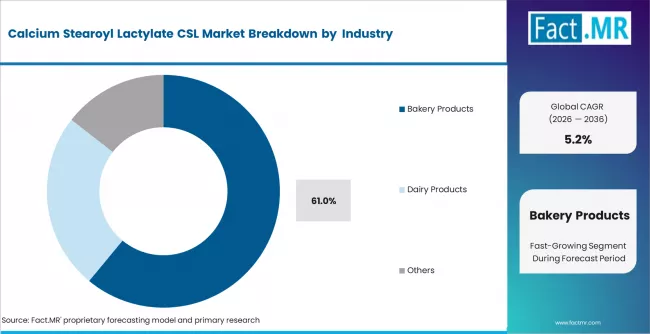
Fact MR opines that the calcium stearoyl lactylate CSL market generated USD 312.8 million in 2025. The market is expected to reach USD 331.4 million in 2026 and grow to USD 548.9 million by 2036, reflecting a 5.2% CAGR. Food processing industry is estimated to capture about 78% share in the end use industry segment, while bakery products are projected to dominate the application category with close to 61%.

Calcium Stearoyl Lactylate CSL Market Forecast and Outlook By Fact.MR

In 2025, the calcium stearoyl lactylate CSL market was valued at USD 312.8 million. Based on Fact MR analysis, demand for calcium stearoyl lactylate is estimated to grow to USD 331.4 million in 2026 and USD 548.9 million by 2036. FMR projects a CAGR of 5.2% during the forecast period.
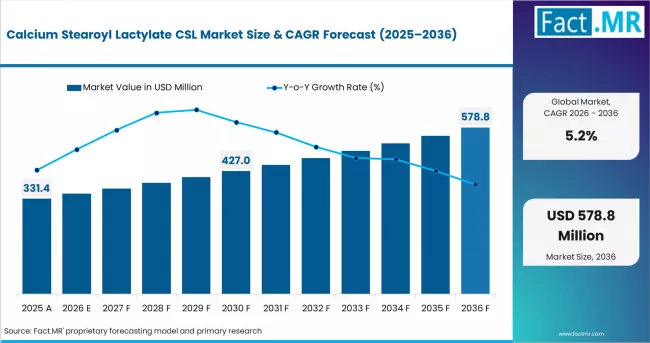
Calcium Stearoyl Lactylate Csl Market Market Value Analysis

Calcium Stearoyl Lactylate CSL Market

Metric Details
Industry Size (2026E) USD 331.4 million
Industry Value (2036F) USD 548.9 million
CAGR (2026 to 2036) 5.2%

Summary of Calcium Stearoyl Lactylate CSL Market

  • Market Definition
    • The calcium stearoyl lactylate market includes production and commercialization of calcium stearoyl lactylate, a food emulsifier used to improve dough strength, crumb structure, texture uniformity, and shelf stability across bakery, processed food, dairy, and nutritional product formulations requiring controlled interaction between proteins, starch, and lipids.
  • Demand Drivers
    • Stable demand for emulsifiers supporting dough conditioning performance across industrial bakery production environments
    • Increasing use of texture stabilizing ingredients supporting crumb structure consistency in processed foods
    • Continued incorporation of functional emulsifiers across packaged food formulations requiring shelf stability performance
    • Consistent demand for ingredients supporting uniform dispersion of fats and water across structured food matrices
  • Key Segments Analyzed
    • End Use Industry: Food processing industry accounts for 78% share supported by widespread emulsifier utilization
    • Application: Bakery products represent 61% share driven by demand for dough strengthening and texture consistency ingredients
    • Function: Emulsifier and dough strengthener demonstrate stable demand across flour-based food formulations
    • Geography: Europe, North America, and Asia demonstrate steady consumption across processed food ingredient markets
  • Analyst Opinion at Fact MR
    • Shambhu Nath Jha, Principal Consultant, Fact MR, opines, "In this updated edition of the Calcium Stearoyl Lactylate Market report, industry participants will observe stable utilization of emulsifier ingredients supporting dough conditioning and texture stabilization across industrial bakery processes. Formulation performance consistency and regulatory compliance remain central considerations influencing supplier positioning across food ingredient supply chains through 2036."
  • Strategic Implications Executive Takeaways
    • Maintain consistent emulsifier functionality supporting dough conditioning performance across industrial baking operations
    • Strengthen supply reliability aligned with processed food manufacturing demand requirements
    • Optimize formulation compatibility supporting uniform texture and crumb structure performance
    • Monitor ingredient substitution trends influencing adoption of alternative dough conditioning systems
  • Methodology
    • Primary interviews conducted with food ingredient manufacturers, bakery producers, and formulation specialists
    • Desk research based on food additive databases, regulatory frameworks, technical literature, and trade publications
    • Hybrid top-down food ingredient demand assessment combined with bottom-up CSL consumption analysis

Validation through cross verification of supplier data, expert consultation, and processed food formulation trend monitoring

A CAGR of 5.2% indicates incremental expansion supported by continued use as an emulsifier and dough strengthener in baked goods. Growth remains steady due to consistent demand in industrial bakery production, while constraints persist from clean label reformulation trends and substitution competition from enzyme-based dough conditioning systems.

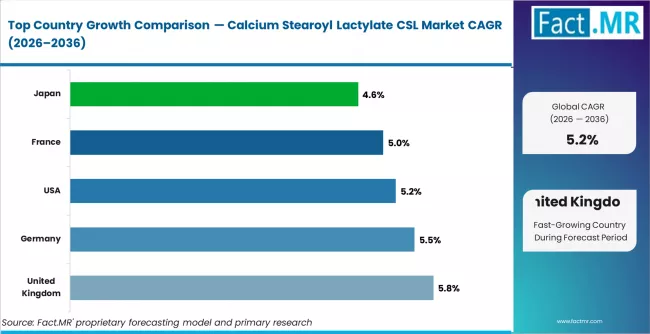
The United Kingdom leads with a projected CAGR of 5.8%, supported by stable use of emulsifying agents across bakery product formulation systems. Germany follows with a CAGR of 5.5%, driven by consistent incorporation of dough strengthening additives across processed food manufacturing operations. The United States records a CAGR of 5.2%, reflecting steady demand for texture stabilizing ingredients across packaged bakery and cereal products. France shows a CAGR of 5.0%, supported by gradual integration of functional emulsifiers across industrial baking processes. Japan records the slowest growth at 4.6%, reflecting a mature market where demand is largely tied to replacement procurement cycles within established food ingredient supply chains. Mature markets generate a significant share of replacement demand as formulation adjustments remain focused on dough conditioning performance, crumb structure stability, and processing consistency across commercial bakery applications.

Segmental Analysis

Calcium Stearoyl Lactylate (CSL) Market Analysis by End Use Industry
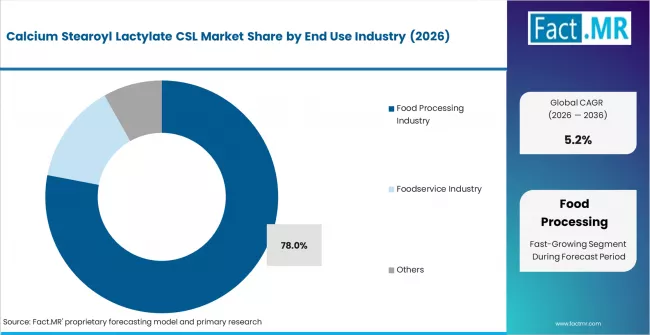
Calcium Stearoyl Lactylate Csl Market Analysis By End Use Industry

  • Market Overview: Based on Fact MR assessment, food processing industry is projected to account for 78% share of the calcium stearoyl lactylate (CSL) market in 2026. CSL functions as an emulsifier incorporated into processed food formulations requiring controlled interaction between starch, proteins, and lipids across structured food matrices. Ingredient inclusion supports dough conditioning performance influencing gas retention stability and crumb texture consistency across thermally processed food products. Manufacturing workflows utilize CSL to maintain uniform ingredient dispersion across large scale mixing environments requiring predictable functional performance across varied processing conditions.
  • Demand Drivers:
    • Emulsion Stability Requirements: CSL supports interaction between hydrophilic and lipophilic components enabling uniform distribution of fats across processed food formulations.
    • Texture Consistency Parameters: Ingredient functionality supports stabilization of crumb structure across thermally processed food systems requiring controlled moisture interaction.
    • Processing Reliability Needs: Food manufacturers incorporate CSL to maintain repeatable functional performance across batch controlled production workflows.

Calcium Stearoyl Lactylate (CSL) Market Analysis by Application
Calcium Stearoyl Lactylate Csl Market Analysis By Application

  • Market Overview: Bakery products are estimated to hold 61% share of the calcium stearoyl lactylate (CSL) market in 2026, supported by widespread utilization across bread, buns, cakes, and laminated dough products requiring dough strengthening performance. CSL interacts with gluten proteins enabling improved gas cell stability during fermentation and baking processes requiring controlled dough elasticity characteristics. Ingredient functionality supports extension of product softness and structural uniformity across packaged bakery products exposed to storage and distribution handling environments.
  • Demand Drivers:
    • Dough Conditioning Requirements: CSL supports strengthening of gluten network structure enabling stable gas retention across yeast leavened bakery formulations.
    • Crumb Structure Stability: Emulsifier interaction supports formation of uniform internal texture across baked food products requiring consistent cell distribution.
    • Shelf Life Performance Parameters: CSL contributes to maintenance of softness characteristics across packaged bakery products subjected to storage duration variability.

Key Dynamics

Calcium Stearoyl Lactylate (CSL) Market Drivers, Restraints, and Opportunities
Calcium Stearoyl Lactylate Csl Market Opportunity Matrix Growth Vs Value

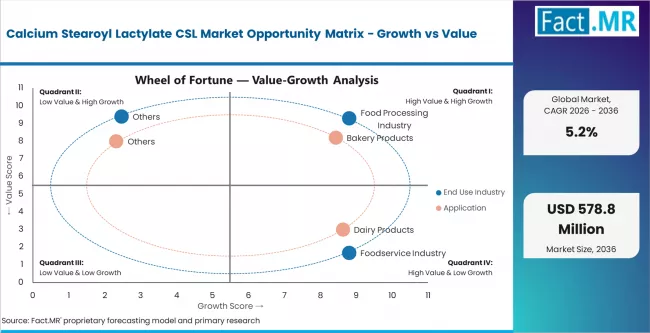
Fact MR analysis indicates that the calcium stearoyl lactylate market developed from food emulsifier chemistry used to improve dough strength and product consistency in industrial baking applications. Early adoption was concentrated in bread and baked goods manufacturing where CSL improved gluten network formation and enhanced crumb structure stability. The current market valuation reflects continued integration across bakery products, processed foods, and animal feed formulations where emulsification and conditioning properties support product texture and shelf stability. Demand persists because CSL improves dough handling performance and enables consistent large-scale production in commercial food processing environments.

A structural shift is occurring as conventional emulsifiers compete with multifunctional ingredient systems designed to improve texture, volume, and stability in processed foods. Traditional emulsifiers remain widely used in high-volume bakery production where cost efficiency and formulation familiarity remain important. CSL requires controlled esterification processes and standardized quality specifications to ensure performance consistency across industrial baking operations. These functional additives often command higher pricing compared with basic emulsifiers due to improved conditioning performance. Even with stable bakery production volumes, higher-value functional emulsifier systems support gradual market value expansion.

  • Dough Conditioning Performance: Bakery manufacturers use CSL to strengthen gluten structure, improve dough machinability, and enhance volume in bread production.
  • Food Additive Regulation: Standards such as European Food Safety Authority approval for E482 emulsifier and Codex Alimentarius emulsifier specifications regulate usage levels.
  • North America Bakery Production: The United States maintains large industrial bakery operations that incorporate CSL in commercial bread and processed baked food manufacturing.

Regional Analysis

The calcium stearoyl lactylate (CSL) market is assessed across North America, Europe, Asia Pacific, Latin America, and Middle East & Africa, segmented by country-level demand in bakery emulsifiers, processed food stabilizers, and texture-enhancing ingredient applications. Regional demand reflects packaged food production, formulation standardization, and additive compliance frameworks. The full report offers market attractiveness analysis.

Top Country Growth Comparison Calcium Stearoyl Lactylate Csl Market Cagr (2026 2036)

Country CAGR (2026–2036)
United Kingdom 5.8%
Germany 5.5%
United States 5.2%
France 5.0%
Japan 4.6%

Source: Fact MR analysis, based on proprietary forecasting model and primary research
Calcium Stearoyl Lactylate Csl Market Cagr Analysis By Country

Europe

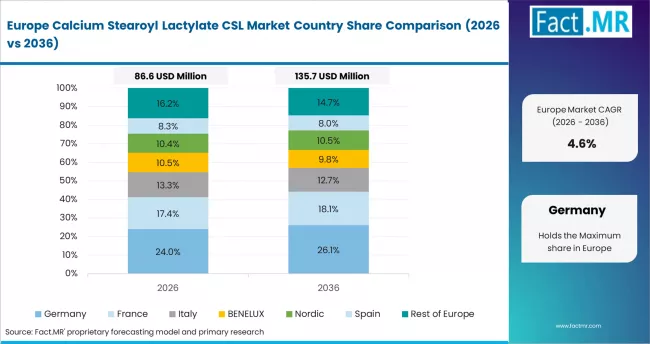
Calcium Stearoyl Lactylate Csl Market Europe Country Market Share Analysis, 2026 & 2036

Europe functions as the food emulsifier regulatory laboratory for standardized bakery ingredient formulations, supported by structured additive approval pathways and processed food manufacturing demand. Corbion N.V. strengthens emulsifier ingredient production capabilities. Kerry Group plc expands bakery additive formulation portfolio. BASF SE supports specialty food ingredient development.

  • United Kingdom: Demand for calcium stearoyl lactylate in United Kingdom is projected to rise at 5.8% CAGR through 2036. The UK Food Additives Regulation framework (Food Standards Agency, updated 2021) supports emulsifier ingredient compliance. Kerry Group plc expanded bakery emulsifier product offerings (March 2023), supporting supply growth.
  • Germany: Demand for calcium stearoyl lactylate in Germany is projected to rise at 5.5% CAGR through 2036. EU Food Additives Regulation framework (European Commission, ongoing) supports standardized emulsifier use. Corbion N.V. expanded emulsifier ingredient production capabilities (February 2023), supporting adoption.
  • France: Demand for calcium stearoyl lactylate in France is projected to rise at 5.0% CAGR through 2036. The French Food Safety Law update (Ministry of Agriculture, 2022) supports additive formulation compliance. BASF SE expanded specialty food ingredient product lines (January 2023), supporting market development.

North America
Calcium Stearoyl Lactylate Csl Market Country Value Analysis

North America functions as the processed food ingredient commercialization and bakery formulation innovation hub, supported by strong packaged food production capacity and structured additive safety standards. Cargill, Incorporated strengthens emulsifier ingredient manufacturing capabilities. Archer Daniels Midland Company expands bakery additive product portfolio. Corbion N.V. supports emulsifier formulation development.

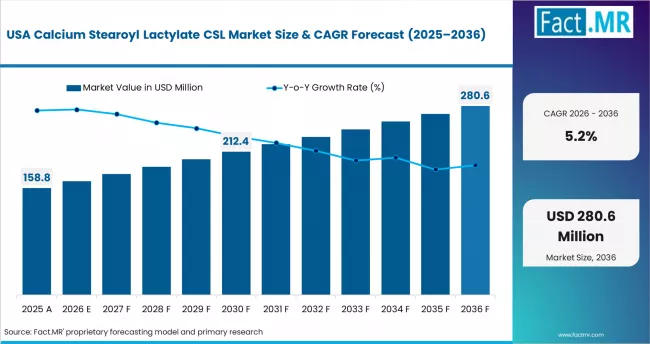
  • United States: Demand for calcium stearoyl lactylate in United States is projected to rise at 5.2% CAGR through 2036. FDA food additive regulatory framework (U.S. FDA, ongoing) supports emulsifier ingredient compliance. Cargill, Incorporated expanded emulsifier ingredient production capacity (April 2023), supporting market expansion.

Asia Pacific
Calcium Stearoyl Lactylate Csl Market Japan Market Share Analysis By End Use Industry

Asia Pacific serves as the processed food ingredient manufacturing and bakery formulation development market, supported by expanding packaged food demand and additive formulation standardization. Kao Corporation strengthens specialty ingredient formulation capabilities. Nippon Chemical Industrial Co., Ltd. expands additive ingredient production capacity. Ajinomoto Co., Inc. supports processed food formulation innovation.

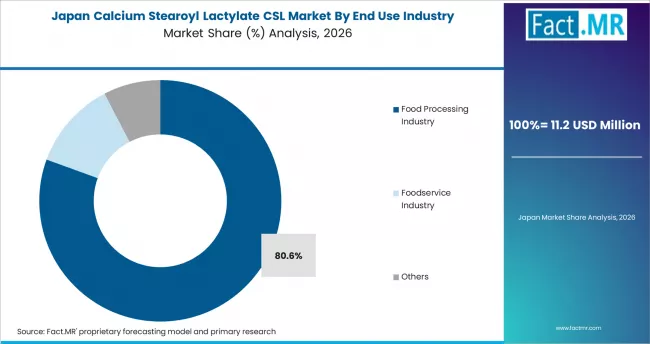
  • Japan: Demand for calcium stearoyl lactylate in Japan is projected to rise at 4.6% CAGR through 2036. The Food Sanitation Act additive standards update (Ministry of Health, Labour and Welfare, 2021) supports emulsifier ingredient compliance. Ajinomoto Co., Inc. expanded processed food ingredient product offerings (May 2023), supporting market demand.

Fact MR's analysis of calcium stearoyl lactylate (CSL) market in global regions consists of country-wise assessment that includes United Kingdom, Germany, United States, France, and Japan. Readers can find emulsifier ingredient demand trends, bakery formulation developments, regulatory frameworks, and competitive positioning across key markets.

Competitive Landscape

Competitive Structure and Buyer Dynamics in the Calcium Stearoyl Lactylate CSL Market
Calcium Stearoyl Lactylate Csl Market Analysis By Company

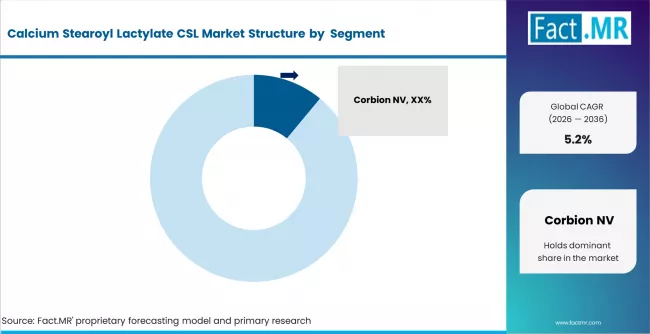
The competitive structure of the Calcium Stearoyl Lactylate Market is moderately concentrated, with global food ingredient manufacturers controlling a significant share of emulsifier production. Companies such as Corbion NV, Cargill Incorporated, Kerry Group Plc, Archer Daniels Midland Company, Ingredion Incorporated, Tate and Lyle Plc, and DuPont Nutrition and Biosciences maintain strong positions through established food ingredient portfolios and global distribution networks. Additional participants including Palsgaard AS, Sternchemie GmbH, and Wilmar International Ltd contribute through specialized emulsifier formulations and regional manufacturing capabilities. Competition is primarily influenced by emulsification performance, dough strengthening properties, formulation compatibility, and compliance with food safety standards across bakery and processed food applications.

Several companies maintain structural advantages through vertically integrated sourcing of fatty acids and fermentation based raw materials used in emulsifier synthesis. Firms such as Cargill Incorporated, Archer Daniels Midland Company, and Wilmar International Ltd benefit from large scale agricultural processing infrastructure supporting stable feedstock availability. Corbion NV and Kerry Group Plc maintain advantages through strong formulation expertise and established relationships with bakery manufacturers. Food producers typically adopt multi supplier sourcing strategies to reduce dependence on a single emulsifier supplier and ensure formulation flexibility. Procurement decisions evaluate suppliers based on product consistency, regulatory compliance, and long term supply reliability, moderating supplier pricing leverage across the market.

Key Players of the Calcium Stearoyl Lactylate CSL Market

  • Corbion NV
  • Cargill Incorporated
  • Kerry Group Plc
  • Archer Daniels Midland Company
  • Ingredion Incorporated
  • Palsgaard AS
  • DuPont Nutrition and Biosciences
  • Tate and Lyle Plc
  • Sternchemie GmbH
  • Wilmar International Ltd

Bibliographies

  • [1] European Food Safety Authority (EFSA). (2013). Re-evaluation of sodium and calcium stearoyl-2-lactylates (E 481 and E 482) when used as food additives: Scientific opinion on safety and acceptable daily intake. EFSA Journal, 11(5), 3144.
  • [2] Bakerpedia Team. (2019). Calcium stearoyl lactylate (CSL) – Function and use in bakery and processed foods. Bakerpedia – Bakery Ingredients Database.
  • [3] American Society of Baking Educators (ASBE). (2024). Calcium stearoyl lactylate (CSL): Dough conditioning and emulsifying properties in breadmaking. ASBE Ingredient Briefs.
  • [4] EFSA Panel on Food Additives and Nutrient Sources added to Food (ANS). (2013). Statement on exposure to stearoyl-2-lactylate and calcium stearoyl-2-lactylate (E 481 and E 482). EFSA Journal, 11(3), 3125.
  • [5] Luckyson, K. (2017). Food additives and processing aids used in breadmaking. In Advances in Food and Nutrition Research (Vol. 82). IntechOpen.

This Report Addresses

  • Market size estimation and revenue forecasts for the Calcium Stearoyl Lactylate CSL Market from 2026 to 2036, supported by bakery ingredient demand benchmarks.
  • Growth opportunity mapping across bakery products, dairy products, processed foods, confectionery products, and nutritional product applications.
  • Segment and regional revenue forecasts covering emulsifier, dough strengthener, texture modifier, and shelf life stabilizer functional roles across food formulations.
  • Competition strategy assessment of Corbion NV, Cargill Incorporated, Kerry Group Plc, Archer Daniels Midland Company, and Ingredion Incorporated.
  • Regulatory impact analysis covering EFSA E482 emulsifier approval, FDA food additive compliance, and Codex Alimentarius emulsifier specifications.
  • Market report delivery in PDF, Excel, PPT, and interactive dashboard formats for food emulsifier benchmarking.
  • Supply chain vulnerability assessments examining fatty acid feedstock availability, esterification production costs, clean label reformulation pressure, and substitution risk from enzyme based dough conditioners.

Calcium Stearoyl Lactylate CSL Market Definition

Calcium Stearoyl Lactylate CSL Market Definition 

The calcium stearoyl lactylate CSL Market includes the production and sale of calcium stearoyl lactylate, a food emulsifier used to improve dough strength, texture, volume, and shelf stability in baked goods, processed foods, and flour based products.

Calcium Stearoyl Lactylate CSL Market Inclusions

The report includes global and regional market size estimates, forecast analysis, and segmentation by grade type, application area, functional role, end use industry, pricing structure, and supply chain distribution patterns.

Calcium Stearoyl Lactylate CSL Market Exclusions

The scope excludes other food emulsifiers such as sodium stearoyl lactylate, finished bakery products, processing equipment, and ingredient blends where CSL composition cannot be clearly identified.

Calcium Stearoyl Lactylate CSL Market Research Methodology

  • Primary Research: Interviews were conducted with food ingredient manufacturers, bakery producers, distributors, formulation specialists, and regulatory professionals.
  • Desk Research: Public sources included food additive databases, company technical documentation, trade statistics, regulatory guidelines, and industry publications related to emulsifier chemistry.
  • Market-Sizing and Forecasting: A hybrid model combining top-down food ingredient demand evaluation and bottom-up analysis of CSL consumption across bakery and processed food applications was applied.
  • Data Validation and Update Cycle: Findings were validated through cross comparison of supplier data, expert consultation, and periodic monitoring of formulation and regulatory trends.

Report Scope

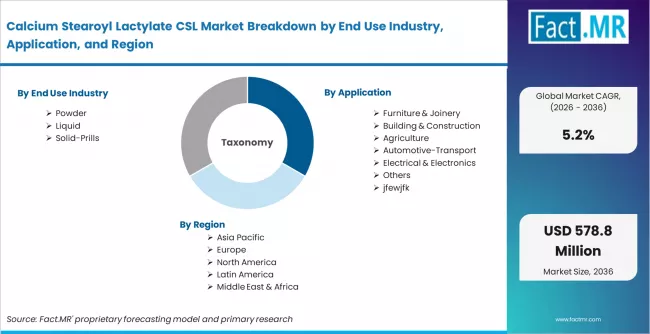
Calcium Stearoyl Lactylate Csl Market Breakdown By End Use Industry, Application, And Region

Metric Value
Quantitative Units USD 331.4 million (2026) to USD 548.9 million (2036), at a CAGR of 5.2%
Market Definition The calcium stearoyl lactylate market includes production and commercialization of food emulsifiers derived from lactic acid and stearic acid, used to improve dough strength, stabilize emulsions, enhance texture, and extend shelf life in processed food formulations.
Application Segmentation Bakery products, Dairy products, Processed foods, Confectionery products, Nutritional products
Function Segmentation Emulsifier, Dough strengthener, Texture modifier, Shelf life stabilizer
End Use Industry Segmentation Food processing industry, Foodservice industry, Nutritional supplement manufacturing
Regions Covered North America, Latin America, Europe, East Asia, South Asia, Oceania, Middle East and Africa
Countries Covered United States, Canada, Mexico, Brazil, Germany, France, United Kingdom, Italy, Spain, Netherlands, China, Japan, South Korea, India, Thailand, Indonesia, Australia, United Arab Emirates, and 40+ countries
Key Companies Profiled Corbion NV, Cargill Incorporated, Kerry Group Plc, Archer Daniels Midland Company, Ingredion Incorporated, Palsgaard AS, DuPont Nutrition and Biosciences, Tate and Lyle Plc, Sternchemie GmbH, Wilmar International Ltd
Forecast Period 2026 to 2036
Approach Hybrid top-down and bottom-up market estimation based on emulsifier consumption ratios in processed foods, bakery production benchmarking, formulation performance demand patterns, ingredient supply chain analysis, and validation through primary interviews with food ingredient manufacturers, processors, and specialty chemical distributors.

Calcium Stearoyl Lactylate CSL Market Key Segments

  • Application:

    • Bakery Products
    • Dairy Products
    • Processed Foods
    • Confectionery Products
    • Nutritional Products
  • Function:

    • Emulsifier
    • Dough Strengthener
    • Texture Modifier
    • Shelf Life Stabilizer
  • End Use Industry:

    • Food Processing Industry
    • Foodservice Industry
    • Nutritional Supplement Manufacturing
  • Region:

    • North America
      • USA
      • Canada
      • Mexico
    • Europe
      • Germany
      • UK
      • France
      • Italy
      • Spain
      • Nordic Countries
      • BENELUX
      • Rest of Europe
    • Asia Pacific
      • China
      • Japan
      • South Korea
      • India
      • Australia
      • Rest of Asia Pacific
    • Latin America
      • Brazil
      • Argentina
      • Rest of Latin America
    • Middle East and Africa
      • Kingdom of Saudi Arabia
      • United Arab Emirates
      • South Africa
      • Rest of Middle East and Africa
    • Other Regions
      • Oceania
      • Central Asia
      • Other Markets

Table of Content

  1. Executive Summary
    • Global Market Outlook
    • Demand to side Trends
    • Supply to side Trends
    • Technology Roadmap Analysis
    • Analysis and Recommendations
  2. Market Overview
    • Market Coverage / Taxonomy
    • Market Definition / Scope / Limitations
  3. Research Methodology
    • Chapter Orientation
    • Analytical Lens and Working Hypotheses
      • Market Structure, Signals, and Trend Drivers
      • Benchmarking and Cross-market Comparability
      • Market Sizing, Forecasting, and Opportunity Mapping
    • Research Design and Evidence Framework
      • Desk Research Programme (Secondary Evidence)
        • Company Annual and Sustainability Reports
        • Peer-reviewed Journals and Academic Literature
        • Corporate Websites, Product Literature, and Technical Notes
        • Earnings Decks and Investor Briefings
        • Statutory Filings and Regulatory Disclosures
        • Technical White Papers and Standards Notes
        • Trade Journals, Industry Magazines, and Analyst Briefs
        • Conference Proceedings, Webinars, and Seminar Materials
        • Government Statistics Portals and Public Data Releases
        • Press Releases and Reputable Media Coverage
        • Specialist Newsletters and Curated Briefings
        • Sector Databases and Reference Repositories
        • Fact.MR Internal Proprietary Databases and Historical Market Datasets
        • Subscription Datasets and Paid Sources
        • Social Channels, Communities, and Digital Listening Inputs
        • Additional Desk Sources
      • Expert Input and Fieldwork (Primary Evidence)
        • Primary Modes
          • Qualitative Interviews and Expert Elicitation
          • Quantitative Surveys and Structured Data Capture
          • Blended Approach
        • Why Primary Evidence is Used
        • Field Techniques
          • Interviews
          • Surveys
          • Focus Groups
          • Observational and In-context Research
          • Social and Community Interactions
        • Stakeholder Universe Engaged
          • C-suite Leaders
          • Board Members
          • Presidents and Vice Presidents
          • R&D and Innovation Heads
          • Technical Specialists
          • Domain Subject-matter Experts
          • Scientists
          • Physicians and Other Healthcare Professionals
        • Governance, Ethics, and Data Stewardship
          • Research Ethics
          • Data Integrity and Handling
      • Tooling, Models, and Reference Databases
    • Data Engineering and Model Build
      • Data Acquisition and Ingestion
      • Cleaning, Normalisation, and Verification
      • Synthesis, Triangulation, and Analysis
    • Quality Assurance and Audit Trail
  4. Market Background
    • Market Dynamics
      • Drivers
      • Restraints
      • Opportunity
      • Trends
    • Scenario Forecast
      • Demand in Optimistic Scenario
      • Demand in Likely Scenario
      • Demand in Conservative Scenario
    • Opportunity Map Analysis
    • Product Life Cycle Analysis
    • Supply Chain Analysis
    • Investment Feasibility Matrix
    • Value Chain Analysis
    • PESTLE and Porter’s Analysis
    • Regulatory Landscape
    • Regional Parent Market Outlook
    • Production and Consumption Statistics
    • Import and Export Statistics
  5. Global Market Analysis 2021 to 2025 and Forecast, 2026 to 2036
    • Historical Market Size Value (USD Million) Analysis, 2021 to 2025
    • Current and Future Market Size Value (USD Million) Projections, 2026 to 2036
      • Y to o to Y Growth Trend Analysis
      • Absolute $ Opportunity Analysis
  6. Global Market Pricing Analysis 2021 to 2025 and Forecast 2026 to 2036
  7. Global Market Analysis 2021 to 2025 and Forecast 2026 to 2036, By Concentration Level
    • Introduction / Key Findings
    • Historical Market Size Value (USD Million) Analysis By Concentration Level , 2021 to 2025
    • Current and Future Market Size Value (USD Million) Analysis and Forecast By Concentration Level , 2026 to 2036
      • 5% to 10% DHA Concentration
      • Below 5% DHA Concentration
      • Above 10% DHA Concentration
    • Y to o to Y Growth Trend Analysis By Concentration Level , 2021 to 2025
    • Absolute $ Opportunity Analysis By Concentration Level , 2026 to 2036
  8. Global Market Analysis 2021 to 2025 and Forecast 2026 to 2036, By Distribution Channel
    • Introduction / Key Findings
    • Historical Market Size Value (USD Million) Analysis By Distribution Channel, 2021 to 2025
    • Current and Future Market Size Value (USD Million) Analysis and Forecast By Distribution Channel, 2026 to 2036
      • Online Retail
      • Supermarkets and Hypermarkets
      • Beauty Specialty Stores
      • Pharmacies and Drugstores
      • Professional Salons and Spas
    • Y to o to Y Growth Trend Analysis By Distribution Channel, 2021 to 2025
    • Absolute $ Opportunity Analysis By Distribution Channel, 2026 to 2036
  9. Global Market Analysis 2021 to 2025 and Forecast 2026 to 2036, By Region
    • Introduction
    • Historical Market Size Value (USD Million) Analysis By Region, 2021 to 2025
    • Current Market Size Value (USD Million) Analysis and Forecast By Region, 2026 to 2036
      • North America
      • Latin America
      • Western Europe
      • Eastern Europe
      • East Asia
      • South Asia and Pacific
      • Middle East & Africa
    • Market Attractiveness Analysis By Region
  10. North America Market Analysis 2021 to 2025 and Forecast 2026 to 2036, By Country
    • Historical Market Size Value (USD Million) Trend Analysis By Market Taxonomy, 2021 to 2025
    • Market Size Value (USD Million) Forecast By Market Taxonomy, 2026 to 2036
      • By Country
        • USA
        • Canada
        • Mexico
      • By Concentration Level
      • By Distribution Channel
    • Market Attractiveness Analysis
      • By Country
      • By Concentration Level
      • By Distribution Channel
    • Key Takeaways
  11. Latin America Market Analysis 2021 to 2025 and Forecast 2026 to 2036, By Country
    • Historical Market Size Value (USD Million) Trend Analysis By Market Taxonomy, 2021 to 2025
    • Market Size Value (USD Million) Forecast By Market Taxonomy, 2026 to 2036
      • By Country
        • Brazil
        • Chile
        • Rest of Latin America
      • By Concentration Level
      • By Distribution Channel
    • Market Attractiveness Analysis
      • By Country
      • By Concentration Level
      • By Distribution Channel
    • Key Takeaways
  12. Western Europe Market Analysis 2021 to 2025 and Forecast 2026 to 2036, By Country
    • Historical Market Size Value (USD Million) Trend Analysis By Market Taxonomy, 2021 to 2025
    • Market Size Value (USD Million) Forecast By Market Taxonomy, 2026 to 2036
      • By Country
        • Germany
        • UK
        • Italy
        • Spain
        • France
        • Nordic
        • BENELUX
        • Rest of Western Europe
      • By Concentration Level
      • By Distribution Channel
    • Market Attractiveness Analysis
      • By Country
      • By Concentration Level
      • By Distribution Channel
    • Key Takeaways
  13. Eastern Europe Market Analysis 2021 to 2025 and Forecast 2026 to 2036, By Country
    • Historical Market Size Value (USD Million) Trend Analysis By Market Taxonomy, 2021 to 2025
    • Market Size Value (USD Million) Forecast By Market Taxonomy, 2026 to 2036
      • By Country
        • Russia
        • Poland
        • Hungary
        • Balkan & Baltic
        • Rest of Eastern Europe
      • By Concentration Level
      • By Distribution Channel
    • Market Attractiveness Analysis
      • By Country
      • By Concentration Level
      • By Distribution Channel
    • Key Takeaways
  14. East Asia Market Analysis 2021 to 2025 and Forecast 2026 to 2036, By Country
    • Historical Market Size Value (USD Million) Trend Analysis By Market Taxonomy, 2021 to 2025
    • Market Size Value (USD Million) Forecast By Market Taxonomy, 2026 to 2036
      • By Country
        • China
        • Japan
        • South Korea
      • By Concentration Level
      • By Distribution Channel
    • Market Attractiveness Analysis
      • By Country
      • By Concentration Level
      • By Distribution Channel
    • Key Takeaways
  15. South Asia and Pacific Market Analysis 2021 to 2025 and Forecast 2026 to 2036, By Country
    • Historical Market Size Value (USD Million) Trend Analysis By Market Taxonomy, 2021 to 2025
    • Market Size Value (USD Million) Forecast By Market Taxonomy, 2026 to 2036
      • By Country
        • India
        • ASEAN
        • Australia & New Zealand
        • Rest of South Asia and Pacific
      • By Concentration Level
      • By Distribution Channel
    • Market Attractiveness Analysis
      • By Country
      • By Concentration Level
      • By Distribution Channel
    • Key Takeaways
  16. Middle East & Africa Market Analysis 2021 to 2025 and Forecast 2026 to 2036, By Country
    • Historical Market Size Value (USD Million) Trend Analysis By Market Taxonomy, 2021 to 2025
    • Market Size Value (USD Million) Forecast By Market Taxonomy, 2026 to 2036
      • By Country
        • Kingdom of Saudi Arabia
        • Other GCC Countries
        • Turkiye
        • South Africa
        • Other African Union
        • Rest of Middle East & Africa
      • By Concentration Level
      • By Distribution Channel
    • Market Attractiveness Analysis
      • By Country
      • By Concentration Level
      • By Distribution Channel
    • Key Takeaways
  17. Key Countries Market Analysis
    • USA
      • Pricing Analysis
      • Market Share Analysis, 2025
        • By Concentration Level
        • By Distribution Channel
    • Canada
      • Pricing Analysis
      • Market Share Analysis, 2025
        • By Concentration Level
        • By Distribution Channel
    • Mexico
      • Pricing Analysis
      • Market Share Analysis, 2025
        • By Concentration Level
        • By Distribution Channel
    • Brazil
      • Pricing Analysis
      • Market Share Analysis, 2025
        • By Concentration Level
        • By Distribution Channel
    • Chile
      • Pricing Analysis
      • Market Share Analysis, 2025
        • By Concentration Level
        • By Distribution Channel
    • Germany
      • Pricing Analysis
      • Market Share Analysis, 2025
        • By Concentration Level
        • By Distribution Channel
    • UK
      • Pricing Analysis
      • Market Share Analysis, 2025
        • By Concentration Level
        • By Distribution Channel
    • Italy
      • Pricing Analysis
      • Market Share Analysis, 2025
        • By Concentration Level
        • By Distribution Channel
    • Spain
      • Pricing Analysis
      • Market Share Analysis, 2025
        • By Concentration Level
        • By Distribution Channel
    • France
      • Pricing Analysis
      • Market Share Analysis, 2025
        • By Concentration Level
        • By Distribution Channel
    • India
      • Pricing Analysis
      • Market Share Analysis, 2025
        • By Concentration Level
        • By Distribution Channel
    • ASEAN
      • Pricing Analysis
      • Market Share Analysis, 2025
        • By Concentration Level
        • By Distribution Channel
    • Australia & New Zealand
      • Pricing Analysis
      • Market Share Analysis, 2025
        • By Concentration Level
        • By Distribution Channel
    • China
      • Pricing Analysis
      • Market Share Analysis, 2025
        • By Concentration Level
        • By Distribution Channel
    • Japan
      • Pricing Analysis
      • Market Share Analysis, 2025
        • By Concentration Level
        • By Distribution Channel
    • South Korea
      • Pricing Analysis
      • Market Share Analysis, 2025
        • By Concentration Level
        • By Distribution Channel
    • Russia
      • Pricing Analysis
      • Market Share Analysis, 2025
        • By Concentration Level
        • By Distribution Channel
    • Poland
      • Pricing Analysis
      • Market Share Analysis, 2025
        • By Concentration Level
        • By Distribution Channel
    • Hungary
      • Pricing Analysis
      • Market Share Analysis, 2025
        • By Concentration Level
        • By Distribution Channel
    • Kingdom of Saudi Arabia
      • Pricing Analysis
      • Market Share Analysis, 2025
        • By Concentration Level
        • By Distribution Channel
    • Turkiye
      • Pricing Analysis
      • Market Share Analysis, 2025
        • By Concentration Level
        • By Distribution Channel
    • South Africa
      • Pricing Analysis
      • Market Share Analysis, 2025
        • By Concentration Level
        • By Distribution Channel
  18. Market Structure Analysis
    • Competition Dashboard
    • Competition Benchmarking
    • Market Share Analysis of Top Players
      • By Regional
      • By Concentration Level
      • By Distribution Channel
  19. Competition Analysis
    • Competition Deep Dive
      • Merck KGaA
        • Overview
        • Product Portfolio
        • Profitability by Market Segments (Product/Age /Sales Channel/Region)
        • Sales Footprint
        • Strategy Overview
          • Marketing Strategy
          • Product Strategy
          • Channel Strategy
      • BASF SE
      • Croda International Plc
      • DSM Firmenich AG
      • Evonik Industries AG
      • Solvay SA
      • Symrise AG
      • Clariant AG
      • Givaudan SA
      • Spec-Chem Industry Inc.
  20. Assumptions & Acronyms Used

List Of Table

  • Table 1: Global Market Value (USD Million) Forecast by Region, 2021 to 2036
  • Table 2: Global Market Value (USD Million) Forecast by Concentration Level, 2021 to 2036
  • Table 3: Global Market Value (USD Million) Forecast by Distribution Channel, 2021 to 2036
  • Table 4: North America Market Value (USD Million) Forecast by Country, 2021 to 2036
  • Table 5: North America Market Value (USD Million) Forecast by Concentration Level, 2021 to 2036
  • Table 6: North America Market Value (USD Million) Forecast by Distribution Channel, 2021 to 2036
  • Table 7: Latin America Market Value (USD Million) Forecast by Country, 2021 to 2036
  • Table 8: Latin America Market Value (USD Million) Forecast by Concentration Level, 2021 to 2036
  • Table 9: Latin America Market Value (USD Million) Forecast by Distribution Channel, 2021 to 2036
  • Table 10: Western Europe Market Value (USD Million) Forecast by Country, 2021 to 2036
  • Table 11: Western Europe Market Value (USD Million) Forecast by Concentration Level, 2021 to 2036
  • Table 12: Western Europe Market Value (USD Million) Forecast by Distribution Channel, 2021 to 2036
  • Table 13: Eastern Europe Market Value (USD Million) Forecast by Country, 2021 to 2036
  • Table 14: Eastern Europe Market Value (USD Million) Forecast by Concentration Level, 2021 to 2036
  • Table 15: Eastern Europe Market Value (USD Million) Forecast by Distribution Channel, 2021 to 2036
  • Table 16: East Asia Market Value (USD Million) Forecast by Country, 2021 to 2036
  • Table 17: East Asia Market Value (USD Million) Forecast by Concentration Level, 2021 to 2036
  • Table 18: East Asia Market Value (USD Million) Forecast by Distribution Channel, 2021 to 2036
  • Table 19: South Asia and Pacific Market Value (USD Million) Forecast by Country, 2021 to 2036
  • Table 20: South Asia and Pacific Market Value (USD Million) Forecast by Concentration Level, 2021 to 2036
  • Table 21: South Asia and Pacific Market Value (USD Million) Forecast by Distribution Channel, 2021 to 2036
  • Table 22: Middle East & Africa Market Value (USD Million) Forecast by Country, 2021 to 2036
  • Table 23: Middle East & Africa Market Value (USD Million) Forecast by Concentration Level, 2021 to 2036
  • Table 24: Middle East & Africa Market Value (USD Million) Forecast by Distribution Channel, 2021 to 2036

List Of Figures

  • Figure 1: Global Market Pricing Analysis
  • Figure 2: Global Market Value (USD Million) Forecast 2021-2036
  • Figure 3: Global Market Value Share and BPS Analysis by Concentration Level, 2026 and 2036
  • Figure 4: Global Market Y-o-Y Growth Comparison by Concentration Level, 2026 to 2036
  • Figure 5: Global Market Attractiveness Analysis by Concentration Level
  • Figure 6: Global Market Value Share and BPS Analysis by Distribution Channel, 2026 and 2036
  • Figure 7: Global Market Y-o-Y Growth Comparison by Distribution Channel, 2026 to 2036
  • Figure 8: Global Market Attractiveness Analysis by Distribution Channel
  • Figure 9: Global Market Value (USD Million) Share and BPS Analysis by Region, 2026 and 2036
  • Figure 10: Global Market Y-o-Y Growth Comparison by Region, 2026 to 2036
  • Figure 11: Global Market Attractiveness Analysis by Region
  • Figure 12: North America Market Incremental Dollar Opportunity, 2026 to 2036
  • Figure 13: Latin America Market Incremental Dollar Opportunity, 2026 to 2036
  • Figure 14: Western Europe Market Incremental Dollar Opportunity, 2026 to 2036
  • Figure 15: Eastern Europe Market Incremental Dollar Opportunity, 2026 to 2036
  • Figure 16: East Asia Market Incremental Dollar Opportunity, 2026 to 2036
  • Figure 17: South Asia and Pacific Market Incremental Dollar Opportunity, 2026 to 2036
  • Figure 18: Middle East & Africa Market Incremental Dollar Opportunity, 2026 to 2036
  • Figure 19: North America Market Value Share and BPS Analysis by Country, 2026 and 2036
  • Figure 20: North America Market Value Share and BPS Analysis by Concentration Level, 2026 and 2036
  • Figure 21: North America Market Y-o-Y Growth Comparison by Concentration Level, 2026 to 2036
  • Figure 22: North America Market Attractiveness Analysis by Concentration Level
  • Figure 23: North America Market Value Share and BPS Analysis by Distribution Channel, 2026 and 2036
  • Figure 24: North America Market Y-o-Y Growth Comparison by Distribution Channel, 2026 to 2036
  • Figure 25: North America Market Attractiveness Analysis by Distribution Channel
  • Figure 26: Latin America Market Value Share and BPS Analysis by Country, 2026 and 2036
  • Figure 27: Latin America Market Value Share and BPS Analysis by Concentration Level, 2026 and 2036
  • Figure 28: Latin America Market Y-o-Y Growth Comparison by Concentration Level, 2026 to 2036
  • Figure 29: Latin America Market Attractiveness Analysis by Concentration Level
  • Figure 30: Latin America Market Value Share and BPS Analysis by Distribution Channel, 2026 and 2036
  • Figure 31: Latin America Market Y-o-Y Growth Comparison by Distribution Channel, 2026 to 2036
  • Figure 32: Latin America Market Attractiveness Analysis by Distribution Channel
  • Figure 33: Western Europe Market Value Share and BPS Analysis by Country, 2026 and 2036
  • Figure 34: Western Europe Market Value Share and BPS Analysis by Concentration Level, 2026 and 2036
  • Figure 35: Western Europe Market Y-o-Y Growth Comparison by Concentration Level, 2026 to 2036
  • Figure 36: Western Europe Market Attractiveness Analysis by Concentration Level
  • Figure 37: Western Europe Market Value Share and BPS Analysis by Distribution Channel, 2026 and 2036
  • Figure 38: Western Europe Market Y-o-Y Growth Comparison by Distribution Channel, 2026 to 2036
  • Figure 39: Western Europe Market Attractiveness Analysis by Distribution Channel
  • Figure 40: Eastern Europe Market Value Share and BPS Analysis by Country, 2026 and 2036
  • Figure 41: Eastern Europe Market Value Share and BPS Analysis by Concentration Level, 2026 and 2036
  • Figure 42: Eastern Europe Market Y-o-Y Growth Comparison by Concentration Level, 2026 to 2036
  • Figure 43: Eastern Europe Market Attractiveness Analysis by Concentration Level
  • Figure 44: Eastern Europe Market Value Share and BPS Analysis by Distribution Channel, 2026 and 2036
  • Figure 45: Eastern Europe Market Y-o-Y Growth Comparison by Distribution Channel, 2026 to 2036
  • Figure 46: Eastern Europe Market Attractiveness Analysis by Distribution Channel
  • Figure 47: East Asia Market Value Share and BPS Analysis by Country, 2026 and 2036
  • Figure 48: East Asia Market Value Share and BPS Analysis by Concentration Level, 2026 and 2036
  • Figure 49: East Asia Market Y-o-Y Growth Comparison by Concentration Level, 2026 to 2036
  • Figure 50: East Asia Market Attractiveness Analysis by Concentration Level
  • Figure 51: East Asia Market Value Share and BPS Analysis by Distribution Channel, 2026 and 2036
  • Figure 52: East Asia Market Y-o-Y Growth Comparison by Distribution Channel, 2026 to 2036
  • Figure 53: East Asia Market Attractiveness Analysis by Distribution Channel
  • Figure 54: South Asia and Pacific Market Value Share and BPS Analysis by Country, 2026 and 2036
  • Figure 55: South Asia and Pacific Market Value Share and BPS Analysis by Concentration Level, 2026 and 2036
  • Figure 56: South Asia and Pacific Market Y-o-Y Growth Comparison by Concentration Level, 2026 to 2036
  • Figure 57: South Asia and Pacific Market Attractiveness Analysis by Concentration Level
  • Figure 58: South Asia and Pacific Market Value Share and BPS Analysis by Distribution Channel, 2026 and 2036
  • Figure 59: South Asia and Pacific Market Y-o-Y Growth Comparison by Distribution Channel, 2026 to 2036
  • Figure 60: South Asia and Pacific Market Attractiveness Analysis by Distribution Channel
  • Figure 61: Middle East & Africa Market Value Share and BPS Analysis by Country, 2026 and 2036
  • Figure 62: Middle East & Africa Market Value Share and BPS Analysis by Concentration Level, 2026 and 2036
  • Figure 63: Middle East & Africa Market Y-o-Y Growth Comparison by Concentration Level, 2026 to 2036
  • Figure 64: Middle East & Africa Market Attractiveness Analysis by Concentration Level
  • Figure 65: Middle East & Africa Market Value Share and BPS Analysis by Distribution Channel, 2026 and 2036
  • Figure 66: Middle East & Africa Market Y-o-Y Growth Comparison by Distribution Channel, 2026 to 2036
  • Figure 67: Middle East & Africa Market Attractiveness Analysis by Distribution Channel
  • Figure 68: Global Market - Tier Structure Analysis
  • Figure 69: Global Market - Company Share Analysis

- Frequently Asked Questions -

How large is the demand for Calcium Stearoyl Lactylate (CSL) in the global market in 2026?

Demand for Calcium Stearoyl Lactylate in the global market is estimated to be valued at USD 331.4 million in 2026.

What will be the market size of Calcium Stearoyl Lactylate (CSL) in the global market by 2036?

Market size for Calcium Stearoyl Lactylate is projected to reach USD 548.9 million by 2036.

What is the expected demand growth for Calcium Stearoyl Lactylate (CSL) in the global market between 2026 and 2036?

Demand for Calcium Stearoyl Lactylate is expected to grow at a CAGR of 5.2% between 2026 and 2036.

Which company is identified as a leading manufacturer in the Calcium Stearoyl Lactylate (CSL) market?

Corbion NV is identified as a leading participant due to its food ingredient portfolio and emulsifier manufacturing capabilities.

Which end use industry is projected to dominate Calcium Stearoyl Lactylate demand by 2026?

Food processing industry is expected to account for approximately 78% of total market share in 2026 due to widespread use as an emulsifier and dough strengthener.

Why is Calcium Stearoyl Lactylate widely used in food processing applications?

CSL improves dough stability, enhances texture, and supports consistent product quality in baked goods and processed foods.

What is driving demand for Calcium Stearoyl Lactylate in the United Kingdom?

Expansion of bakery product manufacturing and increasing use of functional food ingredients are supporting market growth.

What is the growth outlook for the Calcium Stearoyl Lactylate (CSL) market in the United Kingdom?

The United Kingdom is projected to expand at a CAGR of 5.8% during 2026 to 2036 supported by demand for food emulsifiers.

Why is Germany an important market for CSL consumption?

Established bakery manufacturing infrastructure and demand for dough conditioning agents contribute to steady product utilization.

What is the growth outlook for the Calcium Stearoyl Lactylate (CSL) market in Germany?

Germany is projected to grow at a CAGR of 5.5% between 2026 and 2036 supported by processed food ingredient demand.

Germany is projected to grow at a CAGR of 5.5% between 2026 and 2036 supported by processed food ingredient demand.

Demand is supported by utilization in bread production, processed foods, and bakery formulations requiring texture stability.

What is the growth outlook for the Calcium Stearoyl Lactylate (CSL) market in the United States?

The United States is projected to expand at a CAGR of 5.2% during 2026 to 2036 supported by demand for emulsifier ingredients.

What is the growth outlook for the Calcium Stearoyl Lactylate (CSL) market in France?

France is projected to grow at a CAGR of 5.0% between 2026 and 2036 supported by bakery ingredient consumption.

How is Japan positioned in the Calcium Stearoyl Lactylate (CSL) market?

Japan demonstrates steady demand supported by development of processed food formulations requiring emulsifiers.

What is the growth outlook for the Calcium Stearoyl Lactylate (CSL) market in Japan?

Japan is projected to expand at a CAGR of 4.6% during 2026 to 2036 supported by demand for food processing additives.

What is Calcium Stearoyl Lactylate and what is it mainly used for?

Calcium stearoyl lactylate is a food additive used as an emulsifier and dough conditioner to improve texture and stability in processed foods.

What does the Calcium Stearoyl Lactylate (CSL) market include in this report?

The market includes production, supply, and consumption of CSL used as a functional ingredient in food processing formulations.

What applications are included in the scope of the Calcium Stearoyl Lactylate (CSL) market?

Scope covers bakery products, bread, cakes, processed foods, dairy formulations, and packaged food products requiring emulsification.

What is excluded from the scope of the Calcium Stearoyl Lactylate (CSL) market report?

Non food grade emulsifiers and unrelated food additives not containing CSL are excluded unless incorporated within food formulations.

What does market forecast mean in the Calcium Stearoyl Lactylate (CSL) market report?

Market forecast represents a structured projection based on processed food production trends and emulsifier consumption indicators.

How is the Calcium Stearoyl Lactylate (CSL) market forecast developed in this report?

Forecast modeling is based on evaluation of bakery production activity, ingredient demand patterns, and manufacturer supply capacity indicators.

What does primary validation indicate in the Calcium Stearoyl Lactylate (CSL) market analysis?

Primary validation involves assessment of ingredient consumption data, processed food manufacturing indicators, and supplier level output trends supporting forecast assumptions.

Calcium Stearoyl Lactylate CSL Market