Low Fat Protein Snacks Market Size, Share, Growth and Forecast (2026 - 2036)
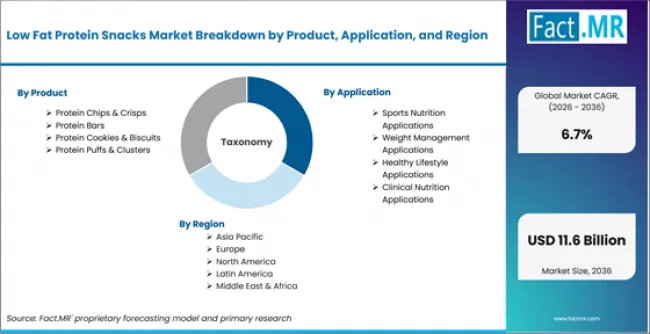
The Low Fat Protein Snacks Market is segmented by Product (Protein Chips & Crisps, Protein Bars, Protein Cookies & Biscuits, Protein Puffs & Clusters), Application (Sports Nutrition Applications, Weight Management Applications, Healthy Lifestyle Applications, Clinical Nutrition Applications), End Use (Fitness Consumers, Health Conscious Consumers, Medical & Wellness Institutions, Retail & Foodservice Buyers), and Region. Forecast for 2026 to 2036.
Low Fat Protein Snacks Market Analysis and Forecast by Fact.MR
- The Low Fat Protein Snacks Market is expected to grow from USD 6.1 billion in 2026 to USD 11.6 billion by 2036, at a 6.7% CAGR.
- The market is driven by expanding end-use consumption, product formulation advances, and evolving regulatory requirements shaping food labeling and nutrition claims.
- Protein Chips & Crisps account for 42.1% product share, while Fitness Consumers contribute 41.9% of end-use demand.
Summary of Low Fat Protein Snacks Market
- Market Snapshot
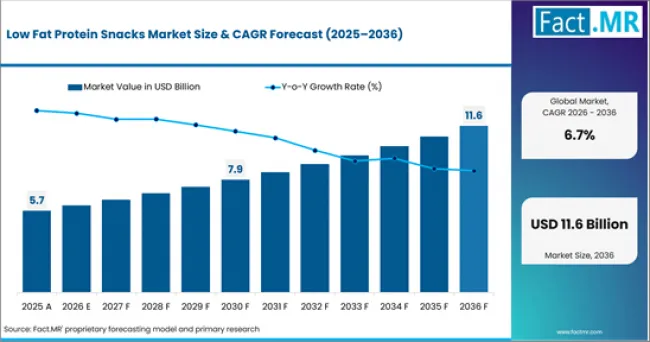
- In 2025, the global Low Fat Protein Snacks Market was valued at approximately USD 5.7 billion.
- The market is estimated to reach USD 6.1 billion in 2026 and is projected to attain USD 11.6 billion by 2036.
- The market is likely to expand at a CAGR of 6.7% during the forecast period.
- The market is anticipated to create an absolute dollar opportunity of USD 5.5 billion between 2026 and 2036.
- Protein Chips & Crisps account for 42.1% of product segment share in 2026.
- China (9.0%) and India (8.4%) are the key growth markets during the forecast period.
- Demand and Growth Drivers
- Primary end-use demand creates sustained procurement for low fat protein snacks products meeting documented quality and regulatory specifications across major consumption channels and geographic markets.
- Regulatory mandates including food safety labeling, nutritional claim standards, and packaging compliance create structured procurement favoring products with certified quality documentation.
- Product formulation advancement improves performance characteristics, expands application scope, and strengthens positioning against conventional alternatives in health-conscious and clean-label consumer segments.
- Growing consumer health awareness and clean-label preference in developed and emerging markets support adoption of products with transparent ingredient profiles and documented nutritional benefits.
- Product and Segment View
- Protein Chips & Crisps accounts for 42.1% of the product segment in 2026, supported by established consumer acceptance and broad distribution compatibility.
- Fitness Consumers represents 41.9% of end use demand in 2026, reflecting procurement concentration among primary industry buyers.
- Plant Based Formulations leads the formulation segment with 66.7% share in 2026, supported by preferred processing and consumer preference characteristics.
- Key segmentation includes:
- Product Type: Protein Chips & Crisps, Protein Bars, Protein Cookies & Biscuits, and Protein Puffs & Clusters
- End Use: Fitness Consumers, Health Conscious Consumers, Medical & Wellness Institutions, and Retail & Foodservice Buyers
- Formulation: Plant-based Formulations, Dairy Protein Formulations, Hybrid Protein Formulations, and Clean-label Formulations
- These systems enable:
- Primary product functionality addressing core consumer and industrial requirements across end-use applications.
- Processing compatibility and formulation flexibility supporting broad application across product categories.
- Regulatory compliance and quality documentation supporting market access across regulated food and consumer goods markets.
- Geography and Competitive Outlook
- North America maintains a significant share supported by established consumer demand, retailer sustainability requirements, and brand differentiation investment.
- Asia Pacific is the fastest-growing region, with China (9.0%) and India (8.4%) leading through urbanization, organized retail expansion, and growing health-conscious consumption.
- Europe maintains steady demand with Germany supported by EU regulatory compliance, retailer consolidation, and premium product specifications.
- Key companies include PepsiCo Inc., Jack Link's Beef Jerky, General Mills Sales Inc., Met-Rx, Inc. among others.
- Analyst Opinion
- Shambhu Nath Jha, Principal Consultant at Fact.MR, says "The low fat protein snacks market reflects the intersection of consumer health awareness, regulatory evolution, and retail channel transformation. Growth is supported by urbanization in emerging markets, clean-label formulation demand in developed markets, and e-commerce access for specialty protein snack brands. Companies that align product development with these converging trends across their primary markets will capture disproportionate share of the incremental opportunity."
Key Growth Drivers, Constraints, and Opportunities
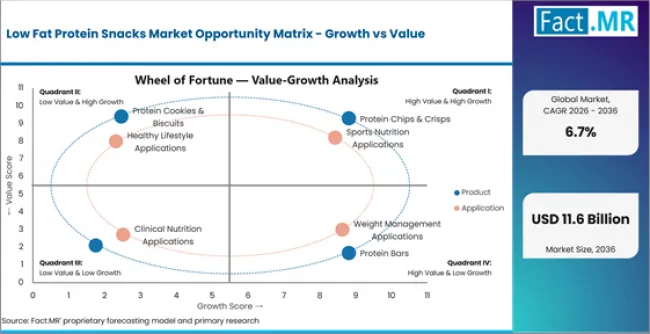
Key Factors Driving Growth
- End-use industry consumption growth creates sustained procurement demand across primary application segments in both developed and emerging market channels.
- Regulatory evolution in food labeling, nutritional claims, and packaging sustainability creates compliance-driven procurement favoring products with certified quality documentation.
- Consumer preference shifts toward health-positioned, clean-label products expand the addressable market beyond traditional consumer segments into mainstream grocery distribution.
Key Market Constraints
- Price premium compared to conventional alternatives limits adoption in cost-sensitive consumer segments and emerging markets where affordability is the primary purchase criterion.
- Distribution infrastructure gaps in emerging markets constrain product availability outside tier-1 cities, limiting penetration into the broader consumer base.
- Consumer taste acceptance barriers require continued formulation investment to match conventional product sensory profiles while maintaining health-positioned ingredient specifications.
Key Opportunity Areas
- E-commerce and direct-to-consumer channels create new distribution pathways that bypass traditional retail infrastructure constraints, enabling faster market penetration in underserved geographies.
- Private-label and retailer brand programs create volume procurement opportunities for manufacturers with production scale and formulation flexibility.
- Functional health positioning that combines nutritional benefits with taste optimization creates premium product categories with higher margins and stronger brand loyalty.
Segment-wise Analysis of the Low Fat Protein Snacks Market
- Protein Chips & Crisps holds 42.1% of the product segment in 2026 through established consumer acceptance and distribution presence.
- Fitness Consumers accounts for 41.9% of end use demand in 2026, reflecting primary buyer procurement concentration.
- Emerging product categories grow faster as health trends and formulation innovation expand the consumer addressable market.
The market is segmented by product, application, end use, technology, formulation, distribution channel, and region. Lead segments maintain dominant positions through established consumer acceptance, while emerging categories grow faster driven by health trends and formulation innovation.
Which Product Segment Dominates the Low Fat Protein Snacks Market?
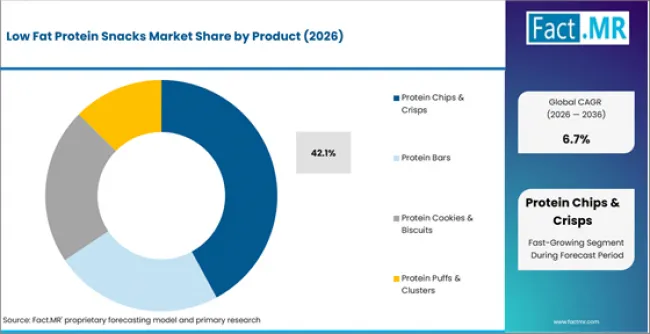
Protein Chips & Crisps accounts for 42.1% of the product segment in 2026. Its leadership reflects established consumer acceptance, broad retail distribution, and proven formulation performance across the primary consumption base. The segment benefits from recognized product positioning and established supply chain relationships.
Supporting segments hold growing positions as health trends, dietary preferences, and formulation innovation create demand for specialized product variants targeting specific consumer requirements.
Which End-Use Segment Dominates the Low Fat Protein Snacks Market?
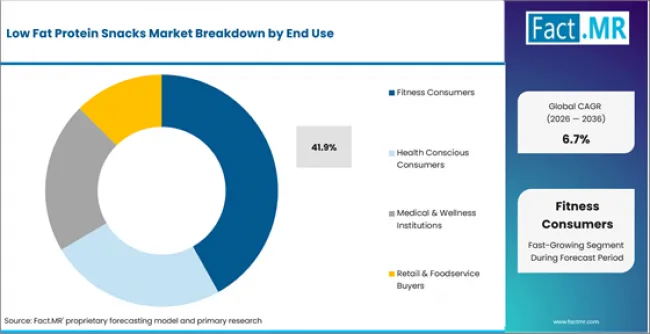
Fitness Consumers is expected to lead the end use segment with a 41.9% share in 2026. This reflects procurement concentration among primary buyers managing the largest consumption volumes across retail and food service channels.
Secondary channels hold growing positions as food service, e-commerce, and specialty retail create new procurement pathways beyond the primary distribution base.
Which Product Trend is Shaping the Next Phase of Growth in the Low Fat Protein Snacks Market?
Clean-label reformulation and health-positioned product innovation are the most significant trends shaping market growth. Manufacturers are developing formulations with simplified ingredient lists, documented nutritional benefits, and transparent supply chain sourcing that meet evolving consumer expectations and retailer procurement specifications across both developed and emerging market channels.
The second dimension is distribution channel diversification through e-commerce, direct-to-consumer, and specialty retail that creates new consumer access pathways for premium and health-positioned product variants, enabling market penetration that traditional retail infrastructure constraints previously limited.
Regional Outlook Across Key Markets
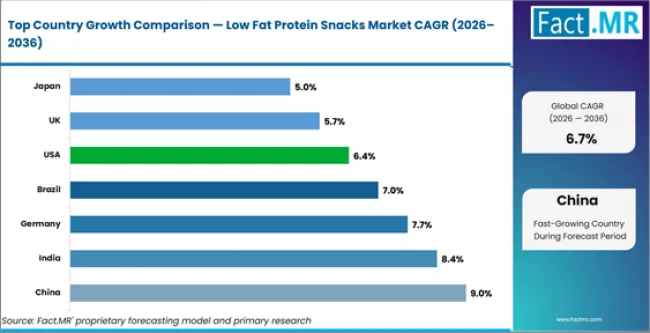
- China leads growth at 9.0%, supported by food manufacturing scale, e-commerce distribution expansion, and growing health-conscious demand across urban and tier-2 city markets.
- India follows at 8.4%, driven by urbanization, organized retail expansion, and rising consumer health awareness creating new demand for low fat protein snacks products.
- North America maintains a significant share through established consumer demand, retailer sustainability requirements, and brand differentiation across mainstream and premium grocery distribution.
- Germany leads European growth at 7.7%, supported by EU regulatory compliance, retailer consolidation, and premium product specifications.
.webp)
CAGR Table
| Country | CAGR (%) |
|---|---|
| China | 9.0% |
| India | 8.4% |
| Germany | 7.7% |
| Brazil | 7.0% |
| USA | 6.4% |
Source: Fact.MR analysis, based on proprietary forecasting model and primary research.
Low Fat Protein Snacks Demand Trends in the United States
The installed base of protein snack consumers is mature and expanding, with protein chips and crisps now occupying dedicated shelf sections in major grocery, convenience, and club store formats. Brand differentiation through plant-based protein formulations, clean ingredient lists, and retailer private-label programs shapes competitive dynamics across the category. Sustainability mandates from retailers including Target and Whole Foods require recyclable packaging documentation for protein snack products, adding environmental compliance to the procurement criteria alongside taste, protein content, and nutritional profile specifications.
- Retailer private-label protein snack programs at Costco, Target, and Whole Foods create competitive pressure on branded manufacturers to maintain price-value positioning.
- Recyclability and sustainable packaging requirements from major retailers add environmental compliance to protein snack procurement specifications.
China Low Fat Protein Snacks Growth Assessment
The scale of e-commerce snack distribution through Tmall, JD.com, and Pinduoduo creates the primary growth channel for low fat protein snack products in China, with online platforms enabling rapid consumer trial and repeat purchase patterns that bypass traditional retail distribution timelines. Domestic manufacturers hold cost advantages in plant-based protein chip and crisp production through local legume and grain protein sourcing, while fitness culture expansion in tier-1 and tier-2 cities creates concentrated demand among gym-going consumers seeking protein-enriched snack alternatives to conventional processed snack products.
- E-commerce platforms Tmall and JD.com create the primary distribution channel for protein snack trial and repeat purchase, bypassing traditional retail timelines.
- Fitness culture expansion in tier-1 and tier-2 cities concentrates demand among gym consumers seeking protein chips and plant-based protein crisp alternatives.
India Low Fat Protein Snacks Market Opportunity Outlook
Demand is shaped by rapid growth in organized fitness and gym culture across urban India, creating a concentrated consumer base seeking protein-enriched snack products including protein chips, baked protein crisps, and plant-based protein bars. E-commerce channels including Amazon India, Flipkart, and specialized health food platforms are the primary distribution pathway for premium protein snack brands, as tier-2 and tier-3 city consumers access products that are not yet available through local organized retail. Domestic manufacturing scaling is improving price accessibility, as Indian protein snack producers develop formulations using locally sourced legume and grain protein ingredients.
- E-commerce platforms provide primary distribution for protein snack brands reaching tier-2 and tier-3 consumers ahead of organized retail penetration.
- Domestic manufacturing using locally sourced legume and grain protein is improving price accessibility for the growing Indian fitness consumer segment.
Germany Low Fat Protein Snacks Demand Analysis
EU nutrition and health claims regulation (EC) No 1924/2006 defines permissible protein content claims and low-fat labeling requirements that shape product formulation and marketing for protein snack manufacturers in Germany. Extended producer responsibility for packaging under the German VerpackG adds recyclability requirements to protein snack packaging specifications. Retailer consolidation and the dominance of Aldi, Lidl, Edeka, and Rewe in German grocery distribution create concentrated procurement influence that shapes product specifications, pricing, and shelf placement for both branded and private-label protein snack products.
- EU nutrition claims regulation defines protein content and low-fat labeling requirements that shape formulation specifications for the German market.
- Retailer consolidation among Aldi, Lidl, and Edeka creates concentrated procurement influence over protein snack product specifications and shelf placement.
Competitive Benchmarking and Company Positioning
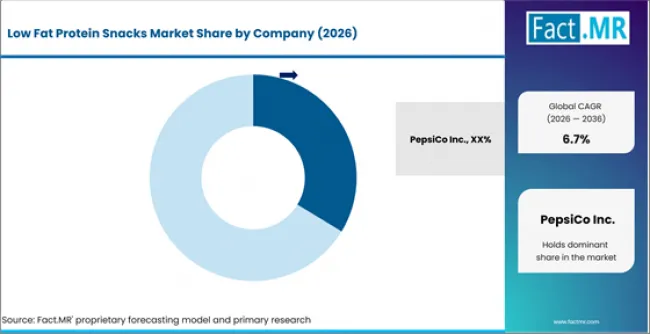
Low Fat Protein Snacks Market Analysis By Company
- Leading companies hold strong positions through comprehensive product portfolios, established retail distribution relationships, and sustained investment in health-positioned product innovation.
- Mid-tier competitors differentiate through focused product categories, regional manufacturing strength, and specialized application expertise.
- Clean-label formulation capability, retailer compliance documentation, and e-commerce channel presence are increasingly important competitive differentiators.
The competitive landscape combines multinational food companies with regional specialty producers. Leading companies compete through broad product portfolios and established retail relationships while mid-tier competitors differentiate through focused health positioning and regional formulation expertise.
Strategic priorities include expanding clean-label product portfolios, strengthening e-commerce distribution capability, and building retailer compliance documentation for sustainability and recyclability requirements.
Key Companies in the Low Fat Protein Snacks Market
- PepsiCo Inc., Jack Link's Beef Jerky are among the leading participants with established product portfolios and distribution networks.
- General Mills Sales Inc., Met-Rx, Inc. hold established positions through focused product categories and regional strength.
- Mondelez International compete through specialized offerings and competitive positioning.
Recent Industry Developments
- PepsiCo, Protein-Focused Snack Pipeline Expansion
- PepsiCo expanded its focus on protein snacks through Doritos Protein, protein-packed meat snacks, and planned protein or fiber snack options under brands such as Quaker, SunChips, PopCorners, and Smartfood.
- General Mills, Nature Valley Protein Snack Positioning
- General Mills continued to position Nature Valley Creamy Protein Bars within protein snacking. The product offers ten grams of protein per bar and supports demand for portable snacks with added protein.
- Quest Nutrition, Protein Chip Flavor Expansion
- Quest Nutrition expanded its protein chip lineup with new flavor options. The chips are baked and positioned as high-protein, low-sugar snacks, but they should not be called plant-based because Quest uses dairy-based protein.
Leading Companies Shaping the Low Fat Protein Snacks Market
- PepsiCo Inc.
- Jack Link's Beef Jerky
- General Mills Sales Inc.
- Met-Rx, Inc.
- Mondelez International
- Laboratoire PYC
Sources and Research References
- General Mills. (2025, September 25). What your game day snack says about you.
- General Mills. (2026, May 14). Finally, a protein bar that tastes like LÄRABAR.
- PepsiCo. (2025, October 9). Third quarter 2025 earnings prepared management remarks.
- PepsiCo. (2026, February 3). Fourth quarter and full year 2025 earnings prepared management remarks.
- PepsiCo. (2026, February 26). Doritos® launches boldest innovation yet: Doritos® Protein.
- The Simply Good Foods Company. (2026, January 5). Quest Nutrition strengthens its leadership in high-protein snacking with new chips flavors for the new year.
This bibliography is provided for reader reference and is not exhaustive. The full report contains the complete reference list and detailed citations.
Key Questions This Report Addresses
- What is the current and future size of the Low Fat Protein Snacks Market?
- How fast is the market expected to grow between 2026 and 2036?
- Which product type leads by 2026?
- Which end-use accounts for highest demand?
- What are the primary growth drivers?
- How is clean-label reformulation influencing the market?
- Which countries show the fastest growth?
- Who are the key companies?
- How does Fact.MR validate the forecast?
Low Fat Protein Snacks Market Definition
The Low Fat Protein Snacks Market covers specialized products and formulations serving food, beverage, and consumer goods applications across commercial, retail, and food service distribution channels.
Low Fat Protein Snacks Market Inclusions
- The scope covers global and regional market size and forecasts for 2026 to 2036 across product type, end use, formulation, and region.
- It includes all major product grades and formulations for primary and secondary end-use applications.
- The report covers technology, regulatory, and consumer trends and the competitive landscape of leading producers.
Low Fat Protein Snacks Market Exclusions
- The scope excludes general-purpose products not classified within this specific market category.
- It excludes raw ingredient supply chains and processing equipment sold independently.
- The report excludes downstream food service meals and assembled retail products.
Low Fat Protein Snacks Market Research Methodology
- The methodology combines secondary research, primary interviews, and forecast modelling.
- It draws on 90+ secondary sources and benchmarks 45+ company portfolios.
- Market sizing covers 30+ countries through a demand-side model, supported by top-down validation.
- Key inputs include food industry production data, consumer spending trends, and regulatory tracking.
- Primary validation includes 25+ interviews across producers, food manufacturers, retailers, and regulatory specialists.
Scope of Analysis

| Parameter | Details |
|---|---|
| Quantitative Units | USD 6.1 billion to USD 11.6 billion, at a CAGR of 6.7% |
| Market Definition | The Low Fat Protein Snacks Market covers specialized products serving food, beverage, and consumer goods applications. |
| Regions Covered | North America, Latin America, Europe, East Asia, South Asia and Pacific, Middle East and Africa |
| Countries Covered | USA, Canada, UK, Germany, China, India, Brazil, 30 plus countries |
| Key Companies | PepsiCo Inc., Jack Link's Beef Jerky, General Mills Sales Inc., Met-Rx, Inc., Mondelez International |
| Forecast Period | 2026 to 2036 |
| Approach | Hybrid demand-side methodology built on food industry data, consumer trends, regulatory tracking, and primary interviews. |
Low Fat Protein Snacks Market Segmentation
-
Low Fat Protein Snacks Market Segmented by Product:
- Protein Chips & Crisps
- Baked Protein Chips
- Pea Protein Baked Chips
- Soy Protein Baked Crisps
- Extruded Protein Crisps
- Whey Protein Extruded Crisps
- Mixed Grain Protein Crisps
- Baked Protein Chips
- Protein Bars
- Plant Based Protein Bars
- Nut Free Vegan Protein Bars
- Seed Based Protein Bars
- Dairy Protein Bars
- Whey Isolate Snack Bars
- Casein Protein Snack Bars
- Plant Based Protein Bars
- Protein Cookies & Biscuits
- Low Carb Protein Cookies
- Almond Flour Protein Cookies
- Oat Protein Cookies
- High Fiber Protein Biscuits
- Whole Grain Protein Biscuits
- Chia Based Protein Biscuits
- Low Carb Protein Cookies
- Protein Puffs & Clusters
- Air Popped Protein Puffs
- Corn Protein Puffs
- Lentil Protein Puffs
- Granola Protein Clusters
- Quinoa Protein Clusters
- Millet Protein Clusters
- Air Popped Protein Puffs
- Protein Chips & Crisps
-
Low Fat Protein Snacks Market Segmented by Application:
- Sports Nutrition Applications
- Pre Workout Nutrition
- Energy Boosting Protein Snacks
- Rapid Digestion Snack Products
- Post Workout Recovery
- Muscle Recovery Protein Snacks
- Electrolyte Enriched Protein Snacks
- Pre Workout Nutrition
- Sports Nutrition Applications
- Weight Management Applications
- Meal Replacement Applications
- Low Calorie Protein Snack Packs
- Portion Controlled Protein Snacks
- Appetite Control Applications
- High Satiety Snack Products
- Fiber Enriched Protein Snacks
- Meal Replacement Applications
- Healthy Lifestyle Applications
- Daily Nutrition Applications
- Balanced Nutrient Protein Snacks
- Whole Food Protein Snack Options
- On The Go Consumption
- Portable Protein Snack Packs
- Ready To Eat Protein Snacks
- Daily Nutrition Applications
- Clinical Nutrition Applications
- Diabetic Friendly Nutrition
- Low Glycemic Protein Snacks
- Sugar Controlled Protein Products
- Elderly Nutrition Applications
- Easy To Digest Protein Snacks
- High Calcium Protein Snack Products
- Diabetic Friendly Nutrition
-
Low Fat Protein Snacks Market Segmented by End Use:
- Fitness Consumers
- Gym & Health Club Consumers
- Strength Training Consumers
- Cardio Fitness Consumers
- Sports Athletes
- Professional Athletes
- Amateur Sports Participants
- Gym & Health Club Consumers
- Health Conscious Consumers
- Urban Wellness Consumers
- Office Lifestyle Consumers
- Preventive Health Consumers
- Diet Focused Consumers
- Weight Loss Consumers
- Low Fat Diet Consumers
- Urban Wellness Consumers
- Medical & Wellness Institutions
- Clinical Nutrition Centers
- Hospital Nutrition Programs
- Rehabilitation Nutrition Centers
- Wellness Program Providers
- Corporate Wellness Providers
- Community Nutrition Programs
- Clinical Nutrition Centers
- Retail & Foodservice Buyers
- Retail Health Chains
- Health Food Retailers
- Organic Grocery Chains
- Foodservice Operators
- Fitness Café Operators
- Healthy Snack Vending Providers
- Retail Health Chains
- Fitness Consumers
-
Low Fat Protein Snacks Market Segmented by Technology:
- Protein Fortification Technology
- Microencapsulation Systems
- Flavor Masking Protein Systems
- Nutrient Protection Technologies
- High Protein Blending Systems
- Multi Source Protein Blending
- High Uniformity Ingredient Mixing
- Microencapsulation Systems
- Low Fat Processing Technology
- Oil Reduction Systems
- Vacuum Frying Reduction Systems
- Hot Air Baking Technologies
- Fat Replacement Technologies
- Fiber Based Fat Replacement Systems
- Hydrocolloid Fat Mimetic Technologies
- Oil Reduction Systems
- Texture Enhancement Technology
- Extrusion Texture Systems
- High Expansion Extrusion Technology
- Crisp Texture Formation Systems
- Binding & Structure Systems
- Natural Binder Technologies
- Protein Matrix Stabilization Systems
- Extrusion Texture Systems
- Shelf Stability Technology
- Moisture Control Systems
- Humidity Barrier Technologies
- Water Activity Reduction Systems
- Preservation Technologies
- Natural Antioxidant Preservation
- Oxygen Control Packaging Integration
- Moisture Control Systems
- Protein Fortification Technology
-
Low Fat Protein Snacks Market Segmented by Formulation:
- Plant Based Formulations
- Legume Protein Formulations
- Pea Protein Snack Systems
- Chickpea Protein Snack Formulations
- Grain Protein Formulations
- Brown Rice Protein Systems
- Oat Protein Snack Formulations
- Legume Protein Formulations
- Dairy Protein Formulations
- Whey Protein Formulations
- Whey Isolate Snack Systems
- Hydrolyzed Whey Snack Formulations
- Casein Protein Formulations
- Slow Release Protein Systems
- Milk Protein Snack Formulations
- Whey Protein Formulations
- Hybrid Protein Formulations
- Multi Source Protein Systems
- Plant Dairy Blend Formulations
- Mixed Protein Matrix Systems
- Functional Nutrition Formulations
- Probiotic Protein Snack Systems
- Vitamin Enriched Protein Formulations
- Multi Source Protein Systems
- Clean Label Formulations
- Natural Ingredient Systems
- Artificial Additive Free Snacks
- Organic Protein Snack Formulations
- Allergen Free Formulations
- Gluten Free Protein Snacks
- Nut Free Protein Snack Systems
- Natural Ingredient Systems
- Plant Based Formulations
-
Low Fat Protein Snacks Market Segmented by Distribution Channel:
- Retail Store Distribution
- Supermarket Distribution
- Hypermarket Protein Snack Sales
- Modern Grocery Retail Sales
- Health Food Store Distribution
- Nutrition Specialty Store Sales
- Organic Retail Distribution
- Supermarket Distribution
- Online Retail Distribution
- E Commerce Platforms
- Direct To Consumer Protein Snack Sales
- Marketplace Based Retail Sales
- Brand Owned Platforms
- Subscription Protein Snack Programs
- Online Wellness Product Stores
- E Commerce Platforms
- Foodservice Distribution
- Fitness Foodservice Channels
- Gym Café Distribution
- Sports Arena Snack Distribution
- Institutional Foodservice
- Corporate Cafeteria Distribution
- Hospital Nutrition Snack Supply
- Fitness Foodservice Channels
- Convenience Retail Distribution
- Convenience Store Networks
- Travel Retail Snack Distribution
- Fuel Station Retail Sales
- Vending Distribution Channels
- Smart Vending Machine Sales
- Fitness Center Vending Distribution
- Convenience Store Networks
- Retail Store Distribution
-
Low Fat Protein Snacks Market by Region:
- North America
- USA
- Canada
- Mexico
- Latin America
- Brazil
- Chile
- Rest of Latin America
- Western Europe
- Germany
- UK
- Italy
- Spain
- France
- Nordic
- BENELUX
- Rest of Western Europe
- Eastern Europe
- Russia
- Poland
- Hungary
- Balkan & Baltic
- Rest of Eastern Europe
- East Asia
- China
- Japan
- South Korea
- South Asia and Pacific
- India
- ASEAN
- Australia & New Zealand
- Rest of South Asia and Pacific
- Middle East & Africa
- Kingdom of Saudi Arabia
- Other GCC Countries
- Turkiye
- South Africa
- Other African Union
- Rest of Middle East & Africa
- North America
- Frequently Asked Questions -
How big is the low fat protein snacks market in 2026?
The global low fat protein snacks market is estimated to be valued at USD 6.1 billion in 2026.
What will be the size of the low-fat protein snacks market in 2036?
The market size for the low fat protein snacks market is projected to reach USD 11.6 billion by 2036.
What CAGR is expected for the low-fat protein snacks market between 2026 and 2036?
The low fat protein snacks market is expected to grow at a 6.7% CAGR between 2026 and 2036.
What are the key products in the low fat protein snacks market?
The key products in the low fat protein snacks market are Protein Chips & Crisps, Protein Bars, Protein Cookies & Biscuits and Protein Puffs & Clusters.
Which application segment is expected to contribute the leading share in the low-fat protein snacks market in 2026?
In terms of application, the Sports Nutrition Applications segment is expected to command 57.2% share in the low-fat protein snacks market in 2026.
Table of Content
- Key Takeaways
- Market Size and CAGR
- Top Growth Driver
- Fastest Growing Segment
- Leading Region
- Key Companies
- Emerging Opportunities
- Executive Summary
- Global Market Outlook
- Demand-side Trends
- Supply-side Trends
- Technology Roadmap Analysis
- Analysis and Recommendations
- Analyst Perspective (What is happening? Why now? What should investors know?)
- Key Questions Answered
- How large is the market?
- What is the CAGR?
- What are key trends?
- Which region dominates?
- Who are the leaders?
- Market Overview
- Market Coverage / Taxonomy
- Market Definition / Scope / Limitations
- Research Methodology
- Chapter Orientation
- Analytical Lens and Working Hypotheses
- Market Structure, Signals, and Trend Drivers
- Benchmarking and Cross-market Comparability
- Market Sizing, Forecasting, and Opportunity Mapping
- Research Design and Evidence Framework
- Desk Research Programme (Secondary Evidence)
- Expert Input and Fieldwork (Primary Evidence)
- Tooling, Models, and Reference Databases
- Data Engineering and Model Build
- Quality Assurance and Audit Trail
- Market Background
- Market Dynamics (Drivers, Restraints, Opportunity, Trends)
- Scenario Forecast (Optimistic, Likely, Conservative)
- Impact Analysis
- AI Impact
- Sustainability Impact
- Regulatory Impact
- Technology Impact
- Consumer / Buyer Analysis
- Purchase Drivers
- Adoption Barriers
- Buyer Journey
- Opportunity Map Analysis
- Product Life Cycle Analysis
- Supply Chain Analysis
- Investment Feasibility Matrix
- Value Chain Analysis
- PESTLE and Porter's Analysis
- Regulatory Landscape
- Regional Parent Market Outlook
- Production and Consumption Statistics
- Import and Export Statistics
- Global Market Analysis and Forecast, 2021 to 2036
- Historical Market Size Value (USD Million) Analysis, 2021 to 2025
- Current and Future Market Size Value (USD Million) Projections, 2026 to 2036
- Y-o-Y Growth Trend Analysis
- Absolute $ Opportunity Analysis
- Global Market Pricing Analysis, 2021 to 2036
- Global Market Analysis and Forecast, By Product, 2021 to 2036
- Introduction / Key Findings
- Historical Market Size Value (USD Million) Analysis By Product, 2021 to 2025
- Current and Future Market Size Value (USD Million) Analysis and Forecast By Product, 2026 to 2036
- Protein Chips & Crisps
- Baked Protein Chips
- Extruded Protein Crisps
- Protein Bars
- Plant Based Protein Bars
- Dairy Protein Bars
- Protein Cookies & Biscuits
- Low Carb Protein Cookies
- High Fiber Protein Biscuits
- Protein Puffs & Clusters
- Air Popped Protein Puffs
- Granola Protein Clusters
- Protein Chips & Crisps
- Y-o-Y Growth Trend Analysis By Product, 2021 to 2025
- Absolute $ Opportunity Analysis By Product, 2026 to 2036
- Global Market Analysis and Forecast, By Application, 2021 to 2036
- Introduction / Key Findings
- Historical Market Size Value (USD Million) Analysis By Application, 2021 to 2025
- Current and Future Market Size Value (USD Million) Analysis and Forecast By Application, 2026 to 2036
- Sports Nutrition Applications
- Pre Workout Nutrition
- Post Workout Recovery
- Weight Management Applications
- Meal Replacement Applications
- Appetite Control Applications
- Healthy Lifestyle Applications
- Daily Nutrition Applications
- On The Go Consumption
- Clinical Nutrition Applications
- Diabetic Friendly Nutrition
- Elderly Nutrition Applications
- Sports Nutrition Applications
- Y-o-Y Growth Trend Analysis By Application, 2021 to 2025
- Absolute $ Opportunity Analysis By Application, 2026 to 2036
- Global Market Analysis and Forecast, By End Use, 2021 to 2036
- Introduction / Key Findings
- Historical Market Size Value (USD Million) Analysis By End Use, 2021 to 2025
- Current and Future Market Size Value (USD Million) Analysis and Forecast By End Use, 2026 to 2036
- Fitness Consumers
- Gym & Health Club Consumers
- Sports Athletes
- Health Conscious Consumers
- Urban Wellness Consumers
- Diet Focused Consumers
- Medical & Wellness Institutions
- Clinical Nutrition Centers
- Wellness Program Providers
- Retail & Foodservice Buyers
- Retail Health Chains
- Foodservice Operators
- Fitness Consumers
- Y-o-Y Growth Trend Analysis By End Use, 2021 to 2025
- Absolute $ Opportunity Analysis By End Use, 2026 to 2036
- Global Market Analysis and Forecast, By Technology, 2021 to 2036
- Introduction / Key Findings
- Historical Market Size Value (USD Million) Analysis By Technology, 2021 to 2025
- Current and Future Market Size Value (USD Million) Analysis and Forecast By Technology, 2026 to 2036
- Protein Fortification Technology
- Microencapsulation Systems
- High Protein Blending Systems
- Low Fat Processing Technology
- Oil Reduction Systems
- Fat Replacement Technologies
- Texture Enhancement Technology
- Extrusion Texture Systems
- Binding & Structure Systems
- Shelf Stability Technology
- Moisture Control Systems
- Preservation Technologies
- Protein Fortification Technology
- Y-o-Y Growth Trend Analysis By Technology, 2021 to 2025
- Absolute $ Opportunity Analysis By Technology, 2026 to 2036
- Global Market Analysis and Forecast, By Formulation, 2021 to 2036
- Introduction / Key Findings
- Historical Market Size Value (USD Million) Analysis By Formulation, 2021 to 2025
- Current and Future Market Size Value (USD Million) Analysis and Forecast By Formulation, 2026 to 2036
- Plant Based Formulations
- Legume Protein Formulations
- Grain Protein Formulations
- Dairy Protein Formulations
- Whey Protein Formulations
- Casein Protein Formulations
- Hybrid Protein Formulations
- Multi Source Protein Systems
- Functional Nutrition Formulations
- Clean Label Formulations
- Natural Ingredient Systems
- Allergen Free Formulations
- Plant Based Formulations
- Y-o-Y Growth Trend Analysis By Formulation, 2021 to 2025
- Absolute $ Opportunity Analysis By Formulation, 2026 to 2036
- Global Market Analysis and Forecast, By Distribution Channel
- Introduction / Key Findings
- Historical Market Size Value (USD Million) Analysis By Distribution Channel, 2021 to 2025
- Current and Future Market Size Value (USD Million) Analysis and Forecast By Distribution Channel, 2026 to 2036
- Retail Store Distribution
- Supermarket Distribution
- Health Food Store Distribution
- Online Retail Distribution
- E Commerce Platforms
- Brand Owned Platforms
- Foodservice Distribution
- Fitness Foodservice Channels
- Institutional Foodservice
- Convenience Retail Distribution
- Convenience Store Networks
- Vending Distribution Channels
- Retail Store Distribution
- Y-o-Y Growth Trend Analysis By Distribution Channel, 2021 to 2025
- Absolute $ Opportunity Analysis By Distribution Channel, 2026 to 2036
- Global Market Analysis and Forecast, By Region, 2021 to 2036
- Introduction
- Historical Market Size Value (USD Million) Analysis By Region, 2021 to 2025
- Current Market Size Value (USD Million) Analysis and Forecast By Region, 2026 to 2036
- North America
- Latin America
- Western Europe
- Eastern Europe
- East Asia
- South Asia and Pacific
- Middle East & Africa
- Market Attractiveness Analysis By Region
- North America Market Analysis and Forecast, By Country, 2021 to 2036
- Historical Market Size Value (USD Million) Trend Analysis By Market Taxonomy, 2021 to 2025
- Market Size Value (USD Million) Forecast By Market Taxonomy, 2026 to 2036
- By Country
- USA
- Canada
- Mexico
- By Product
- By Application
- By End Use
- By Technology
- By Formulation
- By Distribution Channel
- By Country
- Market Attractiveness Analysis
- By Country
- By Product
- By Application
- By End Use
- By Technology
- By Formulation
- By Distribution Channel
- Key Takeaways
- Latin America Market Analysis and Forecast, By Country
- Historical Market Size Value (USD Million) Trend Analysis By Market Taxonomy, 2021 to 2025
- Market Size Value (USD Million) Forecast By Market Taxonomy, 2026 to 2036
- By Country
- Brazil
- Chile
- Rest of Latin America
- By Product
- By Application
- By End Use
- By Technology
- By Formulation
- By Distribution Channel
- By Country
- Market Attractiveness Analysis
- By Country
- By Product
- By Application
- By End Use
- By Technology
- By Formulation
- By Distribution Channel
- Key Takeaways
- Western Europe Market Analysis and Forecast, By Country
- Historical Market Size Value (USD Million) Trend Analysis By Market Taxonomy, 2021 to 2025
- Market Size Value (USD Million) Forecast By Market Taxonomy, 2026 to 2036
- By Country
- Germany
- UK
- Italy
- Spain
- France
- Nordic
- BENELUX
- Rest of Western Europe
- By Product
- By Application
- By End Use
- By Technology
- By Formulation
- By Distribution Channel
- By Country
- Market Attractiveness Analysis
- By Country
- By Product
- By Application
- By End Use
- By Technology
- By Formulation
- By Distribution Channel
- Key Takeaways
- Eastern Europe Market Analysis and Forecast, By Country
- Historical Market Size Value (USD Million) Trend Analysis By Market Taxonomy, 2021 to 2025
- Market Size Value (USD Million) Forecast By Market Taxonomy, 2026 to 2036
- By Country
- Russia
- Poland
- Hungary
- Balkan & Baltic
- Rest of Eastern Europe
- By Product
- By Application
- By End Use
- By Technology
- By Formulation
- By Distribution Channel
- By Country
- Market Attractiveness Analysis
- By Country
- By Product
- By Application
- By End Use
- By Technology
- By Formulation
- By Distribution Channel
- Key Takeaways
- East Asia Market Analysis and Forecast, By Country
- Historical Market Size Value (USD Million) Trend Analysis By Market Taxonomy, 2021 to 2025
- Market Size Value (USD Million) Forecast By Market Taxonomy, 2026 to 2036
- By Country
- China
- Japan
- South Korea
- By Product
- By Application
- By End Use
- By Technology
- By Formulation
- By Distribution Channel
- By Country
- Market Attractiveness Analysis
- By Country
- By Product
- By Application
- By End Use
- By Technology
- By Formulation
- By Distribution Channel
- Key Takeaways
- South Asia and Pacific Market Analysis and Forecast, By Country
- Historical Market Size Value (USD Million) Trend Analysis By Market Taxonomy, 2021 to 2025
- Market Size Value (USD Million) Forecast By Market Taxonomy, 2026 to 2036
- By Country
- India
- ASEAN
- Australia & New Zealand
- Rest of South Asia and Pacific
- By Product
- By Application
- By End Use
- By Technology
- By Formulation
- By Distribution Channel
- By Country
- Market Attractiveness Analysis
- By Country
- By Product
- By Application
- By End Use
- By Technology
- By Formulation
- By Distribution Channel
- Key Takeaways
- Middle East & Africa Market Analysis and Forecast, By Country
- Historical Market Size Value (USD Million) Trend Analysis By Market Taxonomy, 2021 to 2025
- Market Size Value (USD Million) Forecast By Market Taxonomy, 2026 to 2036
- By Country
- Kingdom of Saudi Arabia
- Other GCC Countries
- Turkiye
- South Africa
- Other African Union
- Rest of Middle East & Africa
- By Product
- By Application
- By End Use
- By Technology
- By Formulation
- By Distribution Channel
- By Country
- Market Attractiveness Analysis
- By Country
- By Product
- By Application
- By End Use
- By Technology
- By Formulation
- By Distribution Channel
- Key Takeaways
- Key Countries Market Analysis
- USA
- Pricing Analysis
- Market Share Analysis, 2025
- By Product
- By Application
- By End Use
- By Technology
- By Formulation
- By Distribution Channel
- Canada
- Pricing Analysis
- Market Share Analysis, 2025
- By Product
- By Application
- By End Use
- By Technology
- By Formulation
- By Distribution Channel
- Mexico
- Pricing Analysis
- Market Share Analysis, 2025
- By Product
- By Application
- By End Use
- By Technology
- By Formulation
- By Distribution Channel
- Brazil
- Pricing Analysis
- Market Share Analysis, 2025
- By Product
- By Application
- By End Use
- By Technology
- By Formulation
- By Distribution Channel
- Chile
- Pricing Analysis
- Market Share Analysis, 2025
- By Product
- By Application
- By End Use
- By Technology
- By Formulation
- By Distribution Channel
- Germany
- Pricing Analysis
- Market Share Analysis, 2025
- By Product
- By Application
- By End Use
- By Technology
- By Formulation
- By Distribution Channel
- UK
- Pricing Analysis
- Market Share Analysis, 2025
- By Product
- By Application
- By End Use
- By Technology
- By Formulation
- By Distribution Channel
- Italy
- Pricing Analysis
- Market Share Analysis, 2025
- By Product
- By Application
- By End Use
- By Technology
- By Formulation
- By Distribution Channel
- Spain
- Pricing Analysis
- Market Share Analysis, 2025
- By Product
- By Application
- By End Use
- By Technology
- By Formulation
- By Distribution Channel
- France
- Pricing Analysis
- Market Share Analysis, 2025
- By Product
- By Application
- By End Use
- By Technology
- By Formulation
- By Distribution Channel
- India
- Pricing Analysis
- Market Share Analysis, 2025
- By Product
- By Application
- By End Use
- By Technology
- By Formulation
- By Distribution Channel
- ASEAN
- Pricing Analysis
- Market Share Analysis, 2025
- By Product
- By Application
- By End Use
- By Technology
- By Formulation
- By Distribution Channel
- Australia & New Zealand
- Pricing Analysis
- Market Share Analysis, 2025
- By Product
- By Application
- By End Use
- By Technology
- By Formulation
- By Distribution Channel
- China
- Pricing Analysis
- Market Share Analysis, 2025
- By Product
- By Application
- By End Use
- By Technology
- By Formulation
- By Distribution Channel
- Japan
- Pricing Analysis
- Market Share Analysis, 2025
- By Product
- By Application
- By End Use
- By Technology
- By Formulation
- By Distribution Channel
- South Korea
- Pricing Analysis
- Market Share Analysis, 2025
- By Product
- By Application
- By End Use
- By Technology
- By Formulation
- By Distribution Channel
- Russia
- Pricing Analysis
- Market Share Analysis, 2025
- By Product
- By Application
- By End Use
- By Technology
- By Formulation
- By Distribution Channel
- Poland
- Pricing Analysis
- Market Share Analysis, 2025
- By Product
- By Application
- By End Use
- By Technology
- By Formulation
- By Distribution Channel
- Hungary
- Pricing Analysis
- Market Share Analysis, 2025
- By Product
- By Application
- By End Use
- By Technology
- By Formulation
- By Distribution Channel
- Kingdom of Saudi Arabia
- Pricing Analysis
- Market Share Analysis, 2025
- By Product
- By Application
- By End Use
- By Technology
- By Formulation
- By Distribution Channel
- Turkiye
- Pricing Analysis
- Market Share Analysis, 2025
- By Product
- By Application
- By End Use
- By Technology
- By Formulation
- By Distribution Channel
- South Africa
- Pricing Analysis
- Market Share Analysis, 2025
- By Product
- By Application
- By End Use
- By Technology
- By Formulation
- By Distribution Channel
- USA
- Market Structure Analysis
- Competition Dashboard
- Competition Benchmarking
- Market Share Analysis of Top Players
- By Regional
- By Product
- By Application
- By End Use
- By Technology
- By Formulation
- By Distribution Channel
- Emerging Startups
- Innovation Benchmarking
- Competition Analysis
- Competition Deep Dive
- PepsiCo Inc.
- Overview
- Product Portfolio
- Profitability by Market Segments (Product/Age /Sales Channel/Region)
- Sales Footprint
- Strategy Overview
- Marketing Strategy
- Product Strategy
- Channel Strategy
- Jack Link's Beef Jerky
- General Mills Sales Inc.
- Met-Rx, Inc.
- Mondelez International
- Laboratoire PYC
- MyBars
- Kind LLC
- Hunter Foods LLC
- NZProtein
- Sponser Sport Foods Ltd
- PepsiCo Inc.
- Competition Deep Dive
- Case Studies
- Success Stories
- Recent Developments
- Assumptions & Acronyms Used
List Of Table
- Table 1: Global Market Value (USD Million) Forecast by Region, 2021 to 2036
- Table 2: Global Market Value (USD Million) Forecast by Product, 2021 to 2036
- Table 3: Global Market Value (USD Million) Forecast by Application, 2021 to 2036
- Table 4: Global Market Value (USD Million) Forecast by End Use, 2021 to 2036
- Table 5: Global Market Value (USD Million) Forecast by Technology, 2021 to 2036
- Table 6: Global Market Value (USD Million) Forecast by Formulation, 2021 to 2036
- Table 7: Global Market Value (USD Million) Forecast by Distribution Channel, 2021 to 2036
- Table 8: Global Market rma_anu Forecast by rma_anu, 2021 to 2036
- Table 9: North America Market Value (USD Million) Forecast by Country, 2021 to 2036
- Table 10: North America Market Value (USD Million) Forecast by Product, 2021 to 2036
- Table 11: North America Market Value (USD Million) Forecast by Application, 2021 to 2036
- Table 12: North America Market Value (USD Million) Forecast by End Use, 2021 to 2036
- Table 13: North America Market Value (USD Million) Forecast by Technology, 2021 to 2036
- Table 14: North America Market Value (USD Million) Forecast by Formulation, 2021 to 2036
- Table 15: North America Market Value (USD Million) Forecast by Distribution Channel, 2021 to 2036
- Table 16: Latin America Market Value (USD Million) Forecast by Country, 2021 to 2036
- Table 17: Latin America Market Value (USD Million) Forecast by Product, 2021 to 2036
- Table 18: Latin America Market Value (USD Million) Forecast by Application, 2021 to 2036
- Table 19: Latin America Market Value (USD Million) Forecast by End Use, 2021 to 2036
- Table 20: Latin America Market Value (USD Million) Forecast by Technology, 2021 to 2036
- Table 21: Latin America Market Value (USD Million) Forecast by Formulation, 2021 to 2036
- Table 22: Latin America Market Value (USD Million) Forecast by Distribution Channel, 2021 to 2036
- Table 23: Western Europe Market Value (USD Million) Forecast by Country, 2021 to 2036
- Table 24: Western Europe Market Value (USD Million) Forecast by Product, 2021 to 2036
- Table 25: Western Europe Market Value (USD Million) Forecast by Application, 2021 to 2036
- Table 26: Western Europe Market Value (USD Million) Forecast by End Use, 2021 to 2036
- Table 27: Western Europe Market Value (USD Million) Forecast by Technology, 2021 to 2036
- Table 28: Western Europe Market Value (USD Million) Forecast by Formulation, 2021 to 2036
- Table 29: Western Europe Market Value (USD Million) Forecast by Distribution Channel, 2021 to 2036
- Table 30: Eastern Europe Market Value (USD Million) Forecast by Country, 2021 to 2036
- Table 31: Eastern Europe Market Value (USD Million) Forecast by Product, 2021 to 2036
- Table 32: Eastern Europe Market Value (USD Million) Forecast by Application, 2021 to 2036
- Table 33: Eastern Europe Market Value (USD Million) Forecast by End Use, 2021 to 2036
- Table 34: Eastern Europe Market Value (USD Million) Forecast by Technology, 2021 to 2036
- Table 35: Eastern Europe Market Value (USD Million) Forecast by Formulation, 2021 to 2036
- Table 36: Eastern Europe Market Value (USD Million) Forecast by Distribution Channel, 2021 to 2036
- Table 37: East Asia Market Value (USD Million) Forecast by Country, 2021 to 2036
- Table 38: East Asia Market Value (USD Million) Forecast by Product, 2021 to 2036
- Table 39: East Asia Market Value (USD Million) Forecast by Application, 2021 to 2036
- Table 40: East Asia Market Value (USD Million) Forecast by End Use, 2021 to 2036
- Table 41: East Asia Market Value (USD Million) Forecast by Technology, 2021 to 2036
- Table 42: East Asia Market Value (USD Million) Forecast by Formulation, 2021 to 2036
- Table 43: East Asia Market Value (USD Million) Forecast by Distribution Channel, 2021 to 2036
- Table 44: South Asia and Pacific Market Value (USD Million) Forecast by Country, 2021 to 2036
- Table 45: South Asia and Pacific Market Value (USD Million) Forecast by Product, 2021 to 2036
- Table 46: South Asia and Pacific Market Value (USD Million) Forecast by Application, 2021 to 2036
- Table 47: South Asia and Pacific Market Value (USD Million) Forecast by End Use, 2021 to 2036
- Table 48: South Asia and Pacific Market Value (USD Million) Forecast by Technology, 2021 to 2036
- Table 49: South Asia and Pacific Market Value (USD Million) Forecast by Formulation, 2021 to 2036
- Table 50: South Asia and Pacific Market Value (USD Million) Forecast by Distribution Channel, 2021 to 2036
- Table 51: Middle East & Africa Market Value (USD Million) Forecast by Country, 2021 to 2036
- Table 52: Middle East & Africa Market Value (USD Million) Forecast by Product, 2021 to 2036
- Table 53: Middle East & Africa Market Value (USD Million) Forecast by Application, 2021 to 2036
- Table 54: Middle East & Africa Market Value (USD Million) Forecast by End Use, 2021 to 2036
- Table 55: Middle East & Africa Market Value (USD Million) Forecast by Technology, 2021 to 2036
- Table 56: Middle East & Africa Market Value (USD Million) Forecast by Formulation, 2021 to 2036
- Table 57: Middle East & Africa Market Value (USD Million) Forecast by Distribution Channel, 2021 to 2036
List Of Figures
- Figure 1: Global Market Pricing Analysis
- Figure 2: Global Market Value (USD Million) Forecast 2021 to 2036
- Figure 3: Global Market Value Share and BPS Analysis by Product, 2026 and 2036
- Figure 4: Global Market Y-o-Y Growth Comparison by Product, 2026 to 2036
- Figure 5: Global Market Attractiveness Analysis by Product
- Figure 6: Global Market Value Share and BPS Analysis by Application, 2026 and 2036
- Figure 7: Global Market Y-o-Y Growth Comparison by Application, 2026 to 2036
- Figure 8: Global Market Attractiveness Analysis by Application
- Figure 9: Global Market Value Share and BPS Analysis by End Use, 2026 and 2036
- Figure 10: Global Market Y-o-Y Growth Comparison by End Use, 2026 to 2036
- Figure 11: Global Market Attractiveness Analysis by End Use
- Figure 12: Global Market Value Share and BPS Analysis by Technology, 2026 and 2036
- Figure 13: Global Market Y-o-Y Growth Comparison by Technology, 2026 to 2036
- Figure 14: Global Market Attractiveness Analysis by Technology
- Figure 15: Global Market Value Share and BPS Analysis by Formulation, 2026 and 2036
- Figure 16: Global Market Y-o-Y Growth Comparison by Formulation, 2026 to 2036
- Figure 17: Global Market Attractiveness Analysis by Formulation
- Figure 18: Global Market Value Share and BPS Analysis by Distribution Channel, 2026 and 2036
- Figure 19: Global Market Y-o-Y Growth Comparison by Distribution Channel, 2026 to 2036
- Figure 20: Global Market Attractiveness Analysis by Distribution Channel
- Figure 21: Global Market Value (USD Million) Share and BPS Analysis by Region, 2026 and 2036
- Figure 22: Global Market Y-o-Y Growth Comparison by Region, 2026 to 2036
- Figure 23: Global Market Attractiveness Analysis by Region
- Figure 24: North America Market Incremental Dollar Opportunity, 2026 to 2036
- Figure 25: Latin America Market Incremental Dollar Opportunity, 2026 to 2036
- Figure 26: Western Europe Market Incremental Dollar Opportunity, 2026 to 2036
- Figure 27: Eastern Europe Market Incremental Dollar Opportunity, 2026 to 2036
- Figure 28: East Asia Market Incremental Dollar Opportunity, 2026 to 2036
- Figure 29: South Asia and Pacific Market Incremental Dollar Opportunity, 2026 to 2036
- Figure 30: Middle East & Africa Market Incremental Dollar Opportunity, 2026 to 2036
- Figure 31: North America Market Value Share and BPS Analysis by Country, 2026 and 2036
- Figure 32: North America Market Value Share and BPS Analysis by Product, 2026 and 2036
- Figure 33: North America Market Y-o-Y Growth Comparison by Product, 2026 to 2036
- Figure 34: North America Market Attractiveness Analysis by Product
- Figure 35: North America Market Value Share and BPS Analysis by Application, 2026 and 2036
- Figure 36: North America Market Y-o-Y Growth Comparison by Application, 2026 to 2036
- Figure 37: North America Market Attractiveness Analysis by Application
- Figure 38: North America Market Value Share and BPS Analysis by End Use, 2026 and 2036
- Figure 39: North America Market Y-o-Y Growth Comparison by End Use, 2026 to 2036
- Figure 40: North America Market Attractiveness Analysis by End Use
- Figure 41: North America Market Value Share and BPS Analysis by Technology, 2026 and 2036
- Figure 42: North America Market Y-o-Y Growth Comparison by Technology, 2026 to 2036
- Figure 43: North America Market Attractiveness Analysis by Technology
- Figure 44: North America Market Value Share and BPS Analysis by Formulation, 2026 and 2036
- Figure 45: North America Market Y-o-Y Growth Comparison by Formulation, 2026 to 2036
- Figure 46: North America Market Attractiveness Analysis by Formulation
- Figure 47: North America Market Value Share and BPS Analysis by Distribution Channel, 2026 and 2036
- Figure 48: North America Market Y-o-Y Growth Comparison by Distribution Channel, 2026 to 2036
- Figure 49: North America Market Attractiveness Analysis by Distribution Channel
- Figure 50: Latin America Market Value Share and BPS Analysis by Country, 2026 and 2036
- Figure 51: Latin America Market Value Share and BPS Analysis by Product, 2026 and 2036
- Figure 52: Latin America Market Y-o-Y Growth Comparison by Product, 2026 to 2036
- Figure 53: Latin America Market Attractiveness Analysis by Product
- Figure 54: Latin America Market Value Share and BPS Analysis by Application, 2026 and 2036
- Figure 55: Latin America Market Y-o-Y Growth Comparison by Application, 2026 to 2036
- Figure 56: Latin America Market Attractiveness Analysis by Application
- Figure 57: Latin America Market Value Share and BPS Analysis by End Use, 2026 and 2036
- Figure 58: Latin America Market Y-o-Y Growth Comparison by End Use, 2026 to 2036
- Figure 59: Latin America Market Attractiveness Analysis by End Use
- Figure 60: Latin America Market Value Share and BPS Analysis by Technology, 2026 and 2036
- Figure 61: Latin America Market Y-o-Y Growth Comparison by Technology, 2026 to 2036
- Figure 62: Latin America Market Attractiveness Analysis by Technology
- Figure 63: Latin America Market Value Share and BPS Analysis by Formulation, 2026 and 2036
- Figure 64: Latin America Market Y-o-Y Growth Comparison by Formulation, 2026 to 2036
- Figure 65: Latin America Market Attractiveness Analysis by Formulation
- Figure 66: Latin America Market Value Share and BPS Analysis by Distribution Channel, 2026 and 2036
- Figure 67: Latin America Market Y-o-Y Growth Comparison by Distribution Channel, 2026 to 2036
- Figure 68: Latin America Market Attractiveness Analysis by Distribution Channel
- Figure 69: Western Europe Market Value Share and BPS Analysis by Country, 2026 and 2036
- Figure 70: Western Europe Market Value Share and BPS Analysis by Product, 2026 and 2036
- Figure 71: Western Europe Market Y-o-Y Growth Comparison by Product, 2026 to 2036
- Figure 72: Western Europe Market Attractiveness Analysis by Product
- Figure 73: Western Europe Market Value Share and BPS Analysis by Application, 2026 and 2036
- Figure 74: Western Europe Market Y-o-Y Growth Comparison by Application, 2026 to 2036
- Figure 75: Western Europe Market Attractiveness Analysis by Application
- Figure 76: Western Europe Market Value Share and BPS Analysis by End Use, 2026 and 2036
- Figure 77: Western Europe Market Y-o-Y Growth Comparison by End Use, 2026 to 2036
- Figure 78: Western Europe Market Attractiveness Analysis by End Use
- Figure 79: Western Europe Market Value Share and BPS Analysis by Technology, 2026 and 2036
- Figure 80: Western Europe Market Y-o-Y Growth Comparison by Technology, 2026 to 2036
- Figure 81: Western Europe Market Attractiveness Analysis by Technology
- Figure 82: Western Europe Market Value Share and BPS Analysis by Formulation, 2026 and 2036
- Figure 83: Western Europe Market Y-o-Y Growth Comparison by Formulation, 2026 to 2036
- Figure 84: Western Europe Market Attractiveness Analysis by Formulation
- Figure 85: Western Europe Market Value Share and BPS Analysis by Distribution Channel, 2026 and 2036
- Figure 86: Western Europe Market Y-o-Y Growth Comparison by Distribution Channel, 2026 to 2036
- Figure 87: Western Europe Market Attractiveness Analysis by Distribution Channel
- Figure 88: Eastern Europe Market Value Share and BPS Analysis by Country, 2026 and 2036
- Figure 89: Eastern Europe Market Value Share and BPS Analysis by Product, 2026 and 2036
- Figure 90: Eastern Europe Market Y-o-Y Growth Comparison by Product, 2026 to 2036
- Figure 91: Eastern Europe Market Attractiveness Analysis by Product
- Figure 92: Eastern Europe Market Value Share and BPS Analysis by Application, 2026 and 2036
- Figure 93: Eastern Europe Market Y-o-Y Growth Comparison by Application, 2026 to 2036
- Figure 94: Eastern Europe Market Attractiveness Analysis by Application
- Figure 95: Eastern Europe Market Value Share and BPS Analysis by End Use, 2026 and 2036
- Figure 96: Eastern Europe Market Y-o-Y Growth Comparison by End Use, 2026 to 2036
- Figure 97: Eastern Europe Market Attractiveness Analysis by End Use
- Figure 98: Eastern Europe Market Value Share and BPS Analysis by Technology, 2026 and 2036
- Figure 99: Eastern Europe Market Y-o-Y Growth Comparison by Technology, 2026 to 2036
- Figure 100: Eastern Europe Market Attractiveness Analysis by Technology
- Figure 101: Eastern Europe Market Value Share and BPS Analysis by Formulation, 2026 and 2036
- Figure 102: Eastern Europe Market Y-o-Y Growth Comparison by Formulation, 2026 to 2036
- Figure 103: Eastern Europe Market Attractiveness Analysis by Formulation
- Figure 104: Eastern Europe Market Value Share and BPS Analysis by Distribution Channel, 2026 and 2036
- Figure 105: Eastern Europe Market Y-o-Y Growth Comparison by Distribution Channel, 2026 to 2036
- Figure 106: Eastern Europe Market Attractiveness Analysis by Distribution Channel
- Figure 107: East Asia Market Value Share and BPS Analysis by Country, 2026 and 2036
- Figure 108: East Asia Market Value Share and BPS Analysis by Product, 2026 and 2036
- Figure 109: East Asia Market Y-o-Y Growth Comparison by Product, 2026 to 2036
- Figure 110: East Asia Market Attractiveness Analysis by Product
- Figure 111: East Asia Market Value Share and BPS Analysis by Application, 2026 and 2036
- Figure 112: East Asia Market Y-o-Y Growth Comparison by Application, 2026 to 2036
- Figure 113: East Asia Market Attractiveness Analysis by Application
- Figure 114: East Asia Market Value Share and BPS Analysis by End Use, 2026 and 2036
- Figure 115: East Asia Market Y-o-Y Growth Comparison by End Use, 2026 to 2036
- Figure 116: East Asia Market Attractiveness Analysis by End Use
- Figure 117: East Asia Market Value Share and BPS Analysis by Technology, 2026 and 2036
- Figure 118: East Asia Market Y-o-Y Growth Comparison by Technology, 2026 to 2036
- Figure 119: East Asia Market Attractiveness Analysis by Technology
- Figure 120: East Asia Market Value Share and BPS Analysis by Formulation, 2026 and 2036
- Figure 121: East Asia Market Y-o-Y Growth Comparison by Formulation, 2026 to 2036
- Figure 122: East Asia Market Attractiveness Analysis by Formulation
- Figure 123: East Asia Market Value Share and BPS Analysis by Distribution Channel, 2026 and 2036
- Figure 124: East Asia Market Y-o-Y Growth Comparison by Distribution Channel, 2026 to 2036
- Figure 125: East Asia Market Attractiveness Analysis by Distribution Channel
- Figure 126: South Asia and Pacific Market Value Share and BPS Analysis by Country, 2026 and 2036
- Figure 127: South Asia and Pacific Market Value Share and BPS Analysis by Product, 2026 and 2036
- Figure 128: South Asia and Pacific Market Y-o-Y Growth Comparison by Product, 2026 to 2036
- Figure 129: South Asia and Pacific Market Attractiveness Analysis by Product
- Figure 130: South Asia and Pacific Market Value Share and BPS Analysis by Application, 2026 and 2036
- Figure 131: South Asia and Pacific Market Y-o-Y Growth Comparison by Application, 2026 to 2036
- Figure 132: South Asia and Pacific Market Attractiveness Analysis by Application
- Figure 133: South Asia and Pacific Market Value Share and BPS Analysis by End Use, 2026 and 2036
- Figure 134: South Asia and Pacific Market Y-o-Y Growth Comparison by End Use, 2026 to 2036
- Figure 135: South Asia and Pacific Market Attractiveness Analysis by End Use
- Figure 136: South Asia and Pacific Market Value Share and BPS Analysis by Technology, 2026 and 2036
- Figure 137: South Asia and Pacific Market Y-o-Y Growth Comparison by Technology, 2026 to 2036
- Figure 138: South Asia and Pacific Market Attractiveness Analysis by Technology
- Figure 139: South Asia and Pacific Market Value Share and BPS Analysis by Formulation, 2026 and 2036
- Figure 140: South Asia and Pacific Market Y-o-Y Growth Comparison by Formulation, 2026 to 2036
- Figure 141: South Asia and Pacific Market Attractiveness Analysis by Formulation
- Figure 142: South Asia and Pacific Market Value Share and BPS Analysis by Distribution Channel, 2026 and 2036
- Figure 143: South Asia and Pacific Market Y-o-Y Growth Comparison by Distribution Channel, 2026 to 2036
- Figure 144: South Asia and Pacific Market Attractiveness Analysis by Distribution Channel
- Figure 145: Middle East & Africa Market Value Share and BPS Analysis by Country, 2026 and 2036
- Figure 146: Middle East & Africa Market Value Share and BPS Analysis by Product, 2026 and 2036
- Figure 147: Middle East & Africa Market Y-o-Y Growth Comparison by Product, 2026 to 2036
- Figure 148: Middle East & Africa Market Attractiveness Analysis by Product
- Figure 149: Middle East & Africa Market Value Share and BPS Analysis by Application, 2026 and 2036
- Figure 150: Middle East & Africa Market Y-o-Y Growth Comparison by Application, 2026 to 2036
- Figure 151: Middle East & Africa Market Attractiveness Analysis by Application
- Figure 152: Middle East & Africa Market Value Share and BPS Analysis by End Use, 2026 and 2036
- Figure 153: Middle East & Africa Market Y-o-Y Growth Comparison by End Use, 2026 to 2036
- Figure 154: Middle East & Africa Market Attractiveness Analysis by End Use
- Figure 155: Middle East & Africa Market Value Share and BPS Analysis by Technology, 2026 and 2036
- Figure 156: Middle East & Africa Market Y-o-Y Growth Comparison by Technology, 2026 to 2036
- Figure 157: Middle East & Africa Market Attractiveness Analysis by Technology
- Figure 158: Middle East & Africa Market Value Share and BPS Analysis by Formulation, 2026 and 2036
- Figure 159: Middle East & Africa Market Y-o-Y Growth Comparison by Formulation, 2026 to 2036
- Figure 160: Middle East & Africa Market Attractiveness Analysis by Formulation
- Figure 161: Middle East & Africa Market Value Share and BPS Analysis by Distribution Channel, 2026 and 2036
- Figure 162: Middle East & Africa Market Y-o-Y Growth Comparison by Distribution Channel, 2026 to 2036
- Figure 163: Middle East & Africa Market Attractiveness Analysis by Distribution Channel
- Figure 164: Global Market - Tier Structure Analysis
- Figure 165: Global Market - Company Share Analysis