- Base Value(2025): 14.2 Bn
- Estimated Value(2026): 15.8 Bn
- Forecast Value (2036): 44.9 Bn
- CAGR (2026 - 2036): 11.0%
Adaptogenic Mushrooms Market Size, Market Forecast and Outlook by Fact.MR
- The adaptogenic mushrooms market reached USD 14.2 billion in 2025.
- Market value is estimated at USD 15.8 billion in 2026 and is projected to reach USD 44.9 billion by 2036.
- Fact.MR projects a CAGR of 11.0% from 2026 to 2036.
- An incremental opportunity of approximately USD 29.1 billion is expected during the forecast period.
- Expansion reflects rising use of functional food and dietary supplements.
- Demand is supported by wellness-focused lifestyles and product innovation.
- Raw material quality variation and regulatory differences across countries may limit smaller suppliers.
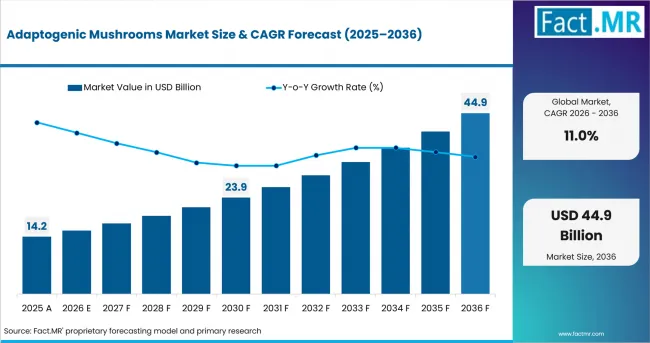
Adaptogenic Mushrooms Market Value Analysis | Source: Fact.MR
Summary of Adaptogenic Mushrooms Market
- Demand Drivers
- Interest in natural wellness products is increasing demand for adaptogenic mushroom supplements and functional foods.
- Stress management awareness is supporting consumption of ingredients linked to mental wellness applications.
- Functional beverage manufacturers are expanding mushroom-based product offerings across retail channels.
- Key Segments Analyzed
- By Product: Reishi accounts for 30% share in 2026 due to established use in immunity and wellness formulations.
- By Application: Immunity booster contributes 35% share in 2026, supported by strong health and wellness positioning.
- By Form: Processed products capture 55% share in 2026 due to convenience and longer shelf life.
- By Distribution Channel: Online Retail represents 41% share in 2026, supported by direct-to-consumer supplement sales.
- By End User: Individual Consumers account for 60% share in 2026, driven by daily wellness product usage.
- By Geography: China is projected to record 12.8% CAGR through 2036, supported by strong cultivation and processing capacity.
- Analyst Opinion at Fact.MR
- Shambhu Nath Jha, Principal Consultant at Fact.MR, opines, "Commercial opportunities are shifting toward premium mushroom extracts and functional wellness products. Companies with reliable ingredient quality and trusted brands can build a stronger market presence."
- Strategic Implications
- Supplement manufacturers should expand mushroom extract portfolios across immunity and cognitive health applications.
- Wellness brands should strengthen ingredient traceability and quality verification programs.
- Functional food companies should increase integration of mushroom ingredients into everyday consumption formats.
| Metric | Value |
|---|---|
| Estimated Value in 2026 | USD 15.8 Billion |
| Forecast Value in 2036 | USD 44.9 Billion |
| Forecast CAGR (2026 to 2036) | 11.0% |
Source: Fact.MR analysis. Updated Jun 11, 2026
China is projected to expand at 12.8% CAGR from 2026 to 2036 supported by mushroom cultivation capacity. India is expected to grow at 12.2% CAGR by 2036 driven by nutraceutical consumption. South Korea is forecast to register 11.7% CAGR through 2036 due to strong functional food demand. The United States is anticipated to witness 10.9% CAGR from 2026 to 2036 supported by premium supplement spending. Germany is estimated to advance at 10.4% CAGR by 2036 due to preference for natural wellness products. Japan is projected to grow at 9.8% CAGR through 2036 supported by established medicinal mushroom consumption.
Segmental Analysis
Adaptogenic Mushrooms Market Analysis by Product
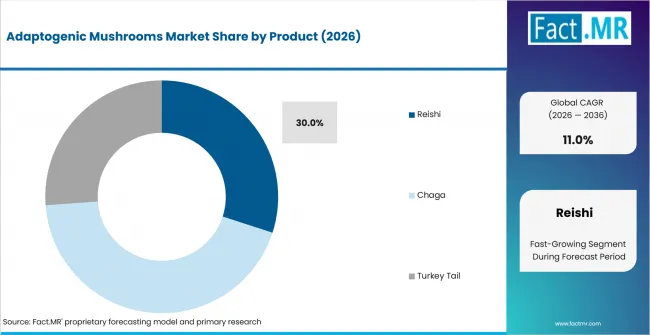
Adaptogenic Mushrooms Market Analysis By Product | Source: Fact.MR
Reishi is estimated to contribute 30% share in 2026. The mushroom has a long history in wellness products and is well known among supplement users. Its use in immunity support and daily health maintenance strengthens commercial demand. Eden’s Harvest launched what it described as the first craft beer line made with Alaskan chaga mushroom extracts, including a six-mushroom IPA and Passion Fruit Wheat Ale. The company stated the launch would begin a broader line of functional and adaptogenic mushroom beverages. [1]
- Brand Recognition: Reishi appears across a large number of supplement products. Familiarity improves purchasing confidence.
- Product Innovation: Manufacturers are introducing concentrated extracts with higher active compound content. New formats improve product differentiation.
- Retail Penetration: Distribution extends across online stores and specialty wellness channels. Market access supports sustained sales activity.
Adaptogenic Mushrooms Market Analysis by Application
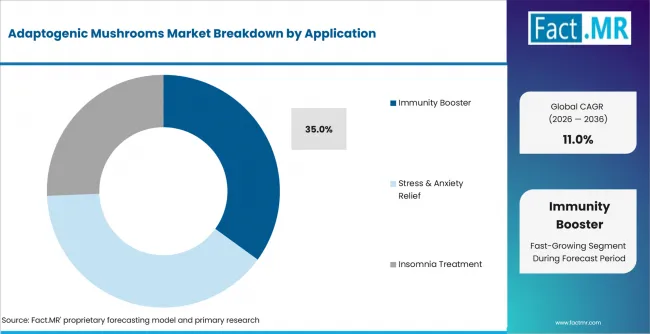
Adaptogenic Mushrooms Market Analysis By Application | Source: Fact.MR
Immunity Booster applications are projected to represent 35% share in 2026. Health-conscious households are choosing products associated with immune support. Daily supplement use keeps demand concentration in this application area. Laird Superfood expanded its mushroom portfolio with six new organic mushroom powders, including Lion’s Mane, Reishi, Turkey Tail, Oyster mushrooms, and specialized blends targeting focus, memory, relaxation, and wellness. [4]
- Preventive Wellness: Individuals are incorporating mushroom supplements into everyday health routines. Usage frequency supports category expansion.
- Portfolio Expansion: Supplement brands are launching immunity-focused formulations. Product diversity strengthens shelf presence.
- Health Awareness: Consumer attention toward immune function remains elevated. This trend supports recurring purchases.
Adaptogenic Mushrooms Market Analysis by Form
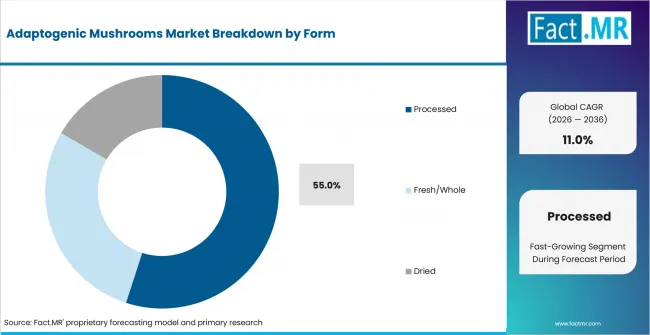
Adaptogenic Mushrooms Market Analysis By Form | Source: Fact.MR
Processed products are expected to account for 55% share in 2026. Powders and gummies are easier to use than whole mushroom formats. Shelf stability and standardized dosing improve commercial acceptance.
- Convenience Factor: Processed formats simplify daily consumption. Ease of use supports demand.
- Dose Consistency: Extract products provide measured ingredient content. Standardization improves product appeal.
- Channel Access: Retailers prefer packaged products with longer storage life. Distribution efficiency supports market concentration.
Adaptogenic Mushrooms Market Analysis by Distribution Channel
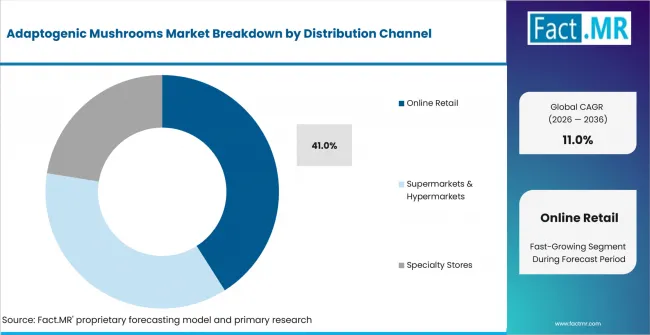
Adaptogenic Mushrooms Market Analysis By Distribution Channel | Source: Fact.MR
Online retail is forecast to generate 41% share in 2026. Digital platforms give consumers access to premium products and detailed ingredient information. Direct-to-consumer strategies strengthen brand visibility across wellness categories. Laird Superfood launched Maca Instant Latte, combining coffee, coconut creamer, maca adaptogen, and functional mushrooms. The product expanded the company's mushroom-based wellness beverage portfolio. [2]
- Digital Reach: Online channels provide access to wider product selections. Visibility supports transaction growth.
- Consumer Education: Product pages explain ingredient sourcing and benefits. Information availability influences purchasing activity.
- Subscription Models: Brands increasingly offer recurring delivery programs. Repeat purchases strengthen channel performance.
Adaptogenic Mushrooms Market Analysis by End User
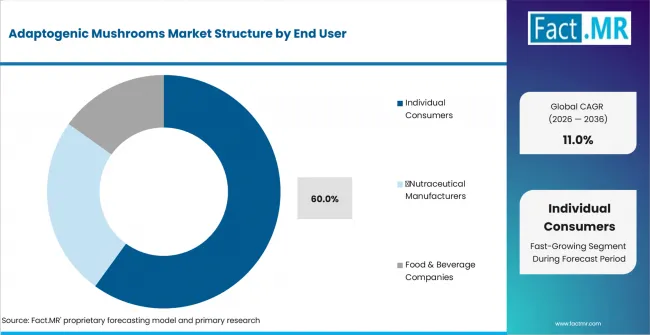
Adaptogenic Mushrooms Market Analysis By End User | Source: Fact.MR
Individual consumers are projected to capture 60% share in 2026. Personal wellness routines create a large share of mushroom supplement demand. Interest in natural health products supports household spending across multiple age groups. CBD Life Sciences (CBDL) entered the adaptogenic mushroom market with the launch of Mushroom Powder Capsules containing Lion's Mane, Cordyceps, Reishi, Maitake, and Turkey Tail mushrooms. The company expanded beyond CBD products into functional mushroom supplements targeting cognitive support, immunity, energy, and wellness. [3]
- Daily Usage: Supplements are frequently consumed as part of wellness regimens. Repeat usage supports demand stability.
- Lifestyle Adoption: Health-focused households are integrating mushroom products into routine nutrition. This behavior supports sales expansion.
- Product Accessibility: Wide availability across retail and digital channels improves purchasing convenience.
Drivers, Restraints, and Opportunities
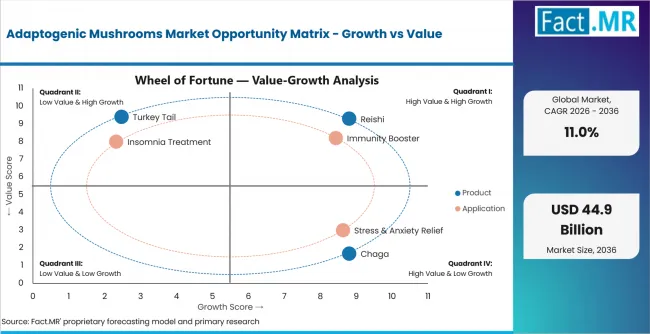
Adaptogenic Mushrooms Market Opportunity Matrix Growth Vs Value | Source: Fact.MR
Fact.MR analysts observe that the adaptogenic mushrooms market is moving from specialty wellness channels to mainstream nutrition products. Early demand was concentrated in herbal supplement users. Growth is increasingly linked to functional beverages and dietary supplements.
Ingredient suppliers are investing in extraction technologies and standardized formulations. Premium extracts carry higher prices than raw mushroom products. Value creation is becoming stronger in branded wellness products than in commodity mushroom sales.
- Functional Nutrition Shift: Beverage and supplement companies are expanding mushroom-based product lines. Demand is supported by interest in ingredients associated with immunity and cognitive health.
- Quality Standardization: Manufacturers are investing in extract verification and ingredient testing. Product quality expectations influence purchasing decisions across premium wellness segments.
- Regulatory Variation: Product labeling and health claim requirements differ across countries. Compliance costs create barriers for smaller ingredient suppliers.
Regional Analysis
The adaptogenic mushrooms market is assessed across North America, Europe, Asia Pacific, Latin America, and the Middle East & Africa. The study evaluates supplement demand, functional food consumption, ingredient production, wellness spending, and retail penetration across major economies.
.webp "Top Country Growth Comparison Adaptogenic Mushrooms Market Cagr (2026 2036)")
Top Country Growth Comparison Adaptogenic Mushrooms Market Cagr (2026 2036) | Source: Fact.MR
| Country | CAGR (2026 to 2036) |
|---|---|
| China | 12.8% |
| India | 12.2% |
| South Korea | 11.7% |
| United States | 10.9% |
| Germany | 10.4% |
| Japan | 9.8% |
Source: Fact.MR analysis. Updated Jun 11, 2026
Source: Fact MR analysis, based on proprietary forecasting model and primary research.
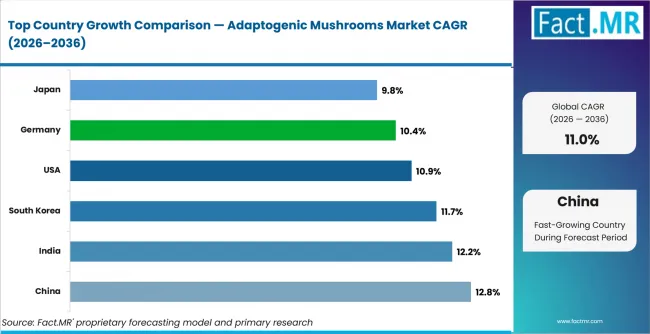
Adaptogenic Mushrooms Market Cagr Analysis By Country | Source: Fact.MR
Asia Pacific Adaptogenic Mushrooms Market Analysis
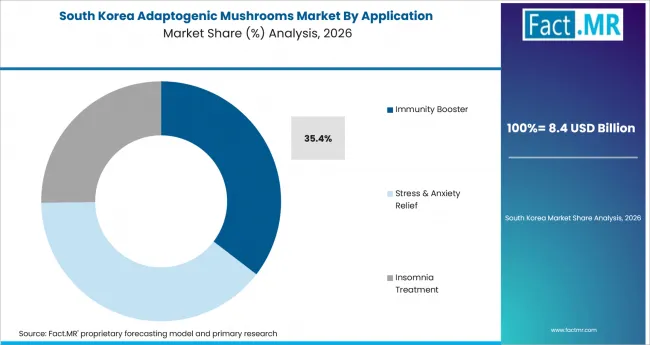
Adaptogenic Mushrooms Market South Korea Market Share Analysis By Application | Source: Fact.MR
Asia Pacific is a major production and consumption hub for adaptogenic mushrooms. Traditional use supports familiarity with mushroom-based wellness products. Product innovation is strengthening commercial demand across the region.
- China: Demand for adaptogenic mushrooms in China is projected to rise at 12.8% CAGR through 2036 as commercial cultivation supports large-scale ingredient production. Functional food manufacturers are using more mushroom extract in beverages and supplements. Market expansion is supported by established consumer acceptance and domestic supply networks.
- India: India is expected to expand at 12.2% CAGR from 2026 to 2036 as nutraceutical spending rises. Interest in plant-based wellness products is rising across urban markets. Digital health platforms are improving product awareness. Demand reflects wider use of immunity-focused dietary supplements.
- South Korea: Supported by strong functional food consumption patterns, South Korea is forecast to register 11.7% CAGR by 2036. Premium wellness brands are introducing mushroom formulations across nutrition categories. Market expansion reflects preference for science-backed health ingredients.
- Japan: Japan is projected to witness 9.8% CAGR through 2036 during the forecast period. Long-standing familiarity with medicinal mushroom products supports stable demand. Aging demographics and preventive health practices support product use.
North America Adaptogenic Mushrooms Market Analysis
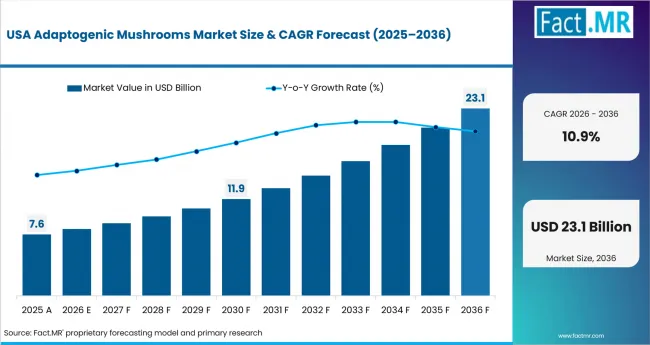
Adaptogenic Mushrooms Market Country Value Analysis | Source: Fact.MR
North America is an important revenue center for mushroom supplements and functional nutrition products. E-commerce penetration and premium product positioning support category development. Barker Wellness expanded distribution of its Mushroom Adaptogen Gummies through a nationwide launch in 880 Target stores and on Target.com. The product line features functional mushrooms such as Lion's Mane, Reishi, Cordyceps, Chaga, Turkey Tail, Shiitake, and Tremella, marking a major retail expansion for adaptogenic mushroom supplements in the U.S. market. [5]
- United States: The United States is anticipated to grow at 10.9% CAGR by 2036 as wellness brands invest in mushroom-based beverages and dietary supplements. Consumer spending on natural health products supports market value. Expansion is supported by direct-to-consumer distribution and product innovation activity.
Europe Adaptogenic Mushrooms Market Analysis
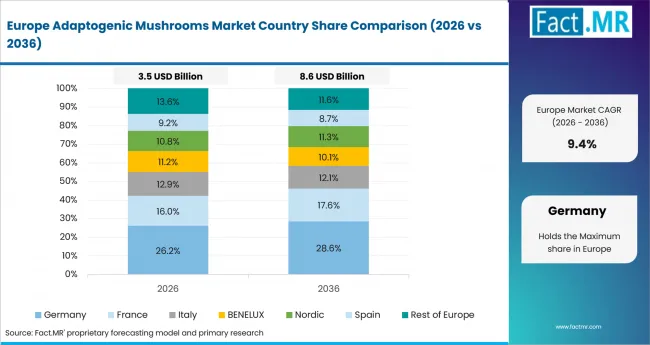
Adaptogenic Mushrooms Market Europe Country Market Share Analysis, 2026 & 2036 | Source: Fact.MR
Europe benefits from rising interest in natural wellness solutions and clean-label nutrition products. Ingredient transparency and quality standards influence purchase behavior across the region.
- Germany: Germany is estimated to advance at 10.4% CAGR through 2036 as demand rises for botanical supplements and functional foods. Retailers are increasing shelf space for naturally positioned wellness ingredients. Consumer preference for preventive health products supports market expansion.
Competitive Aligners for Market Players
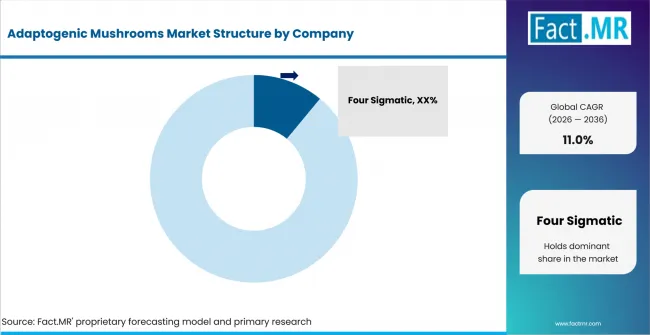
Adaptogenic Mushrooms Market Analysis By Company | Source: Fact.MR
The adaptogenic mushrooms market includes established supplement brands and specialized mushroom ingredient suppliers. Product quality and extract concentration influence commercial positioning. Brand credibility is an important differentiator across premium wellness channels. Consumers prefer products with transparent sourcing and verified ingredient content.
Companies with direct sourcing relationships and processing expertise gain better control over ingredient consistency. Vertical integration improves supply reliability and quality management. Quality certification supports market access across developed economies. Manufacturers are investing in extraction technologies to improve potency and product differentiation. Nutraceutical manufacturers evaluate suppliers based on ingredient purity and traceability. Long-term sourcing agreements reduce supply uncertainty and support production planning. Pricing power depends on extract quality and brand recognition. Premium formulations command higher prices because of concentration levels and standardized active compounds.
Commercial success is increasingly connected to standardized formulations and evidence-backed product positioning. Distribution reach supports market penetration across retail and digital channels. Product differentiation is moving toward concentrated extracts and specialized wellness applications. Companies with research support and established wellness portfolios can strengthen their market position.
Key Players
- Four Sigmatic
- Om Mushroom Superfood
- Real Mushrooms
- Sun Potion
- FreshCap Mushrooms
Bibliography
- [1] Brewbound. (2024, February 9). Eden’s Harvest releases first true chaga mushroom craft beer.
- [2] Laird Superfood, Inc. (2024, December 19). Laird Superfood launches Maca Instant Latte for enhanced energy and vitality. PR Newswire.
- [3] CBD Life Sciences Inc. (2025, February 26). CBD Life Sciences Inc. (CBDL) launches mushroom powder. Stock Titan.
- [4] Laird Superfood, Inc. (2025, May 14). Laird Superfood expands functional mushroom product line as consumer demand for adaptogens increases. PR Newswire.
- [5] Barker Wellness Co. (2026, April 29). Barker Wellness launches mushroom adaptogen gummies at Target nationwide. PR Newswire.
This Report Addresses
- Analysis of adaptogenic mushroom demand across functional nutrition and wellness product applications.
- Market forecast from USD 15.8 billion in 2026 to USD 44.9 billion by 2036 at 11.0% CAGR.
- Opportunity assessment across reishi, lion's mane, cordyceps, and mushroom extract products.
- Segment forecasts covering product, application, form, distribution channel, and end user demand.
- Competitive assessment of mushroom supplement brands and ingredient suppliers.
- Evaluation of wellness consumption patterns and functional food innovation activity.
- Country-level analysis across China, India, South Korea, the United States, Germany, and Japan.
- Report delivery through PDF and Excel formats supported by primary interviews and supplement industry analysis.
Adaptogenic Mushrooms Market Definition
The adaptogenic mushrooms market covers mushroom species used in food, beverages, supplements, and personal wellness products to support stress response and overall health. Common products include reishi, lion's mane, chaga, cordyceps, and turkey tail mushrooms. These ingredients are sold as powders, capsules, extracts, beverages, and functional food products. Demand comes from nutritional supplement brands, food manufacturers, wellness companies, and health-focused individuals seeking natural health support solutions.
Adaptogenic Mushrooms Market Inclusions
The study covers global and regional forecasts from 2026 to 2036 by product, application, form, distribution channel, and end user. It includes adaptogenic mushroom ingredients used in supplements, foods, beverages, and personal care products. The report evaluates consumption trends, retail activity, pricing developments, and product innovation across major markets.
Adaptogenic Mushrooms Market Exclusions
The study excludes conventional edible mushrooms used solely for culinary purposes. It omits pharmaceutical drugs, synthetic stress management products, and non-mushroom botanical adaptogens. Revenue associated with standard mushroom farming is excluded unless products are marketed for adaptogenic or functional wellness applications.
Adaptogenic Mushrooms Market Research Methodology
- Primary Research
- Interviews were conducted with mushroom ingredient suppliers, nutraceutical manufacturers, wellness brands, distributors, and functional food industry executives.
- Desk Research
- Analysis included company disclosures, supplement industry publications, product launch announcements, regulatory updates, and wellness market developments published during 2024 and 2025.
- Market-Sizing and Forecasting
- Hybrid top-down and bottom-up model using supplement sales analysis, ingredient demand trends, retail penetration, and wellness product consumption assessments.
- Data Validation and Update Cycle
- Forecast was validated through manufacturer interviews, distributor assessments, company disclosures, and ingredient demand analysis.
Segmentation
Scope of Report
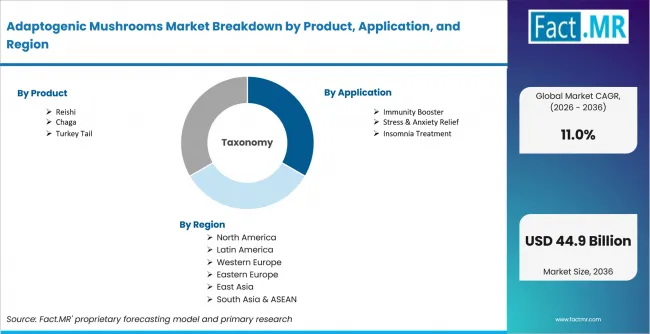
Adaptogenic Mushrooms Market Breakdown By Product, Application, And Region | Source: Fact.MR
| Attribute | Details |
|---|---|
| Quantitative Units | USD 15.8 Billion (2026) to USD 44.9 Billion (2036) at a CAGR of 11.0% |
| Market Definition | Covers adaptogenic mushroom products used in supplements, foods, beverages, and wellness applications. |
| Product Segmentation | Reishi, Chaga, Turkey Tail, Lion's Mane, Cordyceps, Others |
| Application Segmentation | Immunity Booster, Stress & Anxiety Relief, Cognitive Brain Support & Mental Health Support, Insomnia Treatment, Others |
| Form Segmentation | Fresh/Whole, Dried, Processed |
| Distribution Channel Segmentation | Online Retail, Supermarkets & Hypermarkets, Specialty Stores, Pharmacies & Drug Stores, Direct Sales |
| End User Segmentation | Individual Consumers, Nutraceutical Manufacturers, Food & Beverage Companies, Cosmetic & Personal Care Companies |
| Regions Covered | North America, Europe, Asia Pacific, Latin America, Middle East & Africa |
| Countries Covered | China, India, South Korea, United States, Germany, Japan |
| Key Companies Profiled | Four Sigmatic, Om Mushroom Superfood, Real Mushrooms, Sun Potion, FreshCap Mushrooms |
| Forecast Period | 2026 to 2036 |
| Approach | Hybrid top-down and bottom-up model using supplement demand and wellness consumption analysis. |
Source: Fact.MR analysis. Updated Jun 11, 2026
Adaptogenic Mushrooms Market by Segment
-
By Product
- Reishi
- Chaga
- Turkey Tail
- Lion's Mane
- Cordyceps
-
By Application
- Immunity Booster
- Stress & Anxiety Relief
- Cognitive, Brain Support & Mental Health Support
- Insomnia Treatment
-
By Form
- Fresh/Whole
- Dried
- Processed
-
By Distribution Channel
- Online Retail
- Supermarkets & Hypermarkets
- Specialty Stores
- Pharmacies & Drug Stores
- Direct Sales
-
By End User
- Individual Consumers
- Nutraceutical Manufacturers
- Food & Beverage Companies
- Cosmetic & Personal Care Companies
-
By Region
- North America
- United States
- Canada
- Mexico
- Latin America
- Brazil
- Argentina
- Rest of Latin America
- Europe
- Germany
- United Kingdom
- France
- Italy
- Spain
- Rest of Europe
- Asia Pacific
- China
- India
- Japan
- South Korea
- ASEAN
- Middle East & Africa
- UAE
- Saudi Arabia
- South Africa
- Rest of Middle East & Africa
- North America
Frequently Asked Questions
How large is the global adaptogenic mushrooms market in 2025?
What will the adaptogenic mushrooms market size be in 2026?
What is the projected adaptogenic mushrooms market size by 2036?
What is the expected CAGR for the adaptogenic mushrooms market from 2026 to 2036?
Which product segment is poised to lead market demand?
Which application segment contributes the leading demand?
Which country records stronger growth across the assessment period?
Who worked on this report


Preview the report firsthand - request a free sample
Free SampleGet the brochure for pricing and purchase details
Download PDF