- Market Value (2025): USD 630.6 Mn
- Estimated Value (2026): USD 669.7 Mn
- Forecast Value (2036): USD 1195.6 Mn
- CAGR (2026-2036): 6.2%
What is the Camel Dairy Market forecast to be worth by 2036?
USD 669.7 million in 2026 to USD 1195.6 million by 2036, at a 6.2% CAGR.
- The camel dairy market reached USD 630.6 million in 2025.
- Demand is projected to increase from USD 669.7 million in 2026 to USD 1195.6 million by 2036.
- The market is forecast to record a 6.2% CAGR from 2026 to 2036.
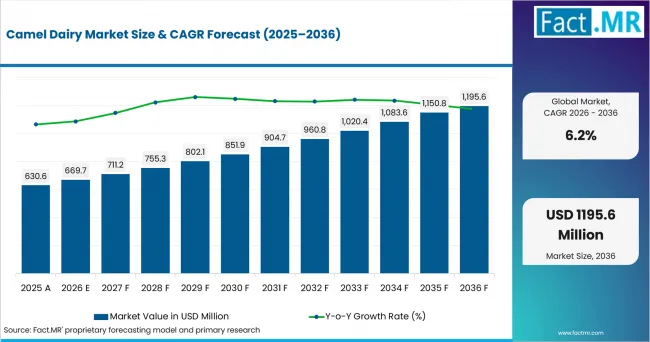
Camel Dairy Market Value Analysis | Source: Fact.MR
What are the defining numbers behind Camel Dairy Market growth?
USD 525.9 million absolute opportunity is expected between 2026 and 2036.
- Demand Drivers in the Market
- Raw camel milk demand is backed by buyers who want a direct product format with clear freshness cues.
- Baby application demand is expected to stay prominent where trust and repeat household buying guide product choice.
- Flavored Camel Milk can widen trial by making the taste easier for new buyers to accept.
- Retail and online grocery routes are expected to improve access where specialty dairy products are hard to find in regular stores.
- Key Segments Analyzed
- By Type: Raw Camel Milk accounts for 63.0% share in 2026.
- By Application: Baby leads with 53.7% share in 2026.
- Analyst Opinion at Fact.MR
- Shambhu Nath Jha, Senior Consultant at Fact.MR, states, “Camel dairy market as a trust-led category. Buyers need a clear reason to choose camel dairy over familiar dairy options. Raw Camel Milk works best when suppliers explain freshness and origin. Flavored formats need steady taste and simple labels. Demand in Baby applications is expected to depend on repeat household buying and clear use guidance. Adult and Elder applications add demand where specialty nutrition buyers compare price and local availability before switching.”
- Strategic Implications
- Brand teams need separate claims for raw camel milk and flavored camel milk so buyers understand the intended use quickly.
- Retail planners can improve availability by matching retail-ready packaging with household buying patterns and chilled storage capacity.
- Suppliers need to explain sourcing and shelf-life control before buyers compare camel dairy with other specialty dairy options.
Australia leads the listed country set at 7.6% CAGR. The UK follows at 7.2% and the USA records 7.1%. Canada advances at 6.9% and Germany expands at 6.1% through 2036.
How does the Camel Dairy Market break down by segment?
Raw Camel Milk leads Type with 63.0% share in 2026. Baby leads Application with 53.7% share in 2026.
Why does Raw Camel Milk lead Type?
Raw Camel Milk is projected to account for 63.0% share in 2026.
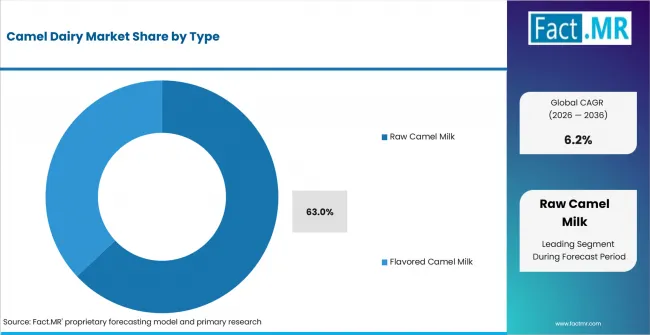
Camel Dairy Market Analysis By Type | Source: Fact.MR
Raw Camel Milk leads Type because it gives buyers the clearest product identity. Freshness and origin are easier to explain in this format. Flavored Camel Milk serves a different role by improving taste acceptance for first-time buyers. Raw Camel Milk keeps the stronger base since it needs fewer format explanations at the point of sale.
Why does Baby lead Application?
Baby holds 53.7% share in 2026.
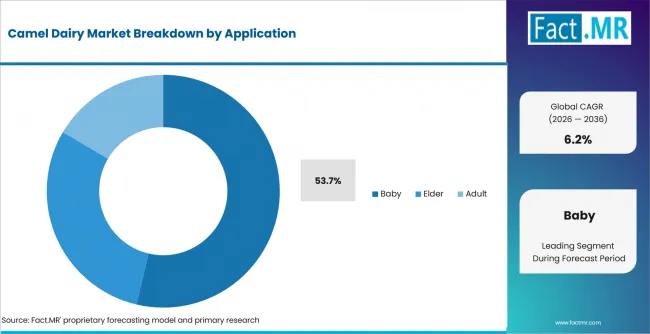
Camel Dairy Market Analysis By Application | Source: Fact.MR
Baby leads Application because repeat household buying is central to this use case. Buyers in this category place weight on trust and product consistency. Elder and Adult applications remain useful where camel dairy is bought as a specialty nutrition option. Their demand is more varied since purchase occasions depend on taste and local availability.
What is accelerating Camel Dairy Market adoption, and what is holding it back?
Demand is expected to rise through clearer product positioning and wider specialty retail access. Recurring use across Baby and Adult applications adds another buying route. Growth may be limited by supply variability and cold-chain discipline.
Drivers Impact Analysis
| DRIVER | MARKET IMPACT | GEOGRAPHIC RELEVANCE | IMPACT TIMELINE |
|---|---|---|---|
| Raw camel milk preference | High positive | UK, Australia, USA | Short term (<= 2 years) |
| Baby application repeat use | High positive | UK and Canada | Short term (<= 2 years) |
| Flavored format trial | Moderate positive | USA and Germany | Medium term (2-4 years) |
| Retail and online access | Moderate positive | Listed countries | Medium term (2-4 years) |
| Pack-size differentiation | Selective positive | Specialty dairy channels | Long term (>= 4 years) |
Source: Fact.MR analysis. Updated Aug 4, 2026
- Raw camel milk preference: Buyers are expected to favor a direct format when freshness and origin cues are easy to understand.
- Baby application repeat use: Repeat household buying is expected to protect demand where trust and clear use guidance are visible.
- Flavored format trial: Taste-adjusted products are likely to support first-time purchase when consumers are unfamiliar with camel dairy.
Opportunity Impact Analysis
| OPPORTUNITY | MARKET IMPACT | GEOGRAPHIC RELEVANCE | IMPACT TIMELINE |
|---|---|---|---|
| Specialty chilled retail placement | High positive | UK, USA, Canada | Medium term (2-4 years) |
| Online specialty dairy sales | Moderate positive | Australia and USA | Medium term (2-4 years) |
| Functional food positioning | Moderate positive | Germany and Canada | Long term (>= 4 years) |
| Pack-size and label clarity | Selective positive | Retail and pharmacy channels | Long term (>= 4 years) |
Source: Fact.MR analysis. Updated Aug 4, 2026
- Specialty chilled retail placement: Better shelf visibility is expected to help camel dairy compete with other premium dairy products.
- Online specialty dairy sales: Online grocery channels can improve access where local stores carry limited camel dairy options.
- Functional foods positioning: Camel dairy suppliers may find stronger trial where buyers already compare specialty nutrition formats.
Restraints Impact Analysis
| RESTRAINT | MARKET IMPACT | GEOGRAPHIC RELEVANCE | IMPACT TIMELINE |
|---|---|---|---|
| Input supply variability | High negative | Global supply routes | Short term (<= 2 years) |
| Cold-chain and shelf-life control | Moderate negative | Retail and online channels | Short term (<= 2 years) |
| Labeling and claims review | Moderate negative | UK, USA, Germany | Medium term (2-4 years) |
| Taste and price barriers | Selective negative | New consumer markets | Long term (>= 4 years) |
Source: Fact.MR analysis. Updated Aug 4, 2026
- Input supply variability: Limited milk collection and seasonal availability can affect cost and order reliability.
- Cold-chain and shelf-life control: Cold chain logistics raises the operating burden for retailers and online sellers.
- Labeling and claims review: Suppliers may face slower market entry when claims and product descriptions differ by country.
Which countries are scaling the Camel Dairy Market fastest?
- The country comparison spans 1.5 percentage points across the listed forecast set.
- Australia leads the set at 7.6% CAGR through specialty dairy trial and channel development.
- The UK follows at 7.2% CAGR as premium dairy retailing gives the category clearer shelf visibility.
- The USA records 7.1% CAGR where specialty nutrition buying and direct-to-consumer access support wider reach.
- Canada advances at 6.9% CAGR through premium product access and steady retail qualification.
- Germany expands at 6.1% CAGR as careful product review shapes a measured adoption path.
Comparable CAGRs can still create different entry conditions. Local retail depth and labeling expectations vary by country. Full report coverage includes North America and Latin America. Europe and East Asia are included as well. South Asia and Oceania complete the scope with Middle East and Africa.
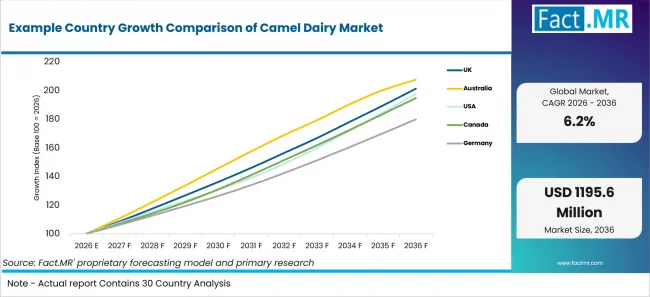
Example Country Growth Comparison Of Camel Dairy Market | Source: Fact.MR
| Country | CAGR (2026-2036) |
|---|---|
| Australia | 7.6% |
| UK | 7.2% |
| USA | 7.1% |
| Canada | 6.9% |
| Germany | 6.1% |
Source: Fact.MR analysis. Updated Aug 4, 2026
What supports Australia adoption?
7.6% CAGR, supported by specialty dairy trial and channel expansion.
Australia records the highest listed pace through specialty stores and direct supply models. These routes matter for camel dairy since mainstream chilled shelves may not carry enough product depth. Suppliers are expected to gain preference when product handling and use cases are easy to understand. Flavored products can support first purchase. Raw Camel Milk remains important for buyers who want a clear product identity.
What supports UK adoption?
7.2% CAGR, led by premium dairy visibility and structured retail selection.
The UK is expected to grow above the global rate as premium retail gives specialty dairy products better visibility. This channel setting helps camel dairy reach buyers who compare niche dairy products before repeat purchase. Clear labeling and dependable chilled supply can turn trial into regular orders across Baby and Adult applications. Elder applications add a smaller route where buyers value specialty nutrition options.
What is driving the USA’s growth from 2026 to 2036?
7.1% CAGR, backed by specialty nutrition purchasing and direct-to-consumer reach.
The USA advances above the global rate through online discovery and specialty nutrition buying. These channels matter when camel dairy is not stocked widely in mainstream dairy aisles. Suppliers are expected to compete on product explanation and order reliability. Baby and Adult applications can both contribute where households connect camel dairy with routine nutrition use.
How is Canada developing demand?
6.9% CAGR, supported by premium product access and steady retail qualification.
Canada grows faster than the global average through careful product selection and dependable availability. Retailers are likely to review shelf-life control before expanding specialty dairy listings. Clear sourcing information can improve buyer confidence in Raw Camel Milk. Flavored Camel Milk can help stores test demand where shoppers need a more familiar taste profile.
How does Germany perform?
6.1% CAGR, led by measured specialty dairy adoption and product-quality review.
Germany’s projected pace is closest to the global rate among the listed countries. Demand is expected to develop where suppliers meet quality expectations and avoid broad health claims. Buyers may take longer to switch since taste and price carry weight in a mature dairy environment. Labeling discipline is expected to shape supplier acceptance.
Who leads the Camel Dairy Market?
Emirates Industry for Camel Milk & Products – Camelicious and Al Ain Farms for Livestock Production show the clearest direct relevance. Desert Farms and The Camel Milk Co. Australia Pty Ltd. widen the supplier set through specialty camel milk positioning.
Emirates Industry for Camel Milk & Products – Camelicious supports demand through an established camel dairy portfolio and brand visibility. Al Ain Farms for Livestock Production adds large dairy-market experience and regional supply strength. Desert Farms contributes specialty camel milk positioning for direct buyers. The Camel Milk Co. Australia Pty Ltd. supports the field through a farm-led product model. Xinjiang Wangyuan Camel Milk Industry Co., Ltd. adds exposure to camel milk products in China. Aadvik Foods & Products Pvt. Ltd. and Tiviski SARL broaden the listed provider base. Kamelenmelkerij Smits – Camel Dairy Smits completes the set through farm-based camel dairy supply.
From 2026 to 2036, competition is expected to depend on product consistency and freshness control. Channel reliability is expected to matter more than company share. Food processing customers may compare suppliers on ingredient fit before expanding use in prepared formats.
Which companies are the key providers?
Key companies include Emirates Industry for Camel Milk & Products – Camelicious; Al Ain Farms for Livestock Production; Desert Farms; The Camel Milk Co. Australia Pty Ltd.; Xinjiang Wangyuan Camel Milk Industry Co., Ltd.; Aadvik Foods & Products Pvt. Ltd.; Tiviski SARL; Kamelenmelkerij Smits – Camel Dairy Smits.
- Emirates Industry for Camel Milk & Products – Camelicious
- Al Ain Farms for Livestock Production
- Desert Farms
- The Camel Milk Co. Australia Pty Ltd.
- Xinjiang Wangyuan Camel Milk Industry Co., Ltd.
- Aadvik Foods & Products Pvt. Ltd.
- Tiviski SARL
- Kamelenmelkerij Smits – Camel Dairy Smits
Bibliography
- Food and Agriculture Organization of the United Nations. (2025, February 4). Exploring the nutraceutical and therapeutic potential of camel milk in India.
- Food and Agriculture Organization of the United Nations. (2025). Dairy market review: Overview of global market developments in 2024.
- Organisation for Economic Co-operation and Development, & Food and Agriculture Organization of the United Nations. (2025, July 15). Dairy and dairy products. In OECD-FAO agricultural outlook 2025–2034. OECD Publishing.
This Report Answers
- The report provides strategic intelligence on the Camel Dairy Market across Type and Application choices that shape product selection and channel planning.
- Segment analysis covers Raw Camel Milk and Flavored Camel Milk. Raw Camel Milk is identified as the 2026 share leader within Type.
- Application analysis covers Baby and Elder use cases. Adult completes the application scope. Baby holds the leading share in 2026.
- Country outlook evaluates Australia and the UK with the USA. Canada and Germany complete the listed forecast set.
- Competitive analysis profiles Emirates Industry for Camel Milk & Products – Camelicious and Al Ain Farms for Livestock Production with Desert Farms and The Camel Milk Co. Australia Pty Ltd.. Xinjiang Wangyuan Camel Milk Industry Co., Ltd. and Aadvik Foods & Products Pvt. Ltd. complete the provider view with Tiviski SARL and Kamelenmelkerij Smits – Camel Dairy Smits.
What does the Camel Dairy Market cover?
The Camel Dairy Market covers commercial camel-origin dairy products sold as Raw Camel Milk and Flavored Camel Milk. Coverage extends to Baby and Elder applications. Adult use cases complete the application scope. The report assesses how product type and channel reach shape demand across the listed regions. Supplier reliability remains part of the scope when it affects product availability.
What is included in the scope?
The scope includes camel dairy products sold through the defined Type and Application categories. Raw Camel Milk is included where it is sold as a direct dairy product. Flavored Camel Milk is included where taste adjustment is part of the product offer. Country demand assessment covers Australia and the UK. The USA and Canada complete the listed country set with Germany.
What is excluded from the scope?
Products outside the defined camel dairy categories remain outside the scope. General dairy products that do not use camel-origin milk are excluded. Non-dairy beverages and unrelated nutrition products are excluded from the assessment. Services without a direct camel dairy product connection are excluded as well.
How Was the Analysis Built?
The analysis draws on 120+ sources and 35+ company portfolios. It also reviews 25+ countries and more than 20 industry interviews.
- Primary Research: Primary research includes discussions with manufacturers and service providers. Technology developers and distributors are covered as well. End users complete the interview group. These conversations examine purchasing priorities and product adoption. They also review approval needs and the factors that influence wider market acceptance.
- Desk Research: Desk research covers government statistics and regulatory publications. Company filings and trade data are reviewed as well. Technical studies add context where they define the market boundary. Industry associations and standards bodies help establish market boundaries. Every source used in the analysis is documented in the bibliography.
- Market Sizing and Forecasting: Market estimates combine historical performance and demand indicators. Pricing trends and volume patterns are reviewed together. Segment shares are checked against the same demand base. Company participation and country-level growth help shape the forecast. Adoption patterns and market barriers are checked before final sizing.
- Data Validation and Update Cycle: Findings are validated by comparing primary interviews with public data. Company activity and regulatory changes are reviewed during the same cycle. Regular updates review product launches and capacity changes. Partnerships and approvals are checked before publication. Procurement trends and commercial adoption shifts are reviewed during the same final check.
Segmentation
What is the report’s scope and coverage?
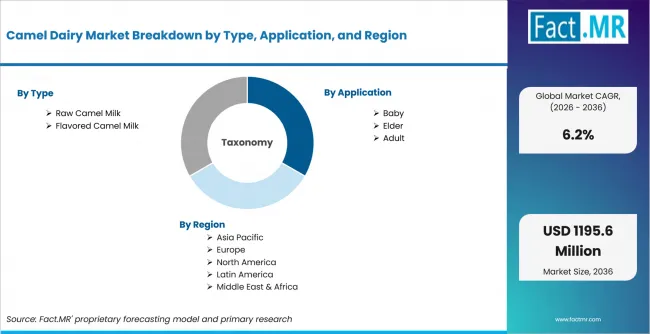
Camel Dairy Market Breakdown By Type, Application, And Region | Source: Fact.MR
| Attribute | Details |
|---|---|
| Quantitative Units | USD million in 2026 to USD million by 2036 at CAGR |
| Market Definition | Camel-origin dairy products sold across Raw Camel Milk and Flavored Camel Milk formats where freshness, taste, label clarity, cold-chain control and channel access influence purchasing decisions |
| Type | Raw Camel Milk; Flavored Camel Milk |
| Application | Baby; Elder; Adult |
| Regions Covered | North America; Latin America; Europe; East Asia; South Asia and Pacific; Middle East and Africa |
| Countries Covered | Australia; UK; USA; Canada; Germany |
| Key Companies Profiled | Emirates Industry for Camel Milk & Products – Camelicious; Al Ain Farms for Livestock Production; Desert Farms; The Camel Milk Co. Australia Pty Ltd.; Xinjiang Wangyuan Camel Milk Industry Co., Ltd.; Aadvik Foods & Products Pvt. Ltd.; Tiviski SARL; Kamelenmelkerij Smits – Camel Dairy Smits |
| Forecast Period | 2026 to 2036 |
| Approach | Hybrid top-down and bottom-up approach using camel dairy demand; Raw and Flavored Camel Milk participation; Baby, Elder and Adult applications; specialty retail and online access; freshness and shelf-life control; cold-chain requirements; labeling review; country growth patterns; supplier reliability; and company portfolio assessment |
Source: Fact.MR analysis. Updated Aug 4, 2026
How is the market segmented?
-
By Type
- Raw Camel Milk
- Flavored Camel Milk
-
By Application
- Baby
- Elder
- Adult
-
By Region
- North America
- USA
- Canada
- Europe
- Germany
- UK
- South Asia & Oceania
- Australia
Frequently Asked Questions
Which type leads the Camel Dairy Market?
Which application leads the market?
Which country records the fastest growth?
Which companies are included in the market assessment?
Who worked on this report


Preview the report firsthand - request a free sample
Free SampleGet the brochure for pricing and purchase details
Download PDF