- Base Value(2025): 2.7 Bn
- Forecast Value (2036): 10.2 Bn
- CAGR (2036): 12.7%
Carbon-Labeled Food Products Market Size, Market Forecast and Outlook By Fact.MR
The carbon-labeled food products market reached USD 2.7 billion in 2025. Fact MR estimates the market will expand to USD 3.1 billion in 2026 and attain USD 10.2 billion by 2036. The market is forecast to register a CAGR of 12.7% across the assessment period.
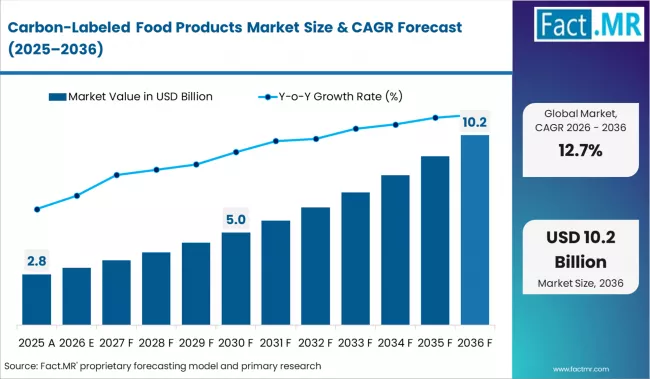
Carbon Labeled Food Products Market Market Value Analysis | Source: Fact.MR
Summary of the Carbon-Labeled Food Products Market
- Market Definition
- The market includes packaged food and beverage products displaying quantified carbon emission information derived from lifecycle assessment of raw material sourcing, production, packaging, and logistics activities. Carbon labeling communicates greenhouse gas emission metrics associated with product manufacturing and distribution processes. These labels provide standardized disclosure of environmental impact indicators across packaged foods, dairy products, beverages, snacks, meat products, and bakery items.
- Demand Drivers
- Expansion of lifecycle emissions measurement frameworks across food supply chains
- Increasing integration of environmental disclosure metrics within retail product labeling requirements
- Growing adoption of standardized carbon accounting methodologies supporting product level emissions transparency
- Rising participation of retailers and food manufacturers in environmental reporting initiatives
- Key Segments Analyzed
- Label Type: Certified carbon footprint labels account for approximately 38% share supported by standardized verification methodologies
- Distribution Channel: Supermarkets and hypermarkets represent nearly 41% share supported by structured shelf visibility of labeled products
- Product Type: Packaged foods and beverages demonstrate relatively higher integration of lifecycle emission disclosure metrics
- Geography: Europe demonstrates relatively strong adoption supported by regulatory initiatives promoting environmental transparency
- Analyst Opinion at Fact MR
- Shambhu Nath Jha, Principal Consultant, Fact MR, opines, "In this updated edition of the Carbon-Labeled Food Products Market report, industry participants will observe increasing integration of lifecycle emissions disclosure across packaged food categories. Carbon labeling frameworks enable standardized communication of greenhouse gas emission metrics associated with product manufacturing and supply chain activities. Companies that strengthen carbon accounting capabilities and verification processes are expected to maintain competitive positioning through 2036."
- Strategic Implications Executive Takeaways
- Strengthen lifecycle assessment capabilities supporting standardized carbon footprint calculation across product portfolios
- Improve traceability systems enabling collection of emissions data across agricultural sourcing, production, and logistics processes
- Expand collaboration with certification bodies supporting third party verification of disclosed carbon metrics
- Monitor regulatory developments influencing environmental disclosure requirements across packaged food supply chains
- Methodology
- Primary interviews conducted with food manufacturers, certification organizations, sustainability consultants, and retail category managers
- Desk research based on environmental labeling frameworks, company sustainability disclosures, regulatory guidance documents, and lifecycle assessment databases
- Market sizing derived using a hybrid approach combining bottom up product adoption analysis with top down packaged food market assessment
- Data validation performed through cross verification with environmental reporting datasets and internal peer review aligned with Fact MR standards
Carbon-Labeled Food Products Market
| Metric | Details |
|---|---|
| Industry Size (2026E) | USD 3.1 billion |
| Industry Value (2036F) | USD 10.2 billion |
| CAGR (2026 to 2036) | 12.7% |
Source: Fact.MR analysis. Updated Mar 27, 2026
A CAGR of 12.7% indicates transformational expansion, reflecting rapid integration of carbon disclosure metrics into product labeling and procurement standards across retail supply chains. Growth remains supported by retailer reporting requirements and lifecycle emission tracking frameworks, while constraints persist due to verification cost burdens, fragmented carbon accounting methodologies, and compliance complexity for small and mid-scale food producers.
The United Kingdom leads with a projected CAGR of 14.1%, supported by increasing integration of environmental footprint disclosure across packaged food labeling standards. Germany follows with a CAGR of 13.8%, driven by growing adoption of lifecycle assessment metrics within retail private label product portfolios. France records a CAGR of 12.9%, reflecting expanding use of product transparency indicators across packaged food categories. The United States shows a CAGR of 12.6%, supported by rising incorporation of environmental impact labeling across branded food product lines. Japan records the slowest growth at 11.8%, reflecting a mature market where demand is largely tied to gradual adoption of standardized product labeling frameworks. Mature markets generate a significant share of replacement demand as labeling frameworks evolve to incorporate updated lifecycle measurement methodologies across packaged food supply chains.
Segmental Analysis
Carbon-Labeled Food Products Market Analysis by Distribution Channel
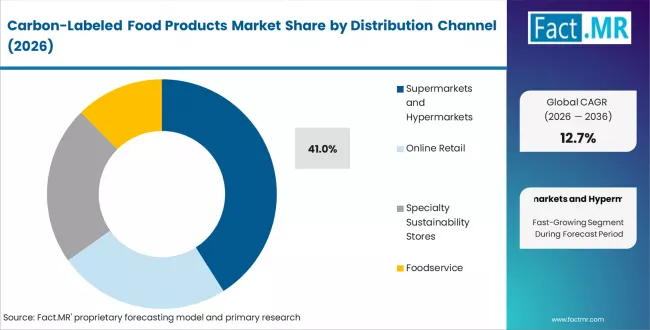
Carbon Labeled Food Products Market Analysis By Distribution Channel | Source: Fact.MR
- Market Overview: Based on Fact MR assessment, supermarkets and hypermarkets are projected to account for 41% share of the carbon-labeled food products market in 2026. Organized retail environments enable standardized product comparison across packaged food categories displaying environmental impact metrics calculated across product life cycle stages. Shelf placement strategies support visibility of carbon footprint information presented alongside ingredient disclosure and nutritional labeling frameworks. Retail category management systems incorporate carbon-labeled packaged foods across dairy alternatives, packaged snacks, beverages, and ready meal products where purchasing decisions are influenced by environmental performance indicators presented at point of sale.
- Demand Drivers:
- Label Visibility Structure: Supermarkets provide structured shelf positioning enabling consumer evaluation of carbon emission disclosure across comparable packaged food product categories.
- Procurement Policy Alignment: Retail chains incorporate carbon footprint labeling within supplier evaluation frameworks supporting inclusion of products meeting defined environmental reporting criteria.
- Product Differentiation Requirements: Packaged food manufacturers integrate carbon disclosure information enabling distinction across competing brands positioned within standardized retail shelf environments.
Carbon-Labeled Food Products Market Analysis by Label Type
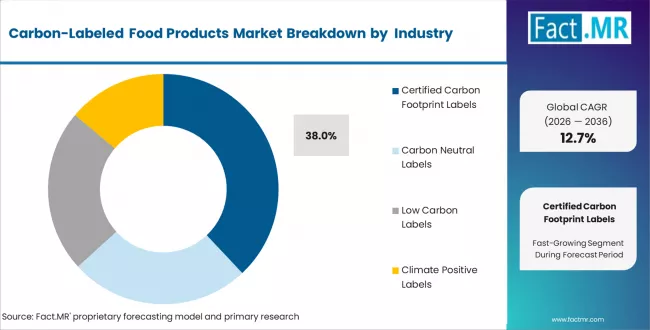
Carbon Labeled Food Products Market Analysis By Label Type | Source: Fact.MR
- Market Overview: Certified carbon footprint labels are estimated to hold 38% share of the carbon-labeled food products market in 2026, supported by verification frameworks requiring standardized calculation of greenhouse gas emissions across production, packaging, and distribution stages. Certification systems are structured to quantify carbon intensity associated with raw material sourcing, energy utilization, and logistics operations. Label formats communicate numerical carbon impact values or graded environmental indicators enabling comparison across packaged food alternatives within defined product categories.
- Demand Drivers:
- Verification Standard Requirements: Certified labeling frameworks incorporate third party assessment methodologies supporting credibility of disclosed carbon emission metrics.
- Comparability Function: Quantified carbon disclosure enables evaluation across similar packaged food products where environmental impact metrics are presented in consistent measurement formats.
- Supply Chain Documentation: Carbon accounting methodologies require structured data collection across ingredient sourcing, manufacturing processes, and transportation activities supporting standardized label issuance.
Key Dynamics
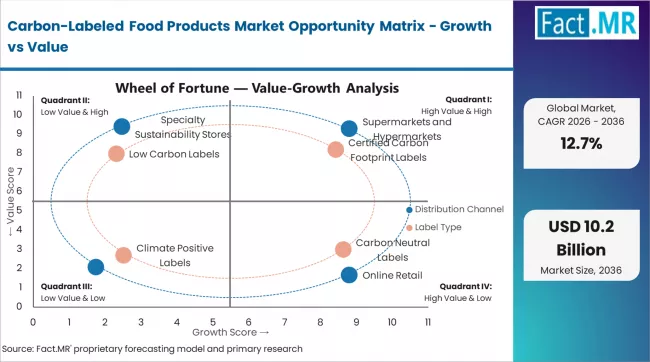
Carbon Labeled Food Products Market Opportunity Matrix Growth Vs Value | Source: Fact.MR
Carbon-Labeled Food Products Market Drivers, Restraints, and Opportunities
FMR analysts observe that the carbon-labeled food products market developed from environmental impact measurement frameworks used to quantify greenhouse gas emissions across agricultural and food supply chains. Early labeling initiatives were introduced by retailers and certification bodies seeking to provide transparency regarding lifecycle emissions associated with food production, packaging, and transportation. The current market valuation reflects expanding use of product labels that disclose carbon footprint metrics, enabling comparison of environmental impact across food categories. Demand persists because carbon labeling supports corporate reporting practices and consumer-facing disclosure of production-related emissions.
A structural shift is occurring as conventional food labeling focused on nutrition information expands toward environmental impact disclosure within packaged food categories. Standard food products remain widely distributed without lifecycle emission labeling where regulatory mandates remain limited. Carbon-labeled products require lifecycle assessment methodologies, emissions data collection, and third-party verification processes that increase compliance and certification costs. These products may involve higher supply chain tracking expenses linked to agricultural inputs and manufacturing processes. Even with moderate adoption volumes, higher compliance costs associated with environmental disclosure support gradual market value expansion.
- Lifecycle Emissions Disclosure: Food manufacturers calculate product-level greenhouse gas emissions across farming, processing, packaging, and distribution stages to provide carbon labeling information.
- Environmental Reporting Frameworks: Standards such as ISO 14067 carbon footprint of products and Greenhouse Gas Protocol Product Standard influence calculation and disclosure methodologies.
- Europe Retail Adoption: The United Kingdom, France, and Sweden maintain active retail initiatives introducing carbon footprint labeling across selected packaged food categories.
Regional Analysis
The carbon-labeled food products market is assessed across North America, Europe, Asia Pacific, Latin America, and Middle East & Africa, segmented by country-level adoption of environmental labeling standards, food transparency requirements, and low-emission product certification frameworks. Regional demand reflects regulatory disclosure practices, consumer awareness of product footprint metrics, and manufacturer participation in labeling initiatives. The full report offers market attractiveness analysis.
.webp "Top Country Growth Comparison Carbon Labeled Food Products Market Cagr (2026 2036)")
Top Country Growth Comparison Carbon Labeled Food Products Market Cagr (2026 2036) | Source: Fact.MR
| Country | CAGR (2026-2036) |
|---|---|
| United Kingdom | 14.1% |
| Germany | 13.8% |
| United States | 12.6% |
| France | 12.9% |
| Japan | 11.8% |
Source: Fact.MR analysis. Updated Mar 27, 2026
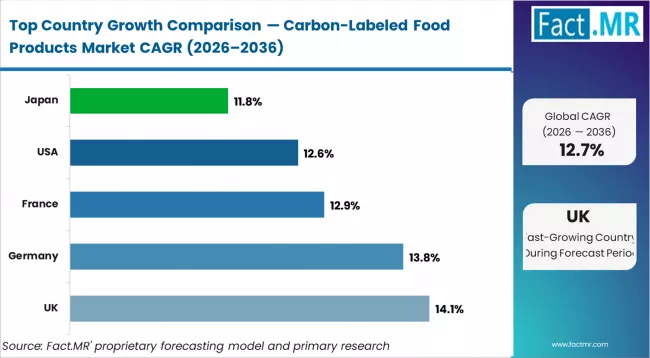
Carbon Labeled Food Products Market Cagr Analysis By Country | Source: Fact.MR
Source: Fact MR analysis, based on proprietary forecasting model and primary research
Europe
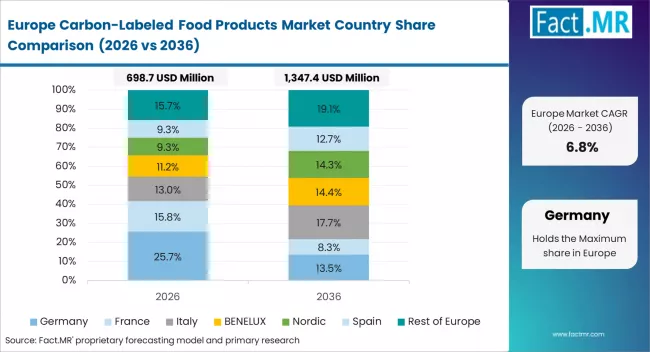
Carbon Labeled Food Products Market Europe Country Market Share Analysis, 2026 & 2036 | Source: Fact.MR
Europe functions as the global regulatory laboratory for environmental labeling frameworks, supported by structured disclosure initiatives and standardized lifecycle assessment practices. Danone S.A. advances product footprint disclosure programs. Nestlé S.A. integrates environmental transparency metrics into packaging. Carrefour S.A. implements carbon label pilot programmes across private-label products.
- United Kingdom: Demand for carbon-labeled food products in United Kingdom is projected to rise at 14.1% CAGR through 2036. The UK Environmental Reporting Guidelines update (Department for Environment, Food & Rural Affairs, September 2021) supports standardized carbon disclosure. Nestlé S.A. expanded carbon footprint labeling pilots on packaged foods (March 2023), supporting transparency initiatives.
- Germany: Demand for carbon-labeled food products in Germany is projected to rise at 13.8% CAGR through 2036. The Product Environmental Footprint initiative (European Commission, December 2021) supports lifecycle emissions measurement standards. Carrefour S.A. expanded environmental labeling implementation across selected European product categories (February 2023), supporting market adoption.
- France: Demand for carbon-labeled food products in France is projected to rise at 12.9% CAGR through 2036. The Climate and Resilience Law (French Government, August 2021) supports environmental disclosure requirements for consumer goods. Danone S.A. expanded environmental impact labeling initiatives across packaged products (January 2023), supporting adoption.
North America
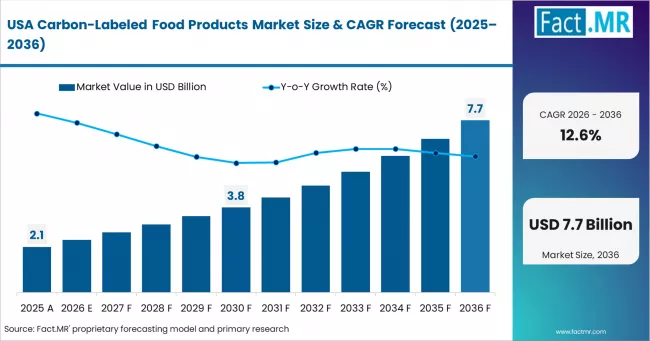
Carbon Labeled Food Products Market Country Value Analysis | Source: Fact.MR
North America functions as the product transparency and environmental disclosure innovation hub, supported by corporate reporting initiatives and voluntary labeling frameworks. Walmart Inc. advances environmental impact disclosure across supply chains. General Mills, Inc. expands carbon footprint measurement initiatives. PepsiCo, Inc. integrates environmental impact metrics into packaging strategies.
- United States: Demand for carbon-labeled food products in United States is projected to rise at 12.6% CAGR through 2036. The SEC climate disclosure proposal (U.S. Securities and Exchange Commission, March 2022) supports corporate environmental transparency initiatives. General Mills, Inc. expanded product lifecycle emission disclosure programs (April 2023), supporting market development.
Asia Pacific
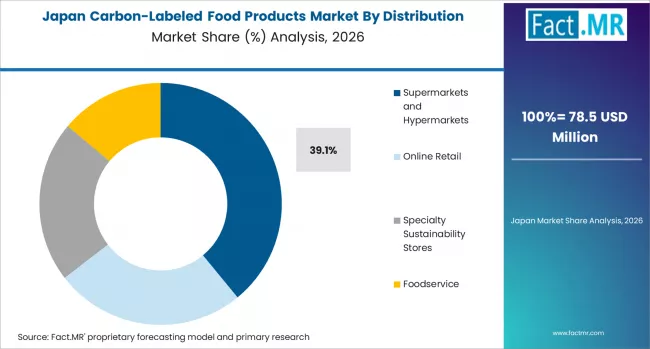
Carbon Labeled Food Products Market Japan Market Share Analysis By Distribution Channel | Source: Fact.MR
Asia Pacific serves as the emerging environmental product disclosure and food transparency market, supported by expanding sustainability reporting frameworks and consumer awareness initiatives. Ajinomoto Co., Inc. advances environmental impact measurement initiatives. Kirin Holdings Company, Limited supports lifecycle emission reporting integration. Seven & i Holdings Co., Ltd. expands environmental labeling trials.
- Japan: Demand for carbon-labeled food products in Japan is projected to rise at 11.8% CAGR through 2036. The Carbon Footprint of Products Pilot Program update (Ministry of Economy, Trade and Industry, February 2022) supports lifecycle emission labeling adoption. Ajinomoto Co., Inc. expanded carbon footprint labeling initiatives for packaged food products (March 2023), supporting market expansion.
Fact MR's analysis of carbon-labeled food products market in global regions consists of country-wise assessment that includes United Kingdom, Germany, United States, France, and Japan. Readers can find environmental labeling adoption trends, regulatory developments, lifecycle assessment practices, and competitive positioning across key markets.
Competitive Landscape
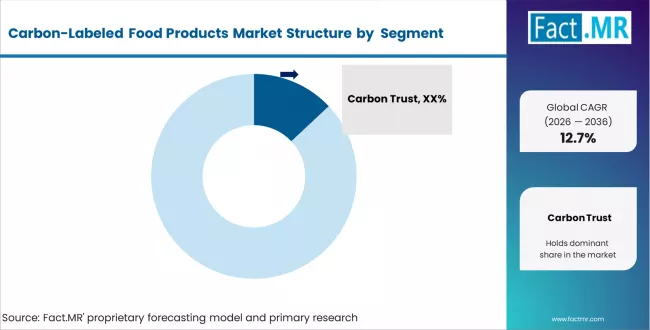
Carbon Labeled Food Products Market Analysis By Company | Source: Fact.MR
Competitive Structure and Buyer Dynamics in the Carbon-Labeled Food Products Market
The competitive structure of the Carbon-Labeled Food Products Market is moderately fragmented, with sustainability analytics providers and environmental data platforms participating in carbon footprint measurement and labeling services. Companies such as Carbon Trust, ClimatePartner, CarbonCloud, HowGood, and Planet FWD maintain strong positions through lifecycle assessment methodologies and emissions tracking platforms designed for food supply chains. These firms provide carbon labeling tools used by food manufacturers to quantify environmental impact and communicate emissions data to consumers. Additional participants including MyEmissions, Sustain.Life, Ecochain, Foodsteps, and Greenly contribute through carbon accounting software, sustainability analytics, and environmental reporting solutions. Competition is primarily influenced by data accuracy, methodological transparency, regulatory alignment, and integration with product lifecycle management systems.
Several companies maintain structural advantages through proprietary emissions databases and established relationships with food manufacturers and retailers. Firms such as Carbon Trust and ClimatePartner benefit from recognized verification frameworks and established carbon accounting methodologies. CarbonCloud and HowGood maintain advantages through extensive ingredient level environmental impact datasets that support detailed product footprint calculations. Food companies often evaluate multiple sustainability analytics providers to ensure flexibility in carbon reporting and regulatory compliance across markets. Procurement decisions assess platform compatibility, data reliability, and reporting capability aligned with environmental standards. This purchasing behavior moderates supplier pricing leverage, while providers with validated methodologies and comprehensive emissions datasets retain moderate negotiating influence within environmental labeling initiatives.
Key Players of the Carbon-Labeled Food Products Market
- Carbon Trust
- Planet FWD
- HowGood
- MyEmissions
- Sustain.Life
- ClimatePartner
- Ecochain
- CarbonCloud
- Foodsteps
- Greenly
Bibliographies
- [1] Lemken, D., Zühlsdorf, A., and Spiller, A. (2021). Improving consumers understanding and use of carbon footprint labels on food: Proposal for a climate score label. Journal of Consumer Policy, 44(4), 479–501. Wiley Online Library. Retrieved March 24, 2026.
- [2] U.S. Environmental Protection Agency (EPA) / Congressional Office. (2025). Voluntary Food Climate Labeling Act: Draft legislation to inform consumers about the carbon footprint of food products. U.S. Congress. Retrieved March 24, 2026.
- [3] Brown, C., et al. (2023). Should carbon footprint labeling be mandatory for all food products? RCT shows no benefit beyond labeling the top third. Social Science Research Network (SSRN). Retrieved March 24, 2026.
- [4] International Organization for Standardization (ISO). (2018, updated 2024). ISO 14067:2018 — Greenhouse gases — Carbon footprint of products — Requirements and guidelines for quantification. ISO. Retrieved March 24, 2026.
- [5] INRAE / ADEME. (2020). Harmonizing environmental labelling in Europe: The ECO FOOD CHOICE project for food-product environmental scores. INRAE and ADEME. Retrieved March 24, 2026.
This Report Addresses
- Market size estimation and revenue forecasts for the Carbon-Labeled Food Products Market from 2026 to 2036, supported by lifecycle emission disclosure adoption trends and environmental labeling integration across packaged food supply chains.
- Growth opportunity mapping across carbon-labeled packaged foods, dairy products, meat and poultry, beverages, snacks, and bakery products, reflecting expansion of quantified carbon disclosure across retail food categories.
- Segment and regional revenue forecasts covering label types, distribution channels, and major adoption markets including United Kingdom, Germany, France, United States, and Japan.
- Competition strategy assessment of leading organizations such as Carbon Trust, ClimatePartner, CarbonCloud, HowGood, and Planet FWD, including lifecycle assessment capability benchmarking and environmental data platform positioning analysis.
- Regulatory impact analysis covering ISO 14067 carbon footprint of products framework, Greenhouse Gas Protocol Product Standard, and regional environmental disclosure initiatives influencing carbon label verification methodologies.
- Market report delivery in PDF, Excel, PPT, and interactive dashboard formats designed for environmental labeling strategy development, product transparency evaluation, and compliance benchmarking across food manufacturers and retailers.
- Supply chain vulnerability assessments examining lifecycle data collection complexity, verification cost structures, fragmented carbon accounting methodologies, and compliance requirements affecting small and mid-scale food producers influencing market adoption pace.
Carbon-Labeled Food Products Market Definition
The Carbon-Labeled Food Products Market includes food and beverage items that display information about the carbon emissions associated with their production, processing, packaging, and distribution. Carbon labeling provides data related to greenhouse gas emissions generated across the product life cycle. These labels are applied to packaged foods to inform consumers about environmental impact linked to manufacturing and supply chain activities. Carbon labeled food products are used by food manufacturers and retailers to communicate emissions related information. The primary function of carbon labeling is to provide standardized disclosure of carbon footprint information associated with food products.
Market Inclusions
This report covers global and regional market sizes for carbon labeled food products with forecast analysis for the study period. The market is segmented by product category including packaged foods, beverages, dairy products, snacks, and processed food items carrying carbon emission labels. Application segments include retail distribution, private label products, and branded food offerings. End users include food manufacturers, retailers, and certification organizations. The report also evaluates pricing patterns, labeling adoption trends, and selected trade flow analysis across major packaged food markets.
Market Exclusions
The report excludes general environmental certification labels that do not specifically quantify carbon emissions. Organic, fair trade, and nutritional labeling systems are not included. The scope also excludes carbon labeling applied to non food consumer products such as textiles or electronics. Carbon emission reporting tools used internally by companies without product level labeling are outside the defined market scope, as the analysis focuses strictly on food products displaying carbon footprint information.
Research Methodology
- Primary Research: Interviews were conducted with food manufacturers, certification bodies, sustainability consultants, and retail distribution managers.
- Desk Research: Public information was collected from food industry publications, regulatory guidelines, company reports, and environmental labeling databases.
- Market-Sizing and Forecasting: A hybrid model combining bottom up product adoption analysis with top down demand assessment across packaged food markets was applied.
- Data Validation and Update Cycle: Findings were cross verified using multiple industry data sources and expert inputs, with periodic updates conducted as new market information becomes available.
Segmentation
Report Scope
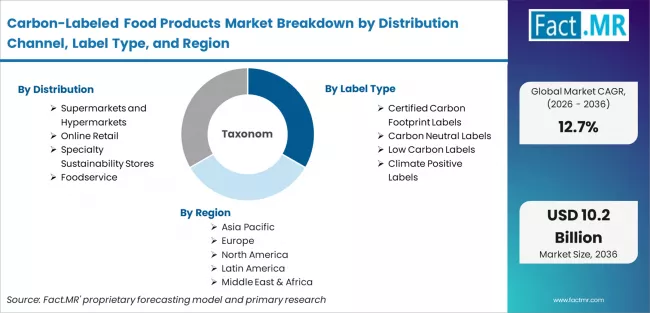
Carbon Labeled Food Products Market Breakdown By Distribution Channel, Label Type, And Region | Source: Fact.MR
| Metric | Value |
|---|---|
| Quantitative Units | USD 3.1 billion (2026) to USD 10.2 billion (2036), at a CAGR of 12.7% |
| Market Definition | The carbon-labeled food products market includes global commercialization of food and beverage products displaying quantified carbon footprint information or climate impact claims, enabling comparison of greenhouse gas emissions associated with production, processing, packaging, and distribution. |
| Product Type Segmentation | Carbon-labeled packaged foods, Carbon-labeled dairy products, Carbon-labeled meat & poultry, Carbon-labeled beverages, Carbon-labeled snacks, Carbon-labeled bakery products |
| Label Type Segmentation | Certified carbon footprint labels, Carbon neutral labels, Low carbon labels, Climate positive labels |
| Distribution Channel Segmentation | Supermarkets & hypermarkets, Online retail, Specialty sustainability stores, Foodservice |
| Regions Covered | North America, Latin America, Europe, East Asia, South Asia, Oceania, Middle East and Africa |
| Countries Covered | United States, Canada, Mexico, Brazil, Argentina, Germany, France, United Kingdom, Netherlands, Sweden, China, Japan, South Korea, India, Australia, New Zealand, Singapore, United Arab Emirates, and 40+ countries |
| Key Companies Profiled | Carbon Trust, Planet FWD, HowGood, MyEmissions, Sustain.Life, ClimatePartner, Ecochain, CarbonCloud, Foodsteps, Greenly |
| Forecast Period | 2026 to 2036 |
| Approach | Hybrid top-down and bottom-up market estimation based on adoption of environmental labeling standards, lifecycle assessment data integration, retail product certification penetration, food company emissions disclosure practices, and validation through primary interviews with sustainability certification bodies, food manufacturers, and environmental data platform providers. |
Source: Fact.MR analysis. Updated Mar 27, 2026
Carbon-Labeled Food Products Market Key Segments
-
Product Type :
- Carbon Labeled Packaged Foods
- Carbon Labeled Dairy Products
- Carbon Labeled Meat and Poultry
- Carbon Labeled Beverages
- Carbon Labeled Snacks
- Carbon Labeled Bakery Products
-
Label Type :
- Certified Carbon Footprint Labels
- Carbon Neutral Labels
- Low Carbon Labels
- Climate Positive Labels
-
Distribution Channel :
- Supermarkets and Hypermarkets
- Online Retail
- Specialty Sustainability Stores
- Foodservice
-
Region :
- North America
- USA
- Canada
- Mexico
- Europe
- Germany
- UK
- France
- Italy
- Spain
- Nordic Countries
- BENELUX
- Rest of Europe
- Asia Pacific
- China
- Japan
- South Korea
- India
- Australia
- Rest of Asia Pacific
- Latin America
- Brazil
- Argentina
- Rest of Latin America
- Middle East and Africa
- Kingdom of Saudi Arabia
- United Arab Emirates
- South Africa
- Rest of Middle East and Africa
- Other Regions
- Oceania
- Central Asia
- Other Markets
- North America
Frequently Asked Questions
How large is the demand for Carbon-Labeled Food Products in the global market in 2026?
What will be the market size of Carbon-Labeled Food Products in the global market by 2036?
What is the expected demand growth for Carbon-Labeled Food Products in the global market between 2026 and 2036?
Which organization is identified as a leading participant in the Carbon-Labeled Food Products market?
Which distribution channel is projected to dominate Carbon-Labeled Food Product sales by 2026?
Why are supermarkets and hypermarkets important distribution channels for carbon-labeled food products?
What is driving demand for Carbon-Labeled Food Products in the United Kingdom?
What is the growth outlook for the Carbon-Labeled Food Products market in the United Kingdom?
Why is Germany an important market for carbon-labeled food products?
What is the growth outlook for the Carbon-Labeled Food Products market in Germany?
How is demand for Carbon-Labeled Food Products evolving in the United States?
What is the growth outlook for the Carbon-Labeled Food Products market in the United States?
What is the growth outlook for the Carbon-Labeled Food Products market in France?
How is Japan positioned in the Carbon-Labeled Food Products market?
What is the growth outlook for the Carbon-Labeled Food Products market in Japan?
What are carbon-labeled food products and what are they mainly used for?
What does the Carbon-Labeled Food Products market include in this report?
What applications are included in the scope of the Carbon-Labeled Food Products market?
What is excluded from the scope of the Carbon-Labeled Food Products market report?
What does market forecast mean in the Carbon-Labeled Food Products market report?
How is the Carbon-Labeled Food Products market forecast developed in this report?
What does primary validation indicate in the Carbon-Labeled Food Products market analysis?
Who worked on this report


Preview the report firsthand - request a free sample
Free SampleGet the brochure for pricing and purchase details
Download PDF