- Base Value(2025): 2.9 Bn
- Estimated Value(2026): 3.0 Bn
- Forecast Value (2036): 4.8 Bn
- CAGR (2026 - 2036): 4.9%
Food Grade Dipotassium Phosphate Market Forecast and Outlook By Fact.MR
In 2025, the food grade dipotassium phosphate market was valued at USD 2.9 billion. Based on Fact.MR analysis, demand for food grade dipotassium phosphate is estimated to grow to USD 3.0 billion in 2026 and USD 4.8 billion by 2036. FACT.MR projects a CAGR of 4.9% during the forecast period.
During this period, the market is expected to generate USD 1.8 billion in new revenue opportunities. Growth is supported by expanding processed food manufacturing in South and Southeast Asia, rising demand for plant-based dairy analogue emulsifiers, and growing foodservice sector adoption in emerging economies. Challenges include feedstock phosphate rock price volatility, evolving food additive labelling regulations across jurisdictions, and substitution pressure from alternative buffering and emulsifying agents.
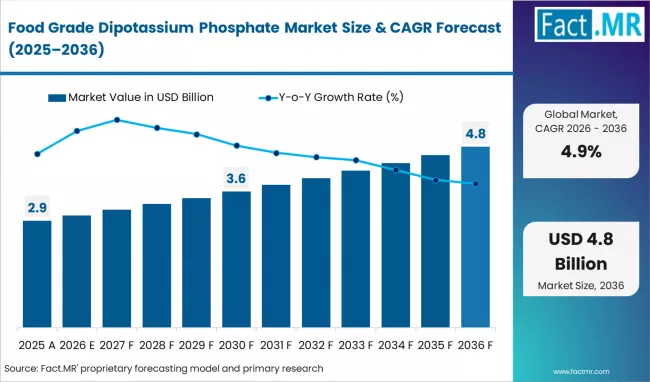
Food Grade Dipotassium Phosphate Market Market Value Analysis | Source: Fact.MR
| Metric | Value |
|---|---|
| Estimated Value in 2026 | USD 3.0 billion |
| Forecast Value in 2036 | USD 4.8 billion |
| Forecast CAGR (2026 to 2036) | 4.9% |
Source: Fact.MR analysis. Updated Mar 25, 2026
The food grade dipotassium phosphate market is expanding as beverage manufacturers require buffering agents for coffee creamers and non-dairy whiteners, processed food producers demand phosphate emulsifiers for cheese analogues and meat products, and industrial food processors seek consistent-grade phosphate salts to meet food safety compliance standards.
Country growth reflects food processing industry scale, clean-label regulatory pressure, and foodservice sector expansion pace. India leads at 7.9% CAGR driven by rapid processed food and beverage manufacturing growth and export-oriented food industry investment. Germany follows at 6.5% supported by stringent EU food additive compliance requirements encouraging certified-grade phosphate procurement. The United States posts 4.9%, a mature but resilient market generating stable replacement demand from established food processing and foodservice networks. China records 4.2% as large-scale food processing firm’s upgrade ingredient sourcing standards. Japan grows at 4.0%, the most mature market, generating sustained replacement demand with structural constraints from already high food ingredient quality standards limiting incremental volume growth.
Summary of Food Grade Dipotassium Phosphate Market
- Market Definition
- Food grade dipotassium phosphate is a buffering, emulsifying, and sequestrant ingredient used in processed foods, beverages, coffee creamers, dairy analogues, and meat products by industrial manufacturers and foodservice operators globally.
- Demand Drivers
- Rising coffee creamer and non-dairy whitener production in Asia Pacific drives demand for DKP as a buffering and anti-caking agent in powder-form formulations.
- EU food additive compliance requirements under Regulation (EC) No 1333/2008 encourage certified food-grade phosphate salt procurement among European industrial manufacturers.
- Expanding foodservice supply chains in India and Southeast Asia increase demand for consistent-grade DKP from institutional food processors and catering manufacturers.
- Key Segments Analyzed
- By Product Type: Dipotassium phosphate anhydrous leads with approximately 35% share in 2026 due to its versatility across beverage buffering, dairy emulsification, and meat processing applications.
- By Form: Powder form dominates with approximately 65% share due to its ease of incorporation into dry blends, coffee creamers, instant beverage mixes, and industrial food processing lines.
- By End User: Industrial end users hold the largest share driven by large-scale processed food manufacturers requiring consistent specification DKP for quality-controlled production environments.
- Analyst Opinion at FACT.MR
- Shambhu Nath Jha, Senior Research Analyst at Fact.MR, opines, 'CXOs will find this report critical for understanding how clean-label reformulation pressure and application-specific grade differentiation are reshaping procurement strategies for food grade dipotassium phosphate across industrial and foodservice segments.'
- Strategic Implications
- Manufacturers should develop application-specific DKP grades certified for coffee creamer and dairy analogue applications to command premium pricing from functional food buyers.
- Suppliers should invest in food safety certification and traceability systems aligned with FSSC 22000 and EFSA compliance to access European and North American industrial procurement contracts.
- Companies should establish regional warehousing and supply chain partnerships in India and Southeast Asia to serve rapidly expanding processed food manufacturing clusters.
- Methodology
- Market sizing based on food-grade DKP shipment volumes and average selling prices by product type, form, and end user segment.
- Regulatory databases including EFSA, FDA GRAS records, FSSAI, and Codex Alimentarius standards supported demand and compliance analysis.
- Forecasts used processed food production data, functional ingredient innovation trends, foodservice sector growth, and industry interviews.
Segmental Analysis
Food Grade Dipotassium Phosphate Market Analysis by Product Type
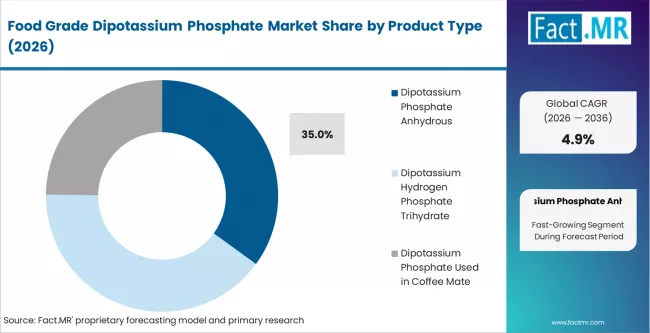
Food Grade Dipotassium Phosphate Market Analysis By Product Type | Source: Fact.MR
Based on FACT.MR's food grade dipotassium phosphate market report, dipotassium phosphate anhydrous is estimated to hold approximately 35% share in 2026 due to its broad functional compatibility across beverage buffering, dairy protein stabilisation, and processed meat pH regulation applications.
- Foodchem Portfolio Expansion: In 2024, Foodchem International Corporation expanded its food grade DKP anhydrous product line with new halal and kosher certifications to serve Middle Eastern and Southeast Asian processed food manufacturers requiring multi-certification compliance. [5]
- Prayon Technology Investment: In January 2025, Prayon SA commissioned additional phosphate salt processing capacity at its Engis facility in Belgium, targeting food grade dipotassium phosphate anhydrous production for European dairy and beverage customers. [6]
- Coffee Mate Grade Adoption Trend: Application-specific DKP grades for coffee mate and non-dairy whitener formulations saw increased procurement by Asian beverage manufacturers in 2024 as instant coffee production volumes expanded across Vietnam, Indonesia, and the Philippines. [7]
Food Grade Dipotassium Phosphate Market Analysis by Form
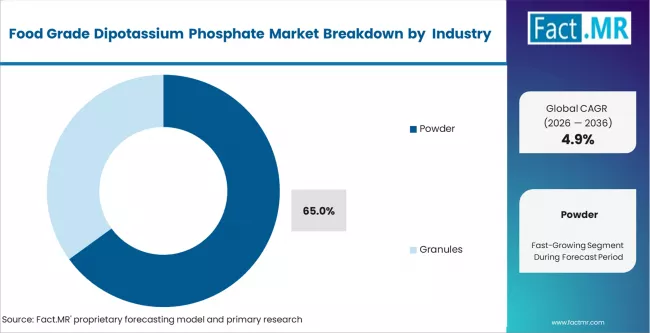
Food Grade Dipotassium Phosphate Market Analysis By Form | Source: Fact.MR
FACT.MR estimates powder form dipotassium phosphate will account for approximately 65% share in 2026 due to its ease of blending with dry ingredient mixes, compatibility with spray-drying processes used in coffee creamers, and lower logistics cost per unit compared with granule form.
- FBC Industries Supply Investment: In 2024, FBC Industries expanded powder-form DKP blending capacity at its Illinois facility to serve North American foodservice and industrial food manufacturers requiring consistent fine-powder specification for dry mix applications. [8]
- Granule Format Development: In 2025, Jiangsu Mupro IFT CORP launched low-dust granule-form DKP targeting industrial food processing lines requiring improved handling characteristics and reduced airborne particle risk during large-scale manufacturing. [9]
- Powder Form Logistics Trend: Bulk powder DKP procurement volumes increased among Southeast Asian foodservice distributors in 2024 as regional beverage manufacturers optimised dry ingredient supply chains to reduce per-unit ingredient costs in instant coffee and creamer production. [10]
Drivers, Restraints, and Opportunities
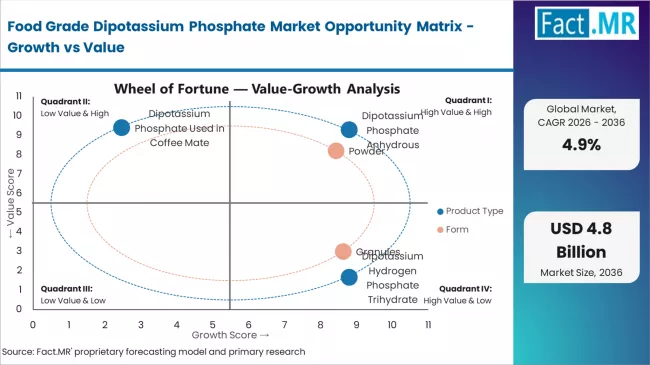
Food Grade Dipotassium Phosphate Market Opportunity Matrix Growth Vs Value | Source: Fact.MR
FACT.MR analysts observe that the food grade dipotassium phosphate market is transitioning from a volume-driven commodity segment to an application-differentiated specialty ingredient market, with structural demand anchored by the global processed food and beverage manufacturing sector.
Commodity DKP volumes have faced margin compression as buyers prioritise specification-certified grades with full traceability documentation, but application-specific product variants for coffee creamers and dairy analogues command higher unit prices that partially offset volume pricing pressure. General phosphate buffering demand is stable, while clean-label substitution pressure in some applications creates localised volume risk.
- EU Food Additive Compliance: Regulation (EC) No 1333/2008 permits dipotassium phosphate as an approved food additive with specific purity criteria, compelling European food manufacturers to source certified-grade DKP, supporting demand for traceable supply chains from qualified producers. [2]
- India Processed Food Expansion: India's food processing industry grew over 12% in 2024 as government production-linked incentive scheme disbursements accelerated investment in beverage, dairy, and snack manufacturing, increasing procurement of functional phosphate ingredients including DKP. [3]
- Coffee Creamer Market Growth: Global non-dairy creamer production expanded in 2024-2025 driven by rising instant beverage demand across Southeast Asia and Middle East, directly increasing DKP consumption as a buffering and emulsifying agent in creamer powder formulations. [4]
Regional Analysis
The food grade dipotassium phosphate market is analysed across Asia Pacific, Europe, North America, Latin America, and Middle East and Africa, covering 40+ countries with distinct demand profiles shaped by food processing industry scale, regulatory additive frameworks, and foodservice sector growth pace. The full report offers market attractiveness analysis based on food additive approval timelines, processing industry investment trajectories, and export-oriented food manufacturing data.
.webp "Top Country Growth Comparison Food Grade Dipotassium Phosphate Market Cagr (2026 2036)")
Top Country Growth Comparison Food Grade Dipotassium Phosphate Market Cagr (2026 2036) | Source: Fact.MR
| Country | CAGR (2026-2036) |
|---|---|
| India | 7.9% |
| Germany | 6.5% |
| USA | 4.9% |
| China | 4.2% |
| Japan | 4.0% |
Source: Fact.MR analysis. Updated Mar 25, 2026
Source: Fact.MR (FACT.MR) analysis, based on proprietary forecasting model and primary research
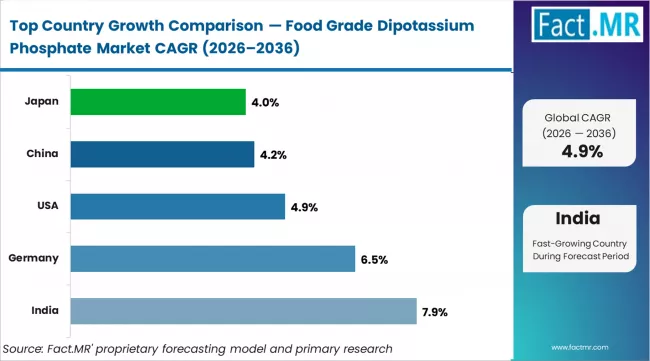
Food Grade Dipotassium Phosphate Market Cagr Analysis By Country | Source: Fact.MR
Asia Pacific Food Grade Dipotassium Phosphate Market Analysis
Asia Pacific is the fastest-growing region due to India’s expanding processed food sector and China’s large-scale industrial production base. Key suppliers include Aditya Birla Chemicals, Jiangsu Mupro IFT CORP, and Yunnan Yihua Phosphorus Chemical.
- India: Strong policy support and food processing expansion are driving DKP demand in India, projected to grow at a CAGR of 7.9% through 2036. The Ministry of Food Processing Industries approved INR 1,800 crore under the PLI scheme in 2024, boosting investments in dairy alternatives, beverages, and instant foods. Additionally, FSSAI updated phosphate additive standards in October 2024, formally permitting DKP in processed cheese and dairy analogue applications, expanding its industrial adoption.
- China: Regulatory adjustments and domestic capacity expansion are shaping China’s DKP demand, expected to grow at 4.2% CAGR through 2036. The 2024 update to GB 2760 revised allowable phosphate usage levels, prompting formulation changes among food manufacturers. Companies such as Yunnan Yihua Phosphorus Chemical and Shifang Talent Chemical increased certified food-grade production to meet rising local demand and reduce reliance on imports.
FACT.MR's regional coverage includes India, China, Japan, South Korea, ASEAN, Australia & New Zealand, and the Rest of South Asia & Pacific, with insights on regulations, investments, and growth trends.
Europe Food Grade Dipotassium Phosphate Market Analysis
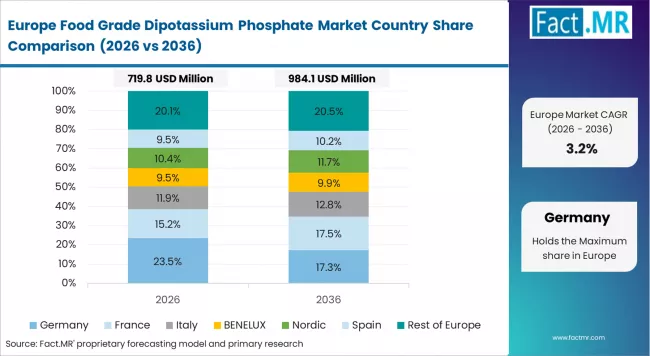
Food Grade Dipotassium Phosphate Market Europe Country Market Share Analysis, 2026 & 2036 | Source: Fact.MR
Europe serves as a regulatory benchmark due to strict EU food additive standards under Regulation (EC) No 1333/2008. Major suppliers include Prayon SA and TKI Hrastnik.
- Germany: Compliance-driven procurement and plant-based food growth are accelerating DKP demand in Germany, projected to expand at a CAGR of 6.5% through 2036. In January 2025, BVL introduced updated traceability requirements for phosphate additives, pushing manufacturers toward certified suppliers. At the same time, rising demand for dairy alternatives through retail networks like REWE and EDEKA has increased DKP usage in plant-based formulations.
FACT.MR’s Europe coverage spans Germany, France, the UK, Italy, Spain, Nordic countries, BENELUX, and Western Europe, highlighting EFSA regulations and clean-label trends.
North America Food Grade Dipotassium Phosphate Market Analysis
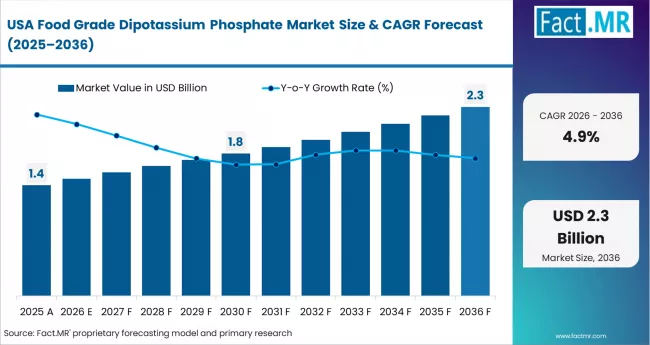
Food Grade Dipotassium Phosphate Market Country Value Analysis | Source: Fact.MR
North America remains the largest revenue-generating region due to the United States’ extensive processed food and foodservice sector. Key suppliers include FBC Industries, Covestro AG, and Haifa Chemicals.
- USA: Regulatory clarity and strong foodservice demand are supporting DKP market growth in the United States, expected at a CAGR of 4.9% through 2036. The FDA reaffirmed DKP’s GRAS status in 2024 for beverage and emulsification applications, enabling wider usage in functional beverages and non-dairy creamers. Additionally, FBC Industries secured long-term supply agreements with foodservice distributors to provide high-grade DKP for institutional and restaurant applications.
FACT.MR’s North America analysis covers the US, Canada, and Mexico, with insights into FDA approvals, demand trends, and segment-level forecasts.
Competitive Aligners for Market Players
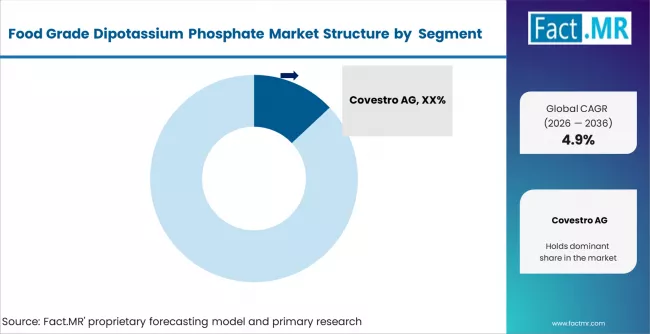
Food Grade Dipotassium Phosphate Market Analysis By Company | Source: Fact.MR
The food grade dipotassium phosphate market is moderately fragmented with a mix of global specialty chemical producers and regional phosphate manufacturers. The top five players collectively account for approximately 35-40% of global food-grade DKP revenue, with the remainder distributed among regional Asian producers, particularly in China and India. The primary competitive variable is food safety certification and application-grade specification consistency rather than price alone.
Companies with integrated phosphate rock-to-finished-salt production chains, including Prayon SA and Aditya Birla Chemicals, hold structural cost advantages that allow them to offer competitive pricing while maintaining food safety certification margins. Long-term supply agreements with large food processing companies anchor revenue predictability and reduce exposure to spot market phosphate price fluctuations.
Large industrial food manufacturers manage supplier dependency through dual-source procurement strategies, qualifying two or more DKP suppliers per application to reduce single-source risk. This buyer behaviour limits individual supplier pricing power but creates structural demand for certified and technically supported suppliers who can maintain consistent specification delivery across high-volume purchase programmes.
Key Players of Food Grade Dipotassium Phosphate Market
- Covestro AG
- Arkema S.A.
- Foodchem International Corporation
- TKI Hrastnik
- FBC Industries
- Aditya Birla Chemicals
- Haifa Chemicals Ltd.
- Prayon SA
- Jiangsu Mupro IFT CORP
- Yunnan Yihua Phosphorus Chemical
- Shifang Talent Chemical
- BANGYE Inc.
- Lianyungang
Report Scope
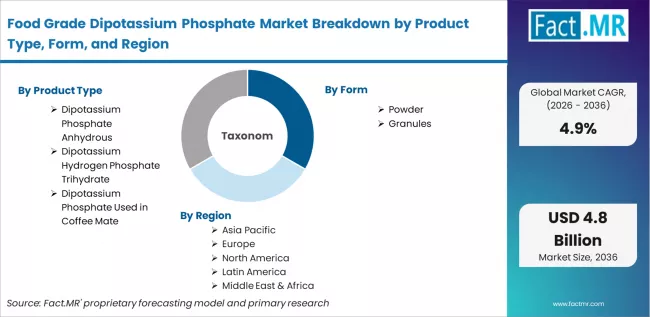
Food Grade Dipotassium Phosphate Market Breakdown By Product Type, Form, And Region | Source: Fact.MR
| Attribute | Details |
|---|---|
| Quantitative Units | USD 3.0 billion (2026) to USD 4.8 billion (2036), at a CAGR of 4.9% |
| Market Definition | The food grade dipotassium phosphate (DKP) market comprises the production and supply of water-soluble phosphate salts used as buffering agents, emulsifiers, and stabilizers in processed foods, beverages, dairy analogues, coffee creamers, and meat products. |
| Product Type Segmentation | Dipotassium Phosphate Anhydrous, Dipotassium Phosphate Trihydrate, Application-Specific Functional Grades |
| Form Segmentation | Powder, Granular, Liquid |
| Application Segmentation | Acidity regulation, protein stabilization, emulsification in creamers, mineral fortification, moisture retention in meat processing, and texture stabilization in plant-based dairy formulations |
| End user segmentation | Industrial Food Manufacturers, Foodservice Operators, Retail/Packaged Food Producers |
| Application Coverage | 5G base station conformance testing, radar waveform simulation, semiconductor wafer characterisation, automotive V2X protocol testing, 6G sub-THz research, GNSS signal simulation, and electronic warfare signal environment replication. |
| Regions Covered | North America, Europe, Asia Pacific, Latin America, Middle East and Africa |
| Countries Covered | USA, Canada, Mexico, UK, Germany, France, Italy, Spain, Nordic, BENELUX, Japan, South Korea, China, India, ASEAN, Australia and New Zealand, Brazil, Argentina, Chile, Saudi Arabia, GCC, Turkey, South Africa, Rest of MEA |
| Key Companies Profiled | Aditya Birla Chemicals, Prayon SA, Yunnan Yihua Phosphorus Chemical, Jiangsu Mupro IFT Corp, TKI Hrastnik, Shifang Talent Chemical, Haifa Chemicals |
| Forecast Period | 2026 to 2036 |
| Approach | Hybrid top-down and bottom-up methodology using phosphate shipment volumes, average selling prices by grade, processed food production data, clean-label reformulation trends, regulatory approvals, and primary interviews with food ingredient procurement and formulation experts. |
Source: Fact.MR analysis. Updated Mar 25, 2026
Bibliography
- [1] European Commission. (2024). Regulation (EC) No 1333/2008 Consolidated Version: Food Additives Permitted in Food Including Dipotassium Phosphate E340(ii) Updated Purity Criteria and Permitted Uses Across Food Categories. October 2024.
- [2] European Food Safety Authority (EFSA). (2024). Re-evaluation of Phosphoric Acid and Phosphates as Food Additives: Updated Safety Assessment and Maximum Usage Level Recommendations Including Dipotassium Phosphate Applications in Dairy and Beverage Sectors. November 2024.
- [3] Ministry of Food Processing Industries, Government of India. (2024). Production Linked Incentive Scheme for Food Processing Industry: Third Tranche Disbursement Report Covering Dairy Analogue, Beverage, and Instant Food Manufacturing Investments. December 2024.
- [4] Food and Agriculture Organization of the United Nations. (2024). CODEX STAN 192-1995 General Standard for Food Additives: Revised Maximum Levels for Phosphate Salts Including Dipotassium Phosphate in Beverage and Dairy Analogue Product Categories. September 2024.
- [5] Foodchem International Corporation. (2024). Product Portfolio Update: Food Grade Dipotassium Phosphate Anhydrous Halal and Kosher Dual-Certification Launch for Middle Eastern and Southeast Asian Processed Food Manufacturers. November 2024.
- [6] Prayon SA. (2025). Capacity Expansion Announcement: Food Grade Phosphate Salt Production Capacity Addition at Engis Belgium Facility for European Dairy and Beverage Food Manufacturer Supply. January 2025.
- [7] Vietnam Ministry of Industry and Trade. (2024). Instant Coffee and Non-Dairy Creamer Production Statistics: Annual Output Volume Data and Ingredient Procurement Trends Including Food Grade Phosphate Buffering Agent Consumption. October 2024.
- [8] FBC Industries Inc. (2024). Supply Agreement Announcement: Multi-Year Food Grade Dipotassium Phosphate Powder Supply Contracts with North American Foodservice Distributors and Institutional Catering Networks. December 2024.
- [9] Jiangsu Mupro IFT CORP. (2025). Product Launch: Low-Dust Granule Format Food Grade Dipotassium Phosphate for Industrial Food Processing Lines Targeting Asia Pacific Beverage and Dairy Manufacturing Customers. January 2025.
- [10] ASEAN Food and Beverage Alliance. (2024). Regional Ingredient Procurement Report: Functional Phosphate Salt Demand Trends in Southeast Asian Instant Beverage and Coffee Creamer Manufacturing Sector. September 2024.
This Report Addresses
- Strategic insights on EU Regulation (EC) No 1333/2008 additive compliance, FDA GRAS certifications, FSSAI phosphate standards, Codex Alimentarius usage levels, and national food safety frameworks influencing food grade DKP demand globally.
- Market forecast from USD 3.0 billion in 2026 to USD 4.8 billion by 2036 at 4.9% CAGR across product type, form, end user, and region.
- Growth opportunities across India PLI scheme food processing investment, Germany certified-grade procurement requirements, USA foodservice DKP supply agreements, China GB 2760 compliance, and Southeast Asian coffee creamer manufacturing expansion.
- Country CAGR outlook including India 7.9%, Germany 6.5%, USA 4.9%, China 4.2%, and Japan 4.0%, supported by food additive regulatory frameworks and processed food industry investment data.
- Competitive analysis of Prayon SA, FBC Industries, Foodchem International, Aditya Birla Chemicals, Haifa Chemicals, Jiangsu Mupro IFT CORP, and Yunnan Yihua Phosphorus Chemical based on food safety certification, production capacity, and application-grade differentiation.
- Technology tracking covering anhydrous DKP production optimisation, low-dust granule format development, halal and kosher certification programmes, coffee mate-grade DKP formulation advances, and traceability system implementation.
- Regulatory analysis of EFSA food additive purity standards, FDA GRAS notifications, FSSAI phosphate additive rules, Codex Alimentarius maximum usage levels, and China GB 2760 processed food phosphate regulations.
- Report delivery includes PDF, Excel datasets, PowerPoint summary, and dashboard tools supported by regulatory databases, food processing industry data, manufacturer disclosures, and primary interviews.
Food Grade Dipotassium Phosphate Market Definition
Food-grade dipotassium phosphate (DKP) is a water-soluble salt used as a buffering agent, emulsifier, and stabilizer in processed foods, beverages, creamers, dairy alternatives, and meat products.
Food Grade Dipotassium Phosphate Market Inclusions
Covers global and regional revenue forecasts (2026-2036) by product type, form, and end user, including anhydrous, trihydrate, and application-specific grades.
Food Grade Dipotassium Phosphate Market Exclusions
Excludes feed-grade and technical-grade DKP, as well as finished food products containing DKP below functional levels.
Food Grade Dipotassium Phosphate Market Research Methodology
- Primary Research: Interviews with procurement managers, manufacturers, formulators, distributors, and compliance experts across key regions.
- Desk Research: Includes EFSA, FDA, FSSAI, Codex standards, manufacturer data, and industry reports (2024-2025).
- Market Sizing and Forecasting: Based on shipment volumes, pricing, production data, demand trends, and primary insights.
- Data Validation and Update Cycle: Validated using company revenues, regulatory data, industry statistics, and expert inputs.
Segmentation
Food Grade Dipotassium Phosphate Market Segment
-
By Product Type :
- Dipotassium Phosphate Anhydrous
- Dipotassium Hydrogen Phosphate Trihydrate
- Dipotassium Phosphate Used in Coffee Mate
- Potassium Phosphate Dibasic
- Dipotassium Hydrogen Phosphate
-
By Form :
- Powder
- Granules
-
By End User :
- Individuals
- Industrial
- Foodservice
-
By Region :
- North America
- United States
- Canada
- Mexico
- Latin America
- Brazil
- Chile
- Ecuador
- Rest of Latin America
- Western Europe
- Germany
- United Kingdom
- France
- Italy
- Spain
- Nordic
- BENELUX
- Rest of Western Europe
- Eastern Europe
- Russia
- Poland
- Hungary
- Balkan and Baltic
- Rest of Eastern Europe
- East Asia
- China
- Japan
- South Korea
- South Asia and Pacific
- India
- ASEAN
- Australia and New Zealand
- Rest of South Asia and Pacific
- Middle East and Africa
- Kingdom of Saudi Arabia
- Other GCC Countries
- Turkey
- South Africa
- Other African Union
- Rest of Middle East and Africa
- North America
Frequently Asked Questions
How large is the food grade dipotassium phosphate market in 2025?
What will the market size be in 2026?
What is the projected market size by 2036?
What is the expected CAGR?
Which product type segment leads the market?
Which form segment dominates?
Which end user segment holds the largest share?
Which country shows the fastest growth?
What is the primary restraint?
Who worked on this report


Preview the report firsthand - request a free sample
Free SampleGet the brochure for pricing and purchase details
Download PDF