- Market Value (2025): USD 892.4 Mn
- Estimated Value (2026): USD 944.4 Mn
- Forecast Value (2036): USD 1664.6 Mn
- CAGR (2026-2036): 5.8%
What is the Cellulose Acetate Butyrate Market forecast to be worth by 2036?
USD 944.4 million in 2026 to USD 1664.6 million by 2036, at a 5.83% CAGR.
- As per Fact.MR analysis, the cellulose acetate butyrate market reached USD 892.4 million in 2025.
- Demand will increase from USD 944.4 million in 2026 to USD 1664.6 million in 2036.
- The market is forecast to record a 5.8% CAGR during 2026 to 2036 as automotive refinish systems, durable consumer goods, and bio-derived polymer compounding expand cellulosic ester integration.
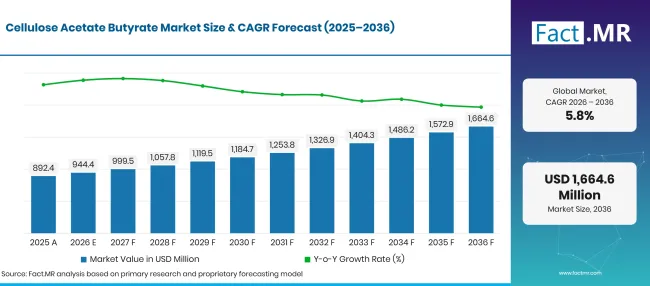
Factmr Cellulose Acetate Butyrate Market Forecast Global | Source: Fact.MR
| Year | Basis | Market Value (USD million) |
|---|---|---|
| 2025 | Actual | 892.4 |
| 2026 | Estimate | 944.4 |
| 2036 | Forecast | 1,664.6 |
| CAGR 2026 to 2036 | Forecast period | 5.8% |
Source: Fact.MR analysis. Updated Oct 19, 2026
What are the defining numbers behind Cellulose Acetate Butyrate Market growth?
USD 720.2 million absolute chance between 2026 and 2036, with injection molding grade resins and protective surface coatings forming the core volume foundation.
- Demand Drivers in the Market
- Automotive coatings formulators incorporate cellulose acetate butyrate to achieve exceptional aluminum flake orientation and metallic pigment consistency in modern clearcoats. Advanced polymer trials demonstrated that thin CAB matrix films facilitate efficient triplet-triplet annihilation photon upconversion and high optical transparency across multicomponent composite films [1]. Paint chemists utilize CAB additives to prevent pigment sagging and accelerate tack-free dry times in commercial refinish booths.
- Plastics compounders and tool handle manufacturers specify injection-grade CAB for its outstanding toughness, low moisture absorption, and smooth self-polishing surface feel. Structural porosity analyses revealed that modified cellulose ester networks exhibit controlled micro-domain architectures that enhance dimensional stability under cyclic thermal variations [2]. Eyewear manufacturers mold CAB pellets into high-end ophthalmic frames that withstand persistent exposure to skin lipids and sweat.
- Pharmaceutical scientists deploy cellulose acetate butyrate as an insoluble, pH-independent matrix former for sustained-release drug delivery systems and in situ ophthalmic gels. Controlled release evaluations confirmed that CAB gel matrices achieve steady therapeutic drug diffusion across mucosal membranes without triggering localized tissue irritation [3]. Biomaterials researchers capitalize on the biocompatibility and enzymatic inertness of cellulosic esters in medical implants.
- Printing ink manufacturers blend low-viscosity CAB resins into flexographic and gravure inks to optimize adhesion on difficult non-porous polymer substrates. Chemical synthesis trials demonstrated that uniform CAB microspheres provide excellent film-forming properties and solvent resistance in specialized microencapsulation applications [4]. Ink chemists rely on CAB to enhance rub resistance, gloss retention, and pigment wetting across packaging substrates.
- Key Segments Analyzed
- By Product Type: Injection Molding Grade holds 46.0% share in 2026, preferred across consumer hardware, luxury eyewear, and industrial tool manufacturing for its exceptional mechanical impact strength and mold flow properties.
- By Application: Coatings accounts for 34.8% share in 2026 as automotive OEMs, wood furniture finishers, and coil coaters deploy CAB binders for rapid solvent release and flake alignment.
- By End-Use Industry: Consumer Goods represents 35.1% share in 2026, driven by high-volume production of optical frames, screwdriver handles, decorative trims, and cosmetic containers.
- Analyst Opinion at Fact.MR
- Shambhu Nath Jha, Lead Consultant at Fact.MR, states, “The commercial adoption of cellulose acetate butyrate is gaining structural momentum as industrial formulators seek bio-renewable chemistries that deliver high-performance durability. With up to 50% renewable carbon content derived from sustainable wood pulp, CAB provides a drop-in decarbonization solution for coating and molded plastic formulators. Chemical producers that guarantee ultra-low color values, uniform butyryl esterification, and dependable supply continuity will capture substantial market share in automotive refinish and optical goods.”
- Strategic Implications
- Cellulose ester synthesizers are optimizing continuous esterification and saponification reaction cascades to achieve tight control over butyryl and hydroxyl substitution levels. Studies on cellulosic ester solvent removal matrices revealed that uniform ester distribution significantly accelerates drying kinetics and improves solvent flashing in thin coating films [5].
- Automotive clearcoat developers are formulating low-VOC, high-solids solventborne finishes that utilize CAB to maintain flow and leveling without adding excess carrier solvents. Sourcing managers evaluate complementary specialty polymers to tailor coating rheology and barrier properties.
- Eyewear and consumer hardware molders are substituting petroleum-based cellulosics and polycarbonates with bio-derived CAB resins to meet corporate sustainability commitments. Mold designers adjust gate designs and tooling temperatures to prevent shear stress marks on optical components.
- Specialty chemical distributors are constructing climate-controlled warehousing facilities to safeguard CAB powder and pellet inventory from ambient humidity absorption. Proper bulk storage ensures that resin flowability is preserved prior to compounding extrusion.
Germany is projected to lead global expansion at a 7.13% CAGR, while Brazil advances at 6.51%, fueled by robust automotive assembly and industrial finishes manufacturing. The United States records a 5.89% CAGR, sustained by aerospace coatings and consumer goods fabrication. The United Kingdom achieves a 5.27% CAGR, supported by marine finishes and luxury optical frames. Japan registers a 4.65% CAGR, driven by precision electronics housings and premium automotive refinish formulations.
How does the Cellulose Acetate Butyrate Market break down by segment?
Injection Molding Grade 46.0%; Coatings 34.8%; Consumer Goods 35.1% in 2026.
Which Product Type dominates?
Injection Molding Grade holds 46.0% share in 2026.
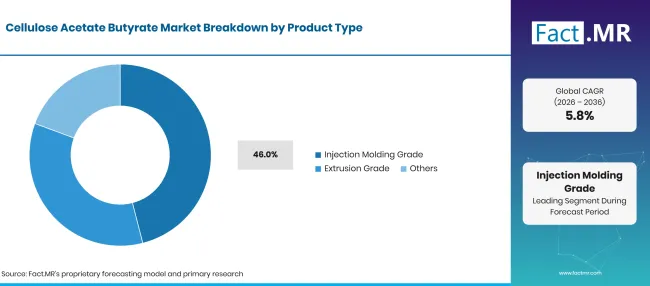
Factmr Cellulose Acetate Butyrate Market Breakdown Product Type | Source: Fact.MR
| Product Type | Share (2026) |
|---|---|
| Injection Molding Grade (Leading segment) | 46.0% |
| Other segments combined | 54.0%* |
| Total | 100.0% |
Source: Fact.MR analysis. Updated Oct 19, 2026
Injection molding grade CAB commands the leading market share due to its unmatched combination of high impact resistance, optical clarity, and ease of thermoplastic processing. Injection molders choose CAB for heavy-duty screwdriver handles, safety goggles, automotive interior buttons, and luxury sunglass frames that require a warm, pleasant hand-feel and high chemical resistance. Extrusion grade CAB accounts for significant volume across profiles, blister pack sheeting, and illuminated outdoor sign faces where weatherability is crucial. Formulators also procure specialized fine-powder grades for solvent dissolution into high-performance lacquers and dip coatings. Sourcing directors regularly evaluate fillers and coating ingredients to enhance composite hardness. Processors also incorporate food grade ceramic coatings when formulating multi-layer barrier films.
What leads the Application segment?
Coatings accounts for 34.8% share in 2026.
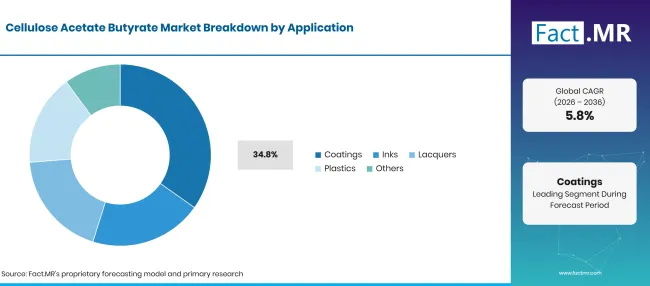
Factmr Cellulose Acetate Butyrate Market Breakdown Application | Source: Fact.MR
| Application | Share (2026) |
|---|---|
| Coatings (Leading segment) | 34.8% |
| Other segments combined | 65.2%* |
| Total | 100.0% |
Source: Fact.MR analysis. Updated Oct 19, 2026
Surface coatings represent the principal commercial destination for CAB resins, driven by the exacting demands of automotive exterior paint systems and premium wood furniture lacquers. Automotive paint chemists rely on CAB to control viscosity, prevent inter-coat strike-in, and ensure that metallic aluminum flakes lie perfectly parallel to the vehicle body panel. Inks and overprint varnishes consume substantial CAB volumes to enhance adhesion on polymer films and provide high-gloss, scuff-resistant finishes for commercial packaging. Specialty plastics compounding absorbs resin pellets for transparent, durable molded articles. Industrial maintenance engineers occasionally utilize paint and coating stripper formulations when reconditioning legacy coated surfaces. Coating manufacturers heavily procure automotive coatings components to support high-throughput assembly lines.
How does End-Use Industry shape consumption?
Consumer Goods represents 35.1% share in 2026.
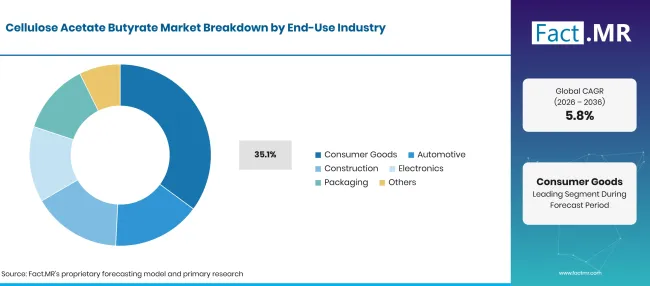
Factmr Cellulose Acetate Butyrate Market Breakdown End Use Industry | Source: Fact.MR
| End-Use Industry | Share (2026) |
|---|---|
| Consumer Goods (Leading segment) | 35.1% |
| Other segments combined | 64.9%* |
| Total | 100.0% |
Source: Fact.MR analysis. Updated Oct 19, 2026
The consumer goods sector serves as the largest end-use category, utilizing CAB across optical eyewear, personal care cosmetic cases, luxury pens, and high-performance hand tools. Brand owners value CAB for its dimensional stability, resistance to human perspiration, and self-polishing surface characteristics that prevent dulling over years of handling. The automotive sector represents the fastest-growing market, demanding CAB for OEM basecoats, refinish primers, and interior decorative bezels. Construction and architectural building products incorporate CAB-based lacquers for durable hardwood flooring and outdoor timber finishes. Electronics manufacturers specify CAB films for polarizers and optical display filters. Engineers evaluate emerging 3d printed nanocellulose composites alongside traditional cellulosic esters. Resin compounders also blend advanced hdpe resins to tailor impact properties in multi-layer structures.
What is accelerating Cellulose Acetate Butyrate Market adoption, and what is holding it back?
Adoption of bio-based cellulosic polymer substitutes, expansion of automotive metallic refinish coatings, and demand for durable optical plastics drive strong market growth. High raw material costs of butyric anhydride, specialized esterification reactor requirements, and competition from commodity acrylics restrict frictionless expansion.
Drivers Impact Analysis
| DRIVER | (~) % IMPACT ON CAGR | GEOGRAPHIC RELEVANCE | IMPACT TIMELINE |
|---|---|---|---|
| Automotive metallic basecoat flake alignment and anti-sagging | +1.2% | Europe, North America | Short term (<= 2 years) |
| Demand for bio-derived, renewable-carbon engineering plastics | +1.0% | Global | Medium term (2–4 years) |
| Premium eyewear and optical frame manufacturing growth | +0.8% | Western Europe, East Asia | Medium term (2–4 years) |
| Rapid solvent release in low-VOC industrial wood lacquers | +0.7% | North America, Europe | Medium term (2–4 years) |
| Expansion of flexographic packaging ink formulations | +0.5% | Global | Long term (>= 4 years) |
Source: Fact.MR analysis. Updated Oct 19, 2026
Opportunity Impact Analysis
| OPPORTUNITY | (~) % IMPACT ON CAGR | GEOGRAPHIC RELEVANCE | IMPACT TIMELINE |
|---|---|---|---|
| Specialized battery binder resins for high-voltage energy storage | +1.1% | East Asia, North America | Short term (<= 2 years) |
| High-solids, low-viscosity CAB grades for zero-emission coatings | +0.9% | Western Europe, USA | Medium term (2–4 years) |
| 3D printing filament formulations utilizing bio-based CAB | +0.7% | Global | Medium term (2–4 years) |
| Biodegradable microencapsulation matrices for agrochemicals | +0.5% | Latin America, Asia | Long term (>= 4 years) |
Source: Fact.MR analysis. Updated Oct 19, 2026
Restraints Impact Analysis
| RESTRAINT | (~) % IMPACT ON CAGR | GEOGRAPHIC RELEVANCE | IMPACT TIMELINE |
|---|---|---|---|
| High synthesis costs and complex multi-acid esterification | -0.9% | Global | Short term (<= 2 years) |
| Price competition from lower-cost synthetic acrylic resins | -0.7% | Global | Short term (<= 2 years) |
| Supply chain volatility of specialty wood pulp feedstocks | -0.6% | North America, Europe | Medium term (2–4 years) |
| Limited number of global certified chemical manufacturing plants | -0.4% | Global | Long term (>= 4 years) |
Source: Fact.MR analysis. Updated Oct 19, 2026
Which countries are scaling the Cellulose Acetate Butyrate Market through 2036?
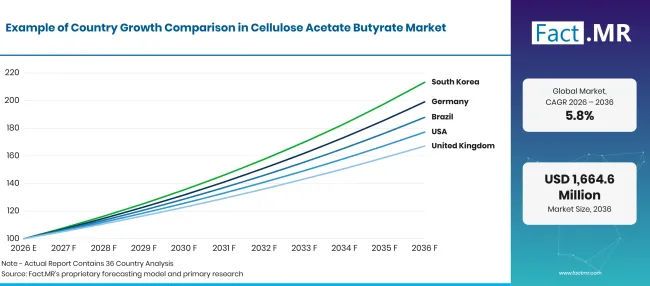
Factmr Cellulose Acetate Butyrate Market Growth Index | Source: Fact.MR
| Country | CAGR (2026–2036) |
|---|---|
| Germany | 7.13% |
| Brazil | 6.51% |
| USA | 5.89% |
| UK | 5.27% |
| Japan | 4.65% |
Source: Fact.MR analysis. Updated Oct 19, 2026
Why is Germany leading growth across European markets?
7.13% CAGR, driven by automotive OEM paint innovations, strict industrial VOC reduction mandates, and advanced chemical compounding clusters.
German automotive giants and coating formulators in Baden-Württemberg and North Rhine-Westphalia consume substantial volumes of CAB to formulate ultra-durable metallic basecoats and low-solvent refinish primers. Chemical engineers utilize CAB to meet strict European Union solvent emission directives while preserving high visual depth and scratch resistance. German polymer compounders also process injection-molding CAB into precision mechanical components, electrical tool handles, and premium optical equipment. Chemical synthesis clusters along the Rhine maintain advanced batch esterification facilities to support domestic coating and plastics manufacturers.
How is Brazil expanding its industrial cellulosic ester consumption?
6.51% CAGR, propelled by automotive manufacturing growth, domestic paint formulation lines, and expanding consumer hardware assembly.
Brazil's automotive assembly plants in São Paulo and Paraná drive robust procurement of CAB-formulated primers and metallic clearcoats to supply domestic passenger vehicles. Local industrial paint manufacturers incorporate CAB into protective wood lacquers and architectural coatings designed for humid tropical environments. Expanding domestic manufacturing of consumer hardware, electrical hand tools, and safety eyewear accelerates demand for durable injection-molded CAB pellets. Sourcing directors in Brazil negotiate supply agreements with global chemical leaders to secure reliable resin imports.
What factors sustain consistent sales across the United States?
5.89% CAGR, supported by aerospace coatings development, large-scale automotive refinish networks, and commercial eyewear fabrication.
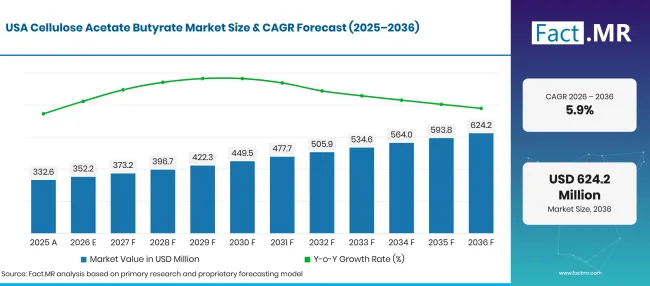
Factmr Cellulose Acetate Butyrate Market Forecast Usa | Source: Fact.MR
The United States represents a powerhouse in CAB production and consumption, housing primary chemical synthesis plants in Tennessee and neighboring states. American commercial vehicle manufacturers and aerospace contractors procure CAB-modified polyurethanes to achieve superior weather resistance, gloss retention, and chemical durability under extreme flight conditions. Automotive refinish distributors across the country stock CAB-based blending solvents and clearcoats to achieve rapid panel repairs in collision repair shops. Consumer goods manufacturers mold CAB into iconic tool handles and protective safety equipment.
Why does the United Kingdom maintain steady procurement?
5.27% CAGR, backed by marine finishes, specialized architectural wood coatings, and boutique optical frame design studios.
British luxury eyewear artisans and boutique optical manufacturers in London and the East Midlands specify high-grade CAB sheets and pellets for handcrafted spectacle frames. Marine paint formulators in coastal shipyards incorporate CAB into marine varnishes and deck lacquers to provide long-lasting UV screening and saltwater barrier protection. UK architectural coating formulators rely on CAB to achieve ultra-fast drying times in commercial interior wood paneling finishes.
How does Japan leverage CAB in high-precision manufacturing?
4.65% CAGR, steered by precision electronics display components, optical films, and high-performance automotive OEM finishes.
Japanese chemical and optical corporations utilize high-purity cellulose acetate butyrate to cast thin, uniform optical films with minimal birefringence for consumer electronics screens. Automotive OEM paint lines across Aichi and Kanagawa deploy CAB additives to maintain metallic flake orientation across robotic electrostatic bell spray applications. Japanese consumer goods manufacturers utilize transparent CAB resins for premium writing instruments, precision measuring instruments, and cosmetic packaging that demand flawless optical surface clarity.
Who leads the Cellulose Acetate Butyrate Market?
Eastman Chemical Company holds a preeminent global position in cellulose ester manufacturing, producing a comprehensive portfolio of CAB grades engineered for automotive coatings, inks, and molded plastics. Celanese Corporation and Daicel Corporation operate large-scale cellulose derivative synthesis networks, delivering high-purity cellulosic esters to international coating and electronics clients. Mitsubishi Chemical Corporation provides specialized polymer grades tailored for optical films and engineering thermoplastics.
Rotuba Extruders and Polymer Plastics Company specialize in custom compounding, sheet extrusion, and distribution of cellulosic plastics for eyewear and industrial tools. Simagchem Corporation, Chemos GmbH, and Merck KGaA distribute laboratory and specialty chemical-grade CAB fractions for pharmaceutical and analytical applications. Solvay S.A. contributes advanced polymer expertise across specialty bio-derived engineering formulations. Coating formulators also integrate battery binder resins and battery separator coatings into electrochemical assemblies. Automotive coating blenders continuously benchmark performance against automotive oem coatings specifications.
Which companies are the key providers?
Key companies include Eastman Chemical Company; Celanese Corporation; Daicel Corporation; Mitsubishi Chemical Corporation; Rotuba Extruders; Polymer Plastics Company; Simagchem Corporation; Chemos GmbH; Merck KGaA; and Solvay S.A.
- Eastman Chemical Company
- Celanese Corporation
- Daicel Corporation
- Mitsubishi Chemical Corporation
- Rotuba Extruders
- Polymer Plastics Company
- Simagchem Corporation
- Chemos GmbH
- Merck KGaA
- Solvay S.A.
Bibliography
- [1] PMC. (2025, February 14). Cellulose acetate butyrate thin films enable efficient triplet-triplet annihilation photon upconversion composites. PMC12059888.
- [2] PMC. (2025, March 22). Structural porosity and morphology evolution in cellulose acetate butyrate membrane networks. PMC12750191.
- [3] PMC. (2024, November 08). Cellulose acetate butyrate in situ gel formulation for sustained therapeutic delivery. PMC11728690.
- [4] PMC. (2024, June 30). Synthesis and morphological characterization of cellulose acetate butyrate microspheres for microencapsulation. PMC11314155.
- [5] PMC. (2025, April 03). Solvent removal kinetics and phase behavior in cellulosic ester polymer matrices. PMC12158182.
This Report Answers
- The report evaluates chemical synthesis economics and yield variations across injection molding and extrusion CAB grades.
- Application assessments detail why automotive coatings and industrial wood finishes absorb the largest volume of dissolved CAB resins.
- Country-level analysis investigates the industrial and regulatory factors enabling Germany and Brazil to achieve faster growth rates.
- Polymer evaluations examine the impact of butyryl, acetyl, and hydroxyl ratios on solubility, weathering, and mechanical toughness.
- Competitive profiling benchmarks esterification capacities, solvent recovery systems, and bio-based carbon certifications across global chemical leaders.
What does the Cellulose Acetate Butyrate Market cover?
The market encompasses commercial shipments of mixed cellulose ester resins formed through the esterification of chemical-grade wood pulp with butyric and acetic anhydrides. It tracks raw resin powders, custom-compounded molding pellets, and extruded sheets supplied to automotive coatings manufacturers, industrial lacquer formulators, optical frame molders, and commercial printing ink producers. The analysis evaluates transactional movements across global chemical distribution channels and direct OEM manufacturing contracts.
What is included in the scope?
The scope covers merchant shipments of virgin, plasticized, and modified cellulose acetate butyrate resins sold in solid pellet, flake, and powder forms. Revenues reflect transactional chemical pricing recognized by chemical synthesizers, authorized polymer distributors, and masterbatch compounders. Formulated clearcoat additives and specialty optical grade resins are fully evaluated within the market revenue boundaries.
What is excluded from the scope?
The scope excludes pure cellulose acetate homopolymers, cellulose acetate propionate (CAP), and unmodified nitrocellulose resins. Finished molded articles such as completed eyewear frames, painted vehicle body panels, and assembled hand tools are excluded from resin totals. Chemical esterification reactors, spray coating booths, and plastic injection molding machinery are outside the scope of this material report.
How Was the Analysis Built?
The analysis draws on 120+ sources, 35+ company portfolios, 25+ countries, and more than 20 industry interviews.
- Primary Research: Primary research includes discussions with manufacturers, service providers, technology developers, distributors, end users, and subject-matter experts. These conversations examine purchasing priorities, product adoption, operational challenges, approval requirements, competitive positioning, and the factors that influence wider market acceptance.
- Desk Research: Desk research covers government statistics, regulatory publications, company filings, trade data, technical studies, industry associations, standards, public policy, and other authoritative sources. Every source used in the analysis is documented in the bibliography.
- Market Sizing and Forecasting: Market estimates combine historical performance, demand indicators, pricing and volume trends, segment shares, company participation, country-level growth, adoption patterns, investment activity, and barriers to market expansion.
- Data Validation and Update Cycle: Findings are validated by comparing primary interviews with public data, company activity, regulatory changes, trade patterns, and industry developments. Regular updates review new product launches, capacity changes, partnerships, approvals, and shifts in commercial adoption.
Segmentation
What is the report’s scope and coverage?
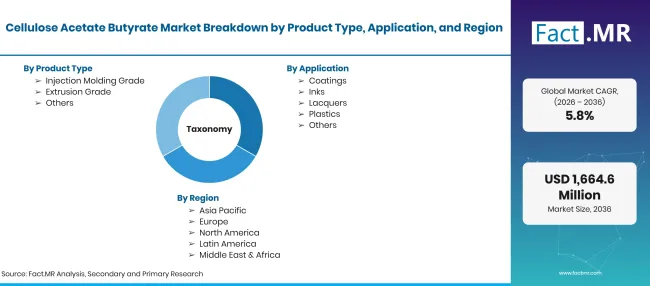
Factmr Cellulose Acetate Butyrate Market Taxonomy | Source: Fact.MR
| Attribute | Details |
|---|---|
| Quantitative Units | USD million in 2026 to USD million by 2036 at 5.83% CAGR |
| Market Definition | Thermoplastic mixed esters of cellulose produced by reacting cellulose with butyric and acetic anhydrides, supplied in pellet, powder, and flake forms for industrial coatings and molded plastics. |
| Product Type | Injection Molding Grade; Extrusion Grade; Others |
| Application | Coatings; Inks; Lacquers; Plastics; Others |
| End-Use Industry | Consumer Goods; Automotive; Construction; Electronics; Packaging; Others |
| Regions Covered | North America; Latin America; Western Europe; Eastern Europe; East Asia; South Asia & Pacific; Middle East & Africa |
| Countries Covered | Germany; Brazil; USA; UK; Japan |
| Companies Profiled | Eastman Chemical Company; Celanese Corporation; Daicel Corporation; Mitsubishi Chemical Corporation; Rotuba Extruders; Polymer Plastics Company; Simagchem Corporation; Chemos GmbH; Merck KGaA; Solvay S.A. |
| Forecast Period | 2026 to 2036 |
| Approach | Primary interviews with chemical ester synthesizers, paint formulation chemists, plastics compounders, and optical frame manufacturers combined with chemical trade import-export data |
Source: Fact.MR analysis. Updated Oct 19, 2026
How is the market segmented?
-
By Product Type
- Injection Molding Grade
- Extrusion Grade
- Others
-
By Application
- Coatings
- Inks
- Lacquers
- Plastics
- Others
-
By End-Use Industry
- Consumer Goods
- Automotive
- Construction
- Electronics
- Packaging
- Others
-
By Region
- North America
- Latin America
- Western Europe
- Eastern Europe
- East Asia
- South Asia & Pacific
- Middle East & Africa
Frequently Asked Questions
How big is the cellulose acetate butyrate market in 2026?
What is the CAGR from 2026 to 2036?
Which product type leads?
Which application leads?
Which companies participate in cellulose acetate butyrate?
Who worked on this report


Preview the report firsthand - request a free sample
Free SampleGet the brochure for pricing and purchase details
Download PDF