Specialty Polymers Market
Specialty Polymers Market Size and Share Forecast Outlook 2026 to 2036
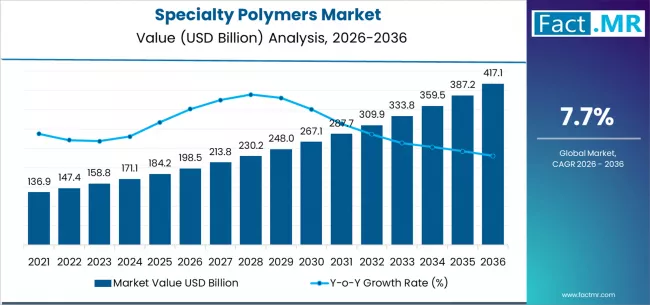
Specialty polymers market is projected to grow from USD 198.5 billion in 2026 to USD 417.1 billion by 2036, at a CAGR of 7.7%. Synthetic will dominate with a 59.0% market share, while solid will lead the form segment with a 76.0% share.
Specialty Polymers Market Forecast and Outlook 2026 to 2036
The global specialty polymers market is projected to reach USD 417.10 billion by 2036. The market is valued at USD 198.45 billion in 2026 and is set to rise at a CAGR of 7.7% during the assessment period. Demand is expected to grow 2.1x, supported by increasing demand for high-performance materials in automotive electrification and electronics manufacturing worldwide, driving adoption of advanced polymer solutions with superior mechanical properties and thermal stability across transportation and industrial sectors globally.
Key Takeaways from the Specialty Polymers Market
- Specialty Polymers Market Value (2026): USD 198.45 billion
- Specialty Polymers Market Forecast Value (2036): USD 417.10 billion
- Specialty Polymers Market Forecast CAGR: 7.7%
- Leading Source in Specialty Polymers Market: Synthetic (59.0%)
- Key Growth Regions in Specialty Polymers Market: Asia Pacific, North America, and Europe
- Top Players in Specialty Polymers Market: Arkema, BASF SE, Evonik Industries AG, Covestro AG, Solvay SA, Dow Inc., DuPont de Nemours, Inc., SABIC, Celanese Corporation, Eastman Chemical Company, Mitsubishi Chemical Group Corporation, Toray Industries, Inc., Kuraray Co., Ltd., LG Chem, Wacker Chemie AG
Material engineers and product designers face mounting pressure to develop lightweight components and enhance energy efficiency while meeting stringent environmental regulations and performance specifications, with modern specialty polymer formulations providing documented advantages including exceptional chemical resistance, enhanced durability, and superior processing characteristics compared to commodity polymer alternatives alone.
Synthetic polymers influence market activity, driven by versatile applications in automotive components, electrical insulation, and industrial equipment requiring engineered material properties worldwide. Manufacturers increasingly recognize the performance advantages of synthetic specialty polymers, with typical product offerings providing consistent quality and customizable characteristics at competitive price points through established chemical supply chains.
Specialty elastomers demonstrate robust growth potential, supported by expanding demand in automotive sealing systems, medical devices, and industrial applications requiring flexibility combined with chemical resistance. The solid form segment emerges as the dominant category, reflecting manufacturing efficiency preferences and established processing technologies across injection molding and extrusion operations.
Specialty Polymers Market
| Metric | Value |
|---|---|
| Market Value (2026) | USD 198.45 billion |
| Market Forecast Value (2036) | USD 417.10 billion |
| Forecast CAGR (2026-2036) | 7.7% |
Category
| Category | Segments |
|---|---|
| Source | Synthetic; Natural; Semisynthetic |
| Form | Solid; Liquid |
| Product Type | Specialty Elastomers; Specialty Thermoplastics; Biodegradable Polymers; Liquid Crystal Polymers; Others |
| End-Use | Transport; Building and Construction; Medical and Healthcare; Electrical and Electronics; Textile; Food and Beverage; Cosmetics and Personal Care; Others |
| Region | Asia Pacific; North America; Europe; Latin America; MEA |
Segmental Analysis
By Source, Which Segment Accounts for the Dominant Market Share?
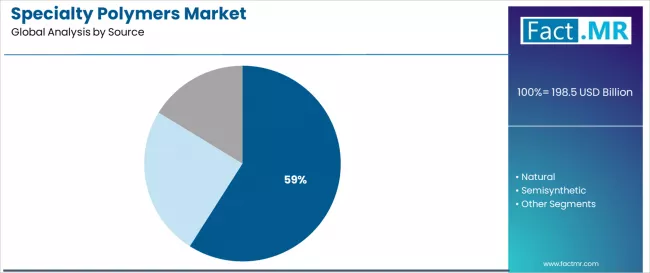
Synthetic polymers represent the dominant force in the specialty polymers market, capturing 59.0% of the total market share in 2026. This category encompasses engineered molecular structures produced through controlled polymerization processes, including advanced formulations with tailored chemical compositions and precise molecular weight distributions that enable superior performance characteristics across automotive, electronics, and industrial applications worldwide.
By Form, Which Segment Accounts for the Largest Market Share?
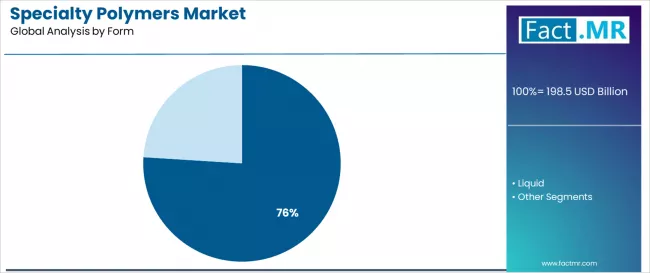
Solid polymers dominate the specialty polymers form landscape with ay 76.0% market share in 2026, reflecting the critical role of solid-state materials in supporting conventional manufacturing processes and established component fabrication technologies across industrial sectors worldwide.
Solid polymers’ leadership is reinforced by manufacturing efficiency advantages, material handling convenience, and compatibility with automated processing equipment that characterize mainstream polymer applications.
By Product Type, Which Segment Accounts for a Significant Market Share?
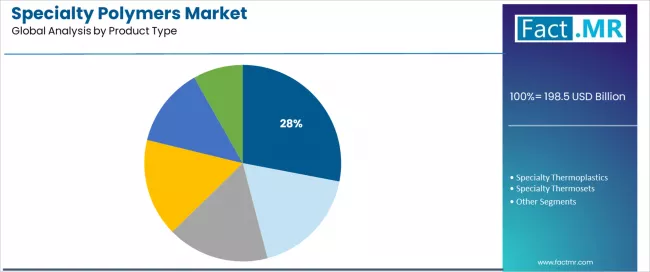
Specialty elastomers represent a leading product type segment in the specialty polymers market with approximately 28.0% market share in 2026, reflecting the fundamental role of flexible polymer materials in supporting sealing applications, vibration damping, and flexible component manufacturing across automotive and industrial sectors.
The specialty elastomers segment demonstrates the fastest growth with 8.8% CAGR, driven by expanding electric vehicle production requiring specialized sealing systems and increasing demand for high-performance elastomers in medical device applications.
By End-Use, Which Segment Accounts for the Dominant Market Share?
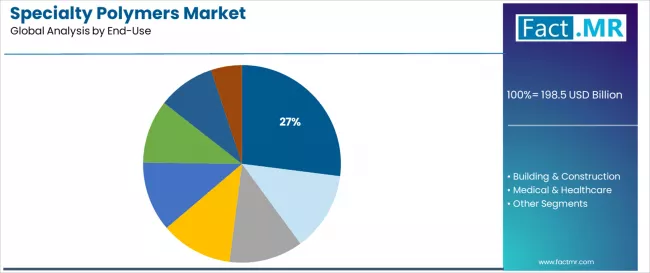
Transport dominates the specialty polymers end-use landscape with a 27.0% market share in 2026, reflecting the critical role of advanced materials in supporting automotive lightweighting strategies, electric vehicle component requirements, and enhanced fuel efficiency targets across global transportation sectors.
Stringent performance specifications, continuous material innovation requirements, and large-scale production volumes that characterize automotive and aerospace manufacturing operations reinforce the transport segment’s market leadership.
What are the Drivers, Restraints, and Key Trends of the Specialty Polymers Market?
The specialty polymers market is driven by structural shifts in automotive, electronics, and sustainability-focused manufacturing. Rising electric vehicle production is increasing demand for polymers offering thermal management, electrical insulation, and lightweight performance for batteries and power electronics.
Expanding electronics manufacturing and ongoing device miniaturization further support adoption of high-performance thermoplastics and liquid crystal polymers that enhance reliability and processing efficiency. In parallel, stricter sustainability regulations are accelerating uptake of biodegradable polymers and recycled-content materials aligned with circular economy objectives.
Market growth is constrained by volatility in petrochemical feedstock and specialty monomer prices, which affects cost predictability and margins. Technical complexity in meeting diverse processing and performance requirements can extend qualification timelines, while limited recycling infrastructure restricts large-scale circular implementation.
Key trends include increased bio-based polymer investment in North America and Europe and growing use of flame-retardant, thermally conductive polymers in EV applications, despite emerging competition from alternative materials.
Analysis of the Specialty Polymers Market by Key Countries
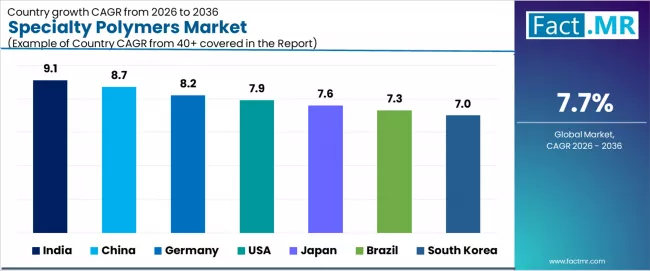
| Country | CAGR (2026-2036) |
|---|---|
| India | 9.1% |
| China | 8.7% |
| Germany | 8.2% |
| USA | 7.9% |
| Japan | 7.6% |
| Brazil | 7.3% |
| South Korea | 7.0% |
How is India Leading Global Market Expansion?
India demonstrates the strongest growth trajectory in the specialty polymers market, expanding at a CAGR of 9.1% through 2036. Growth is driven by rapid industrialization, expanding electronics manufacturing, and rising automotive production requiring advanced material solutions. Demand is concentrated across industrial corridors in Maharashtra, Tamil Nadu, Gujarat, and Karnataka, where electronics assembly units and automotive plants are increasingly integrating specialty polymers for component performance and product differentiation.
Material accessibility continues to improve through chemical distributors, local compounding facilities, and direct supplier relationships with manufacturers. Government-led manufacturing initiatives are strengthening domestic production capabilities, encouraging wider adoption across consumer electronics, automotive components, and industrial applications. Expanding polymer processing capacity and local formulation development further support India’s position as a high-growth consumption hub.
Why is China Emerging as a High-Growth Specialty Polymers Market?
China’s specialty polymers market is projected to grow at a CAGR of 8.7% through 2036, supported by accelerating electric vehicle production and continued dominance in electronics manufacturing. Adoption is strongest across major manufacturing provinces such as Guangdong, Shanghai, Jiangsu, and Zhejiang, where automotive and electronics producers are implementing advanced polymers for lightweighting and performance optimization.
Electric vehicle manufacturers are driving demand for polymers used in battery systems, housings, and structural components to improve efficiency and thermal management. Expanding middle-class consumption sustains demand for consumer electronics and premium vehicles, while industrial upgrading initiatives encourage the use of higher-value materials. Expanded chemical distribution networks and increasing preference for domestically produced polymers alongside localized operations of international suppliers reinforce growth.
What drives Germany’s Market Leadership in Specialty Polymers?
Germany’s specialty polymers market is advancing at a CAGR of 8.2% through 2036, supported by strong automotive engineering capabilities and sustained demand for high-performance materials. Automotive lightweighting, electric vehicle platform development, and energy-efficient building materials remain primary demand drivers.
German manufacturers operate under stringent quality and environmental regulations, creating consistent demand for polymers with documented performance, recyclability, and compliance credentials. Circular economy mandates and recycled content requirements are influencing material selection, particularly within automotive and construction applications. Despite regulatory complexity, Germany’s established industrial base and innovation-led chemical sector provide stable consumption levels.
How does the USA Demonstrate Innovation Leadership in Specialty Polymers?
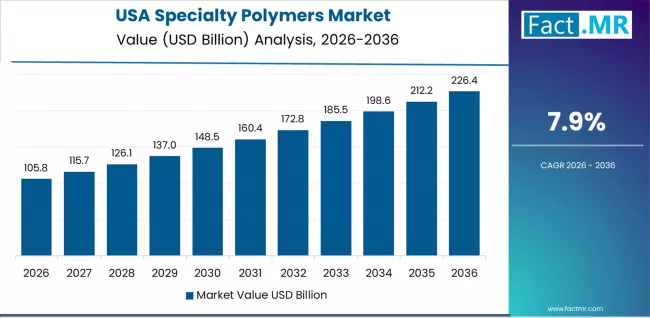
The USA specialty polymers market is projected to grow at a CAGR of 7.9% through 2036, driven by automotive electrification and advanced manufacturing adoption. Demand is concentrated across manufacturing regions such as Michigan, Texas, California, and Ohio, where automotive OEMs and suppliers are integrating polymers into electric vehicle platforms. Specialty polymers are increasingly used for thermal management, electrical insulation, and power electronics encapsulation in high-voltage systems.
Strong collaboration between polymer suppliers and automotive manufacturers supports application-specific material development. Distribution through chemical suppliers, compounding facilities, and direct OEM relationships ensures broad market coverage.
What Positions Japan for Technology Excellence in Specialty Polymers?
Japan’s specialty polymers market is expected to expand at a CAGR of 7.6% through 2036, supported by advanced electronics manufacturing and precision-driven automotive production. Demand is concentrated in industrial hubs such as Tokyo, Aichi, Osaka, and Kanagawa, where manufacturers emphasize tight material specifications and quality control. Electronics producers are adopting specialty polymers to support miniaturization, thermal stability, and component reliability.
Automotive OEMs continue to integrate advanced polymers through specification-led development programs, particularly in electronics-intensive vehicle systems. Japan’s established polymer chemistry expertise and long-standing supplier relationships support adoption of functional polymers, including liquid crystal polymers.
How does Brazil Show Industrial Growth Potential in Specialty Polymers?
Brazil’s specialty polymers market is projected to grow at a CAGR of 7.3% through 2036, driven by infrastructure development and gradual industrial modernization. Demand is strongest across construction, automotive manufacturing, and industrial equipment sectors in regions such as São Paulo, Rio de Janeiro, Minas Gerais, and Rio Grande do Sul.
Construction activity supports polymer use in piping systems, coatings, and building materials, while automotive production encourages adoption of lightweight components. Local manufacturing and compounding capabilities improve price competitiveness and product availability. Distribution through regional chemical suppliers further supports adoption across domestic manufacturing applications.
What Characterizes South Korea’s Advanced Specialty Polymer Applications?
South Korea’s specialty polymers market is advancing at a CAGR of 7.0% through 2036, supported by electronics manufacturing leadership and continuous material innovation. Adoption is concentrated in the Seoul metropolitan area and Gyeonggi province, where electronics and automotive component suppliers integrate high-performance polymers into precision manufacturing environments.
Demand is driven by requirements for miniaturization-compatible thermoplastics, display materials, and semiconductor packaging solutions. Strong collaboration between Korean manufacturers and global polymer suppliers supports application development and technical validation. Comprehensive quality assurance frameworks reinforce consistent material usage across advanced electronics and automotive supply chains.
Competitive Landscape of the Specialty Polymers Market
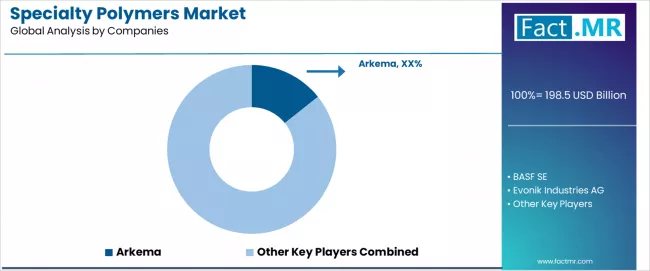
The specialty polymers market comprises approximately 15–20 meaningful players and exhibits moderate concentration, with the leading participants collectively accounting for around 25–30% of global demand. Competition is driven less by pricing and more by polymer chemistry innovation, application development expertise, and the ability to provide consistent technical support across complex end-use requirements. Integrated supply chains, spanning raw material sourcing to polymer compounding, remain an important structural advantage.
Leading multinational chemical companies such as Arkema, BASF SE, and Evonik Industries AG compete through broad specialty polymer portfolios, strong research and development capabilities, and long-standing collaborations with automotive, electronics, and industrial manufacturers. Continuous material innovation and close customer engagement support their expansion into advanced and sustainability-oriented polymer applications.
Challenger companies, including Covestro AG, Solvay SA, and Dow Inc., focus on specialized polymer platforms and customized solutions tailored to specific industry needs, supported by application engineering and sector-focused expertise. Other global producers such as DuPont, SABIC, and Celanese emphasize select high-performance polymer categories, including engineering thermoplastics, elastomers, and thermoset materials.
Regional and emerging producers add competitive pressure through localized manufacturing, faster technical response, and application-specific formulations, particularly in high-growth markets such as India and China. Overall, competitive strength increasingly depends on combining material science expertise with scalable production, sustainability innovation, and long-term technical partnerships.
Key Players in the Specialty Polymers Market
- Arkema
- BASF SE
- Evonik Industries AG
- Covestro AG
- Solvay SA
- Dow Inc.
- DuPont de Nemours, Inc.
- SABIC
- Celanese Corporation
- Eastman Chemical Company
- Mitsubishi Chemical Group Corporation
- Toray Industries, Inc.
- Kuraray Co., Ltd.
- LG Chem
- Wacker Chemie AG
Scope of the Report
| Items | Values |
|---|---|
| Quantitative Units | USD 198.45 Billion |
| Source | Synthetic, Natural, Semisynthetic |
| Form | Solid, Liquid |
| Product Type | Specialty Elastomers (Fluoroelastomers, Fluorosilicone Rubber, Liquid Silicone Rubber, Natural Rubber, Others), Specialty Thermoplastics (Polyolefins, Polyimides, Vinylic Polymer, Polyphenyles, Others), Specialty Thermosets (Epoxy, Polyester, Vinyl Ester, Polyimides, Others), Biodegradable Polymers, Liquid Crystal Polymers, Others |
| End-Use | Transport, Building & Construction, Medical & Healthcare, Electrical & Electronics, Textile, Food & Beverage, Cosmetics & Personal Care, Others |
| Regions Covered | Asia Pacific, North America, Europe, Latin America, Middle East & Africa |
| Country Covered | India, China, Germany, USA, Japan, Brazil, South Korea, and 40+ countries |
| Key Companies Profiled | Arkema, BASF SE, Evonik Industries AG, Covestro AG, Solvay SA, Dow Inc., DuPont de Nemours, Inc., SABIC, Celanese Corporation, Eastman Chemical Company, Mitsubishi Chemical Group Corporation, Toray Industries, Inc., Kuraray Co., Ltd., LG Chem, Wacker Chemie AG |
| Additional Attributes | Dollar sales by source, form, and product type categories, regional adoption trends across Asia Pacific, North America, and Europe, competitive landscape with chemical manufacturers and polymer technology companies, product specifications and processing requirements, integration with automotive OEM specifications and electronics industry standards, innovations in bio-based polymers and sustainable materials, and development of specialized applications with performance validation and circular economy capabilities. |
Specialty Polymers Market by Segments
-
Source :
- Synthetic
- Natural
- Semisynthetic
-
Form :
- Solid
- Liquid
-
Product Type :
- Specialty Elastomers
- Fluoroelastomers
- Fluorosilicone Rubber
- Liquid Silicone Rubber
- Natural Rubber
- Others
- Specialty Thermoplastics
- Polyolefins
- Polyimides
- Vinylic Polymer
- Polyphenyles
- Others
- Specialty Thermosets
- Epoxy
- Polyester
- Vinyl Ester
- Polyimides
- Others
- Biodegradable Polymers
- Liquid Crystal Polymers
- Others
- Specialty Elastomers
-
End-Use :
- Transport
- Building & Construction
- Medical & Healthcare
- Electrical & Electronics
- Textile
- Food & Beverage
- Cosmetics & Personal Care
- Others
-
Region :
- Asia Pacific
- China
- Japan
- South Korea
- India
- Australia
- Thailand
- Rest of Asia Pacific
- North America
- USA
- Canada
- Mexico
- Europe
- Germany
- UK
- France
- Italy
- Spain
- Denmark
- Sweden
- Norway
- Rest of Europe
- Latin America
- Brazil
- Argentina
- Rest of Latin America
- Middle East & Africa
- South Africa
- Saudi Arabia
- UAE
- Kuwait
- Rest of Middle East & Africa
- Asia Pacific
Table of Content
- Executive Summary
- Global Market Outlook
- Demand to side Trends
- Supply to side Trends
- Technology Roadmap Analysis
- Analysis and Recommendations
- Market Overview
- Market Coverage / Taxonomy
- Market Definition / Scope / Limitations
- Market Background
- Market Dynamics
- Drivers
- Restraints
- Opportunity
- Trends
- Scenario Forecast
- Demand in Optimistic Scenario
- Demand in Likely Scenario
- Demand in Conservative Scenario
- Opportunity Map Analysis
- Product Life Cycle Analysis
- Supply Chain Analysis
- Investment Feasibility Matrix
- Value Chain Analysis
- PESTLE and Porter’s Analysis
- Regulatory Landscape
- Regional Parent Market Outlook
- Production and Consumption Statistics
- Import and Export Statistics
- Market Dynamics
- Global Market Analysis 2021 to 2025 and Forecast, 2026 to 2036
- Historical Market Size Value (USD Million) Analysis, 2021 to 2025
- Current and Future Market Size Value (USD Million) Projections, 2026 to 2036
- Y to o to Y Growth Trend Analysis
- Absolute $ Opportunity Analysis
- Global Market Pricing Analysis 2021 to 2025 and Forecast 2026 to 2036
- Global Market Analysis 2021 to 2025 and Forecast 2026 to 2036, By Source
- Introduction / Key Findings
- Historical Market Size Value (USD Million) Analysis By Source, 2021 to 2025
- Current and Future Market Size Value (USD Million) Analysis and Forecast By Source, 2026 to 2036
- Synthetic
- Natural
- Semisynthetic
- Synthetic
- Y to o to Y Growth Trend Analysis By Source, 2021 to 2025
- Absolute $ Opportunity Analysis By Source, 2026 to 2036
- Global Market Analysis 2021 to 2025 and Forecast 2026 to 2036, By Form
- Introduction / Key Findings
- Historical Market Size Value (USD Million) Analysis By Form, 2021 to 2025
- Current and Future Market Size Value (USD Million) Analysis and Forecast By Form, 2026 to 2036
- Solid
- Liquid
- Solid
- Y to o to Y Growth Trend Analysis By Form, 2021 to 2025
- Absolute $ Opportunity Analysis By Form, 2026 to 2036
- Global Market Analysis 2021 to 2025 and Forecast 2026 to 2036, By Product Type
- Introduction / Key Findings
- Historical Market Size Value (USD Million) Analysis By Product Type, 2021 to 2025
- Current and Future Market Size Value (USD Million) Analysis and Forecast By Product Type, 2026 to 2036
- Specialty Elastomers
- Specialty Thermoplastics
- Specialty Thermosets
- Biodegradable Polymers
- Liquid Crystal Polymers
- Others
- Specialty Elastomers
- Y to o to Y Growth Trend Analysis By Product Type, 2021 to 2025
- Absolute $ Opportunity Analysis By Product Type, 2026 to 2036
- Global Market Analysis 2021 to 2025 and Forecast 2026 to 2036, By End-Use
- Introduction / Key Findings
- Historical Market Size Value (USD Million) Analysis By End-Use, 2021 to 2025
- Current and Future Market Size Value (USD Million) Analysis and Forecast By End-Use, 2026 to 2036
- Transport
- Building & Construction
- Medical & Healthcare
- Electrical & Electronics
- Textile
- Food & Beverage
- Cosmetics & Personal Care
- Others
- Transport
- Y to o to Y Growth Trend Analysis By End-Use, 2021 to 2025
- Absolute $ Opportunity Analysis By End-Use, 2026 to 2036
- Global Market Analysis 2021 to 2025 and Forecast 2026 to 2036, By Region
- Introduction
- Historical Market Size Value (USD Million) Analysis By Region, 2021 to 2025
- Current Market Size Value (USD Million) Analysis and Forecast By Region, 2026 to 2036
- North America
- Latin America
- Western Europe
- Eastern Europe
- East Asia
- South Asia and Pacific
- Middle East & Africa
- Market Attractiveness Analysis By Region
- North America Market Analysis 2021 to 2025 and Forecast 2026 to 2036, By Country
- Historical Market Size Value (USD Million) Trend Analysis By Market Taxonomy, 2021 to 2025
- Market Size Value (USD Million) Forecast By Market Taxonomy, 2026 to 2036
- By Country
- USA
- Canada
- Mexico
- By Source
- By Form
- By Product Type
- By End-Use
- By Country
- Market Attractiveness Analysis
- By Country
- By Source
- By Form
- By Product Type
- By End-Use
- Key Takeaways
- Latin America Market Analysis 2021 to 2025 and Forecast 2026 to 2036, By Country
- Historical Market Size Value (USD Million) Trend Analysis By Market Taxonomy, 2021 to 2025
- Market Size Value (USD Million) Forecast By Market Taxonomy, 2026 to 2036
- By Country
- Brazil
- Chile
- Rest of Latin America
- By Source
- By Form
- By Product Type
- By End-Use
- By Country
- Market Attractiveness Analysis
- By Country
- By Source
- By Form
- By Product Type
- By End-Use
- Key Takeaways
- Western Europe Market Analysis 2021 to 2025 and Forecast 2026 to 2036, By Country
- Historical Market Size Value (USD Million) Trend Analysis By Market Taxonomy, 2021 to 2025
- Market Size Value (USD Million) Forecast By Market Taxonomy, 2026 to 2036
- By Country
- Germany
- UK
- Italy
- Spain
- France
- Nordic
- BENELUX
- Rest of Western Europe
- By Source
- By Form
- By Product Type
- By End-Use
- By Country
- Market Attractiveness Analysis
- By Country
- By Source
- By Form
- By Product Type
- By End-Use
- Key Takeaways
- Eastern Europe Market Analysis 2021 to 2025 and Forecast 2026 to 2036, By Country
- Historical Market Size Value (USD Million) Trend Analysis By Market Taxonomy, 2021 to 2025
- Market Size Value (USD Million) Forecast By Market Taxonomy, 2026 to 2036
- By Country
- Russia
- Poland
- Hungary
- Balkan & Baltic
- Rest of Eastern Europe
- By Source
- By Form
- By Product Type
- By End-Use
- By Country
- Market Attractiveness Analysis
- By Country
- By Source
- By Form
- By Product Type
- By End-Use
- Key Takeaways
- East Asia Market Analysis 2021 to 2025 and Forecast 2026 to 2036, By Country
- Historical Market Size Value (USD Million) Trend Analysis By Market Taxonomy, 2021 to 2025
- Market Size Value (USD Million) Forecast By Market Taxonomy, 2026 to 2036
- By Country
- China
- Japan
- South Korea
- By Source
- By Form
- By Product Type
- By End-Use
- By Country
- Market Attractiveness Analysis
- By Country
- By Source
- By Form
- By Product Type
- By End-Use
- Key Takeaways
- South Asia and Pacific Market Analysis 2021 to 2025 and Forecast 2026 to 2036, By Country
- Historical Market Size Value (USD Million) Trend Analysis By Market Taxonomy, 2021 to 2025
- Market Size Value (USD Million) Forecast By Market Taxonomy, 2026 to 2036
- By Country
- India
- ASEAN
- Australia & New Zealand
- Rest of South Asia and Pacific
- By Source
- By Form
- By Product Type
- By End-Use
- By Country
- Market Attractiveness Analysis
- By Country
- By Source
- By Form
- By Product Type
- By End-Use
- Key Takeaways
- Middle East & Africa Market Analysis 2021 to 2025 and Forecast 2026 to 2036, By Country
- Historical Market Size Value (USD Million) Trend Analysis By Market Taxonomy, 2021 to 2025
- Market Size Value (USD Million) Forecast By Market Taxonomy, 2026 to 2036
- By Country
- Kingdom of Saudi Arabia
- Other GCC Countries
- Turkiye
- South Africa
- Other African Union
- Rest of Middle East & Africa
- By Source
- By Form
- By Product Type
- By End-Use
- By Country
- Market Attractiveness Analysis
- By Country
- By Source
- By Form
- By Product Type
- By End-Use
- Key Takeaways
- Key Countries Market Analysis
- USA
- Pricing Analysis
- Market Share Analysis, 2025
- By Source
- By Form
- By Product Type
- By End-Use
- Canada
- Pricing Analysis
- Market Share Analysis, 2025
- By Source
- By Form
- By Product Type
- By End-Use
- Mexico
- Pricing Analysis
- Market Share Analysis, 2025
- By Source
- By Form
- By Product Type
- By End-Use
- Brazil
- Pricing Analysis
- Market Share Analysis, 2025
- By Source
- By Form
- By Product Type
- By End-Use
- Chile
- Pricing Analysis
- Market Share Analysis, 2025
- By Source
- By Form
- By Product Type
- By End-Use
- Germany
- Pricing Analysis
- Market Share Analysis, 2025
- By Source
- By Form
- By Product Type
- By End-Use
- UK
- Pricing Analysis
- Market Share Analysis, 2025
- By Source
- By Form
- By Product Type
- By End-Use
- Italy
- Pricing Analysis
- Market Share Analysis, 2025
- By Source
- By Form
- By Product Type
- By End-Use
- Spain
- Pricing Analysis
- Market Share Analysis, 2025
- By Source
- By Form
- By Product Type
- By End-Use
- France
- Pricing Analysis
- Market Share Analysis, 2025
- By Source
- By Form
- By Product Type
- By End-Use
- India
- Pricing Analysis
- Market Share Analysis, 2025
- By Source
- By Form
- By Product Type
- By End-Use
- ASEAN
- Pricing Analysis
- Market Share Analysis, 2025
- By Source
- By Form
- By Product Type
- By End-Use
- Australia & New Zealand
- Pricing Analysis
- Market Share Analysis, 2025
- By Source
- By Form
- By Product Type
- By End-Use
- China
- Pricing Analysis
- Market Share Analysis, 2025
- By Source
- By Form
- By Product Type
- By End-Use
- Japan
- Pricing Analysis
- Market Share Analysis, 2025
- By Source
- By Form
- By Product Type
- By End-Use
- South Korea
- Pricing Analysis
- Market Share Analysis, 2025
- By Source
- By Form
- By Product Type
- By End-Use
- Russia
- Pricing Analysis
- Market Share Analysis, 2025
- By Source
- By Form
- By Product Type
- By End-Use
- Poland
- Pricing Analysis
- Market Share Analysis, 2025
- By Source
- By Form
- By Product Type
- By End-Use
- Hungary
- Pricing Analysis
- Market Share Analysis, 2025
- By Source
- By Form
- By Product Type
- By End-Use
- Kingdom of Saudi Arabia
- Pricing Analysis
- Market Share Analysis, 2025
- By Source
- By Form
- By Product Type
- By End-Use
- Turkiye
- Pricing Analysis
- Market Share Analysis, 2025
- By Source
- By Form
- By Product Type
- By End-Use
- South Africa
- Pricing Analysis
- Market Share Analysis, 2025
- By Source
- By Form
- By Product Type
- By End-Use
- USA
- Market Structure Analysis
- Competition Dashboard
- Competition Benchmarking
- Market Share Analysis of Top Players
- By Regional
- By Source
- By Form
- By Product Type
- By End-Use
- Competition Analysis
- Competition Deep Dive
- Arkema
- Overview
- Product Portfolio
- Profitability by Market Segments (Product/Age /Sales Channel/Region)
- Sales Footprint
- Strategy Overview
- Marketing Strategy
- Product Strategy
- Channel Strategy
- BASF SE
- Evonik Industries AG
- Covestro AG
- Solvay SA
- Dow Inc.
- DuPont de Nemours, Inc.
- SABIC
- Celanese Corporation
- Eastman Chemical Company
- Mitsubishi Chemical Group Corporation
- Toray Industries, Inc.
- Kuraray Co., Ltd.
- LG Chem
- Wacker Chemie AG
- Arkema
- Competition Deep Dive
- Assumptions & Acronyms Used
- Research Methodology
List Of Table
- Table 1: Global Market Value (USD Million) Forecast by Region, 2021 to 2036
- Table 2: Global Market Value (USD Million) Forecast by Source, 2021 to 2036
- Table 3: Global Market Value (USD Million) Forecast by Form, 2021 to 2036
- Table 4: Global Market Value (USD Million) Forecast by Product Type, 2021 to 2036
- Table 5: Global Market Value (USD Million) Forecast by End-Use, 2021 to 2036
- Table 6: North America Market Value (USD Million) Forecast by Country, 2021 to 2036
- Table 7: North America Market Value (USD Million) Forecast by Source, 2021 to 2036
- Table 8: North America Market Value (USD Million) Forecast by Form, 2021 to 2036
- Table 9: North America Market Value (USD Million) Forecast by Product Type, 2021 to 2036
- Table 10: North America Market Value (USD Million) Forecast by End-Use, 2021 to 2036
- Table 11: Latin America Market Value (USD Million) Forecast by Country, 2021 to 2036
- Table 12: Latin America Market Value (USD Million) Forecast by Source, 2021 to 2036
- Table 13: Latin America Market Value (USD Million) Forecast by Form, 2021 to 2036
- Table 14: Latin America Market Value (USD Million) Forecast by Product Type, 2021 to 2036
- Table 15: Latin America Market Value (USD Million) Forecast by End-Use, 2021 to 2036
- Table 16: Western Europe Market Value (USD Million) Forecast by Country, 2021 to 2036
- Table 17: Western Europe Market Value (USD Million) Forecast by Source, 2021 to 2036
- Table 18: Western Europe Market Value (USD Million) Forecast by Form, 2021 to 2036
- Table 19: Western Europe Market Value (USD Million) Forecast by Product Type, 2021 to 2036
- Table 20: Western Europe Market Value (USD Million) Forecast by End-Use, 2021 to 2036
- Table 21: Eastern Europe Market Value (USD Million) Forecast by Country, 2021 to 2036
- Table 22: Eastern Europe Market Value (USD Million) Forecast by Source, 2021 to 2036
- Table 23: Eastern Europe Market Value (USD Million) Forecast by Form, 2021 to 2036
- Table 24: Eastern Europe Market Value (USD Million) Forecast by Product Type, 2021 to 2036
- Table 25: Eastern Europe Market Value (USD Million) Forecast by End-Use, 2021 to 2036
- Table 26: East Asia Market Value (USD Million) Forecast by Country, 2021 to 2036
- Table 27: East Asia Market Value (USD Million) Forecast by Source, 2021 to 2036
- Table 28: East Asia Market Value (USD Million) Forecast by Form, 2021 to 2036
- Table 29: East Asia Market Value (USD Million) Forecast by Product Type, 2021 to 2036
- Table 30: East Asia Market Value (USD Million) Forecast by End-Use, 2021 to 2036
- Table 31: South Asia and Pacific Market Value (USD Million) Forecast by Country, 2021 to 2036
- Table 32: South Asia and Pacific Market Value (USD Million) Forecast by Source, 2021 to 2036
- Table 33: South Asia and Pacific Market Value (USD Million) Forecast by Form, 2021 to 2036
- Table 34: South Asia and Pacific Market Value (USD Million) Forecast by Product Type, 2021 to 2036
- Table 35: South Asia and Pacific Market Value (USD Million) Forecast by End-Use, 2021 to 2036
- Table 36: Middle East & Africa Market Value (USD Million) Forecast by Country, 2021 to 2036
- Table 37: Middle East & Africa Market Value (USD Million) Forecast by Source, 2021 to 2036
- Table 38: Middle East & Africa Market Value (USD Million) Forecast by Form, 2021 to 2036
- Table 39: Middle East & Africa Market Value (USD Million) Forecast by Product Type, 2021 to 2036
- Table 40: Middle East & Africa Market Value (USD Million) Forecast by End-Use, 2021 to 2036
List Of Figures
- Figure 1: Global Market Pricing Analysis
- Figure 2: Global Market Value (USD Million) Forecast 2021 to 2036
- Figure 3: Global Market Value Share and BPS Analysis by Source, 2026 and 2036
- Figure 4: Global Market Y to o to Y Growth Comparison by Source, 2026 to 2036
- Figure 5: Global Market Attractiveness Analysis by Source
- Figure 6: Global Market Value Share and BPS Analysis by Form, 2026 and 2036
- Figure 7: Global Market Y to o to Y Growth Comparison by Form, 2026 to 2036
- Figure 8: Global Market Attractiveness Analysis by Form
- Figure 9: Global Market Value Share and BPS Analysis by Product Type, 2026 and 2036
- Figure 10: Global Market Y to o to Y Growth Comparison by Product Type, 2026 to 2036
- Figure 11: Global Market Attractiveness Analysis by Product Type
- Figure 12: Global Market Value Share and BPS Analysis by End-Use, 2026 and 2036
- Figure 13: Global Market Y to o to Y Growth Comparison by End-Use, 2026 to 2036
- Figure 14: Global Market Attractiveness Analysis by End-Use
- Figure 15: Global Market Value (USD Million) Share and BPS Analysis by Region, 2026 and 2036
- Figure 16: Global Market Y to o to Y Growth Comparison by Region, 2026 to 2036
- Figure 17: Global Market Attractiveness Analysis by Region
- Figure 18: North America Market Incremental Dollar Opportunity, 2026 to 2036
- Figure 19: Latin America Market Incremental Dollar Opportunity, 2026 to 2036
- Figure 20: Western Europe Market Incremental Dollar Opportunity, 2026 to 2036
- Figure 21: Eastern Europe Market Incremental Dollar Opportunity, 2026 to 2036
- Figure 22: East Asia Market Incremental Dollar Opportunity, 2026 to 2036
- Figure 23: South Asia and Pacific Market Incremental Dollar Opportunity, 2026 to 2036
- Figure 24: Middle East & Africa Market Incremental Dollar Opportunity, 2026 to 2036
- Figure 25: North America Market Value Share and BPS Analysis by Country, 2026 and 2036
- Figure 26: North America Market Value Share and BPS Analysis by Source, 2026 and 2036
- Figure 27: North America Market Y to o to Y Growth Comparison by Source, 2026 to 2036
- Figure 28: North America Market Attractiveness Analysis by Source
- Figure 29: North America Market Value Share and BPS Analysis by Form, 2026 and 2036
- Figure 30: North America Market Y to o to Y Growth Comparison by Form, 2026 to 2036
- Figure 31: North America Market Attractiveness Analysis by Form
- Figure 32: North America Market Value Share and BPS Analysis by Product Type, 2026 and 2036
- Figure 33: North America Market Y to o to Y Growth Comparison by Product Type, 2026 to 2036
- Figure 34: North America Market Attractiveness Analysis by Product Type
- Figure 35: North America Market Value Share and BPS Analysis by End-Use, 2026 and 2036
- Figure 36: North America Market Y to o to Y Growth Comparison by End-Use, 2026 to 2036
- Figure 37: North America Market Attractiveness Analysis by End-Use
- Figure 38: Latin America Market Value Share and BPS Analysis by Country, 2026 and 2036
- Figure 39: Latin America Market Value Share and BPS Analysis by Source, 2026 and 2036
- Figure 40: Latin America Market Y to o to Y Growth Comparison by Source, 2026 to 2036
- Figure 41: Latin America Market Attractiveness Analysis by Source
- Figure 42: Latin America Market Value Share and BPS Analysis by Form, 2026 and 2036
- Figure 43: Latin America Market Y to o to Y Growth Comparison by Form, 2026 to 2036
- Figure 44: Latin America Market Attractiveness Analysis by Form
- Figure 45: Latin America Market Value Share and BPS Analysis by Product Type, 2026 and 2036
- Figure 46: Latin America Market Y to o to Y Growth Comparison by Product Type, 2026 to 2036
- Figure 47: Latin America Market Attractiveness Analysis by Product Type
- Figure 48: Latin America Market Value Share and BPS Analysis by End-Use, 2026 and 2036
- Figure 49: Latin America Market Y to o to Y Growth Comparison by End-Use, 2026 to 2036
- Figure 50: Latin America Market Attractiveness Analysis by End-Use
- Figure 51: Western Europe Market Value Share and BPS Analysis by Country, 2026 and 2036
- Figure 52: Western Europe Market Value Share and BPS Analysis by Source, 2026 and 2036
- Figure 53: Western Europe Market Y to o to Y Growth Comparison by Source, 2026 to 2036
- Figure 54: Western Europe Market Attractiveness Analysis by Source
- Figure 55: Western Europe Market Value Share and BPS Analysis by Form, 2026 and 2036
- Figure 56: Western Europe Market Y to o to Y Growth Comparison by Form, 2026 to 2036
- Figure 57: Western Europe Market Attractiveness Analysis by Form
- Figure 58: Western Europe Market Value Share and BPS Analysis by Product Type, 2026 and 2036
- Figure 59: Western Europe Market Y to o to Y Growth Comparison by Product Type, 2026 to 2036
- Figure 60: Western Europe Market Attractiveness Analysis by Product Type
- Figure 61: Western Europe Market Value Share and BPS Analysis by End-Use, 2026 and 2036
- Figure 62: Western Europe Market Y to o to Y Growth Comparison by End-Use, 2026 to 2036
- Figure 63: Western Europe Market Attractiveness Analysis by End-Use
- Figure 64: Eastern Europe Market Value Share and BPS Analysis by Country, 2026 and 2036
- Figure 65: Eastern Europe Market Value Share and BPS Analysis by Source, 2026 and 2036
- Figure 66: Eastern Europe Market Y to o to Y Growth Comparison by Source, 2026 to 2036
- Figure 67: Eastern Europe Market Attractiveness Analysis by Source
- Figure 68: Eastern Europe Market Value Share and BPS Analysis by Form, 2026 and 2036
- Figure 69: Eastern Europe Market Y to o to Y Growth Comparison by Form, 2026 to 2036
- Figure 70: Eastern Europe Market Attractiveness Analysis by Form
- Figure 71: Eastern Europe Market Value Share and BPS Analysis by Product Type, 2026 and 2036
- Figure 72: Eastern Europe Market Y to o to Y Growth Comparison by Product Type, 2026 to 2036
- Figure 73: Eastern Europe Market Attractiveness Analysis by Product Type
- Figure 74: Eastern Europe Market Value Share and BPS Analysis by End-Use, 2026 and 2036
- Figure 75: Eastern Europe Market Y to o to Y Growth Comparison by End-Use, 2026 to 2036
- Figure 76: Eastern Europe Market Attractiveness Analysis by End-Use
- Figure 77: East Asia Market Value Share and BPS Analysis by Country, 2026 and 2036
- Figure 78: East Asia Market Value Share and BPS Analysis by Source, 2026 and 2036
- Figure 79: East Asia Market Y to o to Y Growth Comparison by Source, 2026 to 2036
- Figure 80: East Asia Market Attractiveness Analysis by Source
- Figure 81: East Asia Market Value Share and BPS Analysis by Form, 2026 and 2036
- Figure 82: East Asia Market Y to o to Y Growth Comparison by Form, 2026 to 2036
- Figure 83: East Asia Market Attractiveness Analysis by Form
- Figure 84: East Asia Market Value Share and BPS Analysis by Product Type, 2026 and 2036
- Figure 85: East Asia Market Y to o to Y Growth Comparison by Product Type, 2026 to 2036
- Figure 86: East Asia Market Attractiveness Analysis by Product Type
- Figure 87: East Asia Market Value Share and BPS Analysis by End-Use, 2026 and 2036
- Figure 88: East Asia Market Y to o to Y Growth Comparison by End-Use, 2026 to 2036
- Figure 89: East Asia Market Attractiveness Analysis by End-Use
- Figure 90: South Asia and Pacific Market Value Share and BPS Analysis by Country, 2026 and 2036
- Figure 91: South Asia and Pacific Market Value Share and BPS Analysis by Source, 2026 and 2036
- Figure 92: South Asia and Pacific Market Y to o to Y Growth Comparison by Source, 2026 to 2036
- Figure 93: South Asia and Pacific Market Attractiveness Analysis by Source
- Figure 94: South Asia and Pacific Market Value Share and BPS Analysis by Form, 2026 and 2036
- Figure 95: South Asia and Pacific Market Y to o to Y Growth Comparison by Form, 2026 to 2036
- Figure 96: South Asia and Pacific Market Attractiveness Analysis by Form
- Figure 97: South Asia and Pacific Market Value Share and BPS Analysis by Product Type, 2026 and 2036
- Figure 98: South Asia and Pacific Market Y to o to Y Growth Comparison by Product Type, 2026 to 2036
- Figure 99: South Asia and Pacific Market Attractiveness Analysis by Product Type
- Figure 100: South Asia and Pacific Market Value Share and BPS Analysis by End-Use, 2026 and 2036
- Figure 101: South Asia and Pacific Market Y to o to Y Growth Comparison by End-Use, 2026 to 2036
- Figure 102: South Asia and Pacific Market Attractiveness Analysis by End-Use
- Figure 103: Middle East & Africa Market Value Share and BPS Analysis by Country, 2026 and 2036
- Figure 104: Middle East & Africa Market Value Share and BPS Analysis by Source, 2026 and 2036
- Figure 105: Middle East & Africa Market Y to o to Y Growth Comparison by Source, 2026 to 2036
- Figure 106: Middle East & Africa Market Attractiveness Analysis by Source
- Figure 107: Middle East & Africa Market Value Share and BPS Analysis by Form, 2026 and 2036
- Figure 108: Middle East & Africa Market Y to o to Y Growth Comparison by Form, 2026 to 2036
- Figure 109: Middle East & Africa Market Attractiveness Analysis by Form
- Figure 110: Middle East & Africa Market Value Share and BPS Analysis by Product Type, 2026 and 2036
- Figure 111: Middle East & Africa Market Y to o to Y Growth Comparison by Product Type, 2026 to 2036
- Figure 112: Middle East & Africa Market Attractiveness Analysis by Product Type
- Figure 113: Middle East & Africa Market Value Share and BPS Analysis by End-Use, 2026 and 2036
- Figure 114: Middle East & Africa Market Y to o to Y Growth Comparison by End-Use, 2026 to 2036
- Figure 115: Middle East & Africa Market Attractiveness Analysis by End-Use
- Figure 116: Global Market - Tier Structure Analysis
- Figure 117: Global Market - Company Share Analysis
- FAQs -
How big is the specialty polymers market in 2026?
The global specialty polymers market is estimated to be valued at USD 198.5 billion in 2026.
What will be the size of specialty polymers market in 2036?
The market size for the specialty polymers market is projected to reach USD 417.1 billion by 2036.
How much will be the specialty polymers market growth between 2026 and 2036?
The specialty polymers market is expected to grow at a 7.7% CAGR between 2026 and 2036.
What are the key product types in the specialty polymers market?
The key product types in specialty polymers market are synthetic, natural and semisynthetic.
Which form segment to contribute significant share in the specialty polymers market in 2026?
In terms of form, solid segment to command 76.0% share in the specialty polymers market in 2026.