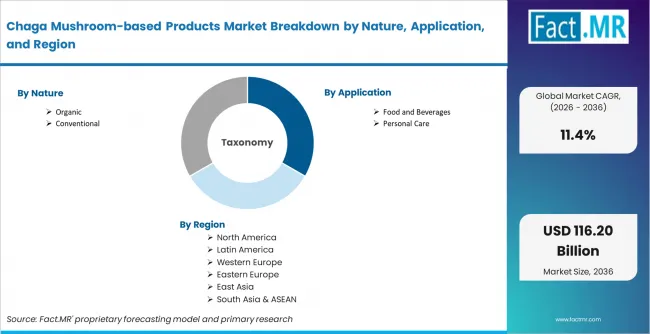
Chaga Mushroom-based Products Market Size, Share, Growth and Forecast (2026 - 2036)
The Chaga Mushroom-based Products Market is segmented by Nature (Organic and Conventional), Application (Food and Beverages and Personal Care), Product Form (Powder and Tea and Extract and Capsules and Beverages and Skincare), Source (Wild-Harvested and Cultivated and Fermented), Sales Channel (Online Retail and Specialty Stores and Supermarkets and Pharmacies and Direct Sales), End User (Individual Consumers and Wellness Practitioners and Food Brands and Beauty Brands and Ingredient Suppliers) and Region. Forecast for 2026 to 2036.
Chaga Mushroom-based Products Market Forecast and Outlook By Fact.MR
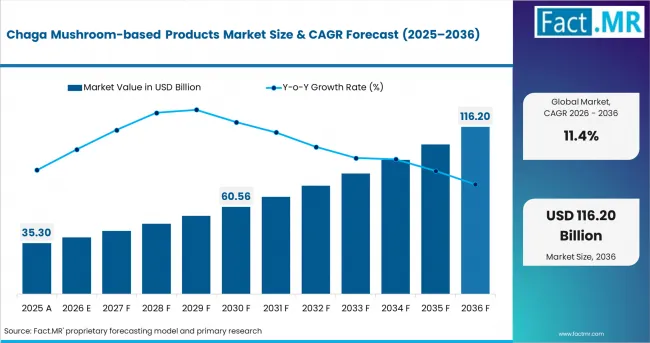
- The chaga mushroom-based products market crossed a valuation of USD 35.3 billion in 2025.
- Demand is estimated to reach USD 39.4 billion in 2026 and USD 116.2 billion by 2036.
- The industry is forecast to rise at 11.4% CAGR during the forecast period.
| Metric | Value |
|---|---|
| Estimated Value in 2026 | USD 39.4 billion |
| Forecast Value in 2036 | USD 116.2 billion |
| Forecast CAGR (2026 to 2036) | 11.4% |
Summary of Chaga Mushroom-based Products Market
- Demand Drivers
- Functional drink brands use chaga mushroom-based products in brewed mixes for daily wellness routines.
- Supplement users support capsule and powder demand as chaga grows in herbal retail channels.
- Beauty nutrition supports personal care use as chaga extracts move into skin care supplements and topical formulas.
- Key Segments Analyzed
- By Nature: Organic products are projected to hold 60.0% share in 2026 because certified claims help brands support source trust and higher shelf prices.
- By Application: Food and Beverages are projected to account for 70.0% share in 2026 as chaga tea blends and drink mixes support easy daily intake.
- By Product Form: Powder is estimated to hold 34.0% share in 2026 due to it works across drinks and capsules.
- By Source: Wild-Harvested chaga is forecast to hold 67.0% share in 2026 since cold-climate origin claims and birch source identity support product trust.
- By Sales Channel: Online Retail is estimated to account for 42.0% share in 2026 as small brands use direct storefronts to explain source proof and serving size.
- By End User: Individual Consumers are projected to account for 58.0% share in 2026 because home use drives powder and tea purchases for weekly wellness routines.
- Analyst Opinion at Fact.MR
- Shambhu Nath Jha, Principal Consultant at Fact.MR, opines "Chaga demand is moving from general wellness interest to repeat formats that consumers can use every week. Powders and brewed drinks offer the main demand path because they are easy to understand at the point of sale. Suppliers can gain through origin proof and clear labels. Brands should watch harvest limits and claim review risk as chaga moves from specialty shelves to wider supplement and beverage retail."
- Strategic Implications
- Manufacturers should prioritize organic chaga mushroom powders and mushroom powder blends because these formats make dose control easier for repeat consumers.
- Brands should build traceable wild source programs for chaga mushroom extract because harvest origin affects trust.
- Retailers should place herbal supplement products as repeat purchase items, not short trial products.
The market is set to generate an incremental revenue opportunity of USD 76.8 billion between 2026 and 2036. Market growth is rising as wellness consumers use chaga powders and drink mixes in daily routines. Tea blends and functional drinks remain important because they make chaga easier to consume. Wild-harvested chaga also supports market value as brands use cold-climate origin claims and source proof to build trust.
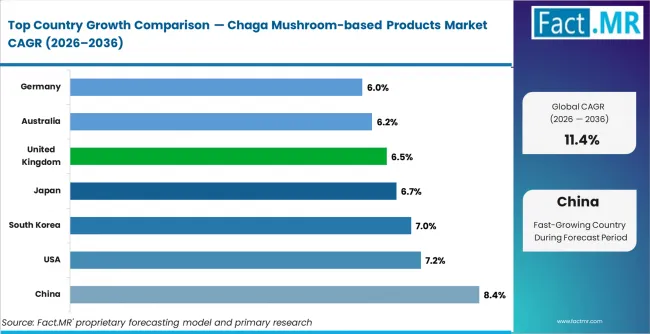
China is projected to record the highest CAGR at 8.4% through 2036 as traditional mushroom use and wellness retail expansion support chaga-based formats. The United States follows at 7.2% as supplement use and online retail make chaga powders easier to order. South Korea is expected to expand at 7.0% as functional drinks and beauty nutrition create cross-use demand. Japan is forecast to grow at 6.7% as aging consumers keep interest in functional foods. The United Kingdom advances at 6.5% as supplement routines support herbal product testing. Australia is forecast at 6.2% as naturopath channels support herbal extracts. Germany is expected to post 6.0% CAGR as herbal supplement retail remains regulated and quality focused.
Segmental Analysis
Chaga Mushroom-based Products Market Analysis by Nature
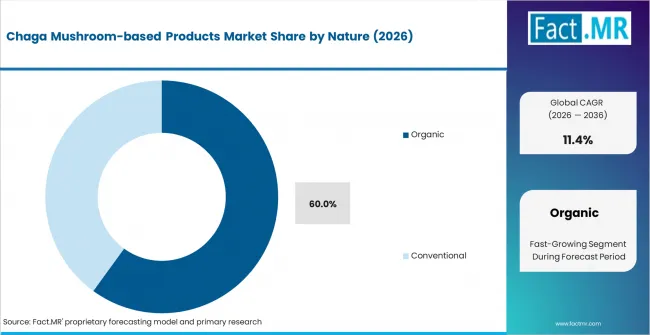
Organic products are likely to represent 60.0% share in 2026 as consumers pay more for source claims and residue control. The Organic Trade Association reported U.S. organic sales at USD 71.6 billion in 2024, which shows the retail base for certified wellness products. Organic chaga gains value from label trust and controlled handling. Conventional formats continue to serve price-sensitive consumers in powder and tea products. [2]
- Organic demand analysis: Certified chaga products hold share as supplement brands use organic proof to reduce concern around wild harvest quality and source control.
- Conventional product role: Conventional chaga remains common in mass online listings because lower prices help new users try the product.
- Certification pressure: Organic claims push suppliers to document harvest zones and processing steps before entering premium retail shelves.
Chaga Mushroom-based Products Market Analysis by Application
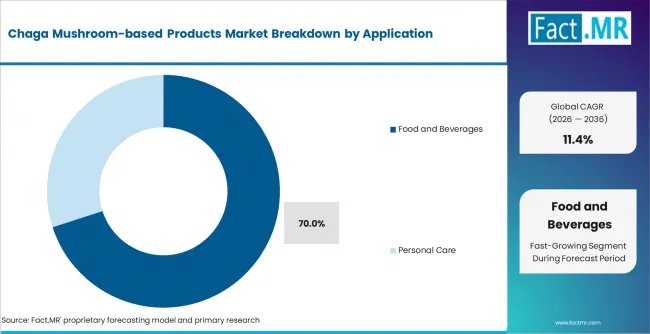
Food and Beverages are likely to account for 70.0% share in 2026 because chaga tea and drink mixes need less user education. A 2024 Molecules study tested 5% to 20% chaga flour in gluten-free bread and found that lower use levels balanced acceptance with antioxidant gain. This shows a clear product limit for food makers because flavor and color affect repeat use. Personal care products add another route through antioxidant positioning. [8]
- Food and beverage use: Functional foods makers prefer chaga powders because they blend into drink mixes and bakery trials with controlled dosing.
- Personal care use: Beauty brands test chaga extracts in creams and capsules as antioxidant claims align with skin and aging themes.
- Format crossover: Liquid mushroom products connect supplement users with ready-to-drink formats that support repeat use.
Chaga Mushroom-based Products Market Analysis by Product Form
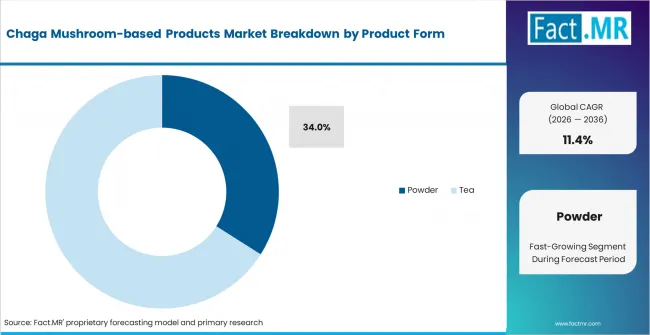
Powder is estimated to account for 34.0% share in 2026 as it works in drinks and dry blends. Powder also reduces shipping weight compared with bottled drinks. Tea follows as a familiar route for consumers seeking a low-dose herbal format. Extracts support ingredient makers that sell to supplement brands and nutraceutical formulators.
- Powder format demand: Brands prefer powder because it suits sachets and bulk jars with fewer handling issues.
- Tea format demand: Herbal tea makers use chaga as a familiar brew format for consumers who avoid stimulant drinks.
- Extract format demand: Botanical extract suppliers focus on standard concentration as brands ask for repeatable active levels.
Chaga Mushroom-based Products Market Analysis by Source
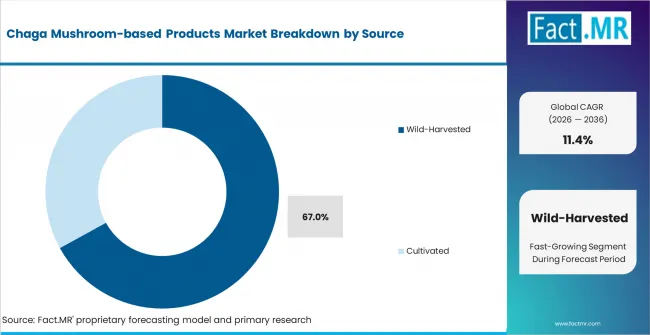
Wild-Harvested chaga is forecast to hold 67.0% share in 2026 since cold-climate birch origin remains central to brand claims. This reflects consumer trust in traditional sourcing, even as supply limits raise price pressure. Cultivated and fermented routes are being tested for scale and steady quality. Source proof will decide which suppliers can enter major supplement programs.
Wild source position: Wild chaga leads as heritage claims and birch tree origin support premium pricing in specialty retail.
Cultivated source testing: Controlled production can reduce supply risk for brands that need steady volumes all year.
Fermented ingredient route: Fermentation may help ingredient suppliers create steady inputs for botanical supplement blends.
Chaga Mushroom-based Products Market Analysis by Sales Channel
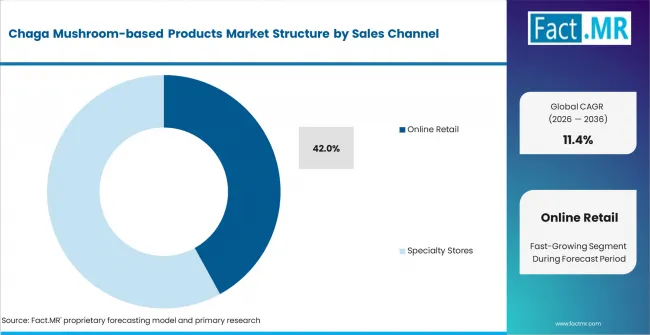
Online Retail is estimated to account for 42.0% share in 2026. Direct storefronts allow brands to explain origin and extraction through detailed product pages. Specialty stores still help consumers who need staff guidance. Supermarkets move slower because shelf space favors established supplement and tea brands.
- Online retail growth path: Direct stores help small chaga brands explain dose size and source proof without major retail reset costs.
- Specialty store role: Health food retailers support repeat use through guided product selection and small pack trials.
- Pharmacy channel route: Pharmacies can support capsules and softgels dietary supplements as claim review and label accuracy gain scrutiny.
Chaga Mushroom-based Products Market Analysis by End User
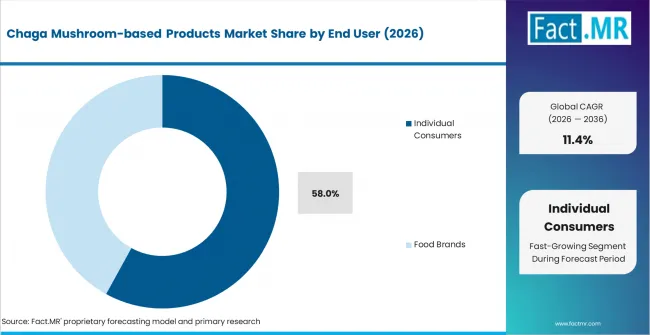
Individual Consumers are likely to account for 58.0% share in 2026 as home use drives powder and tea purchases. Wellness practitioners support smaller volumes through recommendations and clinic retail. Food brands use chaga as a botanical flavor and wellness ingredient. Beauty brands test chaga for antioxidant positioning in ingestible and topical formats.
- Individual consumer demand: Home users lead as powders and tea bags turn curiosity into weekly repeat use.
- Food brand demand: Beverage and bakery makers use chaga as a functional ingredient for limited product trials.
- Beauty brand demand: Personal care firms test chaga in health and wellness foods adjacencies and skin support products.
Drivers Restraints and Opportunities
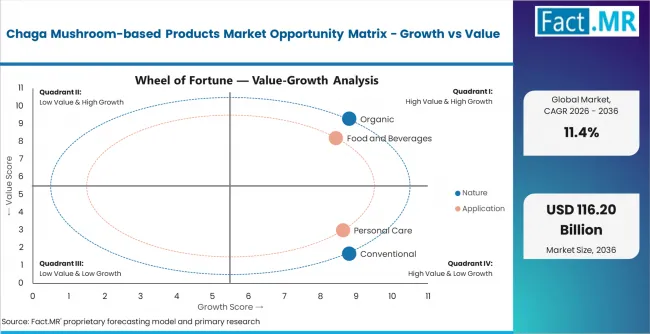
The chaga mushroom-based products market grows as supplement users move toward botanical products with simple formats. The American Botanical Council reported U.S. retail sales of herbal dietary supplements at USD 13.231 billion in 2024. This leaves room for chaga brands to compete on herbal shelves. The main demand path comes from powder and drink formats that are easy to use. [3]
- Supplement routine driver: Consumers already buying natural health supplement products can add chaga powders and capsules without changing retail channels.
- Supply restraint: Wild chaga harvest limits can tighten raw material availability and raise price pressure during heavy order periods.
- Food format opportunity: Tea infusion products offer a familiar brewed format with controlled ingredient strength.
Regional Analysis
The chaga mushroom-based products market is assessed across North America and Europe and East Asia and Oceania and the rest of the world. The full report covers 30+ countries by nature and application and product form. Country growth is based on source market data and one-year forecast adjustment for 2026 to 2036.
.webp)
| Country | CAGR (2026 to 2036) |
|---|---|
| China | 8.4% |
| United States | 7.2% |
| South Korea | 7.0% |
| Japan | 6.7% |
| United Kingdom | 6.5% |
| Australia | 6.2% |
| Germany | 6.0% |
Source: Fact.MR analysis, based on proprietary forecasting model and primary research
East Asia Chaga Mushroom-based Products Market Analysis
East Asia is growing quickly in the chaga mushroom-based products market. Familiarity with medicinal mushrooms reduces the need for consumer education in tea and tonic formats. Online wellness retail and functional drinks support wider use of chaga powders and extracts.
- China: China is projected to grow at 8.4% CAGR from 2026 to 2036. Traditional herbal use supports acceptance of chaga powders and extracts in wellness retail. Domestic brands can place chaga in tea and tonic formats that already have consumer trust in urban health product channels.
- South Korea: South Korea is expected to expand at 7.0% CAGR by 2036. Functional drinks and beauty nutrition create a practical route for chaga formats. The United States Department of Agriculture Foreign Agricultural Service recorded Korea’s health function food industry at KRW 5.07 trillion in 2024. [4]
- Japan: Japan is forecast to grow at 6.7% CAGR from 2026 to 2036. Aging consumers support functional food and herbal ingredient demand. The United States Department of Agriculture Foreign Agricultural Service reported Japan’s food processing output at USD 174 billion in 2024. [5]
North America Chaga Mushroom-based Products Market Analysis
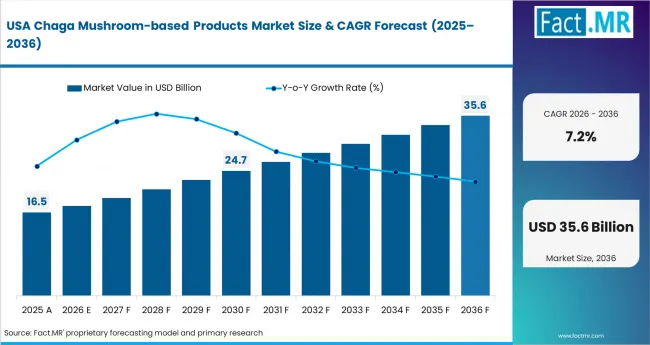
North America remains an important revenue base for chaga powders and tinctures. Supplement routines and natural product retail support repeat purchases. Wild chaga origin claims also support value positioning across specialty stores and direct online channels.
- United States: The United States is projected to grow at 7.2% CAGR by 2036. Online retail and natural product stores support new chaga formats. The Council for Responsible Nutrition reported that 75% of U.S. adults used dietary supplements in 2024. [1]
Europe Chaga Mushroom-based Products Market Analysis
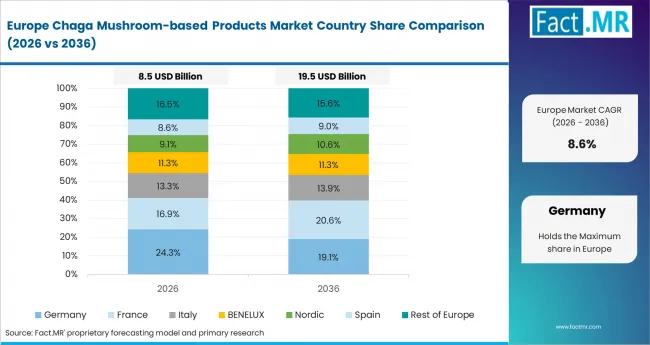
Europe grows through herbal supplement retail and organic certification needs. Careful claim review keeps label accuracy important for chaga brands. Specialty stores and online supplement channels support powders and capsules across the region.
- United Kingdom: The United Kingdom is expected to advance at 6.5% CAGR through 2036. Daily supplement routines support chaga capsules and powders. The Health Food Manufacturers Association reported that 64% of UK adults take a supplement daily in its latest research. [7]
- Germany: Germany is expected to post 6.0% CAGR through 2036. Regulated herbal retail supports traceable sourcing and clear labels. The United States Department of Agriculture Foreign Agricultural Service reported that Germany imported consumer-oriented agricultural products worth USD 92 billion in 2024. [6]
Oceania Chaga Mushroom-based Products Market Analysis
Oceania remains a selective market for chaga mushroom-based products. Naturopath channels and online supplement stores support botanical extract demand. Brands need clear serving guidance and batch testing before wider retail placement.
- Australia: Australia is forecast to grow at 6.2% CAGR through 2036. Naturopath channels and online supplement stores support botanical extracts. Local brands prefer clear labels and batch testing before adding unfamiliar mushroom ingredients. Chaga products are likely to move first through powders and tinctures.
Competitive Aligners for Market Players
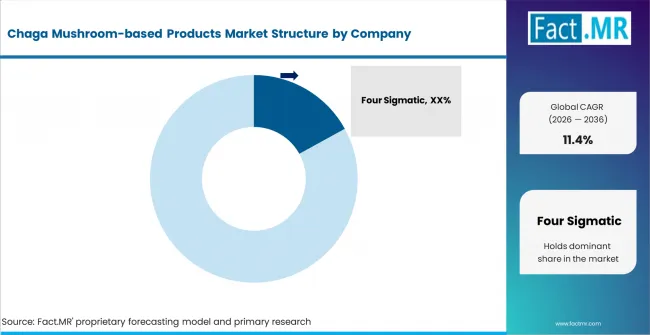
Chaga product companies compete on source proof and simple product formats. Four Sigmatic has a clear retail position through mushroom drinks and instant mixes. Sayan Chaga and Baikal Herbs focus on wild Siberian chaga and source identity. Host Defense Mushrooms serves repeat wellness users through mushroom powders and capsules.
Smaller brands can compete if they prove harvest origin, batch quality and label accuracy. Online retail makes entry easier but increases pressure from reviews and repeat orders. Companies that offer tea bags and powders with clear serving guidance can protect shelf space better than sellers using general wellness claims. Supplier credibility will shape account access as retailers demand proof of ingredient control.
Repeat quality matters more than a wide product range in this market. Companies with capsules, powders and brewed formats can serve supplement and beverage users. Brands with verified source files and simple claims should gain better placement in specialty retail. The next phase will reward firms that treat tea and supplement formats as repeat-use products, not one-time wellness trials.
Key Players
- Four Sigmatic
- Sayan Chaga
- Baikal Herbs Ltd.
- Host Defense Mushrooms
- My Berry Organics, LLC
- Nyishar
- Eartherbs LLC
Bibliography
- [1] Council for Responsible Nutrition. (2024, October 29). CRN survey shows consistent supplement usage with increase of specialty product use over time.
- [2] Organic Trade Association. (2025, April 23). Growth of U.S. organic marketplace accelerated in 2024.
- [3] Smith, T., Lang, C., & Craft, E. (2025). US sales of herbal supplements increase 5.4% in 2024. HerbalGram, 144, 46–69.
- [4] U.S. Department of Agriculture, Foreign Agricultural Service. (2026, April 6). Health functional food and supplements: Market brief for the Republic of Korea (GAIN Report No. KS2026-0003).
- [5] U.S. Department of Agriculture, Foreign Agricultural Service. (2025, April 1). Food processing ingredients annual: Japan (GAIN Report No. JA2025-0014).
- [6] U.S. Department of Agriculture, Foreign Agricultural Service. (2026, March 30). Food processing ingredients annual: Germany (GAIN Report No. GM2026-0007).
- [7] Health Food Manufacturers’ Association. (2025, November 22). Younger consumers are taking more supplements, overall use slips back to pre-pandemic levels.
- [8] Kobus, Z., Krzywicka, M., Blicharz-Kania, A., Bosacka, A., Pecyna, A., Ivanišová, E., Kozłowicz, K., & Kovačiková, E. (2024). Impact of incorporating dried chaga mushroom (Inonotus obliquus) into gluten-free bread on its antioxidant and sensory characteristics. Molecules, 29(16), Article 3801.
This Report Addresses
- Demand analysis for chaga mushroom-based products across food and beverages and personal care products worldwide.
- Forecast from USD 39.4 billion in 2026 to USD 116.2 billion by 2036 at 11.4% CAGR.
- Segment analysis by nature and application and product form and source and sales channel and end user.
- Country analysis for China and United States and South Korea and Japan and United Kingdom and Australia and Germany.
- Company analysis of Four Sigmatic and Sayan Chaga and Baikal Herbs Ltd. and Host Defense Mushrooms
- Assessment of source proof and extract quality and format strategy for supplement and beverage brands.
- Delivery in document format supported by supplied market data and public source checks.
Chaga Mushroom-based Products Market Definition
The chaga mushroom-based products market covers consumer and ingredient products made from Inonotus obliquus for food, beverage, supplement and personal care use. The scope includes chaga powders, teas, extracts, capsules, beverages and skincare formats sold through online retail, specialty stores, supermarkets, pharmacies and direct sales channels.
Chaga Mushroom-based Products Market Inclusions
Covers global and regional market forecasts from 2026 to 2036 by nature, application, product form, source, sales channel and end user. Includes organic and conventional chaga products. Wild-harvested, cultivated and fermented sources are covered. End-use coverage includes individual consumers, wellness practitioners, food brands, beauty brands and ingredient suppliers.
Chaga Mushroom-based Products Market Exclusions
Excludes non-chaga mushroom products sold without Inonotus obliquus content. Omits general herbal supplements where chaga is not the main marketed ingredient. Excludes raw birch material, unrelated mushroom extracts and finished wellness products that do not identify chaga as an active ingredient.
Chaga Mushroom-based Products Market Research Methodology
- Primary Research
- Interviews covered herbal supplement brand managers, functional beverage formulators, botanical ingredient suppliers, specialty wellness retailers, naturopath channel operators and chaga product distributors. Field inputs covered China, the United States, South Korea, Japan, the United Kingdom, Australia and Germany.
- Desk Research
- Desk research used supplement usage surveys, organic product sales data, herbal supplement sales records and food processing ingredient reports. Company review covered public product information from Four Sigmatic, Sayan Chaga, Baikal Herbs, Host Defense Mushrooms, My Berry Organics, Nyishar and Eartherbs.
- Market-Sizing and Forecasting
- The model combined top-down herbal supplement and functional food demand with bottom-up checks by product form and sales channel. Powder, tea and extract demand were assessed separately. Source mix was tested through wild-harvested supply signals and online retail product counts.
- Data Validation and Update Cycle
- The forecast was validated through brand portfolio checks, ingredient supplier feedback, online retail listings, specialty store channel inputs and batch quality documentation. Updates are made annually as wild chaga availability, supplement label rules, organic certification activity and consumer product formats change.
Scope of the Report

| Attribute | Details |
|---|---|
| Quantitative Units | USD 39.4 billion in 2026 to USD 116.2 billion by 2036 at 11.4% CAGR |
| Market Definition | Consumer and ingredient products made from Inonotus obliquus for foods and beverages and supplements and personal care use. |
| Nature Segmentation | Organic, Conventional |
| Application Segmentation | Food and Beverages, Personal Care |
| Product Form Segmentation | Powder, Tea, Extract, Capsules, Beverages, Skincare |
| Source Segmentation | Wild-Harvested, Cultivated, Fermented |
| Sales Channel Segmentation | Online Retail, Specialty Stores, Supermarkets, Pharmacies, Direct Sales |
| End User Segmentation | Individual Consumers, Wellness Practitioners, Food Brands, Beauty Brands, Ingredient Suppliers |
| Regions Covered | North America, Europe, East Asia, Oceania, Rest of World |
| Countries Covered | China, United States, South Korea, Japan, United Kingdom, Australia, Germany |
| Key Companies Profiled | Four Sigmatic, Sayan Chaga, Baikal Herbs Ltd., Host Defense Mushrooms, My Berry Organics LLC, Nyishar, Eartherbs LLC |
| Forecast Period | 2026 to 2036 |
| Approach | One-year forward shift using supplied market values and segment level triangulation |
Chaga Mushroom-based Products Market by Segment
-
By Nature
- Organic
- Conventional
-
By Application
- Food and Beverages
- Personal Care
-
By Product Form
- Powder
- Tea
- Extract
- Capsules
- Beverages
- Skincare
-
By Source
- Wild-Harvested
- Cultivated
- Fermented
-
By Sales Channel
- Online Retail
- Specialty Stores
- Supermarkets
- Pharmacies
- Direct Sales
-
By End User
- Individual Consumers
- Wellness Practitioners
- Food Brands
- Beauty Brands
- Ingredient Suppliers
-
By Region
- North America
- United States
- Canada
- Mexico
- Western Europe
- Germany
- United Kingdom
- France
- Italy
- Spain
- Netherlands
- Nordic Countries
- BENELUX
- Rest of Western Europe
- Eastern Europe
- Poland
- Hungary
- Balkan and Baltic
- Rest of Eastern Europe
- East Asia
- China
- Japan
- South Korea
- South Asia and Pacific
- India
- ASEAN
- Australia and New Zealand
- Rest of South Asia and Pacific
- Middle East and Africa
- Kingdom of Saudi Arabia
- Other GCC Countries
- Turkey
- South Africa
- Rest of Middle East and Africa
- North America
- Frequently Asked Questions -
How large is the Chaga Mushroom-based Products Market in 2025?
The Chaga Mushroom-based Products Market was valued at USD 35.3 billion in 2025.
What will the Chaga Mushroom-based Products Market size be in 2026?
The Chaga Mushroom-based Products Market is estimated to reach USD 39.4 billion in 2026.
What is the projected Chaga Mushroom-based Products Market size by 2036?
The Chaga Mushroom-based Products Market is projected to reach USD 116.2 billion by 2036.
What is the expected CAGR for the Chaga Mushroom-based Products Market?
The Chaga Mushroom-based Products Market is forecast to rise at 11.4% CAGR during the forecast period.
Which application leads the Chaga Mushroom-based Products Market?
Food and Beverages are projected to account for 70.0% share in 2026 as drink and tea formats support routine consumption.
Which country records the fastest Chaga Mushroom-based Products Market growth?
China is projected to record 8.4% CAGR through 2036 as traditional mushroom use supports product acceptance.
Table of Content
- Executive Summary
- Global Market Outlook
- Demand to side Trends
- Supply to side Trends
- Technology Roadmap Analysis
- Analysis and Recommendations
- Market Overview
- Market Coverage / Taxonomy
- Market Definition / Scope / Limitations
- Research Methodology
- Chapter Orientation
- Analytical Lens and Working Hypotheses
- Market Structure, Signals, and Trend Drivers
- Benchmarking and Cross-market Comparability
- Market Sizing, Forecasting, and Opportunity Mapping
- Research Design and Evidence Framework
- Desk Research Programme (Secondary Evidence)
- Company Annual and Sustainability Reports
- Peer-reviewed Journals and Academic Literature
- Corporate Websites, Product Literature, and Technical Notes
- Earnings Decks and Investor Briefings
- Statutory Filings and Regulatory Disclosures
- Technical White Papers and Standards Notes
- Trade Journals, Industry Magazines, and Analyst Briefs
- Conference Proceedings, Webinars, and Seminar Materials
- Government Statistics Portals and Public Data Releases
- Press Releases and Reputable Media Coverage
- Specialist Newsletters and Curated Briefings
- Sector Databases and Reference Repositories
- Fact.MR Internal Proprietary Databases and Historical Market Datasets
- Subscription Datasets and Paid Sources
- Social Channels, Communities, and Digital Listening Inputs
- Additional Desk Sources
- Expert Input and Fieldwork (Primary Evidence)
- Primary Modes
- Qualitative Interviews and Expert Elicitation
- Quantitative Surveys and Structured Data Capture
- Blended Approach
- Why Primary Evidence is Used
- Field Techniques
- Interviews
- Surveys
- Focus Groups
- Observational and In-context Research
- Social and Community Interactions
- Stakeholder Universe Engaged
- C-suite Leaders
- Board Members
- Presidents and Vice Presidents
- R&D and Innovation Heads
- Technical Specialists
- Domain Subject-matter Experts
- Scientists
- Physicians and Other Healthcare Professionals
- Governance, Ethics, and Data Stewardship
- Research Ethics
- Data Integrity and Handling
- Primary Modes
- Tooling, Models, and Reference Databases
- Desk Research Programme (Secondary Evidence)
- Data Engineering and Model Build
- Data Acquisition and Ingestion
- Cleaning, Normalisation, and Verification
- Synthesis, Triangulation, and Analysis
- Quality Assurance and Audit Trail
- Market Background
- Market Dynamics
- Drivers
- Restraints
- Opportunity
- Trends
- Scenario Forecast
- Demand in Optimistic Scenario
- Demand in Likely Scenario
- Demand in Conservative Scenario
- Opportunity Map Analysis
- Product Life Cycle Analysis
- Supply Chain Analysis
- Investment Feasibility Matrix
- Value Chain Analysis
- PESTLE and Porter’s Analysis
- Regulatory Landscape
- Regional Parent Market Outlook
- Production and Consumption Statistics
- Import and Export Statistics
- Market Dynamics
- Global Market Analysis 2021 to 2025 and Forecast, 2026 to 2036
- Historical Market Size Value (USD Million) Analysis, 2021 to 2025
- Current and Future Market Size Value (USD Million) Projections, 2026 to 2036
- Y to o to Y Growth Trend Analysis
- Absolute $ Opportunity Analysis
- Global Market Pricing Analysis 2021 to 2025 and Forecast 2026 to 2036
- Global Market Analysis 2021 to 2025 and Forecast 2026 to 2036, By Nature
- Introduction / Key Findings
- Historical Market Size Value (USD Million) Analysis By Nature , 2021 to 2025
- Current and Future Market Size Value (USD Million) Analysis and Forecast By Nature , 2026 to 2036
- Organic
- Conventional
- Organic
- Y to o to Y Growth Trend Analysis By Nature , 2021 to 2025
- Absolute $ Opportunity Analysis By Nature , 2026 to 2036
- Global Market Analysis 2021 to 2025 and Forecast 2026 to 2036, By Application
- Introduction / Key Findings
- Historical Market Size Value (USD Million) Analysis By Application, 2021 to 2025
- Current and Future Market Size Value (USD Million) Analysis and Forecast By Application, 2026 to 2036
- Food and Beverages
- Personal Care
- Food and Beverages
- Y to o to Y Growth Trend Analysis By Application, 2021 to 2025
- Absolute $ Opportunity Analysis By Application, 2026 to 2036
- Global Market Analysis 2021 to 2025 and Forecast 2026 to 2036, By Product Form
- Introduction / Key Findings
- Historical Market Size Value (USD Million) Analysis By Product Form, 2021 to 2025
- Current and Future Market Size Value (USD Million) Analysis and Forecast By Product Form, 2026 to 2036
- Powder
- Tea
- Extract
- Powder
- Y to o to Y Growth Trend Analysis By Product Form, 2021 to 2025
- Absolute $ Opportunity Analysis By Product Form, 2026 to 2036
- Global Market Analysis 2021 to 2025 and Forecast 2026 to 2036, By Source
- Introduction / Key Findings
- Historical Market Size Value (USD Million) Analysis By Source, 2021 to 2025
- Current and Future Market Size Value (USD Million) Analysis and Forecast By Source, 2026 to 2036
- Wild-Harvested
- Cultivated
- Fermented
- Wild-Harvested
- Y to o to Y Growth Trend Analysis By Source, 2021 to 2025
- Absolute $ Opportunity Analysis By Source, 2026 to 2036
- Global Market Analysis 2021 to 2025 and Forecast 2026 to 2036, By Sales Channel
- Introduction / Key Findings
- Historical Market Size Value (USD Million) Analysis By Sales Channel, 2021 to 2025
- Current and Future Market Size Value (USD Million) Analysis and Forecast By Sales Channel, 2026 to 2036
- Online Retail
- Specialty Stores
- Supermarkets
- Online Retail
- Y to o to Y Growth Trend Analysis By Sales Channel, 2021 to 2025
- Absolute $ Opportunity Analysis By Sales Channel, 2026 to 2036
- Global Market Analysis 2021 to 2025 and Forecast 2026 to 2036, By End User
- Introduction / Key Findings
- Historical Market Size Value (USD Million) Analysis By End User, 2021 to 2025
- Current and Future Market Size Value (USD Million) Analysis and Forecast By End User, 2026 to 2036
- Individual Consumers
- Food Brands
- Beauty Brands
- Individual Consumers
- Y to o to Y Growth Trend Analysis By End User, 2021 to 2025
- Absolute $ Opportunity Analysis By End User, 2026 to 2036
- Global Market Analysis 2021 to 2025 and Forecast 2026 to 2036, By Region
- Introduction
- Historical Market Size Value (USD Million) Analysis By Region, 2021 to 2025
- Current Market Size Value (USD Million) Analysis and Forecast By Region, 2026 to 2036
- North America
- Latin America
- Western Europe
- Eastern Europe
- East Asia
- South Asia and Pacific
- Middle East & Africa
- Market Attractiveness Analysis By Region
- North America Market Analysis 2021 to 2025 and Forecast 2026 to 2036, By Country
- Historical Market Size Value (USD Million) Trend Analysis By Market Taxonomy, 2021 to 2025
- Market Size Value (USD Million) Forecast By Market Taxonomy, 2026 to 2036
- By Country
- USA
- Canada
- Mexico
- By Nature
- By Application
- By Product Form
- By Source
- By Sales Channel
- By End User
- By Country
- Market Attractiveness Analysis
- By Country
- By Nature
- By Application
- By Product Form
- By Source
- By Sales Channel
- By End User
- Key Takeaways
- Latin America Market Analysis 2021 to 2025 and Forecast 2026 to 2036, By Country
- Historical Market Size Value (USD Million) Trend Analysis By Market Taxonomy, 2021 to 2025
- Market Size Value (USD Million) Forecast By Market Taxonomy, 2026 to 2036
- By Country
- Brazil
- Chile
- Rest of Latin America
- By Nature
- By Application
- By Product Form
- By Source
- By Sales Channel
- By End User
- By Country
- Market Attractiveness Analysis
- By Country
- By Nature
- By Application
- By Product Form
- By Source
- By Sales Channel
- By End User
- Key Takeaways
- Western Europe Market Analysis 2021 to 2025 and Forecast 2026 to 2036, By Country
- Historical Market Size Value (USD Million) Trend Analysis By Market Taxonomy, 2021 to 2025
- Market Size Value (USD Million) Forecast By Market Taxonomy, 2026 to 2036
- By Country
- Germany
- UK
- Italy
- Spain
- France
- Nordic
- BENELUX
- Rest of Western Europe
- By Nature
- By Application
- By Product Form
- By Source
- By Sales Channel
- By End User
- By Country
- Market Attractiveness Analysis
- By Country
- By Nature
- By Application
- By Product Form
- By Source
- By Sales Channel
- By End User
- Key Takeaways
- Eastern Europe Market Analysis 2021 to 2025 and Forecast 2026 to 2036, By Country
- Historical Market Size Value (USD Million) Trend Analysis By Market Taxonomy, 2021 to 2025
- Market Size Value (USD Million) Forecast By Market Taxonomy, 2026 to 2036
- By Country
- Russia
- Poland
- Hungary
- Balkan & Baltic
- Rest of Eastern Europe
- By Nature
- By Application
- By Product Form
- By Source
- By Sales Channel
- By End User
- By Country
- Market Attractiveness Analysis
- By Country
- By Nature
- By Application
- By Product Form
- By Source
- By Sales Channel
- By End User
- Key Takeaways
- East Asia Market Analysis 2021 to 2025 and Forecast 2026 to 2036, By Country
- Historical Market Size Value (USD Million) Trend Analysis By Market Taxonomy, 2021 to 2025
- Market Size Value (USD Million) Forecast By Market Taxonomy, 2026 to 2036
- By Country
- China
- Japan
- South Korea
- By Nature
- By Application
- By Product Form
- By Source
- By Sales Channel
- By End User
- By Country
- Market Attractiveness Analysis
- By Country
- By Nature
- By Application
- By Product Form
- By Source
- By Sales Channel
- By End User
- Key Takeaways
- South Asia and Pacific Market Analysis 2021 to 2025 and Forecast 2026 to 2036, By Country
- Historical Market Size Value (USD Million) Trend Analysis By Market Taxonomy, 2021 to 2025
- Market Size Value (USD Million) Forecast By Market Taxonomy, 2026 to 2036
- By Country
- India
- ASEAN
- Australia & New Zealand
- Rest of South Asia and Pacific
- By Nature
- By Application
- By Product Form
- By Source
- By Sales Channel
- By End User
- By Country
- Market Attractiveness Analysis
- By Country
- By Nature
- By Application
- By Product Form
- By Source
- By Sales Channel
- By End User
- Key Takeaways
- Middle East & Africa Market Analysis 2021 to 2025 and Forecast 2026 to 2036, By Country
- Historical Market Size Value (USD Million) Trend Analysis By Market Taxonomy, 2021 to 2025
- Market Size Value (USD Million) Forecast By Market Taxonomy, 2026 to 2036
- By Country
- Kingdom of Saudi Arabia
- Other GCC Countries
- Turkiye
- South Africa
- Other African Union
- Rest of Middle East & Africa
- By Nature
- By Application
- By Product Form
- By Source
- By Sales Channel
- By End User
- By Country
- Market Attractiveness Analysis
- By Country
- By Nature
- By Application
- By Product Form
- By Source
- By Sales Channel
- By End User
- Key Takeaways
- Key Countries Market Analysis
- USA
- Pricing Analysis
- Market Share Analysis, 2025
- By Nature
- By Application
- By Product Form
- By Source
- By Sales Channel
- By End User
- Canada
- Pricing Analysis
- Market Share Analysis, 2025
- By Nature
- By Application
- By Product Form
- By Source
- By Sales Channel
- By End User
- Mexico
- Pricing Analysis
- Market Share Analysis, 2025
- By Nature
- By Application
- By Product Form
- By Source
- By Sales Channel
- By End User
- Brazil
- Pricing Analysis
- Market Share Analysis, 2025
- By Nature
- By Application
- By Product Form
- By Source
- By Sales Channel
- By End User
- Chile
- Pricing Analysis
- Market Share Analysis, 2025
- By Nature
- By Application
- By Product Form
- By Source
- By Sales Channel
- By End User
- Germany
- Pricing Analysis
- Market Share Analysis, 2025
- By Nature
- By Application
- By Product Form
- By Source
- By Sales Channel
- By End User
- UK
- Pricing Analysis
- Market Share Analysis, 2025
- By Nature
- By Application
- By Product Form
- By Source
- By Sales Channel
- By End User
- Italy
- Pricing Analysis
- Market Share Analysis, 2025
- By Nature
- By Application
- By Product Form
- By Source
- By Sales Channel
- By End User
- Spain
- Pricing Analysis
- Market Share Analysis, 2025
- By Nature
- By Application
- By Product Form
- By Source
- By Sales Channel
- By End User
- France
- Pricing Analysis
- Market Share Analysis, 2025
- By Nature
- By Application
- By Product Form
- By Source
- By Sales Channel
- By End User
- India
- Pricing Analysis
- Market Share Analysis, 2025
- By Nature
- By Application
- By Product Form
- By Source
- By Sales Channel
- By End User
- ASEAN
- Pricing Analysis
- Market Share Analysis, 2025
- By Nature
- By Application
- By Product Form
- By Source
- By Sales Channel
- By End User
- Australia & New Zealand
- Pricing Analysis
- Market Share Analysis, 2025
- By Nature
- By Application
- By Product Form
- By Source
- By Sales Channel
- By End User
- China
- Pricing Analysis
- Market Share Analysis, 2025
- By Nature
- By Application
- By Product Form
- By Source
- By Sales Channel
- By End User
- Japan
- Pricing Analysis
- Market Share Analysis, 2025
- By Nature
- By Application
- By Product Form
- By Source
- By Sales Channel
- By End User
- South Korea
- Pricing Analysis
- Market Share Analysis, 2025
- By Nature
- By Application
- By Product Form
- By Source
- By Sales Channel
- By End User
- Russia
- Pricing Analysis
- Market Share Analysis, 2025
- By Nature
- By Application
- By Product Form
- By Source
- By Sales Channel
- By End User
- Poland
- Pricing Analysis
- Market Share Analysis, 2025
- By Nature
- By Application
- By Product Form
- By Source
- By Sales Channel
- By End User
- Hungary
- Pricing Analysis
- Market Share Analysis, 2025
- By Nature
- By Application
- By Product Form
- By Source
- By Sales Channel
- By End User
- Kingdom of Saudi Arabia
- Pricing Analysis
- Market Share Analysis, 2025
- By Nature
- By Application
- By Product Form
- By Source
- By Sales Channel
- By End User
- Turkiye
- Pricing Analysis
- Market Share Analysis, 2025
- By Nature
- By Application
- By Product Form
- By Source
- By Sales Channel
- By End User
- South Africa
- Pricing Analysis
- Market Share Analysis, 2025
- By Nature
- By Application
- By Product Form
- By Source
- By Sales Channel
- By End User
- USA
- Market Structure Analysis
- Competition Dashboard
- Competition Benchmarking
- Market Share Analysis of Top Players
- By Regional
- By Nature
- By Application
- By Product Form
- By Source
- By Sales Channel
- By End User
- Competition Analysis
- Competition Deep Dive
- Four Sigmatic
- Overview
- Product Portfolio
- Profitability by Market Segments (Product/Age /Sales Channel/Region)
- Sales Footprint
- Strategy Overview
- Marketing Strategy
- Product Strategy
- Channel Strategy
- Sayan Chaga
- Baikal Herbs Ltd.
- Host Defense Mushrooms
- My Berry Organics, LLC
- Nyishar
- Four Sigmatic
- Competition Deep Dive
- Assumptions & Acronyms Used
List Of Table
- Table 1: Global Market Value (USD Million) Forecast by Region, 2021 to 2036
- Table 2: Global Market Value (USD Million) Forecast by Nature, 2021 to 2036
- Table 3: Global Market Value (USD Million) Forecast by Application, 2021 to 2036
- Table 4: Global Market Value (USD Million) Forecast by Product Form, 2021 to 2036
- Table 5: Global Market Value (USD Million) Forecast by Source, 2021 to 2036
- Table 6: Global Market Value (USD Million) Forecast by Sales Channel, 2021 to 2036
- Table 7: Global Market Value (USD Million) Forecast by End User, 2021 to 2036
- Table 8: North America Market Value (USD Million) Forecast by Country, 2021 to 2036
- Table 9: North America Market Value (USD Million) Forecast by Nature, 2021 to 2036
- Table 10: North America Market Value (USD Million) Forecast by Application, 2021 to 2036
- Table 11: North America Market Value (USD Million) Forecast by Product Form, 2021 to 2036
- Table 12: North America Market Value (USD Million) Forecast by Source, 2021 to 2036
- Table 13: North America Market Value (USD Million) Forecast by Sales Channel, 2021 to 2036
- Table 14: North America Market Value (USD Million) Forecast by End User, 2021 to 2036
- Table 15: Latin America Market Value (USD Million) Forecast by Country, 2021 to 2036
- Table 16: Latin America Market Value (USD Million) Forecast by Nature, 2021 to 2036
- Table 17: Latin America Market Value (USD Million) Forecast by Application, 2021 to 2036
- Table 18: Latin America Market Value (USD Million) Forecast by Product Form, 2021 to 2036
- Table 19: Latin America Market Value (USD Million) Forecast by Source, 2021 to 2036
- Table 20: Latin America Market Value (USD Million) Forecast by Sales Channel, 2021 to 2036
- Table 21: Latin America Market Value (USD Million) Forecast by End User, 2021 to 2036
- Table 22: Western Europe Market Value (USD Million) Forecast by Country, 2021 to 2036
- Table 23: Western Europe Market Value (USD Million) Forecast by Nature, 2021 to 2036
- Table 24: Western Europe Market Value (USD Million) Forecast by Application, 2021 to 2036
- Table 25: Western Europe Market Value (USD Million) Forecast by Product Form, 2021 to 2036
- Table 26: Western Europe Market Value (USD Million) Forecast by Source, 2021 to 2036
- Table 27: Western Europe Market Value (USD Million) Forecast by Sales Channel, 2021 to 2036
- Table 28: Western Europe Market Value (USD Million) Forecast by End User, 2021 to 2036
- Table 29: Eastern Europe Market Value (USD Million) Forecast by Country, 2021 to 2036
- Table 30: Eastern Europe Market Value (USD Million) Forecast by Nature, 2021 to 2036
- Table 31: Eastern Europe Market Value (USD Million) Forecast by Application, 2021 to 2036
- Table 32: Eastern Europe Market Value (USD Million) Forecast by Product Form, 2021 to 2036
- Table 33: Eastern Europe Market Value (USD Million) Forecast by Source, 2021 to 2036
- Table 34: Eastern Europe Market Value (USD Million) Forecast by Sales Channel, 2021 to 2036
- Table 35: Eastern Europe Market Value (USD Million) Forecast by End User, 2021 to 2036
- Table 36: East Asia Market Value (USD Million) Forecast by Country, 2021 to 2036
- Table 37: East Asia Market Value (USD Million) Forecast by Nature, 2021 to 2036
- Table 38: East Asia Market Value (USD Million) Forecast by Application, 2021 to 2036
- Table 39: East Asia Market Value (USD Million) Forecast by Product Form, 2021 to 2036
- Table 40: East Asia Market Value (USD Million) Forecast by Source, 2021 to 2036
- Table 41: East Asia Market Value (USD Million) Forecast by Sales Channel, 2021 to 2036
- Table 42: East Asia Market Value (USD Million) Forecast by End User, 2021 to 2036
- Table 43: South Asia and Pacific Market Value (USD Million) Forecast by Country, 2021 to 2036
- Table 44: South Asia and Pacific Market Value (USD Million) Forecast by Nature, 2021 to 2036
- Table 45: South Asia and Pacific Market Value (USD Million) Forecast by Application, 2021 to 2036
- Table 46: South Asia and Pacific Market Value (USD Million) Forecast by Product Form, 2021 to 2036
- Table 47: South Asia and Pacific Market Value (USD Million) Forecast by Source, 2021 to 2036
- Table 48: South Asia and Pacific Market Value (USD Million) Forecast by Sales Channel, 2021 to 2036
- Table 49: South Asia and Pacific Market Value (USD Million) Forecast by End User, 2021 to 2036
- Table 50: Middle East & Africa Market Value (USD Million) Forecast by Country, 2021 to 2036
- Table 51: Middle East & Africa Market Value (USD Million) Forecast by Nature, 2021 to 2036
- Table 52: Middle East & Africa Market Value (USD Million) Forecast by Application, 2021 to 2036
- Table 53: Middle East & Africa Market Value (USD Million) Forecast by Product Form, 2021 to 2036
- Table 54: Middle East & Africa Market Value (USD Million) Forecast by Source, 2021 to 2036
- Table 55: Middle East & Africa Market Value (USD Million) Forecast by Sales Channel, 2021 to 2036
- Table 56: Middle East & Africa Market Value (USD Million) Forecast by End User, 2021 to 2036
List Of Figures
- Figure 1: Global Market Pricing Analysis
- Figure 2: Global Market Value (USD Million) Forecast 2021-2036
- Figure 3: Global Market Value Share and BPS Analysis by Nature, 2026 and 2036
- Figure 4: Global Market Y-o-Y Growth Comparison by Nature, 2026 to 2036
- Figure 5: Global Market Attractiveness Analysis by Nature
- Figure 6: Global Market Value Share and BPS Analysis by Application, 2026 and 2036
- Figure 7: Global Market Y-o-Y Growth Comparison by Application, 2026 to 2036
- Figure 8: Global Market Attractiveness Analysis by Application
- Figure 9: Global Market Value Share and BPS Analysis by Product Form, 2026 and 2036
- Figure 10: Global Market Y-o-Y Growth Comparison by Product Form, 2026 to 2036
- Figure 11: Global Market Attractiveness Analysis by Product Form
- Figure 12: Global Market Value Share and BPS Analysis by Source, 2026 and 2036
- Figure 13: Global Market Y-o-Y Growth Comparison by Source, 2026 to 2036
- Figure 14: Global Market Attractiveness Analysis by Source
- Figure 15: Global Market Value Share and BPS Analysis by Sales Channel, 2026 and 2036
- Figure 16: Global Market Y-o-Y Growth Comparison by Sales Channel, 2026 to 2036
- Figure 17: Global Market Attractiveness Analysis by Sales Channel
- Figure 18: Global Market Value Share and BPS Analysis by End User, 2026 and 2036
- Figure 19: Global Market Y-o-Y Growth Comparison by End User, 2026 to 2036
- Figure 20: Global Market Attractiveness Analysis by End User
- Figure 21: Global Market Value (USD Million) Share and BPS Analysis by Region, 2026 and 2036
- Figure 22: Global Market Y-o-Y Growth Comparison by Region, 2026 to 2036
- Figure 23: Global Market Attractiveness Analysis by Region
- Figure 24: North America Market Incremental Dollar Opportunity, 2026 to 2036
- Figure 25: Latin America Market Incremental Dollar Opportunity, 2026 to 2036
- Figure 26: Western Europe Market Incremental Dollar Opportunity, 2026 to 2036
- Figure 27: Eastern Europe Market Incremental Dollar Opportunity, 2026 to 2036
- Figure 28: East Asia Market Incremental Dollar Opportunity, 2026 to 2036
- Figure 29: South Asia and Pacific Market Incremental Dollar Opportunity, 2026 to 2036
- Figure 30: Middle East & Africa Market Incremental Dollar Opportunity, 2026 to 2036
- Figure 31: North America Market Value Share and BPS Analysis by Country, 2026 and 2036
- Figure 32: North America Market Value Share and BPS Analysis by Nature, 2026 and 2036
- Figure 33: North America Market Y-o-Y Growth Comparison by Nature, 2026 to 2036
- Figure 34: North America Market Attractiveness Analysis by Nature
- Figure 35: North America Market Value Share and BPS Analysis by Application, 2026 and 2036
- Figure 36: North America Market Y-o-Y Growth Comparison by Application, 2026 to 2036
- Figure 37: North America Market Attractiveness Analysis by Application
- Figure 38: North America Market Value Share and BPS Analysis by Product Form, 2026 and 2036
- Figure 39: North America Market Y-o-Y Growth Comparison by Product Form, 2026 to 2036
- Figure 40: North America Market Attractiveness Analysis by Product Form
- Figure 41: North America Market Value Share and BPS Analysis by Source, 2026 and 2036
- Figure 42: North America Market Y-o-Y Growth Comparison by Source, 2026 to 2036
- Figure 43: North America Market Attractiveness Analysis by Source
- Figure 44: North America Market Value Share and BPS Analysis by Sales Channel, 2026 and 2036
- Figure 45: North America Market Y-o-Y Growth Comparison by Sales Channel, 2026 to 2036
- Figure 46: North America Market Attractiveness Analysis by Sales Channel
- Figure 47: North America Market Value Share and BPS Analysis by End User, 2026 and 2036
- Figure 48: North America Market Y-o-Y Growth Comparison by End User, 2026 to 2036
- Figure 49: North America Market Attractiveness Analysis by End User
- Figure 50: Latin America Market Value Share and BPS Analysis by Country, 2026 and 2036
- Figure 51: Latin America Market Value Share and BPS Analysis by Nature, 2026 and 2036
- Figure 52: Latin America Market Y-o-Y Growth Comparison by Nature, 2026 to 2036
- Figure 53: Latin America Market Attractiveness Analysis by Nature
- Figure 54: Latin America Market Value Share and BPS Analysis by Application, 2026 and 2036
- Figure 55: Latin America Market Y-o-Y Growth Comparison by Application, 2026 to 2036
- Figure 56: Latin America Market Attractiveness Analysis by Application
- Figure 57: Latin America Market Value Share and BPS Analysis by Product Form, 2026 and 2036
- Figure 58: Latin America Market Y-o-Y Growth Comparison by Product Form, 2026 to 2036
- Figure 59: Latin America Market Attractiveness Analysis by Product Form
- Figure 60: Latin America Market Value Share and BPS Analysis by Source, 2026 and 2036
- Figure 61: Latin America Market Y-o-Y Growth Comparison by Source, 2026 to 2036
- Figure 62: Latin America Market Attractiveness Analysis by Source
- Figure 63: Latin America Market Value Share and BPS Analysis by Sales Channel, 2026 and 2036
- Figure 64: Latin America Market Y-o-Y Growth Comparison by Sales Channel, 2026 to 2036
- Figure 65: Latin America Market Attractiveness Analysis by Sales Channel
- Figure 66: Latin America Market Value Share and BPS Analysis by End User, 2026 and 2036
- Figure 67: Latin America Market Y-o-Y Growth Comparison by End User, 2026 to 2036
- Figure 68: Latin America Market Attractiveness Analysis by End User
- Figure 69: Western Europe Market Value Share and BPS Analysis by Country, 2026 and 2036
- Figure 70: Western Europe Market Value Share and BPS Analysis by Nature, 2026 and 2036
- Figure 71: Western Europe Market Y-o-Y Growth Comparison by Nature, 2026 to 2036
- Figure 72: Western Europe Market Attractiveness Analysis by Nature
- Figure 73: Western Europe Market Value Share and BPS Analysis by Application, 2026 and 2036
- Figure 74: Western Europe Market Y-o-Y Growth Comparison by Application, 2026 to 2036
- Figure 75: Western Europe Market Attractiveness Analysis by Application
- Figure 76: Western Europe Market Value Share and BPS Analysis by Product Form, 2026 and 2036
- Figure 77: Western Europe Market Y-o-Y Growth Comparison by Product Form, 2026 to 2036
- Figure 78: Western Europe Market Attractiveness Analysis by Product Form
- Figure 79: Western Europe Market Value Share and BPS Analysis by Source, 2026 and 2036
- Figure 80: Western Europe Market Y-o-Y Growth Comparison by Source, 2026 to 2036
- Figure 81: Western Europe Market Attractiveness Analysis by Source
- Figure 82: Western Europe Market Value Share and BPS Analysis by Sales Channel, 2026 and 2036
- Figure 83: Western Europe Market Y-o-Y Growth Comparison by Sales Channel, 2026 to 2036
- Figure 84: Western Europe Market Attractiveness Analysis by Sales Channel
- Figure 85: Western Europe Market Value Share and BPS Analysis by End User, 2026 and 2036
- Figure 86: Western Europe Market Y-o-Y Growth Comparison by End User, 2026 to 2036
- Figure 87: Western Europe Market Attractiveness Analysis by End User
- Figure 88: Eastern Europe Market Value Share and BPS Analysis by Country, 2026 and 2036
- Figure 89: Eastern Europe Market Value Share and BPS Analysis by Nature, 2026 and 2036
- Figure 90: Eastern Europe Market Y-o-Y Growth Comparison by Nature, 2026 to 2036
- Figure 91: Eastern Europe Market Attractiveness Analysis by Nature
- Figure 92: Eastern Europe Market Value Share and BPS Analysis by Application, 2026 and 2036
- Figure 93: Eastern Europe Market Y-o-Y Growth Comparison by Application, 2026 to 2036
- Figure 94: Eastern Europe Market Attractiveness Analysis by Application
- Figure 95: Eastern Europe Market Value Share and BPS Analysis by Product Form, 2026 and 2036
- Figure 96: Eastern Europe Market Y-o-Y Growth Comparison by Product Form, 2026 to 2036
- Figure 97: Eastern Europe Market Attractiveness Analysis by Product Form
- Figure 98: Eastern Europe Market Value Share and BPS Analysis by Source, 2026 and 2036
- Figure 99: Eastern Europe Market Y-o-Y Growth Comparison by Source, 2026 to 2036
- Figure 100: Eastern Europe Market Attractiveness Analysis by Source
- Figure 101: Eastern Europe Market Value Share and BPS Analysis by Sales Channel, 2026 and 2036
- Figure 102: Eastern Europe Market Y-o-Y Growth Comparison by Sales Channel, 2026 to 2036
- Figure 103: Eastern Europe Market Attractiveness Analysis by Sales Channel
- Figure 104: Eastern Europe Market Value Share and BPS Analysis by End User, 2026 and 2036
- Figure 105: Eastern Europe Market Y-o-Y Growth Comparison by End User, 2026 to 2036
- Figure 106: Eastern Europe Market Attractiveness Analysis by End User
- Figure 107: East Asia Market Value Share and BPS Analysis by Country, 2026 and 2036
- Figure 108: East Asia Market Value Share and BPS Analysis by Nature, 2026 and 2036
- Figure 109: East Asia Market Y-o-Y Growth Comparison by Nature, 2026 to 2036
- Figure 110: East Asia Market Attractiveness Analysis by Nature
- Figure 111: East Asia Market Value Share and BPS Analysis by Application, 2026 and 2036
- Figure 112: East Asia Market Y-o-Y Growth Comparison by Application, 2026 to 2036
- Figure 113: East Asia Market Attractiveness Analysis by Application
- Figure 114: East Asia Market Value Share and BPS Analysis by Product Form, 2026 and 2036
- Figure 115: East Asia Market Y-o-Y Growth Comparison by Product Form, 2026 to 2036
- Figure 116: East Asia Market Attractiveness Analysis by Product Form
- Figure 117: East Asia Market Value Share and BPS Analysis by Source, 2026 and 2036
- Figure 118: East Asia Market Y-o-Y Growth Comparison by Source, 2026 to 2036
- Figure 119: East Asia Market Attractiveness Analysis by Source
- Figure 120: East Asia Market Value Share and BPS Analysis by Sales Channel, 2026 and 2036
- Figure 121: East Asia Market Y-o-Y Growth Comparison by Sales Channel, 2026 to 2036
- Figure 122: East Asia Market Attractiveness Analysis by Sales Channel
- Figure 123: East Asia Market Value Share and BPS Analysis by End User, 2026 and 2036
- Figure 124: East Asia Market Y-o-Y Growth Comparison by End User, 2026 to 2036
- Figure 125: East Asia Market Attractiveness Analysis by End User
- Figure 126: South Asia and Pacific Market Value Share and BPS Analysis by Country, 2026 and 2036
- Figure 127: South Asia and Pacific Market Value Share and BPS Analysis by Nature, 2026 and 2036
- Figure 128: South Asia and Pacific Market Y-o-Y Growth Comparison by Nature, 2026 to 2036
- Figure 129: South Asia and Pacific Market Attractiveness Analysis by Nature
- Figure 130: South Asia and Pacific Market Value Share and BPS Analysis by Application, 2026 and 2036
- Figure 131: South Asia and Pacific Market Y-o-Y Growth Comparison by Application, 2026 to 2036
- Figure 132: South Asia and Pacific Market Attractiveness Analysis by Application
- Figure 133: South Asia and Pacific Market Value Share and BPS Analysis by Product Form, 2026 and 2036
- Figure 134: South Asia and Pacific Market Y-o-Y Growth Comparison by Product Form, 2026 to 2036
- Figure 135: South Asia and Pacific Market Attractiveness Analysis by Product Form
- Figure 136: South Asia and Pacific Market Value Share and BPS Analysis by Source, 2026 and 2036
- Figure 137: South Asia and Pacific Market Y-o-Y Growth Comparison by Source, 2026 to 2036
- Figure 138: South Asia and Pacific Market Attractiveness Analysis by Source
- Figure 139: South Asia and Pacific Market Value Share and BPS Analysis by Sales Channel, 2026 and 2036
- Figure 140: South Asia and Pacific Market Y-o-Y Growth Comparison by Sales Channel, 2026 to 2036
- Figure 141: South Asia and Pacific Market Attractiveness Analysis by Sales Channel
- Figure 142: South Asia and Pacific Market Value Share and BPS Analysis by End User, 2026 and 2036
- Figure 143: South Asia and Pacific Market Y-o-Y Growth Comparison by End User, 2026 to 2036
- Figure 144: South Asia and Pacific Market Attractiveness Analysis by End User
- Figure 145: Middle East & Africa Market Value Share and BPS Analysis by Country, 2026 and 2036
- Figure 146: Middle East & Africa Market Value Share and BPS Analysis by Nature, 2026 and 2036
- Figure 147: Middle East & Africa Market Y-o-Y Growth Comparison by Nature, 2026 to 2036
- Figure 148: Middle East & Africa Market Attractiveness Analysis by Nature
- Figure 149: Middle East & Africa Market Value Share and BPS Analysis by Application, 2026 and 2036
- Figure 150: Middle East & Africa Market Y-o-Y Growth Comparison by Application, 2026 to 2036
- Figure 151: Middle East & Africa Market Attractiveness Analysis by Application
- Figure 152: Middle East & Africa Market Value Share and BPS Analysis by Product Form, 2026 and 2036
- Figure 153: Middle East & Africa Market Y-o-Y Growth Comparison by Product Form, 2026 to 2036
- Figure 154: Middle East & Africa Market Attractiveness Analysis by Product Form
- Figure 155: Middle East & Africa Market Value Share and BPS Analysis by Source, 2026 and 2036
- Figure 156: Middle East & Africa Market Y-o-Y Growth Comparison by Source, 2026 to 2036
- Figure 157: Middle East & Africa Market Attractiveness Analysis by Source
- Figure 158: Middle East & Africa Market Value Share and BPS Analysis by Sales Channel, 2026 and 2036
- Figure 159: Middle East & Africa Market Y-o-Y Growth Comparison by Sales Channel, 2026 to 2036
- Figure 160: Middle East & Africa Market Attractiveness Analysis by Sales Channel
- Figure 161: Middle East & Africa Market Value Share and BPS Analysis by End User, 2026 and 2036
- Figure 162: Middle East & Africa Market Y-o-Y Growth Comparison by End User, 2026 to 2036
- Figure 163: Middle East & Africa Market Attractiveness Analysis by End User
- Figure 164: Global Market - Tier Structure Analysis
- Figure 165: Global Market - Company Share Analysis