Directed Energy Chemical Fuel Lasers Market

Directed Energy Chemical Fuel Lasers Market Size and Share Forecast Outlook 2026 to 2036

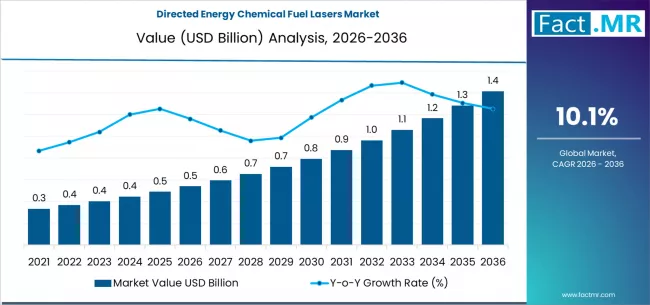
Directed energy chemical fuel lasers market is projected to grow from USD 0.5 billion in 2026 to USD 1.4 billion by 2036, at a CAGR of 10.1%. Deuterium Fluoride (DF) Lasers will dominate with a 38.0% market share, while missile defense systems will lead the application segment with a 41.0% share.

Directed Energy Chemical Fuel Lasers Market Forecast and Outlook 2026 to 2036

The global market for directed energy chemical fuel lasers is projected to accelerate from USD 0.54 billion in 2026 to USD 1.41 billion by 2036, advancing at a 10.1% CAGR. This growth trajectory is propelled by the urgent strategic shift from traditional kinetic interceptors toward scalable, speed-of-light defense solutions against evolving hypersonic and swarm threats.

Key Takeaways from the Directed Energy Chemical Fuel Lasers Market

  • Market Value for 2026: USD 0.54 Billion
  • Market Value for 2036: USD 1.41 Billion
  • Forecast CAGR (2026-2036): 10.1%
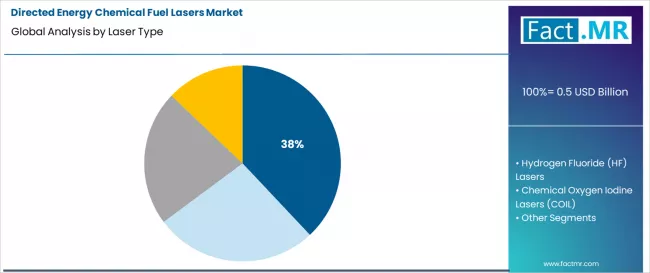
  • Leading Laser Type Segment (2026): Deuterium Fluoride (DF) Lasers (38%)
  • Leading Application Segment (2026): Missile Defense Systems (41%)
  • Leading End User Segment (2026): Defense Forces (56%)
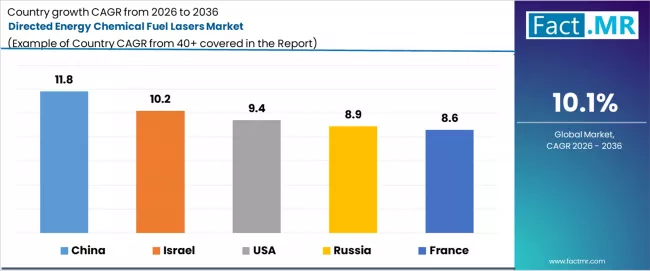
  • Key Growth Countries: China (11.80% CAGR), Israel (10.20% CAGR), USA (9.40% CAGR), Russia (8.90% CAGR), France (8.60% CAGR)
  • Key Players in the Market: Lockheed Martin, Northrop Grumman, Raytheon Technologies, Boeing Defense, Rafael Advanced Defense Systems

Directed Energy Chemical Fuel Lasers Market Market Value Analysis

Chemical fuel lasers, specifically deuterium fluoride and chemical oxygen iodine systems, offer a unique value proposition for high-power, mobile applications where electrical power and thermal management constraints limit solid-state alternatives.

The market is transitioning from protracted R&D cycles to the early stages of operational deployment and integration, driven by demonstrated test successes and clear capability gaps in national defense architectures. China’s leading 11.80% CAGR reflects a concentrated, state-backed push to achieve parity and asymmetry in next-generation warfare domains.

This expansion is less about the core laser technology itself and more about the integration of these high-energy sources into resilient platforms, coupled with advanced beam control and targeting systems, to create viable weapon system products.

Metric

Metric Value
Market Value (2026) USD 0.54 Billion
Market Forecast Value (2036) USD 1.41 Billion
Forecast CAGR (2026-2036) 10.1%

Category

Category Segments
Laser Type Deuterium Fluoride (DF) Lasers, Hydrogen Fluoride (HF) Lasers, Chemical Oxygen Iodine Lasers (COIL), Others
Application Missile Defense Systems, Directed Energy Weapons, Space & Satellite Defense, Research & Testing
End User Defense Forces, Government R&D Agencies, Aerospace Contractors
Region North America, Latin America, Western Europe, Eastern Europe, East Asia, South Asia & Pacific, MEA

Segmental Analysis

By Laser Type, Which Technology Balances Maturity with Strategic Power Output?

Directed Energy Chemical Fuel Lasers Market Analysis By Laser Type

Deuterium fluoride lasers lead the segment with a 38% share, favored for their atmospheric transmission advantages and high technology readiness level for mobile, high-power applications. Their emission in the mid-infrared spectrum offers superior propagation through humid and obscured atmospheres compared to shorter wavelength systems, a critical factor for ground-based and naval defense scenarios.

The extensive legacy of DF laser development, particularly for theater-level applications, provides a foundation of tested components and understood performance parameters, reducing integration risk for next-generation weapon system prototypes.

By Application, Where is the Operational Need Most Acute and Funded?

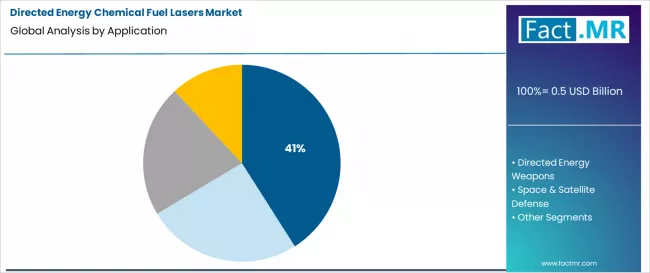
Directed Energy Chemical Fuel Lasers Market Analysis By Application

Missile defense systems constitute the dominant application at 41%. The proliferation of low-cost cruise missiles, drones, and advanced ballistic threats has created a cost-exchange problem for traditional interceptor missiles.

Chemical fuel lasers are being developed as a layer within a broader integrated air and missile defense network to address this, offering a deep magazine and low cost-per-engagement for specific threat sets. This application attracts the largest share of directed energy funding, as it addresses a clear and present operational shortfall for modern militaries.

By End User, Who is driving the Transition from Development to Procurement?

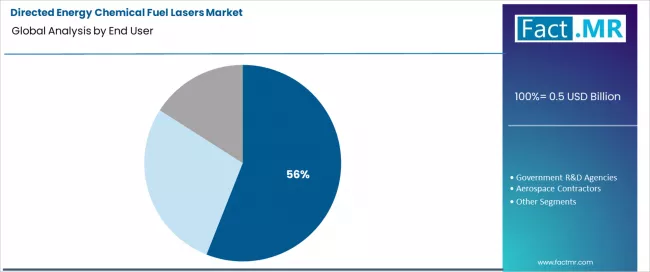
Directed Energy Chemical Fuel Lasers Market Analysis By End User

Defense forces are the primary end-users, commanding a 56% share. This reflects the transition of these systems from laboratory curiosities to program-of-record procurement pathways within army, navy, and air force branches.

Their role has evolved from sponsoring basic research to defining stringent operational requirements for reliability, maintenance, logistics, and integration with existing command and control systems. The budgetary authority and urgent need of defense forces are the ultimate drivers for market scale-up and production line establishment.

What are the Drivers, Restraints, and Key Trends of the Directed Energy Chemical Fuel Lasers Market?

The principal driver is the escalating need for affordable countermeasures against saturated attacks, where the cost of traditional interceptors becomes prohibitively high. This economic imperative is accelerating deployment timelines.

Advancements in adaptive optics and beam combining are finally unlocking the potential of chemical lasers to deliver focused energy at tactically relevant ranges under real-world conditions. Strategic competition among major powers is also creating an action-reaction cycle of investment, as demonstrated capabilities by one nation compel others to follow suit.

A significant restraint remains the formidable challenge of system integration and miniaturization for airborne or space-based platforms, where weight, volume, and chemical fuel management are critical constraints.

The logistics of storing, handling, and replenishing chemical fuels in forward-deployed or remote environments also present operational hurdles compared to all-electric systems. The highly classified nature of performance data and testing results creates an opaque market, making it difficult for new entrants to validate their technologies and for investors to assess progress.

Key trends include a shift toward hybrid approaches, where a chemical laser provides the primary high-power output but is seeded or combined with more manageable solid-state lasers for fine tracking and aiming. There is also a trend in developing closed-cycle or renewable chemical fuel systems to improve operational endurance and reduce logistical burden.

The market is seeing increased collaboration between traditional defense primes and specialized chemical and optics firms to solve material science challenges related to fuel efficiency and optic durability. Finally, the focus is expanding from merely destroying targets to graduated effects, such as dazzle or disable missions, which expands potential use cases and could ease regulatory and rules-of-engagement pathways.

Analysis of the Directed Energy Chemical fuel Lasers Market by Key Countries

Directed Energy Chemical Fuel Lasers Market Cagr Analysis By Country

Country CAGR (2026-2036)
China 11.80%
Israel 10.20%
USA 9.40%
Russia 8.90%
France 8.60%

How is China's Integrated Military-Civilian Fusion Strategy Accelerating Development?

China’s leading 11.80% CAGR is a direct output of its Military-Civilian Fusion strategy, which systematically leverages advancements in industrial chemistry, high-power optics, and power generation from the commercial sector for defense purposes.

This approach allows for rapid iteration and cost-effective scaling of chemical laser subsystems. Development is focused on creating area denial systems, with an emphasis on ground-based and naval platforms to secure regional territorial claims and counter advanced aerial threats, reflecting a focused and geography-specific deployment strategy.

What is the Impact of Israel's Focus on Asymmetric Tactical Defense Solutions?

Israel’s 10.20% growth is driven by an immediate, battle-tested requirement to defend against rocket and drone salvos from non-state actors. This creates a demand for tactical, mobile chemical laser systems that can be deployed rapidly and operate in challenging desert conditions.

Israeli development prioritizes system robustness, rapid engagement cycles, and integration with the country’s renowned multi-layered air defense network, aiming for a operational system that provides a cost-effective solution to persistent, low-end threat saturation.

Why is the USA's Emphasis on System Maturity and Strategic Layered Defense a Key Factor?

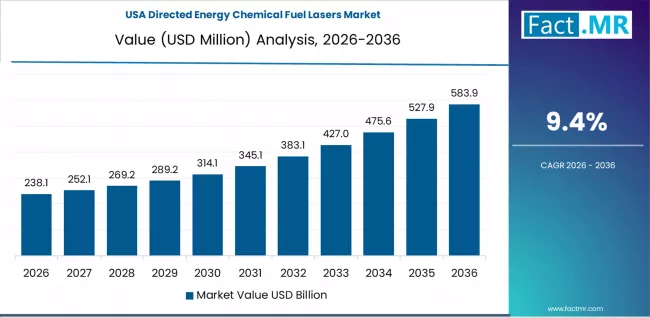
Directed Energy Chemical Fuel Lasers Market Country Value Analysis

The USA’s 9.40% growth is characterized by investments aimed at maturing specific chemical laser programs to achieve documented reliability and supportability milestones required for formal procurement.

The focus is on developing complementary capabilities within a layered defense architecture; for instance, chemical lasers for boost-phase intercept or ship defense, where their power and magazine depth offer unique advantages. The advanced U.S. testbed infrastructure allows for rigorous evaluation against realistic surrogate threats, de-risking future deployment decisions.

How is Russia's Pursuit of Asymmetric Capabilities Shaping its Program Direction?

Russia’s 8.90% CAGR reflects a strategic emphasis on developing counter-space and strategic defense applications, leveraging its historical strength in high-energy physics and chemical engineering. Programs are likely focused on ground-based systems designed to threaten satellites and other high-value assets, aligning with its doctrine of asymmetric escalation.

Development faces challenges related to access to advanced micro-electronics for beam control, but benefits from a concentrated state prioritization on weapons that can alter strategic calculus.

What Role does France's Sovereign European Defense Initiative Play?

France’s 8.60% growth is anchored in its commitment to European strategic autonomy and its desire to maintain a sovereign defense industrial base across all cutting-edge technology domains.

French investment in chemical fuel lasers is part of a broader directed energy portfolio, ensuring it retains the expertise and capability to field future weapon systems independently. Collaboration with other European nations is likely, but with a clear intent to host core technology development and integration expertise domestically.

Competitive Landscape of the Directed Energy Chemical Fuel Lasers Market

Directed Energy Chemical Fuel Lasers Market Analysis By Company

The competitive landscape is exclusively comprised of major national defense prime contractors and specialized defense technology firms with access to classified programs and secure supply chains. Competition is defined by competition for lucrative, long-term system development and demonstration contracts from national defense ministries.

Success is contingent not merely on laser power, but on presenting a complete weapon system solution encompassing platform integration, thermal management, command and control interfaces, and a viable through-life support model. Proven ability to transition technology from the laboratory to fieldable prototypes under budget and schedule constraints is the ultimate differentiator.

Key Players in the Directed Energy Chemical fuel Lasers Market

  • Lockheed Martin
  • Northrop Grumman
  • Raytheon Technologies
  • Boeing Defense
  • Rafael Advanced Defense Systems

Scope of Report

Items Values
Quantitative Units USD Billion
Laser Type Deuterium Fluoride (DF) Lasers, Hydrogen Fluoride (HF) Lasers, Chemical Oxygen Iodine Lasers (COIL), Others
Application Missile Defense Systems, Directed Energy Weapons, Space & Satellite Defense, Research & Testing
End User Defense Forces, Government R&D Agencies, Aerospace Contractors
Key Countries China, Israel, USA, Russia, France
Key Companies Lockheed Martin, Northrop Grumman, Raytheon Technologies, Boeing Defense, Rafael Advanced Defense Systems
Additional Analysis Comparative analysis of chemical fuel logistics versus electrical power requirements; atmospheric propagation modeling for different laser types under varied conditions; lethality and effects testing against representative threat materials; platform integration trade-off studies for airborne, naval, and ground vehicles; counter-countermeasure vulnerability assessment; analysis of international regulatory and arms control implications for deployed systems.

Market by Segments

  • Laser Type :

    • Deuterium Fluoride (DF) Lasers
    • Hydrogen Fluoride (HF) Lasers
    • Chemical Oxygen Iodine Lasers (COIL)
    • Others
  • Application :

    • Missile Defense Systems
    • Directed Energy Weapons
    • Space & Satellite Defense
    • Research & Testing
  • End User :

    • Defense Forces
    • Government R&D Agencies
    • Aerospace Contractors
  • Region :

    • North America
      • USA
      • Canada
    • Latin America
      • Brazil
      • Mexico
      • Argentina
      • Rest of Latin America
    • Western Europe
      • Germany
      • France
      • UK
      • Italy
      • Spain
      • BENELUX
      • Rest of Western Europe
    • Eastern Europe
      • Russia
      • Poland
      • Czech Republic
      • Rest of Eastern Europe
    • East Asia
      • China
      • Japan
      • South Korea
      • Rest of East Asia
    • South Asia & Pacific
      • India
      • ASEAN
      • Australia
      • Rest of South Asia & Pacific
    • MEA
      • Israel
      • Saudi Arabia
      • UAE
      • Turkiye
      • Rest of MEA

References

  • Advanced Strategic Studies Institute. 2024. The Role of Directed Energy in Next Generation Warfare. U.S. Army War College Press.
  • Defense Science Board. 2023. Report on Directed Energy Weapon Systems and Technology Applications. Office of the Under Secretary of Defense for Research and Engineering.
  • International Institute for Strategic Studies. 2024. The Military Balance: Chapter on Emerging and Disruptive Technologies. IISS.
  • Jane’s Information Group. 2023. Jane’s Weapons: Strategic. Sentinal House.
  • National Academies of Sciences, Engineering, and Medicine. 2022. Opportunities in Directed Energy for National Defense. The National Academies Press.
  • NATO Science and Technology Organization. 2023. Directed Energy Weapons: Technology, Applications, and Implications. NATO STO Technical Report.
  • Scholes, G. D., & Andrews, D. L. 2022. Laser Fundamentals and Applications in Defense Systems. Cambridge University Press.
  • Sheehan, M. T., & Smith, J. R. 2024. The Physics and Engineering of High-Power Chemical Lasers. Springer Series in Optical Sciences.
  • U.S. Government Accountability Office. 2023. Directed Energy Weapons: DOD Should Strengthen Oversight and Coordination. GAO Report to Congressional Committees.
  • Work, R. O., & Brimley, S. 2021. Directed Energy and the Future of Warfare. Center for a New American Security.

Table of Content

  1. Executive Summary
    • Global Market Outlook
    • Demand to side Trends
    • Supply to side Trends
    • Technology Roadmap Analysis
    • Analysis and Recommendations
  2. Market Overview
    • Market Coverage / Taxonomy
    • Market Definition / Scope / Limitations
  3. Market Background
    • Market Dynamics
      • Drivers
      • Restraints
      • Opportunity
      • Trends
    • Scenario Forecast
      • Demand in Optimistic Scenario
      • Demand in Likely Scenario
      • Demand in Conservative Scenario
    • Opportunity Map Analysis
    • Product Life Cycle Analysis
    • Supply Chain Analysis
    • Investment Feasibility Matrix
    • Value Chain Analysis
    • PESTLE and Porter’s Analysis
    • Regulatory Landscape
    • Regional Parent Market Outlook
    • Production and Consumption Statistics
    • Import and Export Statistics
  4. Global Market Analysis 2021 to 2025 and Forecast, 2026 to 2036
    • Historical Market Size Value (USD Million) Analysis, 2021 to 2025
    • Current and Future Market Size Value (USD Million) Projections, 2026 to 2036
      • Y to o to Y Growth Trend Analysis
      • Absolute $ Opportunity Analysis
  5. Global Market Pricing Analysis 2021 to 2025 and Forecast 2026 to 2036
  6. Global Market Analysis 2021 to 2025 and Forecast 2026 to 2036, By Laser Type
    • Introduction / Key Findings
    • Historical Market Size Value (USD Million) Analysis By Laser Type, 2021 to 2025
    • Current and Future Market Size Value (USD Million) Analysis and Forecast By Laser Type, 2026 to 2036
      • Deuterium Fluoride (DF) Lasers
      • Hydrogen Fluoride (HF) Lasers
      • Chemical Oxygen Iodine Lasers (COIL)
      • Others
    • Y to o to Y Growth Trend Analysis By Laser Type, 2021 to 2025
    • Absolute $ Opportunity Analysis By Laser Type, 2026 to 2036
  7. Global Market Analysis 2021 to 2025 and Forecast 2026 to 2036, By Application
    • Introduction / Key Findings
    • Historical Market Size Value (USD Million) Analysis By Application, 2021 to 2025
    • Current and Future Market Size Value (USD Million) Analysis and Forecast By Application, 2026 to 2036
      • Missile Defense Systems
      • Directed Energy Weapons
      • Space & Satellite Defense
      • Research & Testing
    • Y to o to Y Growth Trend Analysis By Application, 2021 to 2025
    • Absolute $ Opportunity Analysis By Application, 2026 to 2036
  8. Global Market Analysis 2021 to 2025 and Forecast 2026 to 2036, By End User
    • Introduction / Key Findings
    • Historical Market Size Value (USD Million) Analysis By End User, 2021 to 2025
    • Current and Future Market Size Value (USD Million) Analysis and Forecast By End User, 2026 to 2036
      • Defense Forces
      • Government R&D Agencies
      • Aerospace Contractors
    • Y to o to Y Growth Trend Analysis By End User, 2021 to 2025
    • Absolute $ Opportunity Analysis By End User, 2026 to 2036
  9. Global Market Analysis 2021 to 2025 and Forecast 2026 to 2036, By Region
    • Introduction
    • Historical Market Size Value (USD Million) Analysis By Region, 2021 to 2025
    • Current Market Size Value (USD Million) Analysis and Forecast By Region, 2026 to 2036
      • North America
      • Latin America
      • Western Europe
      • Eastern Europe
      • East Asia
      • South Asia and Pacific
      • Middle East & Africa
    • Market Attractiveness Analysis By Region
  10. North America Market Analysis 2021 to 2025 and Forecast 2026 to 2036, By Country
    • Historical Market Size Value (USD Million) Trend Analysis By Market Taxonomy, 2021 to 2025
    • Market Size Value (USD Million) Forecast By Market Taxonomy, 2026 to 2036
      • By Country
        • USA
        • Canada
        • Mexico
      • By Laser Type
      • By Application
      • By End User
    • Market Attractiveness Analysis
      • By Country
      • By Laser Type
      • By Application
      • By End User
    • Key Takeaways
  11. Latin America Market Analysis 2021 to 2025 and Forecast 2026 to 2036, By Country
    • Historical Market Size Value (USD Million) Trend Analysis By Market Taxonomy, 2021 to 2025
    • Market Size Value (USD Million) Forecast By Market Taxonomy, 2026 to 2036
      • By Country
        • Brazil
        • Chile
        • Rest of Latin America
      • By Laser Type
      • By Application
      • By End User
    • Market Attractiveness Analysis
      • By Country
      • By Laser Type
      • By Application
      • By End User
    • Key Takeaways
  12. Western Europe Market Analysis 2021 to 2025 and Forecast 2026 to 2036, By Country
    • Historical Market Size Value (USD Million) Trend Analysis By Market Taxonomy, 2021 to 2025
    • Market Size Value (USD Million) Forecast By Market Taxonomy, 2026 to 2036
      • By Country
        • Germany
        • UK
        • Italy
        • Spain
        • France
        • Nordic
        • BENELUX
        • Rest of Western Europe
      • By Laser Type
      • By Application
      • By End User
    • Market Attractiveness Analysis
      • By Country
      • By Laser Type
      • By Application
      • By End User
    • Key Takeaways
  13. Eastern Europe Market Analysis 2021 to 2025 and Forecast 2026 to 2036, By Country
    • Historical Market Size Value (USD Million) Trend Analysis By Market Taxonomy, 2021 to 2025
    • Market Size Value (USD Million) Forecast By Market Taxonomy, 2026 to 2036
      • By Country
        • Russia
        • Poland
        • Hungary
        • Balkan & Baltic
        • Rest of Eastern Europe
      • By Laser Type
      • By Application
      • By End User
    • Market Attractiveness Analysis
      • By Country
      • By Laser Type
      • By Application
      • By End User
    • Key Takeaways
  14. East Asia Market Analysis 2021 to 2025 and Forecast 2026 to 2036, By Country
    • Historical Market Size Value (USD Million) Trend Analysis By Market Taxonomy, 2021 to 2025
    • Market Size Value (USD Million) Forecast By Market Taxonomy, 2026 to 2036
      • By Country
        • China
        • Japan
        • South Korea
      • By Laser Type
      • By Application
      • By End User
    • Market Attractiveness Analysis
      • By Country
      • By Laser Type
      • By Application
      • By End User
    • Key Takeaways
  15. South Asia and Pacific Market Analysis 2021 to 2025 and Forecast 2026 to 2036, By Country
    • Historical Market Size Value (USD Million) Trend Analysis By Market Taxonomy, 2021 to 2025
    • Market Size Value (USD Million) Forecast By Market Taxonomy, 2026 to 2036
      • By Country
        • India
        • ASEAN
        • Australia & New Zealand
        • Rest of South Asia and Pacific
      • By Laser Type
      • By Application
      • By End User
    • Market Attractiveness Analysis
      • By Country
      • By Laser Type
      • By Application
      • By End User
    • Key Takeaways
  16. Middle East & Africa Market Analysis 2021 to 2025 and Forecast 2026 to 2036, By Country
    • Historical Market Size Value (USD Million) Trend Analysis By Market Taxonomy, 2021 to 2025
    • Market Size Value (USD Million) Forecast By Market Taxonomy, 2026 to 2036
      • By Country
        • Kingdom of Saudi Arabia
        • Other GCC Countries
        • Turkiye
        • South Africa
        • Other African Union
        • Rest of Middle East & Africa
      • By Laser Type
      • By Application
      • By End User
    • Market Attractiveness Analysis
      • By Country
      • By Laser Type
      • By Application
      • By End User
    • Key Takeaways
  17. Key Countries Market Analysis
    • USA
      • Pricing Analysis
      • Market Share Analysis, 2025
        • By Laser Type
        • By Application
        • By End User
    • Canada
      • Pricing Analysis
      • Market Share Analysis, 2025
        • By Laser Type
        • By Application
        • By End User
    • Mexico
      • Pricing Analysis
      • Market Share Analysis, 2025
        • By Laser Type
        • By Application
        • By End User
    • Brazil
      • Pricing Analysis
      • Market Share Analysis, 2025
        • By Laser Type
        • By Application
        • By End User
    • Chile
      • Pricing Analysis
      • Market Share Analysis, 2025
        • By Laser Type
        • By Application
        • By End User
    • Germany
      • Pricing Analysis
      • Market Share Analysis, 2025
        • By Laser Type
        • By Application
        • By End User
    • UK
      • Pricing Analysis
      • Market Share Analysis, 2025
        • By Laser Type
        • By Application
        • By End User
    • Italy
      • Pricing Analysis
      • Market Share Analysis, 2025
        • By Laser Type
        • By Application
        • By End User
    • Spain
      • Pricing Analysis
      • Market Share Analysis, 2025
        • By Laser Type
        • By Application
        • By End User
    • France
      • Pricing Analysis
      • Market Share Analysis, 2025
        • By Laser Type
        • By Application
        • By End User
    • India
      • Pricing Analysis
      • Market Share Analysis, 2025
        • By Laser Type
        • By Application
        • By End User
    • ASEAN
      • Pricing Analysis
      • Market Share Analysis, 2025
        • By Laser Type
        • By Application
        • By End User
    • Australia & New Zealand
      • Pricing Analysis
      • Market Share Analysis, 2025
        • By Laser Type
        • By Application
        • By End User
    • China
      • Pricing Analysis
      • Market Share Analysis, 2025
        • By Laser Type
        • By Application
        • By End User
    • Japan
      • Pricing Analysis
      • Market Share Analysis, 2025
        • By Laser Type
        • By Application
        • By End User
    • South Korea
      • Pricing Analysis
      • Market Share Analysis, 2025
        • By Laser Type
        • By Application
        • By End User
    • Russia
      • Pricing Analysis
      • Market Share Analysis, 2025
        • By Laser Type
        • By Application
        • By End User
    • Poland
      • Pricing Analysis
      • Market Share Analysis, 2025
        • By Laser Type
        • By Application
        • By End User
    • Hungary
      • Pricing Analysis
      • Market Share Analysis, 2025
        • By Laser Type
        • By Application
        • By End User
    • Kingdom of Saudi Arabia
      • Pricing Analysis
      • Market Share Analysis, 2025
        • By Laser Type
        • By Application
        • By End User
    • Turkiye
      • Pricing Analysis
      • Market Share Analysis, 2025
        • By Laser Type
        • By Application
        • By End User
    • South Africa
      • Pricing Analysis
      • Market Share Analysis, 2025
        • By Laser Type
        • By Application
        • By End User
  18. Market Structure Analysis
    • Competition Dashboard
    • Competition Benchmarking
    • Market Share Analysis of Top Players
      • By Regional
      • By Laser Type
      • By Application
      • By End User
  19. Competition Analysis
    • Competition Deep Dive
      • Lockheed Martin
        • Overview
        • Product Portfolio
        • Profitability by Market Segments (Product/Age /Sales Channel/Region)
        • Sales Footprint
        • Strategy Overview
          • Marketing Strategy
          • Product Strategy
          • Channel Strategy
      • Northrop Grumman
      • Raytheon Technologies
      • Boeing Defense
      • Rafael Advanced Defense Systems
      • Others
  20. Assumptions & Acronyms Used
  21. Research Methodology

List Of Table

  • Table 1: Global Market Value (USD Million) Forecast by Region, 2021 to 2036
  • Table 2: Global Market Value (USD Million) Forecast by Laser Type , 2021 to 2036
  • Table 3: Global Market Value (USD Million) Forecast by Application, 2021 to 2036
  • Table 4: Global Market Value (USD Million) Forecast by End User, 2021 to 2036
  • Table 5: North America Market Value (USD Million) Forecast by Country, 2021 to 2036
  • Table 6: North America Market Value (USD Million) Forecast by Laser Type , 2021 to 2036
  • Table 7: North America Market Value (USD Million) Forecast by Application, 2021 to 2036
  • Table 8: North America Market Value (USD Million) Forecast by End User, 2021 to 2036
  • Table 9: Latin America Market Value (USD Million) Forecast by Country, 2021 to 2036
  • Table 10: Latin America Market Value (USD Million) Forecast by Laser Type , 2021 to 2036
  • Table 11: Latin America Market Value (USD Million) Forecast by Application, 2021 to 2036
  • Table 12: Latin America Market Value (USD Million) Forecast by End User, 2021 to 2036
  • Table 13: Western Europe Market Value (USD Million) Forecast by Country, 2021 to 2036
  • Table 14: Western Europe Market Value (USD Million) Forecast by Laser Type , 2021 to 2036
  • Table 15: Western Europe Market Value (USD Million) Forecast by Application, 2021 to 2036
  • Table 16: Western Europe Market Value (USD Million) Forecast by End User, 2021 to 2036
  • Table 17: Eastern Europe Market Value (USD Million) Forecast by Country, 2021 to 2036
  • Table 18: Eastern Europe Market Value (USD Million) Forecast by Laser Type , 2021 to 2036
  • Table 19: Eastern Europe Market Value (USD Million) Forecast by Application, 2021 to 2036
  • Table 20: Eastern Europe Market Value (USD Million) Forecast by End User, 2021 to 2036
  • Table 21: East Asia Market Value (USD Million) Forecast by Country, 2021 to 2036
  • Table 22: East Asia Market Value (USD Million) Forecast by Laser Type , 2021 to 2036
  • Table 23: East Asia Market Value (USD Million) Forecast by Application, 2021 to 2036
  • Table 24: East Asia Market Value (USD Million) Forecast by End User, 2021 to 2036
  • Table 25: South Asia and Pacific Market Value (USD Million) Forecast by Country, 2021 to 2036
  • Table 26: South Asia and Pacific Market Value (USD Million) Forecast by Laser Type , 2021 to 2036
  • Table 27: South Asia and Pacific Market Value (USD Million) Forecast by Application, 2021 to 2036
  • Table 28: South Asia and Pacific Market Value (USD Million) Forecast by End User, 2021 to 2036
  • Table 29: Middle East & Africa Market Value (USD Million) Forecast by Country, 2021 to 2036
  • Table 30: Middle East & Africa Market Value (USD Million) Forecast by Laser Type , 2021 to 2036
  • Table 31: Middle East & Africa Market Value (USD Million) Forecast by Application, 2021 to 2036
  • Table 32: Middle East & Africa Market Value (USD Million) Forecast by End User, 2021 to 2036

List Of Figures

  • Figure 1: Global Market Pricing Analysis
  • Figure 2: Global Market Value (USD Million) Forecast 2021 to 2036
  • Figure 3: Global Market Value Share and BPS Analysis by Laser Type, 2026 and 2036
  • Figure 4: Global Market Y to o to Y Growth Comparison by Laser Type, 2026 to 2036
  • Figure 5: Global Market Attractiveness Analysis by Laser Type
  • Figure 6: Global Market Value Share and BPS Analysis by Application, 2026 and 2036
  • Figure 7: Global Market Y to o to Y Growth Comparison by Application, 2026 to 2036
  • Figure 8: Global Market Attractiveness Analysis by Application
  • Figure 9: Global Market Value Share and BPS Analysis by End User, 2026 and 2036
  • Figure 10: Global Market Y to o to Y Growth Comparison by End User, 2026 to 2036
  • Figure 11: Global Market Attractiveness Analysis by End User
  • Figure 12: Global Market Value (USD Million) Share and BPS Analysis by Region, 2026 and 2036
  • Figure 13: Global Market Y to o to Y Growth Comparison by Region, 2026 to 2036
  • Figure 14: Global Market Attractiveness Analysis by Region
  • Figure 15: North America Market Incremental Dollar Opportunity, 2026 to 2036
  • Figure 16: Latin America Market Incremental Dollar Opportunity, 2026 to 2036
  • Figure 17: Western Europe Market Incremental Dollar Opportunity, 2026 to 2036
  • Figure 18: Eastern Europe Market Incremental Dollar Opportunity, 2026 to 2036
  • Figure 19: East Asia Market Incremental Dollar Opportunity, 2026 to 2036
  • Figure 20: South Asia and Pacific Market Incremental Dollar Opportunity, 2026 to 2036
  • Figure 21: Middle East & Africa Market Incremental Dollar Opportunity, 2026 to 2036
  • Figure 22: North America Market Value Share and BPS Analysis by Country, 2026 and 2036
  • Figure 23: North America Market Value Share and BPS Analysis by Laser Type, 2026 and 2036
  • Figure 24: North America Market Y to o to Y Growth Comparison by Laser Type, 2026 to 2036
  • Figure 25: North America Market Attractiveness Analysis by Laser Type
  • Figure 26: North America Market Value Share and BPS Analysis by Application, 2026 and 2036
  • Figure 27: North America Market Y to o to Y Growth Comparison by Application, 2026 to 2036
  • Figure 28: North America Market Attractiveness Analysis by Application
  • Figure 29: North America Market Value Share and BPS Analysis by End User, 2026 and 2036
  • Figure 30: North America Market Y to o to Y Growth Comparison by End User, 2026 to 2036
  • Figure 31: North America Market Attractiveness Analysis by End User
  • Figure 32: Latin America Market Value Share and BPS Analysis by Country, 2026 and 2036
  • Figure 33: Latin America Market Value Share and BPS Analysis by Laser Type, 2026 and 2036
  • Figure 34: Latin America Market Y to o to Y Growth Comparison by Laser Type, 2026 to 2036
  • Figure 35: Latin America Market Attractiveness Analysis by Laser Type
  • Figure 36: Latin America Market Value Share and BPS Analysis by Application, 2026 and 2036
  • Figure 37: Latin America Market Y to o to Y Growth Comparison by Application, 2026 to 2036
  • Figure 38: Latin America Market Attractiveness Analysis by Application
  • Figure 39: Latin America Market Value Share and BPS Analysis by End User, 2026 and 2036
  • Figure 40: Latin America Market Y to o to Y Growth Comparison by End User, 2026 to 2036
  • Figure 41: Latin America Market Attractiveness Analysis by End User
  • Figure 42: Western Europe Market Value Share and BPS Analysis by Country, 2026 and 2036
  • Figure 43: Western Europe Market Value Share and BPS Analysis by Laser Type, 2026 and 2036
  • Figure 44: Western Europe Market Y to o to Y Growth Comparison by Laser Type, 2026 to 2036
  • Figure 45: Western Europe Market Attractiveness Analysis by Laser Type
  • Figure 46: Western Europe Market Value Share and BPS Analysis by Application, 2026 and 2036
  • Figure 47: Western Europe Market Y to o to Y Growth Comparison by Application, 2026 to 2036
  • Figure 48: Western Europe Market Attractiveness Analysis by Application
  • Figure 49: Western Europe Market Value Share and BPS Analysis by End User, 2026 and 2036
  • Figure 50: Western Europe Market Y to o to Y Growth Comparison by End User, 2026 to 2036
  • Figure 51: Western Europe Market Attractiveness Analysis by End User
  • Figure 52: Eastern Europe Market Value Share and BPS Analysis by Country, 2026 and 2036
  • Figure 53: Eastern Europe Market Value Share and BPS Analysis by Laser Type, 2026 and 2036
  • Figure 54: Eastern Europe Market Y to o to Y Growth Comparison by Laser Type, 2026 to 2036
  • Figure 55: Eastern Europe Market Attractiveness Analysis by Laser Type
  • Figure 56: Eastern Europe Market Value Share and BPS Analysis by Application, 2026 and 2036
  • Figure 57: Eastern Europe Market Y to o to Y Growth Comparison by Application, 2026 to 2036
  • Figure 58: Eastern Europe Market Attractiveness Analysis by Application
  • Figure 59: Eastern Europe Market Value Share and BPS Analysis by End User, 2026 and 2036
  • Figure 60: Eastern Europe Market Y to o to Y Growth Comparison by End User, 2026 to 2036
  • Figure 61: Eastern Europe Market Attractiveness Analysis by End User
  • Figure 62: East Asia Market Value Share and BPS Analysis by Country, 2026 and 2036
  • Figure 63: East Asia Market Value Share and BPS Analysis by Laser Type, 2026 and 2036
  • Figure 64: East Asia Market Y to o to Y Growth Comparison by Laser Type, 2026 to 2036
  • Figure 65: East Asia Market Attractiveness Analysis by Laser Type
  • Figure 66: East Asia Market Value Share and BPS Analysis by Application, 2026 and 2036
  • Figure 67: East Asia Market Y to o to Y Growth Comparison by Application, 2026 to 2036
  • Figure 68: East Asia Market Attractiveness Analysis by Application
  • Figure 69: East Asia Market Value Share and BPS Analysis by End User, 2026 and 2036
  • Figure 70: East Asia Market Y to o to Y Growth Comparison by End User, 2026 to 2036
  • Figure 71: East Asia Market Attractiveness Analysis by End User
  • Figure 72: South Asia and Pacific Market Value Share and BPS Analysis by Country, 2026 and 2036
  • Figure 73: South Asia and Pacific Market Value Share and BPS Analysis by Laser Type, 2026 and 2036
  • Figure 74: South Asia and Pacific Market Y to o to Y Growth Comparison by Laser Type, 2026 to 2036
  • Figure 75: South Asia and Pacific Market Attractiveness Analysis by Laser Type
  • Figure 76: South Asia and Pacific Market Value Share and BPS Analysis by Application, 2026 and 2036
  • Figure 77: South Asia and Pacific Market Y to o to Y Growth Comparison by Application, 2026 to 2036
  • Figure 78: South Asia and Pacific Market Attractiveness Analysis by Application
  • Figure 79: South Asia and Pacific Market Value Share and BPS Analysis by End User, 2026 and 2036
  • Figure 80: South Asia and Pacific Market Y to o to Y Growth Comparison by End User, 2026 to 2036
  • Figure 81: South Asia and Pacific Market Attractiveness Analysis by End User
  • Figure 82: Middle East & Africa Market Value Share and BPS Analysis by Country, 2026 and 2036
  • Figure 83: Middle East & Africa Market Value Share and BPS Analysis by Laser Type, 2026 and 2036
  • Figure 84: Middle East & Africa Market Y to o to Y Growth Comparison by Laser Type, 2026 to 2036
  • Figure 85: Middle East & Africa Market Attractiveness Analysis by Laser Type
  • Figure 86: Middle East & Africa Market Value Share and BPS Analysis by Application, 2026 and 2036
  • Figure 87: Middle East & Africa Market Y to o to Y Growth Comparison by Application, 2026 to 2036
  • Figure 88: Middle East & Africa Market Attractiveness Analysis by Application
  • Figure 89: Middle East & Africa Market Value Share and BPS Analysis by End User, 2026 and 2036
  • Figure 90: Middle East & Africa Market Y to o to Y Growth Comparison by End User, 2026 to 2036
  • Figure 91: Middle East & Africa Market Attractiveness Analysis by End User
  • Figure 92: Global Market - Tier Structure Analysis
  • Figure 93: Global Market - Company Share Analysis

- FAQs -

How big is the directed energy chemical fuel lasers market in 2026?

The global directed energy chemical fuel lasers market is estimated to be valued at USD 0.5 billion in 2026.

What will be the size of directed energy chemical fuel lasers market in 2036?

The market size for the directed energy chemical fuel lasers market is projected to reach USD 1.4 billion by 2036.

How much will be the directed energy chemical fuel lasers market growth between 2026 and 2036?

The directed energy chemical fuel lasers market is expected to grow at a 10.1% CAGR between 2026 and 2036.

What are the key product types in the directed energy chemical fuel lasers market?

The key product types in directed energy chemical fuel lasers market are deuterium fluoride (df) lasers, hydrogen fluoride (hf) lasers, chemical oxygen iodine lasers (coil) and others.

Which application segment to contribute significant share in the directed energy chemical fuel lasers market in 2026?

In terms of application, missile defense systems segment to command 41.0% share in the directed energy chemical fuel lasers market in 2026.
Directed Energy Chemical Fuel Lasers Market