Phosphorous Recovery Reagents for Circular Fertilizers Market
Phosphorous Recovery Reagents for Circular Fertilizers Market Size and Share Forecast Outlook 2026 to 2036
Phosphorous recovery reagents for circular fertilizers market is projected to grow from USD 310.0 million in 2026 to USD 872.3 million by 2036, at a CAGR of 10.9%. Magnesium-Based Precipitation Reagents (MgCl₂, MgO, Mg(OH)₂) will dominate with a 36.0% market share, while struvite precipitation (map) will lead the recovery process segment with a 40.0% share.
Phosphorus Recovery Reagents for Circular Fertilizers Market Forecast and Outlook 2026 to 2036
The global market for phosphorus recovery reagents used to produce circular fertilizers is projected to reach USD 872.32 million by 2036. The market is valued at USD 310.00 million in 2026 and is set to rise at a CAGR of 10.9% during the assessment period. This represents one of the highest growth rates within the water and waste resource recovery sector, underscoring its strategic importance.
Key Takeaways from the Phosphorus Recovery Reagents for Circular Fertilizers Market
- Market Value for 2026: USD 310.00 Million
- Market Value for 2036: USD 872.32 Million
- Forecast CAGR (2026-2036): 10.9%
- Leading Reagent Type Share (2026): Magnesium-Based Precipitation Reagents (MgCl₂, MgO, Mg(OH)₂) (36%)
- Leading Recovery Process Share (2026): Struvite Precipitation (MAP) (40%)
- Leading End-Use Sector Share (2026): Fertilizer & Agriculture (48%)
- Key Players in the Market: Ostara Nutrient Recovery Technologies, Veolia Environnement S.A., Suez Water Technologies, SNF Floerger, Kemira Oyj.
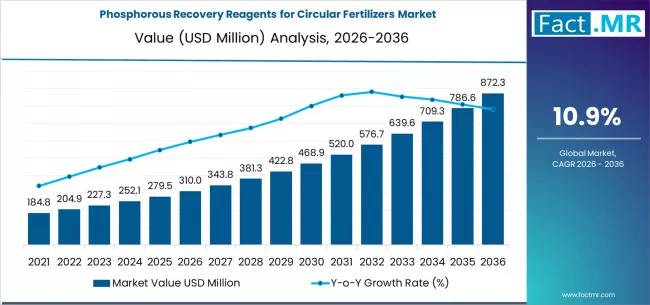
By reagent type, magnesium-based precipitation reagents hold a commanding 36% share. The struvite precipitation process represents the dominant recovery technology at 40%. The fertilizer and agriculture sector is the unequivocal primary end-user, accounting for a 48% share.
Growth is propelled by the critical convergence of global phosphorus scarcity, stringent nutrient discharge regulations, and the rapid adoption of circular economy principles. Phosphorus, a finite resource essential for food security, is being systematically reclaimed from wastewater streams, transforming treatment plants into nutrient factories and reducing dependency on mined phosphate rock.
These specialized reagents are the chemical linchpins of recovery, enabling the transformation of dissolved phosphorus in sludge liquors into valuable, plant-available fertilizer products. Their application is central to closing the nutrient loop, creating sustainable fertilizer supply chains, and mitigating the environmental impact of phosphorus pollution in waterways.
Phosphorus Recovery Reagents for Circular Fertilizers Market
| Metric | Value |
|---|---|
| Market Value (2026) | USD 310.00 Million |
| Market Forecast Value (2036) | USD 872.32 Million |
| Forecast CAGR (2026-2036) | 10.9% |
Category
| Category | Segments |
|---|---|
| Reagent Type | Magnesium-Based Precipitation Reagents (MgCl₂, MgO, Mg(OH)₂), Calcium & Lime-Based Recovery Reagents, Iron/Aluminum Salt Precipitation Reagents, Bio-Based & Enzymatic Recovery Agents, Other Specialty Phosphorus Recovery Reagents |
| Recovery Process | Struvite Precipitation (MAP), Chemical Phosphate Precipitation, Ammonia-Phosphate Co-Recovery, Thermochemical Sludge & Ash Treatment, Bio-Based & Enzymatic Recovery |
| End-Use Sector | Fertilizer & Agriculture, Industrial Chemical Feedstocks, Biogas & Bioenergy Plants, Municipal & Wastewater Utilities, Other Circular Economy Applications |
| Region | North America, Latin America, Western Europe, Eastern Europe, East Asia, South Asia & Pacific, MEA |
Segmental Analysis
By Reagent Type, Which Chemistry is Fundamental to Mainstream Phosphorus Recovery?
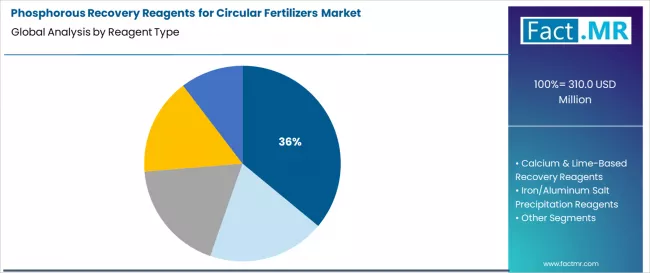
Magnesium-based precipitation reagents, including magnesium chloride and magnesium oxide, lead the segment with a 36% share. Their dominance is directly tied to their role in the predominant struvite crystallization process.
These reagents provide the magnesium ion required to form struvite, a highly desirable slow-release fertilizer. The commercial availability, predictable reactivity, and proven integration into continuous crystallizer designs make magnesium sources the foundational chemical commodity for the phosphorus recovery industry.
By Recovery Process, Which Technology Delivers a Market-Ready Fertilizer Product?
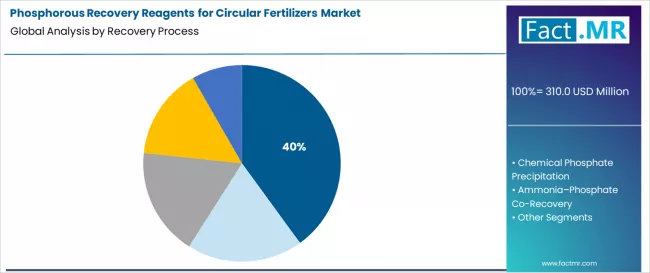
Struvite precipitation (MAP) is the leading recovery process with a 40% share. Its preeminence is due to its ability to simultaneously recover phosphorus and nitrogen into a single, granular, high-value fertilizer product.
The process is relatively straightforward, operates at ambient temperatures, and fits seamlessly into existing wastewater treatment trains, particularly after anaerobic digestion. The direct production of a saleable commodity, rather than an intermediate sludge, provides a clear economic driver that other processes often lack.
By End-Use Sector, Who is the Ultimate Consumer of Recovered Phosphorus?
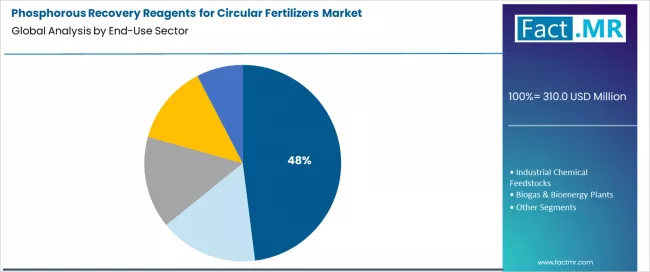
The fertilizer and agriculture sector commands the largest end-use share at 48%. This sector provides the essential demand pull that validates the entire recovery value chain. Recovered phosphorus, primarily in the form of struvite or treated ash, is a direct substitute for mined phosphate in fertilizer manufacturing.
The growing demand for sustainable, low-carbon, and traceable agricultural inputs from both regulators and consumers creates a robust and expanding market for circular phosphate products.
What are the Drivers, Restraints, and Key Trends of the Phosphorus Recovery Reagents for Circular Fertilizers Market?
The paramount market driver is the strategic imperative to secure phosphorus supply chains against geopolitical volatility and the depletion of high-quality phosphate rock reserves. Mandatory recovery legislation, such as the German Sewage Sludge Ordinance and similar policies emerging elsewhere, transforms recovery from an option into a compliance requirement. The rising economic value of recycled nutrients, coupled with the cost savings from preventing struvite scaling in treatment plants, creates a compelling financial case.
A significant restraint is the capital intensity of installing recovery infrastructure and the ongoing operational cost of reagents, which can be sensitive to energy prices for reagents like magnesium oxide. The variability of wastewater composition requires careful process control to ensure consistent product quality and reagent efficiency. In regions without supportive regulation or fertilizer markets, the business case can be challenging to establish based on economics alone.
Key trends include the development of next-generation, high-purity magnesium reagents designed to minimize impurities in the final fertilizer product. There is intense research into reagents for alternative recovery pathways, such as from incinerated sewage sludge ash, which contains concentrated phosphorus. The market is moving toward digital process control and reagent optimization using real-time analytics to minimize chemical consumption. Furthermore, the integration of recovery with carbon capture represents a frontier in circular system design.
Analysis of the Phosphorus Recovery Reagents for Circular Fertilizers Market by Key Countries
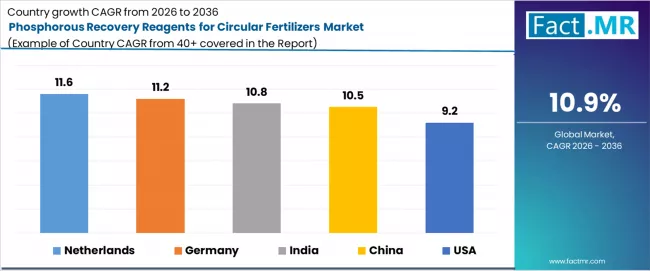
| Country | CAGR (2026-2036) |
|---|---|
| Netherlands | 11.60% |
| Germany | 11.20% |
| India | 10.80% |
| China | 10.50% |
| USA | 9.20% |
Why is the Netherlands the Global Epicenter for Circular Phosphorus Innovation?
The Netherlands' leading CAGR of 11.60% is anchored in its unique combination of world-leading agricultural innovation, dense population, and progressive national circular economy policies. The Dutch "Green Deal" framework aggressively promotes nutrient recycling. The country's expertise in horticulture and process engineering drives demand for high-quality recovered phosphate, fostering a dynamic ecosystem for reagent and technology development.
How does Germany's Regulatory Mandate Create a Guaranteed Market?
Germany's 11.20% growth is directly fueled by its Sewage Sludge Ordinance, which legally mandates phosphorus recovery from nearly all large wastewater treatment plants by 2030. This regulatory certainty has triggered massive investment in recovery infrastructure, creating a predictable, large-scale, and immediate demand for precipitation reagents and related chemicals, setting a benchmark for other nations.
What drives India's High-Growth Trajectory in this Market?
India's 10.80% growth stems from its immense agricultural fertilizer demand and concurrent national mission to build modern sewage treatment infrastructure. The opportunity to integrate phosphorus recovery into thousands of new and upgraded treatment plants presents a massive scale-up potential. Domestic fertilizer security and water pollution abatement provide dual incentives for adoption.
How is China's Dual Focus on Resource Security and Pollution Control Shaping Demand?
China's 10.50% growth is supported by its national strategies for "ecological civilization" and resource security. As the world's largest fertilizer producer and consumer, China views phosphorus recovery as a strategic hedge against import dependency and a solution to severe eutrophication. State-backed research and pilot projects are scaling up, driving reagent demand.
What Underpins Steady Growth in the USA's Market?
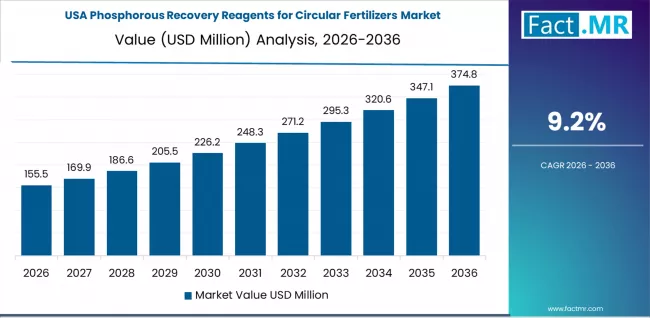
The USA's 9.20% growth is driven by a combination of local nutrient discharge regulations, utility-led innovation to reduce operational maintenance, and growing private sector interest in sustainable fertilizers. While lacking a federal mandate, regional drivers in areas like the Chesapeake Bay watershed and the Great Lakes, alongside corporate sustainability goals, foster a steady adoption of recovery technologies and their associated reagents.
Competitive Landscape of the Phosphorus Recovery Reagents for Circular Fertilizers Market
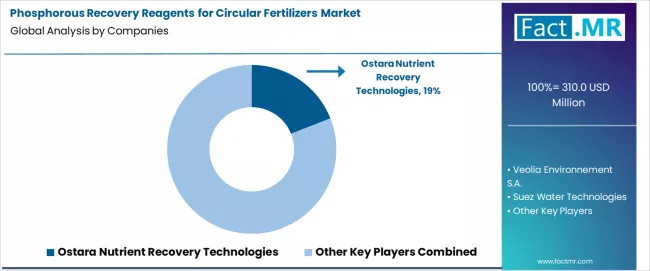
The competitive landscape features a mix of specialized technology pioneers and global water and waste management giants. Ostara, as a specialist, competes through its integrated Pearl® process, which combines proprietary reactor design with optimized reagent use and direct fertilizer marketing.
Corporations like Veolia and Suez leverage their extensive municipal contracts to offer comprehensive recovery-as-a-service models, including reagent supply. Competition centers on reagent efficiency, the quality and marketability of the resulting fertilizer, total cost of ownership for the plant operator, and the depth of process integration and support offered.
Key Players in the Phosphorus Recovery Reagents for Circular Fertilizers Market
- Ostara Nutrient Recovery Technologies
- Veolia Environnement S.A.
- Suez Water Technologies
- SNF Floerger
- Kemira Oyj.
Scope of Report
| Items | Values |
|---|---|
| Quantitative Units | USD Million |
| Reagent Type | Magnesium-Based, Calcium/Lime-Based, Iron/Aluminum Salts, Bio-Based/Enzymatic, Other |
| Recovery Process | Struvite Precipitation, Chemical Precipitation, Co-Recovery, Thermochemical, Bio-Based |
| End-Use Sector | Fertilizer/Agriculture, Industrial Feedstocks, Biogas Plants, Municipal Utilities, Other |
| Key Countries | Netherlands, Germany, India, China, USA |
| Key Companies | Ostara, Veolia, Suez, SNF Floerger, Kemira |
| Additional Analysis | Analysis of reagent stoichiometry and consumption models; quality standards for recovered phosphate fertilizers (e.g., EU Fertilising Products Regulation); life cycle assessment (LCA) of recovered vs. mined P; techno-economic analysis of different recovery pathways; regulatory landscape and subsidy/incentive programs for nutrient recovery. |
Market by Segments
-
Reagent Type :
- Magnesium-Based Precipitation Reagents (MgCl₂, MgO, Mg(OH)₂)
- Calcium & Lime-Based Recovery Reagents
- Iron/Aluminum Salt Precipitation Reagents
- Bio-Based & Enzymatic Recovery Agents
- Other Specialty Phosphorus Recovery Reagents
-
Recovery Process :
- Struvite Precipitation (MAP)
- Chemical Phosphate Precipitation
- Ammonia-Phosphate Co-Recovery
- Thermochemical Sludge & Ash Treatment
- Bio-Based & Enzymatic Recovery
-
End-Use Sector :
- Fertilizer & Agriculture
- Industrial Chemical Feedstocks
- Biogas & Bioenergy Plants
- Municipal & Wastewater Utilities
- Other Circular Economy Applications
-
Region :
- North America
- USA
- Canada
- Latin America
- Brazil
- Mexico
- Argentina
- Rest of Latin America
- Western Europe
- Germany
- Netherlands
- UK
- France
- Spain
- Italy
- BENELUX
- Rest of Western Europe
- Eastern Europe
- Russia
- Poland
- Czech Republic
- Rest of Eastern Europe
- East Asia
- China
- Japan
- South Korea
- Rest of East Asia
- South Asia & Pacific
- India
- ASEAN
- Australia
- Rest of South Asia & Pacific
- MEA
- Saudi Arabia
- UAE
- Turkiye
- Rest of MEA
- North America
Table of Content
- Executive Summary
- Global Market Outlook
- Demand to side Trends
- Supply to side Trends
- Technology Roadmap Analysis
- Analysis and Recommendations
- Market Overview
- Market Coverage / Taxonomy
- Market Definition / Scope / Limitations
- Market Background
- Market Dynamics
- Drivers
- Restraints
- Opportunity
- Trends
- Scenario Forecast
- Demand in Optimistic Scenario
- Demand in Likely Scenario
- Demand in Conservative Scenario
- Opportunity Map Analysis
- Product Life Cycle Analysis
- Supply Chain Analysis
- Investment Feasibility Matrix
- Value Chain Analysis
- PESTLE and Porter’s Analysis
- Regulatory Landscape
- Regional Parent Market Outlook
- Production and Consumption Statistics
- Import and Export Statistics
- Market Dynamics
- Global Market Analysis 2021 to 2025 and Forecast, 2026 to 2036
- Historical Market Size Value (USD Million) Analysis, 2021 to 2025
- Current and Future Market Size Value (USD Million) Projections, 2026 to 2036
- Y to o to Y Growth Trend Analysis
- Absolute $ Opportunity Analysis
- Global Market Pricing Analysis 2021 to 2025 and Forecast 2026 to 2036
- Global Market Analysis 2021 to 2025 and Forecast 2026 to 2036, By Reagent Type
- Introduction / Key Findings
- Historical Market Size Value (USD Million) Analysis By Reagent Type, 2021 to 2025
- Current and Future Market Size Value (USD Million) Analysis and Forecast By Reagent Type, 2026 to 2036
- Magnesium-Based Precipitation Reagents (MgCl₂, MgO, Mg(OH)₂)
- Calcium & Lime-Based Recovery Reagents
- Iron/Aluminum Salt Precipitation Reagents
- Bio-Based & Enzymatic Recovery Agents
- Other Specialty Phosphorus Recovery Reagents
- Magnesium-Based Precipitation Reagents (MgCl₂, MgO, Mg(OH)₂)
- Y to o to Y Growth Trend Analysis By Reagent Type, 2021 to 2025
- Absolute $ Opportunity Analysis By Reagent Type, 2026 to 2036
- Global Market Analysis 2021 to 2025 and Forecast 2026 to 2036, By Recovery Process
- Introduction / Key Findings
- Historical Market Size Value (USD Million) Analysis By Recovery Process, 2021 to 2025
- Current and Future Market Size Value (USD Million) Analysis and Forecast By Recovery Process, 2026 to 2036
- Struvite Precipitation (MAP)
- Chemical Phosphate Precipitation
- Ammonia-Phosphate Co-Recovery
- Thermochemical Sludge & Ash Treatment
- Bio-Based & Enzymatic Recovery
- Struvite Precipitation (MAP)
- Y to o to Y Growth Trend Analysis By Recovery Process, 2021 to 2025
- Absolute $ Opportunity Analysis By Recovery Process, 2026 to 2036
- Global Market Analysis 2021 to 2025 and Forecast 2026 to 2036, By End-Use Sector
- Introduction / Key Findings
- Historical Market Size Value (USD Million) Analysis By End-Use Sector, 2021 to 2025
- Current and Future Market Size Value (USD Million) Analysis and Forecast By End-Use Sector, 2026 to 2036
- Fertilizer & Agriculture
- Industrial Chemical Feedstocks
- Biogas & Bioenergy Plants
- Municipal & Wastewater Utilities
- Other Circular Economy Applications
- Fertilizer & Agriculture
- Y to o to Y Growth Trend Analysis By End-Use Sector, 2021 to 2025
- Absolute $ Opportunity Analysis By End-Use Sector, 2026 to 2036
- Global Market Analysis 2021 to 2025 and Forecast 2026 to 2036, By Region
- Introduction
- Historical Market Size Value (USD Million) Analysis By Region, 2021 to 2025
- Current Market Size Value (USD Million) Analysis and Forecast By Region, 2026 to 2036
- North America
- Latin America
- Western Europe
- Eastern Europe
- East Asia
- South Asia and Pacific
- Middle East & Africa
- Market Attractiveness Analysis By Region
- North America Market Analysis 2021 to 2025 and Forecast 2026 to 2036, By Country
- Historical Market Size Value (USD Million) Trend Analysis By Market Taxonomy, 2021 to 2025
- Market Size Value (USD Million) Forecast By Market Taxonomy, 2026 to 2036
- By Country
- USA
- Canada
- Mexico
- By Reagent Type
- By Recovery Process
- By End-Use Sector
- By Country
- Market Attractiveness Analysis
- By Country
- By Reagent Type
- By Recovery Process
- By End-Use Sector
- Key Takeaways
- Latin America Market Analysis 2021 to 2025 and Forecast 2026 to 2036, By Country
- Historical Market Size Value (USD Million) Trend Analysis By Market Taxonomy, 2021 to 2025
- Market Size Value (USD Million) Forecast By Market Taxonomy, 2026 to 2036
- By Country
- Brazil
- Chile
- Rest of Latin America
- By Reagent Type
- By Recovery Process
- By End-Use Sector
- By Country
- Market Attractiveness Analysis
- By Country
- By Reagent Type
- By Recovery Process
- By End-Use Sector
- Key Takeaways
- Western Europe Market Analysis 2021 to 2025 and Forecast 2026 to 2036, By Country
- Historical Market Size Value (USD Million) Trend Analysis By Market Taxonomy, 2021 to 2025
- Market Size Value (USD Million) Forecast By Market Taxonomy, 2026 to 2036
- By Country
- Germany
- UK
- Italy
- Spain
- France
- Nordic
- BENELUX
- Rest of Western Europe
- By Reagent Type
- By Recovery Process
- By End-Use Sector
- By Country
- Market Attractiveness Analysis
- By Country
- By Reagent Type
- By Recovery Process
- By End-Use Sector
- Key Takeaways
- Eastern Europe Market Analysis 2021 to 2025 and Forecast 2026 to 2036, By Country
- Historical Market Size Value (USD Million) Trend Analysis By Market Taxonomy, 2021 to 2025
- Market Size Value (USD Million) Forecast By Market Taxonomy, 2026 to 2036
- By Country
- Russia
- Poland
- Hungary
- Balkan & Baltic
- Rest of Eastern Europe
- By Reagent Type
- By Recovery Process
- By End-Use Sector
- By Country
- Market Attractiveness Analysis
- By Country
- By Reagent Type
- By Recovery Process
- By End-Use Sector
- Key Takeaways
- East Asia Market Analysis 2021 to 2025 and Forecast 2026 to 2036, By Country
- Historical Market Size Value (USD Million) Trend Analysis By Market Taxonomy, 2021 to 2025
- Market Size Value (USD Million) Forecast By Market Taxonomy, 2026 to 2036
- By Country
- China
- Japan
- South Korea
- By Reagent Type
- By Recovery Process
- By End-Use Sector
- By Country
- Market Attractiveness Analysis
- By Country
- By Reagent Type
- By Recovery Process
- By End-Use Sector
- Key Takeaways
- South Asia and Pacific Market Analysis 2021 to 2025 and Forecast 2026 to 2036, By Country
- Historical Market Size Value (USD Million) Trend Analysis By Market Taxonomy, 2021 to 2025
- Market Size Value (USD Million) Forecast By Market Taxonomy, 2026 to 2036
- By Country
- India
- ASEAN
- Australia & New Zealand
- Rest of South Asia and Pacific
- By Reagent Type
- By Recovery Process
- By End-Use Sector
- By Country
- Market Attractiveness Analysis
- By Country
- By Reagent Type
- By Recovery Process
- By End-Use Sector
- Key Takeaways
- Middle East & Africa Market Analysis 2021 to 2025 and Forecast 2026 to 2036, By Country
- Historical Market Size Value (USD Million) Trend Analysis By Market Taxonomy, 2021 to 2025
- Market Size Value (USD Million) Forecast By Market Taxonomy, 2026 to 2036
- By Country
- Kingdom of Saudi Arabia
- Other GCC Countries
- Turkiye
- South Africa
- Other African Union
- Rest of Middle East & Africa
- By Reagent Type
- By Recovery Process
- By End-Use Sector
- By Country
- Market Attractiveness Analysis
- By Country
- By Reagent Type
- By Recovery Process
- By End-Use Sector
- Key Takeaways
- Key Countries Market Analysis
- USA
- Pricing Analysis
- Market Share Analysis, 2025
- By Reagent Type
- By Recovery Process
- By End-Use Sector
- Canada
- Pricing Analysis
- Market Share Analysis, 2025
- By Reagent Type
- By Recovery Process
- By End-Use Sector
- Mexico
- Pricing Analysis
- Market Share Analysis, 2025
- By Reagent Type
- By Recovery Process
- By End-Use Sector
- Brazil
- Pricing Analysis
- Market Share Analysis, 2025
- By Reagent Type
- By Recovery Process
- By End-Use Sector
- Chile
- Pricing Analysis
- Market Share Analysis, 2025
- By Reagent Type
- By Recovery Process
- By End-Use Sector
- Germany
- Pricing Analysis
- Market Share Analysis, 2025
- By Reagent Type
- By Recovery Process
- By End-Use Sector
- UK
- Pricing Analysis
- Market Share Analysis, 2025
- By Reagent Type
- By Recovery Process
- By End-Use Sector
- Italy
- Pricing Analysis
- Market Share Analysis, 2025
- By Reagent Type
- By Recovery Process
- By End-Use Sector
- Spain
- Pricing Analysis
- Market Share Analysis, 2025
- By Reagent Type
- By Recovery Process
- By End-Use Sector
- France
- Pricing Analysis
- Market Share Analysis, 2025
- By Reagent Type
- By Recovery Process
- By End-Use Sector
- India
- Pricing Analysis
- Market Share Analysis, 2025
- By Reagent Type
- By Recovery Process
- By End-Use Sector
- ASEAN
- Pricing Analysis
- Market Share Analysis, 2025
- By Reagent Type
- By Recovery Process
- By End-Use Sector
- Australia & New Zealand
- Pricing Analysis
- Market Share Analysis, 2025
- By Reagent Type
- By Recovery Process
- By End-Use Sector
- China
- Pricing Analysis
- Market Share Analysis, 2025
- By Reagent Type
- By Recovery Process
- By End-Use Sector
- Japan
- Pricing Analysis
- Market Share Analysis, 2025
- By Reagent Type
- By Recovery Process
- By End-Use Sector
- South Korea
- Pricing Analysis
- Market Share Analysis, 2025
- By Reagent Type
- By Recovery Process
- By End-Use Sector
- Russia
- Pricing Analysis
- Market Share Analysis, 2025
- By Reagent Type
- By Recovery Process
- By End-Use Sector
- Poland
- Pricing Analysis
- Market Share Analysis, 2025
- By Reagent Type
- By Recovery Process
- By End-Use Sector
- Hungary
- Pricing Analysis
- Market Share Analysis, 2025
- By Reagent Type
- By Recovery Process
- By End-Use Sector
- Kingdom of Saudi Arabia
- Pricing Analysis
- Market Share Analysis, 2025
- By Reagent Type
- By Recovery Process
- By End-Use Sector
- Turkiye
- Pricing Analysis
- Market Share Analysis, 2025
- By Reagent Type
- By Recovery Process
- By End-Use Sector
- South Africa
- Pricing Analysis
- Market Share Analysis, 2025
- By Reagent Type
- By Recovery Process
- By End-Use Sector
- USA
- Market Structure Analysis
- Competition Dashboard
- Competition Benchmarking
- Market Share Analysis of Top Players
- By Regional
- By Reagent Type
- By Recovery Process
- By End-Use Sector
- Competition Analysis
- Competition Deep Dive
- Ostara Nutrient Recovery Technologies
- Overview
- Product Portfolio
- Profitability by Market Segments (Product/Age /Sales Channel/Region)
- Sales Footprint
- Strategy Overview
- Marketing Strategy
- Product Strategy
- Channel Strategy
- Veolia Environnement S.A.
- Suez Water Technologies
- SNF Floerger
- Kemira Oyj.
- Ostara Nutrient Recovery Technologies
- Competition Deep Dive
- Assumptions & Acronyms Used
- Research Methodology
List Of Table
- Table 1: Global Market Value (USD Million) Forecast by Region, 2021 to 2036
- Table 2: Global Market Value (USD Million) Forecast by Reagent Type, 2021 to 2036
- Table 3: Global Market Value (USD Million) Forecast by Recovery Process, 2021 to 2036
- Table 4: Global Market Value (USD Million) Forecast by End-Use Sector, 2021 to 2036
- Table 5: North America Market Value (USD Million) Forecast by Country, 2021 to 2036
- Table 6: North America Market Value (USD Million) Forecast by Reagent Type, 2021 to 2036
- Table 7: North America Market Value (USD Million) Forecast by Recovery Process, 2021 to 2036
- Table 8: North America Market Value (USD Million) Forecast by End-Use Sector, 2021 to 2036
- Table 9: Latin America Market Value (USD Million) Forecast by Country, 2021 to 2036
- Table 10: Latin America Market Value (USD Million) Forecast by Reagent Type, 2021 to 2036
- Table 11: Latin America Market Value (USD Million) Forecast by Recovery Process, 2021 to 2036
- Table 12: Latin America Market Value (USD Million) Forecast by End-Use Sector, 2021 to 2036
- Table 13: Western Europe Market Value (USD Million) Forecast by Country, 2021 to 2036
- Table 14: Western Europe Market Value (USD Million) Forecast by Reagent Type, 2021 to 2036
- Table 15: Western Europe Market Value (USD Million) Forecast by Recovery Process, 2021 to 2036
- Table 16: Western Europe Market Value (USD Million) Forecast by End-Use Sector, 2021 to 2036
- Table 17: Eastern Europe Market Value (USD Million) Forecast by Country, 2021 to 2036
- Table 18: Eastern Europe Market Value (USD Million) Forecast by Reagent Type, 2021 to 2036
- Table 19: Eastern Europe Market Value (USD Million) Forecast by Recovery Process, 2021 to 2036
- Table 20: Eastern Europe Market Value (USD Million) Forecast by End-Use Sector, 2021 to 2036
- Table 21: East Asia Market Value (USD Million) Forecast by Country, 2021 to 2036
- Table 22: East Asia Market Value (USD Million) Forecast by Reagent Type, 2021 to 2036
- Table 23: East Asia Market Value (USD Million) Forecast by Recovery Process, 2021 to 2036
- Table 24: East Asia Market Value (USD Million) Forecast by End-Use Sector, 2021 to 2036
- Table 25: South Asia and Pacific Market Value (USD Million) Forecast by Country, 2021 to 2036
- Table 26: South Asia and Pacific Market Value (USD Million) Forecast by Reagent Type, 2021 to 2036
- Table 27: South Asia and Pacific Market Value (USD Million) Forecast by Recovery Process, 2021 to 2036
- Table 28: South Asia and Pacific Market Value (USD Million) Forecast by End-Use Sector, 2021 to 2036
- Table 29: Middle East & Africa Market Value (USD Million) Forecast by Country, 2021 to 2036
- Table 30: Middle East & Africa Market Value (USD Million) Forecast by Reagent Type, 2021 to 2036
- Table 31: Middle East & Africa Market Value (USD Million) Forecast by Recovery Process, 2021 to 2036
- Table 32: Middle East & Africa Market Value (USD Million) Forecast by End-Use Sector, 2021 to 2036
List Of Figures
- Figure 1: Global Market Pricing Analysis
- Figure 2: Global Market Value (USD Million) Forecast 2021 to 2036
- Figure 3: Global Market Value Share and BPS Analysis by Reagent Type, 2026 and 2036
- Figure 4: Global Market Y to o to Y Growth Comparison by Reagent Type, 2026 to 2036
- Figure 5: Global Market Attractiveness Analysis by Reagent Type
- Figure 6: Global Market Value Share and BPS Analysis by Recovery Process, 2026 and 2036
- Figure 7: Global Market Y to o to Y Growth Comparison by Recovery Process, 2026 to 2036
- Figure 8: Global Market Attractiveness Analysis by Recovery Process
- Figure 9: Global Market Value Share and BPS Analysis by End-Use Sector, 2026 and 2036
- Figure 10: Global Market Y to o to Y Growth Comparison by End-Use Sector, 2026 to 2036
- Figure 11: Global Market Attractiveness Analysis by End-Use Sector
- Figure 12: Global Market Value (USD Million) Share and BPS Analysis by Region, 2026 and 2036
- Figure 13: Global Market Y to o to Y Growth Comparison by Region, 2026 to 2036
- Figure 14: Global Market Attractiveness Analysis by Region
- Figure 15: North America Market Incremental Dollar Opportunity, 2026 to 2036
- Figure 16: Latin America Market Incremental Dollar Opportunity, 2026 to 2036
- Figure 17: Western Europe Market Incremental Dollar Opportunity, 2026 to 2036
- Figure 18: Eastern Europe Market Incremental Dollar Opportunity, 2026 to 2036
- Figure 19: East Asia Market Incremental Dollar Opportunity, 2026 to 2036
- Figure 20: South Asia and Pacific Market Incremental Dollar Opportunity, 2026 to 2036
- Figure 21: Middle East & Africa Market Incremental Dollar Opportunity, 2026 to 2036
- Figure 22: North America Market Value Share and BPS Analysis by Country, 2026 and 2036
- Figure 23: North America Market Value Share and BPS Analysis by Reagent Type, 2026 and 2036
- Figure 24: North America Market Y to o to Y Growth Comparison by Reagent Type, 2026 to 2036
- Figure 25: North America Market Attractiveness Analysis by Reagent Type
- Figure 26: North America Market Value Share and BPS Analysis by Recovery Process, 2026 and 2036
- Figure 27: North America Market Y to o to Y Growth Comparison by Recovery Process, 2026 to 2036
- Figure 28: North America Market Attractiveness Analysis by Recovery Process
- Figure 29: North America Market Value Share and BPS Analysis by End-Use Sector, 2026 and 2036
- Figure 30: North America Market Y to o to Y Growth Comparison by End-Use Sector, 2026 to 2036
- Figure 31: North America Market Attractiveness Analysis by End-Use Sector
- Figure 32: Latin America Market Value Share and BPS Analysis by Country, 2026 and 2036
- Figure 33: Latin America Market Value Share and BPS Analysis by Reagent Type, 2026 and 2036
- Figure 34: Latin America Market Y to o to Y Growth Comparison by Reagent Type, 2026 to 2036
- Figure 35: Latin America Market Attractiveness Analysis by Reagent Type
- Figure 36: Latin America Market Value Share and BPS Analysis by Recovery Process, 2026 and 2036
- Figure 37: Latin America Market Y to o to Y Growth Comparison by Recovery Process, 2026 to 2036
- Figure 38: Latin America Market Attractiveness Analysis by Recovery Process
- Figure 39: Latin America Market Value Share and BPS Analysis by End-Use Sector, 2026 and 2036
- Figure 40: Latin America Market Y to o to Y Growth Comparison by End-Use Sector, 2026 to 2036
- Figure 41: Latin America Market Attractiveness Analysis by End-Use Sector
- Figure 42: Western Europe Market Value Share and BPS Analysis by Country, 2026 and 2036
- Figure 43: Western Europe Market Value Share and BPS Analysis by Reagent Type, 2026 and 2036
- Figure 44: Western Europe Market Y to o to Y Growth Comparison by Reagent Type, 2026 to 2036
- Figure 45: Western Europe Market Attractiveness Analysis by Reagent Type
- Figure 46: Western Europe Market Value Share and BPS Analysis by Recovery Process, 2026 and 2036
- Figure 47: Western Europe Market Y to o to Y Growth Comparison by Recovery Process, 2026 to 2036
- Figure 48: Western Europe Market Attractiveness Analysis by Recovery Process
- Figure 49: Western Europe Market Value Share and BPS Analysis by End-Use Sector, 2026 and 2036
- Figure 50: Western Europe Market Y to o to Y Growth Comparison by End-Use Sector, 2026 to 2036
- Figure 51: Western Europe Market Attractiveness Analysis by End-Use Sector
- Figure 52: Eastern Europe Market Value Share and BPS Analysis by Country, 2026 and 2036
- Figure 53: Eastern Europe Market Value Share and BPS Analysis by Reagent Type, 2026 and 2036
- Figure 54: Eastern Europe Market Y to o to Y Growth Comparison by Reagent Type, 2026 to 2036
- Figure 55: Eastern Europe Market Attractiveness Analysis by Reagent Type
- Figure 56: Eastern Europe Market Value Share and BPS Analysis by Recovery Process, 2026 and 2036
- Figure 57: Eastern Europe Market Y to o to Y Growth Comparison by Recovery Process, 2026 to 2036
- Figure 58: Eastern Europe Market Attractiveness Analysis by Recovery Process
- Figure 59: Eastern Europe Market Value Share and BPS Analysis by End-Use Sector, 2026 and 2036
- Figure 60: Eastern Europe Market Y to o to Y Growth Comparison by End-Use Sector, 2026 to 2036
- Figure 61: Eastern Europe Market Attractiveness Analysis by End-Use Sector
- Figure 62: East Asia Market Value Share and BPS Analysis by Country, 2026 and 2036
- Figure 63: East Asia Market Value Share and BPS Analysis by Reagent Type, 2026 and 2036
- Figure 64: East Asia Market Y to o to Y Growth Comparison by Reagent Type, 2026 to 2036
- Figure 65: East Asia Market Attractiveness Analysis by Reagent Type
- Figure 66: East Asia Market Value Share and BPS Analysis by Recovery Process, 2026 and 2036
- Figure 67: East Asia Market Y to o to Y Growth Comparison by Recovery Process, 2026 to 2036
- Figure 68: East Asia Market Attractiveness Analysis by Recovery Process
- Figure 69: East Asia Market Value Share and BPS Analysis by End-Use Sector, 2026 and 2036
- Figure 70: East Asia Market Y to o to Y Growth Comparison by End-Use Sector, 2026 to 2036
- Figure 71: East Asia Market Attractiveness Analysis by End-Use Sector
- Figure 72: South Asia and Pacific Market Value Share and BPS Analysis by Country, 2026 and 2036
- Figure 73: South Asia and Pacific Market Value Share and BPS Analysis by Reagent Type, 2026 and 2036
- Figure 74: South Asia and Pacific Market Y to o to Y Growth Comparison by Reagent Type, 2026 to 2036
- Figure 75: South Asia and Pacific Market Attractiveness Analysis by Reagent Type
- Figure 76: South Asia and Pacific Market Value Share and BPS Analysis by Recovery Process, 2026 and 2036
- Figure 77: South Asia and Pacific Market Y to o to Y Growth Comparison by Recovery Process, 2026 to 2036
- Figure 78: South Asia and Pacific Market Attractiveness Analysis by Recovery Process
- Figure 79: South Asia and Pacific Market Value Share and BPS Analysis by End-Use Sector, 2026 and 2036
- Figure 80: South Asia and Pacific Market Y to o to Y Growth Comparison by End-Use Sector, 2026 to 2036
- Figure 81: South Asia and Pacific Market Attractiveness Analysis by End-Use Sector
- Figure 82: Middle East & Africa Market Value Share and BPS Analysis by Country, 2026 and 2036
- Figure 83: Middle East & Africa Market Value Share and BPS Analysis by Reagent Type, 2026 and 2036
- Figure 84: Middle East & Africa Market Y to o to Y Growth Comparison by Reagent Type, 2026 to 2036
- Figure 85: Middle East & Africa Market Attractiveness Analysis by Reagent Type
- Figure 86: Middle East & Africa Market Value Share and BPS Analysis by Recovery Process, 2026 and 2036
- Figure 87: Middle East & Africa Market Y to o to Y Growth Comparison by Recovery Process, 2026 to 2036
- Figure 88: Middle East & Africa Market Attractiveness Analysis by Recovery Process
- Figure 89: Middle East & Africa Market Value Share and BPS Analysis by End-Use Sector, 2026 and 2036
- Figure 90: Middle East & Africa Market Y to o to Y Growth Comparison by End-Use Sector, 2026 to 2036
- Figure 91: Middle East & Africa Market Attractiveness Analysis by End-Use Sector
- Figure 92: Global Market - Tier Structure Analysis
- Figure 93: Global Market - Company Share Analysis
- FAQs -
How big is the phosphorous recovery reagents for circular fertilizers market in 2026?
The global phosphorous recovery reagents for circular fertilizers market is estimated to be valued at USD 310.0 million in 2026.
What will be the size of phosphorous recovery reagents for circular fertilizers market in 2036?
The market size for the phosphorous recovery reagents for circular fertilizers market is projected to reach USD 872.3 million by 2036.
How much will be the phosphorous recovery reagents for circular fertilizers market growth between 2026 and 2036?
The phosphorous recovery reagents for circular fertilizers market is expected to grow at a 10.9% CAGR between 2026 and 2036.
What are the key product types in the phosphorous recovery reagents for circular fertilizers market?
The key product types in phosphorous recovery reagents for circular fertilizers market are magnesium-based precipitation reagents (mgcl₂, mgo, mg(oh)₂), calcium & lime-based recovery reagents, iron/aluminum salt precipitation reagents, bio-based & enzymatic recovery agents and other specialty phosphorus recovery reagents.
Which recovery process segment to contribute significant share in the phosphorous recovery reagents for circular fertilizers market in 2026?
In terms of recovery process, struvite precipitation (map) segment to command 40.0% share in the phosphorous recovery reagents for circular fertilizers market in 2026.