Circular Smart City Waste Management Systems Market
Circular Smart City Waste Management Systems Market Size and Share Forecast Outlook 2026 to 2036
Circular smart city waste management systems market is projected to grow from USD 4.3 billion in 2026 to USD 12.8 billion by 2036, at a CAGR of 11.5%. Urban circular waste systems will dominate with a 48.0% market share, while integrated collection and sorting will lead the system type segment with a 49.0% share.
Circular Smart City Waste Management Systems Market Forecast and Outlook 2026 to 2036
The circular smart city waste management systems market is projected to reach USD 4.3 billion in 2026 and grow to USD 12.8 billion by 2036, expanding at a CAGR of 11.5%.
Key Takeaways from Circular Smart City Waste Management Systems Market
- Circular Smart City Waste Management Systems Market Value (2026): USD 4.3 billion
- Circular Smart City Waste Management Systems Market Forecast Value (2036): USD 12.8 billion
- Circular Smart City Waste Management Systems Market Forecast CAGR 2026 to 2036: 11.5%
- Leading Segment in Circular Smart City Waste Management Systems Market: IoT, AI analytics & routing (60%)
- Key Growth Region in Circular Smart City Waste Management Systems Market: Asia Pacific
- Key Players in Circular Smart City Waste Management Systems Market: Veolia, WM, Everbright Environment, Hitachi Zose, SUEZ, China Conch Venture, JFE Engineering, Republic Services
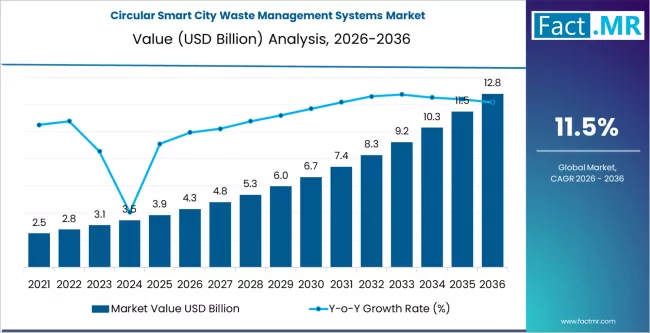
Regional demand concentration in this market is uneven, with significant adoption seen in advanced economies that are investing heavily in smart city initiatives. Geographic cost advantages, particularly in regions with established waste management infrastructure, contribute to market dominance in areas such as North America and Western Europe.
However, adoption in emerging markets is slower, influenced by factors such as infrastructure readiness, regulatory frameworks, and available capital. As these regions advance their urban development plans, the market will likely experience increased demand, though at varying paces across different regions. Vendors will need to tailor their solutions to regional conditions, balancing cost-efficient scalability with the specific needs of each market to maximize growth opportunities.
Circular Smart City Waste Management Systems Market
| Metric | Value |
|---|---|
| Estimated Value in (2026E) | USD 4.3 billion |
| Forecast Value in (2036F) | USD 12.8 billion |
| Forecast CAGR (2026 to 2036) | 11.5% |
Category
| Category | Segments |
|---|---|
| End-Use | Urban circular waste systems; Municipal recycling; Mega-city waste systems; High-efficiency cities; Smart city missions; Urban waste upgrades |
| System Type | Integrated collection and sorting; Smart MRFs & logistics; City-scale recycling; Automated sorting; Others |
| Waste Streams | Plastics, organics, metals; MSW and plastics; Mixed waste; Plastics & packaging; Others |
| Digital Technology | IoT, AI analytics & routing; Data platforms & optimisation; AI-enabled monitoring; Robotics & IoT; Others |
| Region | North America; Europe; Asia Pacific; Latin America; Middle East & Africa |
Segmental Analysis
What Is the Impact of Waste Streams on the Circular Smart City Waste Management Systems Market?
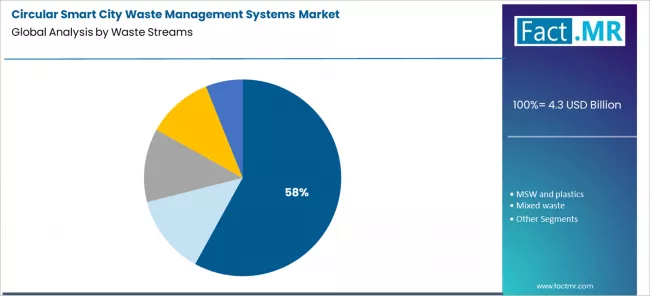
In the circular smart city waste management systems market, waste streams play a key role in determining the direction of innovation and resource efficiency. Plastics, organics, and metals are the leading waste streams, with a 58% share, representing the largest portion of materials being processed in urban waste management systems. These streams are critical due to their volume and potential for recycling. As cities aim to improve sustainability, effectively managing and recycling plastics, organics, and metals becomes essential for reducing landfill waste and promoting circular economy principles. The growing focus on waste diversion and recycling technology is expected to drive further demand for solutions targeting these waste streams.
How Does Digital Technology Influence the Circular Smart City Waste Management Systems Market?
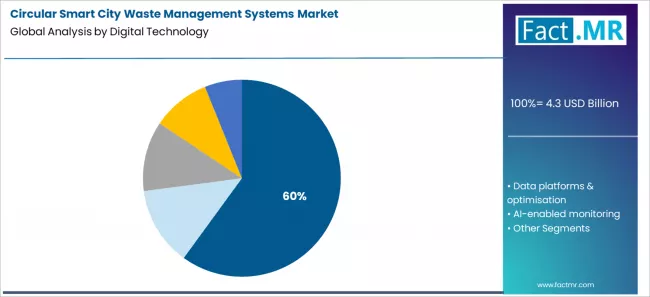
Digital technology is transforming the circular smart city waste management systems market, driving advancements in waste collection and processing efficiency. IoT, AI analytics, and routing lead the market with a 60% share, playing a central role in optimizing waste management operations. These technologies enable real-time monitoring, data-driven decision-making, and automated routing, which improve the efficiency of waste collection and reduce operational costs. The use of IoT sensors and AI algorithms ensures better resource allocation and enhanced recycling processes, making waste management systems more intelligent and responsive. As smart city initiatives expand, digital technology will continue to be a key enabler of sustainable and efficient waste management systems.
What are the Principal Drivers, Constraints, and Evolving Dynamics of the Circular Smart City Waste Management Systems Market?
Deployment of circular smart city waste management systems has been supported by municipal goals to optimize collection efficiency and recover recyclable materials. Data from sensor networks and realtime routing has been used to reduce emptying frequency and improve resource allocation. Regulations that mandate diversion from landfills have encouraged investment in systems that track waste streams and material flows.
High upfront costs for sensor deployment and network infrastructure have restrained adoption in smaller jurisdictions. Integration with legacy waste operations has proven difficult where data standards differ. Work on interoperable platforms that unify sensors, fleet systems, and material tracking tools is in progress. Projects that combine predictive analytics with automated sorting are gaining attention among city planners seeking measurable improvements in diversion rates.
Analysis of the Circular Smart City Waste Management Systems Market by Key Country
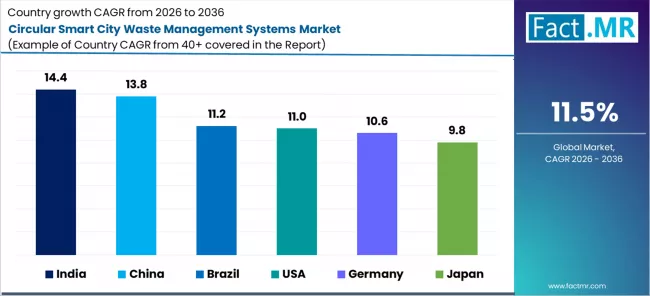
| Country | CAGR (2026-2036) |
|---|---|
| Germany | 10.6% |
| USA | 11% |
| China | 13.8% |
| Japan | 9.8% |
| India | 14.4% |
| Brazil | 11.2% |
The report covers an in-depth analysis of 40+ countries; top-performing countries are highlighted below.
What is the Growth Outlook for Circular Smart City Waste Management Systems in Germany?
Germany’s circular smart city waste management systems market is expected to grow at a CAGR of 10.6% from 2026 to 2036. As a leader in sustainability, Germany’s smart city initiatives focus on integrating circular economy principles to improve waste management efficiency. The country’s strong commitment to reducing waste and promoting resource recovery supports the adoption of circular smart city solutions. With an advanced technological infrastructure and a high level of environmental consciousness, Germany is expected to continue driving growth in the market through innovation and policy support.
How is the Circular Smart City Waste Management Systems Market Performing in the USA?
The USA’s circular smart city waste management systems market is projected to grow at a CAGR of 11% from 2026 to 2036. The push towards sustainable urban development, combined with advancements in smart city technologies, is increasing the adoption of circular waste management systems. As cities in the USA face growing pressure to manage waste efficiently and sustainably, circular solutions offer an effective response. With a focus on integrating technology into waste management processes and reducing landfill waste, the market is poised for steady growth, driven by government incentives and technological innovation.
What is the Market Outlook for Circular Smart City Waste Management Systems in China?
China is expected to experience significant growth in the circular smart city waste management systems market, with a CAGR of 13.8% from 2026 to 2036. China’s large population and rapid urbanization have led to increasing pressure on waste management systems, making circular solutions a priority. The government’s strong focus on environmental sustainability and waste reduction is fostering the adoption of smart, circular waste management technologies. As China’s cities continue to expand, the demand for more efficient, sustainable waste management solutions will drive significant growth in this market.
What is the Growth Potential for Circular Smart City Waste Management Systems in Japan?
Japan’s circular smart city waste management systems market is forecast to grow at a CAGR of 9.8% from 2026 to 2036. Japan has long been a pioneer in waste management and recycling, and the adoption of circular economy principles in smart city initiatives is expected to continue. As Japan faces increasing urbanization and resource constraints, circular waste management systems offer a sustainable solution for waste reduction and resource recovery. Despite a relatively slower growth rate compared to other regions, Japan’s continued investment in smart city infrastructure will support the gradual expansion of the market.
What is the Demand for Circular Smart City Waste Management Systems in India?
India’s circular smart city waste management systems market is set to grow at a robust CAGR of 14.4% from 2026 to 2036. Rapid urbanization, a growing population, and increased waste generation are driving India’s need for efficient, sustainable waste management solutions. The Indian government’s emphasis on smart city development and circular economy initiatives further accelerates the adoption of these systems. With rising environmental awareness and technological advancements, India’s cities are increasingly turning to circular waste management technologies to optimize waste processing and improve resource recovery.
What is the Market Expansion Outlook for Circular Smart City Waste Management Systems in Brazil?
Brazil’s circular smart city waste management systems market is projected to grow at a CAGR of 11.2% from 2026 to 2036. Brazil’s urbanization and focus on sustainability make circular waste management systems an attractive solution for its growing cities. As the country faces challenges in waste management and resource conservation, circular solutions offer an effective approach. The adoption of smart city technologies, along with growing public and government support for waste reduction and recycling, will drive the expansion of the market in Brazil, helping cities manage waste more efficiently and sustainably.
How is Competition Structured in the Circular Smart City Waste Management Systems Market?
Competition in the circular smart city waste management systems market centers on the ability to integrate collection, sorting, recycling, and data analytics into cohesive solutions. Veolia and SUEZ compete with broad service portfolios that cover municipal contracts and large infrastructure projects. Republic Services and WM focus on operational efficiency and service reliability in urban and suburban environments. Everbright Environment and China Conch Venture leverage regional expertise and government partnerships to deploy systems at scale.
Hitachi Zosen and JFE Engineering emphasize engineering and technology integration, with solutions that connect waste streams to energy and material recovery facilities. Competitive factors include digital platform capability, endtoend service delivery, and adaptability to local regulatory frameworks. Firms differentiate through system modularity, service response times, and the breadth of circular outcomes achieved.
Key Players of the Circular Smart City Waste Management Systems Market
- Veolia
- WM
- Everbright Environment
- Hitachi Zosen
- SUEZ
- China Conch Venture
- JFE Engineering
- Republic Services
Scope of the Report
| Items | Values |
|---|---|
| Quantitative Units (2026) | USD Billion |
| End-use | Urban circular waste systems, Municipal recycling, Mega-city waste systems, High-efficiency cities, Smart city missions |
| System Type | Integrated collection and sorting, Smart MRFs & logistics, City-scale recycling, Automated sorting, Others |
| Waste Streams | Plastics, organics, metals, MSW and plastics, Mixed waste, Plastics & packaging, Others |
| Digital Technology | IoT, AI analytics & routing, Data platforms & optimisation, AI-enabled monitoring, Robotics & IoT, Others |
| Regions Covered | North America, Europe, Asia Pacific, Latin America, Middle East & Africa |
| Countries Covered | United States, Canada, Mexico, Brazil, Germany, United Kingdom, France, Italy, Spain, China, Japan, South Korea, India, Australia & New Zealand |
| Key Companies Profiled | Veolia, WM, Everbright Environment, Hitachi Zose, SUEZ, China Conch Venture, JFE Engineering, Republic Services |
| Additional Attributes | Dollar revenue by end-use, system type, waste streams, and digital technology; regional demand trends, competitive landscape, technological advancements in smart city waste management systems, and innovations in digital waste processing |
Circular Smart City Waste Management Systems Market Key Segments
-
End-use :
- Urban circular waste systems
- Municipal recycling
- Mega-city waste systems
- High-efficiency cities
- Smart city missions
- Urban waste upgrades
-
System Type :
- Integrated collection and sorting
- Smart MRFs & logistics
- City-scale recycling
- Automated sorting
- Others
-
Waste Streams :
- Plastics, organics, metals
- MSW and plastics
- Mixed waste
- Plastics & packaging
- Others
-
Digital Technology :
- IoT, AI analytics & routing
- Data platforms & optimisation
- AI-enabled monitoring
- Robotics & IoT
- Others
-
Region :
- North America
- U.S.
- Canada
- Mexico
- Europe
- Germany
- UK
- France
- Italy
- Spain
- Nordic Countries
- BENELUX
- Rest of Europe
- Asia Pacific
- China
- Japan
- South Korea
- India
- Australia
- Rest of Asia Pacific
- Latin America
- Brazil
- Argentina
- Rest of Latin America
- Middle East and Africa
- Kingdom of Saudi Arabia
- United Arab Emirates
- South Africa
- Rest of Middle East and Africa
- Other Regions
- Oceania
- Central Asia
- Other Markets
- North America
Bibliographies
- Organisation for Economic Co-operation and Development. (2023).Circular economy and municipal waste management: Policy instruments and smart infrastructure adoption. OECD Publishing.
- United Nations Environment Programme. (2024).Global waste management outlook: Pathways for circular, digital, and low-carbon cities. UNEP.
- World Bank. (2023).Smart cities, waste systems, and circular economy integration in urban infrastructure. World Bank Group.
- International Organization for Standardization. (2023).ISO 37101: Sustainable development in communities-Management systems for smart and circular cities. ISO.
- Journal of Cleaner Production. (2024).Smart waste management systems for circular cities: Digital monitoring, resource recovery, and lifecycle impacts. Journal of Cleaner Production.
Table of Content
- Executive Summary
- Global Market Outlook
- Demand to side Trends
- Supply to side Trends
- Technology Roadmap Analysis
- Analysis and Recommendations
- Market Overview
- Market Coverage / Taxonomy
- Market Definition / Scope / Limitations
- Market Background
- Market Dynamics
- Drivers
- Restraints
- Opportunity
- Trends
- Scenario Forecast
- Demand in Optimistic Scenario
- Demand in Likely Scenario
- Demand in Conservative Scenario
- Opportunity Map Analysis
- Product Life Cycle Analysis
- Supply Chain Analysis
- Investment Feasibility Matrix
- Value Chain Analysis
- PESTLE and Porter’s Analysis
- Regulatory Landscape
- Regional Parent Market Outlook
- Production and Consumption Statistics
- Import and Export Statistics
- Market Dynamics
- Global Market Analysis 2021 to 2025 and Forecast, 2026 to 2036
- Historical Market Size Value (USD Million) Analysis, 2021 to 2025
- Current and Future Market Size Value (USD Million) Projections, 2026 to 2036
- Y to o to Y Growth Trend Analysis
- Absolute $ Opportunity Analysis
- Global Market Pricing Analysis 2021 to 2025 and Forecast 2026 to 2036
- Global Market Analysis 2021 to 2025 and Forecast 2026 to 2036, By End-use
- Introduction / Key Findings
- Historical Market Size Value (USD Million) Analysis By End-use, 2021 to 2025
- Current and Future Market Size Value (USD Million) Analysis and Forecast By End-use, 2026 to 2036
- Urban circular waste systems
- Municipal recycling
- Mega-city waste systems
- High-efficiency cities
- Smart city missions
- Urban waste upgrades
- Urban circular waste systems
- Y to o to Y Growth Trend Analysis By End-use, 2021 to 2025
- Absolute $ Opportunity Analysis By End-use, 2026 to 2036
- Global Market Analysis 2021 to 2025 and Forecast 2026 to 2036, By System Type
- Introduction / Key Findings
- Historical Market Size Value (USD Million) Analysis By System Type, 2021 to 2025
- Current and Future Market Size Value (USD Million) Analysis and Forecast By System Type, 2026 to 2036
- Integrated collection and sorting
- Smart MRFs & logistics
- City-scale recycling
- Automated sorting
- Others
- Integrated collection and sorting
- Y to o to Y Growth Trend Analysis By System Type, 2021 to 2025
- Absolute $ Opportunity Analysis By System Type, 2026 to 2036
- Global Market Analysis 2021 to 2025 and Forecast 2026 to 2036, By Waste Streams
- Introduction / Key Findings
- Historical Market Size Value (USD Million) Analysis By Waste Streams, 2021 to 2025
- Current and Future Market Size Value (USD Million) Analysis and Forecast By Waste Streams, 2026 to 2036
- Plastics, organics, metals
- MSW and plastics
- Mixed waste
- Plastics & packaging
- Others
- Plastics, organics, metals
- Y to o to Y Growth Trend Analysis By Waste Streams, 2021 to 2025
- Absolute $ Opportunity Analysis By Waste Streams, 2026 to 2036
- Global Market Analysis 2021 to 2025 and Forecast 2026 to 2036, By Digital Technology
- Introduction / Key Findings
- Historical Market Size Value (USD Million) Analysis By Digital Technology, 2021 to 2025
- Current and Future Market Size Value (USD Million) Analysis and Forecast By Digital Technology, 2026 to 2036
- IoT, AI analytics & routing
- Data platforms & optimisation
- AI-enabled monitoring
- Robotics & IoT
- Others
- IoT, AI analytics & routing
- Y to o to Y Growth Trend Analysis By Digital Technology, 2021 to 2025
- Absolute $ Opportunity Analysis By Digital Technology, 2026 to 2036
- Global Market Analysis 2021 to 2025 and Forecast 2026 to 2036, By Region
- Introduction
- Historical Market Size Value (USD Million) Analysis By Region, 2021 to 2025
- Current Market Size Value (USD Million) Analysis and Forecast By Region, 2026 to 2036
- North America
- Latin America
- Western Europe
- Eastern Europe
- East Asia
- South Asia and Pacific
- Middle East & Africa
- Market Attractiveness Analysis By Region
- North America Market Analysis 2021 to 2025 and Forecast 2026 to 2036, By Country
- Historical Market Size Value (USD Million) Trend Analysis By Market Taxonomy, 2021 to 2025
- Market Size Value (USD Million) Forecast By Market Taxonomy, 2026 to 2036
- By Country
- USA
- Canada
- Mexico
- By End-use
- By System Type
- By Waste Streams
- By Digital Technology
- By Country
- Market Attractiveness Analysis
- By Country
- By End-use
- By System Type
- By Waste Streams
- By Digital Technology
- Key Takeaways
- Latin America Market Analysis 2021 to 2025 and Forecast 2026 to 2036, By Country
- Historical Market Size Value (USD Million) Trend Analysis By Market Taxonomy, 2021 to 2025
- Market Size Value (USD Million) Forecast By Market Taxonomy, 2026 to 2036
- By Country
- Brazil
- Chile
- Rest of Latin America
- By End-use
- By System Type
- By Waste Streams
- By Digital Technology
- By Country
- Market Attractiveness Analysis
- By Country
- By End-use
- By System Type
- By Waste Streams
- By Digital Technology
- Key Takeaways
- Western Europe Market Analysis 2021 to 2025 and Forecast 2026 to 2036, By Country
- Historical Market Size Value (USD Million) Trend Analysis By Market Taxonomy, 2021 to 2025
- Market Size Value (USD Million) Forecast By Market Taxonomy, 2026 to 2036
- By Country
- Germany
- UK
- Italy
- Spain
- France
- Nordic
- BENELUX
- Rest of Western Europe
- By End-use
- By System Type
- By Waste Streams
- By Digital Technology
- By Country
- Market Attractiveness Analysis
- By Country
- By End-use
- By System Type
- By Waste Streams
- By Digital Technology
- Key Takeaways
- Eastern Europe Market Analysis 2021 to 2025 and Forecast 2026 to 2036, By Country
- Historical Market Size Value (USD Million) Trend Analysis By Market Taxonomy, 2021 to 2025
- Market Size Value (USD Million) Forecast By Market Taxonomy, 2026 to 2036
- By Country
- Russia
- Poland
- Hungary
- Balkan & Baltic
- Rest of Eastern Europe
- By End-use
- By System Type
- By Waste Streams
- By Digital Technology
- By Country
- Market Attractiveness Analysis
- By Country
- By End-use
- By System Type
- By Waste Streams
- By Digital Technology
- Key Takeaways
- East Asia Market Analysis 2021 to 2025 and Forecast 2026 to 2036, By Country
- Historical Market Size Value (USD Million) Trend Analysis By Market Taxonomy, 2021 to 2025
- Market Size Value (USD Million) Forecast By Market Taxonomy, 2026 to 2036
- By Country
- China
- Japan
- South Korea
- By End-use
- By System Type
- By Waste Streams
- By Digital Technology
- By Country
- Market Attractiveness Analysis
- By Country
- By End-use
- By System Type
- By Waste Streams
- By Digital Technology
- Key Takeaways
- South Asia and Pacific Market Analysis 2021 to 2025 and Forecast 2026 to 2036, By Country
- Historical Market Size Value (USD Million) Trend Analysis By Market Taxonomy, 2021 to 2025
- Market Size Value (USD Million) Forecast By Market Taxonomy, 2026 to 2036
- By Country
- India
- ASEAN
- Australia & New Zealand
- Rest of South Asia and Pacific
- By End-use
- By System Type
- By Waste Streams
- By Digital Technology
- By Country
- Market Attractiveness Analysis
- By Country
- By End-use
- By System Type
- By Waste Streams
- By Digital Technology
- Key Takeaways
- Middle East & Africa Market Analysis 2021 to 2025 and Forecast 2026 to 2036, By Country
- Historical Market Size Value (USD Million) Trend Analysis By Market Taxonomy, 2021 to 2025
- Market Size Value (USD Million) Forecast By Market Taxonomy, 2026 to 2036
- By Country
- Kingdom of Saudi Arabia
- Other GCC Countries
- Turkiye
- South Africa
- Other African Union
- Rest of Middle East & Africa
- By End-use
- By System Type
- By Waste Streams
- By Digital Technology
- By Country
- Market Attractiveness Analysis
- By Country
- By End-use
- By System Type
- By Waste Streams
- By Digital Technology
- Key Takeaways
- Key Countries Market Analysis
- USA
- Pricing Analysis
- Market Share Analysis, 2025
- By End-use
- By System Type
- By Waste Streams
- By Digital Technology
- Canada
- Pricing Analysis
- Market Share Analysis, 2025
- By End-use
- By System Type
- By Waste Streams
- By Digital Technology
- Mexico
- Pricing Analysis
- Market Share Analysis, 2025
- By End-use
- By System Type
- By Waste Streams
- By Digital Technology
- Brazil
- Pricing Analysis
- Market Share Analysis, 2025
- By End-use
- By System Type
- By Waste Streams
- By Digital Technology
- Chile
- Pricing Analysis
- Market Share Analysis, 2025
- By End-use
- By System Type
- By Waste Streams
- By Digital Technology
- Germany
- Pricing Analysis
- Market Share Analysis, 2025
- By End-use
- By System Type
- By Waste Streams
- By Digital Technology
- UK
- Pricing Analysis
- Market Share Analysis, 2025
- By End-use
- By System Type
- By Waste Streams
- By Digital Technology
- Italy
- Pricing Analysis
- Market Share Analysis, 2025
- By End-use
- By System Type
- By Waste Streams
- By Digital Technology
- Spain
- Pricing Analysis
- Market Share Analysis, 2025
- By End-use
- By System Type
- By Waste Streams
- By Digital Technology
- France
- Pricing Analysis
- Market Share Analysis, 2025
- By End-use
- By System Type
- By Waste Streams
- By Digital Technology
- India
- Pricing Analysis
- Market Share Analysis, 2025
- By End-use
- By System Type
- By Waste Streams
- By Digital Technology
- ASEAN
- Pricing Analysis
- Market Share Analysis, 2025
- By End-use
- By System Type
- By Waste Streams
- By Digital Technology
- Australia & New Zealand
- Pricing Analysis
- Market Share Analysis, 2025
- By End-use
- By System Type
- By Waste Streams
- By Digital Technology
- China
- Pricing Analysis
- Market Share Analysis, 2025
- By End-use
- By System Type
- By Waste Streams
- By Digital Technology
- Japan
- Pricing Analysis
- Market Share Analysis, 2025
- By End-use
- By System Type
- By Waste Streams
- By Digital Technology
- South Korea
- Pricing Analysis
- Market Share Analysis, 2025
- By End-use
- By System Type
- By Waste Streams
- By Digital Technology
- Russia
- Pricing Analysis
- Market Share Analysis, 2025
- By End-use
- By System Type
- By Waste Streams
- By Digital Technology
- Poland
- Pricing Analysis
- Market Share Analysis, 2025
- By End-use
- By System Type
- By Waste Streams
- By Digital Technology
- Hungary
- Pricing Analysis
- Market Share Analysis, 2025
- By End-use
- By System Type
- By Waste Streams
- By Digital Technology
- Kingdom of Saudi Arabia
- Pricing Analysis
- Market Share Analysis, 2025
- By End-use
- By System Type
- By Waste Streams
- By Digital Technology
- Turkiye
- Pricing Analysis
- Market Share Analysis, 2025
- By End-use
- By System Type
- By Waste Streams
- By Digital Technology
- South Africa
- Pricing Analysis
- Market Share Analysis, 2025
- By End-use
- By System Type
- By Waste Streams
- By Digital Technology
- USA
- Market Structure Analysis
- Competition Dashboard
- Competition Benchmarking
- Market Share Analysis of Top Players
- By Regional
- By End-use
- By System Type
- By Waste Streams
- By Digital Technology
- Competition Analysis
- Competition Deep Dive
- Veolia
- Overview
- Product Portfolio
- Profitability by Market Segments (Product/Age /Sales Channel/Region)
- Sales Footprint
- Strategy Overview
- Marketing Strategy
- Product Strategy
- Channel Strategy
- WM
- Everbright Environment
- Hitachi Zose
- SUEZ
- China Conch Venture
- JFE Engineering
- Republic Services
- Veolia
- Competition Deep Dive
- Assumptions & Acronyms Used
- Research Methodology
List Of Table
- Table 1: Global Market Value (USD Million) Forecast by Region, 2021 to 2036
- Table 2: Global Market Value (USD Million) Forecast by End-use, 2021 to 2036
- Table 3: Global Market Value (USD Million) Forecast by System Type, 2021 to 2036
- Table 4: Global Market Value (USD Million) Forecast by Waste Streams, 2021 to 2036
- Table 5: Global Market Value (USD Million) Forecast by Digital Technology, 2021 to 2036
- Table 6: North America Market Value (USD Million) Forecast by Country, 2021 to 2036
- Table 7: North America Market Value (USD Million) Forecast by End-use, 2021 to 2036
- Table 8: North America Market Value (USD Million) Forecast by System Type, 2021 to 2036
- Table 9: North America Market Value (USD Million) Forecast by Waste Streams, 2021 to 2036
- Table 10: North America Market Value (USD Million) Forecast by Digital Technology, 2021 to 2036
- Table 11: Latin America Market Value (USD Million) Forecast by Country, 2021 to 2036
- Table 12: Latin America Market Value (USD Million) Forecast by End-use, 2021 to 2036
- Table 13: Latin America Market Value (USD Million) Forecast by System Type, 2021 to 2036
- Table 14: Latin America Market Value (USD Million) Forecast by Waste Streams, 2021 to 2036
- Table 15: Latin America Market Value (USD Million) Forecast by Digital Technology, 2021 to 2036
- Table 16: Western Europe Market Value (USD Million) Forecast by Country, 2021 to 2036
- Table 17: Western Europe Market Value (USD Million) Forecast by End-use, 2021 to 2036
- Table 18: Western Europe Market Value (USD Million) Forecast by System Type, 2021 to 2036
- Table 19: Western Europe Market Value (USD Million) Forecast by Waste Streams, 2021 to 2036
- Table 20: Western Europe Market Value (USD Million) Forecast by Digital Technology, 2021 to 2036
- Table 21: Eastern Europe Market Value (USD Million) Forecast by Country, 2021 to 2036
- Table 22: Eastern Europe Market Value (USD Million) Forecast by End-use, 2021 to 2036
- Table 23: Eastern Europe Market Value (USD Million) Forecast by System Type, 2021 to 2036
- Table 24: Eastern Europe Market Value (USD Million) Forecast by Waste Streams, 2021 to 2036
- Table 25: Eastern Europe Market Value (USD Million) Forecast by Digital Technology, 2021 to 2036
- Table 26: East Asia Market Value (USD Million) Forecast by Country, 2021 to 2036
- Table 27: East Asia Market Value (USD Million) Forecast by End-use, 2021 to 2036
- Table 28: East Asia Market Value (USD Million) Forecast by System Type, 2021 to 2036
- Table 29: East Asia Market Value (USD Million) Forecast by Waste Streams, 2021 to 2036
- Table 30: East Asia Market Value (USD Million) Forecast by Digital Technology, 2021 to 2036
- Table 31: South Asia and Pacific Market Value (USD Million) Forecast by Country, 2021 to 2036
- Table 32: South Asia and Pacific Market Value (USD Million) Forecast by End-use, 2021 to 2036
- Table 33: South Asia and Pacific Market Value (USD Million) Forecast by System Type, 2021 to 2036
- Table 34: South Asia and Pacific Market Value (USD Million) Forecast by Waste Streams, 2021 to 2036
- Table 35: South Asia and Pacific Market Value (USD Million) Forecast by Digital Technology, 2021 to 2036
- Table 36: Middle East & Africa Market Value (USD Million) Forecast by Country, 2021 to 2036
- Table 37: Middle East & Africa Market Value (USD Million) Forecast by End-use, 2021 to 2036
- Table 38: Middle East & Africa Market Value (USD Million) Forecast by System Type, 2021 to 2036
- Table 39: Middle East & Africa Market Value (USD Million) Forecast by Waste Streams, 2021 to 2036
- Table 40: Middle East & Africa Market Value (USD Million) Forecast by Digital Technology, 2021 to 2036
List Of Figures
- Figure 1: Global Market Pricing Analysis
- Figure 2: Global Market Value (USD Million) Forecast 2021 to 2036
- Figure 3: Global Market Value Share and BPS Analysis by End-use, 2026 and 2036
- Figure 4: Global Market Y to o to Y Growth Comparison by End-use, 2026 to 2036
- Figure 5: Global Market Attractiveness Analysis by End-use
- Figure 6: Global Market Value Share and BPS Analysis by System Type, 2026 and 2036
- Figure 7: Global Market Y to o to Y Growth Comparison by System Type, 2026 to 2036
- Figure 8: Global Market Attractiveness Analysis by System Type
- Figure 9: Global Market Value Share and BPS Analysis by Waste Streams, 2026 and 2036
- Figure 10: Global Market Y to o to Y Growth Comparison by Waste Streams, 2026 to 2036
- Figure 11: Global Market Attractiveness Analysis by Waste Streams
- Figure 12: Global Market Value Share and BPS Analysis by Digital Technology, 2026 and 2036
- Figure 13: Global Market Y to o to Y Growth Comparison by Digital Technology, 2026 to 2036
- Figure 14: Global Market Attractiveness Analysis by Digital Technology
- Figure 15: Global Market Value (USD Million) Share and BPS Analysis by Region, 2026 and 2036
- Figure 16: Global Market Y to o to Y Growth Comparison by Region, 2026 to 2036
- Figure 17: Global Market Attractiveness Analysis by Region
- Figure 18: North America Market Incremental Dollar Opportunity, 2026 to 2036
- Figure 19: Latin America Market Incremental Dollar Opportunity, 2026 to 2036
- Figure 20: Western Europe Market Incremental Dollar Opportunity, 2026 to 2036
- Figure 21: Eastern Europe Market Incremental Dollar Opportunity, 2026 to 2036
- Figure 22: East Asia Market Incremental Dollar Opportunity, 2026 to 2036
- Figure 23: South Asia and Pacific Market Incremental Dollar Opportunity, 2026 to 2036
- Figure 24: Middle East & Africa Market Incremental Dollar Opportunity, 2026 to 2036
- Figure 25: North America Market Value Share and BPS Analysis by Country, 2026 and 2036
- Figure 26: North America Market Value Share and BPS Analysis by End-use, 2026 and 2036
- Figure 27: North America Market Y to o to Y Growth Comparison by End-use, 2026 to 2036
- Figure 28: North America Market Attractiveness Analysis by End-use
- Figure 29: North America Market Value Share and BPS Analysis by System Type, 2026 and 2036
- Figure 30: North America Market Y to o to Y Growth Comparison by System Type, 2026 to 2036
- Figure 31: North America Market Attractiveness Analysis by System Type
- Figure 32: North America Market Value Share and BPS Analysis by Waste Streams, 2026 and 2036
- Figure 33: North America Market Y to o to Y Growth Comparison by Waste Streams, 2026 to 2036
- Figure 34: North America Market Attractiveness Analysis by Waste Streams
- Figure 35: North America Market Value Share and BPS Analysis by Digital Technology, 2026 and 2036
- Figure 36: North America Market Y to o to Y Growth Comparison by Digital Technology, 2026 to 2036
- Figure 37: North America Market Attractiveness Analysis by Digital Technology
- Figure 38: Latin America Market Value Share and BPS Analysis by Country, 2026 and 2036
- Figure 39: Latin America Market Value Share and BPS Analysis by End-use, 2026 and 2036
- Figure 40: Latin America Market Y to o to Y Growth Comparison by End-use, 2026 to 2036
- Figure 41: Latin America Market Attractiveness Analysis by End-use
- Figure 42: Latin America Market Value Share and BPS Analysis by System Type, 2026 and 2036
- Figure 43: Latin America Market Y to o to Y Growth Comparison by System Type, 2026 to 2036
- Figure 44: Latin America Market Attractiveness Analysis by System Type
- Figure 45: Latin America Market Value Share and BPS Analysis by Waste Streams, 2026 and 2036
- Figure 46: Latin America Market Y to o to Y Growth Comparison by Waste Streams, 2026 to 2036
- Figure 47: Latin America Market Attractiveness Analysis by Waste Streams
- Figure 48: Latin America Market Value Share and BPS Analysis by Digital Technology, 2026 and 2036
- Figure 49: Latin America Market Y to o to Y Growth Comparison by Digital Technology, 2026 to 2036
- Figure 50: Latin America Market Attractiveness Analysis by Digital Technology
- Figure 51: Western Europe Market Value Share and BPS Analysis by Country, 2026 and 2036
- Figure 52: Western Europe Market Value Share and BPS Analysis by End-use, 2026 and 2036
- Figure 53: Western Europe Market Y to o to Y Growth Comparison by End-use, 2026 to 2036
- Figure 54: Western Europe Market Attractiveness Analysis by End-use
- Figure 55: Western Europe Market Value Share and BPS Analysis by System Type, 2026 and 2036
- Figure 56: Western Europe Market Y to o to Y Growth Comparison by System Type, 2026 to 2036
- Figure 57: Western Europe Market Attractiveness Analysis by System Type
- Figure 58: Western Europe Market Value Share and BPS Analysis by Waste Streams, 2026 and 2036
- Figure 59: Western Europe Market Y to o to Y Growth Comparison by Waste Streams, 2026 to 2036
- Figure 60: Western Europe Market Attractiveness Analysis by Waste Streams
- Figure 61: Western Europe Market Value Share and BPS Analysis by Digital Technology, 2026 and 2036
- Figure 62: Western Europe Market Y to o to Y Growth Comparison by Digital Technology, 2026 to 2036
- Figure 63: Western Europe Market Attractiveness Analysis by Digital Technology
- Figure 64: Eastern Europe Market Value Share and BPS Analysis by Country, 2026 and 2036
- Figure 65: Eastern Europe Market Value Share and BPS Analysis by End-use, 2026 and 2036
- Figure 66: Eastern Europe Market Y to o to Y Growth Comparison by End-use, 2026 to 2036
- Figure 67: Eastern Europe Market Attractiveness Analysis by End-use
- Figure 68: Eastern Europe Market Value Share and BPS Analysis by System Type, 2026 and 2036
- Figure 69: Eastern Europe Market Y to o to Y Growth Comparison by System Type, 2026 to 2036
- Figure 70: Eastern Europe Market Attractiveness Analysis by System Type
- Figure 71: Eastern Europe Market Value Share and BPS Analysis by Waste Streams, 2026 and 2036
- Figure 72: Eastern Europe Market Y to o to Y Growth Comparison by Waste Streams, 2026 to 2036
- Figure 73: Eastern Europe Market Attractiveness Analysis by Waste Streams
- Figure 74: Eastern Europe Market Value Share and BPS Analysis by Digital Technology, 2026 and 2036
- Figure 75: Eastern Europe Market Y to o to Y Growth Comparison by Digital Technology, 2026 to 2036
- Figure 76: Eastern Europe Market Attractiveness Analysis by Digital Technology
- Figure 77: East Asia Market Value Share and BPS Analysis by Country, 2026 and 2036
- Figure 78: East Asia Market Value Share and BPS Analysis by End-use, 2026 and 2036
- Figure 79: East Asia Market Y to o to Y Growth Comparison by End-use, 2026 to 2036
- Figure 80: East Asia Market Attractiveness Analysis by End-use
- Figure 81: East Asia Market Value Share and BPS Analysis by System Type, 2026 and 2036
- Figure 82: East Asia Market Y to o to Y Growth Comparison by System Type, 2026 to 2036
- Figure 83: East Asia Market Attractiveness Analysis by System Type
- Figure 84: East Asia Market Value Share and BPS Analysis by Waste Streams, 2026 and 2036
- Figure 85: East Asia Market Y to o to Y Growth Comparison by Waste Streams, 2026 to 2036
- Figure 86: East Asia Market Attractiveness Analysis by Waste Streams
- Figure 87: East Asia Market Value Share and BPS Analysis by Digital Technology, 2026 and 2036
- Figure 88: East Asia Market Y to o to Y Growth Comparison by Digital Technology, 2026 to 2036
- Figure 89: East Asia Market Attractiveness Analysis by Digital Technology
- Figure 90: South Asia and Pacific Market Value Share and BPS Analysis by Country, 2026 and 2036
- Figure 91: South Asia and Pacific Market Value Share and BPS Analysis by End-use, 2026 and 2036
- Figure 92: South Asia and Pacific Market Y to o to Y Growth Comparison by End-use, 2026 to 2036
- Figure 93: South Asia and Pacific Market Attractiveness Analysis by End-use
- Figure 94: South Asia and Pacific Market Value Share and BPS Analysis by System Type, 2026 and 2036
- Figure 95: South Asia and Pacific Market Y to o to Y Growth Comparison by System Type, 2026 to 2036
- Figure 96: South Asia and Pacific Market Attractiveness Analysis by System Type
- Figure 97: South Asia and Pacific Market Value Share and BPS Analysis by Waste Streams, 2026 and 2036
- Figure 98: South Asia and Pacific Market Y to o to Y Growth Comparison by Waste Streams, 2026 to 2036
- Figure 99: South Asia and Pacific Market Attractiveness Analysis by Waste Streams
- Figure 100: South Asia and Pacific Market Value Share and BPS Analysis by Digital Technology, 2026 and 2036
- Figure 101: South Asia and Pacific Market Y to o to Y Growth Comparison by Digital Technology, 2026 to 2036
- Figure 102: South Asia and Pacific Market Attractiveness Analysis by Digital Technology
- Figure 103: Middle East & Africa Market Value Share and BPS Analysis by Country, 2026 and 2036
- Figure 104: Middle East & Africa Market Value Share and BPS Analysis by End-use, 2026 and 2036
- Figure 105: Middle East & Africa Market Y to o to Y Growth Comparison by End-use, 2026 to 2036
- Figure 106: Middle East & Africa Market Attractiveness Analysis by End-use
- Figure 107: Middle East & Africa Market Value Share and BPS Analysis by System Type, 2026 and 2036
- Figure 108: Middle East & Africa Market Y to o to Y Growth Comparison by System Type, 2026 to 2036
- Figure 109: Middle East & Africa Market Attractiveness Analysis by System Type
- Figure 110: Middle East & Africa Market Value Share and BPS Analysis by Waste Streams, 2026 and 2036
- Figure 111: Middle East & Africa Market Y to o to Y Growth Comparison by Waste Streams, 2026 to 2036
- Figure 112: Middle East & Africa Market Attractiveness Analysis by Waste Streams
- Figure 113: Middle East & Africa Market Value Share and BPS Analysis by Digital Technology, 2026 and 2036
- Figure 114: Middle East & Africa Market Y to o to Y Growth Comparison by Digital Technology, 2026 to 2036
- Figure 115: Middle East & Africa Market Attractiveness Analysis by Digital Technology
- Figure 116: Global Market - Tier Structure Analysis
- Figure 117: Global Market - Company Share Analysis
- FAQs -
How big is the circular smart city waste management systems market in 2026?
The global circular smart city waste management systems market is estimated to be valued at USD 4.3 billion in 2026.
What will be the size of circular smart city waste management systems market in 2036?
The market size for the circular smart city waste management systems market is projected to reach USD 12.8 billion by 2036.
How much will be the circular smart city waste management systems market growth between 2026 and 2036?
The circular smart city waste management systems market is expected to grow at a 11.5% CAGR between 2026 and 2036.
What are the key product types in the circular smart city waste management systems market?
The key product types in circular smart city waste management systems market are urban circular waste systems, municipal recycling, mega-city waste systems, high-efficiency cities, smart city missions and urban waste upgrades.
Which system type segment to contribute significant share in the circular smart city waste management systems market in 2026?
In terms of system type, integrated collection and sorting segment to command 49.0% share in the circular smart city waste management systems market in 2026.