- Base Value(2025): 9150 Mn
- Forecast Value (2035): 33331 Mn
- CAGR (2035): 14.4%
Cleanroom Robotics Market Outlook 2025 to 2035
The global cleanroom robotics market is expected to reach USD 33,331 million by 2035, up from USD 9,150 million in 2025. During the forecast period 2025 to 2035, the industry is projected to expand at a CAGR of 13.8%.
The cleanroom robotics market experiences strong expansion because semiconductor manufacturing and pharmaceutical production and electronics assembly require contamination-free environments. The growing trend of smaller product sizes together with more rigorous GMP and ISO cleanroom requirements and worker shortages forces businesses to adopt automated systems for producing consistent products. SCARA robots together with articulated and collaborative robots now operate safely in ISO Class 1 through 5 environments because of their low-particle design improvements.
The adoption process moves forward because East Asia invests heavily in semiconductor fabs, and North America and Europe expand their biopharma facilities and South Asia receives government support for manufacturing development. The combination of these factors establishes cleanroom robotics as a vital technology which enables precision manufacturing and productivity improvements.
Quick Stats for Cleanroom Robotics Market
- Industry Value (2025): USD 9,150 Million
- Projected Value (2035): USD 33,331 Million
- Forecast CAGR (2025 to 2035): 13.8%
- Leading Segment (2025): Articulated robots (41.3% Market Share)
- Fastest Growing Country (2025-2035): China (14.4% CAGR)
- Top Key Players: ABB Ltd., FANUC Corporation, KUKA AG, Yaskawa Electric Corporation, and Kawasaki Heavy Industries (Kawasaki Robotics)
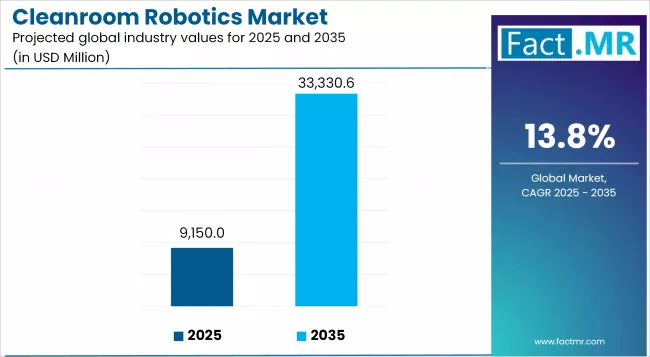
Cleanroom Robotics Market Industry Value Analysis | Source: Fact.MR
What are the drivers of the Cleanroom Robotics market?
The cleanroom robotics market receives support from different elements which create rising demand for these systems in semiconductor production and pharmaceutical manufacturing and electronic manufacturing. The primary motivator stems from the requirement to protect human contamination risks during critical manufacturing operations which follow strict ISO and GMP cleanroom regulations. The growing need for sophisticated chips has led to increased semiconductor wafer production which drives the implementation of automated wafer-handling systems.
The market continues to grow because pharmaceutical and biotech manufacturing expands and focuses on aseptic filling and sterile packaging operations. Manufacturers use automation to replace manual work because they face worker shortages and need to boost their output levels. The controlled environment robotics sector experiences expansion through technological progress that includes compact SCARA robots and collaborative robots and autonomous mobile robots which now possess cleanroom certification.
What are the regional trends of the Cleanroom Robotics market?
The cleanroom robotics market experiences fast expansion in East Asia because China and Taiwan and South Korea and Japan continue to build large semiconductor manufacturing facilities which now make East Asia the dominant market region.
The advanced semiconductor facilities and biopharma innovation and cleanroom robotics retrofitting in North America continue to support its substantial market position. Western Europe maintains a consistent rate of adoption because Germany and France lead the way through their Industry 4.0 initiatives and their strict regulatory systems which promote cleanroom automation.
The South Asia and Pacific region experience rapid expansion because India and Southeast Asian governments run programs which draw electronics and medical manufacturing businesses to their countries.
The pharmaceutical and electronics manufacturing industry will expand in Latin America and Eastern Europe and MEA because these regions will increase their domestic production capabilities.
What are the challenges and restraining factors of the Cleanroom Robotics market?
The cleanroom robotics market continues to grow rapidly yet encounters multiple obstacles which restrict its expansion. The high price of cleanroom-ready robots and their necessary infrastructure prevent small and medium-sized manufacturers from adopting these systems. The process of integrating new systems with existing production lines together with validation procedures and regulatory requirements creates additional expenses and extended deployment periods.
The risks of maintenance and downtime become worse in environments which need strict contamination control. The implementation process faces delays because there are not enough trained professionals who can perform programming and calibration and validation tasks. The procurement process becomes longer because organizations need to customize equipment for various cleanroom environments and select appropriate low-particle materials and process-specific end-effectors. The cleanroom automation investment in the short term will face limitations because of economic downturns and interruptions in semiconductor and pharmaceutical development initiatives.
Country-Wise Insights
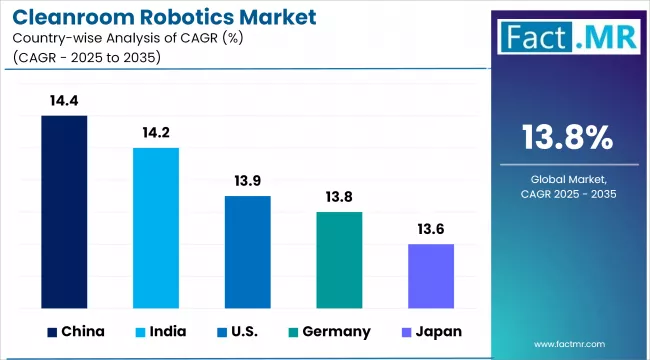
Cleanroom Robotics Market Cagr Analysis By Country | Source: Fact.MR
China is Accelerating Cleanroom Robotics Through Semiconductor and Pharma Expansion
China leads the world leader in cleanroom robotics as its market expands at the fastest pace because the country invests heavily in semiconductor fabrication plants and electronics manufacturing and biopharmaceutical production facilities. The Chinese government backs new manufacturing technologies through its "Made in China 2025" program and domestic chip production support which leads to the creation of robots that handle wafers and perform transfer operations and inspection tasks in ISO Class 1–5 environments.
The pharmaceutical and biotech sectors in China adopt cleanroom automation systems to achieve GMP compliance and boost production speed and reduce contamination risks during sterile filling and packaging processes. Local robot manufacturers develop affordable SCARA and articulated and collaborative robot models which function in cleanroom environments to serve both major fabrication facilities and medium-sized manufacturers. The country stands as a worldwide cleanroom robotics hub because of its manufacturing power and rising export trade which will drive the market to double-digit growth until 2035.
India is Accelerating Cleanroom Robotics Adoption to Boost Manufacturing Competitiveness
India has become one of the major emerging growth centers of the cleanroom robotics market, with the assistance of the government programs such as the Make in India and the India Semiconductor Mission. Increasing investments in semiconductor fabrication, electronics assembly and pharmaceutical production are generating a need to find contamination free automation solution. Robots in cleanrooms are helping the Indian producers to attain accuracy, adherence to the GMP requirements, and uniformity of product quality with less reliance on human expertise.
High-growing pharmaceutical export business in the country and growing interest in manufacturing vaccines and biologics also contribute to the adoption of robotic aseptic handling systems. It is predicted that increasing partnerships between Indian manufacturing companies and international automation companies, as well as a reduction in the cost of robots and the growing integration experience in the area will catalyze implementation.
The United States Driving Innovation and Adoption in Cleanroom Robotics
The US is also turning out to be a major market driver in the cleanroom robotics industry, as evidenced by the high-tech semiconductor manufacturing industries, strong pharmaceutical manufacturing industries, and the accelerating growth of the biotech and medical equipment industries. Federal funding through programs like the CHIPS and the Science Act is driving the development of new fabs and the refurbishment of existing ones with automation ready clean rooms.
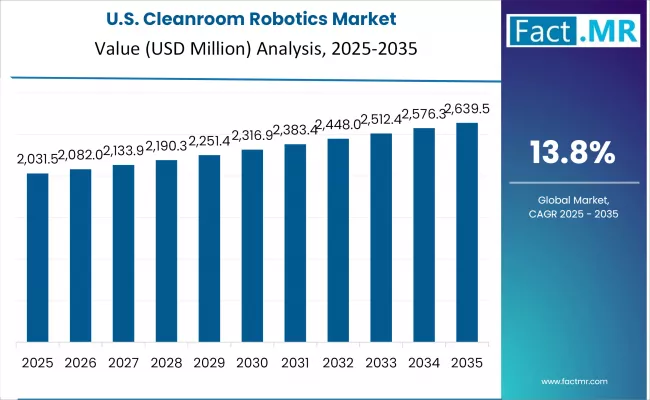
Cleanroom Robotics Market Country Value Analysis | Source: Fact.MR
The manufacturers in the U.S. focus on contamination, accuracy, and efficiency, which leads to the implementation of ISO-certified articulated, SCARA, and collaborative robots in wafer handling, aseptic filling, and micro-assembly. Innovation is accelerated at a high level by the highly skilled workforce as well as the high levels of R&D and collaboration between the robotics companies, and research institutes.
Moreover, the high FDA and GMO standards provide a good incentive to adopt robotics in the quest to reduce risks of human contamination. The combination of these elements makes the U.S. market a market leader in technological innovations as well as in new cleanroom automation solutions.
Category-Wise Analysis
Articulated Robots Are Powering Precision and High-Flexibility Operations in Cleanroom Automation
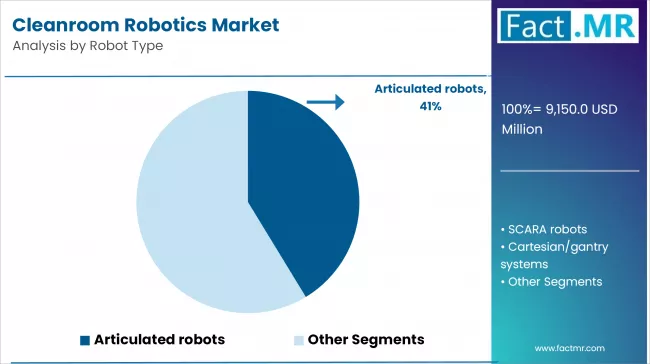
Cleanroom Robotics Market Analysis By Robot Type | Source: Fact.MR
The next generation of cleanroom automation is articulated robots, which are more flexible, can reach difficult places, and multi-axis, making them clean and able to perform a range of tasks in semiconductor, pharmaceutical, and electronic production. They are most suited to the ISO Class 1-5 environment due to their capability to operate delicate pick-and-place, handling of wafers, aseptic filling, and micro-assembly with a low risk of contamination.
The segment enjoys unremitting innovation in low-particle design, small footprint and high motion control, making it easy to integrate into tight cleanroom designs. Increased need of 24/7 operations, optimization of labor costs, and repeatability tendencies are some of the factors that promote adoption in high value manufacturing industries. As firms embark on Industry 4.0 approaches, articulated robots are central in supporting data-driven connected cleanroom environments that maximize productivity and compliance.
ISO Class 4–6 Cleanroom Robotics Drive High-Clean Automation Across Pharmaceuticals and Electronics
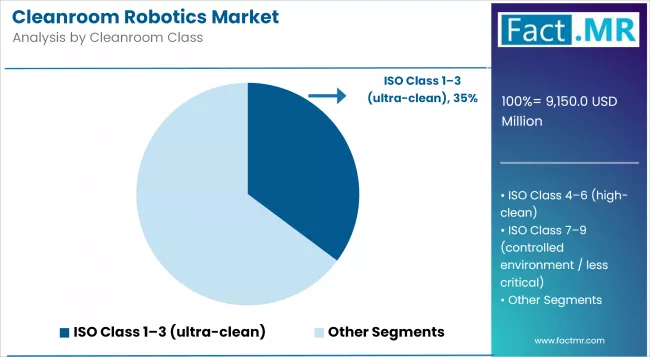
Cleanroom Robotics Market Analysis By Cleanroom Class | Source: Fact.MR
The cleanroom robotics market segment of ISO Class 4-6 in the market is growing at an alarming rate as companies want to have quality automation in high-clean working conditions. These robots work in closed areas that have heavy particulates and allow handling of sensitive drugs, biotech materials and electronic parts with accuracy. Increased demand in aseptic filling, wafer handling and micro-assembly leads to adoption and regulatory standards and quality compliance makes manual operations less practical.
Highly articulated, collaborative, and SCARA robots using low-particle materials and designs that are compatible with HEPA are also being incorporated into the production lines. Additionally, the demand of increased throughput, minimised contamination hazards and uniform quality among the key manufacturing operations makes ISO Class 4 -6 robotics a fundamental supporter of scalable high-clean manufacturing.
Competitive Analysis
Key players in the Cleanroom Robotics market ABB Ltd., FANUC Corporation, KUKA AG, Yaskawa Electric Corporation, Kawasaki Heavy Industries (Kawasaki Robotics), Mitsubishi Electric Corporation, Denso Corporation, Nachi-Fujikoshi Corp., Epson (Seiko Epson Corporation), Omron Corporation, Universal Robots A/S, Stäubli International AG, Comau S.p.A., Yamaha Robotics, Aerotech
Cleanroom Robotics market is a very competitive market due to the fast technological change and the increasing market demand in semiconductor, pharmaceutical, and biotechnology. Firms are also working on creating more precise robots, with low-particle emission and flexible to different classes of clean rooms. Some competitive strategies involve research and development of advanced SCARA, articulated and collaborative robots and the expansion of automation to aseptic processing, micro-assembly and handling of wafer.
Companies are focusing on low cost, high-quality, and quicker implementation to lure new customers and maintain the ones they have. It has strategic collaborations, partnerships, and alliances with system integrators and research institutions that are typical in order to speed up innovation and market penetration. Competition to sustain scalable, customizable, and efficient cleanroom automation reuse is accelerating, and continuous improvement and differentiation are the key to success in the market.
Recent Development
- In June 2025, Seiko Epson Corporation is developing its first collaborative robot solution, with a planned launch in 2025. Designed to enhance efficiency and productivity across a wide range of industries-including manufacturing, logistics, and the rapidly evolving life sciences and pharmaceutical sectors, this new solution represents a significant expansion of Epson's automation portfolio. Initial sales are planned for Japan and Europe, with a phased rollout to additional regions to follow.
- In March 2025, Stäubli Robotics in collaboration with a prominent pharmaceutical company has developed a mobile robot for use in Grade A/B/C/D cleanrooms. A cross-functional team comprised of experts from both companies collaborated on product development, resulting in a new technology to automate production in sensitive environments.
Fact.MR has provided detailed information about the price points of key manufacturers of Cleanroom Robotics Market positioned across regions, sales growth, production capacity, and speculative technological expansion, in the recently published report.
Methodology and Industry Tracking Approach
The Fact.MR 2025 global Cleanroom Robotics market report relies on the opinions of 1,200 stakeholders in 12 countries, where each respondent will give a minimum of 75 answers. Among them, end users (semi-conductor manufacturers, pharmaceutical and biotech companies, medical devices manufacturers and electronics OEMs) made up 65% of the total, with supply chain managers, clean room compliance consultants and automation technology advisors constituting the other 35 percent.
The fieldwork would be carried out between September 2024 and August 2025 with an emphasis on the efficiency of robot deployment, compliance of the classrooms, automation of the processes, throughput optimization and the cost metrics of the operations. An equalizing model of calibration guaranteed proper regional representation of North America, Europe and Asia-Pacific.
The research utilized more than 95 credible sources such as automation implementation reports, robotics technical audit reports, cleanroom documentation, industry journals, and manufacturing process data. Data reliability was guaranteed through triangulation protocol and analytical tools like multi-variable regression and scenario modeling, provided accurate forecasts and practical insights to the stakeholders that need to gain competitive advantage and sustainable growth in cleanroom automation.
Segmentation
Segmentation of Cleanroom Robotics Market
-
By Robot Type :
- Articulated robots
- SCARA robots
- Cartesian/gantry systems
- Collaborative robots
- Autonomous mobile robots
-
By Payload :
- Ultralight (<5 kg)
- Light (5-20 kg)
- Medium (20-100 kg)
- Heavy (>100 kg)
-
By Collection and Supply Channel :
- Formal Sector Collection
- Informal Sector Collection
- Municipal and Government Channels
- OEM Take-back Programs
-
By Cleanroom Class :
- ISO Class 1-3 (ultra-clean)
- ISO Class 4-6 (high-clean)
- ISO Class 7-9 (controlled environment / less critical)
-
By Application :
- Semiconductor & wafer handling
- Pharmaceutical aseptic filling & vial handling
- Biotech — cell therapy, sample prep
- Medical device manufacturing & assembly
- Electronics assembly & MEMS
- Other
-
End-use Industry :
- Semiconductor fabs
- Pharmaceutical and Medical device manufacturers
- Biotechnology firms / CROs
- Aerospace & defense (precision components)
- Research institutions / universities
- Other
-
By Region :
- North America
- Latin America
- Western Europe
- Eastern Europe
- East Asia
- South Asia & Pacific
- Middle East & Africa
Frequently Asked Questions
What was the Global Cleanroom Robotics Market Size Reported by Fact.MR for 2025?
Who are the Major Players Operating in the Cleanroom Robotics Market?
What is the Estimated Valuation of the Cleanroom Robotics Market in 2035?
What Value CAGR did the Cleanroom Robotics Market Exhibit Over the Last Five Years?
Who worked on this report


Preview the report firsthand - request a free sample
Free SampleGet the brochure for pricing and purchase details
Download PDF