- Market Value (2025): USD 570.2 Mn
- Estimated Value (2026): USD 690.0 Mn
- Forecast Value (2036): USD 4642.0 Mn
- CAGR (2026-2036): 21.0%
What is the CNC Anomaly Detectors Market forecast to be worth by 2036?
USD 690.0 million in 2026 to USD 4,642.0 million by 2036 at a 21.0% CAGR.
- The CNC Anomaly Detectors Market reached USD 570.2 million in 2025.
- Demand is projected to increase from USD 690.0 million in 2026 to USD 4,642.0 million by 2036.
- The market is forecast to record 21.0% CAGR from 2026 to 2036 as manufacturers use anomaly data to reduce scrap and protect spindle uptime.
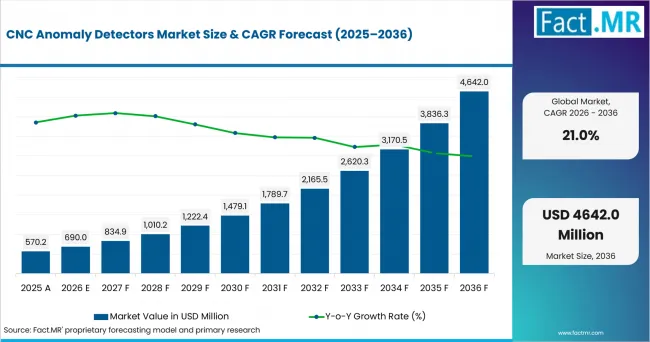
Cnc Anomaly Detectors Market Value Analysis | Source: Fact.MR
What are the defining numbers behind CNC Anomaly Detectors Market growth?
USD 3,952.0 million absolute opportunity is expected between 2026 and 2036.
- Demand Drivers in the Market
- CNC production managers need earlier tool-breakage alerts so high-value parts stay protected during lights-out machining and repeat-batch production.
- Maintenance teams need detector data that turns vibration, spindle-load and visual changes into repair action. The Federal Reserve reported in August 2026 that U.S. manufacturing production grew 0.2% in July 2026.
- Quality engineers need inspection-linked anomaly detection because tolerance drift often begins before the final gauge check confirms a reject.
- Automation integrators need Industrial Ethernet and IO-Link connectivity so anomaly alerts move into PLCs, MES dashboards and maintenance workflows.
- Plant operators need cleaner alarm rules that separate tool wear from chatter, collision risk and harmless process variation during high-mix machining.
- Key Segments Analyzed
- By Sensor Type: Optical is expected to hold 42.0% share in 2026 because visible tool, chip and surface variation can be checked quickly by operators.
- By Connectivity: Industrial Ethernet is projected to account for 46.0% share in 2026 owing to its fit with CNC controls and factory systems.
- By Function: Condition monitoring is anticipated to capture 39.0% share in 2026 since maintenance teams prioritize early warnings over post-event diagnosis.
- By End Use: Automotive is estimated to represent 30.0% share in 2026 due to repeat machining and strict line-stop economics.
- Analyst Opinion at Fact.MR
- Shambhu Nath Jha, Principal Consultant at Fact.MR, states, “The issue is no longer whether a CNC machine produces data. The test is whether a detector finds a bad cut early enough to protect the part and the spindle. Systems that combine signal quality, control integration and clear alarm rules are expected to earn faster trust.”
- Strategic Implications
- Machine-tool OEMs should package anomaly detection with control interfaces so customers avoid separate integration work for every CNC cell.
- Sensor manufacturers should document false-alarm behavior by machining process because plant teams judge alerts by interruption cost.
- Maintenance software providers should connect anomaly events with repair records so teams learn which warnings predict faults.
- Plant operators should standardize alarm thresholds across similar CNC assets before scaling detectors across multiple lines.
Japan is projected to post 25.1% CAGR through 2036 due to machinery investment and precision factory upgrades. The USA is anticipated to record 23.8% CAGR as durable-goods production keeps uptime tied to domestic planning. The UK is expected to reach 21.5% CAGR supported by advanced-manufacturing programs. South Korea is forecast to hold 21.0% CAGR as electronics exports lift process-control requirements. Germany is estimated to reach 20.2% CAGR through machine-tool orders and industrial data integration.
How does the CNC Anomaly Detectors Market break down by segment?
Optical leads Sensor Type at 42.0%; Industrial Ethernet leads Connectivity at 46.0%.
Which Sensor Type dominates?
Optical is expected to hold 42.0% share in 2026.
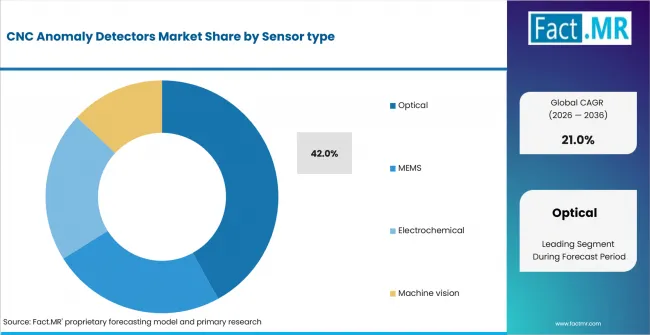
Cnc Anomaly Detectors Market Analysis By Sensor Type | Source: Fact.MR
Optical detection leads Sensor Type because cameras, lasers and tool setters show cutter-edge and surface variation directly. MEMS sensors support vibration checks in compact housings, while machine vision serves inspection-heavy cells where operators need visible proof of tool damage. Kistler introduced its Telemetric Measurement System in September 2025 for wireless, wear-free transmission of signals for process and tool monitoring in dynamic structures such as turret lathes.
What leads the Connectivity segment?
Industrial Ethernet is projected to account for 46.0% share in 2026.
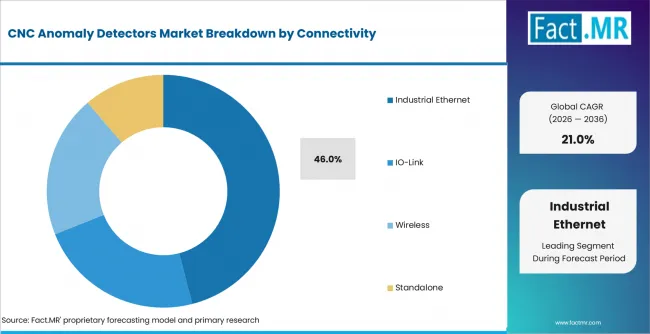
Cnc Anomaly Detectors Market Analysis By Connectivity | Source: Fact.MR
Industrial Ethernet leads Connectivity because CNC lines need reliable communication between detectors, PLCs and plant systems. IO-Link supports device diagnostics where plants add sensors without replacing the control architecture. Wireless links fit retrofit work when cabling raises installation cost or disrupts moving machine sections.
How does Function shape demand?
Condition monitoring is anticipated to capture 39.0% share in 2026.
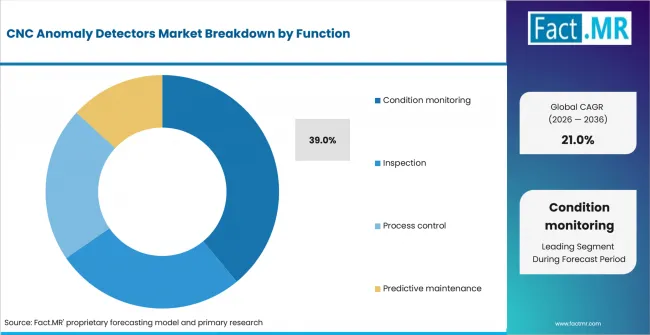
Cnc Anomaly Detectors Market Analysis By Function | Source: Fact.MR
Condition monitoring leads Function because downtime avoidance is the first buying case for many machining teams. Early warnings on tool wear, overload and vibration change help teams act before damage reaches the spindle or workpiece. Inspection remains closely linked to the market when detector outputs support part-quality decisions during the cycle.
What supports Automotive within End Use?
Automotive is estimated to represent 30.0% share in 2026.
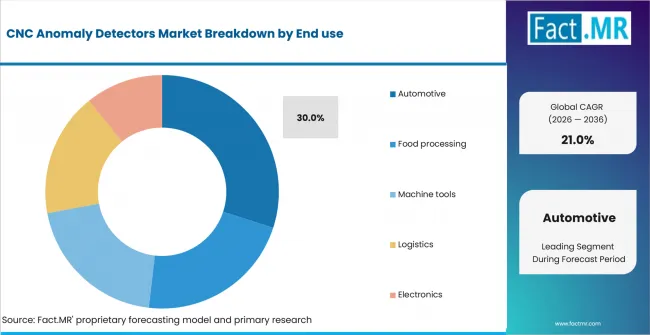
Cnc Anomaly Detectors Market Analysis By End Use | Source: Fact.MR
Automotive leads End Use because repeated machining makes alarm accuracy commercially valuable. A single cell can produce similar parts through many cycles, so stable detector rules can be validated faster. Machine-tool and electronics applications follow as plants look for earlier warnings during small-part machining and tighter tolerance work.
What is accelerating CNC Anomaly Detectors Market adoption, and what is holding it back?
CNC uptime drives it; integration cost restrains it.
Drivers Impact Analysis
| DRIVER | (~) % IMPACT ON CAGR | GEOGRAPHIC RELEVANCE | IMPACT TIMELINE |
|---|---|---|---|
| Unattended CNC production and scrap avoidance | +2.1% | Global | Short term (<= 2 years) |
| Industrial Ethernet and IO-Link integration | +1.7% | North America, Europe, East Asia | Medium term (2-4 years) |
| Tool-life optimization in high-volume machining | +1.4% | Automotive hubs | Medium term (2-4 years) |
| Condition monitoring tied to maintenance software | +1.0% | Global | Long term (>= 4 years) |
| Machine-vision inspection near the cutting process | +0.8% | Japan, Germany, USA | Long term (>= 4 years) |
Source: Fact.MR analysis. Updated Aug 27, 2026
- Unattended CNC production and scrap avoidance: Longer shifts raise the cost of missed tool problems. Detector alarms are expected to protect high-value workpieces when operators oversee several machines or run lights-out schedules.
- Industrial Ethernet and IO-Link integration: Connected alarms need direct control and network access. Plants are projected to favor detector packages that pass clean signals into PLCs, maintenance dashboards and quality records.
- Tool-life optimization in high-volume machining: Signal trends support safer replacement rules. Automotive and electronics plants are anticipated to use anomaly histories to adjust tool changes before hard failures occur.
- Condition monitoring tied to maintenance software: Repair history makes anomaly records more useful. When alerts connect with work orders, maintenance teams are expected to learn which signal shifts deserve action.
- Machine-vision inspection near the cutting process: Optical checks find tool and surface problems earlier. This is forecast to support adoption where scrap cost and inspection delays are linked.
Opportunity Impact Analysis
| OPPORTUNITY | (~) % IMPACT ON CAGR | GEOGRAPHIC RELEVANCE | IMPACT TIMELINE |
|---|---|---|---|
| Retrofitting older CNC fleets | +1.3% | USA, UK, Germany | Short term (<= 2 years) |
| Packaged OEM detector modules | +1.1% | Japan, Germany, South Korea | Medium term (2-4 years) |
| AI-assisted anomaly classification | +0.9% | Global | Medium term (2-4 years) |
| Remote service and service-contract bundling | +0.7% | North America, Europe | Long term (>= 4 years) |
Source: Fact.MR analysis. Updated Aug 27, 2026
- Retrofitting older CNC fleets: Add-on detectors are projected to reduce replacement disruption. The opportunity is concentrated where plants run mixed machine ages and need better alarms before buying new equipment.
- Packaged OEM detector modules: Validated modules are expected to reduce commissioning work. Machine-tool builders can bundle monitoring with controls so end users receive tested signal paths from the first installation.
- AI-assisted anomaly classification: Software is anticipated to separate wear, chatter and collision risk. Better classification gives operators clearer actions and lowers the chance of unnecessary stoppages.
- Remote service and service-contract bundling: Detector data is forecast to support remote diagnosis. Service teams can use alarm histories to prepare parts and reduce repeated site visits.
Restraints Impact Analysis
| RESTRAINT | (~) % IMPACT ON CAGR | GEOGRAPHIC RELEVANCE | IMPACT TIMELINE |
|---|---|---|---|
| False alarms and process variability | -0.8% | Global | Short term (<= 2 years) |
| Retrofit integration cost | -0.6% | North America, Europe | Medium term (2-4 years) |
| Limited labelled failure data | -0.5% | Global | Medium term (2-4 years) |
| Skilled maintenance and controls gaps | -0.4% | USA, UK, Germany, Japan | Long term (>= 4 years) |
Source: Fact.MR analysis. Updated Aug 27, 2026
- False alarms and process variability: Nuisance alerts push operators to pause detector use. Adoption is expected to slow when alarm rules fail to reflect material changes, tooling differences and batch size.
- Retrofit integration cost: Mixed controls raise total project cost beyond the detector. Plants are projected to demand clearer commissioning packages before they scale across older CNC fleets.
- Limited labelled failure data: Missing records weaken failure classification. Detector models need enough confirmed events to separate true faults from routine process noise.
- Skilled maintenance and controls gaps: Detection spans controls, tooling and maintenance teams. Adoption is anticipated to move faster where plants assign owners for thresholds, alarm review and repair follow-up.
Which countries are scaling the CNC Anomaly Detectors Market through 2036?
- The country comparison spans 4.9 percentage points between Japan and Germany.
- Japan remains 1.3 percentage points above the USA through machinery investment and precision factory upgrades.
- The USA remains 2.3 percentage points above the UK as durable-goods orders keep uptime central to production planning.
- The UK remains 0.5 percentage point above South Korea with advanced-manufacturing funding and precision engineering upgrades.
- South Korea remains 0.8 percentage point above Germany as electronics exports lift process-control requirements.
- Germany closes the displayed range while machine-tool orders sustain demand for more usable condition data.
Comparable CAGRs create different entry conditions due to CNC fleet age, controls integration, export exposure and machine-tool service depth. Full report coverage includes North America, Latin America, Western Europe, Eastern Europe, East Asia, South Asia & Pacific, Middle East & Africa.
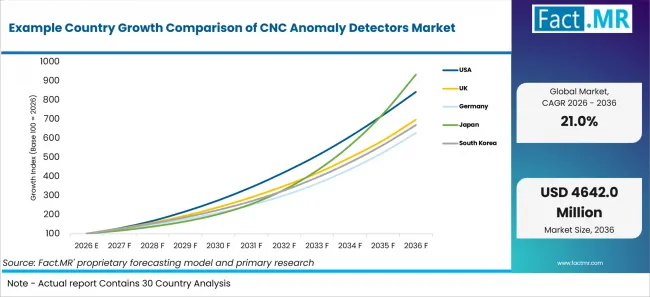
Example Country Growth Comparison Of Cnc Anomaly Detectors Market | Source: Fact.MR
| Country | CAGR |
|---|---|
| Japan | 25.1% |
| USA | 23.8% |
| UK | 21.5% |
| South Korea | 21.0% |
| Germany | 20.2% |
Source: Fact.MR analysis. Updated Aug 27, 2026
What supports Japan adoption?
25.1% CAGR, supported by machinery orders and precision factory upgrades.
Japan is projected to post 25.1% CAGR through 2036 as machine-tool builders and electronics manufacturers connect detector data with process control. The Cabinet Office reported in August 2026 that machinery orders from 280 manufacturers rose 11.3% in April-June 2026 from the prior quarter.
What supports USA adoption?
23.8% CAGR, supported by durable-goods orders and CNC uptime needs.
U.S. demand is anticipated to record 23.8% CAGR through 2036 because durable-goods producers link CNC uptime with output planning. The U.S. Census Bureau reported in July 2026 that new orders for manufactured durable goods reached USD 334.8 billion in June 2026.
What supports the UK outlook?
21.5% CAGR, supported by manufacturing output and advanced-manufacturing policy.
The UK is expected to reach 21.5% CAGR through 2036 as precision engineering plants test monitoring upgrades inside smaller CNC fleets. The Office for National Statistics reported in August 2026 that manufacturing output grew 1.0% in the three months to June 2026 from the three months to March 2026.
How is South Korea developing demand?
21.0% CAGR, supported by electronics exports and equipment investment.
South Korea is forecast to hold 21.0% CAGR through 2036 because electronics-linked machining needs tighter process control. MOTIR and MSIT announced in August 2026 that Korea’s ICT exports reached USD 53.36 billion in July 2026, a record July level.
What supports Germany adoption?
20.2% CAGR, supported by machinery orders and industrial automation depth.
Germany is estimated to reach 20.2% CAGR through 2036 as machine-tool users connect anomaly alarms with quality documentation. Destatis reported in August 2026 that real new orders in manufacturing rose 3.1% in June 2026 from the previous month.
Who leads the CNC Anomaly Detectors Market?
Siemens and Renishaw are profiled for CNC digitalization, metrology and process-control technologies, while Kistler is profiled for process and condition-monitoring technologies.
Siemens anchors the software and control side through MACHINUM, SINUMERIK and machine-tool digitalization tools. Renishaw adds machine-tool probes, ballbar checks and process-control software that help operators confirm tool and machine behavior. Marposs brings tool and process monitoring through machine-mounted systems that detect tool wear, tool breakage and collision risk during machining.
Kistler supports force and process monitoring in dynamic machine structures. ifm electronic complements the provider set through connected sensing and IO-Link devices used in factory condition-monitoring and industrial data architectures.
Which companies are the key providers?
Key companies include Siemens, Renishaw, Marposs, Kistler, and ifm electronic.
- Siemens
- Renishaw
- Marposs
- Kistler
- ifm electronic
Bibliography
- U.S. Census Bureau. (2026, July 27). Monthly advance report on durable goods manufacturers' shipments inventories and orders.
- Board of Governors of the Federal Reserve System. (2026, August 18). Industrial production and capacity utilization—G.17.
- Economic and Social Research Institute. (2026, August 19). Machinery orders in June, 2026 and forecast for Jul.-Sep. 2026. Cabinet Office, Government of Japan.
- Office for National Statistics. (2026, August 13). GDP monthly estimate, UK: June 2026.
- Ministry of Trade, Industry and Resources, & Ministry of Science and ICT. (2026, August 14). Korea’s ICT exports reach record $53.36 billion for July.
- Federal Statistical Office (Destatis). (2026, August 6). New orders in manufacturing in June 2026: +3.1% on the previous month.
- Siemens AG. (2025, January 23). Siemens unveils MACHINUM at IMTEX 2025: Delivers machine tool efficiency and sustainability.
- Kistler Group. (2025, September 29). New telemetric measurement system with wireless signal transmission for process monitoring.
- Schaeffler. (2026, January 27). Schaeffler expands OPTIME portfolio: FAG OPTIME E-CM monitors electrically driven units.
- Renishaw plc. (2025, August). Renishaw to exhibit the future of metrology with new smart factory innovations at EMO Hannover 2025.
This Report Addresses
- The report explains where CNC anomaly detectors are used across sensor type and connectivity, together with function and end use.
- Segment analysis identifies Optical and Industrial Ethernet as the two lead positions and explains the operational reasons behind selection.
- Country analysis examines Japan, USA, UK, South Korea and Germany, including manufacturing signals that shape adoption.
- Competitive analysis reviews Siemens, Renishaw, Marposs, Kistler, and ifm electronic across CNC monitoring and connected sensing.
- Technology assessment covers optical, MEMS, electrochemical and machine-vision detection used around CNC machining processes.
- Application assessment covers automotive, food processing, machine tools, logistics and electronics where anomaly alarms guide maintenance action.
- The forecast is supported by primary interviews, provider portfolio checks and official evidence review across the target countries.
What does the CNC Anomaly Detectors Market cover?
Optical, MEMS, electrochemical and machine-vision detector systems used for CNC anomaly detection.
The CNC Anomaly Detectors Market covers sensors, machine-mounted modules and software that identify abnormal CNC machine behavior during production. It includes optical checks, vibration sensing, load monitoring, tool-wear alerts and process-control signals.
The assessment differs from broad factory automation because it focuses on detection around CNC machining. Wider asset-health systems are included only when they detect anomalies on CNC machines or machining-related equipment.
What is included in the scope?
CNC anomaly detector systems used in machining cells and computer-controlled metalworking equipment.
The scope includes CNC-mounted and CNC-connected detector systems used in machining cells, turning centers, machining centers and grinding lines. It covers optical, MEMS, electrochemical and machine-vision sensing where the output identifies abnormal tool or process behavior.
What is excluded from the scope?
General plant automation and standalone machine safety devices are outside the scope.
General SCADA platforms, standalone maintenance software and broad machine safety devices are outside the scope when they are sold apart from CNC anomaly detection. Machine tools sold as standard equipment packages are outside the scope unless detector capability is bundled. Adjacent digital twins for CNC machining centers are considered separately when the offer centers on simulation instead of direct anomaly alerts.
How Was the Analysis Built?
The analysis draws on 120+ sources, 35+ company portfolios, 25+ countries, and more than 20 industry interviews.
- Primary Research: Primary research includes discussions with manufacturers, service providers, technology developers, distributors, end users, procurement teams, and subject-matter experts. These conversations examine purchasing priorities, product adoption, operational challenges, approval requirements, competitive positioning, and the factors that influence wider market acceptance.
- Desk Research: Desk research covers government statistics, regulatory publications, company filings, trade data, technical studies, industry associations, standards, public policy, and other authoritative sources. Every source used in the analysis is documented in the bibliography.
- Market Sizing and Forecasting: Market estimates combine historical performance, demand indicators, pricing and volume trends, segment shares, company participation, country-level growth, adoption patterns, investment activity, and barriers to market expansion.
- Data Validation and Update Cycle: Findings are validated by comparing primary interviews with public data, company activity, regulatory changes, trade patterns, and industry developments. Regular updates review new product launches, capacity changes, partnerships, approvals, procurement trends, and shifts in commercial adoption.
Segmentation
What is the report's scope and coverage?
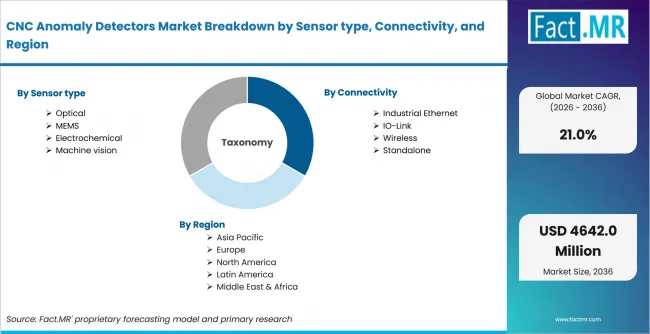
Cnc Anomaly Detectors Market Breakdown By Sensor Type, Connectivity, And Region | Source: Fact.MR
| Attribute | Details |
|---|---|
| Quantitative Units | USD million |
| Market Definition | Systems, sensors and software used to detect abnormal CNC machine, tool or process behavior during machining operations. |
| Sensor Type | Optical; MEMS; Electrochemical; Machine vision |
| Connectivity | Industrial Ethernet; IO-Link; Wireless; Standalone |
| Function | Condition monitoring; Inspection; Process control; Predictive maintenance |
| End Use | Automotive; Food processing; Machine tools; Logistics; Electronics |
| Regions Covered | North America; Latin America; Western Europe; Eastern Europe; East Asia; South Asia & Pacific; Middle East & Africa |
| Countries Covered | Japan; USA; UK; South Korea; Germany |
| Key Companies Profiled | Siemens; Renishaw; Marposs; Kistler; ifm electronic |
| Forecast Period | 2026 to 2036 |
| Approach | Hybrid top-down and bottom-up approach using CNC fleet exposure, sensor attachment rates, connectivity mix, application demand and provider portfolio review. |
Source: Fact.MR analysis. Updated Aug 27, 2026
How is the market segmented?
-
By Sensor Type:
- Optical
- MEMS
- Electrochemical
- Machine vision
-
By Connectivity:
- Industrial Ethernet
- IO-Link
- Wireless
- Standalone
-
By Function:
- Condition monitoring
- Inspection
- Process control
- Predictive maintenance
-
By End Use:
- Automotive
- Food processing
- Machine tools
- Logistics
- Electronics
-
By Region:
- North America
- Latin America
- Western Europe
- Eastern Europe
- East Asia
- South Asia & Pacific
- Middle East & Africa
Frequently Asked Questions
How big is the CNC anomaly detectors market in 2026?
What is the CAGR of the CNC anomaly detectors market from 2026 to 2036?
Which sensor type leads the CNC anomaly detectors market?
Which connectivity segment leads the CNC anomaly detectors market?
Who are the leading companies in the CNC anomaly detectors market?
Who worked on this report


Preview the report firsthand - request a free sample
Free SampleGet the brochure for pricing and purchase details
Download PDF