Cobot Vacuum Unit Market Size, Share, Growth and Forecast (2026 - 2036)
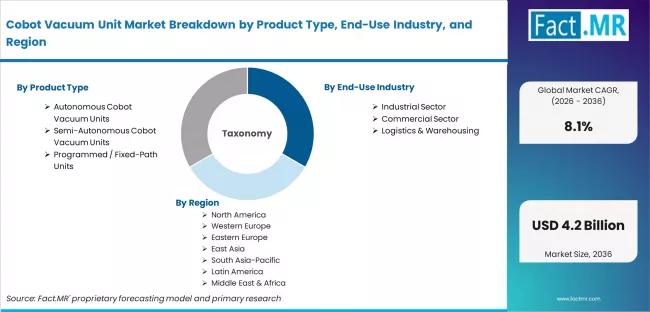
The Cobot Vacuum Unit Market is segmented by Product Type, Technology , End Use Industry , Operation Mode , and Region. The forecast period is 2026 to 2036.
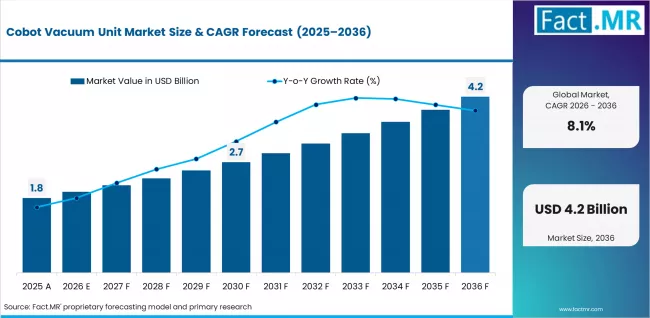
According to market estimates, the cobot vacuum unit market stood at approximately USD 1.8 billion in 2025. The market is projected to reach around USD 1.9 billion in 2026 and is expected to grow significantly to approximately USD 4.2 billion by 2036, progressing at a CAGR of 8.1% during the forecast period. Autonomous Cobot Vacuum Units are anticipated to account for nearly 62.8% share by 2026, driven by increasing adoption of AI-based navigation systems and automation in industrial and logistics environments, while Navigation Technology is expected to remain the leading technology segment with around 57.9% share by 2026, supported by rapid integration of LiDAR, SLAM, and sensor fusion systems across advanced cleaning platforms.
Cobot Vacuum Unit Market Overview, Growth Outlook, and Forecast By Fact.MR
Global Cobot Vacuum Unit market revenue stood at USD 1.8 Bn in 2025 and is forecast to reach USD 4.2 Bn by 2036. At 8.1% CAGR from 2026 to 2036, this market is set to expand ~0.3x in value, adding USD 2.3 Bn in absolute opportunity.
Summary of Cobot Vacuum Unit Market
- Market Snapshot
- In 2025, the global cobot vacuum unit market was valued at approximately USD 1.8 billion.
- The market is estimated to reach around USD 1.9 billion in 2026 and is projected to attain nearly USD 4.2 billion by 2036.
- The cobot vacuum unit market is expected to expand at a CAGR of approximately 8.1% during the forecast period.
- The market is anticipated to create an absolute dollar opportunity of approximately USD 2.3 billion between 2026 and 2036.
- Autonomous Cobot Vacuum Units dominate the product type segment with a share of approximately 62.8% in 2026, driven by rapid adoption of AI-based navigation.
- Navigation Technology dominates the technology segment with a share of approximately 57.9% in 2026, supported by advancements in LiDAR, computer vision, and sensor fusion enabling high-accuracy autonomous cleaning operations.
- Fully Autonomous Operation leads the operation mode segment with a share of approximately 60.3% in 2026, driven by rising demand for unmanned cleaning systems and fleet-based robotic facility management solutions.
- Industrial Sector dominates the end-use industry segment with a share of approximately 34.5% in 2026, followed closely by Logistics & Warehousing, driven by rapid growth of e-commerce fulfillment centers and smart warehouse automation.
- Demand and Growth Drivers
- The need for Cobot Vacuum Unit Systems has increased due to the fact that sensitive electronics are being used in multiple high-stress industries including defence and industrial applications.
- The rapid growth of data centres, edge computing, and telecommunications infrastructure creates more demand for a stable and secure system.
- The increased investment in Aerospace, Marine, and Transport systems creates a demand for advanced shock isolation technology.
- Product and Segment View
- Increasing demand for Autonomous Cobot Vacuum Units with 62.8% share in 2026 is driven by rapid adoption of AI-based navigation systems, SLAM technology, and large-scale deployment across industrial and logistics environments requiring fully automated cleaning operations.
- Rising adoption of Semi-Autonomous Units with 25.4% share is supported by hybrid human–robot workflows in commercial buildings and healthcare facilities where partial supervision is still required for complex cleaning tasks.
- Increasing adoption of Navigation Technology with 57.9% share is supported by advancements in LiDAR, SLAM, computer vision, and sensor fusion enabling high-precision autonomous movement in dynamic environments.
- Rising use of Cleaning Mechanism systems with 28.2% share is driven by improvements in vacuum suction performance, hybrid wet-dry cleaning systems, and advanced filtration technologies for industrial hygiene applications.
- Increasing demand for Fully Autonomous Operation with 60.3% share is driven by the shift toward unmanned facility cleaning, smart building automation, and robotic fleet deployment in large-scale infrastructures.
- Geography and Competitive Outlook
- China and India represent the world’s two fastest growing markets for the autonomous cleaning robot industry due to their rapid development of industrial automation, expanding logistics and e-commerce infrastructure, and vast amounts of autonomous cleaning system usage within manufacturing plants, warehouses, and commercial facilities.
- North America and Europe dominate the current global autonomous cleaning robot market, as both regions are considered relatively mature due to having well-developed ecosystems of industrial automation and smart building technologies, as such, they have been the earliest adopters of autonomous cleaning robots, with large numbers deployed throughout airports, hospitals, and large-scale commercial infrastructure facilities.
- The growth rate of the Asia-Pacific region will drive demand for vacuum cobots, due primarily to: the rapid establishment of smart factories, the establishment of distribution centers/logistics hubs, and the rapid modernization of manufacturing capabilities requiring efficient, ongoing automated cleaning solutions.
- The global Cobot Vacuum Unit market includes key players such as Gausium, i-Team, Deceler, Optima Robotics, and Nexaro.
- Analyst Opinion
- Shambhu Nath Jha, Principal Consultant at Fact.MR, says, “There is an increasing momentum in the market for Cobot Vacuum Units due to automation requirements being considered essential within various sectors, such as hygiene efficiency and cost reduction in facilities management. As demand increases for autonomous robots in the fields of industry, logistics, health care, and commercial operations, there will be rapid uptake of robots with AI-based navigation and mapping.
Cobot Vacuum Unit Market — At a Glance
| Market Value 2025 | USD 1.8 Billion |
|---|---|
| Market Value 2026 | USD 1.9 Billion |
| Market Value 2036 | USD 4.2 Billion |
| Absolute Dollar Opportunity | USD 2.3 Billion (2026–2036) |
| CAGR | 8.1% |
| Growth Multiple | ~2.1X |
| Key Demand Theme | Rising adoption of autonomous cleaning systems across industrial, logistics, healthcare, and commercial environments driven by AI-based navigation and smart facility automation |
| Leading Product Type | Autonomous Cobot Vacuum Units |
| Product Type Share | 62.8% |
| Leading End-Use Industry | Industrial Sector |
| End-Use Industry Share | 34.5% |
| Leading Operation Mode | Fully Autonomous Operation |
| Operation Mode Share | 60.3% |
| Leading Technology | Navigation Technology |
| Technology Share | 57.9% |
| Key Growth Regions | North America, Asia-Pacific, Europe |
| Fastest Growing Countries | China (8.8% CAGR), South Korea (8.2% CAGR), USA (7.5%), Japan (7.8%) |
| Key Companies | Gausium, i-Team, Deceler, Optima Robotics, Nexaro |
| Product Type Segmentation | Autonomous Cobot Vacuum Units, Semi-Autonomous Cobot Vacuum Units, Programmed / Fixed-Path Units |
| Technology Segmentation | Navigation Technology, Cleaning Mechanism, Control & Intelligence |
| End Use Industry Segmentation | Industrial Sector, Commercial Sector, Healthcare Sector, Logistics & Warehousing |
| Operation Mode Segmentation | Fully Autonomous Operation, Human–Robot Collaborative Mode, Remote-Controlled Operation |
| Region | North America, Europe, Asia-Pacific, Middle East & Africa, Latin America |
Key Growth Drivers, Constraints, and Opportunities
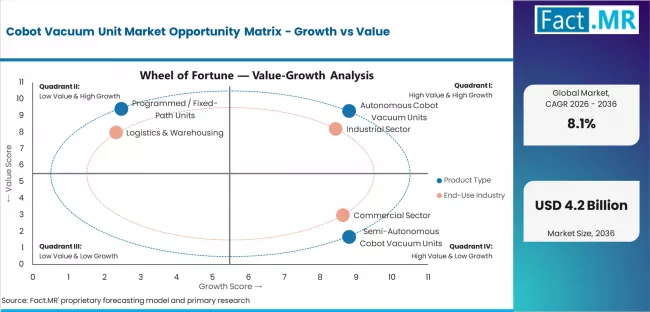
Key Factors Driving Growth
- As manufacturers become increasingly reliant on industrial automation and smart manufacturing systems, there has been a corresponding increase in the demand for cobot vacuum units.
- An increasing amount of autonomous cleaning robots are being deployed throughout commercial buildings, healthcare facilities, and large-scale industrial environments due to the heightened need for operational efficiency and hygiene standards and a reduction in labor costs.
- In addition to the demand for robotic cleaners, the rapid growth of logistics hubs, e-commerce fulfillment centers, and smart warehouses have greatly enhanced the need for autonomous vacuum cobots.
| Growth Driver | Demand Impact | Time Horizon | Key Impact Area | Fact.MR Insight |
|---|---|---|---|---|
| Increasing adoption of industrial automation, smart factories, and Industry 4.0 systems | High | Short–Mid Term | Adoption acceleration | Rising deployment of robotics in manufacturing and production facilities is driving strong demand for autonomous cleaning systems to support continuous operations |
| Rapid expansion of e-commerce, logistics hubs, and smart warehousing infrastructure | High | Short–Mid Term | System deployment & scaling | Growth in fulfillment centers and automated warehouses is increasing the need for autonomous vacuum cobots for continuous floor cleaning and operational efficiency |
| Growing demand for operational efficiency, hygiene standards, and labor cost reduction | High | Mid Term | Performance optimization | Industries such as healthcare, commercial buildings, and industrial facilities are increasingly adopting cobot vacuum units to reduce manual cleaning dependency |
| Increasing integration of AI-based navigation systems (LiDAR, SLAM, sensor fusion) | High | Mid–Long Term | Technology advancement | Advancements in autonomous navigation are enhancing accuracy, reliability, and real-time adaptability of cobot vacuum units across complex environments |
| Rising demand for smart infrastructure and autonomous facility management systems | Medium-High | Mid Term | Infrastructure modernization | Development of smart buildings, airports, and industrial campuses is accelerating the adoption of fleet-based autonomous cleaning solutions |
Key Market Constraints
- The initial investment cost for autonomous robotic systems, AI-based navigation technologies, and fleet management infrastructure limits the adoption of advanced vacuum cobot systems.
- The awareness of, and technical skills to deploy and integrate, autonomous cleaning robots could slow market entrance, particularly in developing countries and small to medium-sized companies.
- Compatibility issues with current facility layouts, cleaning infrastructure and legacy maintenance systems require customization/integration, which increases deployment complexity and overall cost to implement.
Key Opportunity Areas
-
There is considerable growth potential as a result of the increasing employment of autonomous cleaning robots that comes from the rapid advancement of smart factories, industrial automation, and Industry 4.0 in both developed and developing countries.
- Footprint expansion in logistics infrastructure, eCommerce fulfilment centres, and smart warehousing systems is all creating significant demand for cobots to provide continuous and efficient floor cleaning operations.
- The expanded use of smart buildings, autonomous facility management, and edge infrastructure is also driving demand for modular, scalable and fleet-based cobot vacuum solutions across both commercial and industrial applications.
Segment-wise Analysis of the Cobot Vacuum Unit Market
- Autonomous Cobot Vacuum Units hold 62.8% share in the product type segment, driven by rapid adoption of AI-based navigation systems, SLAM technology.
- Navigation Technology accounts for 57.9% share in the technology segment, supported by advancements in LiDAR, computer vision, sensor fusion, and real-time mapping systems enabling accurate and efficient autonomous movement in complex environments.
- Industrial Sector holds 34.0% share, driven by increasing adoption of automation in manufacturing facilities, electronics plants, and heavy industrial environments requiring continuous and efficient cleaning operations.
The market is segmented by product type, technology, operation mode, end-use industry, and region. In terms of operation mode, Fully Autonomous Operation accounts for 60.3% share, driven by strong demand for unmanned cleaning systems, fleet-based robotic management, and smart facility automation across large-scale infrastructure.
Which Product Type Segment Dominates the Market?
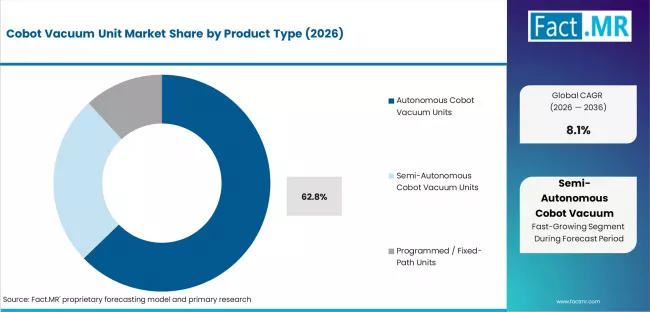
The autonomous cobot vacuum units are set to remain the dominant players with market shares accounting for about 62.8%. The reason for this high level of dominance can be attributed to the fast pace of adoption of artificial intelligence-based navigation systems, SLAM technology, and autonomous cleaning features by the industries. These units’ capability to provide consistent performance despite working in a dynamically changing environment makes them the best options for automation.
Which Technology Segment Dominates the Market?
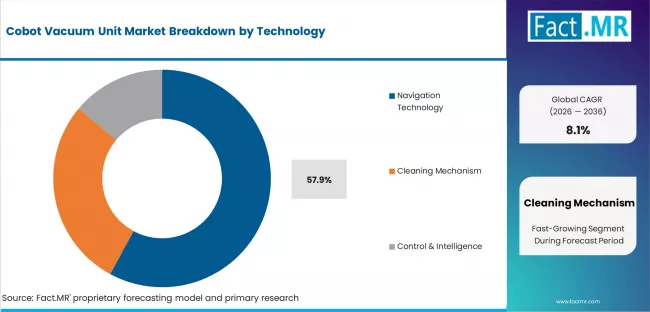
The market size of Navigation Technology will remain dominant and account for the highest market share of around 57.9% in 2026. The high market share will be attributed to the quick adoption of artificial intelligence-based navigation technology that includes LiDAR, Simultaneous Localization and Mapping (SLAM), computer vision, and sensor fusion technologies.
Which End-Use Industry Segment Dominates the Market?
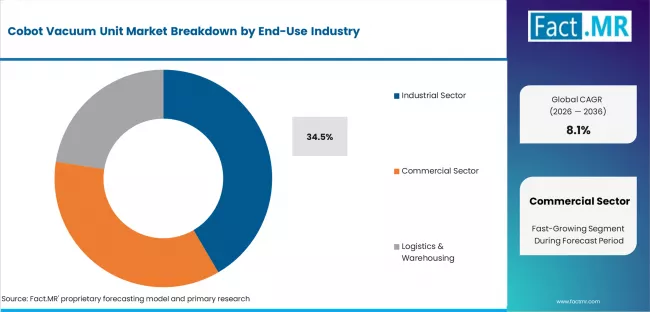
Market share held by the Industrial Sector is expected to remain the highest at around 34.5%. This can be attributed to the increasing demand for automation in manufacturing plants, electronics factories, and other industrial units where constant cleaning is necessary.
Which Operation Mode Segment Dominates the Cobot Vacuum Unit Market?
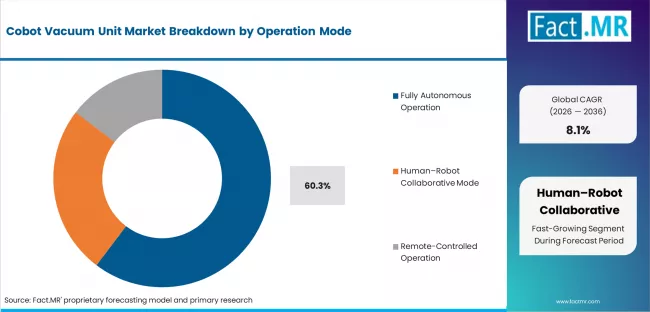
Fully Autonomous Operation will remain dominant and have the highest market share, accounting for around 60.3% in 2026. This dominance will be fueled by the growing trend towards unattended cleaning systems, artificial intelligence for facility management, and robot fleets.
Regional Outlook Across Key Markets
The market analysis covers key global regions, including South Asia and Pacific, Middle East & Africa, North America, Latin America, Western Europe, and Eastern Europe. It is segmented geographically, with specific market dynamics for each region. The full report provides a detailed market attractiveness analysis.
.webp)
CAGR Table
| Country | CAGR (%) |
|---|---|
| China | 8.8% |
| USA | 7.5% |
| Germany | 8.1% |
| Japan | 7.8% |
| South Korea | 8.2% |
| India | 8.8% |
| South Korea | 8.7% |
Source: Fact.MR (FMR) analysis, based on proprietary forecasting model and primary research.
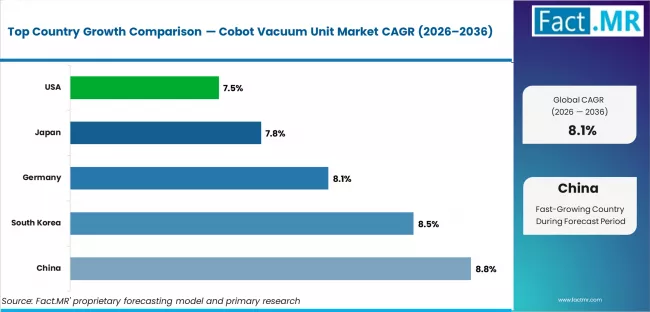
North America – The Defense & Advanced Infrastructure Hub
The North America cobot vacuum unit market will experience steady growth due to rising adoption of automation technologies, smart building management systems, as well as the fast-growing logistics and ecommerce infrastructure, which demands autonomous vacuum unit systems for cleaning applications.
- U.S.: Demand for cobot vacuum units in the U.S. is projected to grow at a 7.5% CAGR, supported by strong investments in warehouse automation, healthcare facility cleaning systems, and rapid expansion of smart buildings, airports, and industrial campuses integrating AI-based autonomous cleaning robots.
Western Europe – The Industrial & Engineering Excellence Hub
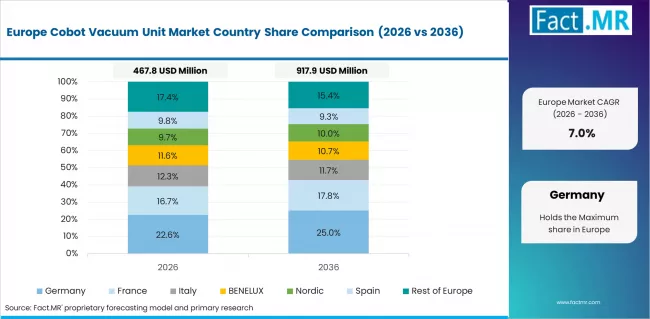
The steady growth of the market in Western Europe is driven by an increase in the adoption of industrial automation, the expansion of smart manufacturing ecosystems, and the greater use of autonomous cleaning solutions in logistic hubs, medical facilities, and commercial buildings.
- Germany: Demand for in Germany is projected to grow at an 8.1% CAGR through 2036, supported by its robust manufacturing base, strong Industry 4.0 ecosystem, and increasing adoption of autonomous robotics in industrial facilities.
East Asia – The High-Growth Manufacturing & Robotics Hub
The East Asia market is seeing impressive growth because of the quick advancements in the automation industry, rise of smart factories, and widespread use of autonomous robotics.
- China: Demand for Cobot Vacuum Units in China is projected to grow at an 8.8% CAGR through 2036, supported by large-scale industrial automation, rapid expansion of smart manufacturing facilities, and strong adoption of autonomous cleaning robots across logistics hubs, factories, and commercial infrastructure.
South Asia & Pacific – The Rapid Infrastructure & Industrial Expansion Region
South Asia & Pacific cobot vacuum unit market has been evolving rapidly due to several factors such as fast-changing industries, evolving logistics and e-commerce systems, and an increasing demand for smarter management techniques for buildings that are used for commercial, health care and manufacturing.
- India: Demand for cobot vacuum units in India is projected to grow steadily at an 8.8% CAGR through 2036, driven by rapid expansion of e-commerce warehouses, increasing deployment of smart factories.
Latin America – The Emerging Industrial & Commercial Automation Region
The market for Latin American cobot vacuum unit is slowly growing, fueled by modernization of industries, development of commercial facilities, and the use of automation technology in logistics, healthcare, and retail settings.
- Brazil: Demand for cobot vacuum units in Brazil is projected to grow steadily at an 8.5% CAGR through 2036, supported by expansion of logistics networks, increasing investments in industrial automation, and growing adoption of autonomous cleaning solutions across commercial buildings, manufacturing facilities, and healthcare infrastructure.
Middle East & Africa – The Infrastructure & Defense Expansion Zone
There is considerable growth in the market of Middle East due to the increasing number of developments for the construction of smart cities, fast growth in commercial infrastructures, and increasing use of automation technologies.
- KSA: Demand for Cobot Vacuum Units in KSA is projected to grow steadily at a 9.2% CAGR through 2036, supported by Vision 2030 initiatives, rapid development of smart cities such as NEOM, expansion of logistics and industrial zones.
Fact.MR’s analysis of the Cobot Vacuum Unit Market provides a comprehensive regional outlook covering North America, Western Europe, East Asia, South Asia & Pacific, Latin America, and Middle East & Africa. Readers can access country-wise insights, growth trends, industrial automation expansion patterns, and adoption dynamics shaping both mature and emerging markets, driven by increasing deployment of autonomous cleaning systems across industrial, logistics, healthcare, and commercial infrastructure globally.
Competitive Benchmarking and Company Positioning
Leading Companies Shaping the Cobot Vacuum Unit Market
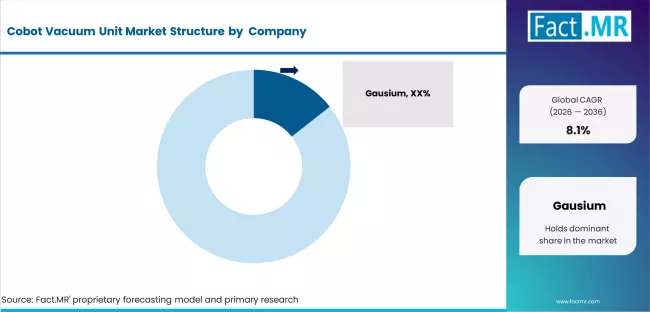
The cobot vacuum unit industry has a great deal of competition among many of the leading global robotics and automation companies such as GAUSIUM, ECOVACS Commercial Robotics, Tennant Company, Nilfisk, KARCHER, and ECOSYSTEM PARTNERS OF BRAIN CORP, who together account for an estimated 50 -55% or more of the overall worldwide marketplace for this product category. These companies remain dominant in the Market primarily due to their continuing innovations in autonomous navigation technologies, intelligent Cleaning System technologies, & Advanced Fleet Management System technologies.
• Key Players of the Cobot Vacuum Unit Market
- Gausium
- i-Team
- Deceler
- Optima Robotics
- Nexaro
- Karcher
- SMC
- Piab Group
- BrainCorp
- Nilfisk
- Viggo
- Waybot
- Tennant Company
- Pearse Bertram+
Recent Industry Developments
- Brain Corp unveils BrainOS Clean 2.0 in partnership with Tennant (2026), Brain Corp. unveiled BrainOS Clean 2.0, a software update that introduced autonomous route generation to Tennant Co.’s robotic floor cleaners.[1]
- Piab launches piCOBOT® Electric for ABB GoFa (2026): piCOBOT® Electric for ABB GoFa delivers plug-and-play electric vacuum gripping for clean, efficient and flexible cobot cells.[2]
- ECOVACS Introduces DEEBOT X12 OmniCyclone (2025): New Robot Vacuum Designed to Tackle Real-World Messes with Ease.3]
- Festo unveils new compact vacuum generator for robot end effectors (2025): Launched the “OVEH” compact vacuum generator, a versatile and innovative End of Arm Tooling (EOAT) solution.[4]
- iRobot Introduces Suite of Innovative ROOMBA Floor Cleaning Robots (2025): Introduces multiple series including the Roomba® 105 Vac Robot with 70x more suction power, Roomba® 205 DustCompactor™ series, and premium Plus 405 and 505 Combo Robots with AutoWash™ Docks.[5]
Sources and Research References
- [1] “Brain Corp unveils BrainOS Clean 2.0 in partnership with Tennant”, 2026
- [2] Piab, “piCOBOT® Electric for ABB GoFa delivers plug-and-play electric vacuum gripping for clean, efficient and flexible cobot cells”, 2025
- [3] “ECOVACS Introduces DEEBOT X12 OmniCyclone, the New Flagship Robot Vacuum Designed to Tackle Real-World Messes with Ease”, 2026
- [4] “Festo unveils new compact vacuum generator for robot end effectors”, 2025
- [5] “iRobot announced its largest product launch ever with a new suite of Roomba® floor cleaning robots”, 2026
Cobot Vacuum Unit Market Definition
The market for cobot vacuum units comprises robotic cleaning machines that are either autonomously or semi-autonomously operated in order to accomplish tasks such as vacuuming or cleaning the floor within industries, companies, or institutions with little human intervention. The robot vacuum cleaners integrate robotics and AI technology as well as navigation technologies such as SLAM and LIDAR.
Cobot Vacuum Unit Market Inclusions
The market refers to all the autonomous or semi-autonomous robotic vacuum cleaners that have been developed specifically for vacuuming and cleaning of floors in industries, hospitals, retail, logistics among others. These include both autonomous cobot vacuum cleaners, semi-autonomous robotic vacuums, as well as programmed/fixed-path vacuum cleaners that utilize AI technologies like LiDAR and SLAM for navigation.
Cobot Vacuum Unit Market Exclusions
The market excludes conventional manual vacuum cleaners, non-robotic cleaning equipment, and traditional industrial cleaning machines without autonomous or semi-autonomous capabilities.
Cobot Vacuum Unit Market Research Methodology
- Primary Research: The current trends regarding how the cobot vacuum unit market accommodates requests and accepts new technologies were generated by gathering feedback from stakeholders such as: autonomous cleaning robot manufacturers, suppliers of AI-driven navigation & sensor systems, facility management companies servicing industrial & commercial clients, and any organization (i.e., end user) deploying autonomous cleaning solutions within industrial, logistics, healthcare, or commercial infrastructure settings.
- Desk Research: Several tools for analysis were used to conduct an investigation of the Cobot Vacuum Unit Market, such as yearly reports from the manufacturers of cleaning robots, industrial automation firms, and AMR providers, in addition to market analysis of service robotics, intelligent building automation, and warehouse robotics.
- Market-Sizing and Forecasting: Aggregating the sales revenue of independent cleaning robot makers, robotic vacuum system providers, artificial intelligence navigation technology vendors, and allied component makers helped determine the size of the Cobot Vacuum Unit market.
- Data Validation and Update Cycle: The market data has gone through multiple rounds of cross-validation, and the information is constantly updated based on new trends in industrial automation, growth in logistics, and the increasing use of smart facilities and their management.
Scope of Analysis

| Parameter | Details |
|---|---|
| Quantitative Units | USD 1.8 billion in 2025 to USD 4.2 billion in 2036, at a CAGR of 8.1% |
| Market Definition | The Cobot Vacuum Unit Market comprises autonomous and semi-autonomous robotic cleaning systems designed for vacuuming and floor cleaning operations across industrial, logistics, commercial, and healthcare environments using AI-based navigation technologies such as LiDAR, SLAM, and sensor fusion to enable efficient, intelligent, and unmanned cleaning operations. |
| Regions Covered | North America, Latin America, Europe, East Asia, South Asia & Pacific, Middle East & Africa |
| Countries Covered | USA, Canada, UK, Germany, China, India, 30 plus countries |
| Key Companies | Gausium, ECOVACS Commercial Robotics, Tennant Company, Nilfisk, Kärcher, Brain Corp ecosystem partners, and others |
| Forecast Period | 2026 to 2036 |
| Approach | Hybrid demand-side and top-down methodology based on industrial automation trends, expansion of logistics and e-commerce infrastructure, growth of smart facilities and healthcare hygiene requirements. |
Analysis by Product Type, by Technology, by End-Use Industry, by Operation Mode, and by Region
-
Cobot Vacuum Unit Market By Product Type:
- Autonomous Cobot Vacuum Units
- Fully self-operating cleaning robots
- AI-based navigation
- Semi-Autonomous Cobot Vacuum Units
- Human-supervised or collaborative operation
- Shared workspace cleaning
- Programmed / Fixed-Path Units
- Autonomous Cobot Vacuum Units
-
Cobot Vacuum Unit Market By Technolog:
- Navigation Technology
- Cleaning Mechanism
- Control & Intelligence
-
Cobot Vacuum Unit Market By End-Use Industry:
- Industrial Sector
- Commercial Sector
- Healthcare Sector
- Logistics & Warehousing
-
Cobot Vacuum Unit Market By Operation Mode:
- Fully Autonomous Operation
- Human–Robot Collaborative Mode
- Remote-Controlled Operation
-
Cobot Vacuum Unit Market By Region:
- North America
- USA
- Canada
- Mexico
- Latin America
- Brazil
- Chile
- Rest of LATAM
- East Asia
- China
- Japan
- South Korea
- Western Europe
- Germany
- Italy
- France
- U.K.
- Spain
- BENELUX
- Nordic
- Rest of W. Europe
- Eastern Europe
- Russia
- Hungary
- Poland
- Balkan & Baltics
- Rest of E. Europe
- Middle East and Africa
- Kingdom of Saudi Arabia
- United Arab Emirates
- South Africa
- Rest of Middle East and Africa
- North America
- Frequently Asked Questions -
How large is the demand for Cobot Vacuum Unit in the global market in 2025?
Demand for Cobot Vacuum Unit in the global market is estimated to be valued at USD 3.9 billion in 2025.
What will be the market size of Cobot Vacuum Unit in the global market by 2036?
The market size for Cobot Vacuum Unit is projected to reach USD 8.9 billion by 2036.
What is the expected demand growth for Cobot Vacuum Unit in the global market between 2026 and 2036?
Demand for Cobot Vacuum Unit in the global market is expected to grow at a CAGR of 7.8% between 2026 and 2036.
Which product type segment is expected to dominate the Cobot Vacuum Unit Market?
Autonomous Cobot Vacuum Units are expected to dominate the market, accounting for around 62.8% share in 2026, driven by increasing demand from industrial, logistics, and commercial environments for fully automated cleaning solutions enabled by AI-based navigation and SLAM technology.
How significant is the growth outlook for India in this market?
India is expected to grow at a CAGR of 8.8% through 2036, reflecting strong demand from rapid expansion of e-commerce logistics infrastructure, smart warehouse development, increasing healthcare facility modernization, and rising adoption of autonomous cleaning robots across industrial and commercial sectors.
Which company is identified as a leading player in the Cobot Vacuum Unit market?
Gausium is recognized as a leading player in the market, offering advanced autonomous cleaning robots with AI-powered navigation, smart fleet management capabilities, and widely deployed solutions across industrial facilities.
Table of Content
- Cobot Vacuum Unit Market – Executive Summary
- Market Overview
- Market Definition & Introduction
- Market Taxonomy & Research Scope
- Global Cobot Vacuum Unit Market Demand Analysis 2021-2025 and Forecast, 2026–2036
- Historical Market Volume (Units) Analysis, 2021-2025
- Current and Future Market Volume (Units) Projections, 2026–2036
- Y-o-Y Growth Trend Analysis
- Global Cobot Vacuum Unit Market - Pricing Analysis
- Product Category and Country-Level Pricing Analysis
- Region Average Pricing Analysis Benchmark
- Price Trends and Forecasts
- Historical price trends
- Future price forecasts
- Factors Influencing Pricing
- Competitive Pricing Strategies
- Cost Structure Analysis
- Global Cobot Vacuum Unit Market Demand (in Value or Size in US$ Mn) Analysis 2021-2025 and Forecast, 2026–2036
- Historical Market Value (US$ Mn) Analysis, 2021-2025
- Current and Future Market Value (US$ Mn) Projections, 2026–2036
- Y-o-Y Growth Trend Analysis
- Absolute $ Opportunity Analysis
- Market Background and Foundational Data Points
- Installed Base of Facility Spaces Requiring Autonomous Cleaning
- AI-Enabled Autonomous Robot Penetration Rate (%)
- Average Cleaning Load per Facility (Sq. Meters per Robot Unit)
- Robotic Fleet Lifecycle / Replacement Frequency
- OEM vs Service/Aftermarket Demand Split (%)
- Industry-wise Operational Criticality Index
- Adoption Rate of Fleet-Based Autonomous Cleaning Systems (%)
- Operational Intensity (Cleaning Utilization Levels)
- Technology Mix Share (LiDAR, SLAM, AI Vision, Hybrid Navigation)
- Adoption Level of Predictive Maintenance & Smart Monitoring Systems
- Energy Efficiency & Battery Performance Sensitivity
- AI Robotics Ecosystem Development (2021–2025)
- Cobot Vacuum Unit Market Opportunity Assessment
- Total Available Market (US$ Mn)
- Serviceable Addressable Market (US$ Mn)
- Serviceable Obtainable Market (US$ Mn)
- Porter’s Five Forces and PESTEL Analysis
- Investment Feasibility Analysis
- Macro-Economic Factors & Forecast Factors - Relevance & Impact
- Industry Value and Supply Chain Analysis
- List of Key Channel Partners
- Profit Margin & Operating Margin at Each Node of Supply Chain.
- Notes on Value Added at Each Node in the Value Chain
- Factors Influencing Value Chain
- Market Dynamics
- Drivers
- Restraints
- Opportunity Analysis
- Key Regulations & Certifications
- Cobot Vacuum Unit Market Analysis 2021-2025 and Forecast 2026–2036, By Product Type
- Introduction / Key Findings
- Historical Market Size (US$ Mn) & Volume (Units) Trend Analysis By Product Type, 2021-2025
- Current and Future Market Size (US$ Mn) & Volume (Units) Analysis and Forecast By Product Type, 2026-2036
- Autonomous Cobot Vacuum Units
- Fully self-operating cleaning robots
- AI-based navigation
- Semi-Autonomous Cobot Vacuum Units
- Human-supervised or collaborative operation
- Shared workspace cleaning
- Programmed / Fixed-Path Units
- Autonomous Cobot Vacuum Units
- Market Attractiveness Analysis By Product Type
- Cobot Vacuum Unit Market Analysis 2021-2025 and Forecast 2026–2036, By Technology
- Introduction / Key Findings
- Historical Market Size (US$ Mn) & Volume (Units) Trend Analysis By Technology, 2021-2025
- Current and Future Market Size (US$ Mn) & Volume (Units) Analysis and Forecast By Technology, 2026-2036
- Navigation Technology
- Cleaning Mechanism
- Control & Intelligence
- Market Attractiveness Analysis By Technology
- Cobot Vacuum Unit Market Analysis 2021-2025 and Forecast 2026–2036, By End-Use Industry
- Introduction / Key Findings
- Historical Market Size (US$ Mn) & Volume (Units) Trend Analysis By End-Use Industry, 2021-2025
- Current and Future Market Size (US$ Mn) & Volume (Units) Analysis and Forecast By End-Use Industry, 2026-2036
- Industrial Sector
- Commercial Sector
- Healthcare Sector
- Logistics & Warehousing
- Market Attractiveness Analysis By End-Use Industry
- Cobot Vacuum Unit Market Analysis 2021-2025 and Forecast 2026–2036, By Operation Mode
- Introduction / Key Findings
- Historical Market Size (US$ Mn) & Volume (Units) Trend Analysis By Operation Mode, 2021-2025
- Current and Future Market Size (US$ Mn) & Volume (Units) Analysis and Forecast By Operation Mode, 2026-2036
- Fully Autonomous Operation
- Human–Robot Collaborative Mode
- Remote-Controlled Operation
- Market Attractiveness Analysis By Operation Mode
- Global Cobot Vacuum Unit Market Analysis and Forecast, by Region
- Introduction / Key Findings
- Historical Market Size (US$ Mn) & Volume (Units) Trend Analysis by Region, 2021-2025
- Current and Future Market Size (US$ Mn) & Volume (Units) Analysis and Forecast by Region, 2026-2036
- North America
- Latin America
- Western Europe
- Eastern Europe
- East Asia
- South Asia & Pacific
- Middle East & Africa
- Market Attractiveness Analysis by Region
- North America Cobot Vacuum Unit Market Analysis and Forecast
- Introduction / Key Findings
- Pricing Analysis
- Historical Market Size (US$ Mn) & Volume (Units) Trend Analysis by Market Taxonomy, 2021-2025
- Current and Future Market Size (US$ Mn) and Volume (Units) Analysis & Forecast by Market Taxonomy, 2026-2036
- By Country
- United States
- Canada
- Mexico
- By Taxonomy
- Market Attractiveness Analysis By Country & Taxonomy
- Market Trends
- Key Market Participants – Intensity Mapping
- Drivers and Restraints - Impact Analysis
- Latin America Cobot Vacuum Unit Market Analysis and Forecast
- Introduction / Key Findings
- Pricing Analysis
- Historical Market Size (US$ Mn) & Volume (Units) Trend Analysis by Market Taxonomy, 2021-2025
- Current and Future Market Size (US$ Mn) and Volume (Units) Analysis & Forecast by Market Taxonomy, 2026-2036
- By Country
- Brazil
- Chile
- Rest of LATAM
- By Taxonomy
- Market Attractiveness Analysis By Country & Taxonomy
- Market Trends
- Key Market Participants – Intensity Mapping
- Drivers and Restraints - Impact Analysis
- Western Europe Cobot Vacuum Unit Market Analysis and Forecast
- Introduction / Key Findings
- Pricing Analysis
- Historical Market Size (US$ Mn) & Volume (Units) Trend Analysis by Market Taxonomy, 2021-2025
- Current and Future Market Size (US$ Mn) and Volume (Units) Analysis & Forecast by Market Taxonomy, 2026-2036
- By Country
- Germany
- Italy
- France
- United Kingdom
- Spain
- BENELUX
- Nordics
- Rest of Western Europe
- By Taxonomy
- Market Attractiveness Analysis By Country & Taxonomy
- Market Trends
- Key Market Participants – Intensity Mapping
- Drivers and Restraints - Impact Analysis
- Eastern Europe Cobot Vacuum Unit Market Analysis and Forecast
- Introduction / Key Findings
- Pricing Analysis
- Historical Market Size (US$ Mn) & Volume (Units) Trend Analysis by Market Taxonomy, 2021-2025
- Current and Future Market Size (US$ Mn) and Volume (Units) Analysis & Forecast by Market Taxonomy, 2026-2036
- By Country
- Russia
- Hungary
- Poland
- Balkan & Baltics
- Rest of Eastern Europe
- By Taxonomy
- Market Attractiveness Analysis By Country & Taxonomy
- Market Trends
- Key Market Participants – Intensity Mapping
- Drivers and Restraints - Impact Analysis
- East Asia Cobot Vacuum Unit Market Analysis and Forecast
- Introduction / Key Findings
- Pricing Analysis
- Historical Market Size (US$ Mn) & Volume (Units) Trend Analysis by Market Taxonomy, 2021-2025
- Current and Future Market Size (US$ Mn) and Volume (Units) Analysis & Forecast by Market Taxonomy, 2026-2036
- By Country
- China
- Japan
- South Korea
- By Taxonomy
- Market Attractiveness Analysis By Country & Taxonomy
- Market Trends
- Key Market Participants – Intensity Mapping
- Drivers and Restraints - Impact Analysis
- South Asia & Pacific Cobot Vacuum Unit Market Analysis and Forecast
- Introduction / Key Findings
- Pricing Analysis
- Historical Market Size (US$ Mn) & Volume (Units) Trend Analysis by Market Taxonomy, 2021-2025
- Current and Future Market Size (US$ Mn) and Volume (Units) Analysis & Forecast by Market Taxonomy, 2026-2036
- By Country
- India
- ASEAN
- Australia & New Zealand
- Rest of South Asia & Pacific
- By Taxonomy
- Market Attractiveness Analysis By Country & Taxonomy
- Market Trends
- Key Market Participants – Intensity Mapping
- Drivers and Restraints - Impact Analysis
- Middle East & Africa Cobot Vacuum Unit Market Analysis and Forecast
- Introduction / Key Findings
- Pricing Analysis
- Historical Market Size (US$ Mn) & Volume (Units) Trend Analysis by Market Taxonomy, 2021-2025
- Current and Future Market Size (US$ Mn) and Volume (Units) Analysis & Forecast by Market Taxonomy, 2026-2036
- By Country
- Kingdom of Saudi Arabia
- Other GCC Countries
- Turkiye
- South Africa
- Other African Union
- By Taxonomy
- Market Attractiveness Analysis By Country & Taxonomy
- Market Trends
- Key Market Participants – Intensity Mapping
- Drivers and Restraints - Impact Analysis
- Country-level Cobot Vacuum Unit Market Analysis and Forecast
- Introduction
- Market Value Proportion Analysis, By Key Countries
- Global Vs. Country Growth Comparison
- United States Cobot Vacuum Unit Market Analysis
- Market Size (US$ Mn) & Volume (Units) Analysis by Market Taxonomy, 2021–2036
- By Product Type
- By Technology
- By End-Use Industry
- By Operation Mode
- United States Cobot Vacuum Unit Market Analysis
- Canada Cobot Vacuum Unit Market Analysis
- Mexico Cobot Vacuum Unit Market Analysis
- Brazil Cobot Vacuum Unit Market Analysis
- Chile Cobot Vacuum Unit Market Analysis
- Germany Cobot Vacuum Unit Market Analysis
- France Cobot Vacuum Unit Market Analysis
- Italy Cobot Vacuum Unit Market Analysis
- Spain Cobot Vacuum Unit Market Analysis
- United Kingdom Cobot Vacuum Unit Market Analysis
- BENELUX Cobot Vacuum Unit Market Analysis
- Nordics Cobot Vacuum Unit Market Analysis
- Poland Cobot Vacuum Unit Market Analysis
- Russia Cobot Vacuum Unit Market Analysis
- Hungary Cobot Vacuum Unit Market Analysis
- Balkan & Baltics Cobot Vacuum Unit Market Analysis
- China Cobot Vacuum Unit Market Analysis
- Japan Cobot Vacuum Unit Market Analysis
- South Korea Cobot Vacuum Unit Market Analysis
- India Cobot Vacuum Unit Market Analysis
- ASEAN Cobot Vacuum Unit Market Analysis
- ANZ Cobot Vacuum Unit Market Analysis
- KSA Cobot Vacuum Unit Market Analysis
- Other GCC Countries Cobot Vacuum Unit Market Analysis
- South Africa Cobot Vacuum Unit Market Analysis
- Turkiye Cobot Vacuum Unit Market Analysis
- Cobot Vacuum Unit Market Structure Analysis
- Market Analysis by Tier of Companies
- Market Concentration
- Market Share Analysis of Top Players
- Market Space for New Brands and Dollar Opportunity
- Market Presence Analysis
- Regional Footprint of Players
- Product Footprint by Players
- Cobot Vacuum Unit Competition Analysis
- Competition Dashboard
- Pricing Analysis by Competition
- Competition Benchmarking
- Competition Deep Dive
- Gausium
- Overview
- Product Portfolio
- Sales Footprint
- Key Developments
- SWOT Analysis
- Strategy Overview
- Key Financials
- i-Team
- Deceler
- Optima Robotics
- Nexaro
- Karcher
- SMC
- Piab Group
- BrainCorp
- Nilfisk
- Viggo
- Waybot
- Tennant Company
- Pearse Bertram+
- Other Prominent Players
- Gausium
- Primary insights
- Assumptions & Acronyms Used
- Research Methodology & Data Sources
List Of Table
- Table 1: Global Market Value (USD Mn) Forecast by Region, 2021 to 2036
- Table 2: Global Market Volume (Units) Forecast by Region, 2021 to 2036
- Table 3: Global Market Value (USD Mn) Forecast by Product Type, 2021 to 2036
- Table 4: Global Market Volume (Units) Forecast by Product Type, 2021 to 2036
- Table 5: Global Market Value (USD Mn) Forecast by Technology, 2021 to 2036
- Table 6: Global Market Volume (Units) Forecast by Technology, 2021 to 2036
- Table 7: Global Market Value (USD Mn) Forecast by End-Use Industry, 2021 to 2036
- Table 8: Global Market Volume (Units) Forecast by End-Use Industry, 2021 to 2036
- Table 9: Global Market Value (USD Mn) Forecast by Operation Mode, 2021 to 2036
- Table 10: Global Market Volume (Units) Forecast by Operation Mode, 2021 to 2036
- Table 11: North America Market Value (USD Mn) Forecast by Country, 2021 to 2036
- Table 12: North America Market Volume (Units) Forecast by Country, 2021 to 2036
- Table 13: North America Market Value (USD Mn) Forecast by Product Type, 2021 to 2036
- Table 14: North America Market Volume (Units) Forecast by Product Type, 2021 to 2036
- Table 15: North America Market Value (USD Mn) Forecast by Technology, 2021 to 2036
- Table 16: North America Market Volume (Units) Forecast by Technology, 2021 to 2036
- Table 17: North America Market Value (USD Mn) Forecast by End-Use Industry, 2021 to 2036
- Table 18: North America Market Volume (Units) Forecast by End-Use Industry, 2021 to 2036
- Table 19: North America Market Value (USD Mn) Forecast by Operation Mode, 2021 to 2036
- Table 20: North America Market Volume (Units) Forecast by Operation Mode, 2021 to 2036
- Table 21: Latin America Market Value (USD Mn) Forecast by Country, 2021 to 2036
- Table 22: Latin America Market Volume (Units) Forecast by Country, 2021 to 2036
- Table 23: Latin America Market Value (USD Mn) Forecast by Product Type, 2021 to 2036
- Table 24: Latin America Market Volume (Units) Forecast by Product Type, 2021 to 2036
- Table 25: Latin America Market Value (USD Mn) Forecast by Technology, 2021 to 2036
- Table 26: Latin America Market Volume (Units) Forecast by Technology, 2021 to 2036
- Table 27: Latin America Market Value (USD Mn) Forecast by End-Use Industry, 2021 to 2036
- Table 28: Latin America Market Volume (Units) Forecast by End-Use Industry, 2021 to 2036
- Table 29: Latin America Market Value (USD Mn) Forecast by Operation Mode, 2021 to 2036
- Table 30: Latin America Market Volume (Units) Forecast by Operation Mode, 2021 to 2036
- Table 31: Western Europe Market Value (USD Mn) Forecast by Country, 2021 to 2036
- Table 32: Western Europe Market Volume (Units) Forecast by Country, 2021 to 2036
- Table 33: Western Europe Market Value (USD Mn) Forecast by Product Type, 2021 to 2036
- Table 34: Western Europe Market Volume (Units) Forecast by Product Type, 2021 to 2036
- Table 35: Western Europe Market Value (USD Mn) Forecast by Technology, 2021 to 2036
- Table 36: Western Europe Market Volume (Units) Forecast by Technology, 2021 to 2036
- Table 37: Western Europe Market Value (USD Mn) Forecast by End-Use Industry, 2021 to 2036
- Table 38: Western Europe Market Volume (Units) Forecast by End-Use Industry, 2021 to 2036
- Table 39: Western Europe Market Value (USD Mn) Forecast by Operation Mode, 2021 to 2036
- Table 40: Western Europe Market Volume (Units) Forecast by Operation Mode, 2021 to 2036
- Table 41: Eastern Europe Market Value (USD Mn) Forecast by Country, 2021 to 2036
- Table 42: Eastern Europe Market Volume (Units) Forecast by Country, 2021 to 2036
- Table 43: Eastern Europe Market Value (USD Mn) Forecast by Product Type, 2021 to 2036
- Table 44: Eastern Europe Market Volume (Units) Forecast by Product Type, 2021 to 2036
- Table 45: Eastern Europe Market Value (USD Mn) Forecast by Technology, 2021 to 2036
- Table 46: Eastern Europe Market Volume (Units) Forecast by Technology, 2021 to 2036
- Table 47: Eastern Europe Market Value (USD Mn) Forecast by End-Use Industry, 2021 to 2036
- Table 48: Eastern Europe Market Volume (Units) Forecast by End-Use Industry, 2021 to 2036
- Table 49: Eastern Europe Market Value (USD Mn) Forecast by Operation Mode, 2021 to 2036
- Table 50: Eastern Europe Market Volume (Units) Forecast by Operation Mode, 2021 to 2036
- Table 51: East Asia Market Value (USD Mn) Forecast by Country, 2021 to 2036
- Table 52: East Asia Market Volume (Units) Forecast by Country, 2021 to 2036
- Table 53: East Asia Market Value (USD Mn) Forecast by Product Type, 2021 to 2036
- Table 54: East Asia Market Volume (Units) Forecast by Product Type, 2021 to 2036
- Table 55: East Asia Market Value (USD Mn) Forecast by Technology, 2021 to 2036
- Table 56: East Asia Market Volume (Units) Forecast by Technology, 2021 to 2036
- Table 57: East Asia Market Value (USD Mn) Forecast by End-Use Industry, 2021 to 2036
- Table 58: East Asia Market Volume (Units) Forecast by End-Use Industry, 2021 to 2036
- Table 59: East Asia Market Value (USD Mn) Forecast by Operation Mode, 2021 to 2036
- Table 60: East Asia Market Volume (Units) Forecast by Operation Mode, 2021 to 2036
- Table 61: South Asia and Pacific Market Value (USD Mn) Forecast by Country, 2021 to 2036
- Table 62: South Asia and Pacific Market Volume (Units) Forecast by Country, 2021 to 2036
- Table 63: South Asia and Pacific Market Value (USD Mn) Forecast by Product Type, 2021 to 2036
- Table 64: South Asia and Pacific Market Volume (Units) Forecast by Product Type, 2021 to 2036
- Table 65: South Asia and Pacific Market Value (USD Mn) Forecast by Technology, 2021 to 2036
- Table 66: South Asia and Pacific Market Volume (Units) Forecast by Technology, 2021 to 2036
- Table 67: South Asia and Pacific Market Value (USD Mn) Forecast by End-Use Industry, 2021 to 2036
- Table 68: South Asia and Pacific Market Volume (Units) Forecast by End-Use Industry, 2021 to 2036
- Table 69: South Asia and Pacific Market Value (USD Mn) Forecast by Operation Mode, 2021 to 2036
- Table 70: South Asia and Pacific Market Volume (Units) Forecast by Operation Mode, 2021 to 2036
- Table 71: Middle East & Africa Market Value (USD Mn) Forecast by Country, 2021 to 2036
- Table 72: Middle East & Africa Market Volume (Units) Forecast by Country, 2021 to 2036
- Table 73: Middle East & Africa Market Value (USD Mn) Forecast by Product Type, 2021 to 2036
- Table 74: Middle East & Africa Market Volume (Units) Forecast by Product Type, 2021 to 2036
- Table 75: Middle East & Africa Market Value (USD Mn) Forecast by Technology, 2021 to 2036
- Table 76: Middle East & Africa Market Volume (Units) Forecast by Technology, 2021 to 2036
- Table 77: Middle East & Africa Market Value (USD Mn) Forecast by End-Use Industry, 2021 to 2036
- Table 78: Middle East & Africa Market Volume (Units) Forecast by End-Use Industry, 2021 to 2036
- Table 79: Middle East & Africa Market Value (USD Mn) Forecast by Operation Mode, 2021 to 2036
- Table 80: Middle East & Africa Market Volume (Units) Forecast by Operation Mode, 2021 to 2036
List Of Figures
- Figure 1: Global Market Volume (Units) Forecast 2021–2036
- Figure 2: Global Market Pricing Analysis
- Figure 3: Global Market Value (USD Mn) Forecast 2021–2036
- Figure 4: Global Market Value Share and BPS Analysis by Product Type, 2026 and 2036
- Figure 5: Global Market Y-o-Y Growth Comparison by Product Type, 2026 to 2036
- Figure 6: Global Market Attractiveness Analysis by Product Type
- Figure 7: Global Market Value Share and BPS Analysis by Technology, 2026 and 2036
- Figure 8: Global Market Y-o-Y Growth Comparison by Technology, 2026 to 2036
- Figure 9: Global Market Attractiveness Analysis by Technology
- Figure 10: Global Market Value Share and BPS Analysis by End-Use Industry, 2026 and 2036
- Figure 11: Global Market Y-o-Y Growth Comparison by End-Use Industry, 2026 to 2036
- Figure 12: Global Market Attractiveness Analysis by End-Use Industry
- Figure 13: Global Market Value Share and BPS Analysis by Operation Mode, 2026 and 2036
- Figure 14: Global Market Y-o-Y Growth Comparison by Operation Mode, 2026 to 2036
- Figure 15: Global Market Attractiveness Analysis by Operation Mode
- Figure 16: Global Market Value (USD Mn) Share and BPS Analysis by Region, 2026 and 2036
- Figure 17: Global Market Y-o-Y Growth Comparison by Region, 2026 to 2036
- Figure 18: Global Market Attractiveness Analysis by Region
- Figure 19: North America Market Incremental $ Opportunity, 2026 to 2036
- Figure 20: Latin America Market Incremental $ Opportunity, 2026 to 2036
- Figure 21: Western Europe Market Incremental $ Opportunity, 2026 to 2036
- Figure 22: Eastern Europe Market Incremental $ Opportunity, 2026 to 2036
- Figure 23: East Asia Market Incremental $ Opportunity, 2026 to 2036
- Figure 24: South Asia and Pacific Market Incremental $ Opportunity, 2026 to 2036
- Figure 25: Middle East & Africa Market Incremental $ Opportunity, 2026 to 2036
- Figure 26: North America Market Value Share and BPS Analysis by Country, 2026 and 2036
- Figure 27: North America Market Value Share and BPS Analysis by Product Type, 2026 and 2036
- Figure 28: North America Market Y-o-Y Growth Comparison by Product Type, 2026 to 2036
- Figure 29: North America Market Attractiveness Analysis by Product Type
- Figure 30: North America Market Value Share and BPS Analysis by Technology, 2026 and 2036
- Figure 31: North America Market Y-o-Y Growth Comparison by Technology, 2026 to 2036
- Figure 32: North America Market Attractiveness Analysis by Technology
- Figure 33: North America Market Value Share and BPS Analysis by End-Use Industry, 2026 and 2036
- Figure 34: North America Market Y-o-Y Growth Comparison by End-Use Industry, 2026 to 2036
- Figure 35: North America Market Attractiveness Analysis by End-Use Industry
- Figure 36: North America Market Value Share and BPS Analysis by Operation Mode, 2026 and 2036
- Figure 37: North America Market Y-o-Y Growth Comparison by Operation Mode, 2026 to 2036
- Figure 38: North America Market Attractiveness Analysis by Operation Mode
- Figure 39: Latin America Market Value Share and BPS Analysis by Country, 2026 and 2036
- Figure 40: Latin America Market Value Share and BPS Analysis by Product Type, 2026 and 2036
- Figure 41: Latin America Market Y-o-Y Growth Comparison by Product Type, 2026 to 2036
- Figure 42: Latin America Market Attractiveness Analysis by Product Type
- Figure 43: Latin America Market Value Share and BPS Analysis by Technology, 2026 and 2036
- Figure 44: Latin America Market Y-o-Y Growth Comparison by Technology, 2026 to 2036
- Figure 45: Latin America Market Attractiveness Analysis by Technology
- Figure 46: Latin America Market Value Share and BPS Analysis by End-Use Industry, 2026 and 2036
- Figure 47: Latin America Market Y-o-Y Growth Comparison by End-Use Industry, 2026 to 2036
- Figure 48: Latin America Market Attractiveness Analysis by End-Use Industry
- Figure 49: Latin America Market Value Share and BPS Analysis by Operation Mode, 2026 and 2036
- Figure 50: Latin America Market Y-o-Y Growth Comparison by Operation Mode, 2026 to 2036
- Figure 51: Latin America Market Attractiveness Analysis by Operation Mode
- Figure 52: Western Europe Market Value Share and BPS Analysis by Country, 2026 and 2036
- Figure 53: Western Europe Market Value Share and BPS Analysis by Product Type, 2026 and 2036
- Figure 54: Western Europe Market Y-o-Y Growth Comparison by Product Type, 2026 to 2036
- Figure 55: Western Europe Market Attractiveness Analysis by Product Type
- Figure 56: Western Europe Market Value Share and BPS Analysis by Technology, 2026 and 2036
- Figure 57: Western Europe Market Y-o-Y Growth Comparison by Technology, 2026 to 2036
- Figure 58: Western Europe Market Attractiveness Analysis by Technology
- Figure 59: Western Europe Market Value Share and BPS Analysis by End-Use Industry, 2026 and 2036
- Figure 60: Western Europe Market Y-o-Y Growth Comparison by End-Use Industry, 2026 to 2036
- Figure 61: Western Europe Market Attractiveness Analysis by End-Use Industry
- Figure 62: Western Europe Market Value Share and BPS Analysis by Operation Mode, 2026 and 2036
- Figure 63: Western Europe Market Y-o-Y Growth Comparison by Operation Mode, 2026 to 2036
- Figure 64: Western Europe Market Attractiveness Analysis by Operation Mode
- Figure 65: Eastern Europe Market Value Share and BPS Analysis by Country, 2026 and 2036
- Figure 66: Eastern Europe Market Value Share and BPS Analysis by Product Type, 2026 and 2036
- Figure 67: Eastern Europe Market Y-o-Y Growth Comparison by Product Type, 2026 to 2036
- Figure 68: Eastern Europe Market Attractiveness Analysis by Product Type
- Figure 69: Eastern Europe Market Value Share and BPS Analysis by Technology, 2026 and 2036
- Figure 70: Eastern Europe Market Y-o-Y Growth Comparison by Technology, 2026 to 2036
- Figure 71: Eastern Europe Market Attractiveness Analysis by Technology
- Figure 72: Eastern Europe Market Value Share and BPS Analysis by End-Use Industry, 2026 and 2036
- Figure 73: Eastern Europe Market Y-o-Y Growth Comparison by End-Use Industry, 2026 to 2036
- Figure 74: Eastern Europe Market Attractiveness Analysis by End-Use Industry
- Figure 75: Eastern Europe Market Value Share and BPS Analysis by Operation Mode, 2026 and 2036
- Figure 76: Eastern Europe Market Y-o-Y Growth Comparison by Operation Mode, 2026 to 2036
- Figure 77: Eastern Europe Market Attractiveness Analysis by Operation Mode
- Figure 78: East Asia Market Value Share and BPS Analysis by Country, 2026 and 2036
- Figure 79: East Asia Market Value Share and BPS Analysis by Product Type, 2026 and 2036
- Figure 80: East Asia Market Y-o-Y Growth Comparison by Product Type, 2026 to 2036
- Figure 81: East Asia Market Attractiveness Analysis by Product Type
- Figure 82: East Asia Market Value Share and BPS Analysis by Technology, 2026 and 2036
- Figure 83: East Asia Market Y-o-Y Growth Comparison by Technology, 2026 to 2036
- Figure 84: East Asia Market Attractiveness Analysis by Technology
- Figure 85: East Asia Market Value Share and BPS Analysis by End-Use Industry, 2026 and 2036
- Figure 86: East Asia Market Y-o-Y Growth Comparison by End-Use Industry, 2026 to 2036
- Figure 87: East Asia Market Attractiveness Analysis by End-Use Industry
- Figure 88: East Asia Market Value Share and BPS Analysis by Operation Mode, 2026 and 2036
- Figure 89: East Asia Market Y-o-Y Growth Comparison by Operation Mode, 2026 to 2036
- Figure 90: East Asia Market Attractiveness Analysis by Operation Mode
- Figure 91: South Asia and Pacific Market Value Share and BPS Analysis by Country, 2026 and 2036
- Figure 92: South Asia and Pacific Market Value Share and BPS Analysis by Product Type, 2026 and 2036
- Figure 93: South Asia and Pacific Market Y-o-Y Growth Comparison by Product Type, 2026 to 2036
- Figure 94: South Asia and Pacific Market Attractiveness Analysis by Product Type
- Figure 95: South Asia and Pacific Market Value Share and BPS Analysis by Technology, 2026 and 2036
- Figure 96: South Asia and Pacific Market Y-o-Y Growth Comparison by Technology, 2026 to 2036
- Figure 97: South Asia and Pacific Market Attractiveness Analysis by Technology
- Figure 98: South Asia and Pacific Market Value Share and BPS Analysis by End-Use Industry, 2026 and 2036
- Figure 99: South Asia and Pacific Market Y-o-Y Growth Comparison by End-Use Industry, 2026 to 2036
- Figure 100: South Asia and Pacific Market Attractiveness Analysis by End-Use Industry
- Figure 101: South Asia and Pacific Market Value Share and BPS Analysis by Operation Mode, 2026 and 2036
- Figure 102: South Asia and Pacific Market Y-o-Y Growth Comparison by Operation Mode, 2026 to 2036
- Figure 103: South Asia and Pacific Market Attractiveness Analysis by Operation Mode
- Figure 104: Middle East & Africa Market Value Share and BPS Analysis by Country, 2026 and 2036
- Figure 105: Middle East & Africa Market Value Share and BPS Analysis by Product Type, 2026 and 2036
- Figure 106: Middle East & Africa Market Y-o-Y Growth Comparison by Product Type, 2026 to 2036
- Figure 107: Middle East & Africa Market Attractiveness Analysis by Product Type
- Figure 108: Middle East & Africa Market Value Share and BPS Analysis by Technology, 2026 and 2036
- Figure 109: Middle East & Africa Market Y-o-Y Growth Comparison by Technology, 2026 to 2036
- Figure 110: Middle East & Africa Market Attractiveness Analysis by Technology
- Figure 111: Middle East & Africa Market Value Share and BPS Analysis by End-Use Industry, 2026 and 2036
- Figure 112: Middle East & Africa Market Y-o-Y Growth Comparison by End-Use Industry, 2026 to 2036
- Figure 113: Middle East & Africa Market Attractiveness Analysis by End-Use Industry
- Figure 114: Middle East & Africa Market Value Share and BPS Analysis by Operation Mode, 2026 and 2036
- Figure 115: Middle East & Africa Market Y-o-Y Growth Comparison by Operation Mode, 2026 to 2036
- Figure 116: Middle East & Africa Market Attractiveness Analysis by Operation Mode
- Figure 117: Global Market – Tier Structure Analysis
- Figure 118: Global Market – Company Share Analysis