- Market Value (2025): USD 1.9 Bn
- Estimated Value (2026): USD 2.1 Bn
- Forecast Value (2036): USD 4.5 Bn
- CAGR (2026-2036): 8.0%
What is the Cocoa Butter Equivalents Market forecast to be worth by 2036?
USD 2.1 billion in 2026 to USD 4.5 billion by 2036, at an 8.0% CAGR.
- The cocoa butter equivalents market surpassed a value of USD 1.9 billion in 2025.
- Demand is projected to increase from USD 2.1 billion in 2026 to USD 4.5 billion by 2036.
- The market is forecast to record an 8.0% CAGR from 2026 to 2036 as confectionery brands and bakery processors qualify fat systems that reduce exposure to cocoa butter pricing.
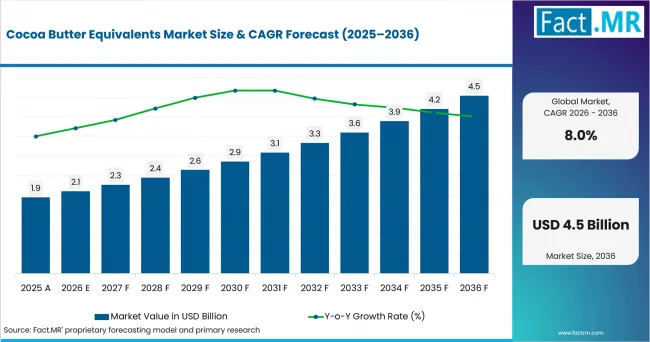
Cocoa Butter Equivalents Market Value Analysis | Source: Fact.MR
What are the defining numbers behind Cocoa Butter Equivalents Market growth?
USD 2.4 billion absolute opportunity is expected between 2026 and 2036.
- Demand Drivers in the Market
- Chocolate manufacturers need predictable crystallization when partial cocoa-butter replacement must preserve mold release and eating quality.
- BLS reported that U.S. candy and chewing gum prices were 9.6% higher year over year in July 2026, highlighting continued pricing pressure across confectionery categories.
- Bakery coating teams need heat-stable systems for cookies, cakes and wafers that move through warm retail and warehouse conditions.
- Key Segments Analyzed
- By Fat System: Lauric is projected to account for 38.0% share in 2026 due to its functional performance, processing suitability and widespread use in confectionery fat systems.
- By Function: Heat stability is projected to account for 41.0% share in 2026 due to transport and retail conditions that test coating shape.
- By Application: Confectionery is anticipated to represent 37.0% share in 2026 owing to chocolate-style bars, pralines and enrobed snacks requiring repeatable fat performance.
- By Form: Blocks are estimated to capture 36.0% share in 2026 as industrial users value clean handling, measured dosing and stable storage.
- Analyst Opinion at Fact.MR
- Shambhu Nath Jha, Principal Consultant at Fact.MR, states, "Cocoa butter equivalents sit at the point where recipe science meets procurement discipline. Demand is expected to move toward blends that prove compatibility before scale-up. Suppliers that combine fractionation control, application support and traceable feedstock files are better placed to pass customer trials."
- Strategic Implications
- Fat blenders should document solid-fat content curves and bloom behavior for each compound chocolate use case before customer line trials begin.
- Chocolate brands should separate CBE-qualified recipes from compound coating recipes so label claims remain clear in each market.
- Bakery processors should test block and flake formats against melting equipment because handling losses can offset raw-material savings. Trial reports should record cleaning time, waste levels and operator feedback.
The USA is forecast to post 8.8% CAGR through 2036, supported by confectionery reformulation and retail price pressure. Germany is projected to record 8.4% CAGR as chocolate output supports supplier qualification. Japan is anticipated to advance at 7.8% CAGR due to export confectionery and premium gift channels. France is expected to hold 7.5% CAGR, shaped by chocolate-price pass-through. Brazil is estimated to reach 7.2% CAGR as cocoa and derivative exports support local specialty-fat participation.
How does the Cocoa Butter Equivalents Market break down by segment?
Heat stability leads Function at 41.0%; the Lauric leads Fat System at 38.0%.
What leads the Fat System segment??
Lauric fat systems account for 38.0% share in 2026.
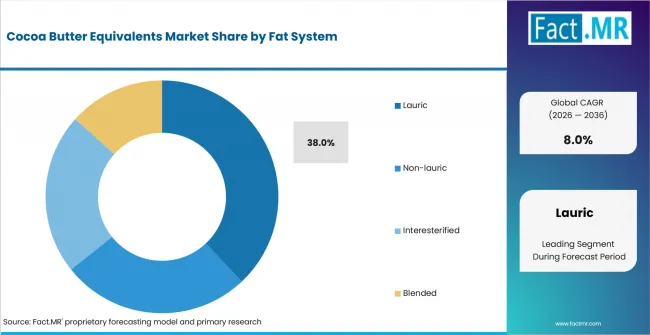
Cocoa Butter Equivalents Market Analysis By Fat System | Source: Fact.MR
Lauric fat systems lead with a 38.0% share in 2026, supported by their use in compound coatings and confectionery applications where rapid crystallization, firm texture and cost-efficient processing are important. These systems can help manufacturers achieve consistent coating performance across molded, enrobed and filled products while supporting high-throughput production.
Non-lauric fat systems remain important where closer compatibility with cocoa butter is required. They are particularly relevant to cocoa-butter-equivalent applications that prioritize melting behavior, texture and compatibility with the existing cocoa-butter phase.
What leads the Function segment?
Heat stability accounts for 41.0% share in 2026.
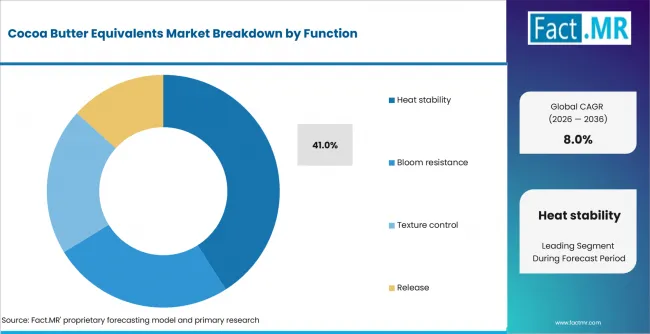
Cocoa Butter Equivalents Market Analysis By Function | Source: Fact.MR
Heat stability leads because many coated snacks move through shipping lanes where temperature control is uneven. A fat system that resists softening is expected to reduce rejected coatings and keep texture close to the product brief. The function is especially useful when products move between factory, warehouse and store without full climate control.
Bloom resistance and texture control follow closely in product briefs. Release performance is more visible to contract manufacturers running molds and enrobers for several customers. These teams often judge a fat system by cleaning time, line stoppages and surface defects.
How does Application shape demand?
Confectionery represents 37.0% share in 2026.
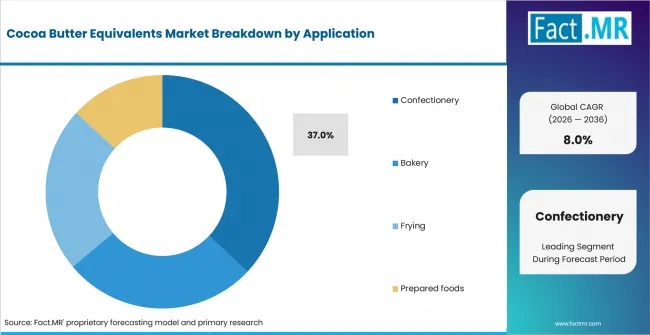
Cocoa Butter Equivalents Market Analysis By Application | Source: Fact.MR
Confectionery is the primary application because CBE decisions are tied directly to chocolate-style sensory expectations. Bars, pralines and filled pieces need clean snap, controlled melt and surface gloss. Small recipe changes can affect mouthfeel, so customer panels and shelf-life testing remain part of approval.
Bakery remains a practical route for adoption because coated cookies and cakes often need fat systems that behave well in enrobing equipment. Frying and prepared foods use smaller volumes where release and heat behavior are more valuable than chocolate mimicry. Those applications give suppliers a lower-risk route to prove handling and stability before premium confectionery trials.
What supports Blocks within Form?
Blocks capture 36.0% share in 2026.
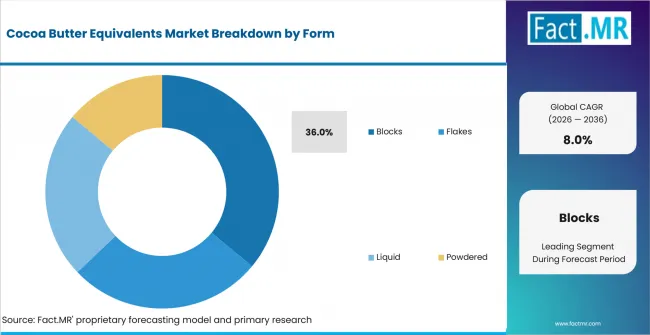
Cocoa Butter Equivalents Market Analysis By Form | Source: Fact.MR
Blocks lead the form segment because they fit factory storage and make dosing easier for large batches. They reduce leakage risk and simplify inbound inspection for manufacturers using several specialty fats in one plant. Receiving teams can check pallet condition and storage temperature more easily than with liquid formats.
Flakes serve customers that need faster melting or smaller-batch flexibility. Liquid and powdered forms remain narrower choices in industrial chocolate applications where a coating line or dry mix handles fat differently. These formats are selected when melting time or dry blending matters more than warehouse simplicity.
What is accelerating Cocoa Butter Equivalents Market adoption, and what is holding it back?
Demand is expected to rise through cocoa-butter cost pressure, heat-stable coatings and label-aware reformulation.
Drivers Impact Analysis
| DRIVER | (~) % IMPACT ON CAGR | GEOGRAPHIC RELEVANCE | IMPACT TIMELINE |
|---|---|---|---|
| Cocoa butter cost pressure in chocolate recipes | +1.4% | North America, Europe, Japan | Short term (<= 2 years) |
| Heat-stable coating needs in bakery and confectionery | +1.1% | Global | Medium term (2-4 years) |
| Regulation-aware vegetable-fat formulation | +0.8% | Europe, North America | Medium term (2-4 years) |
| Factory handling gains from blocks and flakes | +0.6% | Global | Long term (>= 4 years) |
Source: Fact.MR analysis. Updated Aug 28, 2026
- Cocoa butter cost pressure in chocolate recipes: Chocolate brands are expected to evaluate CBEs where fat substitution can ease recipe costs without weakening shelf stability.
- Heat-stable coating needs: Bakery and confectionery processors value fats that hold finish through storage and transport, especially where cold-chain control is uneven.
- Regulation-aware vegetable-fat formulation: European chocolate rules make label fit and fat identity central before CBEs move into premium recipes.
- Factory handling gains from blocks and flakes: Industrial users prefer forms that reduce leakage, simplify dosing and fit melting equipment already used for confectioneries.
Opportunity Impact Analysis
| OPPORTUNITY | (~) % IMPACT ON CAGR | GEOGRAPHIC RELEVANCE | IMPACT TIMELINE |
|---|---|---|---|
| Enrobing-specific CBE launches | +0.8% | North America, Europe | Short term (<= 2 years) |
| Compound coating and bakery expansion | +0.7% | Global | Medium term (2-4 years) |
| Premium gift confectionery in Japan and France | +0.4% | Japan, Western Europe | Long term (>= 4 years) |
Source: Fact.MR analysis. Updated Aug 28, 2026
- Enrobing-specific CBE designs: Newer systems are expected to target flow behavior, buildup control and coating finish where high replacement levels pressure production lines.
- Compound coating and bakery expansion: Blocks and flakes give manufacturers an easier route to trial CBEs in wafers, sandwich cookies and coated cakes before core chocolate recipes change.
- Premium gift confectionery: Japan and France create demand for clean finish and stable texture in seasonal products where visual defects carry direct cost.
Restraints Impact Analysis
| RESTRAINT | (~) % IMPACT ON CAGR | GEOGRAPHIC RELEVANCE | IMPACT TIMELINE |
|---|---|---|---|
| Chocolate identity and naming limits | -0.5% | Europe, USA, Japan | Short term (<= 2 years) |
| Bloom and tempering validation risk | -0.4% | Global | Medium term (2-4 years) |
| Tropical feedstock volatility | -0.3% | Brazil, Southeast Asia, Europe | Long term (>= 4 years) |
Source: Fact.MR analysis. Updated Aug 28, 2026
- Chocolate identity and naming limits: FDA announced on July 16, 2025 that it was revoking, or proposing to revoke, 52 food standards it considered obsolete and unnecessary.
- Bloom and tempering validation risk: Aggressive fat substitution changes crystallization, so manufacturers slow adoption until shelf-life testing confirms surface quality.
- Tropical feedstock volatility: Shea, palm and sal supply depends on harvest quality and traceability files, which restricts short-notice recipe switching.
Which countries are scaling the Cocoa Butter Equivalents Market through 2036?
- The country comparison spans 1.6 percentage points between the USA and Brazil across the forecast period.
- The USA remains 0.4 percentage point above Germany as confectionery price pressure and food-spending scale support reformulation trials.
- Germany remains 0.6 percentage point above Japan because chocolate output supports industrial qualification.
- Japan remains 0.3 percentage point above France as exports and inbound gift confectionery keep premium applications active.
- France remains 0.3 percentage point above Brazil through bakery and agrifood production depth.
- Brazil closes the displayed range while cocoa and derivative exports support upstream participation in CBE blends.
Comparable CAGRs create different entry conditions due to chocolate identity rules, fat supply chains and product-positioning choices. Full report coverage includes North America, Latin America, Western Europe, Eastern Europe, East Asia, South Asia & Pacific, Middle East & Africa.
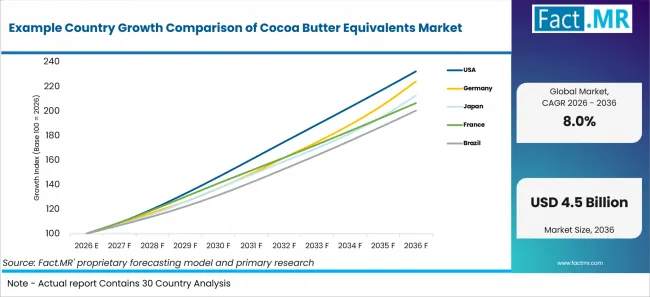
Example Country Growth Comparison Of Cocoa Butter Equivalents Market | Source: Fact.MR
| Country | CAGR (2026-2036) |
|---|---|
| USA | 8.8% |
| Germany | 8.4% |
| Japan | 7.8% |
| France | 7.5% |
| Brazil | 7.2% |
Source: Fact.MR analysis. Updated Aug 28, 2026
What supports USA adoption?
8.8% CAGR, supported by confectionery reformulation and food-spending scale.
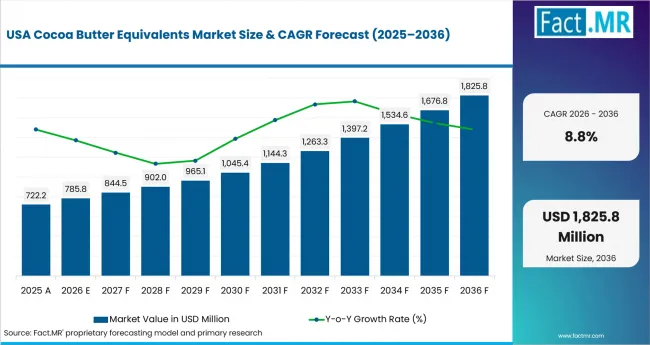
Cocoa Butter Equivalents Market Country Value Analysis | Source: Fact.MR
U.S. chocolate and bakery brands are expected to test CBEs where coating performance must offset cocoa-butter cost swings. USDA ERS reported in June 2026 that total U.S. food spending reached USD 2.51 trillion in 2025. That scale gives confectionery and bakery processors a wide base for controlled reformulation trials. Processors can test CBE systems first in coatings before moving into higher-risk branded chocolate recipes.
How is Germany scaling demand?
8.4% CAGR, driven by chocolate output and edible-fat processing depth.
Germany remains a qualification-heavy market because confectionery producers expect repeatable melt curves and clean label files before approving a new fat. Destatis reported in December 2025 that Germany produced 12.8 kilograms of chocolate per person in 2024. That processing base supports CBE trials where texture control matters across molded and coated products.
What supports Japan’s outlook?
7.8% CAGR, led by food exports and premium confectionery channels.
Japan is expected to favor CBEs where small-format gifts and premium snacks need stable finish during seasonal retail cycles. MAFF reported in February 2026 that agricultural, forestry, fishery and food exports reached JPY 1.7005 trillion in 2025. Export-facing brands are likely to value fat systems that protect gloss and texture during long distribution routes.
How does France perform?
7.5% CAGR, supported by bakery depth and chocolate price pass-through.
France is expected to use CBEs where bakery, pastry and chocolate-style applications need better control over cost and finish. INSEE reported in June 2025 that the CPI for cocoa-based products rose 22.0% between mid-2023 and May 2025. That pressure gives formulators a stronger reason to test lower-cocoa-butter systems while protecting premium eating quality.
What supports Brazil’s position?
7.2% CAGR, shaped by cocoa supply and local derivative trade.
Brazil is expected to remain more supply-linked than the other profiled countries because local cocoa logistics shape processor access to derivatives. The Ministry of Ports and Airports reported in April 2025 that Brazil exported 51,049 tonnes of cocoa and derivatives through ports in 2024. That flow supports local participation in cocoa ingredients and specialty-fat blending routes.
Who leads the Cocoa Butter Equivalents Market?
AAK, Cargill, Incorporated, Bunge Global SA, Fuji Oil Co., Ltd., Mewah International Inc. and Mewah International are active providers.
AAK is active through ILLEXAO and other chocolate and confectionery fat systems. Its ILLEXAO portfolio provides cocoa butter equivalent solutions offering controlled cocoa-butter replacement, bloom stability, heat resistance and tailored melting and texture properties.
Cargill, Incorporated, Bunge Global SA and Fuji Oil Co., Ltd. bring broad specialty-fat and confectionery capabilities. Their portfolios include cocoa butter equivalents alongside technical support for chocolate formulation, coating performance, bloom control and processing requirements.
Mewah International Inc. and Mewah International add substantial Asian specialty-fats capabilities. Wilmar offers WILCHOC cocoa butter equivalents, while Mewah provides cocoa butter equivalents alongside other confectionery fats. Their capabilities are supported by vegetable-oil processing, specialty-fat formulation and application expertise for chocolate and confectionery products.
Which companies are the key providers?
Key companies include AAK, Cargill, Incorporated, Bunge Global SA, Fuji Oil Co., Ltd., Mewah International Inc. and Mewah International.
- AAK
- Cargill, Incorporated
- Bunge Global SA
- Fuji Oil Co., Ltd.
- Mewah International Inc.
- Mewah International
Bibliography
- AAK. (2026, May 28). AAK’s new cocoa butter equivalent overcomes enrobing challenges – even when used at high levels.
- U.S. Bureau of Labor Statistics. (2026, August 12). Consumer Price Index—July 2026.
- Federal Statistical Office (Destatis). (2025, December 2). 12,8 Kilo Schokolade pro Kopf wurden 2024 produziert [12.8 kilograms of chocolate per capita were produced in 2024].
- U.S. Food and Drug Administration. (2025, July 16). FDA to revoke 52 obsolete standards of identity for food products.
- Institut national de la statistique et des études économiques. (2025, June 24). The surge in tropical commodity prices in 2024 is being passed on to consumer prices for chocolate and coffee in 2025.
- Ministério de Portos e Aeroportos. (2025, April 17). Portos Brasileiros: Da rota do cacau à magia do chocolate.
- Zeballos, E., & Sinclair, W. (2026, June 11). Total U.S. food spending reached $2.51 trillion in 2025. U.S. Department of Agriculture, Economic Research Service.
- European Parliament, & Council of the European Union. (2000, June 23). Directive 2000/36/EC of the European Parliament and of the Council relating to cocoa and chocolate products intended for human consumption. Official Journal of the European Communities, L 197, 19–25.
This Report Answers
- The report explains where cocoa butter equivalents are used across fat system, function, application and form.
- Segment analysis identifies the leading subsegments and the operational reasons manufacturers prioritize them.
- Country analysis examines listed markets and the pricing, trade or production mechanisms supporting adoption.
- Competitive analysis reviews current providers across specialty fats, edible oils and confectionery ingredient systems.
- Application analysis assesses how melt behavior, heat stability and label rules influence purchase decisions.
What does the Cocoa Butter Equivalents Market cover?
The Cocoa Butter Equivalents Market covers commercial fat systems designed to match or partially replace cocoa butter behavior in chocolate-style, confectionery, bakery and coating applications. It includes products supplied as blocks, flakes, liquids and powders, including systems used in enrobed biscuits and fillings where stable finish, melt behavior and processing performance are important.
The assessment covers fat system, function, application and form segmentation across heat stability, bloom resistance, texture control and release requirements. It also includes supplier application support related to processing behavior, melt profile and surface-quality testing.
What is included in the scope?
The scope includes commercial CBE systems sold as blocks, flakes, liquids or powders for chocolate-style, bakery coating and confectionery applications. It includes fats used in enrobed biscuits and fillings where the product brief requires a stable finish.
Application support is included when the supplier sells a qualifying fat system and provides testing help for processing behavior, melt profile and surface quality.
What is excluded from the scope?
The scope excludes cocoa bean farming, raw cocoa trading, conventional cocoa butter sold outside equivalent-function positioning and finished chocolate products sold as branded consumer goods.
The scope also excludes general edible oils outside cocoa-butter-matching properties, dairy butter, margarine spreads and specialty fats directed to non-chocolate applications.
How Was the Analysis Built?
The analysis draws on 120+ sources, 35+ company portfolios, 25+ countries, and more than 20 industry interviews.
- Primary Research: Primary research includes discussions with manufacturers, service providers, technology developers, distributors, end users, and subject-matter experts. These conversations examine purchasing priorities, product adoption, operational challenges, approval requirements, competitive positioning, and the factors that influence wider market acceptance.
- Desk Research: Desk research covers government statistics, regulatory publications, company filings, trade data, technical studies, industry associations, standards, public policy, and other authoritative sources. Every source used in the analysis is documented in the bibliography.
- Market Sizing and Forecasting: Market estimates combine historical performance, demand indicators, pricing and volume trends, segment shares, company participation, country-level growth, adoption patterns, investment activity, and barriers to market expansion.
- Data Validation and Update Cycle: Findings are validated by comparing primary interviews with public data, company activity, regulatory changes, trade patterns, and industry developments. Regular updates review new product launches, capacity changes, partnerships, approvals, and shifts in commercial adoption.
Segmentation
What is the report’s scope and coverage?
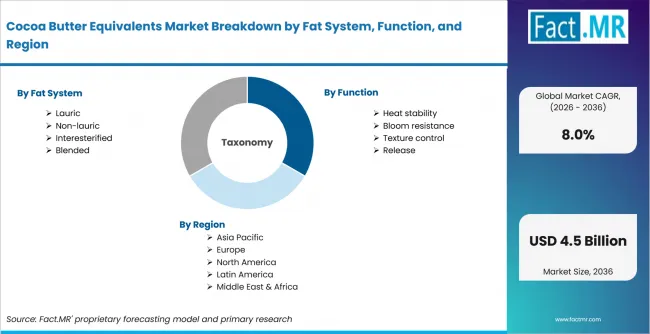
Cocoa Butter Equivalents Market Breakdown By Fat System, Function, And Region | Source: Fact.MR
| Attribute | Details |
|---|---|
| Quantitative Units | USD billion in 2026 to USD billion by 2036 at a CAGR |
| Market Definition | Non-lauric vegetable fat systems used to match or partially replace cocoa butter behavior in chocolate-style, confectionery, bakery and coating applications. Qualifying CBEs are compatible with cocoa butter and meet the criteria in Directive 2000/36/EC Annex II; lauric cocoa-butter substitutes are excluded. |
| Fat System | Non-lauric CBE-compatible fats; Fractionated CBE systems; Blended CBE systems |
| Function | Heat stability; Bloom resistance; Texture control; Release |
| Application | Confectionery; Bakery; Frying; Prepared foods |
| Form | Blocks; Flakes; Liquid; Powdered |
| Regions Covered | North America; Latin America; Western Europe; Eastern Europe; East Asia; South Asia & Pacific; Middle East & Africa |
| Countries Covered | United States; Germany; Japan; France; Brazil |
| Key Companies Profiled | AAK; Cargill, Incorporated; Bunge Global SA; Fuji Oil Co., Ltd.; Mewah International Inc.; Mewah International |
| Forecast Period | 2026 to 2036 |
| Approach | Hybrid top-down and bottom-up approach using confectionery output, specialty-fat supply, application trials, regional adoption, country growth and provider portfolio review. |
Source: Fact.MR analysis. Updated Aug 28, 2026
How is the market segmented?
-
By Fat System:
- Non-lauric CBE-compatible fats
- Fractionated CBE systems
- Blended CBE systems
-
By Function:
- Heat stability
- Bloom resistance
- Texture control
- Release
-
By Application:
- Confectionery
- Bakery
- Frying
- Prepared foods
-
By Form:
- Blocks
- Flakes
- Liquid
- Powdered
-
By Region:
- North America
- Latin America
- Western Europe
- Eastern Europe
- East Asia
- South Asia & Pacific
- Middle East & Africa
Frequently Asked Questions
How big is the cocoa butter equivalents market in 2026?
What is the CAGR of the cocoa butter equivalents market from 2026 to 2036?
Which fat system leads the cocoa butter equivalents market?
Which function leads the cocoa butter equivalents market?
Who are the leading companies in the cocoa butter equivalents market?
Who worked on this report


Preview the report firsthand - request a free sample
Free SampleGet the brochure for pricing and purchase details
Download PDF