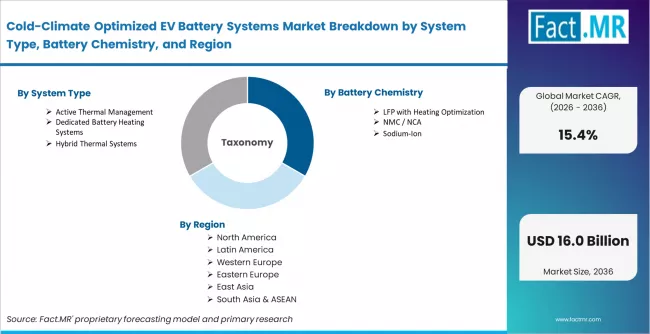
The Cold-Climate Optimized EV Battery Systems Market is analyzed by system type, including active thermal management, dedicated battery heating systems and hybrid thermal systems, and region, forecast 2026 to 2036.
By Fact.MR Automotive DeskLead analyst:
Shubham PatidarPublished :
16 min read
Fact-checked under the Fact.MR editorial process
Cold-Climate Optimized EV Battery Systems Market Forecast and Outlook By Fact.MR
In 2025, the cold-climate optimized EV battery systems market was valued at USD 2.9 billion.
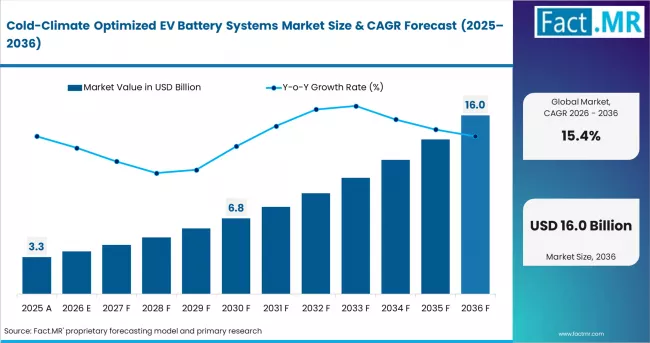
Based on Fact.MR analysis, demand for cold-climate electric vehicle battery systems is estimated to grow to USD 3.3 billion in 2026 and USD 14.2 billion by 2036.
FACT.MR projects a CAGR of 15.4% during the forecast period.
Cold Climate Optimized Ev Battery Systems Market Market Value Analysis | Source: Fact.MR
Metric
Value
Estimated Value in 2026
USD 3.3 billion
Forecast Value in 2036
USD 14.2 billion
Forecast CAGR (2026 to 2036)
15.4%
Source: Fact.MR analysis. Updated May 12, 2026
Summary ofCold-Climate Optimized EV Battery Systems Market
Market Definition
The market covers active, dedicated, and hybrid thermal management systems integrated with LFP, NMC/NCA, and sodium-ion EV batteries deployed in cold-climate passenger and commercial vehicle applications globally.
Demand Drivers
Nordic and Canadian government mandates requiring cold-weather EV range performance are driving OEM procurement of integrated active thermal systems for all-season EV programmes.
China's state-backed EV expansion into northeastern provinces with severe winter conditions is increasing platform-level investment in LFP battery heating optimization at domestic automakers.
European premium OEMs are integrating dedicated battery heating modules into new EV architectures to meet consumer range expectations below -20°C across German, Scandinavian, and Alpine markets.
Key Segments Analyzed
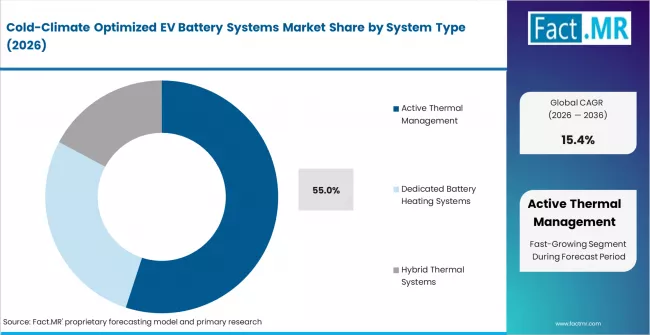
By System Type: Active Thermal Management leads with 55% share in 2026, driven by integrated heating-cooling control improving cold-climate range and fast-charging reliability.
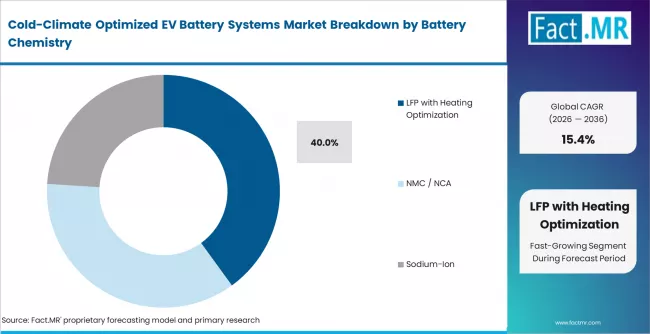
By Battery Chemistry: LFP with Heating Optimization leads with 40% share in 2026, balancing cost, thermal stability, and widespread cold-climate EV deployment across China and North America.
By Geography: Norway leads at 17.2% CAGR through 2036, driven by near-universal EV penetration and all-weather range policy requirements.
Analyst Opinion at FACT.MR
Shambhu Nath Jha, Principal Consultant at Fact.MR, opines, ' CXOs will find that competitive positioning is increasingly defined by active thermal management integration. Optimization of LFP heating performance is also becoming critical.’
Strategic Implications
Invest in active thermal management platform development certified for sub-zero operation to meet OEM programme award requirements in Norway, Canada, and northern China.
Build LFP battery heating optimization product lines targeting cost-sensitive EV manufacturers scaling cold-climate deployment across mid-range and commercial vehicle segments.
Develop OEM qualification partnerships in Germany and the United States to secure multi-year thermal system supply contracts as premium EV programmes expand northward.
Methodology
Market sizing based on EV thermal system shipment volumes, system-level ASPs, and OEM programme deployment data. Validated with 2024–2025 data.
Uses IEA EV Outlook, national EV registration data, OEM sustainability reports, and battery chemistry production disclosures for demand analysis.
Forecasts consider cold-climate EV fleet expansion, sodium-ion chemistry commercialisation timelines, and active thermal system adoption rates across premium and volume OEM programmes.
The market is projected to generate USD 10.9 billion in absolute opportunity between 2026 and 2036. Growth is transformational, driven by accelerating EV penetration across high-latitude and continental-climate markets. Cold-weather range anxiety remains the primary consumer barrier to EV adoption in northern regions, and OEM programme investment in integrated thermal management is rising structurally. Growth is moderated by system cost premiums, battery chemistry qualification timelines, and raw material constraints for sodium-ion scale-up.
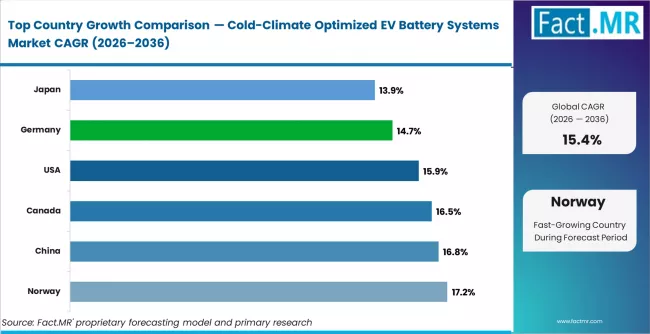
Norway leads with a projected CAGR of 17.2% through 2036, driven by near-universal EV penetration and government mandates for all-weather range performance standards. Canada follows at 16.5%, supported by federal zero-emission vehicle targets and provincial cold-climate fleet electrification programmes. China records 16.8%, anchored by state-backed EV expansion into northeastern provinces with extreme winter conditions. The United States grows at 15.9%, driven by federal EV adoption incentives and OEM investment at northern manufacturing hubs. Germany records 14.7%, reflecting premium OEM integration of active thermal platforms across EV lines. Japan grows at 13.9%, supported by cold-region Hokkaido EV deployment and domestic battery supplier advancement in low-temperature chemistries. Mature European markets face higher system integration costs and longer OEM qualification timelines as structural constraints on faster growth.
Segmental Analysis
Cold-Climate Optimized EV Battery Systems Market Analysis by System Type
Based on FACT.MR analysis, Active Thermal Management holds 55% share in 2026. It leads due to integrated heating and cooling control that maintains cell temperature within optimal operating range in sub-zero conditions. Cold-climate fast-charging performance and range retention require active thermal regulation that dedicated or hybrid systems cannot fully replicate.
Cold Climate Optimized Ev Battery Systems Market Analysis By System Type | Source: Fact.MR
Continental AG Investment: Continental AG launched its integrated EV thermal management system for cold-climate applications in Q2 2024, targeting OEM programmes in Scandinavia and Canada. The system integrates battery heating, cabin HVAC, and powertrain cooling into a single electronic control architecture. [4]
Gentherm Technology Development: Gentherm introduced its Battery Thermal Management module with active heating for extreme cold environments at CES January 2025, targeting North American and Nordic OEM qualifications. The system delivers cell-level heating from -40°C ambient for fast-charge readiness. [5]
Active System Adoption Trend: IEA's Global EV Outlook 2024 reported cold-climate EV sales in northern markets grew 38% in 2024, with OEM thermal specification requirements shifting from passive to active systems across new platform programmes starting 2025. [6]
Cold-Climate Optimized EV Battery Systems Market Analysis by Battery Chemistry
Based on FACT.MR analysis, LFP with Heating Optimization holds 40% share in 2026. Cost-per-kWh economics and thermal stability at sub-zero temperatures drive its dominance. LFP chemistry paired with resistive or heat-pump battery heating delivers acceptable cold-climate range retention at lower system cost than NMC/NCA alternatives.
Cold Climate Optimized Ev Battery Systems Market Analysis By Battery Chemistry | Source: Fact.MR
BYD Chemistry Investment: BYD announced its Blade Battery 2.0 with enhanced cold-climate heating optimization in Q3 2024, targeting sub-zero charging performance in northern China and European markets. The system achieves 80% charge retention at -20°C using integrated cell-level heating. [7]
Sodium-Ion Development: CATL disclosed its second-generation sodium-ion battery with improved low-temperature performance in Q1 2025, achieving less than 10% capacity loss at -40°C without active heating. The chemistry targets cost-sensitive cold-climate EV segments in northern China and Russia. [8]
NMC Cold-Climate Trend: Valeo reported in its 2024 annual results that NMC thermal system integration contracts with European premium OEMs grew 28% year-on-year, driven by OEM platform requirements for fast-charge performance at -20°C in Scandinavian and Alpine markets. [9]
Drivers, Restraints, and Opportunities
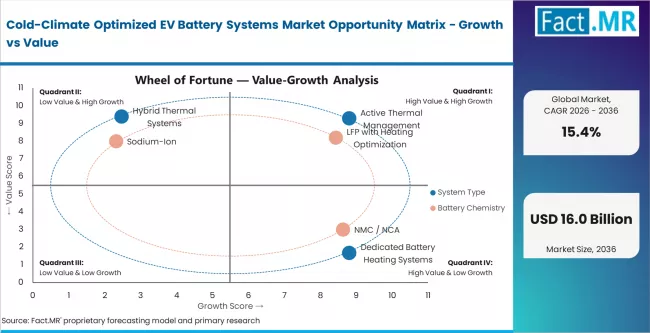
Cold Climate Optimized Ev Battery Systems Market Opportunity Matrix Growth Vs Value | Source: Fact.MR
FACT.MR analysts observe that growth is driven by rising EV adoption in cold-climate markets. Battery performance in low temperatures has been a key barrier. OEMs are increasing investment in thermal solutions. This aligns with EV sales targets. Active thermal system demand is rising with new EV platforms.
Procurement trends are shifting. Passive heating solutions are losing relevance. Active integrated systems are gaining preference. Range performance is the key driver. OEMs are now specifying thermal systems at the platform level. Aftermarket solutions are declining. Active systems carry 30–50% higher costs. However, they improve range and reduce adoption risk.
Cold-Climate EV Policy Mandates: Norwegian Electric Vehicle Association reported 90% EV share in new car sales in 2024. This is increasing demand for all-weather battery performance. Canada targets 100% ZEV sales by 2035. Provincial fleet programmes are accelerating thermal system adoption [1].
China Northeastern EV Expansion: Ministry of Industry and Information Technology updated cold-weather EV standards in 2024. These require minimum range retention at -20°C. OEMs are integrating LFP heating systems. Focus regions include Heilongjiang, Jilin, and Inner Mongolia [2].
U.S. Federal EV Investment: The U.S. Department of Energy allocated USD 3.5 billion in 2024. Funding supports battery performance R&D. Northern states like Minnesota and Michigan are accelerating fleet electrification. Active thermal systems are becoming standard in OEM specifications [3].
Regional Analysis
The cold-climate optimized EV battery systems market is assessed across Asia Pacific, North America, Europe, Latin America, and Middle East and Africa, covering 40+ countries with distinct demand profiles shaped by cold-climate EV penetration, government mandate structures, OEM platform investment cycles, and battery chemistry localization requirements. The full report provides market attractiveness analysis by region and country.
Top Country Growth Comparison Cold Climate Optimized Ev Battery Systems Market Cagr (2026 2036) | Source: Fact.MR
Country
CAGR (2026 to 2036)
Norway
17.2%
Canada
16.5%
China
16.8%
United States
15.9%
Germany
14.7%
Japan
13.9%
Source: Fact.MR analysis. Updated May 12, 2026
Source: Fact.MR (FACT.MR) analysis, based on proprietary forecasting model and primary research
Cold Climate Optimized Ev Battery Systems Market Cagr Analysis By Country | Source: Fact.MR
Europe Cold-Climate Optimized EV Battery Systems Market Analysis
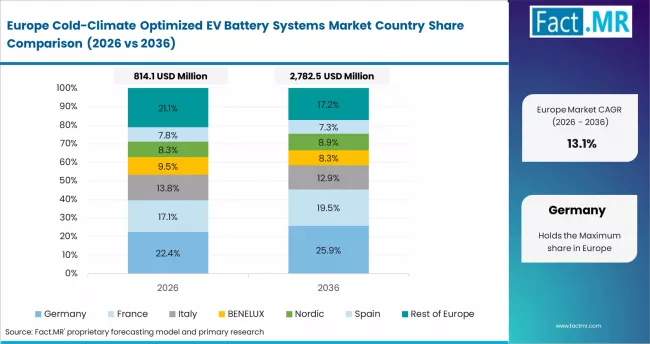
Cold Climate Optimized Ev Battery Systems Market Europe Country Market Share Analysis, 2026 & 2036 | Source: Fact.MR
Europe represents a regulation-intensive and premium OEM-led ecosystem for cold-climate EV battery systems. Norway drives real-world validation through high EV penetration. Germany anchors engineering integration across premium vehicle platforms. Valeo and Continental AG lead supply with OEM-certified active thermal solutions.
Norway: Norway stands as a real-world performance benchmark market. A 17.2% CAGR through 2036 reflects sustained EV saturation and replacement cycles. Over 90% EV penetration is creating continuous demand for reliable cold-weather performance. Updated 2024 guidelines define minimum thermal standards for vehicles. Valeo secured supply agreements for heat-pump-based systems. National transport policy continuity is supporting long-term procurement visibility.
Germany: Germany operates as a premium engineering integration hub. A 14.7% CAGR through 2036 reflects platform-level thermal standardization. Active thermal systems are becoming default specifications across EV lines. Continental AG integrated its system into a major OEM platform for 2026 production. Updated approval norms now include cold-climate range validation. This is accelerating adoption across BMW, Volkswagen, and Mercedes-Benz platforms.
Fact.MR covers Norway, Germany, France, the United Kingdom, Sweden, Finland, and Rest of Europe. It includes policy benchmarks, OEM integration trends, and country-level attractiveness analysis.
North America Cold-Climate Optimized EV Battery Systems Market Analysis
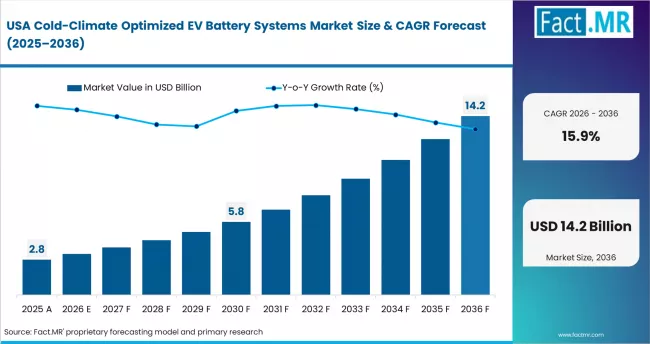
Cold Climate Optimized Ev Battery Systems Market Country Value Analysis | Source: Fact.MR
North America reflects a mandate-driven and investment-backed market. Canada drives adoption through federal targets and provincial programmes. The United States leads technology funding and OEM deployment. Gentherm and Hanon Systems lead supply with OEM-qualified platforms.
Canada: Canada represents a policy-enforced cold-climate adoption market. A 16.5% CAGR through 2036 reflects strong regulatory push. Federal mandates require 100% ZEV sales by 2035. Updated guidelines specify performance at -30°C for eligible vehicles. Quebec’s funding expansion is accelerating fleet electrification. Commercial and transit fleets are driving thermal system uptake.
United States: The U.S. reflects an R&D-led and fleet-driven deployment environment. A 15.9% CAGR through 2036 is supported by federal funding and state-level mandates. The U.S. Department of Energy allocated USD 3.5 billion toward battery innovation. General Motors is integrating active thermal systems into Ultium platforms. State programmes in northern regions are accelerating fleet-level adoption.
Fact.MR covers the United States, Canada, and Mexico. It includes federal mandates, investment flows, and OEM integration trends.
Asia Pacific Cold-Climate Optimized EV Battery Systems Market Analysis
Asia Pacific represents the highest-volume and fastest-scaling region. China drives deployment through policy enforcement and regional subsidies. Japan supports innovation through targeted cold-region programmes. BYD, CATL, and Denso Corporation anchor supply through advanced thermal and battery technologies.
China: China functions as a standards-driven scale market. A 16.8% CAGR through 2036 reflects regulatory enforcement across all EV segments. Updated national standards require performance at -20°C. CATL is advancing sodium-ion batteries for extreme climates. Subsidy programmes are targeting northeastern provinces. OEMs including BYD and SAIC are expanding LFP heating system integration.
Japan: Japan represents a precision-engineered cold-region deployment market. A 13.9% CAGR through 2036 reflects targeted regional programmes. Hokkaido initiatives are funding fleet electrification in extreme climates. Denso Corporation introduced next-generation thermal systems in 2025. Updated subsidy criteria now prioritize cold-weather performance certification. This is increasing OEM-level thermal integration.
Fact.MR covers China, Japan, South Korea, and Rest of Asia Pacific. It includes cold-climate policy analysis, thermal system adoption trends, and battery innovation timelines.
Competitive Aligners for Market Players
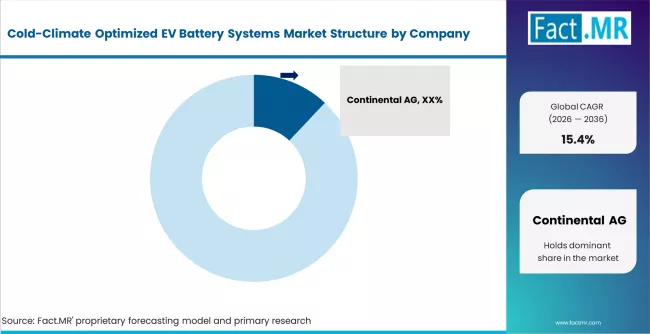
Cold Climate Optimized Ev Battery Systems Market Analysis By Company | Source: Fact.MR
The cold-climate optimized EV battery systems market is moderately concentrated. A small group of Tier 1 suppliers controls most OEM-approved programmes. Entry barriers are high. Suppliers must complete long validation cycles. These typically take 18 to 30 months in extreme cold conditions. Approval depends on proven system integration, reliable sub-zero performance, and strong OEM relationships. Pricing alone is not a deciding factor.
Continental AG and Robert Bosch hold leading positions. Their advantage comes from integrated capabilities across thermal hardware, electronics, and HVAC systems. They also benefit from long-standing OEM partnerships. Testing infrastructure in regions like Scandinavia and Canada strengthens their validation edge. Valeo competes through advanced heat-pump systems and strong ties with French automakers. Hanon Systems leads supply for Korean OEMs. Denso Corporation anchors the Japanese market with next-generation thermal platforms.
Buyer behaviour is shaped by long OEM platform cycles. Automakers usually select one supplier per platform. Contracts often last 6 to 10 years. This creates stable revenue for approved suppliers. It also limits opportunities for new entrants. Without certified cold-climate data, market access remains difficult. Gentherm has carved out a niche. It focuses on battery-level thermal solutions. This has helped secure wins in North American programmes where precise heating performance is critical.
Key Players
Continental AG
Robert Bosch
Valeo
Hanon Systems
Denso Corporation
Gentherm
Scope of Report
Cold Climate Optimized Ev Battery Systems Market Breakdown By System Type, Battery Chemistry, And Region | Source: Fact.MR
Attribute
Details
Quantitative Units
USD 3.3 billion (2026) to USD 14.2 billion (2036), at a CAGR of 15.4%
Market Definition
Active thermal management, dedicated battery heating, and hybrid thermal systems integrated with LFP, NMC/NCA, and sodium-ion battery chemistries for cold-climate EV applications globally.
System Type Segmentation
Active Thermal Management, Dedicated Battery Heating Systems, Hybrid Thermal Systems
Battery Chemistry Segmentation
LFP with Heating Optimization, NMC/NCA, Sodium-Ion
Application Coverage
Cold-climate passenger EV thermal management, commercial EV fleet heating systems, OEM platform cold-weather battery integration, northern market EV range optimization.
Regions Covered
North America, Europe, Asia Pacific, Latin America, Middle East and Africa
Countries Covered
USA, Canada, Mexico, Germany, Norway, UK, France, Sweden, Finland, China, Japan, South Korea, India, ASEAN, Australia and New Zealand, Brazil, Argentina, Chile, Saudi Arabia, GCC, Turkey, South Africa, Rest of MEA
Key Companies Profiled
Continental AG, Robert Bosch, Valeo, Hanon Systems, Denso Corporation, Gentherm
Forecast Period
2026 to 2036
Approach
Hybrid top-down and bottom-up model using EV thermal system shipment volumes by system type and battery chemistry, OEM programme award data, cold-climate EV fleet registration trends, and primary interviews with EV thermal engineers and OEM battery procurement managers.
Source: Fact.MR analysis. Updated May 12, 2026
Cold-Climate Optimized EV Battery Systems Market by Segments
By System Type:
Active Thermal Management (Heating + Cooling Integrated)
Dedicated Battery Heating Systems
Hybrid Thermal Systems
By Battery Chemistry:
Lithium Iron Phosphate (LFP) with Heating Optimization
NMC / NCA
Sodium-Ion
By Region:
North America
United States
Canada
Mexico
Latin America
Brazil
Mexico
Argentina
Chile
Rest of Latin America
Western Europe
Germany
United Kingdom
France
Norway
Sweden
Finland
Rest of Western Europe
Eastern Europe
Russia
Poland
Rest of Eastern Europe
East Asia
China
Japan
South Korea
South Asia and Pacific
India
ASEAN
Australia and New Zealand
Rest of South Asia and Pacific
Middle East and Africa
Kingdom of Saudi Arabia
Other GCC Countries
Turkey
South Africa
Rest of Middle East and Africa
Bibliography
[1] Norwegian EV Association. (2024). Norwegian EV Market Statistics 2024: EV Penetration Reaching 90% of New Passenger Car Sales and Cold-Weather Range Performance Standards Published by Norwegian EV Association for Market Compliance. January 2025. elbil.no/statistikk
[2] Ministry of Industry and Information Technology, China. (2024). GB/T 18385-2023 Electric Vehicle Energy Consumption Update: Minimum Cold-Weather Range Retention Requirements at -20°C for All EV Models Sold in the Chinese Market Effective January 2024. 2024. miit.gov.cn
[3] U.S. Department of Energy. (2024). Battery Materials and Technology Programme Award 2024: USD 3.5 Billion Allocation Including Cold-Climate Battery Performance R&D at Argonne and Oak Ridge National Laboratories. Q3 2024. energy.gov/battery-materials
[4] Continental AG. (Q2 2024). Press Release: Launch of Integrated Cold-Climate EV Thermal Management System for Northern Market OEM Programmes with 2026 Production Start Confirmation. Q2 2024. continental.com/newsroom
[5] Gentherm Incorporated. (January 2025). CES 2025 Product Announcement: Battery Thermal Management Module with Active Cell-Level Heating Certified to -40°C for North American and Nordic OEM Qualification Programmes. January 2025. gentherm.com/news
[6] International Energy Agency. (2024). Global EV Outlook 2024: Cold-Climate EV Sales Growth of 38% in Northern Markets and OEM Thermal Specification Shift from Passive to Active Systems Across New Platform Programmes. 2024. iea.org/reports/global-ev-outlook-2024
[7] BYD Company Limited. (Q3 2024). Blade Battery 2.0 Product Announcement: Enhanced Cold-Climate Heating Optimization Achieving 80% Charge Retention at -20°C for Northern China and European EV Markets. Q3 2024. byd.com/press
[8] CATL. (Q1 2025). Second-Generation Sodium-Ion Battery Disclosure: Less than 10% Capacity Loss at -40°C Without Active Heating for Cost-Sensitive Cold-Climate EV Segments in Northern China and Export Markets. Q1 2025. catl.com/news
[9] Valeo SE. (2024). Annual Results 2024: NMC Thermal System Integration Contract Growth of 28% Year-on-Year with European Premium OEMs for Fast-Charge Cold-Climate Performance at -20°C. 2024. valeo.com/investor-relations
This Report Addresses
Strategic intelligence on cold-climate EV battery system demand across active thermal management, dedicated heating, and hybrid thermal architectures for passenger and commercial EV applications globally.
Market forecast from USD 3.3 billion in 2026 to USD 14.2 billion by 2036 at a CAGR of 15.4%.
Growth opportunity mapping across Norway mandate-driven demand, Canada federal ZEV programmes, China northeastern EV expansion, U.S. DOE investment, Germany OEM integration, and Japan cold-region deployment.
Segment analysis by system type (Active Thermal Management, Dedicated Battery Heating, Hybrid Thermal) and battery chemistry (LFP, NMC/NCA, Sodium-Ion) across global and regional markets.
Regional outlook covering Europe mandate-led demand, North America federal investment cycles, and Asia Pacific cold-climate EV expansion dynamics.
Competitive analysis of Continental AG, Robert Bosch, Valeo, Hanon Systems, Denso Corporation, and Gentherm covering OEM qualification depth, cold-climate certification, and platform programme positioning.
Regulatory impact analysis covering Norway EV performance mandates, Canada Zero Emission Vehicles Act, China GB/T cold-weather standards, U.S. DOE Battery Materials programme, and Germany type approval updates.
Report delivered in PDF, Excel datasets, and presentation formats. Supported by primary interviews, OEM programme disclosures, IEA EV Outlook data, and national EV registration records.
Cold-Climate Optimized EV Battery Systems Market Definition
The market covers active thermal management, dedicated battery heating, and hybrid thermal systems integrated with LFP, NMC/NCA, and sodium-ion battery chemistries, deployed in passenger and commercial EVs operating in sub-zero and cold-climate environments globally.
Cold-Climate Optimized EV Battery Systems Market Inclusions
Covers global and regional forecasts from 2026 to 2036. Includes system type, battery chemistry, and geography segments. Covers active, dedicated, and hybrid thermal systems across LFP, NMC/NCA, and sodium-ion chemistries. Includes passenger EV, commercial EV, and fleet cold-climate deployments.
Cold-Climate Optimized EV Battery Systems Market Exclusions
Excludes standard EV battery systems without cold-climate optimization features. Omits consumer EV battery pack assembly unless integrated with thermal management. Excludes charging infrastructure hardware. Focuses strictly on thermal management systems and cold-optimized battery chemistry platforms.
Cold-Climate Optimized EV Battery Systems Market Research Methodology
Primary Research:Interviews with EV thermal engineers, OEM battery procurement managers, battery chemistry specialists, and fleet electrification directors across the United States, Germany, Norway, Canada, China, and Japan.
Desk Research:Uses IEA EV Outlook data, national EV policy documents, OEM sustainability reports, and battery chemistry trade data. Includes disclosures from Continental AG, Bosch, Valeo, Hanon Systems, Denso, and Gentherm (2024–2025).
Market-Sizing and Forecasting:Hybrid model based on EV thermal system shipment volumes by system type and battery chemistry. Uses OEM programme award data and cold-climate EV fleet deployment projections across key regions.
Data Validation and Update Cycle:Validated using OEM CapEx disclosures, EV fleet registrations, battery chemistry production data, and cold-climate range testing benchmarks. Updated annually.
Questions Answered
Frequently Asked Questions
How large is the global cold-climate optimized EV battery systems market in 2025?
The global cold-climate optimized EV battery systems market was valued at USD 2.9 billion in 2025.
What will the market size be in 2026?
Based on Fact.MR analysis, demand for cold-climate EV battery systems is estimated to grow to USD 3.3 billion in 2026.
What is the projected market size by 2036?
The market is projected to reach USD 14.2 billion by 2036, generating USD 10.9 billion in absolute dollar opportunity over the forecast period.
What is the expected CAGR from 2026 to 2036?
FACT.MR projects a CAGR of 15.4% for the global cold-climate optimized EV battery systems market during the 2026 to 2036 forecast period.
Which system type segment is poised to lead the market?
Active Thermal Management leads with approximately 55% share in 2026, supported by integrated heating-cooling control requirements for cold-climate range retention and fast-charging performance.
Which battery chemistry segment holds the largest share?
LFP with Heating Optimization leads with approximately 40% share in 2026.
Which country shows the fastest growth?
Norway leads at 17.2% CAGR through 2036, reflecting near-universal EV penetration and all-weather range performance policy requirements.
What is driving demand for cold-climate EV battery systems?
Demand is driven by cold-climate EV mandate expansion in Norway and Canada, China northeastern EV deployment, U.S. DOE battery investment, European OEM platform integration, and sodium-ion chemistry commercialisation for extreme cold applications.
What are the major restraints?
Key restraints include active thermal system cost premiums of 30–50% over passive alternatives, long OEM cold-climate qualification cycles of 18 to 30 months, and sodium-ion battery scale-up constraints limiting chemistry diversification timelines.
.webp "Top Country Growth Comparison Cold Climate Optimized Ev Battery Systems Market Cagr (2026 2036)")