- Base Value(2025): 9.0 Bn
- Estimated Value(2026): 9.4 Bn
- Forecast Value (2036): 16.0 Bn
- CAGR (2026 - 2036): 5.4%
EV-Optimized Seating Components Market Forecast and Outlook 2026 to 2036
In 2025, the EV-optimized seating components market was valued at USD 9.0 billion. Based on FACT.MR analysis, demand for EV-optimized seating components is estimated to grow to USD 9.4 billion in 2026 and USD 16.0 billion by 2036. FACT.MR projects a CAGR of 5.4% during the forecast period.
The absolute dollar growth from 2026 to 2036 represents an incremental gain of USD 6.6 billion an expansion that is structurally driven rather than cyclical, anchored by the compounding uplift of rising global EV penetration rates and per-vehicle content increases as seating systems absorb sensor, connectivity, and thermal management functions previously housed in separate modules. Growth is constrained by the prolonged capital intensity of tooling transitions as Tier-1 suppliers retool stamping and foam-injection lines for EV-specific dimensions, and by OEM cost pressure strategies that periodically force value engineering of premium content back toward commodity specifications.
As Douglas Del Grosso, President and Chief Executive Officer of Adient, noted in the Q2 2024 earnings call, 'We are actively repositioning our seating portfolio for electric vehicles, where the flat floor architecture creates genuine opportunity to differentiate through new seating configurations, and we see that customers are willing to pay for the added functionality that full recline, swivel, and integrated massage systems enable in premium EV cabins' [1].
Country-level growth reveals clear divergence between high-velocity EV adoption markets and mature automotive economies. China leads at 6.6% CAGR, underpinned by government NEV mandates and a domestic EV production ecosystem spanning 28+ active seating supply chains. Brazil follows at 6.2% CAGR, supported by hybrid and electric bus fleet electrification programs and light EV assembly expansion. Europe registers 5.2% CAGR under Euro 7 emission regulations and fleet electrification mandates from corporate buyers. The United States and United Kingdom each post 5.1% CAGR, driven by IRA-linked EV assembly investment and commercial EV fleet procurement programs. Germany reaches 5.0% CAGR through premium OEM electrification programs at BMW, Mercedes-Benz, and Volkswagen Group platforms. South Korea advances at 4.6% CAGR via Hyundai-Kia EV platform investment and export-oriented seating supply chains. Japan trails at 3.9% CAGR, constrained by a later EV transition pace among domestic automakers, though Toyota and Honda electrification commitments underpin medium-term demand.
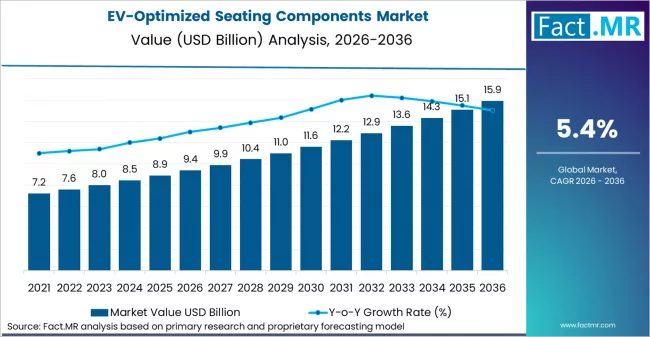
Ev Optimized Seating Components Market Market Value Analysis | Source: Fact.MR
Market Definition
EV-optimized seating components are purpose-engineered assemblies including structural frames, foam and cushion systems, sensor and electronics modules, and trim and upholstery layers designed specifically to meet the performance, packaging, and interface requirements of battery electric and plug-in hybrid vehicle platforms The market serves global automotive OEMs and Tier-1 suppliers prioritizing mass reduction, electrified thermal comfort, and connected interior experiences across passenger car, SUV, light commercial, and bus segments.
Market Inclusions
The report covers global and regional EV-optimized seating components market sizes from 2026 to 2036, with detailed segment breakdowns by component type (frames and structural assemblies, foam and cushion systems, sensors and electronics, trim and upholstery), vehicle class (passenger cars, SUV/crossover, light commercial vehicles, buses), material (steel, aluminum, composite structures, bio-based foam), and buyer type (OEM and Tier-1 integrated supply, aftermarket replacement and upgrade). Analysis includes per-vehicle content value trajectories, light weighting material substitution economics, and OEM sourcing strategy shifts toward consolidated seat-system supply.
Market Exclusions
The scope excludes complete seat assemblies sold as finished interior modules unless disaggregated by component category, focusing strictly on discrete seating subsystems and their immediate Tier-2 and Tier-3 material inputs. It omits conventional ICE vehicle seating components without EV-platform-specific design adaptations. Seat belt systems, airbag modules, and child restraint systems are excluded as safety hardware classified under separate automotive safety component markets. Aftermarket cosmetic seat covers and non-OEM-approved accessories are outside scope. The report does not cover electric bus body fabrication or rail vehicle seating, which are addressed in separate transit and rail infrastructure reports.
Research Methodology
- Primary Research: Primary research involved structured interviews with OEM global sourcing directors, Tier-1 seating system program managers, lightweight material engineers at steel and aluminum suppliers, and EV platform interior architects at automotive OEMs across North America, Europe, and Asia-Pacific.
- Desk Research: Desk research synthesized production-weighted seating content data from OEM annual reports and supplier earnings disclosures, EV production forecasts from ACEA, JAMA, and China Passenger Car Association, light weighting program announcements in trade publications, and government EV incentive policy documents.
- Market-Sizing and Forecasting: Market sizing employed a hybrid bottom-up and top-down approach, building from vehicle-class-level EV production forecasts multiplied by per-vehicle seating component content values, cross-calibrated against disclosed revenues from Adient, Lear, Faurecia (Forvia), Toyota Boshoku, and Magna seating divisions.
- Data Validation and Update Cycle: Outputs were cross-validated against OEM sourcing award announcements, Tier-1 supplier capital expenditure guidance for EV-specific tooling, and EV production ramp schedules, reconciled semi-annually with revised EV market penetration forecasts from ACEA, IEA, and BloombergNEF mobility databases.
Key Takeaways
- Market Definition
- EV-optimized seating components encompass purpose-designed structural frames, foam systems, sensor electronics, and trim assemblies engineered to exploit battery electric vehicle flat-floor architectures and deliver integrated thermal comfort, connectivity, and light weighting functions unavailable in conventional ICE seat designs.
- Demand Drivers
- Global EV production volumes surpassing 20 million units annually by 2026 create structural baseline demand for EV-native seating architectures, as OEM platform programs mandate seat system redesigns incompatible with ICE component carryover strategies.
- Occupant experience differentiation in the premium EV segment where interior cabin noise reduction and flat-floor space gains are primary purchase motivators drives OEM willingness to approve 18-30% per-seat content premiums for multi-function, electronically adjustable, and thermally active seating systems.
- Light weighting mandates tied to EV range efficiency targets compel seating suppliers to substitute steel frames with aluminum and composite alternatives, generating a structural material upgrade cycle that increases per-seat revenue while constraining legacy suppliers lacking advanced materials processing capabilities.
- Key Segments Analyzed
- By Component Type, Frames/Structures command 35% share in 2025, reflecting the foundational structural investment required for EV platform-specific seat geometry and the high tooling and engineering content embedded in structural assembly per-unit values.
- By Vehicle Class, Passenger Cars hold 45% share in 2025, representing the highest-volume EV production segment globally and the primary application arena for new seating configurations enabled by flat-floor EV architecture.
- By Material, Steel holds 40% share in 2025, remaining the dominant structural frame material by volume due to cost efficiency and established manufacturing compatibility.
- By Buyer Type, OEM/Tier-1 commands 70% share in 2025, reflecting consolidated multi-year platform sourcing agreements with integrated seating system suppliers.
- By Region, Asia-Pacific leads with the highest absolute production volume share, driven by China's dominant EV manufacturing base, while Europe commands the highest per-seat value content through premium OEM platform programs and integrated sensor and comfort system specifications.
- Analyst Opinion at FACT.MR
- Shambhu Nath Jha, Principal Consultant at FACT.MR, opines, 'CXOs will find this report essential for understanding which component categories frames, foam, sensors, or trim are capturing the largest share of EV seating system value growth, and how regional OEM electrification timelines determine whether content premiums or volume scale will drive Tier-1 seating supplier margin expansion through 2036.'
- Strategic Implications / Executive Takeaways
- Tier-1 seating suppliers must accelerate investment in aluminum hydroforming, fiber-reinforced composite stamping, and bio-based foam certification to secure positions on next-generation EV platform sourcing programs where material specification is locked 3-5 years before production launch.
- OEM procurement teams should evaluate modular seating system sourcing strategies that consolidate frame, foam, sensor, and trim supply under single integrated system suppliers, as ECU-level seat integration complexity makes multi-supplier assembly coordination increasingly cost-prohibitive on EV platforms.
- Aftermarket channel participants including fleet operators and premium EV retail networks should assess EV-specific seating upgrade program viability, as the growing installed base of battery electric vehicles creates addressable demand for biometric sensor retrofits, enhanced lumbar systems, and upgraded upholstery packages.
- Methodology
- Market sizing built from vehicle-class-level EV production forecasts multiplied by per-vehicle seating content values, cross-calibrated against disclosed seating division revenues from Adient, Lear, Faurecia (Forvia), Toyota Boshoku, and Magna.
- Light weighting material substitution economics validated through OEM annual report disclosures, supplier capital expenditure filings for EV-specific tooling, and aluminum and composite materials pricing indices from CRU and Metal Bulletin.
- Regional policy impact assessments based on EV production mandate tracking from ACEA European CO2 regulation implementation reports, China NEV credit policy updates from MIIT, and IRA advanced manufacturing credit qualification filings from U.S. Treasury.
Segmental Analysis
EV-Optimized Seating Components Market Analysis by Component Type
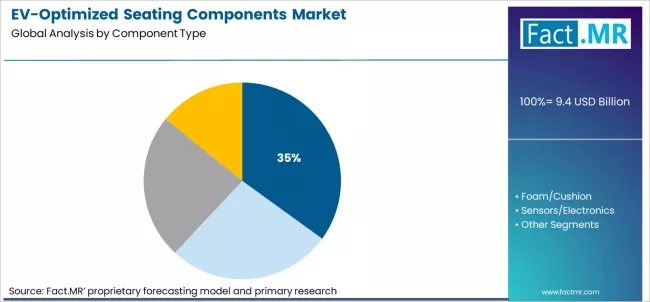
Ev Optimized Seating Components Market Analysis By Component Type | Source: Fact.MR
Based on FACT.MR's EV-optimized seating components market report, consumption of Frames/Structures is estimated to hold 35% share in 2025. Frames and structural assemblies dominate because they constitute the highest per-unit engineering content in any seat system, embedding EV-platform-specific packaging geometry, integrated mounting interface hardware, and in premium applications mechanisms for full-recline and swivel configurations that represent genuine design departures from ICE seat frames. Structural assemblies also anchor the supply chain: downstream foam, trim, and sensor suppliers quote their systems as overlays on frame specifications already locked in OEM sourcing programs.
- Adient Investment: Adient announced in September 2024 a EUR 120 million capital investment across its European structural seat frame manufacturing network specifically to retool for EV platform dimensions and aluminum hydroforming requirements, targeting structural seat component supply for Volkswagen Group's MEB and SSP platforms beginning in 2026 production programs [5].
- Magna Composite Frame Development: Magna International's Seating division disclosed in its Q3 2024 investor presentation a multi-material seat frame program using glass-fiber-reinforced polymer inserts co-molded with steel stampings, achieving 22% mass reduction versus all-steel baseline and qualifying for supply on General Motors' Ultium platform underpinning the Chevrolet Equinox EV and Cadillac LYRIQ programs [6].
- Bio-Foam Certification Trend: Toyota Boshoku's 2024 sustainability report disclosed that its EV seat foam programs for Toyota bZ-series vehicles incorporate 30% plant-derived polyol content certified under ISCC PLUS, reflecting a growing OEM requirement for bio-attributed materials in EV interior components as part of Scope 3 emissions reduction commitments embedded in supplier code of conduct standards [7].
EV-Optimized Seating Components Market Analysis by Vehicle Class
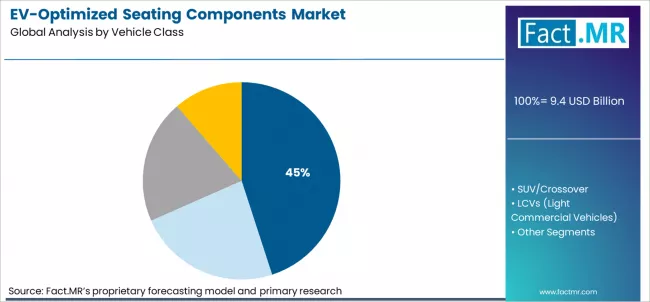
Ev Optimized Seating Components Market Analysis By Vehicle Class | Source: Fact.MR
Based on FACT.MR's EV-optimized seating components market report, Passenger Cars are estimated to hold 45% share in 2025. Passenger car platforms account for the majority of global EV production volume and are the primary deployment arena for advanced EV seating configurations, as consumer-facing cabin experience differentiation is most commercially potent in the passenger vehicle segment where purchase decisions involve direct driver and passenger interaction with seat functionality, ergonomics, and aesthetics. EV passenger car platforms particularly those in the USD 35,000-75,000 price band simultaneously demand cost discipline and functional content that creates volume-weighted purchasing power for EV seating system suppliers securing multi-year platform supply agreements.
- Lear Corporation Award: Lear Corporation announced in August 2024 a long-term seating system supply award covering complete seat assemblies for a major European OEM's next-generation battery electric passenger car platform, with program lifetime revenues estimated at USD 800 million and production launch targeted for model year 2027, confirming passenger car as the anchor segment for Lear's EV seating growth strategy [8].
- Faurecia (Forvia) Lightweight Seat: Faurecia (Forvia) unveiled its SHape Adaptative Seat system at the September 2024 IAA Munich exhibition, featuring a 15% weight reduction versus previous generation through aluminum backframe substitution and open-cell foam architecture, targeting passenger car EV programs in the C and D segments across European and Chinese OEMs beginning 2026 [9].
- SUV/Crossover Segment Acceleration: Industry production data from ACEA and China PCA for Q3 2024 confirm that SUV and crossover body styles account for 51% of global BEV registrations, with body-style-specific seat fold-flat, sliding, and reclining mechanism requirements creating differentiated component complexity and per-vehicle content uplift versus standard passenger car seat specifications for high-volume programs such as the Tesla Model Y, Volkswagen ID.4, and BYD Atto 3 [10].
EV-Optimized Seating Components Market Drivers, Restraints, And Opportunities
FACT.MR analysts observe that the EV-optimized seating components market exists at a structural inflection point: the global EV production base has crossed the volume threshold approximately 15-20 million units annually at which EV-specific seat architecture programs deliver positive returns on the dedicated tooling and engineering investment required to depart from ICE platform carryover strategies. At USD 9.0 billion in 2025, the market reflects a concentrated composition skewed toward established Tier-1 seating integrators supplying premium and mainstream EV programs, with structural frame and foam categories dominating by value while sensor and electronics content grows fastest from a lower base.
The central tension is between OEM cost reduction mandates applied uniformly across vehicle programs and the genuine technological upgrade cycle embedded in EV seat architecture transitions. As EV platforms mature through second and third-generation designs at Tesla, Volkswagen ID, Hyundai IONIQ, and BYD Han-class programs, per-seat content values are simultaneously rising from added sensor, heating, ventilation, and adjustment functions and being subjected to resourcing competition as a broader Tier-1 supplier base qualifies for EV seating programs previously dominated by incumbents. The net effect is per-seat average selling price growth of 2-4% annually in premium segments, offset by 1-2% annual price compression in volume EV segments, producing a blended market growth rate anchored by unit volume expansion rather than pricing power alone.
- EU Vehicle CO2 Regulation Tightening: The European Union's 2025 fleet average CO2 target of 93.6 g/km, declining to 0 g/km for new passenger cars by 2035 under Regulation (EU) 2019/631, compels European OEMs to accelerate BEV program launches, directly expanding the addressable EV seating components market across Volkswagen Group, Stellantis, Renault Group, and BMW Group platform programs [2].
- China NEV Dual Credit Mandate: China's New Energy Vehicle dual-credit policy administered by MIIT requires automakers selling over 30,000 units annually to accumulate NEV credits proportional to their EV production, sustaining structural incentive for domestic EV volume growth and generating captive demand for locally sourced EV seating components from BYD, SAIC, Geely, and Chery supplier networks [3].
- Lightweighting Content Premium Dynamics: Every 10 kg of mass reduction in a seat assembly extends BEV range by approximately 0.3-0.5 km under WLTP test conditions, creating quantifiable ROI for aluminum and composite frame substitution that OEM engineering teams can present against added material cost. This engineering-economic linkage structurally differentiates EV seating procurement from ICE cost-minimization sourcing, sustaining premium content spend [4].
Regional Analysis
The EV-optimized seating components market is analyzed across North America, Latin America, Europe, Asia-Pacific, spanning 40+ countries aligned with global automotive OEM production footprints and EV platform launch schedules. The report offers detailed market attractiveness analysis comparing regulatory electrification mandates, per-seat content value trajectories, and supplier network qualification depth across regional EV seating markets.
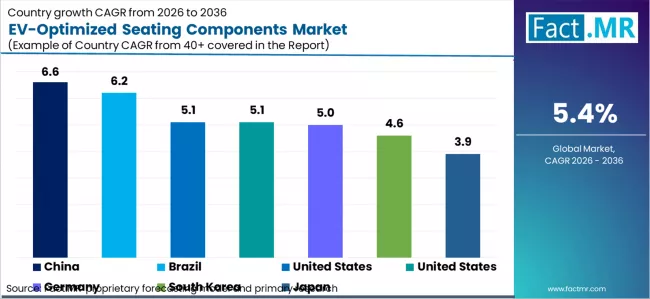
Ev Optimized Seating Components Market Cagr Analysis By Country | Source: Fact.MR
| Country | CAGR% |
|---|---|
| China | 6.6% |
| Brazil | 6.2% |
| United States | 5.1% |
| United Kingdom | 5.1% |
| South Korea | 4.6% |
| Germany | 5.0% |
| Japan | 3.9% |
Source: Fact.MR analysis. Updated Feb 19, 2026
Source: Fact.MR (FACT.MR) analysis, based on proprietary forecasting model and primary research
North America EV-Optimized Seating Components Market Analysis
North America is emerging as a key innovation hub for EV seating premiumization, supported by IRA-driven domestic EV manufacturing expansion across major automotive corridors. Tier-1 suppliers such as Lear, Adient, and Gentherm are strengthening vertically integrated capabilities to meet domestic content rules and accelerated OEM electrification programs. Competitive advantage depends on early qualification for dedicated EV platforms and integration of thermal comfort and lightweight seat architectures aligned with new-generation battery skateboard designs.
- United States: Demand for EV-optimized seating components in the United States is projected to rise at 5.1% CAGR through 2036. Growth is supported by IRA manufacturing credits and major EV investments such as General Motors’ Ultium platform rollout across Tennessee and Michigan facilities, generating long-term seating sourcing programs exceeding USD 1.2 billion through 2030 [11].
FACT.MR's analysis of EV-optimized seating components market in North America consists of country-wise assessment including the United States covering IRA domestic content impacts on Tier-1 seating sourcing strategies, thermal comfort electronics content by vehicle segment, and OEM platform program award timelines.
Europe EV-Optimized Seating Components Market Analysis
Europe operates as a regulation-driven premium EV seating market, where zero-emission mandates and luxury OEM electrification strategies support high per-seat value growth. Suppliers including Forvia, Adient, and Grupo Antolin compete on sustainability credentials and advanced comfort integration. EV-native seat platforms increasingly incorporate lightweight frames, recycled materials, and enhanced heating and ventilation features, differentiating content from legacy ICE programs.
- Germany: Demand for EV-optimized seating components in Germany is projected to rise at 5.0% CAGR through 2036. Expansion is driven by Volkswagen’s MEB and SSP platforms and BMW’s Neue Klasse launch from 2025, which specifies integrated lumbar heating and ventilation systems generating EUR 80-120 per-seat content uplift [12].
- United Kingdom: Demand in the United Kingdom is projected to rise at 5.1% CAGR through 2036. Growth is supported by the Zero Emission Vehicle mandate and Jaguar Land Rover’s all-electric transition beginning 2025, sustaining premium EV seat procurement [13].
FACT.MR's analysis of EV-optimized seating components market in Europe includes Germany, United Kingdom, France, Netherlands, Italy, and Nordic markets, detailing OEM electrification platform timelines, per-seat content value trajectories by vehicle class, and bio-material qualification requirements under OEM supplier sustainability codes.
Asia-Pacific EV-Optimized Seating Components Market Analysis
Asia-Pacific represents the global EV volume production center, led by China’s large-scale NEV ecosystem and supported by Japan and South Korea’s structured OEM supplier networks. Regional competition emphasizes cost efficiency, localized sourcing of foam and trim materials, and integration of advanced features such as zero-gravity recline and massage functions.
- China: Demand for EV-optimized seating components in China is projected to rise at 6.6% CAGR through 2036. Growth is driven by NEV production volumes exceeding 8 million units annually and lightweight seat mass targets under NEV Technology Roadmap 2.0 requiring composite frame adoption.
- Japan: Demand in Japan is projected to rise at 3.9% CAGR through 2036. Growth aligns with Toyota’s 3.5 million annual BEV target by 2030 and supplier tooling support under GX policy frameworks.
- South Korea: Demand in South Korea is projected to rise at 4.6% CAGR through 2036. Expansion is supported by Hyundai’s E-GMP platform underpinning IONIQ and EV6 programs exceeding USD 500 million in seating value.
FACT.MR's analysis of EV-optimized seating components market in Asia-Pacific includes China, Japan, South Korea, India, and Southeast Asian economies, covering NEV production volume forecasts, per-seat content value by OEM program tier, and localized material supply chain qualification timelines.
Latin America EV-Optimized Seating Components Market Analysis
Latin America is an emerging EV assembly base where policy-led industrial programs are creating new seating demand. Brazil anchors development through automotive transformation incentives encouraging electrified vehicle production and localization of EV component supply chains.
- Brazil: Demand for EV-optimized seating components in Brazil is projected to rise at 6.2% CAGR through 2036. Growth is supported by the Mover program allocating BRL 19.3 billion through 2028 and BYD’s BRL 3 billion Camaçari plant investment beginning production from 2025, generating localized EV seating procurement demand.
FACT.MR's analysis of EV-optimized seating components market in Latin America centers on Brazil, detailing Mover program investment impacts on EV assembly capacity, local Tier-1 seating supplier development timelines, and per-seat content evolution as OEM programs mature.
Competitive Aligners for Market Players
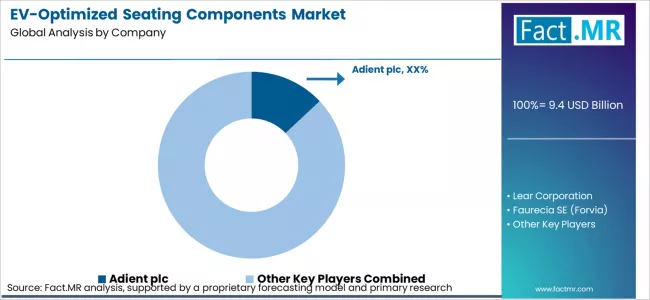
Ev Optimized Seating Components Market Analysis By Company | Source: Fact.MR
The EV-optimized seating components market is moderately concentrated at the integrated seating system level, with Adient, Lear, and Faurecia (Forvia) collectively accounting for maximum share of global seat system assembly revenues, while the components market spanning discrete frames, foam systems, electronic modules, and trim is more fragmented, with sub-component specialists including Gentherm in thermal comfort electronics, NHK Spring in frame assemblies, and Grupo Antolin in headliners and trim competing alongside vertically integrated Tier-1 systems integrators. Feedstock access to automotive-grade aluminum extrusions and bio-based foam raw materials is emerging as a differentiated competitive variable as OEM sustainability specifications tighten and material qualification lead times extend program sourcing timelines.
Vertically integrated Tier-1 suppliers benefit from consolidated platform sourcing awards that encompass frames, foam, trim, and electronics in single-supplier packages, reducing OEM engineering coordination burden and generating per-vehicle revenue streams that justify dedicated EV platform tooling investment. Toyota Boshoku and TS Tech operate within Toyota Group captive supply relationships that provide volume assurance and engineering collaboration access unavailable to independent Tier-1 competitors, enabling earlier-stage EV architecture integration at lower program risk. Lear's E-Systems division provides a cross-selling bridge between seating and electrical architecture businesses, allowing Lear to offer OEMs integrated seat heating element and wiring harness packages that competitors must subcontract to electrical Tier-2 suppliers.
Buyer behavior in EV seating components reflects the dual pressure of OEM platform cost-down programs and interior experience premium expectations. Volkswagen Group's procurement strategy applies FAST (Future Automotive Supply Tracks) competitive resourcing processes to seating awards that benchmark incumbent Tier-1 pricing against qualified alternative suppliers on three-year cycles, maintaining 10-15% pricing pressure even within long-term framework agreements. Tesla's direct-development sourcing model where interior component specifications are co-engineered with seat suppliers under NDA collaboration agreements rather than competitive RFQ processes represents an alternative buyer behavior pattern that prioritizes speed-to-production and proprietary configuration control over unit price minimization.
Key Players
- Adient plc
- Lear Corporation
- Faurecia SE (Forvia)
- Toyota Boshoku Corporation
- Magna International Inc.
- TS Tech Co., Ltd.
- Tachi-S Co., Ltd.
- NHK Spring Co., Ltd.
- Gentherm Incorporated
- Grupo Antolin Irausa, S.A.
Bibliography
- [1] Adient plc. (2024, August). Q2 FY2024 Earnings Conference Call Transcript.
- [2] European Parliament and Council. (2019, April). Regulation (EU) 2019/631 on CO2 emission performance standards for new passenger cars. Official Journal of the European Union.
- [3] Ministry of Industry and Information Technology, People's Republic of China. (2023, July). New Energy Vehicle Dual-Credit Policy 2023 Revision Implementation Notice.
- [4] International Energy Agency. (2024, June). Global EV Outlook 2024: Lightweighting and Efficiency in Battery Electric Vehicles. IEA Technology Report.
- [5] Adient plc. (2024, September). European Structural Seat Frame Manufacturing Investment Announcement. Press Release.
- [6] Magna International Inc. (2024, November). Q3 2024 Investor Presentation-Seating Division Multi-Material Frame Program Disclosure.
- [7] Toyota Boshoku Corporation. (2024, June). Sustainability Report 2024-Bio-attributed Materials in EV Seating Foam Programs.
- [8] Lear Corporation. (2024, August). Long-term EV Platform Seating System Award Announcement. Press Release.
- [9] Faurecia (Forvia). (2024, September). SHape Adaptative Seat Press Release-IAA Munich 2024.
- [10] European Automobile Manufacturers' Association (ACEA) and China Passenger Car Association (CPCA). (2024, October). Global BEV Registration Statistics Q3 2024-Body Style Analysis.
- [11] Ford Motor Company. (2024, March). BlueOval City Tennessee Complex Production Timeline and EV Sourcing Commitments. Press Release. Retrieved from https://media.ford.com/
- [12] BMW Group. (2024, May). Neue Klasse Platform Interior Specification and Seating Thermal Comfort System Requirements. Investor Presentation.
- [13] Jaguar Land Rover Automotive plc. (2024, January). Reimagine Strategy Update: All-Electric Jaguar Brand and Range Rover EV Program Timelines. Press Release.
This Report Addresses
- Market intelligence for strategic planning: comprehensive analysis of EV seating component engineering content economics, OEM platform sourcing program timelines, and lightweighting-driven material substitution trajectories across passenger car, SUV, commercial vehicle, and bus EV segments.
- Market size and forecast: global EV-optimized seating components market valued at USD 9.4 billion in 2026, projected to reach USD 16.0 billion by 2036 at 5.4% CAGR, with segment-level sizing by component type, vehicle class, material, and buyer type.
- Growth opportunity mapping: identification of high-value subsegments including sensors and electronics for biometric and thermal comfort integration, aluminum and composite frames for lightweighting premium capture, and aftermarket upgrade channels addressing the growing installed EV vehicle base.
- Segment and regional forecasts: country-level CAGR analysis for China, Brazil, United States, Germany, United Kingdom, South Korea, and Japan, with component type and vehicle class breakdowns revealing OEM program-driven versus aftermarket-driven adoption patterns.
- Competition strategy assessment: competitive positioning analysis of Adient, Lear, Faurecia (Forvia), Toyota Boshoku, and Magna seating divisions, including vertical integration advantages, EV platform qualification strategies, and sustainability material compliance capabilities.
- Regulatory impact analysis: assessment of EU CO2 fleet regulation zero-emission mandates, China NEV dual-credit policy, IRA domestic content requirements, and national ZEV mandates determining EV production volume trajectories that govern seating component demand.
- Material supply chain analysis: assessment of automotive-grade aluminum extrusion availability, bio-based polyol certification pipelines, composite prepreg manufacturing capacity constraints, and their implications for per-seat content value and Tier-1 supplier margin structure.
- Report delivery formats: Excel data tables with segment-level forecasts and per-vehicle content value benchmarks, PowerPoint executive summary with OEM platform program mapping, and PDF comprehensive report with verifiable source citations.
Segmentation
Scope of the Report
| Items | Values |
|---|---|
| Quantitative Units | USD 9.4 billion (2026) to USD 16.0 billion (2036), at a CAGR of 5.4% |
| Market Definition | EV-optimized seating components are engineered assemblies frames, foam/cushioning, sensors, electronics, trim, and upholstery designed specifically for battery electric and hybrid vehicle platforms, balancing structural efficiency, lightweight mass reduction, occupant comfort, and integrated charging or thermal management functions. |
| Component Type | Frames/Structures, Foam/Cushion, Sensors/Electronics, Trim/Upholstery |
| Vehicle Class | Passenger Cars, SUV/Crossover, LCVs, Buses |
| Material | Steel, Aluminum, Composite, Bio-Foam |
| Buyer Type | OEM/Tier-1, Aftermarket |
| Regions Covered | Asia Pacific, Europe, North America, Latin America, Middle East & Africa |
| Countries Covered | India, China, Japan, South Korea, Indonesia, Australia & New Zealand, ASEAN, Rest of Asia Pacific, Germany, Italy, France, United Kingdom, Spain, Benelux, Nordics, Central & Eastern Europe, Rest of Europe, United States, Canada, Mexico, Brazil, Argentina, Chile, Rest of Latin America, Kingdom of Saudi Arabia, United Arab Emirates, South Africa, Turkey, Rest of Middle East & Africa |
| Key Companies Profiled | Adient, Lear, Faurecia (Forvia), Toyota Boshoku, Magna, TS Tech, Tachi-S, NHK Spring, Gentherm, Grupo Antolin |
| Forecast Period | 2026 to 2036 |
| Approach | Top-down and bottom-up market modeling validated through primary interviews with OEM sourcing directors, Tier-1 seating system engineers, EV platform program managers, aftermarket seating distributors, and lightweight material suppliers, supported by EV production forecasts, OEM supplier filings, lightweighting program announcements, and government EV incentive policy data. |
Source: Fact.MR analysis. Updated Feb 19, 2026
EV-Optimized Seating Components Market by Segments
-
By Component Type
- Frames/Structures
- Foam/Cushion
- Sensors/Electronics
- Trim/Upholstery
-
By Vehicle Class
- Passenger Cars
- SUV/Crossover
- LCVs (Light Commercial Vehicles)
- Buses
-
By Material
- Steel
- Aluminum
- Composite
- Bio-Foam
-
By Buyer Type
- OEM/Tier-1
- Aftermarket
-
Region
- Asia Pacific
- India
- China
- Japan
- South Korea
- Indonesia
- Australia & New Zealand
- ASEAN
- Rest of Asia Pacific
- Europe
- Germany
- Italy
- France
- United Kingdom
- Spain
- Benelux
- Nordics
- Central & Eastern Europe
- Rest of Europe
- North America
- United States
- Canada
- Mexico
- Latin America
- Brazil
- Argentina
- Chile
- Rest of Latin America
- Middle East & Africa
- Kingdom of Saudi Arabia
- United Arab Emirates
- South Africa
- Turkey
- Rest of Middle East & Africa
- Asia Pacific
Frequently Asked Questions
How large is the EV-optimized seating components market in 2025?
What will the market size be in 2026?
What will the market size be by 2036?
What is the expected CAGR for the forecast period 2026 to 2036?
Which component type segment is poised to lead in 2025?
How significant is the Foam/Cushion segment in the EV seating market?
Which vehicle class segment dominates demand for EV-optimized seating components?
How significant is the SUV/Crossover segment in the EV seating components market?
What is the market share of OEM/Tier-1 buyer type in 2025?
How significant is the Aftermarket segment?
Which country is growing fastest in the EV-optimized seating components market?
What is the projected CAGR for Brazil in the EV seating components market?
What is the projected CAGR for Europe in the EV-optimized seating components market?
What is the absolute dollar growth of the market from 2026 to 2036?
Which material segment leads in the EV-optimized seating components market?
Who worked on this report


Preview the report firsthand - request a free sample
Free SampleGet the brochure for pricing and purchase details
Download PDF